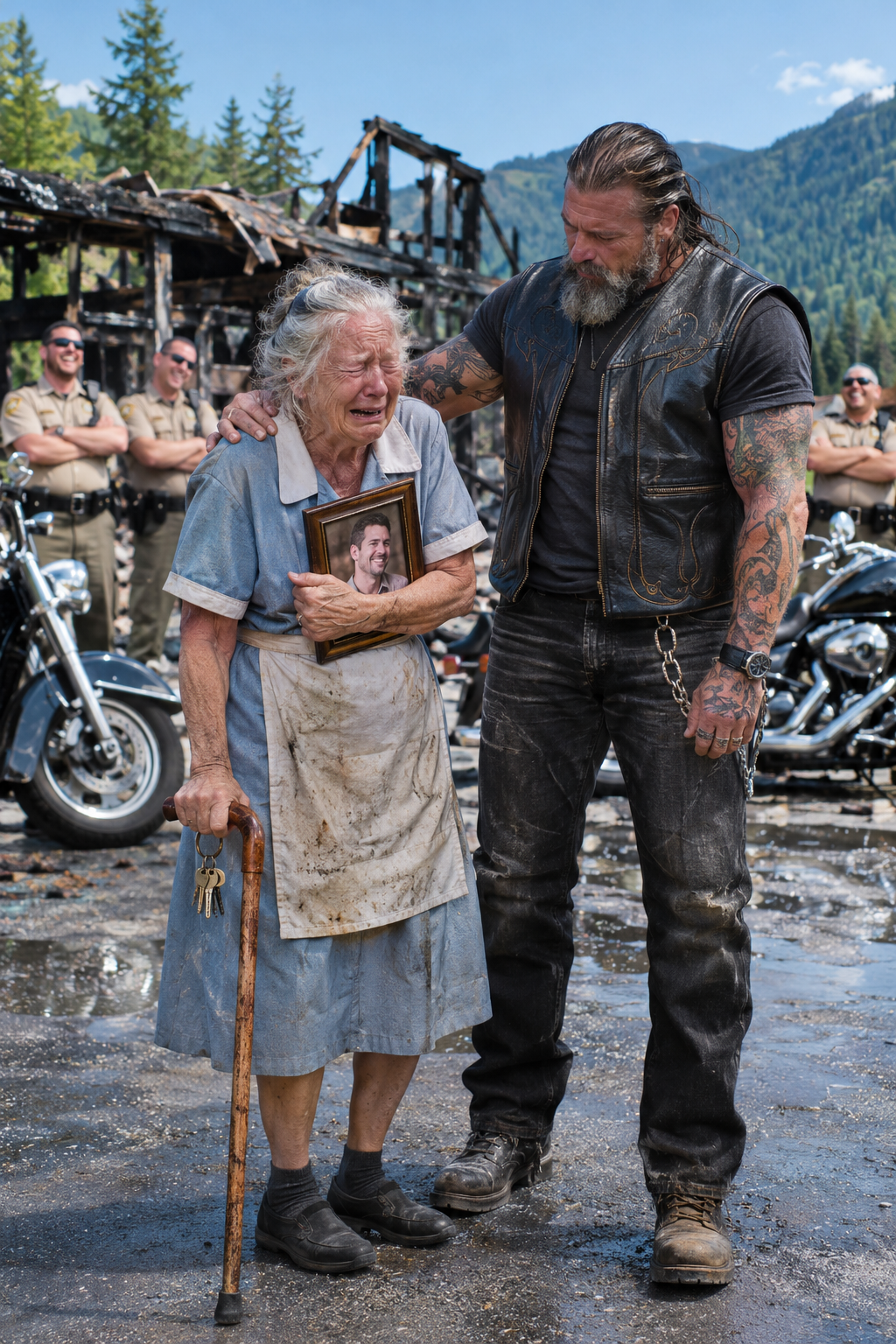
The sheriff stood beside Martha’s burned-down diner and told her there was nothing he could do.
“Your father doesn’t want this property for another café, does he?” Dutch asked.
Travis lowered his hand.
“What are you talking about?”
Dutch reached into his jacket and pulled out a folded piece of paper.
“Interesting thing about public records. Anybody can look at them.”
He unfolded the document.
“There’s a development company planning to build a distribution center outside Oak Haven. They’ve already secured almost every piece of land they need. Except for one.”
Dutch pointed toward the burned diner.
“This one.”
Travis glanced at the document, then at the bikers surrounding him.
“You don’t know anything.”
“I know your father stands to make several million dollars if that deal goes through. And I know Martha refused to sell.”
Travis tried to laugh, but the sound came out strangely weak.
“Good luck proving anything.”
Dutch folded the paper and slipped it back into his jacket.
“We’re working on that.”
Travis climbed into his truck and drove away so quickly that his tires threw gravel across the road.
Martha had watched the entire exchange from her front porch.
When Dutch returned, she looked at him with confusion.
“How did you find out about the development?”
Dutch smiled.
“Some of us have jobs besides riding motorcycles, Martha.”
One of the bikers, a gray-haired man named Reaper, had worked as a property attorney for nearly thirty years. Another, called Bishop, was a retired fire investigator.
They had spent the previous evening examining public documents and arranging for an independent inspection of the diner.
But what Bishop discovered that afternoon was far more troubling than anyone expected.
He approached Martha carrying a notebook.
“The fire appears to have started near the rear entrance. There are signs suggesting it wasn’t accidental. We’ll need laboratory results to establish exactly what happened.”
Martha closed her eyes.
She had known it in her heart, but hearing someone confirm her suspicions made the loss feel fresh again.
“Can you prove who did it?” she asked.
“Not yet.”
Bishop hesitated before continuing.
“But there’s something else. Your security camera is missing.”
Martha looked toward the wreckage.
“Henry installed that camera years ago. It was right above the back door.”
“The mounting bracket is still there,” Bishop explained. “Someone appears to have removed the camera.”
Martha suddenly remembered something.
“The recordings! Henry had them backed up somewhere. He used to complain about paying for the service every month.”
Dutch immediately asked if she still had access to the account.
Unfortunately, Henry had handled all the passwords, and Martha couldn’t remember where he had written them down.
For the next several hours, she searched through drawers, old bills, and boxes of paperwork.
Meanwhile, something unexpected was happening throughout Oak Haven.
The bikers were buying groceries from independent stores, eating at restaurants that didn’t belong to Arthur Cobb, and paying local mechanics to inspect their motorcycles.
Businesses that had struggled for months were suddenly earning more money than they had all year.
People began realizing that the strangers they had initially feared were treating them better than the man who had controlled their town for decades.
A young waitress named Emily was the first person to approach Martha.
She arrived shortly before sunset, looking nervously over her shoulder.
“Mrs. Wilson, can we talk somewhere private?”
Martha invited her inside.
Emily sat at the kitchen table, twisting her fingers together.
“I saw Travis the night of the fire.”
Martha stopped pouring coffee.
“Where?”
“Behind your diner. I was driving home from work. His truck was parked near the alley.”
“Did you tell the sheriff?”
Emily nodded.
“He told me I must have been mistaken. The next morning, Mr. Cobb came into the café where I work.”
Her voice cracked.
“He said my mother could lose her house if I started spreading rumors.”
Emily’s mother had a mortgage through Cobb’s bank.
Martha reached across the table and took her hand.
“You don’t have to risk your family for me.”
“But that’s what everyone keeps saying,” Emily whispered. “And nothing ever changes.”
Dutch, who had been standing near the doorway, quietly stepped forward.
“Would you be willing to tell your story to someone outside this town?”
Emily looked at Martha.
Then she nodded.
That evening, Reaper contacted the state authorities and submitted a formal complaint containing Emily’s statement, the property records, and Bishop’s preliminary findings.
For the first time, Arthur Cobb was facing something he couldn’t simply make disappear with a telephone call.
And he knew it.
At nine that night, Martha received a visitor.
Arthur himself stood outside her house, dressed in an expensive suit.
Two bikers were sitting on the porch, drinking coffee.
Arthur glanced at them with disgust.
“I’d like to speak with Martha alone.”
Martha appeared in the doorway.
“Anything you have to say, you can say here.”
Arthur pulled an envelope from his coat.
“There’s a check inside for three hundred thousand dollars. Consider it compensation for your unfortunate loss.”
Martha stared at him.
“Unfortunate loss?”
“I’m trying to help you.”
“Your son threatened me three days before my diner burned down.”
Arthur’s expression hardened.
“Be careful about making accusations you cannot support.”
Martha looked at the envelope.
Three hundred thousand dollars would have changed her life. She could have bought a comfortable house, paid her bills, and lived without worrying about money again.
But then she remembered Henry standing behind the counter, wearing his ridiculous Christmas apron and making pancakes for children whose parents couldn’t afford breakfast.
She remembered the lonely truck drivers who came in on holidays because they had nowhere else to go.
She remembered every person who had walked through those doors and been treated like family.
“Keep your money, Arthur.”
His smile disappeared.
“You’re making a terrible mistake.”
“No,” Martha replied. “I made that mistake years ago when I believed people like you were respectable.”
Arthur left without another word.
The following morning, Martha discovered that her bank account had been temporarily restricted over a supposed documentation issue.
She couldn’t withdraw money or pay her bills.
When Dutch heard about it, he didn’t shout or threaten anyone.
Instead, Reaper helped Martha document what had happened and file complaints with the appropriate banking regulators.
Then the bikers organized a community breakfast in an empty lot belonging to a local farmer.
They brought portable cooking equipment, tables, chairs, and enough food to feed hundreds of people.
A handwritten sign stood near the entrance.
MARTHA’S DINER — STILL OPEN IN SPIRIT.
Martha arrived expecting a small gathering.
Instead, she found nearly the entire lot filled with townspeople.
Some had brought eggs. Others brought bread, homemade pies, and vegetables from their gardens.
A carpenter offered to help rebuild the diner. An electrician volunteered his labor. A retired teacher placed fifty dollars inside a donation jar.
Martha stood there speechless.
For years, she had believed her kindness had gone unnoticed.
Now, everywhere she looked, someone was returning it.
But across town, Travis was growing increasingly desperate.
His father had discovered that state investigators were coming to Oak Haven.
The development company had also suspended negotiations after learning about the fire and the disputed property.
Arthur summoned his son to his office.
“You told me nobody saw you.”
Travis froze.
“Keep your voice down.”
“Do you have any idea what you’ve done? Everything I’ve worked for could disappear because of you!”
“You told me to get her off that property!”
“I told you to persuade her!”
Travis laughed bitterly.
“Is that what we’re calling it now?”
Neither man noticed the office door was slightly open.
Arthur’s longtime secretary, Helen, stood outside holding a stack of documents.
She had worked for him for twenty-seven years.
She had watched him pressure struggling families, manipulate business owners, and use his influence to escape consequences.
She had always told herself that keeping her job was more important than getting involved.
But Martha had once fed Helen’s children for an entire summer after her husband abandoned them.
Martha had never asked for repayment.
Helen quietly returned to her desk.
That afternoon, she contacted Reaper.
“I think I have something the investigators need to see.”
She explained that Arthur had instructed her to prepare a property acquisition agreement for Martha’s land before Martha had ever agreed to sell.
There were also emails discussing the urgency of removing the diner from the development site.
One message from Arthur to Travis was particularly disturbing.
Handle the Wilson problem before Friday. I don’t care what it takes.
The diner had burned on Thursday night.
The messages alone couldn’t establish exactly what Arthur had intended, but they gave investigators another important reason to examine his involvement.
Helen agreed to cooperate and identify the relevant business records.
By then, Sheriff Miller was beginning to understand that his own position was in danger.
State investigators arrived the following morning and requested his original reports concerning the fire.
They also wanted to know why Emily’s witness statement had never been formally recorded.
Miller claimed it had been an oversight.
Nobody believed him.
Meanwhile, Martha finally found something hidden inside Henry’s old toolbox.
It was a small notebook containing measurements, repair instructions, and passwords.
On the last page, beneath a reminder to replace the kitchen faucet, Henry had written the login information for the security system.
Martha called Dutch immediately.
With help from the security company’s support team, they recovered several recordings from the night of the fire.
Most showed nothing unusual.
Then one video appeared.
Martha leaned closer to the computer.
A familiar pickup truck entered the camera’s view.
A man stepped out.
Even in the poor lighting, Martha recognized Travis Cobb.
The footage showed him approaching the diner shortly before the recording abruptly ended.
Martha covered her mouth.
There was no clear footage of the fire being started, but the recording placed Travis exactly where Emily had claimed to see him.
And it contradicted his earlier statement that he had been home all evening.
Dutch immediately arranged for the original files to be turned over to investigators.
“Henry,” Martha whispered, touching the little notebook.
Even after his death, her husband had somehow helped her one last time.
By late afternoon, investigators had obtained a warrant to search Travis’s property.
Additional evidence was recovered, and several witnesses were interviewed.
Travis realized the walls were closing in.
But instead of accepting responsibility, he decided to blame the person he believed had destroyed his life.
Martha.
That evening, while most of the bikers were attending a community meeting, Travis appeared outside her house.
Martha was sitting on the porch, holding Henry’s photograph.
She smelled alcohol before Travis even spoke.
“Are you happy now?”
Martha slowly stood.
“You should go home, Travis.”
“My father says the deal is dead. The investigators are tearing everything apart.”
“That’s not my doing.”
“You could’ve taken the money!”
Martha looked at him sadly.
“You could’ve left my diner alone.”
Travis stepped closer.
“It was just a stupid building!”
For the first time since the fire, Martha raised her voice.
“That building was thirty-eight years of my life!”
Travis stopped.
“Every morning, my husband woke up at four to make bread. Every winter, we fed people who couldn’t afford a hot meal. When your mother died, who brought food to your house for two weeks?”
Travis looked away.
“Who gave you your first summer job when your father said you needed to learn responsibility?”
His jaw tightened.
“That doesn’t matter anymore.”
“It mattered to me.”
For a moment, Travis seemed like the frightened little boy Martha remembered.
Then anger returned to his face.
He knocked the photograph from her hands.
The glass shattered against the porch.
Martha gasped.
Before Travis could move any closer, Dutch’s voice came from the driveway.
“That’s enough.”
Several bikers had returned from the meeting.
Dutch walked toward the porch, stopping between Martha and Travis.
Travis looked around desperately.
“Go ahead! Hit me! That’s what you people do, isn’t it?”
Dutch remained still.
“No. You’re going to leave her alone, and you’re going to answer for what you’ve done.”
Travis began shouting insults, hoping someone would lose control.
Nobody did.
One of the bikers called the authorities.
Another helped Martha gather the pieces of the broken photograph.
When state officers arrived, Travis was taken into custody without anyone laying a hand on him.
As the police car disappeared down the road, Martha sat on the porch steps.
Dutch handed her Henry’s photograph.
The frame was broken, but the picture had survived.
“I wanted him to suffer,” Martha admitted quietly.
Dutch sat beside her.
“That’s understandable.”
“Does that make me a terrible person?”
“No. It makes you someone who’s been hurt. What matters is what you choose to do with that hurt.”
Martha looked at the photograph for a long time.
The investigation continued for several weeks.
More residents came forward with stories about Arthur Cobb.
A former employee described being pressured to alter business records. Several property owners reported threats connected to land purchases. Others provided evidence of questionable financial practices.
The town that had remained silent for decades was finally speaking.
Sheriff Miller was placed on administrative leave while his conduct was investigated.
Arthur Cobb was eventually charged in connection with the intimidation of witnesses and other offenses uncovered during the investigation.
Travis faced charges related to the destruction of Martha’s diner.
Months later, he pleaded guilty to arson.
During the court proceedings, he admitted that he had believed frightening Martha into selling would earn his father’s approval.
He had never considered what the diner meant to her or how easily the fire could have endangered other lives.
Arthur’s legal troubles continued, and the development agreement collapsed entirely.
His influence over Oak Haven weakened as customers moved their business elsewhere and regulators examined his companies.
For the first time in years, people could disagree with a Cobb without fearing that their entire future would disappear.
But Martha wasn’t interested in celebrating their downfall.
She had something more important to do.
Rebuild.
The bikers had raised a substantial amount of money through donations, community events, and contributions from riders across the country.
Local businesses supplied materials at reduced prices.
Insurance payments and the community’s support helped cover the remaining construction costs.
Every Saturday, volunteers gathered at the old diner site.
Dutch carried lumber alongside carpenters. Bishop helped coordinate fire safety improvements. Reaper assisted Martha with the legal paperwork.
Even Emily showed up after her shifts, painting walls until her arms ached.
One afternoon, Martha discovered a man standing quietly near the construction fence.
It was Sheriff Miller.
He wasn’t wearing his uniform.
“I resigned,” he told her.
Martha set down her paintbrush.
Miller looked older than she remembered.
“I convinced myself I was protecting the town by keeping Arthur happy. He helped fund community projects. He knew everybody. I thought challenging him would create more problems than it solved.”
“And what about my problems?” Martha asked.
Miller lowered his head.
“I abandoned you.”
Martha said nothing.
“I don’t expect forgiveness. I just wanted to tell you that I’m cooperating with the investigators.”
He reached into his pocket and handed her an envelope containing a donation.
Martha accepted it.
“You can’t change what happened, Robert.”
“I know.”
“But you can decide what kind of man you’re going to be tomorrow.”
Miller wiped his eyes and walked away.
Seven months after the fire, Martha’s diner stood again.
It was larger than before, with bright windows, comfortable booths, and a beautiful wooden counter built by volunteers.
Above the entrance hung a new sign.
HENRY AND MARTHA’S DINER.
On opening morning, the familiar roar of motorcycles echoed through Oak Haven.
Hundreds of riders returned.
This time, nobody called the sheriff.
Children waved from sidewalks. Shopkeepers stood outside smiling. Residents carried homemade banners welcoming the bikers back.
Dutch entered the diner and found Martha standing behind the counter.
She was wearing Henry’s old apron, which had been at home on the night of the fire.
“Coffee?” she asked.
Dutch grinned.
“Only if you’re charging me this time.”
Martha laughed.
“Not a chance.”
Near the entrance stood a special table with a small wooden plaque.
It read: If you’re hungry and cannot afford a meal, sit here. You are welcome.
The table had been Dutch’s idea.
Customers could contribute toward meals for strangers, and Martha promised that nobody sitting there would ever be asked to explain their circumstances.
As the morning continued, the diner filled with laughter.
Then a woman entered carrying a little boy.
Martha recognized her immediately.
She was Travis Cobb’s wife.
The room grew uncomfortable.
Several people stopped talking.
The woman looked exhausted.
“I shouldn’t have come,” she whispered.
Martha stepped around the counter.
“Are you hungry?”
The woman nodded reluctantly.
Since Travis’s arrest, she had struggled to support herself and her son. Arthur had stopped helping her, and many townspeople refused to speak to her because of her family’s name.
Martha looked down at the little boy.
He couldn’t have been more than six.
“Do you like pancakes?”
He nodded.
“With chocolate chips?”
His eyes brightened.
Martha led them to a booth and brought them breakfast.
Dutch watched silently.
Later, he approached her.
“After everything that family did to you, you can still feed them?”
Martha glanced toward the little boy, who was happily covering his pancakes with syrup.
“That child didn’t burn my diner.”
Dutch nodded slowly.
Martha continued.
“I spent months fighting because I wanted justice. But if I start punishing innocent people for someone else’s mistakes, then Arthur Cobb has taken something from me that matters more than this building.”
Dutch understood.
The fire had destroyed Martha’s diner, but it hadn’t destroyed the woman who had made it special.
That evening, after the last customer left, Dutch and Martha stood outside beneath the glowing sign.
Martha handed him a small package.
Inside was a framed photograph taken ten years earlier.
It showed Henry and Martha standing beside a group of rain-soaked bikers during the desert storm.
Dutch smiled as he recognized his younger self.
“You kept this?”
“Henry always said it was one of his favorite pictures.”
Dutch studied the photograph.
“We were strangers. You didn’t know anything about us.”
“You were cold and hungry. That’s all we needed to know.”
Dutch’s eyes filled with tears.
Martha hugged him.
“Thank you for keeping your promise.”
Dutch held her tightly.
“Thank you for giving us a reason to make it.”
The following morning, the motorcycles departed Oak Haven.
Martha stood outside her diner until the final rider disappeared beyond the horizon.
Years passed, and the little town continued to change.
Emily eventually became the diner manager. The community established a fund to help families facing emergencies, and local residents became more willing to stand together when someone was treated unfairly.
Visitors often asked Martha about the hundreds of bikers who had come to save her business.
She always corrected them gently.
“They didn’t just save my diner. They reminded this town what happens when ordinary people stop being afraid to do what’s right.”
Above the counter, beside Henry’s photograph, Martha displayed a handwritten message that every customer could read.
Never underestimate a small act of kindness. You may forget the meal you shared, the door you opened, or the stranger you helped. But somewhere, someone may remember it for the rest of their life.
Martha had opened her doors during a storm without expecting anything in return.
Ten years later, when the greatest storm of her own life arrived, hundreds of people came to stand beside her.
And although Arthur Cobb had once believed money could buy everything, Martha had built something his fortune could never purchase.
Loyalty earned through kindness.
Courage strengthened by compassion.
And a community that finally understood that the most powerful people are not those who make others afraid, but those who make others feel safe.
But there was one final chapter in Martha’s story that nobody in Oak Haven could have predicted.
Nearly four years after the fire, a letter arrived at the diner.
There was no return address on the envelope, but Martha recognized the name written beneath the opening sentence.
Travis Cobb.
She carried the letter into her office and closed the door.
“Dear Martha,
I’ve started this letter more times than I can remember. Every time, I stopped because I knew there was nothing I could write that would undo what I did.
My father spent my entire childhood teaching me that losing was the worst thing a man could do. I believed him. I thought having money meant having power, and having power meant never having to apologize.
Prison has given me plenty of time to think about that.
My wife told me what you did for her and my son. She told me you fed them when nobody else would even look at them.
I don’t understand how you found it in your heart to do that.
I destroyed something you loved, and you protected something I loved.
I don’t expect you to forgive me. But I needed you to know that I’m sorry.
For the first time in my life, I actually understand what those words mean.”
Martha read the letter twice.
Then she placed it beside Henry’s photograph.
She didn’t respond immediately.
Forgiveness, she had learned, wasn’t something that could be demanded simply because someone finally regretted their actions.
But three days later, she sat down and wrote a reply.
“Travis,
Your son deserves a father he can be proud of. You cannot change the man you were, but you still have time to become that father.
Don’t waste it.
Martha.”
Several months later, Dutch returned to Oak Haven.
He arrived alone this time, riding the same motorcycle he had ridden during that terrible desert storm so many years earlier.
Martha noticed that he walked more slowly now.
His beard had turned almost completely white, and there was a tiredness in his eyes that hadn’t been there before.
“Getting old?” she teased.
Dutch lowered himself onto a stool.
“Apparently, nobody asked my permission.”
Martha poured him a cup of coffee.
But Dutch didn’t touch it.
Instead, he reached into his jacket and placed a hospital envelope on the counter.
“I’ve got cancer, Martha.”
Her smile disappeared.
“The doctors are doing what they can,” he continued. “But I wanted to come here while I still could.”
Martha reached across the counter and held his hand.
For a long moment, neither of them spoke.
Then Dutch looked around the diner.
“You know something? That night you and Henry took us in, I wasn’t planning on going home.”
Martha frowned.
“What do you mean?”
Dutch stared into his coffee.
“My daughter had stopped speaking to me. My marriage was over. I’d spent years pushing away everyone who cared about me. I was angry at the whole world.”
He paused.
“Then we got caught in that storm. I walked into your diner expecting you to throw us out. Instead, Henry handed me a towel, and you brought me a bowl of soup.”
Martha remembered the evening clearly.
“You sat beside me,” Dutch continued. “You asked whether I had somebody waiting for me at home. When I said no, you told me something I’ve never forgotten.”
“What did I say?”
“You said sometimes people are waiting for us to come home, even when they’ve stopped asking.”
Martha’s eyes filled with tears.
“I called my daughter the following morning,” Dutch said. “It took years to repair our relationship. But today, I have three grandchildren. They call me Grandpa Dutch.”
He smiled through his tears.
“I wouldn’t have any of that if I hadn’t walked through your door.”
Martha came around the counter and embraced him.
For the first time, she understood that the kindness she had offered that night had changed far more than she had ever imagined.
Dutch stayed in Oak Haven for a week before returning home for treatment.
Six months later, Martha received a telephone call from his daughter.
Dutch had passed away peacefully, surrounded by his family.
Martha closed the diner early that afternoon.
She sat at the table reserved for customers who couldn’t afford a meal and cried until the sun disappeared behind the mountains.
Two weeks later, nearly three hundred motorcycles returned to Oak Haven.
They came to honor the man who had once brought them together to help a grieving widow.
Dutch’s daughter arrived carrying a small wooden box.
“My father wanted you to have this.”
Inside was the photograph Martha had given Dutch on the diner’s reopening night.
On the back, he had written a message.
“Martha and Henry taught me that a man’s strength isn’t measured by how many people fear him, but by how many people can depend on him.”
Martha pressed the photograph against her chest.
The following year, she established the Dutch Memorial Fund, using a portion of the diner’s profits and voluntary donations to help struggling families throughout the county.
The fund helped people pay emergency medical bills, repair damaged homes, and purchase groceries during difficult times.
Nobody receiving assistance was required to belong to a particular organization, share a particular belief, or explain why they deserved kindness.
Years later, when Martha turned seventy-five, she finally decided to retire.
Emily purchased the diner through an affordable agreement Martha had arranged with her.
There was only one condition.
The table for hungry strangers had to remain.
On Martha’s final working day, an unfamiliar man entered the diner with a teenage boy.
The man removed his hat.
Martha immediately recognized him.
Travis Cobb.
His hair was shorter, his clothes were plain, and the arrogance that had once defined him was gone.
He had served his sentence and found work repairing agricultural equipment in another county.
The teenage boy beside him was his son.
Travis approached the counter nervously.
“I wanted him to meet you.”
Martha looked at the boy.
He smiled.
“You’re the pancake lady.”
Martha laughed.
“I suppose I am.”
Travis swallowed hard.
“I’ve told him everything. What I did. What happened afterward. I don’t want him growing up believing the things my father taught me.”
Martha studied his face.
“Are you taking care of your family?”
“Every day.”
“Are you working honestly?”
“Yes, ma’am.”
“Then keep doing that.”
Travis lowered his head.
“Can you ever forgive me?”
Martha remained silent for several seconds.
Then she answered.
“I forgave you a long time ago, Travis. That doesn’t mean what you did was acceptable. It means I decided not to spend the rest of my life carrying what you did.”
Travis covered his face with his hands.
His son placed an arm around his shoulder.
Martha brought them two plates of pancakes.
And when Travis reached for his wallet, she shook her head.
“These are on the house.”
Outside, the afternoon sun illuminated the little town that had once been too frightened to defend her.
Martha removed her apron for the last time and handed it to Emily.
“Take care of this place.”
Emily hugged her.
“I promise.”
Martha walked slowly toward the door, stopping beneath the photographs of Henry and Dutch.
Two men who had never imagined how deeply their lives would become connected.
She touched each frame gently.
“We did all right, didn’t we?”
A few years later, Martha passed away peacefully in her sleep.
On the morning of her funeral, businesses throughout Oak Haven closed their doors.
Hundreds of motorcycles arrived from across the country.
Former customers, neighbors, families, and strangers whose lives had been changed by her generosity gathered to say goodbye.
Among them stood Travis Cobb and his son.
Nobody asked them to leave.
After the funeral, Emily opened the diner and served free meals throughout the day.
It was exactly what Martha would have wanted.
And above the entrance, beneath the original sign, Emily placed a new wooden plaque.
“In memory of Martha Wilson, who never needed to know someone’s name before deciding they deserved kindness.”
The diner remained open for generations.
Travelers continued stopping there. Hungry strangers continued finding warm meals. And whenever a terrible storm swept across the desert, the lights remained on long after closing time.
Because somewhere out there, somebody might need shelter.
Somebody might need a second chance.
Somebody might need a simple reminder that the world had not forgotten them.
Martha never became wealthy or famous. She never held a position of power, and she never demanded recognition for the good she did.
Yet her kindness changed the lives of hundreds of people, who went on to change the lives of countless others.
Arthur Cobb had spent his life building an empire that eventually crumbled.
Martha had spent hers building something that continued growing even after she was gone.
And that was her greatest victory.
Because everything we own will eventually belong to someone else. The money we accumulate will be spent, the buildings we construct will grow old, and even our names may someday be forgotten.
But the kindness we leave in another person’s heart can travel farther than we will ever know.
Sometimes, all it takes to change the world is a warm meal, an open door, and the courage to care when everyone else chooses to look away.
Decades later, the little diner still stood beside the desert highway. Above its entrance hung a faded photograph of Martha, Henry, and Dutch, reminding every visitor of the extraordinary friendship that had saved an entire community.
The Cobbs had once ruled Oak Haven through wealth and fear. Martha had transformed it through generosity and courage.
She had lost her husband, her livelihood, and nearly everything she owned. Yet she had refused to let cruelty change the goodness within her heart.
And whenever a hungry stranger walked through those doors, someone would smile, pull out a chair, and say the same words Martha had spoken so many years before.
“Come inside. There’s always room for one more.”
Her story was proof that kindness is never wasted, even when the world seems determined to prove otherwise. What we give freely today may become the very thing that saves us tomorrow.
In the end, Martha’s greatest legacy wasn’t the diner she rebuilt, but the humanity she inspired in others.
The fire had turned her life’s work into ashes.
But from those ashes, an entire community had learned how to love again.
THE END.