The pounding on Clare Whitmore’s diner door was so loud she thought the glass might shatter.
“This is a notice of default,” Mercer said, sliding the document toward her. “Your outstanding loan, including interest and penalties, comes to eighty-seven thousand, four hundred dollars.”
Clare felt the blood drain from her face.
“That’s impossible. I’ve been making payments.”
“Insufficient payments.”
“But the bank agreed to give me another three months.”
Mercer smiled as though he had been waiting for her to say that.
“The bank no longer owns your loan. My company purchased it last week.”
For several seconds, Clare couldn’t speak. The refrigerator continued rattling in the kitchen, and the clock above the counter ticked with unbearable clarity.
“You bought my debt?”
“Along with several other properties in the area. It’s perfectly legal.”
He straightened his expensive coat.
“You have thirty days to resolve the default. Of course, you could avoid all that unpleasantness by accepting my offer today.”
Clare looked toward the framed photograph of her father hanging beside the kitchen entrance. He stood proudly beneath the original Golden Pine sign, wearing a flour-covered apron and smiling like the happiest man in Montana.
“You planned this,” she whispered.
“I recognized an opportunity.”
“My father would never have sold this place to you.”
“Your father is dead, Clare. Perhaps it’s time you stopped making business decisions based on what a dead man would have wanted.”
Something inside her hardened.
“Get out.”
Mercer collected his briefcase.
“Thirty days. After that, I won’t be asking.”
When his SUV disappeared, Clare locked the door and sank into the nearest booth. For the first time since her father’s funeral, she allowed herself to cry without trying to stop.
She had spent four years fighting to keep the diner alive. She had sold her father’s pickup, canceled her health insurance, and moved into the tiny apartment above the kitchen to save money.
She had done everything she could.
And somehow, it still wasn’t enough.
What Clare didn’t know was that nearly seventy miles away, sixteen motorcycles were pulling into a large workshop behind an old brick building.
A wooden sign above the entrance read IRON BROTHERHOOD.
Inside, Grizzly removed his gloves and called everyone around a long wooden table.
“We’ve got something to discuss.”
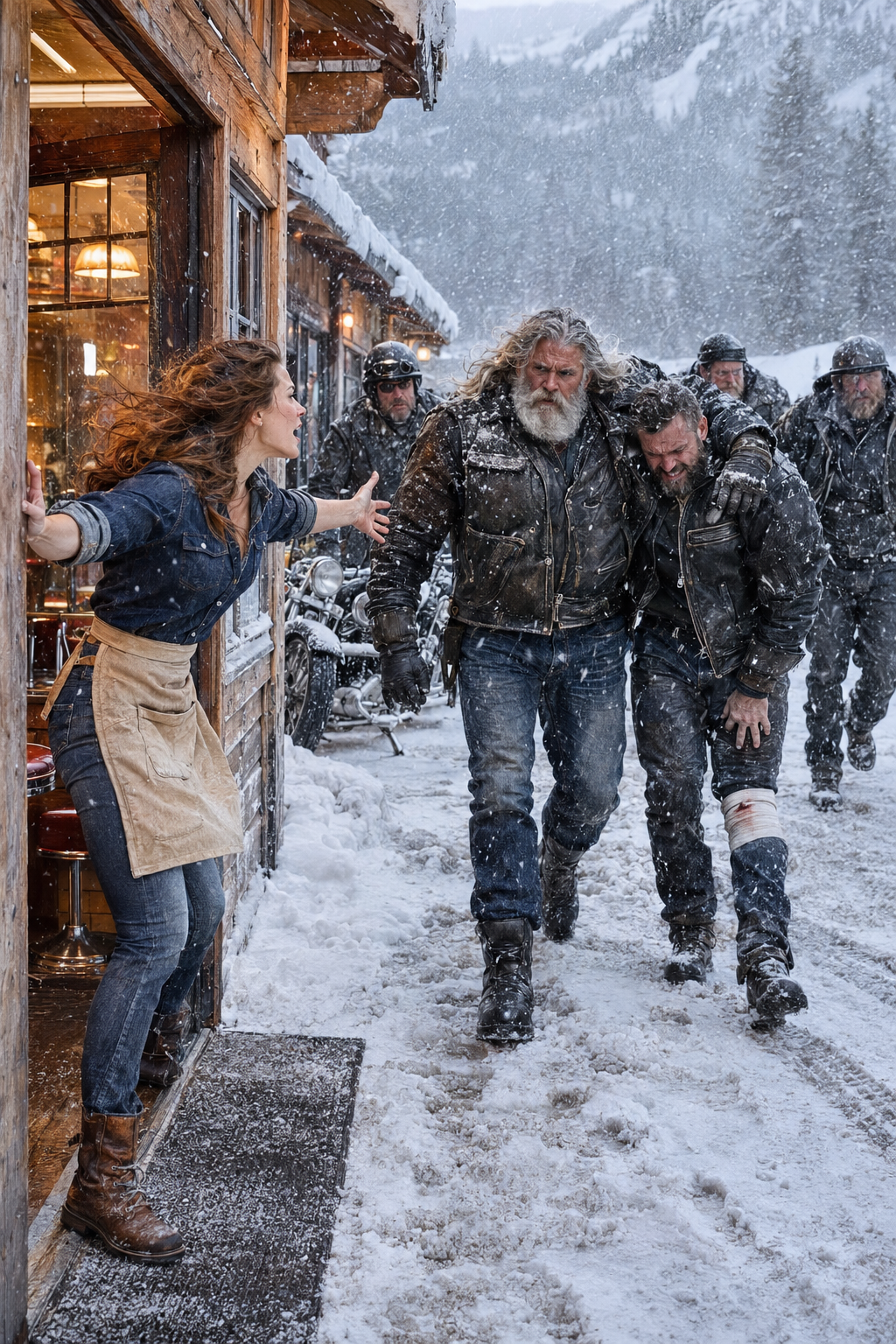
The injured rider, a young man named Danny, lowered himself into a chair.
“Is this about the lady at the diner?”
Grizzly nodded.
“She’s in trouble. Evan Mercer is trying to take her property.”
At the mention of that name, several men exchanged uncomfortable looks.
An older biker named Walter, whose gray beard reached halfway down his chest, slowly set down his coffee.
“Same Mercer?”
“Same one.”
The room fell silent.
Seven years earlier, Mercer had purchased the land beneath a motorcycle repair shop that Grizzly and his younger brother had spent fifteen years building.
He had promised to renew their lease.
Instead, he doubled their rent, refused their payments under disputed lease terms, and eventually forced them out.
Grizzly’s brother never recovered financially. He died two years later following a long illness, leaving behind a wife and two children.
Grizzly had never forgotten the humiliation of watching everything they had built disappear behind a locked gate.
But this time, something was different.
This time, he had fifteen brothers standing beside him.
“That woman fed us when she had almost nothing,” Grizzly said. “She didn’t ask who we were. She didn’t care what we looked like. She saw people who needed help.”
Danny looked down at his bandaged ankle.
“She probably saved my foot.”
Walter leaned forward.
“So what are we going to do?”
Grizzly rested both hands on the table.
“We’re going to give her a fighting chance.”
Two mornings later, Clare was trying to repair a leaking faucet when she heard motorcycles approaching.
She stepped outside and froze.
The entire group had returned.
Behind them came three pickup trucks carrying tools, lumber, electrical equipment, and a commercial refrigerator.
Grizzly climbed off his motorcycle.
“Morning, ma’am.”
Clare stared at the refrigerator.
“What is all this?”
“Breakfast, hopefully. But first, we’ve got some work to do.”
Before she could protest, the men began unloading their trucks.
Walter inspected the plumbing. Another rider climbed onto the roof. Two others carried the broken refrigerator outside while Danny, walking with crutches, started cleaning the storage room.
“Wait!” Clare shouted. “I can’t pay for any of this!”
Grizzly turned toward her.
“Did we ask you to?”
“It’s too much.”
“So was sixteen hungry men showing up at midnight.”
She opened her mouth, but no words came.
By noon, the kitchen had a working refrigerator, the leaking pipes were repaired, and the damaged heating system was running better than it had in years.
Clare stood behind the counter, watching strangers work on a building that most people in town had already given up on.
Then Grizzly placed a business card beside her coffee cup.
“Her name is Rebecca Hayes. She’s an attorney. She helps small businesses with property disputes.”
Clare shook her head.
“I can’t afford a lawyer.”
“She’s Walter’s daughter. She agreed to look at your paperwork for free.”
For the first time in months, Clare felt something she had almost forgotten.
Hope.
Unfortunately, hope was precisely what Evan Mercer wanted to destroy.
When he learned about the repairs, he drove straight to the county offices.
The following afternoon, a building inspector arrived at the Golden Pine.
He examined the kitchen, electrical panels, roof, and emergency exits. After nearly two hours, he handed Clare a temporary closure notice.
“Your rear emergency exit doesn’t meet current safety requirements, and there are issues with the electrical service.”
Clare stared at him.
“But everything was just repaired.”
“The new refrigerator is fine. The building’s original electrical panel is not.”
“How long do I have to fix it?”
“You cannot reopen until the violations are corrected and inspected.”
As the inspector left, Clare noticed a familiar black SUV parked across the highway.
Mercer was watching.
She walked outside, her hands trembling with anger.
“You did this!”
Mercer lowered his window.
“I simply expressed concerns about public safety.”
“You’re trying to destroy me.”
“No, Clare. I’m trying to buy a piece of land. You’re the one making it difficult.”
He drove away before she could answer.
That evening, Grizzly found Clare sitting on the front steps beneath the darkened Golden Pine sign.
“I think he won,” she said.
Grizzly sat beside her.
“Did somebody tell you the fight was over?”
“I have twenty-six days left. My diner is closed. Even if we fix everything, I still owe more money than I’ll ever make.”
She buried her face in her hands.
“I promised my father I wouldn’t let this happen.”
Grizzly looked through the window at the photograph on the wall.
“Did your father ever tell you why he opened this place?”
Clare nodded slowly.
“He said people traveling through Montana needed somewhere warm to stop.”
“Then maybe your promise wasn’t just about keeping a building.”
She looked at him.
“Maybe it was about keeping a door open.”
The next morning, Rebecca Hayes arrived carrying a laptop and several folders.
She spent hours reviewing loan agreements, payment receipts, property records, and every letter Mercer had sent.
Finally, she stopped typing.
“Clare, where did you get this statement?”
“Mercer’s office mailed it last month.”
Rebecca compared it with an earlier document.
“These charges don’t match your original agreement.”
“What does that mean?”
“It means somebody has some explaining to do.”
She discovered thousands of dollars in questionable administrative fees, unexplained penalties, and payments that appeared to have been applied incorrectly.
There was still a substantial legitimate debt, but the amount Mercer demanded was significantly higher than the records appeared to support.
Rebecca requested a complete accounting and challenged the default notice.
Meanwhile, the bikers obtained the necessary permits and hired a licensed electrician to replace the old panel. They rebuilt the emergency exit and arranged another inspection.
But Grizzly knew repairs alone wouldn’t save the diner.
So Danny recorded a short video.
Standing outside the Golden Pine, he explained how sixteen riders had been stranded during the blizzard and how a struggling diner owner had given them shelter without asking for anything in return.
He showed his injured ankle, the repaired kitchen, and the photograph of Clare’s father.
“She opened her door when nobody else was around,” Danny said into the camera. “Now we’re asking people to help keep that door open.”
He posted the video online.
By midnight, it had been viewed twelve thousand times.
By the following evening, it had reached nearly half a million people.
Messages arrived from truck drivers, veterans, motorcycle clubs, restaurant owners, and people who had never set foot in Montana.
Some remembered eating at the Golden Pine decades earlier.
Others shared stories about Clare’s father.
One woman wrote that he had fed her children for free after her husband lost his job.
A retired truck driver remembered being allowed to sleep inside during a dangerous winter storm.
Another man recalled how Clare’s father had driven him forty miles to a hospital after his car broke down.
Clare read every message with tears running down her cheeks.
She had never realized how many lives her father had touched.
Three days later, the diner passed its inspection.
When Clare arrived downstairs to reopen, she found motorcycles stretching along the highway.
There were hundreds of them.
Families stood in the parking lot. Local farmers brought eggs and vegetables. A bakery delivered boxes of fresh bread, and a restaurant supplier donated enough ingredients to keep the kitchen running for weeks.
Grizzly stood near the entrance, holding a handwritten sign.
BREAKFAST FOR A SECOND CHANCE.
Clare pressed a hand against her mouth.
“Graham, what have you done?”
He smiled.
“Invited a few friends.”
For the next twelve hours, the Golden Pine served more customers than it normally served in an entire month.
People paid for meals and left generous tips. Some purchased gift certificates. Others contributed to a community fundraiser that Rebecca had helped organize with Clare’s permission.
Even residents who had once complained about motorcycle noise volunteered to wash dishes and carry plates.
By closing time, the fundraiser had collected thirty-eight thousand dollars.
Clare couldn’t believe it.
But Mercer was not finished.
Two nights later, Clare awoke to the smell of smoke.
At first, she thought something had burned in the kitchen.
Then she heard glass breaking downstairs.
She rushed toward the staircase and saw orange flames spreading near the rear storage room.
“Oh, God.”
She grabbed her phone, called emergency services, and escaped through the upstairs exterior staircase.
Outside, snow covered her bare feet as she watched smoke pour from the building.
Within minutes, fire engines arrived.
Grizzly and several riders appeared shortly afterward, having received a frantic call from Clare.
She stood across the parking lot wearing pajamas and a borrowed firefighter’s coat.
“My father’s picture,” she whispered. “It’s still inside.”
Grizzly held her shoulders.
“Clare, look at me. Let the firefighters do their job.”
She watched helplessly as water crashed through the broken windows.
It took nearly an hour to extinguish the fire.
The kitchen suffered smoke and water damage, and the rear storage room was almost completely destroyed.
But the main dining area remained standing.
As dawn approached, a firefighter emerged carrying a blackened picture frame.
“Found this near the counter.”
Clare took it with shaking hands.
The glass was cracked, but her father’s smiling face was still visible.
She hugged the photograph against her chest and began sobbing.
Grizzly turned away, his jaw tightening.
The fire investigator soon determined that the blaze appeared to have been deliberately started.
Someone had broken a rear window before the fire began.
Then Walter remembered something.
During the repairs, he had installed security cameras around the property.
Although one camera had been damaged, footage from another had been saved remotely.
Rebecca contacted the sheriff immediately.
The recording showed a man approaching the diner shortly before the fire. His face was partially covered, but investigators were able to identify the vehicle he arrived in.
It belonged to a contractor who had worked on several of Mercer’s development projects.
The contractor was questioned and later arrested.
Investigators discovered messages between him and Mercer discussing ways to prevent the diner from reopening. One message specifically referred to making the building unusable before the loan deadline.
Faced with the evidence, the contractor began cooperating with authorities.
Mercer denied everything.
He claimed his messages had been misunderstood and insisted that he had never authorized a fire.
But investigators were no longer interested only in the Golden Pine.
Rebecca’s challenge to the loan had uncovered irregularities that resembled complaints from other property owners.
One by one, frightened business owners began coming forward.
A retired couple had lost their grocery store. A mechanic had been forced out of his garage. A widow had sold her family’s property after receiving demands containing unexplained fees.
For years, each had believed they were alone.
Now they were finally speaking to one another.
With Rebecca’s help, Clare obtained a temporary court order preventing Mercer from proceeding with foreclosure while the disputed debt was examined.
For the first time, the developer found himself facing consequences he couldn’t simply purchase his way around.
Still, Clare had a difficult decision to make.
The diner was damaged again. Insurance payments would take time. Her remaining legitimate debt was substantial, and rebuilding would require months of work.
One afternoon, she found Grizzly standing inside the ruined kitchen.
“Maybe I should stop,” she admitted.
He looked at her without judgment.
“Is that what you want?”
“I don’t know anymore. I’m tired of being afraid.”
Grizzly nodded.
“Then don’t make your decision because you’re afraid.”
She looked around at the blackened walls.
“What if I fail again?”
“Then you’ll have people beside you when you do.”
He paused.
“Keeping your father’s memory alive doesn’t mean you have to suffer forever. You can walk away if that’s what you truly want. Nobody here would think less of you.”
Clare hadn’t expected those words.
Everyone had been fighting to save the diner, yet Grizzly was giving her permission to let it go.
That night, she sat alone in her apartment and opened an old wooden box containing her father’s belongings.
Inside were photographs, handwritten recipes, and a small notebook filled with names.
Beside each name was a brief description.
Lost his job. Feed him until Friday.
Three children. Mother needs groceries.
Truck broke down. Give him a room upstairs.
Clare turned the pages slowly.
Near the back, she discovered a note written in her father’s familiar handwriting.
“Money keeps the lights on, but people give a place its soul. Never confuse the two.”
She read the sentence several times.
Then she closed the notebook and smiled through her tears.
The following morning, she called Grizzly.
“I want to rebuild.”
Over the next several months, the Golden Pine rose from the ashes.
Insurance covered much of the fire damage, and the community fundraiser continued growing. After a detailed accounting and negotiations with Mercer’s company, the improperly assessed charges were removed.
Clare used part of the donated funds to settle the corrected outstanding loan balance and retained ownership of the property.
Mercer was eventually convicted of offenses connected to the fraudulent financial practices and his involvement in arranging the fire.
Several former property owners pursued compensation through separate legal proceedings.
Grizzly testified about his own experiences, hoping that others would finally receive the justice his brother never had.
When spring arrived, the Golden Pine reopened.
Its walls were freshly painted, its booths restored, and its familiar wooden sign hung above the entrance.
Clare had added something new beside the register.
A small board covered with prepaid meal tickets.
Anyone who couldn’t afford food could take a ticket without explaining their circumstances.
Customers who wished to help could purchase another.
Above the board were the words:
THERE IS ALWAYS ROOM AT OUR TABLE.
On opening day, Grizzly arrived with the fifteen men who had once stood outside her door in the blizzard.
Danny walked without crutches now.
Walter complained that the coffee was too strong before drinking three cups.
The men occupied their favorite booths, laughing loudly enough to fill every corner of the diner.
Clare brought out sixteen plates of eggs, bacon, and potatoes.
Grizzly reached for his wallet.
She pointed a warning finger at him.
“Don’t even think about it.”
He laughed.
“You’re going to put yourself out of business feeding us.”
“Not this time.”
She placed a framed photograph on the table.
It showed the sixteen riders standing outside the Golden Pine on the day they had returned with tools and a refrigerator.
“I spent years thinking this place was all I had left of my father,” she said. “But I was wrong. What he taught me was worth more than these walls.”
Grizzly studied the photograph.
“My brother would have liked you.”
Clare smiled gently.
“I think my father would have liked all of you.”
Years passed, and the Golden Pine became known throughout Montana as a place where nobody was turned away hungry.
Travelers came for the homemade pies, truck drivers came for the coffee, and motorcycle clubs made the diner a regular stop.
Every winter, Grizzly and his brothers collected blankets, coats, and emergency supplies for stranded travelers.
Clare kept her father’s notebook beneath the register and began filling its remaining pages with names of her own.
Then, on a particularly cold December evening, a young mother entered the diner with two children.
Her coat was thin, her shoes were soaked, and she looked terrified.
“I’m sorry,” she whispered. “Our car broke down. I don’t have any money. Could my children just sit somewhere warm for a little while?”
Clare glanced toward the corner booth, where Grizzly was enjoying his usual cup of coffee.
Their eyes met.
He smiled.
Clare walked around the counter, took the woman’s trembling hands, and guided her toward an empty table.
“Of course,” she said. “What would you like to eat?”
The woman began crying.
“But I can’t pay you.”
Clare looked at the photograph of her father, then at the picture of the sixteen bikers hanging beside it.
“Someone already has.”
Outside, snow began falling across the Montana highway.
Inside, the children ate warm food while their mother slowly stopped shivering.
Grizzly quietly purchased three more meal tickets and placed them on the board before returning to his coffee.
Clare watched him and finally understood something her father had spent his entire life trying to teach her.
Kindness was never a guarantee that life would be fair. It could not prevent every tragedy, erase every debt, or protect a person from every cruel intention.
But kindness could travel farther than anyone imagined.
A meal given freely could become a friendship. A friendship could become a community. And a community could stand against the very things that one frightened person could never overcome alone.
On the night of the blizzard, Clare believed she was saving sixteen strangers.
She never imagined that opening her door would change the course of her own life.
And perhaps that was the greatest lesson of the Golden Pine Diner.
You never truly know what someone is carrying when they knock on your door.
Sometimes, the person you welcome inside is carrying the very hope you thought you had lost.