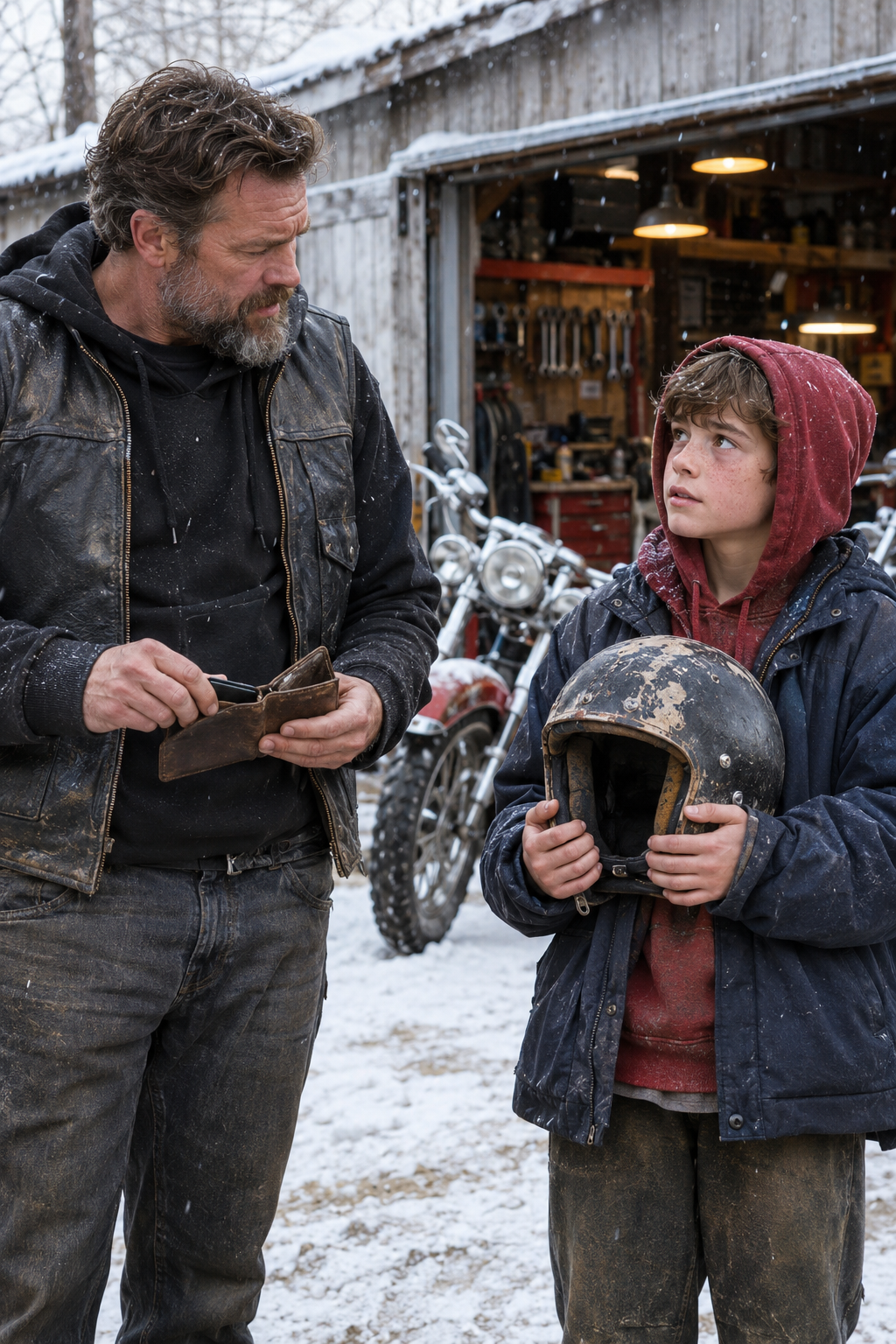
“Five dollars. That’s all I’m asking.”
Mason pulled out a brown envelope, its corners bent and its surface stained with grease.
Across the front, written in familiar handwriting, were three words.
FOR MY FAMILY.
Jamie recognized the handwriting immediately. Troy used to leave notes on the refrigerator whenever he worked late.
“Where did you get that?” Jamie asked.
“Your brother gave it to me eleven months ago,” Mason replied. “He told me to keep it somewhere safe.”
“What’s inside?”
“Something he was building for you and your sister.”
Mason sat beside Jamie and carefully opened the envelope. Inside were several receipts, a photograph, a small brass key, and a handwritten letter.
The photograph showed Troy standing beside an old motorcycle in a garage. He was smiling, his hands covered in grease.
Jamie hadn’t seen that smile in a long time.
“Your brother bought that motorcycle for three hundred dollars,” Mason explained. “Spent nearly two years rebuilding it. Every spare dollar went into that machine.”
“Why?”
“He wanted to sell it and put the money toward your education. He talked about getting Kayla out of that diner, too. Said she’d been taking care of everybody except herself.”
Jamie rubbed his eyes with his sleeve.
“Where’s the motorcycle now?”
Mason’s expression changed.
“That’s where things get complicated.”
Before he could explain, the clubhouse door swung open again.
Kayla rushed inside, still wearing her waitress uniform. Her hair was tied back, and exhaustion showed beneath her eyes.
“Jamie!”
She hurried toward him and wrapped her arms around his shoulders.
“Don’t ever disappear like that again. I thought something happened to you.”
“I’m sorry.”
Then she noticed the helmet on the table.
Her expression hardened.
“You took Troy’s helmet?”
“I was trying to help.”
“Jamie, that was the only thing we had left of him.”
“I know. But you haven’t eaten properly in three days.”
Kayla opened her mouth, but nothing came out.
She looked around at the strangers watching them and lowered her head.
Walt quietly placed another plate of food on the table.
“Miss Milner, nobody here is judging you.”
Kayla shook her head.
“We don’t need charity.”
“Good,” Walt replied. “Because your brother left something behind that belongs to you.”
Mason handed her the envelope.
Kayla read the letter slowly. Halfway through, her fingers began trembling.
Jamie moved closer.
“What does it say?”
She struggled to speak.
Finally, Mason read the letter aloud.
“If you’re reading this, something probably didn’t go according to plan. Kayla, you’ve been carrying this family since you were practically a kid yourself. Jamie, listen to your sister, stay in school, and don’t let anybody convince you that being poor means you’re worth less. I’m working on something that might make life easier for both of you. Mason knows where everything is. And if things ever get too heavy, ask for help. Being strong doesn’t mean carrying everything alone.”
Kayla covered her mouth.
For months, she had refused to cry in front of Jamie.
Now she couldn’t stop.
Mason waited until she had regained her composure.
“Your brother’s motorcycle was almost finished when he died. It’s worth considerably more than what he paid for it. But the garage where he kept it was rented under another man’s name.”
“Who?” Kayla asked.
“Derek Harlan.”
Walt’s jaw tightened.
Derek had once been associated with the Steel Pines. He owned a small towing business outside town and had a reputation for making money wherever he could.
“After Troy’s accident,” Mason continued, “Derek changed the locks. He claimed your brother owed him storage fees and refused to release the motorcycle.”
“How much?”
“Eight thousand dollars.”
Kayla stared at him.
“That’s impossible.”
“It is. Troy kept records of every payment. That’s why these receipts matter.”
Mason spread the papers across the table.
“He paid everything through the end of the year.”
“Then why didn’t you get it back?”
“I tried. Derek said I wasn’t family and had no legal claim. I’ve been trying to locate you ever since. The address Troy gave me was your old apartment.”
Kayla looked away.
They had moved twice since Troy’s funeral, each apartment smaller and cheaper than the last.
“Can we really get it back?” Jamie asked.
Walt leaned forward.
“We’re going to find out.”
That evening, the siblings returned home carrying groceries, the helmet, and the envelope.
Kayla had resisted accepting the food until Frank explained that the clubhouse kitchen always prepared more than the members could eat.
For the first time in weeks, Jamie watched his sister finish an entire meal.
The next morning, Walt introduced them to a retired attorney named Helen Brooks, who volunteered at a local legal aid center.
Helen listened carefully as Kayla explained the guardianship situation.
Their mother had died years earlier. Their father had disappeared when Jamie was six. Troy had eventually become Jamie’s legal guardian, and after his death, Kayla had received temporary guardianship.
Now the court wanted additional documentation proving she could provide a stable home.
“I have two jobs,” Kayla explained. “I haven’t missed a rent payment until this month. Jamie goes to school every day. I don’t understand why that’s not enough.”
Helen examined the paperwork.
“Someone has filed an objection to your permanent guardianship.”
Kayla went pale.
“Who?”
Helen turned the document around.
The name printed at the bottom made Kayla feel sick.
Raymond Milner.
Their father.
Jamie stared at the paper.
“He’s coming back?”
“Apparently, he’s requesting custody,” Helen said.
Kayla pushed herself away from the desk.
“He hasn’t called Jamie in eight years. He didn’t even come to Troy’s funeral.”
Helen remained calm.
“Do you know why he might suddenly be interested?”
Kayla shook her head.
But Mason, who had accompanied them, looked troubled.
“Maybe I do.”
Everyone turned toward him.
“Last week, Derek called me. He asked whether Troy’s family had opened an estate.”
Helen narrowed her eyes.
“What exactly did he say?”
“He wanted to know who would inherit Troy’s property.”
Kayla felt a terrible suspicion forming.
Their father hadn’t returned because he missed Jamie.
He had returned because he believed there was something to collect.
Two days later, Raymond appeared outside their apartment.
He wore an expensive-looking jacket and carried a bag of fast food.
Jamie barely recognized him.
“There’s my boy,” Raymond said, opening his arms.
Jamie remained behind the screen door.
Kayla stepped between them.
“What do you want?”
“Can’t a father visit his son?”
“You had eight years.”
Raymond sighed dramatically.
“I made mistakes. People change.”
“Then withdraw your custody petition.”
His smile disappeared.
“You’re twenty-three, Kayla. You’re drowning in debt. Everybody knows it. Jamie deserves better.”
“He deserves someone who doesn’t abandon him.”
Raymond glanced past her toward the kitchen.
“I hear Troy left some property behind. Might be enough to get everybody back on their feet.”
Kayla’s stomach turned.
“Get out.”
“Think carefully,” Raymond warned. “A judge might not be impressed by an unemployed waitress living in a dump.”
“I have two jobs.”
“Not for long, working yourself into the ground.”
He placed the food on the doorstep and walked away.
Jamie watched him disappear down the stairs.
“Kayla?”
“Yeah?”
“Please don’t let him take me.”
She pulled him against her chest.
“I won’t.”
But that night, after Jamie fell asleep, Kayla sat alone at the kitchen table and cried into her hands.
She didn’t know how to keep that promise.
Saturday arrived, and Jamie returned to the Crow Hollow clubhouse.
Walt gave him an old work shirt and showed him how to change the oil on a motorcycle. Frank taught him the names of tools. Mason explained how an engine worked.
Jamie made mistakes, dropped a wrench, and accidentally spilled oil across the floor.
Nobody yelled.
By lunchtime, he was laughing.
Walt noticed.
It was the first time he had seen the boy smile without looking guilty afterward.
“You’ve got your brother’s hands,” Walt told him.
Jamie looked down at his greasy fingers.
“Was Troy really that good?”
“Better than most.”
“Then why did he die?”
The question caught Walt off guard.
Jamie continued working, pretending he hadn’t asked anything important.
Walt set his wrench down.
“Sometimes good people get hurt, son. Being good doesn’t protect you from everything.”
Jamie swallowed.
“He was supposed to pick me up from school that day. I called him because I didn’t want to walk home in the rain.”
Walt listened.
“If I hadn’t called him, maybe he wouldn’t have been on that road.”
“Jamie, look at me.”
The boy slowly raised his head.
“Your brother made his own decisions. You asking for a ride didn’t cause that accident.”
Jamie wiped his cheek with his shoulder.
“I never told Kayla.”
“Maybe you should. I reckon she’s been blaming herself for things that weren’t her fault, too.”
Before Jamie could answer, Mason entered the garage.
“We’ve got a problem.”
Derek had advertised Troy’s motorcycle for sale.
The asking price was twenty-six thousand dollars.
Worse, a buyer was coming Monday morning.
Helen immediately contacted Derek and informed him that the motorcycle’s ownership was disputed. She warned him against selling it.
Derek insisted the machine belonged to him.
He even produced a document supposedly signed by Troy, transferring ownership in exchange for unpaid garage fees.
Mason examined the signature.
“That’s not his handwriting.”
“Proving that will take time,” Helen replied.
Jamie suddenly remembered something.
“The helmet.”
Everyone looked at him.
“Troy used to keep stuff inside it. Emergency money, receipts, things he didn’t want to lose.”
He hurried into the clubhouse and retrieved the scratched helmet.
Carefully, Mason removed the inner padding.
A folded piece of paper fell onto the table.
It was the motorcycle’s original purchase agreement, identifying Troy as the buyer. Behind it was a signed storage agreement with Derek, along with a receipt confirming the final payment.
Helen photographed everything.
“This helps enormously.”
There was something else tucked inside.
A small memory card.
Frank found an adapter, and Mason inserted it into a laptop.
Several videos appeared.
Most showed Troy working on the motorcycle, explaining what he had repaired and recording its progress.
Then they opened the final video.
Troy appeared on the screen, sitting beside the nearly completed machine.
“Okay, Mason, here’s proof that Derek finally got every penny I owed him. He’s probably going to complain that I’m recording this.”
Derek stepped into view.
“Yeah, yeah. You’re paid up. Now turn that thing off.”
Troy laughed.
“Just keeping records, buddy.”
The video continued for another minute.
After Derek walked away, Troy turned the camera toward himself.
“Kayla’s birthday is coming up. Jamie needs new shoes. Hopefully, this old beauty is going to solve a few problems.”
He smiled.
“Just a little longer.”
Jamie stared at the frozen image.
He wanted desperately to hear another sentence.
But the recording ended.
Mason closed the laptop gently.
Helen gathered the documents and contacted the authorities. With the evidence of ownership and the disputed transfer document, she was able to pursue an emergency court order preventing the sale.
By Monday morning, Derek could no longer legally dispose of the motorcycle.
But he wasn’t finished.
Three nights later, Jamie woke to the sound of someone pounding on their apartment door.
Kayla hurried into his bedroom.
“Stay here.”
Through the door, Raymond shouted that she was keeping him away from his son.
Then came another voice.
Derek.
“You’ve got paperwork that belongs to me,” he demanded.
Kayla immediately called the police.
The men continued shouting until they heard approaching sirens. By the time officers arrived, both had disappeared.
Jamie sat on his bed, shaking.
“I want to go somewhere else.”
Kayla looked around their tiny apartment.
For months, she had convinced herself that protecting Jamie meant handling everything privately.
That night, she finally called Walt.
Twenty minutes later, Walt and his wife, Margaret, arrived.
Margaret helped Kayla pack clothes while Walt waited with Jamie.
“You’re staying in our guest rooms tonight,” Margaret said. “Tomorrow, we’ll figure out the rest.”
Kayla tried to apologize.
Margaret stopped her.
“Honey, you don’t apologize for keeping your brother safe.”
The following morning, Kayla received another devastating phone call.
The diner manager had replaced her.
She had missed too many shifts dealing with court appointments.
She sat on Margaret’s porch, staring at her phone.
Everything she had worked to preserve seemed to be collapsing at once.
Walt sat beside her.
“I lost my job,” she whispered.
He nodded.
“Margaret tells me you’re good with numbers.”
“I used to study accounting. Before Mom got sick.”
“Why’d you stop?”
“Somebody had to pay the bills.”
Walt looked toward the garage.
“Our repair shop needs someone to handle invoices, appointments, and inventory. Full-time. Regular hours. Benefits.”
Kayla stared at him.
“You’d hire me?”
“I’d interview you. If you’re terrible, Margaret will fire you before I get the chance.”
From inside the house, Margaret shouted, “He’s not kidding!”
For the first time that morning, Kayla laughed.
Two weeks later, the guardianship hearing took place.
Raymond arrived wearing a suit, accompanied by an attorney.
He described himself as a father seeking reconciliation and portrayed Kayla as financially unstable.
His attorney presented photographs of their apartment and copies of overdue bills.
Kayla sat quietly, her hands clenched beneath the table.
Then Helen stood.
She presented Jamie’s school attendance records, medical records, statements from teachers, Kayla’s new employment agreement, and evidence of Raymond’s prolonged absence.
She also submitted the police report concerning the late-night confrontation.
Finally, the judge agreed to speak privately with Jamie.
When Jamie returned, Kayla couldn’t read his expression.
The judge reviewed the documents once more.
“Financial hardship alone does not establish that a caregiver is unfit,” she said. “The evidence demonstrates that Miss Milner has consistently acted in her brother’s best interests.”
Raymond shifted uncomfortably.
The judge continued.
“Permanent guardianship is granted to Kayla Milner.”
Kayla burst into tears.
Jamie threw his arms around her.
Raymond stormed out without saying goodbye.
Outside the courthouse, nearly a dozen motorcycles were parked along the street.
Walt, Mason, Frank, Margaret, and members of both riding clubs stood waiting.
When Jamie raised his thumb, the entire group erupted in cheers.
Kayla walked toward Walt.
“I don’t know how to thank you.”
“Finish raising that boy,” he said. “That’s plenty.”
The motorcycle dispute took another month to resolve.
Confronted with the receipts, the recording, and questions about the authenticity of the transfer document, Derek withdrew his ownership claim.
The motorcycle was released to Troy’s estate.
When Mason opened the garage, however, his excitement disappeared.
The motorcycle had been partially dismantled. Several expensive components were missing.
Jamie stared at the damaged machine.
“Can we fix it?”
Mason walked around it slowly.
“Not cheaply.”
Walt picked up a discarded bolt from the floor.
“Good thing we know a few mechanics.”
Over the next six Saturdays, members of the Crow Hollow Riders and Steel Pines worked together.
A retired mechanic donated parts. A painter restored the fuel tank. Frank repaired the wiring.
Jamie attended every session.
He learned how to clean components, organize tools, and follow instructions. Whenever he grew frustrated, Mason reminded him that Troy hadn’t learned everything in a single afternoon either.
Eventually, the motorcycle was ready.
Walt turned the ignition.
The engine came alive.
Jamie stood motionless, listening.
It sounded exactly like the motorcycle in Troy’s videos.
Mason placed a hand on his shoulder.
“He would’ve loved this.”
The clubs organized a public auction, with the proceeds designated for Troy’s estate after expenses.
People arrived from neighboring towns.
Some had known Troy. Others had heard about the siblings.
The bidding began at ten thousand dollars.
Within minutes, it reached twenty thousand.
Then twenty-five.
A man near the back raised his hand.
“Thirty thousand.”
The room quieted.
“Thirty-five,” another bidder called.
Jamie couldn’t believe what he was hearing.
The final bid came from an elderly man wearing a faded denim jacket.
“Forty thousand dollars.”
Nobody challenged him.
The auctioneer brought down his hammer.
Kayla covered her face.
The elderly man approached them afterward.
“My name’s Arthur Bennett,” he said. “Your brother helped me three winters ago.”
He explained that Troy had repaired his truck for free when Arthur couldn’t afford the work.
“I offered him money later. He wouldn’t take it. Told me to help somebody else when I got the chance.”
Arthur looked at the motorcycle.
“I’ve been waiting for that chance.”
He completed the purchase through the estate’s attorney.
Then he turned toward Jamie.
“I’m going to keep this motorcycle here for a while. When you’re old enough and properly licensed, maybe Mason can teach you how to ride it.”
Jamie smiled through his tears.
The money didn’t make Kayla rich.
But it allowed her to clear the overdue bills, secure a better apartment, and establish savings for Jamie’s education. She also enrolled in evening accounting classes.
For the first time since Troy’s death, the future felt like something other than a threat.
One year later, a handwritten sign appeared outside the Crow Hollow clubhouse.
THE RIDGE PROJECT.
Underneath, smaller letters read:
FREE MEALS. BASIC REPAIRS. A PLACE TO ASK FOR HELP.
The project began with donated tools, a few folding tables, and volunteers from both motorcycle clubs.
Kayla managed the finances.
Jamie helped repair bicycles for children whose families couldn’t afford new ones.
One cold Saturday afternoon, a little girl approached the garage carrying a broken pink bicycle.
Her mother stood behind her, embarrassed.
“How much would it cost to fix?” she asked.
Jamie examined the damaged chain.
“Nothing.”
The woman shook her head.
“I don’t want to take advantage of anybody.”
Jamie smiled.
“You’re not.”
He repaired the bicycle while Frank prepared two plates of food.
Watching from the doorway, Walt noticed Troy’s old helmet sitting on a shelf above Jamie’s workbench.
The scratches remained untouched.
Beside it was a framed five-dollar bill.
Walt pointed toward it.
“Never did ask you about that.”
Jamie glanced up.
“It’s the first five dollars I earned fixing something here.”
“Why’d you frame it?”
Jamie thought for a moment.
“Because I came here thinking five dollars was all I needed.”
He looked toward Kayla, who was laughing with Margaret near the kitchen. Mason was teaching another teenager how to use a wrench. Outside, the little girl rode her repaired bicycle across the parking lot.
“I didn’t know how much I was missing.”
Walt nodded slowly.
Jamie returned to his workbench.
He still missed Troy. Some mornings, he woke expecting to hear his brother moving around the kitchen. Some nights, the memories hurt so badly that he couldn’t sleep.
But grief no longer felt like something he had to survive alone.
Troy hadn’t left behind a fortune, a perfect plan, or a promise that life would always be fair.
He had left something that proved far more valuable.
People who remembered how he had treated them.
People willing to carry his kindness forward.
And Jamie finally understood that a person’s legacy wasn’t measured by the things they owned when they died, but by the goodness that continued to exist because they had lived.
He had walked into the clubhouse hoping to sell his brother’s helmet for five dollars.
Instead, he discovered that the most precious things his brother had left behind could never have been sold.
And now, whenever someone walked through those doors feeling hungry, frightened, or ashamed, Jamie made sure they heard the same words that had changed his life.
“Sit down. We’ll figure something out.”
Three years later, Jamie was closing the garage when he noticed a boy standing outside the fence.
He looked about twelve, wearing a jacket much too thin for the November weather. In his hands was a small red toolbox.
“Can I help you?” Jamie called.
The boy approached cautiously.
“Do you buy tools?”
“Sometimes. What have you got?”
The boy opened the toolbox. Inside were several rusty wrenches, a screwdriver, and a pair of pliers.
“They were my dad’s,” he explained. “He’s in the hospital. My mom needs money for gas so she can visit him.”
Jamie felt something tighten inside his chest.
“How much are you asking?”
“Ten dollars. But I’ll take five.”
For a moment, Jamie couldn’t speak.
He remembered his worn sneakers, his empty stomach, and the scratched helmet he had carried into this very clubhouse.
He remembered how ashamed he had felt.
And he remembered what Walt had done.
“What’s your name?”
“Lucas.”
“Well, Lucas, those tools look pretty important to you.”
The boy nodded.
“My dad said he’d teach me how to use them when he got better.”
Jamie closed the toolbox gently.
“Then you’d better keep them.”
Lucas lowered his head.
“Sorry for bothering you.”
“Hold on. I didn’t say you had to leave.”
Jamie opened the garage door and called toward the kitchen.
“Frank! You got anything left to eat?”
“Always!” came the familiar reply.
Jamie invited Lucas inside, gave him a warm meal, and called Kayla.
Within an hour, they had contacted the boy’s mother and arranged transportation to the hospital through one of the Ridge Project’s volunteers.
Before Lucas left, Jamie handed him a card.
“Come back Saturday. Bring those tools. I’ll show you how to clean them up.”
Lucas smiled.
“Really?”
“Really.”
From across the room, Walt watched silently.
His beard had grown whiter, and he walked with a cane now. His hands were no longer steady enough to repair engines, but he still visited the clubhouse almost every day.
When Lucas finally left, Walt approached Jamie.
“You handled that pretty well.”
Jamie smiled.
“Had a good teacher.”
Walt chuckled, but his expression soon became serious.
“There’s something I need to talk to you about.”
He reached into his pocket and pulled out a set of keys.
Jamie recognized them immediately.
They belonged to the repair shop.
“Margaret and I are moving closer to our daughter next spring,” Walt explained. “Doctor says I ought to slow down.”
Jamie felt his heart sink.
“You’re leaving?”
“I’m getting old, kid. Happens to the best of us.”
Walt placed the keys on the workbench.
“Kayla’s agreed to manage the business. Mason will oversee the mechanics. And when you finish your training, there’s a permanent place here for you.”
Jamie stared at the keys.
“You trust me that much?”
Walt looked toward Troy’s helmet.
“Your brother trusted you before you ever gave him a reason to. I reckon I’ve got plenty of reasons now.”
Jamie hugged him.
Walt patted his back awkwardly.
“Easy, son. These old ribs aren’t what they used to be.”
They both laughed.
Six months later, Jamie graduated from high school.
Kayla sat in the front row, holding a photograph of Troy. Beside her were Margaret, Walt, Mason, Frank, and several members of both motorcycle clubs.
When Jamie’s name was called, their cheers were louder than anyone else’s.
After the ceremony, Kayla handed him the photograph.
“He would’ve been proud of you.”
Jamie looked at his brother’s smiling face.
“I wish he could’ve been here.”
“Me too.”
They stood together for a moment, surrounded by families celebrating.
Then Jamie reached into his graduation gown and pulled out an envelope.
“What’s this?” Kayla asked.
“Open it.”
Inside was a check made payable to her college.
Jamie had been saving part of every paycheck from his apprenticeship.
Kayla stared at the amount.
“Jamie, you need this money.”
“So do you.”
“But your future—”
“You put yours on hold for me,” he interrupted gently. “You don’t have to do that anymore.”
Kayla began crying.
Jamie wrapped his arms around her.
For years, she had believed that her dreams were a luxury she couldn’t afford. Now her little brother was reminding her that she deserved a life of her own.
Two years later, Kayla completed her accounting degree.
The Ridge Project expanded into a larger community center, offering meals, vocational training, emergency assistance, and free transportation for struggling families.
Jamie became a certified motorcycle mechanic.
Lucas became one of his youngest and most enthusiastic students.
And Troy’s helmet remained above the original workbench.
One autumn morning, Arthur Bennett returned to the clubhouse, pushing Troy’s restored motorcycle out of a trailer.
He handed Jamie the keys and an envelope containing the ownership documents.
“It’s yours now.”
Jamie stared at him.
“Arthur, I can’t accept this.”
The old man smiled.
“I bought it because your brother helped me when I had nothing. I’ve enjoyed looking after it. But I think it’s time it came home.”
Jamie ran his fingers across the fuel tank.
Every polished surface reminded him of the hours Troy had spent working toward a future he would never see.
“Thank you,” Jamie whispered.
Arthur shook his head.
“Just remember what your brother told me.”
“Help somebody else when I get the chance.”
“Exactly.”
That afternoon, after checking the motorcycle and putting on his own properly fitted helmet, Jamie rode to the cemetery.
He parked beneath an oak tree and walked toward Troy’s grave.
The grass was covered with fallen leaves.
Jamie sat beside the headstone.
“Hey, big brother.”
A gentle wind moved through the trees.
“Kayla finished college. We’ve got a good home now. She doesn’t skip meals anymore. And I’m fixing motorcycles, just like you.”
He smiled through gathering tears.
“You should see the garage. There are kids everywhere. Some of them remind me of myself.”
Jamie brushed a leaf from the headstone.
“I used to think you left us too soon to teach me everything I needed to know.”
His voice cracked.
“But I think you taught me the most important thing without even realizing it.”
He remained there until the afternoon sunlight began to fade.
Before leaving, Jamie placed a small photograph beside the flowers.
It showed Kayla, Walt, Mason, Frank, Lucas, and dozens of volunteers standing outside the Ridge Project.
On the back, Jamie had written a message.
Your kindness is still here.
When he returned to the clubhouse, the kitchen was full. Children were laughing, volunteers were serving dinner, and the garage echoed with the familiar sound of tools.
A woman stood near the entrance, holding an overdue electricity bill. She looked frightened and embarrassed.
Jamie approached her.
“Is everything okay?”
She shook her head.
“I don’t know where else to go.”
Jamie pulled out a chair.
“Then you’re in the right place.”
Above them, Troy’s scratched helmet caught the warm glow of the overhead lights.
It had once seemed like the last valuable thing a desperate boy could sell.
Now it stood as a reminder of something no amount of money could purchase.
One act of kindness had saved a family from falling apart. That family had gone on to help hundreds of others. And those people would carry that kindness into places Jamie might never visit and lives he might never know.
That was how Troy lived on.
Not through the motorcycle he had restored or the money he had left behind, but through every hungry person who received a meal, every frightened child who found a safe place, and every struggling family that discovered they hadn’t been forgotten.
Jamie had learned that you didn’t need to be wealthy to change someone’s life.
Sometimes, all it took was noticing their pain, offering them a chair, and refusing to let them face their darkest moments alone.
Years ago, he had entered that clubhouse believing his brother’s helmet was worth five dollars.
He finally knew its true value.
It had opened a door.
And for the rest of his life, Jamie made sure that door remained open for others.
THE END.