“You’re too heavy to represent our hotel,” the manager told Clara Fenwick, sliding her final paycheck across the desk.
Clara placed the invoice on the table and pointed toward the sacks beside the wagon.
“Mr. Harlan has been charging you for supplies that never reach this ranch. I’ve checked everything twice.”
Harlan laughed.
“You’re going to trust a woman who has been here less than a week over a man you’ve known for twenty years?”
Gideon picked up the invoice.
“Walter, bring the weighing scale.”
Harlan’s laughter stopped.
Within minutes, every sack had been weighed. The flour was twelve pounds short. The sugar was eight pounds short. Even the barrels of salted pork contained less than the invoice claimed.
Gideon stared at the figures.
“How long?”
“An innocent mistake,” Harlan replied. “One of my employees must have loaded the wrong quantities.”
“Then you’ll correct it before sunset.”
Harlan climbed onto his wagon, his face dark with anger.
“You ought to be careful, Mercer. Some things are better left buried.”
As the wagon disappeared down the road, Clara noticed Gideon’s hands trembling.
“He said something similar to your sister, didn’t he?”
Gideon folded the invoice.
“Josephine accused him of stealing thousands of dollars. Harlan showed me documents proving she had authorized every payment.”
“Did you ask her about those documents?”
“She said her signature had been forged.”
“And you believed him?”
Gideon looked toward the distant mountains.
“I did.”
For the first time, Clara saw something beneath his cold expression that frightened her more than anger.
Shame.
That evening, Gideon didn’t join the men for supper.
Clara found him sitting on the porch, holding a photograph of two women standing beside a rosebush. One was Eleanor. The other had Gideon’s eyes.
“Josephine was seventeen when our parents died,” he said. “I promised I’d always protect her.”
Clara sat beside him.
“What happened after she left?”
“She wrote three letters. I returned them unopened.”
He swallowed.
“Eleanor begged me to answer her. We argued about it the night before she died.”
“How did Eleanor die?”
“Her wagon went over the northern ridge. The sheriff said a wheel came loose.”
Clara remembered Harlan’s warning.
“Was she traveling alone?”
“Yes. She told me she was going into town to buy fabric.”
Gideon looked down at the photograph.
“I never understood why she took the northern road. It was twice as long.”
Clara hesitated before speaking.
“Perhaps she wasn’t going to town.”
Gideon turned toward her.
Neither spoke for several moments.
The following morning, Clara found a small envelope pushed beneath her bedroom door.
Inside was a single piece of paper.
LEAVE ASHWOOD CROSSING WHILE YOU STILL CAN.
There was no signature.
She carried it straight to Gideon.
He read the message, then reached for his coat.
“I’m taking you to town. You’ll stay somewhere safe until I settle this.”
“No.”
“Clara, this isn’t a request.”
She stood her ground.
“I spent twelve years letting other people decide what I deserved. I’m not doing that anymore.”
“You could get hurt.”
“So could everyone on this ranch.”
Gideon stared at her.
“Why would you risk your safety for people you barely know?”
Clara thought about the hotel manager who had dismissed her without even tasting the meal she had prepared for an important banquet.
“Because I know what happens when decent people remain silent.”
Gideon slowly lowered his coat.
“Then we find out the truth together.”
They began with Eleanor’s belongings.
For five years, Gideon had kept his wife’s sewing room locked. When he finally opened it, the scent of lavender still lingered inside.
Clara waited while he stood motionless in the doorway.
“You don’t have to do this today,” she said.
“Yes, I do.”
They searched drawers, trunks, and boxes of old correspondence. Most contained ordinary household records.
Then Clara discovered a recipe book with several pages missing.
She examined the remaining recipes.
“Gideon, look at these numbers.”
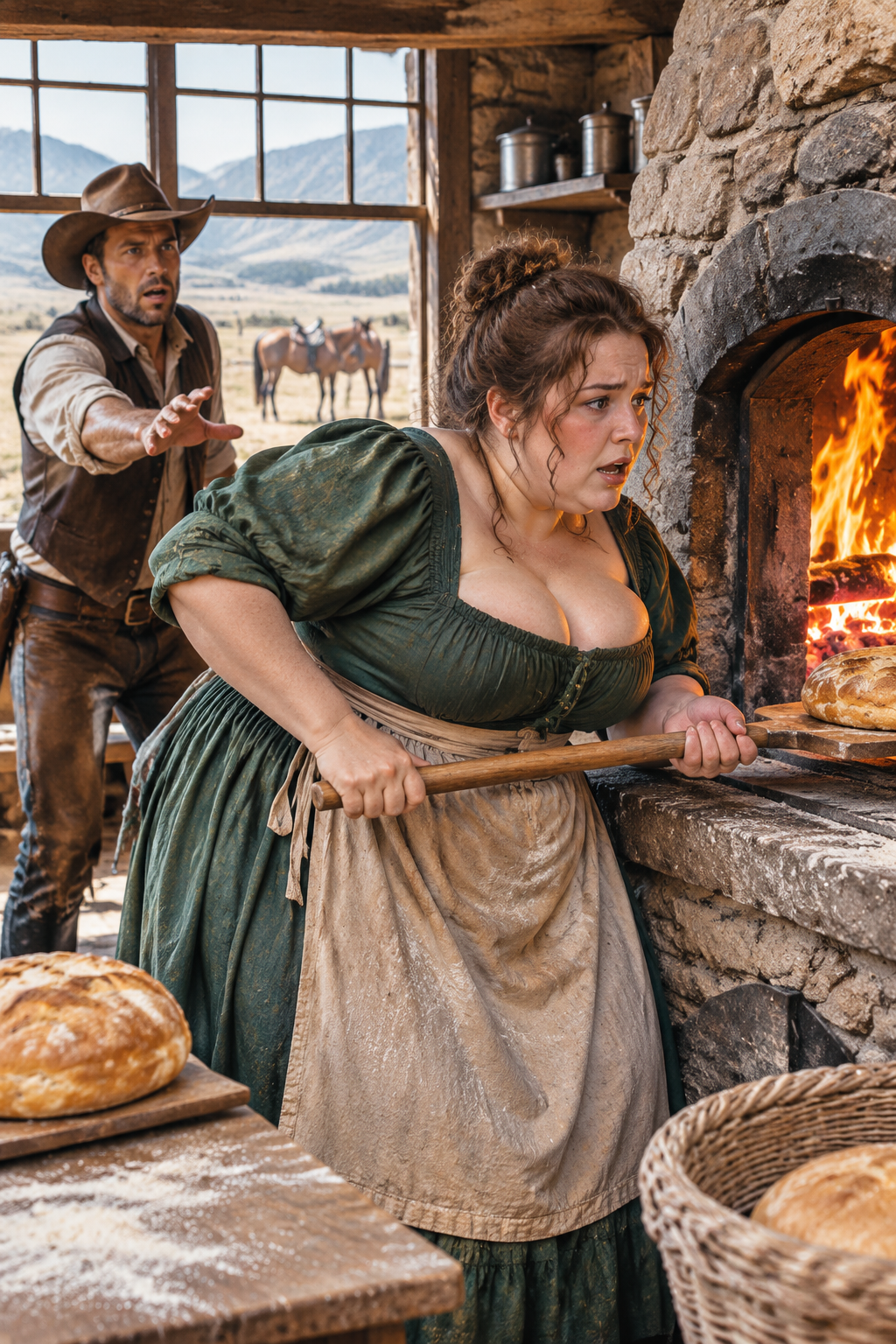
Beside a recipe for peach preserves, Eleanor had written several dates and amounts. Similar figures appeared beside recipes for bread, pickled vegetables, and blackberry pie.
Gideon brought the ranch’s financial records upstairs.
The numbers matched payments made to Harlan.
But Eleanor had recorded smaller amounts beside each one.
“She was calculating the differences,” Clara whispered.
Gideon turned another page.
At the bottom, Eleanor had written an address in a town called Millbrook, nearly eighty miles away.
Beside it were two words.
Josephine’s copies.
Gideon sat down heavily.
“She knew where my sister was.”
“And she was helping her.”
For several minutes, Gideon couldn’t bring himself to speak.
Finally, he closed the book.
“We leave at sunrise.”
Before dawn, Walter prepared a wagon and packed blankets for the journey.
Clara made sandwiches and filled a tin with molasses cookies.
As they traveled through the mountains, Gideon spoke about his childhood. Josephine had been stubborn, fearless, and terrible at keeping secrets. She had once rescued a half-frozen calf and hidden it in his bedroom for three days.
Clara laughed.
Gideon smiled before realizing what he was doing.
“I haven’t told that story in years.”
“Maybe you should tell it more often.”
They reached Millbrook shortly before nightfall.
The address led them to a modest boardinghouse with yellow curtains and a crooked wooden fence.
A woman carrying a basket of laundry stepped outside.
Gideon stopped walking.
The basket slipped from her hands.
“Josephine.”
His sister stared at him.
“What do you want?”
Gideon removed his hat.
“I came to apologize.”
“Six years late.”
“I know.”
Josephine’s eyes filled with tears, but her expression remained hard.
“Did Eleanor have to die before you finally decided I might be telling the truth?”
Gideon flinched.
Clara quietly gathered the fallen laundry.
Josephine noticed her.
“Who are you?”
“Clara Fenwick. I’m the cook at Ashwood Crossing.”
“A cook convinced him to listen?”
“Your sister-in-law did,” Clara answered. “I only found what she left behind.”
Josephine invited them inside.
From beneath a loose floorboard, she retrieved a metal box containing receipts, contracts, and letters.
“Harlan wasn’t just stealing supplies,” she explained. “He was creating false debts against the ranch.”
Gideon examined the documents.
According to several contracts, Ashwood Crossing owed Harlan nearly twenty thousand dollars.
“I never signed these.”
“Neither did I.”
Josephine showed him a letter bearing Eleanor’s handwriting.
“She discovered what Harlan was doing after I left. We planned to take everything to a federal investigator.”
Gideon read the letter.
Eleanor had arranged to meet Josephine at an abandoned schoolhouse beyond the northern ridge.
The meeting was scheduled for the morning she died.
“She never arrived,” Josephine whispered.
Gideon’s face went pale.
“Why didn’t you tell me?”
“I tried. You returned my letters.”
The words struck him harder than any accusation.
Josephine wiped her eyes.
“I attended her funeral from behind the cemetery fence. Harlan saw me and told me I’d be next if I returned.”
Clara reached across the table and took her hand.
“You don’t have to be afraid alone anymore.”
Josephine began to cry.
Gideon knelt beside his sister’s chair.
“I failed you.”
She looked at him for a long time.
Then she placed a trembling hand against his cheek.
“Yes, you did.”
He bowed his head.
“But you’re here now,” she added.
They remained in Millbrook overnight.
The next morning, Josephine packed her belongings and agreed to return to Ashwood Crossing.
However, when their wagon reached the ranch, smoke was rising above the eastern barn.
Walter came running toward them.
“Someone set fire to the hay!”
Gideon jumped down.
The men were desperately carrying buckets from the well. Flames climbed the barn walls, threatening the nearby stable.
Clara heard a horse screaming.
“There’s an animal inside!”
Before Gideon could stop her, she grabbed a wet blanket and rushed toward the stable entrance.
Inside, thick smoke burned her throat.
A young mare was kicking wildly against her stall.
Clara struggled with the latch until it opened. The frightened animal knocked her against the wall before bolting outside.
A burning beam crashed across the doorway.
“Clara!”
Gideon’s voice came from somewhere beyond the smoke.
She tried to stand, but pain shot through her ankle.
Then Gideon appeared, covering his mouth with his sleeve.
He pulled her upright and helped her toward a side opening just as part of the roof collapsed.
They fell onto the cold ground outside.
Gideon held her shoulders.
“What were you thinking?”
“That the horse couldn’t open the door herself.”
He stared at her, breathing heavily.
Then he pulled her against him.
For a moment, neither cared who was watching.
The fire destroyed the barn and nearly half the winter hay.
Walter discovered fresh wagon tracks near the eastern fence and an empty kerosene can beside the burned building.
Gideon wanted to ride directly to Harlan’s store.
Josephine stopped him.
“He wants you angry. Don’t give him what he wants.”
Clara, sitting with her injured ankle wrapped in cloth, nodded.
“We need someone outside this town to examine the evidence.”
They sent a trusted ranch hand to Millbrook with copies of the documents and instructions to contact the district attorney.
Two days later, Harlan arrived with Sheriff Bell.
He carried a leather folder.
“I’m sorry about your barn, Mercer. Terrible misfortune.”
Gideon said nothing.
Harlan opened the folder.
“Unfortunately, your outstanding debts have become a serious concern. I’m exercising my right to claim the ranch.”
Josephine stepped onto the porch.
Harlan’s face changed.
“You.”
“Disappointed?”
Sheriff Bell shifted uncomfortably.
Harlan handed Gideon a foreclosure notice.
“You have until Friday to surrender the property.”
“These signatures are forged,” Gideon replied.
“That’s a matter for the court.”
Clara watched Sheriff Bell.
“Were you the sheriff when Eleanor died?”
He looked away.
“Yes.”
“Did you examine the wagon yourself?”
“Of course.”
“Then you won’t mind answering questions when the district attorney arrives.”
Harlan’s smile vanished.
“What district attorney?”
“The one who has copies of Eleanor’s records.”
It was a gamble. Clara didn’t know whether the messenger had reached his destination.
But Harlan believed her.
He turned toward the sheriff.
“We’re leaving.”
That night, Gideon moved the documents into his bedroom and stationed two men outside the house.
Clara couldn’t sleep.
She went downstairs and stood before Eleanor’s beautiful iron stove.
Gideon found her there.
“I used to sit at that table while she baked,” he said. “Sometimes I’d pretend I needed coffee just to spend another few minutes with her.”
Clara smiled gently.
“She must have loved this room.”
“She did.”
He reached for the faded blue apron.
For a moment, he held it against his chest.
Then he folded it carefully and placed it inside a drawer.
“Would you cook here tomorrow?”
Clara looked at him.
“Are you certain?”
“No. But Eleanor wouldn’t have wanted this kitchen to become a tomb.”
The following morning, the stove was lit for the first time in five years.
The smell of cinnamon bread drifted through the house.
Josephine cried when she entered the kitchen.
Gideon stood beside the doorway, his eyes shining.
Clara served breakfast without mentioning either reaction.
Later that afternoon, a stranger arrived on horseback.
His name was Daniel Reeves, an investigator working for the district attorney.
He had already examined the documents.
“We have enough to begin investigating the fraud,” he explained. “But proving what happened to Mrs. Mercer will be more difficult.”
Walter, who had been standing near the window, suddenly removed his hat.
“I might know something.”
Everyone turned toward him.
The old cowboy looked at Gideon.
“The morning your wife died, I saw Harlan’s younger brother, Amos, working on her wagon.”
Gideon rose from his chair.
“Why didn’t you tell me?”
“He said you asked him to grease the wheels. After the accident, I wondered about it. Then Harlan threatened to have my son arrested for stealing cattle.”
Walter’s voice broke.
“My boy had a wife and two babies. I was scared.”
Gideon walked toward him.
For a terrible moment, Clara thought he might strike him.
Instead, Gideon placed a hand on his shoulder.
“I understand what fear can make a man do.”
Reeves immediately requested Walter’s formal statement.
But Amos Harlan had disappeared years earlier.
Finding him seemed impossible until Josephine remembered a letter Eleanor had written.
Amos had been planning to leave for Oregon.
Reeves sent telegrams to several authorities.
Meanwhile, Harlan made his final move.
On Thursday evening, Clara was preparing supper when she heard glass breaking upstairs.
She rushed into the hallway.
A man emerged from Gideon’s bedroom carrying the metal box.
It was Harlan.
“Put that down,” Clara demanded.
He drew a revolver.
“Get out of my way.”
Clara froze.
Harlan backed toward the staircase.
“You should have stayed at whatever miserable hotel threw you out.”
Clara’s heart pounded.
“How do you know about the hotel?”
“I make inquiries about people who interfere with my business.”
He smiled cruelly.
“They said you were an embarrassment to their establishment.”
Clara felt the familiar sting of humiliation.
But this time, it didn’t silence her.
“And yet here you are, holding a gun because you’re afraid of me.”
His expression twisted.
“You think you’re clever?”
“I think Eleanor was clever. That’s why you killed her.”
Harlan raised the revolver.
“You know nothing about Eleanor.”
“Then tell me.”
“She wouldn’t listen! Amos was supposed to frighten her, not send her over that ridge!”
The front door opened.
Gideon stepped inside with Reeves and Walter.
Harlan turned.
Clara seized a heavy brass candlestick from the hallway table and struck his wrist.
The revolver fell.
A shot exploded into the ceiling.
Gideon lunged forward, knocking Harlan to the floor.
Reeves retrieved the weapon and secured Harlan’s hands.
For several seconds, the only sound was Clara’s ragged breathing.
Then Gideon rushed to her.
“Are you hurt?”
She shook her head.
He pulled her close.
Behind them, Reeves looked down at Harlan.
“I heard what you said about Eleanor. So did these two gentlemen.”
Harlan stopped struggling.
For the first time since Clara had met him, he looked genuinely frightened.
Over the following weeks, the investigation uncovered a network of forged contracts involving several ranches.
Sheriff Bell admitted that Harlan had paid him to overlook evidence from Eleanor’s accident.
Amos was located in Oregon and agreed to testify.
He confessed that he had loosened a wheel on Eleanor’s wagon under his brother’s instructions, believing she would discover the damage before traveling far.
Eleanor had not.
Harlan and Amos were eventually convicted for their roles in her death. The sheriff lost his position and faced criminal charges of his own.
The fraudulent debts against Ashwood Crossing were canceled.
But justice didn’t immediately heal everything.
One morning, Clara found Gideon standing beside Eleanor’s grave.
“I spent five years blaming myself because our last conversation was an argument,” he said.
Clara placed fresh flowers beside the headstone.
“You loved her for more than one conversation.”
“I should have listened.”
“Yes,” Clara replied softly. “And now you can live differently because you know that.”
Gideon took her hand.
They stood together until the winter sun disappeared behind the mountains.
By spring, Ashwood Crossing had changed.
Josephine took responsibility for the ranch’s finances. Walter supervised the construction of a new barn, and every delivery was carefully weighed.
Clara transformed the kitchen into the warmest room in the house.
Then an unexpected letter arrived.
It came from the hotel that had dismissed her.
Several wealthy guests had complained about the declining quality of its meals. The owners had investigated the manager’s decisions and discovered that he had dismissed three experienced employees for reasons unrelated to their work.
They offered Clara her former position, a substantial raise, and an apology.
Gideon found her reading the letter.
“Are you considering it?”
“It’s more money than I’ve ever earned.”
He nodded, though disappointment crossed his face.
“You deserve that.”
Clara folded the letter.
“I also deserve to decide where I belong.”
That evening, she wrote her reply.
She accepted the apology but declined the position.
She recommended two talented former colleagues and urged the owners to judge their employees by their abilities rather than their appearances.
The next morning, Gideon invited Clara to walk with him.
He led her toward a small building near the main road. Its windows had been repaired, and a new chimney rose above the roof.
“What is this?” she asked.
“Your restaurant. If you want it.”
Clara stared at him.
Gideon handed her a set of keys.
“Josephine and I thought the ranch could use a place where travelers and neighboring families could eat. You’d own the business. We’d supply what we could at fair prices.”
Clara’s eyes filled with tears.
“Why would you do this?”
“Because you’re an extraordinary cook. And because you deserve something that belongs to you.”
He hesitated.
“There’s another reason.”
Clara looked up.
“I’ve fallen in love with you.”
The wind moved gently through the grass.
Gideon continued.
“I don’t want you to feel that you owe me anything. You can take those keys and never give me another answer.”
Clara laughed through her tears.
“You really are terrible at romantic speeches.”
“I haven’t had much practice.”
She stepped closer.
“Fortunately, I’m willing to give you some.”
When he kissed her, it was with a tenderness she had never expected from the man who had greeted her so coldly months earlier.
They married the following autumn beneath the rosebush Eleanor had planted.
Josephine stood beside Clara, and Walter cried openly throughout the ceremony.
Clara wore a beautiful ivory dress that fit her exactly as she was.
She hadn’t changed her body to earn Gideon’s affection.
She hadn’t made herself smaller to deserve happiness.
She had simply found people who recognized what had always been there.
Years later, Clara’s restaurant became famous throughout the county.
Above the entrance hung a wooden sign reading THE OPEN TABLE.
She hired people who had been rejected elsewhere. An older widow became her finest baker. A young man with an injured leg managed the dining room. A shy girl who had been mocked for her appearance eventually became Clara’s most talented apprentice.
One afternoon, that girl asked Clara why she had given her a chance when nobody else would.
Clara looked through the window toward Ashwood Crossing, where Gideon was teaching their little daughter to ride a pony.
“Because someone once looked at me and decided what I was worth without knowing anything about me,” she answered.
“And were they wrong?”
Clara smiled.
“Completely.”
She handed the girl a fresh apron and showed her how to prepare Eleanor’s famous cinnamon bread.
The original recipe book remained on a shelf above the kitchen counter, protected by a glass cover. Beside it stood a photograph of Eleanor and Josephine.
Clara never allowed Eleanor’s courage to be forgotten.
And every evening, when the restaurant closed, Gideon came to help carry the remaining bread to families who needed it.
Sometimes he still brought flowers to Eleanor’s grave.
Sometimes Clara went with him.
They understood that loving someone new did not require forgetting someone old.
One winter evening, Gideon found Clara sitting beside the restaurant window, watching snow settle across the ranch.
“Do you ever regret coming here?” he asked.
She considered the question.
She remembered the humiliation of losing her job, the threatening letter, the burning barn, and the lonely man who had refused to open his kitchen.
Then she remembered Josephine’s laughter, Walter’s gratitude, their wedding, and the countless meals that had brought strangers together.
“No,” she said. “Not for a moment.”
Gideon kissed her forehead.
Inside, the stove crackled warmly.
Outside, snow covered the road that had once carried a frightened, unemployed cook toward an uncertain future.
Clara had arrived at Ashwood Crossing believing she had lost everything.
Instead, she had discovered that rejection could close one door without determining what waited behind the next.
The hotel manager had measured her worth by the space she occupied.
But at Ashwood Crossing, that space had become a place of warmth, justice, forgiveness, and love.
And there would always be room at Clara Fenwick’s table for someone the rest of the world had overlooked.
Seven years later, on a bitter December morning, a man collapsed outside The Open Table.
Clara was rolling pastry when her daughter, Lily, rushed into the kitchen.
“Mama! There’s someone lying in the snow!”
Clara hurried outside with two employees.
The stranger wore a threadbare coat, and his boots were nearly falling apart. His face was thin, his beard untrimmed, and his fingers had turned a dangerous shade of blue.
“Bring him inside,” Clara ordered.
They carried him toward the fireplace, wrapped him in blankets, and sent someone for the doctor.
When the stranger finally opened his eyes, Clara was holding a bowl of warm broth.
“Drink slowly,” she instructed.
The man looked at her.
Then his expression changed.
“Miss Fenwick?”
Clara stopped.
She studied his face more carefully.
Beneath the beard and exhaustion, she recognized the man who had once destroyed her livelihood with a single sentence.
His name was Arthur Whitmore.
He had been the manager of the hotel that dismissed her.
For several moments, neither spoke.
Arthur lowered his eyes.
“I didn’t know this was your restaurant.”
Clara placed the bowl beside him.
“What happened to you?”
He gave a bitter laugh.
“Everything I thought could never happen.”
After losing his position at the hotel, Arthur had invested his savings in a business that failed. His wife had died of pneumonia, and mounting debts had forced him to sell his house.
He had been traveling west, hoping to find employment, when the winter storm caught him.
“I haven’t eaten in two days,” he admitted.
Clara handed him the broth.
“Then you’d better finish this.”
Arthur stared at her.
“You remember what I said to you?”
“Every word.”
“Why are you helping me?”
Clara pulled a chair beside the fireplace.
“Because being hungry isn’t a punishment anyone deserves.”
Arthur’s eyes filled with tears.
That evening, Gideon returned from checking the cattle and found Clara preparing a room for their unexpected guest.
When she explained who Arthur was, his expression hardened.
“The man who fired you?”
“Yes.”
“And you’re letting him stay?”
“Until he’s strong enough to travel.”
Gideon looked toward the guest room.
“I don’t think I could be that generous.”
Clara smiled faintly.
“Neither could I, once.”
Arthur remained at Ashwood Crossing for nearly two weeks.
During that time, he watched Clara manage her restaurant, teach her employees, comfort frightened children, and welcome travelers who couldn’t always afford their meals.
He saw people treat her with the kind of respect he had once believed could only be earned through wealth and appearance.
One afternoon, he found her reviewing accounts at a corner table.
“May I ask you something?”
Clara nodded.
“Did you hate me?”
She considered his question.
“For a while.”
“And now?”
“Now I have too much worth loving to spend my life hating you.”
Arthur sat down slowly.
“I thought I understood what made people valuable. I thought appearance, education, and social standing were everything.”
He looked at his worn hands.
“Then I lost all three.”
Clara closed the account book.
“You haven’t lost your ability to become a better man.”
The following morning, Arthur asked whether there was any work he could do.
Clara offered him a temporary position washing dishes and organizing supplies.
He accepted without hesitation.
For the first time in his life, Arthur worked beside people he would once have considered beneath him.
He discovered that the elderly baker knew more about running a kitchen than most hotel executives. He learned that the young man with the injured leg could manage a crowded dining room with remarkable efficiency.
And he watched Clara’s former apprentice, now an accomplished chef, prepare dishes that would have impressed the wealthiest guests at his old hotel.
One evening, after the last customer departed, Arthur approached Clara.
“I owe you an apology.”
“You’ve already apologized.”
“Not properly.”
He removed his apron.
“I dismissed you because I believed your appearance might embarrass the hotel. The truth is, I was the embarrassment.”
Clara remained silent.
“You were talented, hardworking, and loyal. I took away your livelihood because I wanted to impress people who wouldn’t have cared whether I lived or died.”
His voice broke.
“I cannot undo what I did. But I’m deeply sorry.”
Clara stood and extended her hand.
“I accept your apology, Arthur.”
He shook it, struggling to hold back tears.
By spring, Arthur had saved enough money to continue his journey. Clara wrote him a recommendation, and Josephine helped him secure employment at a boardinghouse in Millbrook.
Before leaving, he placed a small envelope on Clara’s desk.
Inside was his first week’s wages.
A note accompanied the money.
“For someone who needs a meal more than I do.”
Clara smiled and placed the money inside the restaurant’s donation jar.
She never saw Arthur again, but letters arrived occasionally.
He eventually became the manager of the boardinghouse, where he earned a reputation for hiring people who struggled to find employment elsewhere.
Years passed peacefully at Ashwood Crossing.
Lily grew into a spirited young woman with her father’s determination and her mother’s compassion.
Walter retired from ranch work but continued visiting the restaurant every morning, claiming Clara’s biscuits were the only reason he remained alive.
Josephine married a schoolteacher from Millbrook and opened a small school for children whose families couldn’t afford tuition.
Gideon’s hair gradually turned silver.
Clara’s hands became slower, but her recipes remained as wonderful as ever.
Then, one autumn afternoon, a wealthy businessman arrived at The Open Table.
He introduced himself as Charles Bennett, the owner of several successful hotels.
“I’ve heard remarkable things about your establishment, Mrs. Mercer.”
Clara poured him a cup of coffee.
“I hope they were good things.”
“Exceptional things.”
He presented her with an offer to purchase the restaurant for an enormous sum of money.
Clara examined the document.
It was enough to guarantee financial security for her entire family.
“There would be a few changes, naturally,” Bennett explained.
“What kind of changes?”
“A more refined atmosphere. Higher prices. A carefully selected clientele.”
He glanced toward a table where two ranch hands were eating beside a traveling family.
“We would need to discourage certain customers.”
Clara pushed the document back toward him.
“Then I’m afraid you’ve misunderstood what this restaurant is.”
Bennett frowned.
“Mrs. Mercer, this is an extraordinary opportunity.”
“For whom?”
“For you, of course.”
Clara looked around the dining room.
She saw a widow sharing bread with her grandchildren, a tired farmer drinking coffee, and a young mother feeding her baby beside the window.
“These people are the reason this place exists.”
“You’re refusing a fortune for them?”
“I’m refusing to become someone I spent years learning not to be.”
Bennett left without purchasing the restaurant.
That evening, Clara told Gideon about the offer.
He laughed.
“I wish I’d seen his face.”
“Are you disappointed?”
Gideon took her hand.
“Clara, we’ve been rich for years.”
She looked around their modest home.
Then she understood.
Their wealth had never been measured in dollars.
It was in the people who came through their door, the family they had built, and the peace they had fought so hard to find.
On their twenty-fifth wedding anniversary, Lily organized a celebration at The Open Table.
Former employees traveled from distant towns. Ranchers brought flowers, children carried handmade cards, and Josephine prepared a speech that made everyone laugh and cry.
Above the fireplace hung Eleanor’s photograph.
Beneath it was a small brass plaque bearing the words:
“Courage begins when someone refuses to remain silent.”
Clara stood before the gathering, overwhelmed by the faces surrounding her.
“I don’t know what to say,” she admitted.
Walter, now an exceptionally old man, raised his walking stick.
“Tell us when supper’s ready!”
The room erupted with laughter.
Gideon wrapped an arm around his wife.
“You’ve given these people more than food,” he whispered.
Clara looked at him.
“And they’ve given me more than I ever imagined.”
Late that evening, after the celebration ended, Clara and Gideon walked toward the house beneath a sky filled with stars.
They stopped beside Eleanor’s rosebush.
Gideon gently touched one of its branches.
“I used to believe my life ended when Eleanor died.”
Clara slipped her hand into his.
“I know.”
“Then you arrived carrying a suitcase and asking questions nobody wanted to answer.”
“You weren’t particularly welcoming.”
“I was a fool.”
“Occasionally, you still are.”
He laughed and kissed her.
Many years later, when Clara finally retired, Lily took responsibility for The Open Table.
She preserved her mother’s recipes, maintained the donation jar, and refused to remove the wooden sign above the entrance.
On Clara’s final morning working in the kitchen, Lily found her standing beside the old iron stove.
“Are you going to miss it?”
Clara ran her fingers along the worn countertop.
“Every day.”
“You can always come back.”
“I know, sweetheart. But it’s your turn now.”
She handed Lily a handwritten recipe book.
Inside were decades of recipes, notes, and memories.
On the final page, Clara had written a message.
“Never judge a person by their appearance, their possessions, or the mistakes they have made. Give them the opportunity to show you who they are. And whenever possible, leave the world a little kinder than you found it.”
Lily embraced her mother.
Outside, Gideon waited on the porch with two cups of coffee.
Clara joined him, resting her head against his shoulder as they watched customers arrive.
A young woman approached the restaurant carrying a battered suitcase.
Her clothes were worn, and uncertainty filled her expression.
She stopped beside Lily.
“Excuse me. I heard you might be looking for a cook.”
“Do you have experience?” Lily asked.
“Some. But nobody seems willing to give me a chance.”
Lily smiled and opened the door.
“Come inside. Let’s see what you can do.”
Watching from the porch, Clara felt tears gather in her eyes.
Gideon squeezed her hand.
“Remind you of anyone?”
Clara nodded.
For a moment, she remembered the frightened woman who had arrived at Ashwood Crossing all those years ago, believing that losing her job meant losing her future.
How little she had known about the beautiful life waiting beyond that disappointment.
She had never needed to become thinner, prettier, or more acceptable to deserve happiness.
She had only needed the courage to stop allowing other people to define her worth.
And now, the kindness she had fought to preserve would continue long after she was gone.
Clara closed her eyes and smiled beneath the warm afternoon sunlight.
The restaurant door remained open.
The kitchen was filled with laughter.
And there was another place being set at the table.
THE END.