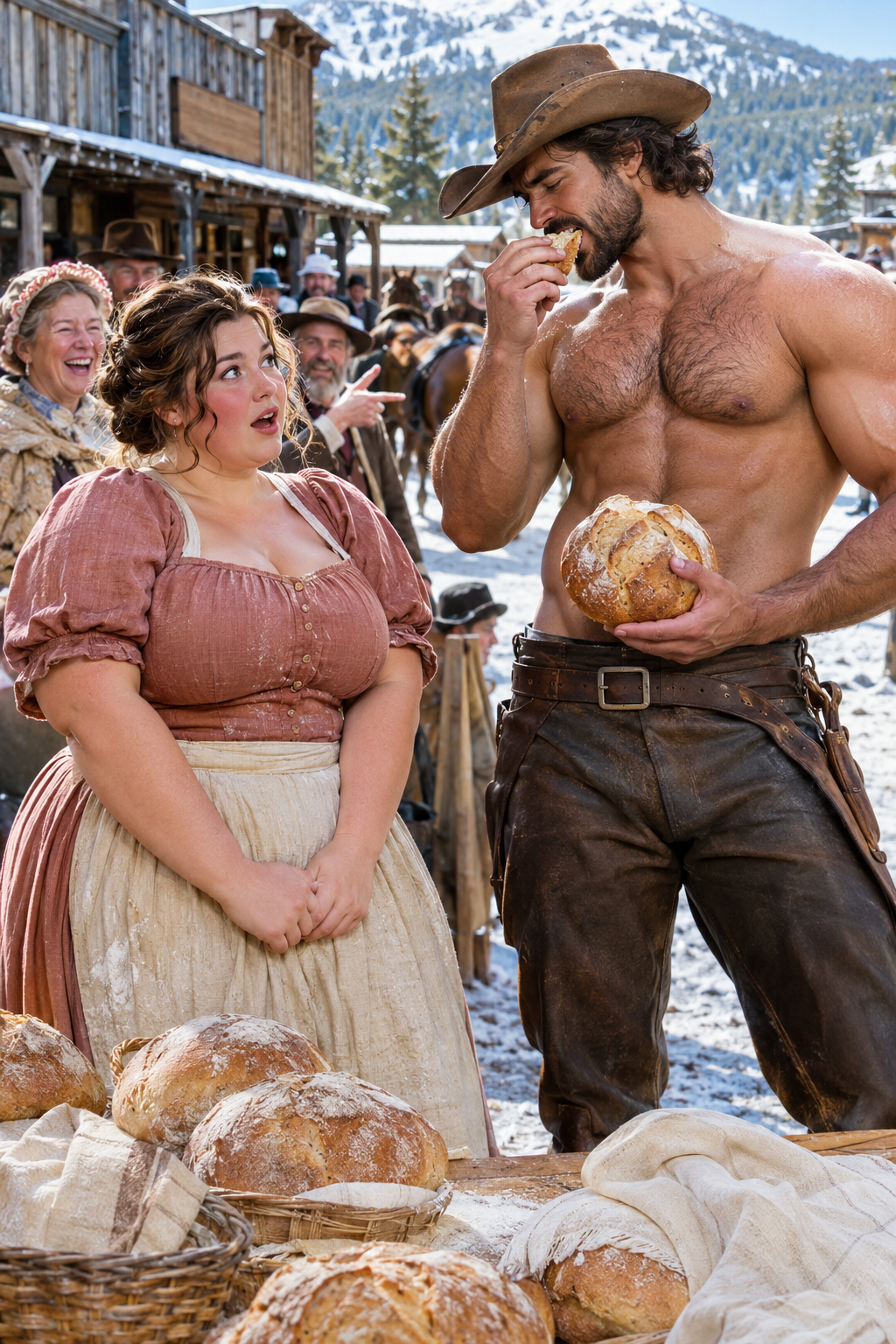
“Your bread is too heavy for decent people,” the woman sneered. Then the biggest rancher in Red Pine walked into my bakery and said six words that made everyone go silent.
I looked down at the paper.
At first, I thought it was a bill. Then I noticed the official seal stamped at the bottom and the words written across the top.
NOTICE OF FORECLOSURE.
My stomach tightened.
“What is this?”
Caleb pulled out a chair and sat down. For the first time since I had met him, he looked tired.
“The bank is taking the ranch.”
I stared at him.
“But… this is Morgan Ranch. Everyone in Red Pine knows how much land you own.”
“Knowing how much land a man owns and knowing how much money he has are two different things.”
He rubbed his forehead.
“Last winter, we lost nearly a third of our cattle to a terrible storm. Then the spring floods destroyed two bridges and washed away part of the southern grazing land. I borrowed money to keep my men employed and the ranch running.”
He tapped the paper.
“The bank gave me until the end of the month. After that, they’ll auction everything.”
I looked at the date.
There were only nineteen days left.
“Why are you telling me this?”
Caleb hesitated.
“Because I need your help.”
I almost laughed.
“Mr. Morgan, I’m a baker. I don’t know anything about banks, cattle, or ranching.”
“I know.”
“Then what could I possibly do?”
He looked toward the enormous stove, where the last warmth of the evening meal still lingered.
“Your bread.”
I blinked.
“My bread?”
“Your loaves keep my men full. They don’t have to leave work early to find something else to eat. Your biscuits have become the only thing Amos talks about when he’s sober.”
Despite everything, I almost smiled.
Caleb continued.
“I’ve been thinking about opening a supply business. Flour, preserved food, bread, dried meat. We could sell provisions to the other ranches and mining camps. There’s a growing demand, but I don’t have anyone I trust to run the kitchen and manage the food side of it.”
I studied him carefully.
“You want me to help you start a business?”
“I want to offer you a partnership.”
The word sounded almost foreign.
Partnership.
Not employment. Not charity.
Something equal.
But before I could answer, a voice came from the doorway.
“That’s a generous offer, boss. Shame it’ll be worthless by the end of the month.”
Amos stood there, his hat tilted back and a cigarette hanging from his lips.
Caleb’s expression hardened.
“What do you want?”
“Just thought Miss Collins ought to know the truth before she gets herself mixed up in a sinking ship.”
He stepped inside and dropped a folded newspaper onto the table.
“Your little partnership won’t save anything. The bank has already found a buyer.”
Caleb stood.
“Get out, Amos.”
Amos ignored him.
“The buyer is offering enough to settle the debt and then some. But there’s one condition.”
He turned toward me with a crooked smile.
“He wants the ranch sold immediately. No employees, no existing contracts, no troublesome business arrangements.”
My hands went cold.
“Who is the buyer?” I asked.
Amos smiled.
“Silas Whitmore.”
I knew that name.
Everyone in Red Pine knew it.
Silas Whitmore owned the largest general store, two warehouses, and several freight wagons. He had a reputation for buying struggling businesses cheaply and selling their assets for a fortune.
He had once offered my aunt a ridiculous amount of money for her bakery.
When she refused, he had reminded her that debts had a way of making people reconsider.
Caleb folded the newspaper.
“Amos, you’re finished here.”
The cowboy’s smile disappeared.
“Fine. But don’t say I didn’t warn you.”
He walked out, leaving the kitchen door swinging behind him.
For a long moment, neither of us spoke.
Then I asked the question that had been bothering me.
“Why would Whitmore want your ranch?”
Caleb looked at me.
“Because there’s a railroad survey planned for the valley. The new line could pass through this property. Whoever controls the land could make a fortune.”
I glanced at the foreclosure notice again.
Suddenly, the situation seemed much bigger than a struggling ranch.
“Then we need to stop him.”
Caleb gave a weary smile.
“Rebecca, I appreciate your determination, but this isn’t a problem you can solve with flour and determination.”
“Maybe not. But you hired me because you believed I could do something useful. Give me the chance to prove you right.”
He studied me for several seconds.
Then he nodded.
“Three weeks, Rebecca. That’s what we have.”
I looked at the notice.
“We have nineteen days.”
And for the first time in my life, I was no longer afraid of what might happen if I stood up for myself.
The next morning, I woke before sunrise.
I found the kitchen already occupied by Caleb, who was sitting at the table with a stack of account books.
He looked surprised when I entered.
“You’re up early.”
“So are you.”
“I haven’t slept much.”
I tied my apron.
“Then let’s make breakfast before we save your ranch.”
He laughed.
It was the first genuine laugh I’d heard from him.
By seven, the kitchen smelled of coffee, fried potatoes, eggs, and fresh bread.
The ranch hands gathered around the table, but the usual jokes were absent.
Caleb had told them about the foreclosure.
Eleven men now faced the possibility of losing their jobs and homes.
Amos sat at the far end, unusually quiet.
I placed a basket of warm bread in the center.
“We’re going to need everyone’s help,” I announced.
A young cowboy named Thomas raised his hand.
“What kind of help?”
“First, I need to know what food we have, what we’re spending, and what we’re wasting. Then I want to know who has relatives in nearby towns, who knows the miners, and who can drive a wagon.”
One of the men frowned.
“Why?”
“Because we’re going to start selling food.”
Amos snorted.
“Selling food? That’s your grand plan?”
I turned toward him.
“No. My grand plan is to make sure eleven hardworking men don’t lose their livelihoods because a few wealthy people believe they can buy everything.”
Nobody laughed.
I continued.
“We’ll bake bread, prepare biscuits, preserve meat, and sell provisions to nearby ranches. We’ll take orders before making anything, so we don’t waste supplies.”
Caleb watched me with an expression I couldn’t quite read.
Then Thomas stood.
“I can drive a wagon.”
Another man raised his hand.
“I know the foreman at the Silver Creek mine.”
A third offered to repair the old delivery wagon.
One by one, the men began volunteering.
Even Amos finally muttered, “I know a man who owns a smokehouse.”
I nodded.
“Good. Then perhaps you can help us make something useful.”
He looked at me as if he wasn’t sure whether I’d forgiven him.
I hadn’t.
But I was beginning to understand that a person’s past behavior didn’t have to determine every decision they made next.
The following days were exhausting.
I worked from before dawn until well after dark.
We baked rye loaves, cornmeal bread, honey biscuits, meat pies, and small cakes that could survive a long wagon journey.
Thomas and two other men delivered samples to neighboring ranches.
At first, the response was disappointing.
Some ranchers thought our prices were too high.
Others doubted that food prepared by a woman who had never managed a business could be reliable.
Then something unexpected happened.
A letter arrived from the Silver Creek mine.
They wanted forty loaves every Monday and Thursday, along with twenty dozen biscuits.
The order was worth more than anything my aunt’s bakery had earned in a month.
I read the letter twice.
Then I read it a third time.
Caleb stood behind me.
“Looks like you’ve got your first customer.”
I turned toward him, grinning.
“We’ve got a business.”
He smiled.
For the next few days, everything seemed to move in our favor.
The mine placed another order.
Two ranches requested weekly deliveries.
A traveling merchant agreed to purchase our preserved food.
For the first time, the ranch kitchen wasn’t simply a place where hungry men gathered.
It had become the center of something alive.
But success brought attention.
And not everyone was pleased.
On the eighth day, I returned from the smokehouse to find a stranger waiting beside the kitchen door.
He wore an expensive coat and polished boots that looked completely out of place in the muddy yard.
“Miss Collins?”
“Yes.”
He removed his hat.
“Silas Whitmore. I believe we’ve met.”
I remembered him immediately.
He had the same thin smile and cold eyes I recalled from my aunt’s bakery.
“Mr. Whitmore.”
He glanced toward the kitchen.
“I hear you’ve been making quite a business out of feeding cowboys.”
“Someone has to.”
He chuckled.
“That’s a charming answer.”
He reached into his coat and handed me a small envelope.
Inside was a bank draft.
The amount was enough to pay every debt my aunt’s bakery owed, repair the roof, replace the ovens, and leave enough money for us to live comfortably for years.
I stared at it.
“What is this?”
“An opportunity.”
“I don’t understand.”
“I understand your aunt’s bakery is struggling. I also understand that you’re working here because you need money.”
He leaned closer.
“Take the payment. Return to Red Pine. Let Mr. Morgan handle his own problems.”
My fingers tightened around the envelope.
“You want me to abandon the business?”
“I want you to make a sensible decision.”
“And if I refuse?”
His smile faded.
“Then I suspect you’ll discover how expensive stubbornness can become.”
I handed the envelope back.
“My aunt taught me that bread tastes better when it’s made with honest hands. I don’t believe she’d want me selling those hands to you.”
Whitmore slipped the draft into his pocket.
“Pity.”
He placed his hat on his head.
“Enjoy the kitchen while you can, Miss Collins. It won’t be yours for much longer.”
He rode away.
I watched him disappear down the road.
That evening, I told Caleb everything.
He listened without interrupting.
When I finished, he looked furious.
“He has no right to threaten you.”
“He didn’t threaten me directly.”
“Rebecca, I’ve known men like Whitmore for years. They don’t make offers unless they’ve already decided what they want.”
I sat down.
“What do we do?”
Caleb looked at the account books.
“Keep working.”
But the next morning, we discovered that someone had sabotaged the delivery wagon.
One wheel had been smashed, and the harness was missing.
The order for the Silver Creek mine was due by noon.
Thomas cursed when he saw the damage.
“We’ll never make it in time.”
I looked at the kitchen.
Forty loaves were already cooling on the shelves.
Twenty dozen biscuits sat packed in wooden crates.
“We can still do it.”
Caleb frowned.
“How?”
“We take the smaller wagon. Load only the bread and biscuits. The rest can follow tomorrow.”
“The smaller wagon can’t carry everything.”
“Then we’ll make two trips.”
Thomas shook his head.
“That’s six hours each way.”
I looked at Caleb.
“Then we leave now.”
He studied me, then reached for his coat.
“I’ll drive.”
The road to Silver Creek was rough, and rain began falling halfway through the journey.
The little wagon creaked beneath its load.
By the time we reached the mine, we were nearly an hour late.
The foreman stood outside the supply building with his arms crossed.
“I was expecting your delivery at noon.”
“I apologize,” I said. “We had a problem with the wagon.”
He looked at the crates.
“Are those the biscuits?”
“Yes.”
He opened one and took a bite.
His expression changed.
He took another.
Then he looked at Caleb.
“Can you guarantee the next order arrives on time?”
“We can,” Caleb replied.
The foreman considered this.
“Good. Because the men have been asking for your bread all morning.”
I nearly laughed with relief.
We returned to the ranch after dark.
I was soaked, exhausted, and aching in places I hadn’t known could ache.
Caleb helped me down from the wagon.
“You didn’t have to come.”
“Neither did you.”
He looked at me for a long moment.
“That’s what partnership means, I suppose.”
I smiled.
“Something like that.”
For a second, the world seemed quiet around us.
Then he reached out and gently brushed a strand of wet hair away from my cheek.
Neither of us moved.
But before either could speak, a shout came from the barn.
“Boss! We’ve got trouble!”
Caleb stepped back.
A ranch hand came running toward us.
“The north pasture fence is down. Half the cattle are missing.”
Caleb’s face went pale.
“How many?”
“Nearly thirty.”
He ran for his horse.
I followed him to the barn.
“Rebecca, stay here.”
“I’m coming.”
“This isn’t a kitchen problem.”
“No,” I replied. “It’s a ranch problem. And this is our business.”
He stared at me, then handed me a lantern.
We rode into the darkness with four ranch hands.
The storm had made the ground difficult to navigate.
We found hoofprints leading toward the old creek crossing.
Then Thomas spotted something in the distance.
A lantern.
Someone was moving the cattle.
Caleb rode forward.
“Who’s there?”
A figure turned.
Then another.
Two men were driving the missing cattle toward a waiting wagon.
One of them raised a rifle.
“Stay back!”
Caleb pulled his horse to a stop.
“Those cattle belong to Morgan Ranch.”
The man laughed.
“Not for much longer.”
A gunshot cracked through the night.
The horses panicked.
I ducked instinctively as Caleb grabbed the reins and pulled me behind a rocky rise.
Thomas and the other men scattered.
“Stay down!” Caleb shouted.
I could hear my heart pounding.
Then I noticed something.
The wagon was stuck in the mud.
One of the thieves was trying desperately to free it.
The other had moved toward the cattle.
“Caleb,” I whispered.
He looked at me.
“The wagon can’t move. They’re trapped.”
He glanced toward the creek.
Then he understood.
“Thomas! Circle around the crossing!”
The ranch hands moved quickly.
The thieves realized they were surrounded and tried to escape.
One managed to mount a horse, but Thomas caught the reins.
The other dropped his rifle and surrendered.
When the sheriff arrived an hour later, both men were in custody.
One of them eventually admitted that Silas Whitmore had paid them to move the cattle.
Caleb stood beside me as the sheriff wrote down the confession.
For the first time, I saw something other than worry in his eyes.
Hope.
But the following morning, that hope was nearly destroyed.
A messenger arrived from Red Pine carrying a telegram.
The bank had scheduled the auction for the next afternoon.
Not the end of the month.
Not nineteen days.
Tomorrow.
Caleb read the telegram twice.
“They’ve accelerated the foreclosure.”
“Can they do that?”
“They claim the agreement allows it.”
I felt anger rising inside me.
“Then we need a lawyer.”
Caleb shook his head.
“We can’t afford one.”
I thought about the account books, the growing orders, and the money we’d earned.
“How much do we owe?”
He told me.
I went completely still.
Even if every customer paid immediately, we would still be short.
By a great deal.
For the first time since arriving at the ranch, I felt powerless.
That afternoon, I went into the kitchen and found Amos sitting alone.
He was staring at a plate of untouched food.
“Something wrong?” I asked.
He looked up.
“I need to tell you something.”
I waited.
He took a long breath.
“Whitmore offered me money to tell him about the ranch’s business.”
My stomach dropped.
“What?”
“He wanted to know how many orders we were getting, which wagons we were using, when Caleb would be away from the property.”
I stared at him.
“And you told him?”
Amos lowered his head.
“At first.”
The kitchen suddenly felt very small.
“You were helping him?”
“I was desperate. My brother’s been sick. I needed money.”
He swallowed.
“But when I heard about the cattle, I realized what I’d done.”
I folded my arms.
“Why are you telling me now?”
“Because I know something.”
He reached into his coat and placed a small piece of paper on the table.
“Whitmore told me he had the original deed to the eastern grazing land. He said the bank couldn’t touch it because the ownership was disputed.”
I frowned.
“What does that have to do with anything?”
“Caleb’s father never finished transferring the property into the ranch company. The deed might still be registered under his father’s estate.”
My mind raced.
“Then the bank may not have the right to sell that land.”
Amos nodded.
“I think Whitmore knows that. That’s why he wants the whole ranch.”
I grabbed the paper.
“Does Caleb know?”
“No. His father handled all the paperwork.”
I hurried to find Caleb.
When I told him, he looked as though someone had struck him.
“My father?”
“He may have left an unresolved property claim.”
Caleb paced across the office.
“I remember him talking about the eastern land. He said it was meant to remain in the family.”
“Where would the deed be?”
Caleb stopped.
“In his old study.”
We searched the house for hours.
Dust-covered boxes, ledgers, letters, and old maps lay scattered across the floor.
At last, Caleb found a locked wooden chest beneath his father’s desk.
He tried several keys before one finally turned.
Inside were letters, receipts, and a leather folder.
He opened it carefully.
There it was.
An original deed bearing the county registrar’s seal.
The eastern grazing land had never been transferred to the ranch’s creditors.
But there was something else.
A handwritten letter from Caleb’s father.
He read it silently, then passed it to me.
The letter explained that the eastern land contained a natural spring and an old mineral survey. His father had refused to sell it because he wanted it preserved for the ranch and the families who depended on it.
At the bottom, he’d written one final sentence:
Land is not valuable because of what you can take from it. It is valuable because of what it allows others to build.
I looked up.
“Caleb, this could change everything.”
He nodded slowly.
“If the deed is valid, the bank can’t auction that parcel.”
“And if Whitmore’s offer depends on buying the entire property, his plan could collapse.”
We rode to Red Pine before sunrise.
The county courthouse opened at eight.
Caleb submitted the deed to the registrar, who examined the seal and the original signatures.
After nearly two hours, he called us into his office.
“The document appears authentic,” he said. “But there’s a problem.”
My heart sank.
“What problem?”
“The estate’s ownership records were never updated. We need the original probate file to confirm the chain of title.”
“Where is it?”
“Possibly in the county archives. Unfortunately, those records were damaged in the flood years ago.”
Caleb leaned forward.
“Then how do we prove it?”
The registrar looked at him.
“Witness statements. Tax receipts. Any official correspondence showing your father maintained ownership.”
We had less than six hours before the auction.
I felt the walls closing in.
Then I remembered something.
“My aunt.”
Caleb turned.
“What about her?”
“She used to talk about how your father helped her after the bakery fire. She said he had kept a small book of loans and land agreements because he never trusted banks with important family records.”
Caleb stared at me.
“Where would that book be?”
I swallowed.
“In my aunt’s bakery.”
We rode back to Red Pine as quickly as we could.
My aunt, Margaret, was waiting behind the counter when we arrived.
When I explained everything, she immediately disappeared into the storage room.
She returned carrying a battered wooden box.
“I wondered when someone would come looking for this.”
Inside was a small leather ledger.
My aunt explained that Caleb’s father had left it with her for safekeeping after the flood.
He had trusted her because she had never asked for anything in return.
We opened the ledger.
There were pages of transactions, signatures, and land records.
Near the middle, we found an entry dated twenty-two years earlier.
It confirmed that Caleb’s father had paid the property taxes on the eastern land for twelve consecutive years and had never transferred ownership.
There was also a signed statement from the former county clerk.
The registrar examined the documents.
Then he looked up.
“This is sufficient to establish a legitimate claim. The auction cannot proceed until the disputed title is resolved.”
Caleb closed his eyes.
For a moment, neither of us spoke.
Then he reached for my hand.
“Rebecca, you just saved the ranch.”
I shook my head.
“We did.”
The auction was postponed.
But Whitmore wasn’t finished.
That afternoon, he appeared outside the courthouse with two lawyers.
He looked directly at Caleb.
“You think you’ve won?”
Caleb stood beside me.
“I think you’ve underestimated how far people will go to protect what belongs to them.”
Whitmore turned toward me.
“And you, Miss Collins. You could have walked away with enough money to live comfortably. Instead, you’ve chosen to tie yourself to a failing ranch.”
I looked him straight in the eye.
“Perhaps you should learn the difference between something that is failing and something that is being rebuilt.”
His expression darkened.
“You’ll regret this.”
He walked away.
But the next challenge was waiting inside the bank.
The foreclosure on the remaining property was still valid.
We had bought time, not freedom.
Caleb needed to refinance the debt.
And he needed someone willing to invest.
That evening, I returned to the ranch kitchen and found all eleven men waiting around the table.
There was an envelope in front of each of them.
“What are these?” I asked.
Thomas stood.
“Pay advances. Our savings.”
I stared at him.
“You can’t do that.”
“We’ve been paid fairly for years,” he said. “Now it’s our turn to help.”
Another man nodded.
“My wife and I have some money put away.”
Amos stood last.
“I sold my horse.”
I looked at him in disbelief.
“You did what?”
He shrugged.
“Never was much of a horse anyway.”
A few men laughed.
Then his expression grew serious.
“I know I don’t deserve your trust, Rebecca. But I want to make things right. I’ll testify about Whitmore, and I’ll work every delivery until we get this place back on its feet.”
I looked around the table.
Eleven men.
Eleven families.
A business built from bread, hard work, and people who refused to abandon one another.
I felt tears gathering in my eyes.
“We can’t ask you to risk everything.”
Thomas smiled.
“Then don’t ask. Let us choose.”
The following morning, Caleb and I took the money to the bank.
We presented the sales contracts from the mine and neighboring ranches, the revised property records, and the investment pledges from the workers.
The bank manager studied the documents for a long time.
Finally, he removed his glasses.
“Mr. Morgan, this business has potential.”
Caleb leaned forward.
“Then give us a chance.”
The manager glanced at me.
“Miss Collins, these contracts carry your name as well.”
I nodded.
“I’m a partner.”
He examined the accounts again.
Then he made an offer.
The bank would restructure the debt over five years, provided we could meet a reduced initial payment and maintain regular business income.
It was a risk.
A tremendous one.
But it was a chance.
Caleb accepted.
Outside the bank, he stopped on the courthouse steps.
“We did it.”
I smiled.
“Not quite. We still have to make enough bread to pay for it.”
He laughed.
Then his expression softened.
“Rebecca, there’s something I’ve wanted to ask you.”
I looked at him.
“Go ahead.”
“When these three weeks are over, will you stay?”
I hesitated.
“On the ranch?”
“On the ranch. In the business. Wherever you want to be.”
He took a breath.
“I know I hired you because I needed a cook. But somewhere along the way, I started looking forward to seeing you every morning. I don’t want to pretend that’s only because of your biscuits.”
My cheeks warmed.
“That’s fortunate.”
“Why?”
“Because I stopped pretending it was only about the bread a long time ago.”
He smiled.
Then he kissed me.
It was gentle and uncertain at first, as though he was afraid of asking for too much.
I reached for his hand.
And for the first time in years, I felt no need to hide who I was.
Three weeks later, Morgan Ranch was still standing.
The new supply business had a name.
Morgan & Collins Provision Company.
We built a proper bakery beside the old barn, with a larger oven, clean storage rooms, and a covered loading area.
My aunt came to visit and cried when she saw the new sign.
“You’ve done something wonderful,” she whispered.
I shook my head.
“We did it together.”
The business grew faster than we expected.
The Silver Creek mine increased its orders.
Three additional ranches signed regular contracts.
Within six months, we employed six local women to help bake, preserve food, and package deliveries.
We paid them the same wages as the men who worked in the warehouse.
No one questioned it.
Not after they tasted the food.
As for Amos, he kept his promise.
He worked harder than anyone and eventually became our delivery supervisor.
He never made another joke about my size.
One evening, I found him placing a fresh loaf on the kitchen counter.
“Miss Collins,” he said awkwardly.
“Yes?”
“I wanted to thank you.”
“For what?”
“For giving me a chance to do better when I hadn’t earned one.”
I looked at him.
“Don’t thank me. Just remember how it felt to be judged before someone knew you.”
He nodded.
“I will.”
Whitmore eventually faced charges for hiring men to steal the cattle and interfering with the ranch’s operations.
His reputation collapsed, and several businesses he had purchased under questionable circumstances came under investigation.
The railroad survey was eventually completed, but the route passed through the valley without destroying the ranch.
Caleb refused to sell the eastern grazing land.
Instead, he worked with the county to protect the spring and preserve access for neighboring families during dry seasons.
His father’s words became a guiding principle for everything we built.
One year after my first day at Morgan Ranch, we held a celebration in the courtyard.
There were tables filled with roasted beef, apple pies, biscuits, and every kind of bread I knew how to make.
The ranch hands brought their families.
The miners came from Silver Creek.
Even the woman who had once insulted my bread in Red Pine appeared, wearing a fine dress and an uncomfortable expression.
She approached me while I was arranging a basket of rye loaves.
“Miss Collins,” she said.
I turned.
“Yes?”
She glanced at the bread.
“I suppose I owe you an apology.”
I waited.
“Your bread is… quite popular now.”
I smiled politely.
“It’s the same bread I’ve always made.”
She looked embarrassed.
“I didn’t mean what I said back then.”
I placed another loaf in the basket.
“Perhaps not. But I heard it.”
She lowered her eyes.
For a moment, I considered all the years I’d spent believing that my body made me less deserving of kindness, respect, and opportunity.
Then I realized something important.
Her opinion had never been the truth.
It had only been an opinion.
“Would you like a slice?” I asked.
She looked surprised.
“If you don’t mind.”
I cut her a generous piece and handed it over.
She took a bite.
Then another.
“It’s delicious,” she admitted.
“Thank you.”
When she walked away, Caleb appeared beside me.
“You handled that well.”
I shrugged.
“I’ve had practice.”
He laughed and slipped his arm around my waist.
Across the courtyard, the men were singing, the children were chasing one another between the tables, and my aunt was telling anyone who would listen that she’d always known I was capable of great things.
I leaned against Caleb.
“Do you remember the first time you came into my bakery?”
He smiled.
“I remember the bread.”
“Not the woman who was being insulted?”
“I remember her too.”
“What did you think?”
He considered the question.
“I thought she was standing in a room full of people who couldn’t see what was right in front of them.”
My throat tightened.
He continued.
“I thought your bread was honest, your hands were talented, and your heart was stronger than you realized.”
I looked toward the bakery.
The ovens glowed warmly through the open windows.
For years, I had believed that I needed to become smaller, quieter, and less noticeable to deserve a place in the world.
But I had been wrong.
I didn’t need to change my body to earn respect.
I didn’t need to apologize for making food that filled hungry stomachs.
And I didn’t need to wait for someone important to tell me that my work mattered.
I had spent so long trying to prove that I was worthy of being chosen that I had forgotten I could choose myself.
Caleb squeezed my hand.
“What’s on your mind?”
I smiled.
“I’m thinking about tomorrow’s orders.”
He groaned.
“It’s our anniversary celebration. Can’t you think about something else?”
“I can.”
I looked at him mischievously.
“Like the fact that we’re almost out of flour.”
He laughed and pulled me closer.
“Then I suppose I’ll have to make another trip to town.”
“No,” I said, kissing his cheek. “Tomorrow, we’re both sleeping in.”
He raised an eyebrow.
“Is that an order?”
“Absolutely.”
He laughed again.
And as the evening settled over Morgan Ranch, I watched the people gathered around the tables, sharing food that had begun as nothing more than a few humble loaves in a struggling bakery.
Those loaves had brought customers to my door.
They had brought me to the ranch.
And somehow, they had helped build a future for eleven men, their families, and a town that had once believed a woman like me had very little to offer.
I finally understood what my aunt had tried to teach me all along.
The value of a person is never measured by the shape of their body, the size of their bank account, or the approval of those who look down on them.
It is measured by what they create, what they stand for, and how they treat others when life gives them the power to choose.
Some people spend their lives trying to make others feel small.
Others build something big enough for everyone to belong.
And sometimes, all it takes to begin changing the world is a warm loaf of bread, a little courage, and the refusal to let someone else decide what you’re worth.
The bread had never been too heavy for decent people.
It had simply been too honest for those who had forgotten what truly mattered.