“You will not be marrying the Duke of Westland, Beatrice. Your sister will take your place.”
The moment my fingers touched the document, my father lunged forward.
“Beatrice, give that to me!”
His voice cracked across the chapel, so loud that several guests gasped.
I had never heard my father sound frightened before.
Angry, yes. Disappointed, often. But frightened?
Never.
The Duke stepped between us before Father could reach me.
“I would advise you to remain where you are, Lord Ashford,” he said quietly. “You have already made enough decisions on your daughter’s behalf.”
My father stopped.
For the first time in my life, he actually obeyed someone.
I unfolded the document with trembling hands.
At first, the words made little sense.
It was a financial agreement between my father and a company called Northern Agricultural Holdings. The agreement promised a considerable payment upon the completion of a marriage between the Duke of Westland and a daughter of the Ashford family.
That alone was strange.
But the final paragraph made my stomach turn.
The payment was to be transferred directly into an account controlled by my father, with no involvement from the bride.
And beneath that paragraph was his signature.
Dated six weeks earlier.
Six weeks before my family announced that Charlotte would marry the Duke instead of me.
I looked up slowly.
“What is this?”
Father’s expression hardened.
“A private family arrangement. Nothing that concerns you.”
“Nothing that concerns me?” My voice rose despite my efforts to remain calm. “It concerns my marriage!”
Mother immediately stood.
“Beatrice, lower your voice. People are watching.”
I looked around the chapel.
Every face was turned toward us.
Women who had spent years whispering about my unmarried state now watched with open curiosity. Men who had once spoken over me at dinner suddenly seemed interested in every word I said.
For one brief moment, I almost apologized.
It was an old habit.
Whenever my family embarrassed me, somehow I was expected to feel ashamed.
Then the Duke spoke.
“Lady Beatrice has every right to ask questions.”
His voice was firm enough to silence the room.
I looked at the document again.
“Why would a company pay Father because one of his daughters married you?”
The Duke’s jaw tightened.
“That,” he replied, “is what I intend to discover.”
Charlotte let out an impatient sigh.
“This is ridiculous. We are standing in a chapel, and everyone is waiting for a wedding.”
She stepped toward the Duke.
“Surely we can discuss business matters afterward.”
He looked at her.
“Lady Charlotte, did you know about this arrangement?”
Her eyes flickered toward our mother.
It was such a small movement that another person might have missed it.
But I had spent twenty-eight years living with Charlotte.
I knew exactly what that look meant.
She was searching for the answer Mother wanted her to give.
“No,” Charlotte said finally.
The Duke studied her for a moment.
Then he turned to my father.
“Perhaps you should explain why a business that has been receiving money from my estate for nearly two years suddenly offered to pay you for this marriage.”
A strange silence followed.
My father’s face lost its color.
I stared at the Duke.
“Two years?”
He nodded.
“That was one of the irregularities you identified in the accounts.”
I remembered the entries immediately.
Every month, a payment of three hundred pounds had been recorded under agricultural improvements.
There were no accompanying receipts.
No reports.
No evidence of completed work.
I had written a single question beside the figures.
What improvements were purchased, and who authorized them?
I had never imagined that question would lead to this.
“Those payments were being made before our engagement,” I whispered.
“Yes,” the Duke replied.
“Then this has nothing to do with Charlotte taking my place.”
“Not entirely.”
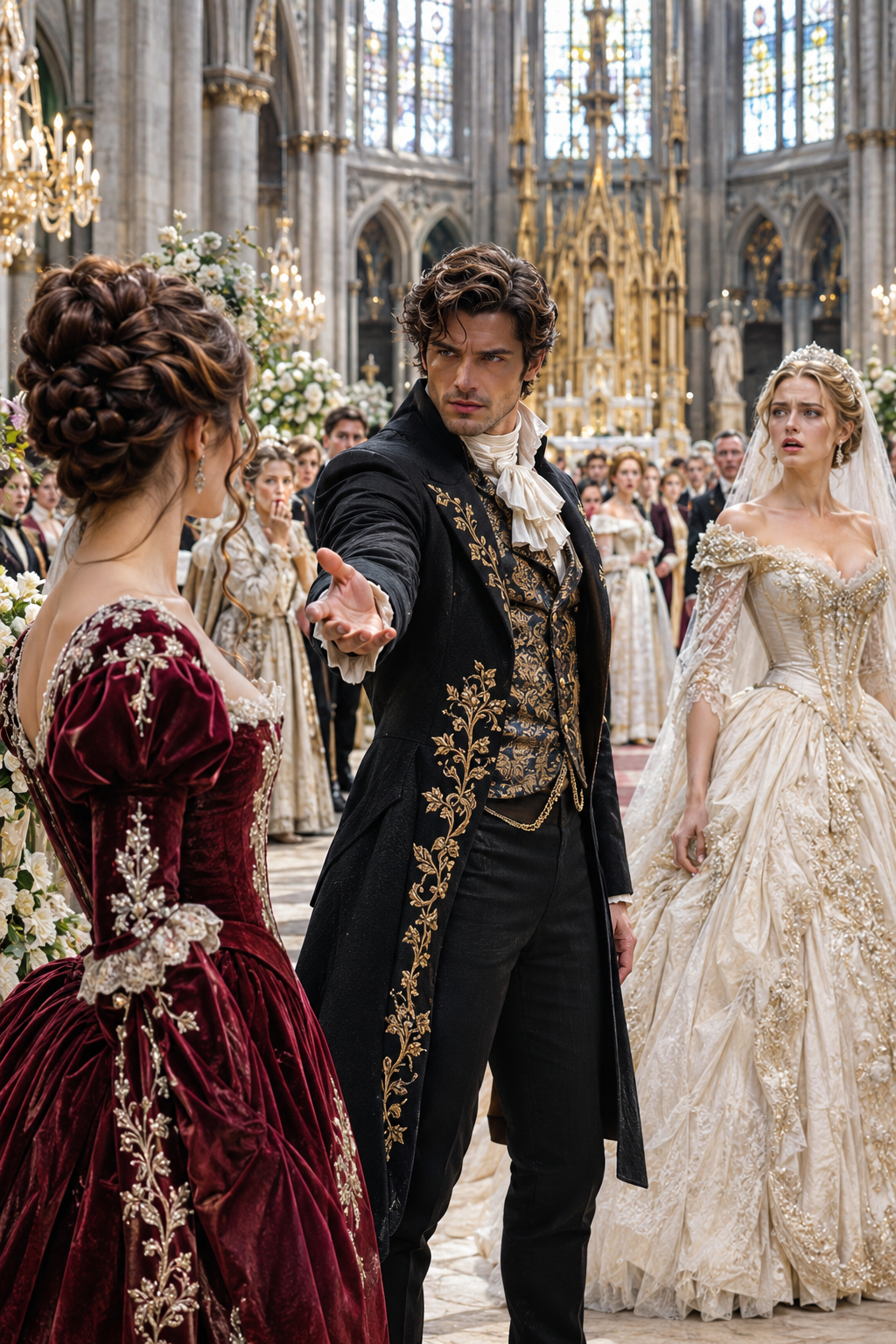
The way he said it made me uneasy.
He glanced toward the guests, then lowered his voice.
“There are details I would rather explain somewhere private.”
My father seized the opportunity.
“Excellent. Then let us proceed with the ceremony and discuss these unfortunate misunderstandings later.”
“No,” the Duke said.
One word.
Nothing more.
Yet it seemed to shake the entire chapel.
My father’s expression turned furious.
“You cannot humiliate my family like this!”
The Duke took a step toward him.
“I arrived expecting to marry the woman named in our agreement. Instead, you presented another daughter and apparently assumed I would not object.”
“She is younger,” Father snapped. “More beautiful. Better suited to your position!”
I felt the familiar sting of those words.
Even now, with everything falling apart around him, Father could not resist reminding me of my supposed shortcomings.
The Duke looked at him with unmistakable disgust.
“You have misunderstood something rather important, Lord Ashford.”
Father said nothing.
“I did not agree to marry Lady Beatrice because I required a pretty decoration for my drawing room.”
Several guests exchanged startled glances.
“I chose her because she demonstrated intelligence, sound judgment, and an understanding of my estate that some of my own employees have failed to show.”
My throat tightened.
He turned toward me.
“Your letters were the first useful advice I had received concerning Westland in months.”
I could barely speak.
“You knew they were mine?”
“Of course.”
“But I signed only my initials.”
“And your handwriting matched the notes in the accounts. Besides, no one else in your household had ever shown the slightest interest in crop yields or tenant agreements.”
A few people laughed softly.
Charlotte’s cheeks turned scarlet.
The Duke continued.
“I have spent years surrounded by people who tell me what they think I wish to hear. Lady Beatrice told me what I needed to know.”
No one had ever spoken about me that way.
Certainly not in public.
Certainly not in front of my family.
For a moment, I forgot the document in my hands.
Then Charlotte burst into tears.
“You are cruel!” she cried. “You invited me here to be humiliated!”
Mother rushed toward her.
“My poor darling!”
Father pointed at the Duke.
“You have destroyed her reputation!”
The Duke’s expression remained controlled.
“I did not invite Lady Charlotte to marry me. You did.”
That silenced them.
He turned toward Charlotte once more.
“I regret the embarrassment you have suffered. But I will not enter a marriage arranged through deception.”
Charlotte stared at him.
Then she looked at me.
The hatred in her eyes startled me.
“You did this,” she whispered.
I shook my head.
“Charlotte, I didn’t even know he had received my letters.”
“You couldn’t bear seeing me happy!”
I wanted to defend myself.
To remind her that she had happily taken my wedding gown, my engagement ring, and the future everyone insisted should belong to her.
But something stopped me.
Perhaps it was exhaustion.
Perhaps it was the realization that no explanation would ever satisfy someone determined to see me as the villain.
“I hope one day you understand what happened here,” I said quietly.
Then I turned away.
The Duke extended his arm.
“Lady Beatrice, would you allow me to escort you outside?”
I looked toward my parents.
Mother’s expression was full of warning.
Father looked ready to explode.
For once, I did not ask permission.
“Yes, Your Grace.”
I placed my hand on his arm.
And together, we walked down the aisle.
Not as husband and wife.
Not yet.
But for the first time, I was leaving a room without waiting for my family to decide whether I was allowed.
Outside, the late morning air was cool.
The Duke’s carriage stood near the church gates.
He stopped beside it and turned to me.
“I owe you an apology.”
I blinked.
“For what?”
“For allowing this situation to reach the chapel. I knew there were financial irregularities, but I did not know your family intended to substitute your sister until yesterday evening.”
“Yesterday?”
“My solicitor received a revised marriage document. It named Charlotte.”
I stared at him.
“And you still came?”
“I needed to know whether you had agreed to the change.”
I lowered my eyes.
“I was told I had no choice.”
His expression softened.
“That is not the same thing as agreeing.”
Something inside me shifted.
I had grown so accustomed to being ordered around that I had almost forgotten the difference.
“May I ask you something?” I said.
“Anything.”
“Why did you choose me in the first place?”
He considered the question.
“Our families discussed a possible marriage last spring. I was not enthusiastic about the arrangement.”
I gave a small, humorless laugh.
“Neither was I.”
“But then I received your first letter. You questioned why my estate was purchasing seed at nearly twice the usual price.”
“You were.”
“I know that now.”
“You also had three cottages standing empty while families were living in overcrowded rooms.”
“I remember.”
“And your southern fields needed drainage.”
He smiled slightly.
“You see? Most people ask whether I own a castle. You ask why my fields are flooded.”
I almost smiled back.
Then he grew serious.
“I began to look forward to your letters, Lady Beatrice. I found myself wondering what you would say about matters beyond the estate.”
I felt heat rise in my cheeks.
It was absurd.
I was twenty-eight years old, and a simple compliment made me feel like a nervous schoolgirl.
But he was not finished.
“I hoped to marry someone whose judgment I could respect. I believe I have found her.”
I looked away toward the church.
“What about the document?”
His smile faded.
“That is considerably more complicated.”
He opened the carriage door.
“My solicitor is waiting at the inn. I would like you to hear what he has discovered.”
I hesitated.
“Are you asking me to investigate my own father?”
“I am asking whether you wish to know the truth.”
I thought about the payments.
The hidden agreement.
The way Father had tried to snatch the paper from my hands.
Then I climbed into the carriage.
“Yes,” I said. “I do.”
The Duke’s solicitor was a thin, silver-haired gentleman named Mr. Harcourt.
He rose immediately when we entered the private sitting room.
“Your Grace. Lady Beatrice.”
Several documents lay across the table.
One glance told me this was no ordinary family disagreement.
Mr. Harcourt looked at the Duke.
“Shall I begin?”
“Please.”
The solicitor opened a leather folder.
“Northern Agricultural Holdings was established three years ago. On paper, it supplies equipment and services to large estates.”
“And in reality?” I asked.
“In reality, very little equipment appears to have been supplied.”
He placed several account statements before me.
The Duke watched as I examined them.
The payments were familiar.
Three hundred pounds.
Two hundred and fifty.
Four hundred.
Different amounts, all recorded as agricultural improvements.
Then I noticed something.
“These entries come from more than one estate.”
Mr. Harcourt nodded.
“Very observant.”
“Westland isn’t the only property paying this company?”
“No. At least four estates have made similar payments.”
I traced a line with my finger.
“And these accounts all list the same manager.”
“Mr. Pembroke,” the Duke said.
I knew the name.
He had been the Duke’s chief estate manager for more than a decade.
His letters were full of impressive language but very little useful information.
I had questioned several of his decisions in my margins.
“Does he own the company?” I asked.
“Not directly,” Mr. Harcourt replied. “But we believe he controls it through another person.”
“Who?”
The solicitor hesitated.
Then he slid another document toward me.
It was a bank record.
My father’s name appeared beside several large deposits.
I read the figures twice.
“Five thousand pounds?”
“Yes.”
“And another two thousand?”
“Yes.”
I looked up.
“Why?”
Mr. Harcourt folded his hands.
“Your father has been struggling financially for several years. His debts are considerably greater than society realizes.”
I thought of the grand dinners.
The new horses.
Charlotte’s expensive gowns.
Mother’s constant insistence that appearances must be maintained.
“We aren’t wealthy anymore,” I whispered.
“I am afraid not.”
The Duke sat beside me.
“Your father appears to have introduced Pembroke to several gentlemen who invested in the company. In return, he received payments.”
“From money taken out of your estates?”
“That is our suspicion.”
I felt sick.
Father had always lectured me about responsibility.
He had called my interest in money vulgar.
Meanwhile, he had apparently been taking money from a business involved in questionable estate payments.
“But why arrange the marriage?” I asked.
Mr. Harcourt exchanged a glance with the Duke.
“Because your marriage would have given the family a much stronger connection to Westland.”
I frowned.
“And Charlotte?”
The solicitor opened another folder.
“Your father apparently believed your sister would be easier to persuade into supporting his business interests.”
The words struck harder than I expected.
They had not replaced me simply because Charlotte was prettier.
They had replaced me because I asked too many questions.
I looked at the Duke.
“Father knew I would examine the accounts.”
“Yes.”
“And he knew I would never agree to protect questionable payments.”
“That appears to be the case.”
I leaned back in my chair.
For years, my family had called my intelligence an embarrassment.
Now I understood why it had become a threat.
Suddenly, there was a knock at the door.
Mr. Harcourt opened it.
A young messenger stood outside, breathless.
“Forgive me, sir. There has been trouble at Westland.”
The Duke rose.
“What kind of trouble?”
“Mr. Pembroke has ordered several account books burned. One of the clerks refused, and there was an argument.”
The solicitor went rigid.
“Burned?”
“The clerk managed to save some papers, sir. But Pembroke has disappeared.”
The Duke reached for his coat.
“Have the remaining records secured immediately.”
The messenger nodded and hurried away.
I stood.
“I am coming with you.”
The Duke looked surprised.
“Lady Beatrice, this could become unpleasant.”
I met his eyes.
“My father may have helped steal from your tenants. I have spent months studying those accounts. If there is something hidden in them, I may recognize it.”
Mr. Harcourt cleared his throat.
“She has a point, Your Grace.”
The Duke looked from him to me.
Then he gave a small nod.
“Very well.”
By evening, we arrived at Westland.
The estate was more beautiful than I had imagined.
Green hills stretched beneath a pale sky. Stone buildings stood beyond carefully tended gardens, and beyond them lay the fields I knew so well from maps and reports.
But there was little time to admire anything.
Inside the estate office, papers were scattered across the floor.
A young clerk stood beside a locked cabinet, looking terrified.
His name was Thomas Reed.
He could not have been older than twenty.
“I tried to stop him, Your Grace,” he said. “Mr. Pembroke told me the old books were no longer needed.”
“You did the right thing,” the Duke assured him.
Thomas swallowed.
“There is something else.”
He reached beneath his coat and produced a small ledger.
“I kept this hidden because the figures didn’t make sense.”
I took it carefully.
The pages were filled with names, dates, and payments.
Most were familiar.
But near the back, one entry caught my attention.
Ashford House — special advance.
The amount was enormous.
Ten thousand pounds.
I stared at the figure.
“That cannot be right.”
The Duke came closer.
“What is it?”
I showed him.
Mr. Harcourt examined the entry.
“This payment was made only two months ago.”
Two months ago.
I remembered that time clearly.
Mother had suddenly ordered new furniture.
Father had purchased a carriage.
Charlotte had received an emerald necklace.
And I had been informed that the family’s financial position was improving.
I turned the page.
There was another entry.
Marriage settlement — final release.
I read the figure beneath it.
Twenty thousand pounds.
My hands went cold.
“Father was expecting another payment after the wedding.”
Mr. Harcourt nodded slowly.
“It would seem so.”
The Duke’s expression darkened.
“They intended to use my marriage to complete their arrangement.”
I shook my head.
“No. There is something missing.”
Both men looked at me.
“The figures don’t match.”
I turned back several pages.
“The money recorded as leaving Westland is greater than the money Father received. Someone else has been taking a share.”
Mr. Harcourt leaned forward.
“Can you prove that?”
“Give me a pen.”
For the next two hours, I worked through the ledger.
The Duke brought fresh candles.
Thomas fetched additional records.
Mr. Harcourt checked the bank statements.
No one told me that numbers were unsuitable for a lady.
No one asked whether I ought to be practicing the piano instead.
When I finally placed my pen down, I had found the missing pattern.
The false charges were divided among several accounts before the money reached my father.
One account belonged to Pembroke.
Another belonged to a lawyer in London.
The final account had no name.
Only a number.
“This is where the largest payments went,” I said.
Mr. Harcourt examined the page.
“I may be able to identify the holder.”
The Duke looked exhausted.
“Then do so.”
A servant entered with a tray of tea.
As he placed it on the table, he hesitated.
“Forgive me, Your Grace, but there is a lady asking to see Lady Beatrice.”
I looked up.
“Who?”
“Lady Charlotte, miss.”
I nearly dropped my pen.
Charlotte stood in the entrance moments later.
Her wedding gown was gone.
She wore a plain traveling dress, and her eyes were swollen from crying.
For once, there was no jewelry around her neck.
No confident smile.
No mother standing beside her to tell everyone how wonderful she was.
“Beatrice,” she whispered.
The Duke moved toward the door.
“I can have someone escort her home.”
“No,” I said. “Let her speak.”
Charlotte glanced at the men.
“Alone, please.”
I led her into a smaller sitting room.
The moment the door closed, she began crying again.
“I didn’t know,” she said.
I remained standing.
“Didn’t know what?”
“That Father was taking money.”
I watched her carefully.
“You knew about the marriage substitution.”
“Yes.”
“You knew I was being pushed aside.”
Her shoulders shook.
“Yes.”
“And you were pleased.”
She covered her face.
“I thought he wanted me because I was beautiful.”
The words sounded childish.
But Charlotte had been raised to believe beauty was the only thing that made her valuable.
I had been raised to believe I possessed nothing valuable at all.
Perhaps neither of us had been told the truth.
“Why are you here?” I asked.
She lowered her hands.
“Because Father is frightened.”
“Of what?”
“Mother found him packing money and documents. He said we must leave England immediately.”
My heart began pounding.
“Where is he?”
“I don’t know. He left before I could ask.”
“Did he say anything else?”
Charlotte hesitated.
Then she reached into her pocket.
“He told Mother to burn this.”
She handed me a small envelope.
Inside was a letter written in Father’s unmistakable handwriting.
It was addressed to Pembroke.
I read it once.
Then again.
The message was short.
If the Duke discovers the account, the entire arrangement collapses. Under no circumstances must Beatrice be permitted to examine the original settlement.
My stomach tightened.
“What original settlement?”
Charlotte shook her head.
“I don’t know.”
I looked at her.
“Why didn’t you burn this?”
She began crying again.
“Because I heard Father tell Mother that if everything went wrong, he would blame you.”
I stared at her.
“He said you had handled the Duke’s accounts. He said people would believe you had altered the figures.”
For several seconds, I could not speak.
It was one thing to know my father considered me unimportant.
It was another to learn he was willing to sacrifice my reputation to protect himself.
Charlotte stepped closer.
“I know I was terrible to you.”
I looked away.
“You took my place at the altar.”
“I know.”
“You laughed when Mother called me an old spinster.”
“I know.”
“And you never once asked whether I was unhappy.”
Charlotte wiped her eyes.
“No. I didn’t.”
I expected another excuse.
Another accusation.
Instead, she whispered, “I was afraid that if I wasn’t the beautiful one, there would be nothing special about me.”
The confession startled me.
I sat down slowly.
For years, Charlotte and I had been treated as rivals in a competition neither of us had chosen.
I had envied her beauty.
She had feared my intelligence.
And our parents had used both weaknesses against us.
“I cannot pretend today didn’t happen,” I told her.
“I don’t expect you to.”
“But you did the right thing by bringing this letter.”
She nodded.
Then she said something I had never heard from her before.
“I’m sorry, Beatrice.”
There were no dramatic embraces.
No sudden forgiveness.
But when she reached for my hand, I did not pull away.
A sudden commotion sounded in the hallway.
The Duke appeared at the door.
“Lady Beatrice, Mr. Harcourt has identified the final account.”
I stood immediately.
“Who owns it?”
He looked deeply troubled.
“The account is held in trust by your mother.”
For a moment, I thought I had misheard.
“Mother?”
“Yes.”
Charlotte sank into a chair.
“No,” she whispered. “That cannot be true.”
But the Duke’s face told me it was.
We returned to the office together.
Mr. Harcourt laid out the evidence.
The trust had been created under Mother’s maiden name.
Large amounts of money had passed through it for nearly three years.
And unlike Father’s deposits, these payments had been carefully concealed.
“She was not merely aware of the scheme,” Mr. Harcourt explained. “She appears to have helped organize it.”
I thought of Mother sitting at breakfast, criticizing the way I held my spoon.
Mother warning me never to embarrass the family.
Mother telling me that a woman’s greatest duty was to protect her husband’s reputation.
All the while, she had apparently been helping him steal.
Charlotte stared at the documents.
“She told me Father handled all the money.”
Mr. Harcourt sighed.
“There is one more thing.”
He opened the original settlement.
“The marriage agreement contains a clause that would have appointed Lord Ashford as an adviser to several estate investments.”
The Duke frowned.
“I never approved such a clause.”
“No, Your Grace. Your signature appears to have been copied from another document.”
I looked at the page.
The signature was convincing.
Too convincing.
But there was a detail I recognized.
The Duke usually formed the final letter of his surname with a sharp upward stroke.
This one ended flat.
I pointed it out.
Mr. Harcourt examined the signature closely.
“Excellent observation.”
The Duke’s expression hardened.
“They intended to forge my consent.”
“And use the marriage to obtain control over investments,” I added.
The full picture finally emerged.
My parents had not simply traded one daughter for another.
They had attempted to place someone they could influence inside the Duke’s household while gaining access to his wealth.
My intelligence had made me inconvenient.
Charlotte’s willingness to obey had made her useful.
The thought made me feel physically ill.
The next morning, my parents were brought to Westland for a formal meeting.
They arrived with their usual confidence.
Father wore an expensive coat.
Mother carried herself as though she were attending a royal dinner.
But when they entered the library and saw Mr. Harcourt, the Duke, Charlotte, and me seated around the table, their expressions changed.
“Beatrice,” Mother said sharply, “come here at once.”
I remained seated.
“No.”
She stared at me.
“Excuse me?”
“I said no.”
Father slammed his walking stick against the floor.
“This behavior is disgraceful!”
The Duke rose.
“Lord Ashford, you will address Lady Beatrice respectfully in my house.”
Father looked ready to argue.
Then he noticed the documents.
Mr. Harcourt began laying them out one by one.
The false payments.
The bank transfers.
The marriage settlement.
The forged signature.
The letter to Pembroke.
Mother’s face became pale.
Father tried to laugh.
“This is absurd. Business arrangements are often complicated.”
“Forgery is not a complication,” Mr. Harcourt replied.
“Neither is fraud.”
Father looked toward Charlotte.
“You brought them that letter?”
She lifted her chin.
“Yes.”
Mother gasped.
“After everything we have done for you?”
Charlotte’s eyes filled with tears.
But she did not look away.
“You taught me that a lady should always tell the truth.”
Mother opened her mouth.
Then closed it.
For once, she had no answer.
Father turned toward me.
“You have destroyed this family.”
The words struck me with surprising force.
Even after everything, a small part of me still wanted his approval.
I wanted him to say he was proud of me.
I wanted him to admit that I had been right.
But he looked at me as though I were a stranger.
And suddenly, I understood.
He had never wanted a daughter who could think for herself.
He had wanted a daughter who would obey.
“No, Father,” I said quietly. “I did not destroy this family. I discovered what you were doing to it.”
He stepped toward me.
“You ungrateful girl!”
The Duke moved immediately.
“Enough.”
Father stopped.
The room fell silent.
Mr. Harcourt explained that the financial records would be submitted to the proper authorities.
An investigation would follow.
Any money obtained unlawfully would have to be accounted for.
Mother began crying.
Not because she regretted what had happened.
But because she finally understood that her reputation could not protect her.
Father demanded a private arrangement.
He offered repayment.
Then he offered silence.
Finally, he begged the Duke to remember that we would soon be related by marriage.
The Duke looked at me.
“Lady Beatrice, the decision concerning your relationship with your family belongs entirely to you. But the money taken from the estate must be recovered.”
I nodded.
“I understand.”
Father looked at me desperately.
“You can still help us.”
For one terrible moment, I considered it.
They were my parents.
They had given me a home.
They had raised me.
Surely that counted for something.
Then I remembered the letter Charlotte had brought.
If their scheme failed, they had planned to blame me.
I took a steady breath.
“I will not lie for you.”
Father’s face twisted.
“You will regret this.”
I stood.
“No. I think this is the first decision I have made that I will never regret.”
The investigation lasted several months.
Pembroke was eventually located in Scotland, where he had attempted to hide under another name.
His records confirmed what we had already discovered.
My parents had helped move stolen estate funds through false business contracts.
The money had supported their expensive lifestyle and covered years of unpaid debts.
The forged settlement had been their final attempt to secure access to even greater wealth.
Father faced criminal proceedings.
Mother’s involvement became public.
The Ashford name, once so proudly guarded, appeared in newspapers across the country.
There was gossip, of course.
There were cruel whispers.
But something unexpected happened.
People stopped laughing at me.
Instead, they began asking how I had noticed the irregularities.
Several estate owners wrote requesting advice.
One gentleman even offered to employ me as a financial secretary.
I nearly laughed when I read his letter.
A year earlier, I had been considered a hopeless spinster because I enjoyed mathematics.
Now my knowledge had become valuable.
Yet the greatest change was not in society’s opinion.
It was in my own.
For the first time, I no longer measured myself against Charlotte.
I no longer heard Mother’s criticism every time I entered a room.
And I no longer believed Father’s approval was necessary for my happiness.
Meanwhile, the Duke and I continued working together.
We spent mornings reviewing estate reports.
Afternoons visiting farms and speaking with tenants.
He listened when I questioned his decisions.
Sometimes we disagreed.
Once, we argued for nearly an hour about whether to replace an old bridge.
I insisted it was unsafe.
He believed repairs would be sufficient.
Eventually, we visited the bridge together.
One look at the damaged supports convinced him I was right.
He turned toward me and sighed.
“I am beginning to suspect that marrying you will be financially dangerous.”
I laughed.
“Why?”
“Because you will never allow me to waste a single penny.”
“Only the pennies that belong to you.”
He smiled.
“And the rest?”
“Those belong to the people who depend upon this estate.”
His expression softened.
“That is precisely why I want you beside me.”
I looked at him.
He reached for my hand.
“Beatrice, I know our first wedding was a disaster.”
I smiled despite myself.
“That is a generous description.”
“But I would very much like to try again.”
My heart began pounding.
He continued before I could answer.
“Not because our families arranged it. Not because society expects it. And certainly not because I need someone to manage my accounts.”
“Then why?”
He took a breath.
“Because I have discovered that the best part of my day is hearing what you think.”
Tears filled my eyes.
“I am not young,” I whispered.
He looked genuinely confused.
“Neither am I.”
“I am not beautiful like Charlotte.”
“Beatrice.”
His voice was gentle.
“I did not fall in love with your sister.”
The words settled between us.
Simple.
Certain.
True.
He brushed his thumb across my hand.
“I fell in love with the woman who cared enough to tell me that my estate was being mismanaged, even when she believed I might be offended.”
I laughed through my tears.
“That is a rather unusual declaration.”
“I have been told I am an unusual man.”
“Yes,” I whispered. “You certainly are.”
Then he asked me again.
“Will you marry me?”
This time, there was no family standing nearby.
No wedding gown waiting for someone else.
No frightened father.
No secret agreement.
Only a man asking a woman to share his life.
And a woman who finally understood that she had the right to choose.
“Yes,” I said.
His smile was the most beautiful thing I had ever seen.
Our wedding took place in the small chapel at Westland.
There were no hundreds of guests.
No extravagant flowers.
No expensive spectacle designed to impress strangers.
Only a handful of friends, several trusted servants, and the people who had stood beside us when things became difficult.
Charlotte attended.
She wore a simple lavender dress.
When she entered my room before the ceremony, she stood quietly beside the door.
“You look beautiful,” she said.
I smiled.
“Thank you.”
She hesitated.
“I used to think being beautiful was the most important thing a woman could be.”
“And now?”
She looked down at her hands.
“Now I think being someone you can respect matters more.”
I reached for her hand.
“You are learning.”
“So are you,” she replied.
She was right.
Charlotte had begun volunteering at a school for girls whose families could not afford private lessons.
For the first time, she was discovering what it meant to be useful beyond the drawing room.
Our relationship was not magically repaired.
There were still painful memories.
Still things we needed to discuss.
But we had stopped treating each other as enemies.
And that was a beginning.
When the chapel bells rang, Charlotte helped fasten my veil.
“Are you nervous?” she asked.
“Terribly.”
She smiled.
“Good. That means you care.”
I laughed.
Then I walked toward the altar.
The Duke was waiting.
This time, when he saw me, there was no confusion in his eyes.
No surprise.
Only a smile.
He held out his hand.
And I took it.
The years that followed were not perfect.
Marriage never is.
There were difficult harvests.
Financial setbacks.
Arguments about repairs, tenants, and investments.
There were evenings when the Duke was stubborn.
And mornings when I was far too impatient.
But we learned to disagree without cruelty.
We learned to apologize without shame.
And we learned that love was not simply admiration.
It was respect expressed through ordinary choices, day after day.
Together, we improved the estate.
We reduced unfair rents.
Repaired neglected cottages.
Established a small school for the children of workers.
And created a fund to help families through harsh winters.
The Duke insisted I oversee the accounts.
I insisted he attend every meeting.
“You cannot escape your responsibilities simply because you married someone who enjoys them,” I told him.
He laughed.
“Then I appear to have chosen a very demanding wife.”
“You certainly have.”
“And a very clever one.”
“That too.”
Years later, I received a letter from my father.
He had lost his position in society.
Much of the family’s property had been sold to repay debts and financial claims.
His handwriting looked smaller than I remembered.
He wrote that he was old.
That he was tired.
That he hoped I could forgive him.
I sat with the letter for a long time.
I had imagined receiving such words for years.
Yet when they finally came, I felt neither triumph nor anger.
Only sadness for everything that might have been different.
I wrote back.
I told him I hoped he would find peace.
I told him I no longer carried hatred in my heart.
But I also told him that forgiveness did not mean pretending the past had never happened.
I would not return to being the daughter he could silence.
And I would not allow guilt to become another form of control.
When I sealed the letter, I felt strangely light.
That evening, my husband found me standing beside the library window.
“Are you all right?” he asked.
I nodded.
“I think so.”
He followed my gaze toward the hills.
“What are you thinking about?”
I smiled.
“The day we met at the chapel.”
He groaned.
“Must we remember that disaster?”
“Actually,” I said, “I think it may have been the best thing that ever happened to me.”
He raised an eyebrow.
“Being publicly rejected by your family?”
“No.”
I turned toward him.
“Discovering that I did not need to become someone else to deserve a happy life.”
He took my hand.
“You never did.”
And as we stood together watching the evening light settle over Yorkshire, I finally understood something my younger self had desperately needed to hear.
For years, I had believed that my worth depended on whether someone chose me.
My parents had chosen Charlotte.
Society had chosen beauty.
The world had seemed determined to remind me of everything I lacked.
But the greatest freedom came when I stopped asking other people to decide what I was worth.
I was not valuable because I became a duchess.
I was not valuable because a wealthy man fell in love with me.
And I was not valuable because I discovered a financial crime.
I had been valuable all along.
The title changed my place in society.
The marriage changed my life.
But learning to respect myself changed everything.
And if there is one lesson I carried from that extraordinary day in the chapel, it is this:
Never make yourself smaller to fit into a place where others refuse to see your worth.
The right people will not ask you to hide your intelligence, your kindness, your ambition, or your true nature.
They will recognize those qualities as the very reasons you belong beside them.
And sometimes, the moment you believe you have lost everything is the moment life finally opens the door you were always meant to walk through.
Years passed, and Westland became more than a grand estate with beautiful gardens and endless fields. It became a home filled with laughter, honest conversations, and people who knew their voices mattered.
My husband never stopped asking for my opinion. Even when we disagreed, he listened. And every evening, no matter how busy our day had been, we found time to sit together beside the fireplace.
One autumn afternoon, a young woman arrived at Westland asking to speak with me.
She was twenty-seven, unmarried, and had recently been dismissed from her position as a governess.
“I was told Your Grace sometimes helps women find respectable work,” she said nervously.
“I do. What kind of work interests you?”
She hesitated.
“I enjoy mathematics, Your Grace. But my family says no gentleman will marry a woman who spends her evenings studying numbers.”
For a moment, I felt as though I were looking at my younger self.
I invited her to sit.
“Tell me something,” I said. “Are you good with numbers?”
Her face brightened.
“Very good, Your Grace.”
“Then perhaps you would like to help manage the accounts for our new school.”
She stared at me.
“You would trust me with something so important?”
“Why wouldn’t I?”
Her eyes filled with tears.
“No one has ever asked me that before.”
I smiled and placed a ledger in front of her.
“Then it is time someone did.”
Within a year, she had become one of our most capable employees. Her work helped us expand the school and provide scholarships for girls whose families could not afford an education.
Soon, other young women began arriving at Westland.
Some wished to teach.
Others wanted to study bookkeeping, agriculture, or business.
I realized that the opportunity I had once desperately needed was something I could now help provide to others.
With my husband’s support, we established the Westland Women’s Academy.
It began with twelve students in a small converted building beside the estate.
Five years later, more than a hundred young women had studied there.
Some became teachers.
Others opened businesses.
Several found work managing estates.
And a few simply discovered the confidence to build lives of their own choosing.
On the academy’s fifth anniversary, I stood before the students to deliver a speech.
My husband sat in the front row, smiling proudly.
Charlotte sat beside him.
She had become one of the academy’s most devoted supporters, teaching music and helping young women prepare for independent lives.
Looking out at those hopeful faces, I remembered the day my father had told me I was too old, too plain, and too interested in business to become a duchess.
I remembered sitting alone at Charlotte’s wedding, believing my future had been taken from me.
And I remembered the Duke standing in the chapel, asking where the woman he had actually agreed to marry was.
“I want to tell you something,” I began.
“Many years ago, I was told that my greatest weakness was that I thought too much.”
The students laughed softly.
“I was told that my interests were unsuitable, that my opinions were unnecessary, and that my future depended upon whether a gentleman found me pleasing.”
I paused.
“For a long time, I believed them.”
The room grew quiet.
“But the greatest mistake I ever made was not loving numbers or asking questions. It was allowing other people to convince me that the things which made me different made me less worthy.”
I looked toward my husband.
He nodded gently.
“So I ask each of you to remember this. Never apologize for the abilities you have been given. Use them wisely. Work hard. Treat others fairly. And never let someone else’s narrow opinion become the measure of your life.”
When the speech ended, the students rose to their feet.
Their applause filled the hall.
But what touched me most happened afterward.
A girl of perhaps sixteen approached me, clutching a small notebook.
“Your Grace,” she said, “my father believes girls should not study business.”
I smiled.
“And what do you believe?”
She lifted her chin.
“I believe I could be very good at it.”
“Then,” I replied, “we had better make certain you have the chance to prove it.”
That evening, my husband and I walked through the gardens as the sun disappeared behind the Yorkshire hills.
“You were magnificent today,” he said.
“I was terribly nervous.”
“I know.”
I laughed.
“Was it that obvious?”
“Only to someone who knows you very well.”
He stopped beside the rose garden and took both my hands.
“Do you ever wonder what would have happened if your father had not tried to replace you with Charlotte?”
I thought for a moment.
“Sometimes.”
“And?”
“Perhaps we would have married without all the trouble. Perhaps we would never have uncovered the missing money. Perhaps I would have spent years trying to prove I deserved my place here.”
He smiled.
“And now?”
I looked toward the academy, its windows glowing warmly in the distance.
“Now I know that I do.”
He kissed my forehead.
“Good. Because I have known it from the beginning.”
We remained in the garden until the first stars appeared.
And I thought about how strange life could be.
The people who had tried to make me feel worthless had accidentally led me toward a future far greater than anything they had imagined.
My father’s betrayal had brought painful consequences.
Charlotte’s jealousy had nearly destroyed our relationship.
My mother’s obsession with appearances had cost her the respect she valued most.
Yet none of those things had the power to determine the rest of my life.
That choice had always belonged to me.
I had simply needed the courage to claim it.
And if I could speak to the lonely woman sitting in the back of that chapel years earlier, I would tell her one thing.
Do not cry because someone has taken the place you were promised.
Do not waste your life begging people to appreciate what they refuse to see.
And never confuse being overlooked with being unworthy.
Sometimes a closed door is not a punishment.
Sometimes it is protection.
Sometimes the people who reject you are clearing the path toward the life you deserve.
But most importantly, your value does not begin when someone finally recognizes it.
It has been there all along.
I entered that chapel believing I was the sister nobody wanted.
I walked out knowing I could choose my own future.
And in the years that followed, I learned that the greatest happiness was not becoming the Duchess of Westland.
It was becoming a woman who no longer needed a title, a marriage, or anyone else’s approval to know her worth.
Because the greatest victory is not making those who doubted you regret their choices. It is building a life so meaningful that their opinions no longer have the power to define you.