“You will marry me before Sunday,” the Duke said coldly. “In return, I will pay every debt your father left behind.”
The signature at the bottom of the warning made Lily Goodwin’s heart nearly stop.
It belonged to Mrs. Whitmore, the elderly housekeeper who had served the Kensington family for more than thirty years.
Lily had met her only once, during her visit to Thornwick. The woman had seemed nervous, barely looking her in the eye.
Now Lily understood why.
Someone inside the Duke’s own household was helping his cousin destroy him.
And the housekeeper knew something about the accident that had left Charles unable to walk.
Lily folded the note and slipped it beneath her pillow.
She did not sleep that night.
By morning, she had made two decisions.
She would marry Charles Kensington.
And she would discover who was trying to ruin him.
Three days later, Lily stood inside the small chapel at Thornwick, wearing an ivory gown that had belonged to her mother.
There were no flowers beyond a few white roses.
No musicians.
No grand celebration.
Only the Duke, his solicitor, two witnesses, and a handful of servants.
Charles sat in his wheelchair beside the altar, dressed in a perfectly tailored black coat.
His expression was unreadable.
When Lily approached, he looked at her for a long moment.
“You may still change your mind,” he whispered.
“So may you.”
“I have already signed the agreement.”
“Then I suppose we are both trapped.”
Something unexpected happened.
Charles smiled.
It was brief, almost invisible, but Lily saw it.
And for reasons she could not explain, that small smile made her more nervous than the wedding itself.
When the minister pronounced them husband and wife, Charles reached for her hand.
His fingers were warm.
His grip was surprisingly strong.
“Welcome to Thornwick, Duchess,” he said quietly.
Lily looked into his dark eyes.
“Thank you, Your Grace.”
“Charles,” he corrected.
She hesitated.
“Then you must call me Lily.”
For the first time, their marriage felt like something other than a contract.
That feeling lasted until dinner.
Lord Augustus Kensington arrived without an invitation.
He entered the dining room carrying a silver-topped cane and wearing a smile Lily immediately disliked.
“My dear cousin,” he announced. “I hear congratulations are in order.”
Charles placed his wineglass down.
“You were not invited.”
“Family should never require an invitation.”
Augustus turned toward Lily.
“And what a fortunate young woman you are. From a ruined household to a duchess in less than a week.”
Lily felt the insult, but she refused to show it.
“Fortune had very little to do with it, my lord.”
“Indeed?”
“I made a decision. There is a difference.”
Charles looked at her.
Augustus laughed.
“How refreshing. A bride with opinions.”
He leaned closer.
“Do be careful, Duchess. Thornwick has a habit of disappointing its women.”
The room fell silent.
Charles’s expression hardened.
“Leave.”
Augustus raised both hands.
“Very well. I merely came to offer my good wishes.”
But before departing, he looked directly at Lily.
“Ask your husband why the west staircase remains locked.”
Then he walked away.
That evening, Lily found Charles in his library.
The room smelled of leather, old books, and burning wood.
He was reading a document beside the fireplace.
“Your cousin is an unpleasant man,” she said.
“That is among his better qualities.”
“He mentioned the west staircase.”
Charles stopped reading.
“Did he?”
“Why is it locked?”
“Because I ordered it locked.”
“That is not an answer.”
“It is the only answer I am prepared to give.”
Lily studied him.
“Charles, I married you to protect my brother. You married me to protect your estate. But if we are to live beneath the same roof, I need to know what dangers surround us.”
He looked away.
“Some things are better left buried.”
“Buried things have a habit of being discovered.”
His hand tightened around the paper.
“Good night, Lily.”
She understood the dismissal.
But she did not obey it immediately.
“Someone left a warning inside our marriage agreement.”
Charles looked up sharply.
“What warning?”
She removed the folded note from her pocket.
He read it once.
Then again.
The color drained from his face.
“Where did you get this?”
“It was between the pages.”
“Who else has seen it?”
“No one.”
He moved toward the fireplace.
For one terrible moment, Lily thought he intended to burn it.
Instead, he held it beneath the lamplight.
“Mrs. Whitmore,” he murmured.
“Do you trust her?”
“With my life.”
“Then perhaps you should listen to her.”
Charles closed his eyes.
“She has already risked too much.”
Before Lily could question him further, a scream echoed through the corridor.
Both turned toward the door.
A maid rushed inside.
“Your Grace! The housekeeper has fallen!”
They found Mrs. Whitmore at the bottom of the servants’ staircase.
Her gray hair had come loose, and blood stained the side of her forehead.
She was conscious but trembling.
Lily knelt beside her.
“Don’t move. Someone fetch the physician.”
The housekeeper grabbed Lily’s wrist.
“Your Grace…”
“I’m here.”
“The ledger…”
“What ledger?”
Mrs. Whitmore’s frightened eyes moved toward the servants gathered nearby.
“Not here,” she whispered.
Then she fainted.
Charles ordered everyone away except the physician and two trusted attendants.
Lily remained beside the housekeeper until she was carried to her room.
When she returned to the library, Charles was staring into the fire.
“That was no accident,” Lily said.
He did not answer.
“Charles.”
“I know.”
“Then why are you sitting here?”
He turned toward her.
“Because the last time I acted without proof, I lost the use of my legs.”
Lily stood motionless.
At last, the truth was beginning to emerge.
The following morning, she began examining the household accounts.
Charles had given her permission to manage domestic expenses under their marriage agreement.
It was a small responsibility, intended to keep her occupied.
Lily turned it into something much larger.
Her father had been careless with money, but she had spent years trying to understand his books.
She knew how debts could be hidden.
She knew how figures could be changed.
And she knew that dishonest men often depended upon honest people being too embarrassed to ask questions.
By lunchtime, she had found three strange payments.
All had been made to a company called Ashcombe Agricultural Supplies.
Yet Thornwick had received no equipment, seed, or livestock matching the invoices.
The amounts were enormous.
Lily summoned the estate steward, Mr. Hargreaves.
He was a thin man with nervous hands and a habit of wiping his forehead.
“These payments,” she said. “What were they for?”
“Routine agricultural purchases, Your Grace.”
“Then where are the delivery records?”
“I would need time to locate them.”
“How much time?”
“Several days.”
“You have until tomorrow morning.”
His face tightened.
“His Grace has never concerned himself with such details.”
“His Grace has a duchess now.”
The steward bowed stiffly and left.
That afternoon, Lily visited Mrs. Whitmore.
The housekeeper lay beneath heavy blankets, her forehead bandaged.
When Lily entered, she began to cry.
“I never meant to bring danger upon you.”
“Who pushed you?”
Mrs. Whitmore shook her head.
“I did not see his face.”
“His?”
“Someone came behind me. I heard footsteps. Then a hand struck my shoulder.”
Lily sat beside her.
“You mentioned a ledger.”
The older woman reached beneath her pillow.
Her trembling fingers produced a small brass key.
“Your father-in-law kept private records,” she whispered. “Before he died, he discovered that money was disappearing from the estate.”
“Where are those records?”
“In the old schoolroom. Behind the wooden panel beneath the window.”
“Why did you not tell Charles?”
“I tried.”
Her voice broke.
“But after the accident, he would not allow anyone to speak of it.”
Lily took the key.
“And the west staircase?”
Mrs. Whitmore looked toward the door.
“That is where His Grace fell.”
Lily felt a chill.
“Was it truly an accident?”
The housekeeper began shaking.
“Please, Duchess. Find the ledger before they destroy it.”
That night, Lily waited until the household was quiet.
Then she carried a candle to the abandoned schoolroom.
Dust covered the furniture.
Old maps hung crookedly on the walls.
Beneath the window, she found a narrow wooden panel.
The brass key turned with difficulty.
Behind it lay a leather-bound ledger and several sealed letters.
Lily opened the book.
The first pages contained ordinary estate expenses.
Then the figures changed.
Large sums had been transferred from Thornwick’s accounts to unfamiliar companies.
Beside several entries appeared the initials A.K.
Augustus Kensington.
Lily’s heart pounded.
She turned another page.
There, beneath a list of payments, she found a signature.
Not Augustus’s.
Her father’s.
Edward Goodwin.
For several seconds, Lily could not breathe.
Her father had been connected to the missing money.
The debts that had destroyed her family suddenly looked very different.
A floorboard creaked behind her.
Lily turned.
Mr. Hargreaves stood in the doorway.
His expression was no longer nervous.
“That book does not belong to you, Your Grace.”
Lily closed it.
“As Duchess of Thornwick, I believe it does.”
He stepped inside.
“You should have left the accounts alone.”
“Does Lord Augustus know I found it?”
Hargreaves smiled without warmth.
“He knows considerably more than you imagine.”
Lily backed toward the window.
“Charles is expecting me.”
“His Grace is occupied.”
“With what?”
“An unfortunate matter concerning the north stables.”
A terrible thought struck her.
They had arranged a distraction.
Hargreaves reached for the ledger.
Lily moved first.
She snatched the candleholder and hurled it toward the floor beside him.
The flame went out, plunging the room into darkness.
Hargreaves cursed.
Lily ran.
She knew the corridor only vaguely, but she kept one hand against the wall and followed the distant light of the main staircase.
Behind her came hurried footsteps.
Then a voice rang out.
“Stop!”
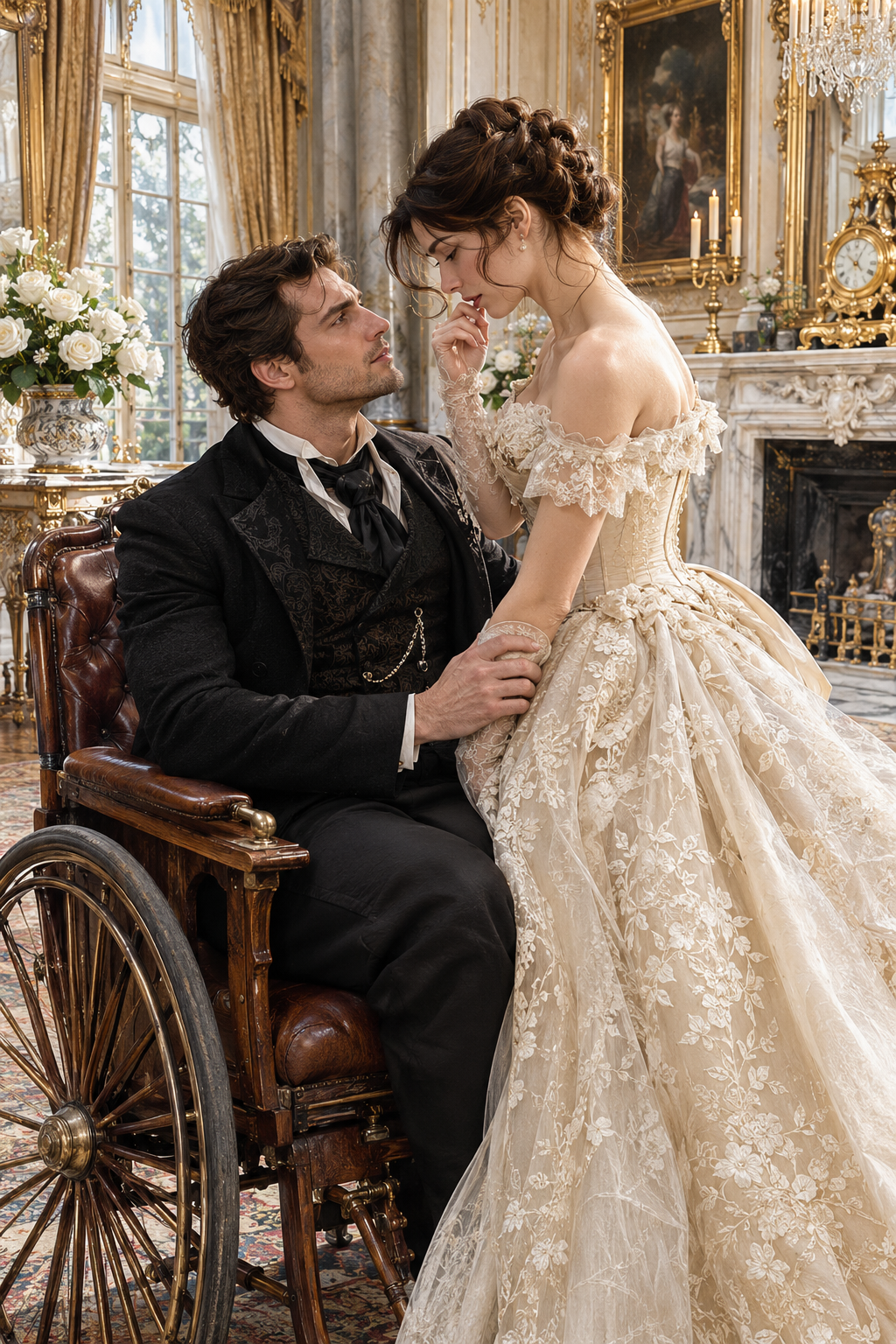
It was Charles.
He sat at the far end of the corridor, his wheelchair positioned beneath a wall lamp.
Two footmen stood beside him.
Hargreaves stopped so suddenly that his shoes scraped the floor.
Charles looked from the steward to Lily.
“What is happening?”
Lily held up the ledger.
“I believe I have found the reason someone tried to kill you.”
For the first time since their marriage, Charles looked genuinely afraid.
Not for himself.
For her.
He reached out.
“Come here.”
Lily crossed the corridor and placed her hand in his.
His fingers closed around hers.
“Are you hurt?”
“No.”
“Did he touch you?”
“No.”
Charles looked at the footmen.
“Take Mr. Hargreaves to the east sitting room. He is not to leave the house until the magistrate arrives.”
Hargreaves began protesting.
But Charles’s voice cut through the corridor.
“One more word, and I shall have you removed in irons.”
The steward fell silent.
When they were alone, Lily placed the ledger on Charles’s lap.
He stared at her father’s signature.
“Where did you find this?”
“Mrs. Whitmore gave me the key.”
Charles turned several pages.
His face grew increasingly pale.
“These are my father’s records.”
“Then you recognize the handwriting?”
“Yes.”
“Charles, why is my father’s name here?”
He did not answer immediately.
Instead, he turned to the final pages.
There, written in a firm hand, was a short note.
If anything happens to me, examine the Ashcombe transfers. Augustus has gained control of accounts that were never his to manage.
Charles closed the book.
“My father suspected him.”
“And mine?”
Charles looked at Lily with unmistakable sorrow.
“I believe your father was used to move the money.”
Lily sank into a chair.
For weeks, she had believed Edward Goodwin had simply ruined his family through foolish decisions.
Now she wondered whether he had been trapped in something far worse.
“Did you know?” she whispered.
“Not until now.”
“Then why did you choose me?”
Charles hesitated.
“Because I knew your family had suffered. And because your brother was about to be accused of debts he did not create.”
Lily looked at him.
“You knew my brother was innocent?”
“I suspected it.”
“And you said nothing?”
“I had no proof.”
She stood.
“That seems to be your favorite answer.”
“Lily—”
“You could have told me.”
“I feared you would refuse the marriage.”
The words hurt more than she expected.
“So you protected me by keeping me ignorant?”
Charles lowered his eyes.
“No. I protected myself from losing the one person willing to stand beside me.”
The confession silenced her.
He looked exhausted.
“I have spent two years watching people decide what I can no longer do. They speak over me. They pity me. They wait for me to disappear.”
Lily’s anger softened, but it did not vanish.
“Then you should understand why I refuse to be treated the same way.”
Charles nodded slowly.
“You are right.”
It was the first apology he had offered her.
And somehow, it meant more than a hundred promises.
The next morning, the magistrate arrived.
Hargreaves denied everything.
He claimed Lily had misunderstood the accounts.
He insisted the ledger was incomplete.
Then he produced a letter supposedly written by Edward Goodwin, admitting responsibility for the missing funds.
Lily read it carefully.
Her father’s signature appeared at the bottom.
But something was wrong.
The handwriting was too neat.
Her father had injured his right hand years earlier. His signature always slanted slightly upward.
This one did not.
“It’s forged,” Lily said.
Hargreaves laughed.
“An emotional daughter defending her father’s reputation. How touching.”
Lily placed the letter beside a genuine document from her father’s estate.
“Look at the final letters.”
The magistrate leaned closer.
Charles watched silently.
“The difference is noticeable,” the magistrate admitted.
Hargreaves’s smile disappeared.
Lily continued.
“And the paper carries a watermark from a mill that began supplying Thornwick only last year. My father died before this letter was supposedly written.”
The magistrate looked up sharply.
“Mr. Hargreaves, I believe you have considerably more to explain.”
The steward’s hands began shaking.
Before he could speak, the drawing-room doors opened.
Augustus Kensington entered.
“How unfortunate,” he said pleasantly. “A family gathering without me.”
Charles’s expression turned cold.
“You are too late, Augustus.”
“Am I?”
Augustus removed a folded document from his coat.
“I have come on official business.”
He handed it to the magistrate.
The room became silent as the man read.
Then the magistrate looked at Charles.
“Your Grace, this is a petition challenging your legal capacity to administer Thornwick.”
Augustus smiled.
“Given my cousin’s condition, his questionable financial decisions, and the sudden appearance of a young wife from an indebted family, I believe an inquiry is necessary.”
Lily felt her stomach drop.
Augustus had anticipated them.
He had prepared another attack.
Charles remained perfectly still.
Then he asked, “On what grounds?”
Augustus looked toward the wheelchair.
“Must I explain?”
Lily stepped forward.
“Yes. You must.”
Augustus laughed.
“My dear Duchess, this is not a matter for ladies.”
“It concerns my husband.”
“Your husband is incapable of managing his own affairs.”
Lily’s voice remained steady.
“His legs are injured, Lord Augustus. His mind is not.”
The magistrate cleared his throat.
“Physical disability alone does not establish incapacity.”
Augustus’s smile faltered.
“Then perhaps the court should examine the estate’s losses.”
“An excellent suggestion,” Lily replied.
She placed the ledger on the table.
“Shall we begin with the money transferred to companies connected to you?”
For one brief second, Augustus looked genuinely surprised.
Then he recovered.
“Careful, Duchess. Accusations require evidence.”
“And evidence requires investigation.”
He leaned toward her.
“You have no idea what you are interfering with.”
Lily met his gaze.
“Then I suggest you explain it.”
Augustus straightened.
“Very well. We shall settle this properly.”
He turned toward Charles.
“You have seven days before the hearing. I recommend you enjoy your title while you still possess it.”
Then he left.
That evening, Charles refused dinner.
Lily found him in the library, staring at the rain beyond the windows.
“You should have stayed out of this,” he said.
“Would you prefer that I allowed your cousin to steal everything?”
“I would prefer that you remained safe.”
“Those are not the same thing.”
He looked at her.
“You do not understand what Augustus is capable of.”
“Then tell me.”
Charles remained silent for so long that Lily thought he would refuse.
Finally, he spoke.
“The night of my accident, I discovered documents in my father’s study. They showed that Augustus had been moving money through false companies.”
Lily sat beside him.
“I confronted him.”
“On the west staircase?”
Charles nodded.
“He told me the documents were meaningless. Then he tried to take them.”
“What happened?”
“We struggled. I remember losing my balance.”
His voice became quieter.
“Then I felt a hand against my back.”
Lily’s breath caught.
“He pushed you?”
“I cannot prove it. Everything happened too quickly.”
“And afterward?”
“I woke three days later. My legs would not move.”
She reached for his hand.
Charles stared at their joined fingers.
“The physicians told me the injury might never heal. Augustus told everyone I had fallen because I was drunk.”
“Were you?”
“No.”
“Then why did you allow the story to stand?”
“Because I had lost the documents. My father was dead. And everyone believed Augustus.”
Lily felt tears burning behind her eyes.
Not because Charles could not walk.
But because he had been forced to endure betrayal while the world treated him as helpless.
She moved closer.
“You are not broken, Charles.”
He gave a bitter smile.
“Society disagrees.”
“Society has been wrong before.”
He looked at her.
“Why do you care so much?”
Lily hesitated.
Because somewhere between their awkward wedding and the nights spent examining accounts, something had changed.
She had begun looking forward to his dry remarks.
She had learned that he preferred tea without sugar.
She had discovered that he secretly paid school fees for children whose parents worked on the estate.
And she had seen how carefully he hid his pain whenever someone looked at his wheelchair.
“I care,” she whispered, “because you are my husband.”
Charles studied her face.
“Only because of the contract?”
Lily shook her head.
“No.”
He lifted her hand and pressed his lips against her fingers.
It was a gentle gesture.
But it changed everything.
For the next four days, they worked together.
Lily examined every suspicious payment.
Charles contacted former estate employees who had served his father.
Mrs. Whitmore recovered enough to provide testimony about the night of the accident.
And the magistrate discovered that Ashcombe Agricultural Supplies had never operated as a legitimate business.
But Augustus remained dangerous.
On the fifth morning, Lily received a letter.
It contained only one sentence.
If you wish to save your brother, come alone to the old hunting lodge before sunset.
Beneath it lay her brother’s signet ring.
Lily’s blood turned cold.
She immediately sent a servant to confirm whether her brother was at home.
The answer came an hour later.
He had disappeared.
Lily stood in the entrance hall, staring at the ring.
She knew the message was a trap.
She also knew Augustus would use her brother without hesitation.
When Charles found her, she was already wearing her traveling cloak.
“Where are you going?”
She handed him the letter.
He read it.
His expression changed.
“You are not going alone.”
“They threatened my brother.”
“And they will threaten you next.”
“I cannot abandon him.”
Charles reached for her hand.
“Then we shall not abandon him.”
She looked toward his wheelchair.
“The hunting lodge is deep in the woods.”
“I know where it is.”
“Charles—”
“Do not mistake my inability to walk for an inability to act.”
His voice was firm.
“We face this together.”
An hour later, they traveled toward the lodge in a carriage, accompanied at a distance by two trusted estate men and a constable.
Charles had sent the magistrate a message before leaving.
The lodge stood beneath dark trees, its windows glowing in the approaching dusk.
Inside, Lily found her brother seated beside the fireplace.
His wrists were tied.
Augustus stood behind him.
“How touching,” Augustus said. “The devoted sister and her unfortunate husband.”
Lily rushed forward.
“Release him.”
Augustus raised a hand.
“Not so quickly.”
Charles entered in his wheelchair, pushed by one of the estate men.
His expression was calm.
“What do you want, Augustus?”
“The ledger. And a signed statement withdrawing your accusations.”
Charles looked around the room.
“You brought us here for paperwork?”
“I brought you here because you have become inconvenient.”
Lily noticed movement near the rear door.
Hargreaves stood there.
He had escaped supervision after being released pending further inquiry.
Now he held a heavy iron poker.
Augustus smiled.
“Your father should have accepted the arrangement when he had the chance.”
Charles went still.
“What arrangement?”
Augustus’s face changed.
For the first time, the pleasant mask disappeared.
“Thornwick was drowning in debt long before you inherited it. Your father refused to understand that certain opportunities required flexibility.”
“You stole from him.”
“I saved what I could.”
“You destroyed my father,” Lily said.
Augustus turned toward her.
“Your father was a useful man until he developed a conscience.”
Lily felt the room tilt.
“What did you do to him?”
Augustus smiled.
“Ask your husband what happens to men who interfere.”
Charles’s hands tightened on the wheelchair.
“Enough.”
Augustus stepped closer.
“You were always Father’s favorite. Even after your accident, he believed you would protect this estate.”
Charles looked at him.
“He was my father, Augustus. Your uncle.”
“And he left me nothing!”
The shout echoed through the room.
For a moment, Augustus seemed startled by his own anger.
Then he pointed toward the papers on the table.
“Sign.”
Charles did not move.
Augustus nodded toward Hargreaves.
The steward stepped toward Lily’s brother.
“Stop!” Lily cried.
Charles raised one hand.
“I will sign.”
Lily turned toward him.
“No.”
He looked at her with extraordinary tenderness.
“Trust me.”
Augustus placed the document before him.
Charles took the pen.
Then he asked, “Before I surrender Thornwick, answer one question.”
Augustus narrowed his eyes.
“What?”
“Did you push me?”
The room fell silent.
Augustus stared at him.
Then he laughed.
“You still cannot remember?”
Charles’s expression did not change.
“I remember enough.”
Augustus leaned forward.
“You should have died on those stairs.”
Lily felt her heart stop.
Charles remained perfectly still.
Augustus continued, his voice trembling with years of bitterness.
“I pushed you because you would not let go of those papers. And when you fell, I thought the problem was finally solved.”
A voice sounded from the doorway.
“That will be sufficient, Lord Augustus.”
The magistrate stood there with two constables.
Behind him were the estate men who had accompanied the carriage.
Augustus spun around.
His face drained of color.
Charles placed the pen down.
“I believe you have just confessed.”
Hargreaves lunged toward the rear door.
One constable seized him before he reached it.
Augustus backed away.
“You planned this.”
Charles looked at Lily.
“We planned this.”
The constables secured both men.
Lily hurried to her brother and untied his wrists.
He embraced her so tightly that she could barely breathe.
“I’m sorry,” he whispered. “They told me you would be hurt if I refused.”
“You are safe now.”
Across the room, Augustus stared at Charles.
“You think this changes anything? You will always be a cripple.”
Charles looked at him without anger.
“Perhaps. But I will never be you.”
Augustus had no answer.
The investigation that followed lasted several weeks.
The ledger, forged documents, testimony, and Augustus’s confession exposed years of fraud.
Hargreaves admitted helping transfer money through false companies.
He also confessed to pushing Mrs. Whitmore down the stairs after discovering she had hidden the ledger.
Lily learned that her father had initially signed financial papers believing he was helping manage a legitimate investment.
When he discovered the fraud, Augustus threatened to implicate Lily’s younger brother.
Edward Goodwin had spent his final months trying to gather proof.
His sudden death had prevented him from completing that work.
But he had left behind something important.
A letter addressed to Lily.
It had been hidden among documents recovered from Hargreaves’s office.
Lily opened it with trembling hands.
My dearest Lily,
If you are reading this, I fear I have failed to protect you from the consequences of my mistakes.
I trusted a man who used my concern for our family against me.
I cannot undo what has happened, but I hope you will remember one thing.
Never allow fear to make your choices for you.
You are stronger than I ever taught you to believe.
And whatever happens, do not sacrifice your happiness merely to save our name.
Your loving father.
Lily pressed the letter against her chest.
For the first time since his death, she allowed herself to cry without restraint.
Charles found her sitting beside the window.
He said nothing.
He simply moved close enough for her to rest her head against his shoulder.
And she did.
When the hearing finally concluded, Augustus’s petition was dismissed.
The estate remained under Charles’s control.
The stolen funds were traced, and proceedings began to recover what could be restored.
Lily’s brother was cleared of wrongdoing.
The threat hanging over the Goodwin family disappeared.
Yet the greatest change at Thornwick had little to do with money.
Charles began opening rooms that had remained locked for years.
The west staircase was repaired.
The neglected gardens were restored.
The household accounts were reorganized under Lily’s supervision.
And for the first time since his accident, Charles began inviting friends into his home again.
One afternoon, Lily found him in the conservatory.
He was watching sunlight fall across the roses.
A physician had recently suggested a new course of treatment that might help reduce his pain and improve his strength.
There were no promises that he would walk again.
Charles had accepted that.
But he no longer measured his future by what his legs could do.
“Lily,” he said as she approached.
“Yes?”
“I have something for you.”
He handed her a folded document.
She opened it.
It was their marriage agreement.
Across the first page, Charles had written two words.
Contract terminated.
Lily stared at him.
“What does this mean?”
“It means your brother is safe. Your family’s debts have been settled. Augustus can no longer threaten Thornwick.”
He took a breath.
“You have fulfilled every obligation you agreed to.”
Her heart began beating painfully.
“Are you asking me to leave?”
“No.”
His voice broke slightly.
“I am giving you the freedom to choose.”
Lily looked down at the paper.
For months, she had feared being trapped by circumstances beyond her control.
Now the door stood open.
She could return to her family.
She could travel.
She could build a life without the responsibilities of a duchess.
Charles watched her quietly.
“You deserve a marriage founded on more than desperation.”
Lily knelt beside his wheelchair.
“Charles, do you know what frightened me most when I first came here?”
“My terrible reputation?”
She smiled through her tears.
“No. The thought that I might spend my life beside a man who would never truly see me.”
He reached toward her face.
“And have I?”
“More clearly than anyone.”
His eyes filled with emotion.
“I love you, Lily.”
She closed her eyes.
The words she had secretly hoped to hear were finally spoken.
“I tried not to,” he continued. “I told myself our arrangement was temporary. That you would eventually leave. But every morning I found myself listening for your footsteps.”
Lily laughed softly through her tears.
“I wondered why you always appeared in the breakfast room before me.”
“Because I wanted to see you.”
She took his hands.
“Then listen carefully, Charles Kensington.”
He looked at her.
“I did not fall in love with a duke. I did not fall in love with Thornwick. And I certainly did not fall in love with your money.”
A tear slipped down her cheek.
“I fell in love with the man who remembered how I took my tea. The man who quietly paid for village children to attend school. The man who was brave enough to admit when he was wrong.”
Charles’s eyes shone.
“And the wheelchair?”
“It is part of your life. It does not define your worth.”
He pulled her gently closer.
“Then will you stay?”
Lily kissed him.
It was their first kiss born entirely of love.
When she drew back, she smiled.
“I am already home.”
Six months later, Thornwick hosted its first grand celebration in years.
The ballroom glowed with candlelight.
Musicians played beneath the painted ceiling.
Neighbors who had once whispered about the Broken Duke now watched Charles and Lily with admiration.
But Lily noticed something different.
Charles no longer seemed interested in their approval.
He sat beside her, laughing with friends, speaking confidently about the estate’s future.
When the musicians began a waltz, he looked toward the dancers.
“Do you regret never having a proper wedding dance?” he asked.
Lily considered the question.
“Perhaps a little.”
Charles lowered his eyes.
“I am sorry.”
She stood.
“Whatever for?”
“I cannot give you that.”
Lily smiled.
“Who says?”
Before he could answer, she moved his wheelchair toward the center of the ballroom.
The guests stepped aside.
Charles looked alarmed.
“Lily, what are you doing?”
“Dancing with my husband.”
She took his hand.
The musicians continued playing.
Lily moved gracefully around him as Charles guided his chair in a slow circle.
They laughed when she nearly stepped on his foot.
Then he drew her closer.
The room fell quiet.
No one laughed.
No one whispered.
Because what they witnessed was not a tragedy.
It was a husband and wife enjoying their first dance.
When the music ended, Charles kissed her hand.
“I believe, Duchess, that was the finest dance of my life.”
Lily leaned down.
“And we have many more ahead of us.”
Years later, people would still speak of the unusual marriage between Lily Goodwin and the Duke of Thornwick.
Some remembered the scandal.
Others remembered the trial.
A few remembered the grand ball where a duchess danced with her husband in his wheelchair.
But Lily remembered something else.
She remembered a lonely man sitting beside a fireplace, offering her a marriage without affection.
She remembered the fear in his eyes when he first allowed himself to trust her.
And she remembered the day he placed their marriage contract in her hands and told her she was free.
Because that was the moment she understood what love truly meant.
It was not possession.
It was not obligation.
It was not rescuing someone so they would forever owe you gratitude.
Love was the courage to offer someone freedom, even when you feared they might leave.
And it was the joy of discovering that, when given every opportunity to walk away, they chose to remain.
Charles never needed to become the man he had been before his accident.
Lily never needed to become the obedient duchess society expected.
Together, they became something neither had imagined.
Equals.
Partners.
A family built not upon duty, but upon trust.
And whenever someone called Charles the Broken Duke, Lily would smile and answer with quiet certainty.
“There is nothing broken about a man who knows how to love.”
THE END.