“You will have my name, my protection, and nothing more.”
The seal was dark blue wax, stamped with a silver crest I had never seen before. Yet the moment Arthur recognized it, the color drained from his face.
“Where did you get this?” he demanded.
The servant, Mr. Collins, lowered his voice. “A messenger delivered it to Somerset House, Your Grace. He insisted it be placed directly into Her Grace’s hands.”
“Then why have you brought it to me?”
“Because the messenger said something rather troubling, sir.”
Arthur’s fingers tightened around the envelope.
“What did he say?”
Collins glanced nervously at me. “He said the duchess deserved to know what her husband had purchased.”
For a moment, the ballroom seemed to fall silent around us.
I looked from the servant to Arthur.
“Purchased?” I repeated. “What exactly does that mean?”
Arthur dismissed Collins with a sharp nod, but I stepped forward before the man could leave.
“No. I want an answer.”
“Beatrice, this is neither the time nor the place.”
“Then perhaps you should have thought of that before someone sent a mysterious letter accusing you of buying your own wife.”
Several nearby guests turned toward us.
Arthur noticed immediately.
His expression hardened into the cold mask I knew so well.
“We are leaving.”
He reached for my arm.
I pulled away.
“Not until you tell me what is happening.”
Something flickered across his face. It was not anger. It was fear.
And that frightened me more than anything else.
“Please,” he said quietly. “Trust me long enough to get you home.”
It was the first time Arthur had ever asked me for anything instead of issuing an order.
I should have refused.
Instead, I followed him.
The carriage ride back to Somerset House was unbearable.
Arthur sat opposite me, holding the unopened envelope. Streetlights passed across his face, revealing a man who looked suddenly older than his thirty-six years.
“Are you going to read it?” I finally asked.
“No.”
“Then give it to me.”
He looked up.
“It was addressed to me, Arthur.”
“I know.”
“Then you have no right to keep it.”
His eyes closed briefly.
“You are correct.”
He handed it over.
I broke the seal.
Inside was a single sheet of expensive paper.
The message was short.
“Your Grace, before you continue enjoying the comforts of your marriage, perhaps you should discover why your family’s debts were purchased three weeks before your engagement. Ask your husband who arranged the transaction. Ask him what happened to your father’s estate. And most importantly, ask why the Duke of Somerset was so determined that no other gentleman should marry you.”
There was no signature.
Only a small drawing of a black rose.
I read it twice.
Then a third time.
My hands began to shake.
“Arthur.”
He stared out the carriage window.
“Did you purchase my family’s debts?”
“Yes.”
The word struck harder than a slap.
I had married him believing he was rescuing us from financial ruin.
But what if he had helped create that ruin?
“Before our engagement?”
“Yes.”
I swallowed.
“Did you arrange for my father to lose everything?”
Arthur turned toward me.
“No.”
“Then explain.”
“I cannot explain everything tonight.”
I laughed, although nothing was funny.
“You demanded silence from me on our wedding day. You insisted I never question your private affairs. And now I discover you were involved in my family’s financial disaster before you ever proposed.”
“I was trying to protect you.”
“From whom?”
He hesitated.
That hesitation destroyed the little trust I had left.
“From you?” I whispered.
“No, Beatrice. Never from me.”
But he still would not answer.
When we reached Somerset House, I went directly to my rooms.
Arthur followed me upstairs.
“Beatrice, please.”
I stopped at my door.
“Do you know what the worst part is?”
He said nothing.
“For weeks, I thought you were beginning to see me as a person. Tonight, when you asked me to dance, I thought perhaps something had changed.”
“It has.”
“Then why do I still feel like something you bought?”
His face tightened.
“You are not something I bought.”
“Then stop treating me like property.”
I entered my room and closed the door.
For the first time since our marriage, Arthur knocked.
I did not answer.
The following morning, I discovered that the entire household knew something was wrong.
Mrs. Whitmore, our elderly housekeeper, brought breakfast herself.
“You haven’t eaten, Your Grace.”
“I’m not hungry.”
She placed the tray beside my bed.
“His Grace hasn’t eaten either.”
I looked away.
“That is hardly my concern.”
Mrs. Whitmore hesitated.
“Forgive me, ma’am, but I have served the Somerset family for thirty-two years. I have never seen the duke behave as he did last night.”
“Perhaps because someone finally questioned him.”
“Perhaps,” she agreed. “Or perhaps because he is terrified of losing the first person who has made this house feel like a home.”
I stared at her.
“Mrs. Whitmore, do you know why my husband purchased my family’s debts?”
Her expression changed.
“I know only that he began making inquiries about your father’s affairs months before the wedding.”
“Months?”
“Yes, ma’am.”
I sat upright.
Arthur had told me our marriage was a practical arrangement proposed after my father approached him for assistance.
But according to Mrs. Whitmore, Arthur had been investigating us long before that.
“Did he know my family before our engagement?”
“I believe he knew your father.”
“Why didn’t anyone tell me?”
“Because His Grace ordered the matter kept private.”
There it was again.
Silence.
Always silence.
I spent the next hour pacing my bedroom.
Then I made a decision.
If Arthur refused to tell me the truth, I would find it myself.
I dressed and went downstairs to the household office, where I had spent weeks restoring the neglected accounts.
The room had become my sanctuary.
Every unpaid bill, every missing receipt, every careless expense had eventually found its way onto my desk.
I knew the estate’s finances better than anyone except Arthur himself.
And perhaps that was why I noticed something strange.
Among the recent payments was a monthly transfer to a London solicitor named Edmund Vale.
The amount was substantial.
The description read simply: Private family settlement.
I searched the older ledgers.
The payments had begun shortly before my engagement.
And the first payment matched the date mentioned in the mysterious letter.
My heart began pounding.
I copied the solicitor’s address.
Then I summoned the carriage.
Mrs. Whitmore met me in the entrance hall.
“Are you going somewhere, Your Grace?”
“London.”
“Does His Grace know?”
“No.”
She studied me for a moment.
Then she quietly handed me my gloves.
“Be careful, my dear.”
Mr. Vale’s office occupied the second floor of a respectable building near Lincoln’s Inn.
He was a thin, nervous man with silver spectacles and a habit of twisting his wedding ring.
When I introduced myself, he nearly dropped his pen.
“Your Grace. I wasn’t expecting you.”
“That seems to be a common problem lately.”
He offered me a chair.
I remained standing.
“I understand you handle certain private matters for my husband.”
“I handle legal affairs for several distinguished families.”
“Then you won’t mind answering a few questions about mine.”
His smile disappeared.
“I’m afraid professional confidentiality—”
“Mr. Vale, my father nearly lost his home. My mother sold her jewelry to pay our servants. My younger brother abandoned his education because we could no longer afford his tuition.”
The solicitor lowered his eyes.
“I know.”
“Then tell me why the Duke of Somerset purchased our debts before he proposed marriage.”
Vale’s fingers tightened around his ring.
“Because someone else was preparing to purchase them.”
“Who?”
“I cannot say.”
“Cannot or will not?”
He looked toward the door.
“Your Grace, there are people involved in this matter who would prefer you remained uninformed.”
“Then they should have chosen a less curious woman.”
For the first time, he almost smiled.
But the smile vanished when I placed the anonymous letter on his desk.
He recognized the black rose immediately.
“Where did you get this?”
“It was delivered yesterday.”
He stood so quickly his chair scraped against the floor.
“You must return to Somerset House.”
“Not until you explain.”
“Please understand. This is not merely about money.”
“Then what is it about?”
He hesitated.
Before he could answer, the office door opened.
A tall gentleman entered without knocking.
He wore an elegant gray coat and carried a silver-topped walking stick.
I recognized him from the ball.
He was the gentleman who had asked me to dance.
“Lady Somerset,” he said pleasantly. “What an unexpected pleasure.”
Mr. Vale went pale.
“Lord Ashford.”
The gentleman smiled.
“Edmund. You look as though you’ve seen a ghost.”
I looked between them.
“You know each other?”
“Of course,” Lord Ashford replied. “Our families have conducted business for years.”
He approached me.
“I hope the duke wasn’t too unpleasant after our little encounter last night.”
“That is none of your concern.”
“Quite right. Forgive me.”
His tone was charming.
His eyes were not.
They moved toward the letter on the desk.
For one brief second, his expression changed.
Then he smiled again.
“Ah. I see you’ve received some interesting correspondence.”
My stomach tightened.
“You know about this letter?”
“London society is full of secrets, Your Grace.”
He picked up his walking stick.
“Some secrets are worth discovering. Others are best left buried.”
Mr. Vale stepped forward.
“My lord, I believe the duchess was just leaving.”
Ashford ignored him.
“Tell me, Beatrice, has your husband ever explained why he refuses to speak about his first engagement?”
I froze.
“His what?”
Ashford’s smile widened.
“Oh, dear. Another secret?”
I stared at him.
Arthur had been engaged before?
Not once had anyone mentioned it.
Ashford bowed.
“Perhaps you should ask him about Lady Eleanor.”
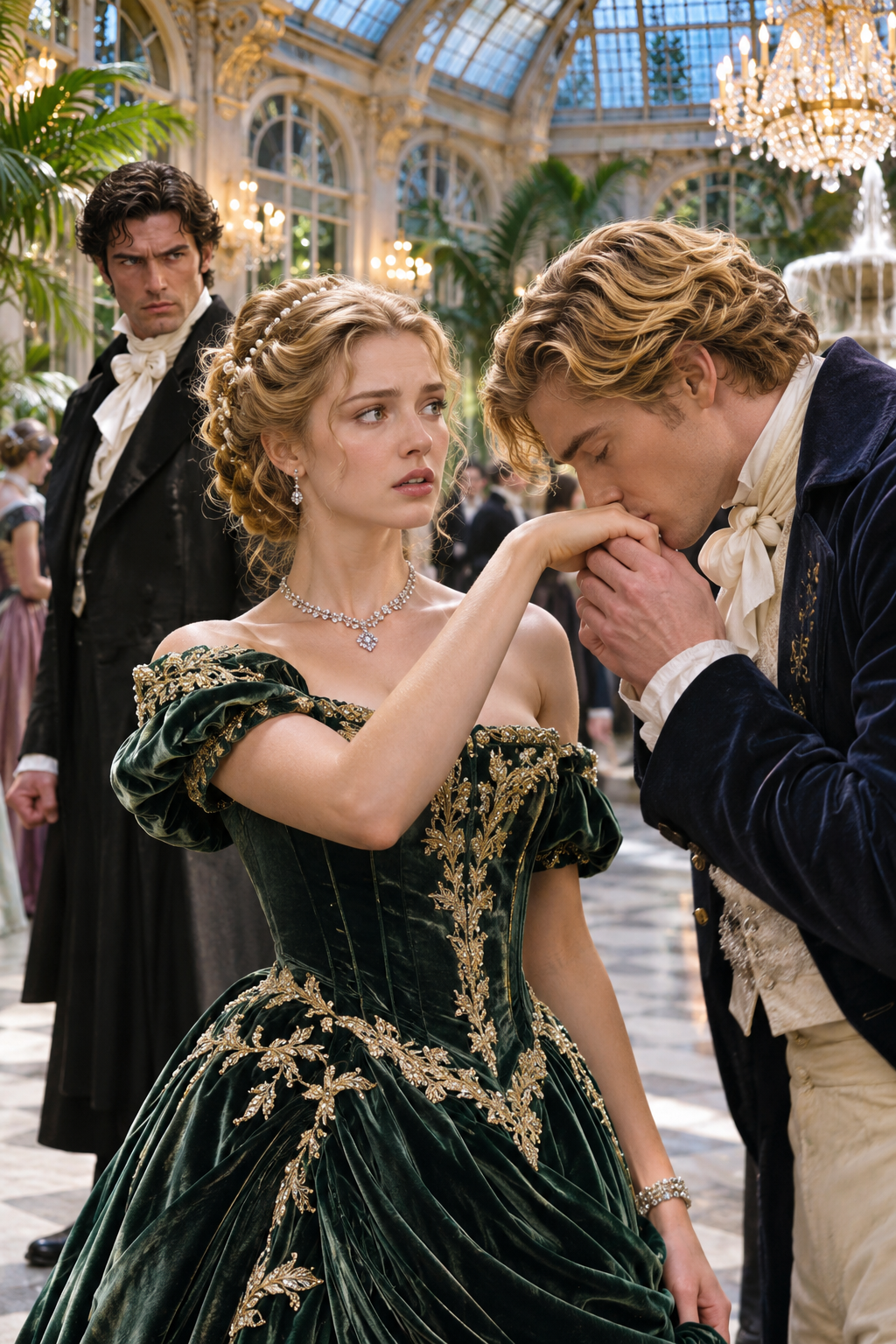
Then he walked out.
I turned toward Mr. Vale.
“Who is Lady Eleanor?”
The solicitor sank into his chair.
“Someone whose memory has caused His Grace considerable pain.”
“Was she his fiancée?”
“Yes.”
“What happened to her?”
Vale looked exhausted.
“She died.”
I felt the room tilt.
“How?”
“I cannot discuss the circumstances.”
“Was Lord Ashford involved?”
The solicitor said nothing.
But his silence told me enough.
I returned to Somerset House shortly before sunset.
Arthur was waiting in the entrance hall.
He looked as though he had spent the entire day searching for me.
“Where have you been?”
“London.”
“Alone?”
“With a coachman.”
“Beatrice, you cannot simply disappear without telling anyone.”
I removed my gloves.
“And you cannot continue hiding half your life from your wife.”
He stopped.
I watched him carefully.
“Who was Eleanor?”
The change was immediate.
His face became completely still.
“Who told you that name?”
“Lord Ashford.”
Arthur took a step backward.
For the first time, I saw genuine horror in his eyes.
“You spoke to Ashford?”
“He came to Mr. Vale’s office.”
Arthur turned toward the nearest servant.
“Send for Collins. Immediately.”
“Arthur—”
“Did Ashford give you anything?”
“No.”
“Did he threaten you?”
“Not directly.”
Arthur closed his eyes.
Then he took my hands.
His fingers were cold.
“Listen to me carefully. You must never meet that man alone again.”
“Why?”
“Because he is dangerous.”
“Then tell me what he wants.”
Arthur looked toward the staircase.
For several seconds, he seemed to struggle with himself.
Finally, he said, “Come to my study.”
It was the one room I had been forbidden to enter.
I followed him down the corridor.
The study was dark, lined with books and heavy furniture.
Above the fireplace hung a portrait of a beautiful young woman with auburn hair.
She wore a pale blue gown and held a small white rose.
I knew immediately who she was.
“Eleanor,” I whispered.
Arthur stood beside the fireplace.
“We were engaged six years ago.”
I waited.
“She was kind. Clever. Far braver than I deserved.”
His voice was almost inaudible.
“We had known each other since childhood. Everyone expected us to marry.”
“What happened?”
Arthur stared at the portrait.
“She discovered financial irregularities involving several noble families. Large sums of money were being moved through false investments and private loans.”
“Was Ashford involved?”
“Yes.”
“And Eleanor discovered it?”
“She believed she had.”
Arthur swallowed.
“She came to me with documents. She wanted me to help expose the men responsible.”
“Did you?”
“Not quickly enough.”
His voice broke.
“I told her to wait. I wanted more evidence. I thought I could handle the matter quietly.”
He looked at me.
“Three days later, she was killed in a carriage accident.”
I covered my mouth.
“Arthur.”
“The authorities ruled it an accident. There was no proof otherwise.”
“But you believe someone arranged it.”
“I believe there were questions that were never answered.”
For the first time, I understood the terrible weight behind his silence.
He had not simply withdrawn from society because he disliked people.
He had built walls around himself after losing someone he loved.
But there was still one question.
“What does Eleanor have to do with my family?”
Arthur approached his desk.
He unlocked a drawer and removed a worn leather folder.
“Your father was one of the investors.”
My breath caught.
“He lost nearly everything because the investments collapsed.”
“Yes.”
“And you knew?”
“I discovered the connection several months before we married.”
He opened the folder.
“Your father’s debts were about to be purchased by a company controlled through intermediaries. I believed Ashford was behind it.”
“Why would he want my father’s debts?”
“Because your father retained records from those investments. Records that might have exposed what happened.”
I stared at him.
“So you bought the debts first.”
“Yes.”
“And then you married me.”
Arthur looked ashamed.
“I feared Ashford would use your family’s situation to force your father into surrendering the documents.”
“You could have told me.”
“I know.”
“You could have helped us without marrying me.”
He did not answer immediately.
Then he said something I had never expected.
“I wanted to.”
My heart stumbled.
“What?”
“I wanted to help you. But I also wanted you here.”
I stared at him.
Arthur looked down.
“I had met you before, Beatrice.”
I shook my head.
“No. We met when you visited my father’s house.”
“That was not the first time.”
He moved toward the window.
“Two years earlier, at a charity gathering in Bath, you defended an elderly servant who had been accused of stealing a silver bracelet.”
I remembered the incident.
A wealthy guest had publicly humiliated the woman.
I had intervened because the bracelet had been found beneath a chair.
“You were there?”
“I watched you refuse to apologize for embarrassing the gentleman who accused her.”
I almost smiled despite everything.
“He deserved to be embarrassed.”
“Yes,” Arthur said softly. “He did.”
He turned toward me.
“I remembered you.”
The room became very quiet.
“When I learned your family was in danger, I saw an opportunity to protect you. And perhaps, selfishly, an opportunity to bring you into my life.”
I stared at him.
“Then why insist on a loveless marriage?”
His eyes filled with pain.
“Because I believed loving someone meant giving the world another way to hurt me.”
I wanted to reach for him.
But the memory of our wedding agreement stopped me.
“You made that decision for both of us.”
“I know.”
“You never gave me a choice about the truth.”
“I know.”
“And now someone is threatening us because of secrets you refused to share.”
Arthur lowered his head.
“You have every right to be angry.”
“Yes,” I whispered. “I do.”
He looked at me.
“I am sorry, Beatrice.”
It was not enough to repair everything.
But it was the first honest apology he had given me.
Before I could respond, Collins knocked urgently.
“Your Grace, forgive the interruption. A message has arrived from Lady Somerset’s father.”
Arthur opened the door.
Collins handed him a folded note.
Arthur read it.
His expression darkened.
“What is it?” I asked.
He handed me the paper.
My father’s handwriting was shaky.
“Beatrice, Lord Ashford has requested a private meeting tomorrow. He claims he can restore everything our family lost. He says he possesses information your husband has concealed. I fear I have made a terrible mistake.”
Below that was one final sentence.
“I have already agreed to meet him.”
I looked up.
“We have to stop him.”
Arthur nodded.
“Yes.”
But I could see the fear returning to his eyes.
And this time, I refused to let him face it alone.
The next morning, we traveled together to my father’s country home.
During the journey, Arthur told me everything he knew about the suspicious investments.
He showed me copies of transactions, letters, and legal agreements.
Some were incomplete.
Others contained names I recognized from society.
Ashford appeared repeatedly, though never as the direct owner of the companies involved.
“He has been careful,” Arthur explained.
“Then we must be more careful.”
Arthur studied me.
“You sound remarkably calm.”
“I spent months managing a household that everyone believed was beyond repair. I have learned that panic rarely balances an account.”
For the first time, he laughed.
It was a small sound.
But hearing it felt extraordinary.
My father greeted us at the door.
He looked older than when I had last seen him.
“Beatrice, I am sorry.”
I embraced him.
“Tell us what happened.”
He led us into the drawing room.
There, he admitted that Ashford had approached him with an offer.
If my father signed a statement declaring that Arthur had manipulated his debts to force our marriage, Ashford would restore a large portion of the family’s lost fortune.
I felt sick.
“He wants to destroy Arthur’s reputation.”
My father nodded.
“And he claims to possess documents proving the duke’s involvement in Eleanor’s death.”
Arthur went still.
“What documents?”
“He wouldn’t say.”
“Did you sign anything?” I asked.
“No.”
Relief washed through me.
“Then we still have time.”
My father looked toward the fireplace.
“There is something else.”
He walked to a cabinet and removed a small wooden box.
“I kept these because I never trusted the men who handled our investments.”
Inside were old letters, receipts, and a narrow ledger.
Arthur leaned forward.
“May I?”
My father handed it to him.
As Arthur examined the pages, his expression changed.
“Beatrice, look at this.”
Several payments had been recorded under false company names.
But one entry stood out.
It carried a date three days before Eleanor’s death.
Beside it was a notation concerning a carriage company.
Arthur’s hands began trembling.
“Eleanor’s carriage was hired through this company.”
I looked at the page.
“Does that prove anything?”
“Not by itself.”
He turned another page.
“But it gives us somewhere to begin.”
My father spoke quietly.
“There was a clerk who handled these transactions. His name was Thomas Reed.”
“Where is he now?” Arthur asked.
“I don’t know. He disappeared after the investments collapsed.”
I looked at Arthur.
“Then we find him.”
We returned to Somerset House with the ledger.
Over the following days, I worked beside Arthur in his study.
The room that had once been forbidden became the place where we spent nearly every waking hour.
We compared dates.
We traced payments.
We questioned former employees.
And slowly, the pattern emerged.
Ashford had used failing investments to trap wealthy families in debt.
He then offered private settlements in exchange for influence, property, or silence.
But the connection to Eleanor’s death remained uncertain.
One evening, after hours of searching, I found Arthur asleep at his desk.
His head rested on his folded arms.
Beside him lay Eleanor’s portrait in a small silver frame.
I stood watching him.
For years, he had carried guilt that might never have belonged to him.
I gently placed a blanket over his shoulders.
He woke.
“Beatrice?”
“You should rest.”
He looked at the blanket.
Then at me.
“Why are you still here?”
“Because we haven’t finished.”
He caught my hand.
“I wasn’t asking about the investigation.”
I froze.
His eyes searched mine.
“Why are you still here with me?”
I could have given him a dozen practical answers.
The marriage agreement.
My family’s security.
The estate.
The servants.
Instead, I told him the truth.
“Because somewhere between repairing your household and arguing with you, I began to care about the man who lives inside these walls.”
Arthur’s expression softened.
“Even after everything?”
“Caring about someone doesn’t mean pretending they haven’t hurt you.”
He nodded slowly.
“I understand.”
“Do you?”
“I am beginning to.”
He raised my hand to his lips.
The kiss was gentle.
Almost uncertain.
And for the first time, I did not feel like a woman trapped in a bargain.
I felt like someone whose choice mattered.
The following morning, Collins brought extraordinary news.
Thomas Reed had been located.
He was living quietly in a village outside Oxford.
Arthur wanted to go immediately.
I insisted on accompanying him.
When we arrived, Reed refused to open his door.
“I have nothing to say,” he shouted from inside.
Arthur stepped forward.
“Mr. Reed, I am the Duke of Somerset.”
“Then I have even less to say.”
I moved beside Arthur.
“Mr. Reed, my name is Beatrice Somerset. My father lost his fortune because of those investments.”
Silence.
“I am not here to threaten you. I only want to understand what happened.”
A lock turned.
The door opened slightly.
An elderly man peered out.
“You’re his daughter?”
“Yes.”
He looked exhausted.
“Your father was one of the few decent men involved.”
“Then help us.”
Reed stared at Arthur.
Finally, he opened the door.
Inside his small cottage, he told us a story that changed everything.
Ashford had not merely profited from the fraudulent investments.
He had organized them.
He had used borrowed names and false accounts to conceal his ownership.
And when Eleanor began asking questions, he became desperate.
“Did he arrange her death?” Arthur asked.
Reed looked away.
“I cannot swear to that.”
Arthur’s shoulders fell.
“But I can tell you something else,” Reed continued.
“Three days before her accident, Lord Ashford ordered a payment to a carriage contractor. He told me it was for private transportation.”
“Do you have proof?” I asked.
Reed nodded.
“I kept copies.”
He reached beneath a loose floorboard and removed a packet of papers.
“I was afraid he would come after me.”
Arthur examined the documents.
His face became pale.
“These signatures.”
Reed nodded.
“They belong to Ashford’s private secretary.”
Arthur sat down.
For several moments, he could not speak.
Then he whispered, “Eleanor was right.”
I placed my hand on his shoulder.
“She was.”
Reed looked between us.
“There is one more thing. Ashford knows someone has been searching for me. His men came here yesterday.”
My blood ran cold.
“Did they threaten you?”
“They offered me money to leave England.”
Arthur stood.
“You must come with us.”
Reed shook his head.
“I am tired of running.”
“Then let us protect you,” I said.
He studied me for a long moment.
Finally, he agreed.
We brought Reed back to Somerset House and contacted a trusted magistrate.
Arthur’s solicitor began preparing the evidence.
But Ashford was not finished.
Two nights later, a fire broke out in the estate’s eastern storage wing.
The alarm came shortly after midnight.
Servants rushed through the corridors carrying buckets.
Smoke poured beneath the doors.
Arthur ran toward the flames.
I followed.
“Beatrice, stay back!”
“Where is Mr. Reed?”
Arthur stopped.
Reed had been staying in a guest room near the eastern wing.
We found him in the courtyard, coughing but unharmed.
He had escaped through a side passage.
But the fire was spreading toward the records room.
Inside were years of estate documents.
Including copies of the evidence we had gathered.
Arthur moved toward the building.
I caught his arm.
“No.”
“We cannot lose those papers.”
“We have the originals secured elsewhere.”
He stared at me.
I had moved them that afternoon.
After everything we had discovered, I no longer trusted locked doors.
Arthur looked at the burning windows.
Then he turned back toward me.
“You thought of that?”
“I thought of several things.”
For a moment, despite the danger, he smiled.
The fire was eventually contained.
No one was seriously injured.
But the damage was considerable.
The next morning, investigators discovered signs that the fire had been deliberately started.
Arthur stood in the ruined corridor, staring at the blackened walls.
“He came into my home.”
I stepped beside him.
“He tried to frighten us.”
“He could have killed someone.”
“Yes.”
Arthur looked at me.
“I should send you away until this is over.”
I shook my head.
“No.”
“Beatrice—”
“You don’t get to decide that for me.”
He fell silent.
“I married you to protect my family,” I continued. “I stayed because I believed there was something worth saving between us. But I will not spend the rest of my life being hidden whenever you are afraid.”
Arthur’s eyes filled with emotion.
“I cannot bear the thought of losing you.”
“Then stand beside me instead of putting me behind you.”
He took my hands.
And this time, he did not argue.
Within days, the evidence was placed before the authorities.
Ashford was summoned for questioning.
He denied everything.
He claimed the financial records were forged.
He insisted the carriage payment was innocent.
And he accused Arthur of inventing the entire scandal to conceal his own involvement.
Society erupted with gossip.
Invitations disappeared.
Old acquaintances crossed the street rather than greet us.
Newspapers hinted at disgrace without naming anyone directly.
Arthur endured it silently.
But I saw how deeply it hurt him.
One afternoon, I found him standing before Eleanor’s portrait.
“Perhaps Ashford is right about one thing,” he said.
I looked up.
“What?”
“My silence allowed him to continue.”
I approached him.
“You made mistakes.”
“Yes.”
“But you are not responsible for every terrible thing another man chose to do.”
Arthur stared at the portrait.
“I should have listened to her.”
“Then listen to her now.”
He turned toward me.
“Tell the truth,” I said. “Even if it hurts. Even if people judge you. Even if you must admit that you were afraid.”
His eyes met mine.
“And if the truth destroys my reputation?”
“Then we build something better than a reputation.”
“What could possibly be better?”
“A life you no longer have to lie to protect.”
The next morning, Arthur requested a formal hearing.
He gave a complete statement.
He admitted his earlier silence.
He acknowledged that he had purchased my family’s debts without informing me.
He explained his suspicions about Ashford and his failure to act quickly when Eleanor first raised concerns.
He concealed nothing.
Then Thomas Reed testified.
The solicitor presented the financial records.
My father confirmed the attempted bargain.
And I submitted the anonymous letter, along with the household records showing Arthur’s payments.
For hours, Ashford maintained his innocence.
Then the magistrate produced the final document.
It was a letter from Ashford’s private secretary, recovered among Reed’s papers.
The letter referred to a payment intended to ensure that Eleanor’s carriage would be delayed on a particular road.
The wording did not establish who caused the fatal accident.
But it was enough to demand a deeper investigation.
Ashford’s expression changed.
For the first time, his confidence disappeared.
He looked directly at me.
“You have no idea what you’ve done.”
I held his gaze.
“I have done what you hoped everyone would be too frightened to do.”
“And what is that?”
“I asked questions.”
The investigation continued for several months.
More witnesses came forward.
Former investors produced missing documents.
A carriage contractor admitted that Ashford’s secretary had paid him to alter Eleanor’s route, though he denied knowing any plan to harm her.
The authorities uncovered enough evidence of fraud, intimidation, and financial conspiracy to bring serious charges.
The precise cause of Eleanor’s accident remained disputed.
But Ashford could no longer hide behind his wealth and title.
He was convicted of financial fraud and conspiracy connected to the fraudulent investments. The separate investigation into Eleanor’s death remained open.
For Arthur, the outcome brought relief, but not the simple peace he had imagined.
One evening, we stood together in the garden.
The roses were beginning to bloom.
“Do you feel better?” I asked.
He considered the question.
“Not entirely.”
I nodded.
“I suppose some wounds don’t disappear because someone is punished.”
“No,” he said. “But perhaps they can finally begin to heal.”
He took my hand.
“I spent six years believing that if I never loved anyone again, I would never feel that kind of pain.”
“And did it work?”
He gave a sad smile.
“No. It only made every day empty.”
We walked in silence.
Then Arthur stopped.
“There is something I need to give you.”
He reached into his coat and removed a folded document.
I recognized it immediately.
Our marriage agreement.
The rules he had placed before me on our wedding day.
No unnecessary conversation.
No entering his private rooms.
No questions.
No love.
Arthur held the paper between us.
“I was wrong to ask you to live this way.”
I stared at him.
“I know.”
He nodded.
“I cannot undo the loneliness I caused you. And I cannot ask you to forget it.”
He slowly tore the agreement in half.
Then again.
The pieces fell into his hand.
“I want you to be free, Beatrice.”
My heart tightened.
“What are you saying?”
“If you wish to leave this marriage, I will make certain you and your family remain secure. I will never use money, duty, or gratitude to keep you here.”
I looked at the torn paper.
For months, I had dreamed of hearing those words.
Freedom.
A choice.
A life that belonged to me.
And now that he offered it, I understood something important.
I had never wanted to escape love.
I had wanted to escape a marriage without it.
“Arthur,” I whispered, “what if I don’t want to leave?”
He stared at me.
“Then I would ask whether you could ever forgive me.”
“Forgiveness isn’t something you can demand.”
“I know.”
“It is something you earn.”
He nodded.
“And I intend to spend the rest of my life earning it, if you will allow me.”
Tears filled my eyes.
“Then perhaps we should begin with something simple.”
“Anything.”
“Have breakfast with me tomorrow.”
He laughed softly.
“Breakfast?”
“At the same table. At the same time. And you must actually speak to me.”
Arthur took my hand.
“I believe I can manage that.”
“And no disappearing into your study for days.”
“That may require practice.”
I smiled.
“Then practice.”
He stepped closer.
“Beatrice, may I kiss you?”
It was such a small question.
Yet it meant more than every grand promise he could have made.
Because he was asking.
Not ordering.
Not assuming.
Not hiding behind a title.
I answered by moving into his arms.
Our first real kiss was not perfect.
We were both nervous.
We had too much history between us.
But it was honest.
And that made it beautiful.
In the months that followed, Somerset House changed.
Arthur began joining the household for important celebrations.
He learned the names of servants who had worked for him for years.
He listened when Mrs. Whitmore spoke.
He consulted me on estate decisions instead of treating my work as something that happened quietly in the background.
We established a fund to assist families harmed by the fraudulent investments.
My father’s finances were gradually restored through recovered assets and lawful settlements.
My younger brother returned to his studies.
And the estate that had once felt like a beautiful prison became a place filled with conversation, music, and laughter.
But the greatest change was not in the house.
It was in us.
We still argued.
Arthur could be stubborn.
I could be impatient.
Sometimes he withdrew when memories overwhelmed him.
Sometimes I feared that silence meant he was shutting me out again.
But we learned to speak before resentment grew.
We learned to apologize without making excuses.
And we learned that love was not proven by dramatic gestures alone.
It lived in ordinary moments.
A cup of tea brought without being requested.
A hand reaching across the dinner table.
A question asked with genuine interest.
A difficult truth spoken even when silence would have been easier.
One spring morning, nearly a year after our wedding, Arthur found me in the garden.
I was supervising the planting of new roses near the eastern wall.
He approached carrying two cups of tea.
“Your Grace,” he said solemnly, “I have been informed that the duchess is once again reorganizing my entire estate.”
I accepted a cup.
“Your informant is correct.”
“Should I be concerned?”
“Only if you intend to interfere.”
He smiled.
“I wouldn’t dare.”
We sat together on a stone bench.
For a while, neither of us spoke.
But this silence was different.
It was peaceful.
Comfortable.
Chosen.
Arthur looked toward the house.
“Do you remember our wedding day?”
“How could I forget?”
“I told you that you would have my name and protection, but nothing more.”
“Yes.”
He turned toward me.
“I thought those words would keep us safe.”
“They nearly destroyed us.”
“I know.”
He took my hand.
“If I could return to that day, I would say something different.”
“What would you say?”
He looked directly into my eyes.
“I would tell you that I was frightened. That I had forgotten how to trust. That I needed help learning how to live again.”
My throat tightened.
“And what would you ask of me?”
“Not obedience. Not silence. Just patience, honesty, and the chance to become someone worthy of your love.”
I rested my head against his shoulder.
“You could have saved us both a great deal of trouble.”
He laughed.
“Yes. I believe I could have.”
Then he kissed my forehead.
“Do you regret marrying me, Beatrice?”
I thought about the frightened young woman who had walked into Somerset House believing she had sold her future to save her family.
I thought about the cold man who had stood beside her, convinced that love was a weakness.
And I thought about everything we had nearly lost because neither of us had understood the cost of silence.
“I regret the pain,” I answered. “But I don’t regret what we chose to build after it.”
Arthur held my hand a little tighter.
That afternoon, we walked through the estate together.
The servants greeted us with smiles.
Children from the nearby village played beside the fountain.
Sunlight streamed through windows that had once remained covered.
And for the first time, Somerset House truly felt alive.
I had entered that marriage believing my greatest duty was to rescue my family.
Arthur had entered it believing his greatest duty was to protect his heart.
We were both wrong about what mattered most.
Because a marriage cannot survive on duty alone.
Wealth cannot purchase devotion.
A title cannot command affection.
And silence, no matter how carefully maintained, cannot protect people from the pain of being misunderstood.
Arthur did not become a better husband because he was jealous at a ball.
Jealousy merely exposed what he had been too frightened to admit.
He became a better husband when he told the truth, accepted responsibility, respected my choices, and learned to love without trying to control.
And I did not find happiness because I endured his coldness.
I found it because I finally demanded honesty, dignity, and a voice in my own life.
Years later, people would speak of our marriage as a remarkable love story.
They would say the cold Duke of Somerset had been transformed by the woman he married.
But I knew the truth was more complicated.
I had not rescued Arthur by loving him enough to make his pain disappear.
He had chosen to face that pain.
He had chosen to change.
And I had chosen to stay only when staying became an act of freedom rather than sacrifice.
That was the lesson our marriage taught me.
Love is not the absence of fear.
It is the courage to be honest despite it.
And the greatest gift one person can offer another is not wealth, protection, or even a promise of forever.
It is the freedom to be fully seen, fully heard, and freely loved.
On our first wedding anniversary, Arthur gave me a small velvet box.
Inside was a simple gold ring engraved with four words.
“Never silent. Always together.”
I looked up at him through tears.
“Another agreement, Your Grace?”
He smiled.
“No, my love.”
He slipped the ring onto my finger.
“This time, it’s a promise we both get to make.”
And as he kissed me beneath the morning sunlight, I realized that the marriage which had begun as a bargain had become something neither money nor power could ever buy.
A home.
A partnership.
And a love we had both been brave enough to choose.
THE END.