Wyoming winters had a way of revealing what people were made of.
Inside the iron pot was not a magnificent roast, nor any costly cut of beef that might have exposed Tilly as a cheat.
It was stew.
But it was the richest-looking stew most of the men had seen in weeks.
Dark gravy rolled slowly around pieces of browned meat, onions, beans, and hand-cut dumplings swollen with broth. Fat shimmered across the surface in tiny golden circles. Steam rose into the Wyoming evening carrying the smell of peppered beef, toasted flour, onion, and wood smoke.
One of the younger hands stopped halfway across the yard.
“Lord above,” he murmured.
Orson Bradock said nothing.
Tilly replaced the lid.
“Not yet,” she said.
Those two words seemed to hurt Orson more than an argument would have.
The men went back to the last of the branding, but their attention had shifted. Every few minutes somebody glanced toward the trench stove.
Tilly ignored them.
She had survived railroad camps where two hundred hungry workers could complain louder than a Wyoming cattle crew. Forty men did not frighten her.
Running out of heat did.
She crouched beside the trench and examined the coals.
The missing seasoned wood had forced her to abandon the original cooking sequence. Instead of maintaining several separate fires, she had concentrated nearly every coal beneath the long trench. Thick beans occupied the hottest end. The stew sat in the middle, where steady heat would tenderize the scraps without boiling them dry. At the far end, a cast-iron pan held cornmeal batter mixed with rendered fat and a little precious sugar.
Everything depended on timing.
The branding ended as the sun lowered toward the western hills.
Men washed their hands at the pump and gathered near the tables Abram had built from boards laid across sawhorses.
No tablecloth covered them.
No china waited.
Only tin plates, spoons, cups, and forty men who had worked since dawn.
Orson walked slowly toward Tilly.
“So,” he said loudly enough for everyone to hear, “this is your grand feast?”
Tilly looked at him.
“This is supper.”
A few men smiled.
Orson leaned toward the trench stove.
“Beans, bread, and scraps?”
“Among other things.”
“That feeding forty?”
“That is the arrangement.”
He looked toward the men.
“I hope you boys brought strong teeth.”
This time no one laughed.
The smell had made laughter difficult.
Tilly nodded to Abram.
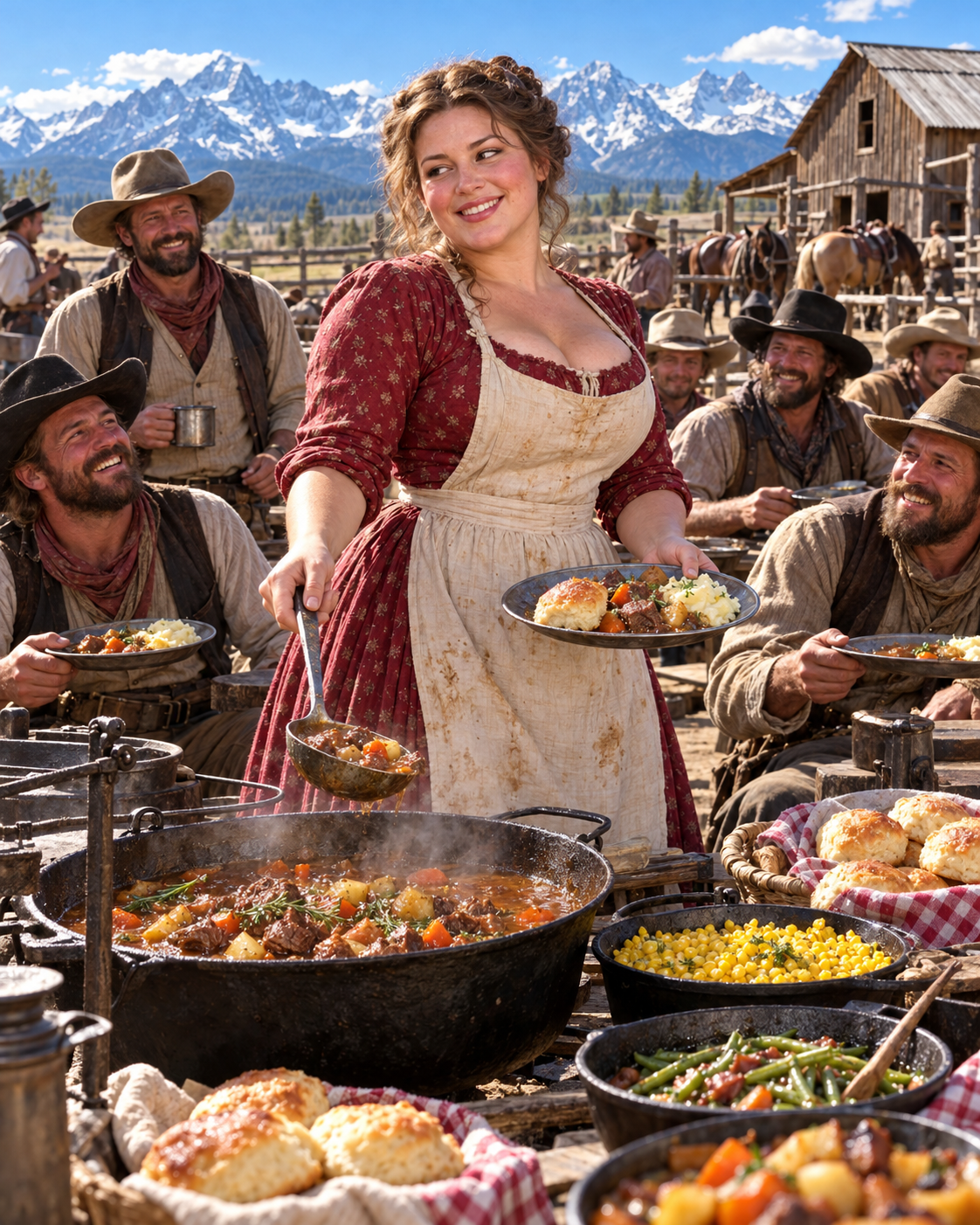
He carried the first iron pot toward the table.
The beans had cooked slowly with pieces of browned fat, onion ends, salt, and scraps of meat too small for any sensible butcher to sell. Hours of gentle heat had turned the thin ingredients into something thick and smoky.
Then came the stew.
Then the corn bread.
But Tilly was not finished.
From beneath a folded cloth near the stove, she produced two pans of biscuits.
Abram stared.
He had not seen her make them.
Orson stared harder.
“Where’d the extra flour come from?”
Tilly wiped her hands on her apron.
“The same flour you saw yesterday.”
“There wasn’t enough.”
“There was enough if you didn’t waste it.”
She had used the coarse flour for the biscuits and saved the finer portion for thickening the stew. Instead of rolling dough thick and cutting large rounds, she had formed smaller biscuits by hand, just enough for each man to receive one while leaving enough flour for dumplings.
Nothing was accidental.
Nothing was extravagant.
That was precisely why it worked.
The men lined up.
Tilly served each plate herself.
One spoonful of beans.
One ladle of stew.
A square of corn bread.
One biscuit.
At first the portions seemed almost too careful.
Orson noticed.
“Afraid you’ll run out?”
Tilly did not answer.
She waited.
The first men began eating.
Conversation stopped.
That silence was different from the silence inside the general store.
There, people had been uncomfortable.
Here, they were busy.
A gray-bearded ranch hand named Mercer swallowed a spoonful of stew and looked at Tilly.
“What’d you put in this?”
“What I had.”
“That ain’t an answer.”
“It’s the only one you’re getting until you finish.”
Mercer laughed and took another bite.
Others followed.
The dumplings stretched the meat without pretending to be meat. The beans provided weight. The corn bread absorbed gravy. The biscuit made the plate feel generous.
Tilly had built the meal the same way a carpenter built a wall—each part supporting another.
By the time the first plates were empty, men were looking toward the pots.
“Seconds?” someone asked cautiously.
Tilly glanced at the line, then at the remaining food.
She had calculated for this.
“Beans and stew,” she said. “One more round.”
The men cheered.
Orson’s face tightened.
He had expected the trick to reveal itself there.
Perhaps the first serving could have been staged, but seconds meant volume.
Abram carried the pots back down the table.
Every man who wanted more received more.
When Mercer held out his plate for the second time, he grinned at Orson.
“Bradock, I reckon you ought to have insulted her cooking sooner. Might’ve been eating this all year.”
Laughter moved along the table.
Orson’s neck reddened.
Tilly said nothing.
She had not accepted the wager merely to hear Orson mocked in return.
There was still one problem.
The fire was dying.
And dessert had not been served.
Only Abram knew there was supposed to be dessert.
He approached her quietly.
“Tilly.”
“I see it.”
There were hardly enough coals left beneath the far end of the trench.
The cornbread had been removed. The beans were safe. The stew was finished.
But beside the stove waited a shallow covered skillet containing the last part of Tilly’s plan.
She had found several wrinkled apples stored in the cellar—too soft for eating fresh but not spoiled. She had sliced them thin, cooked them with a spoonful of sugar, and covered them with scraps of biscuit dough.
The cobbler needed another fifteen minutes.
The coals probably had ten.
Abram lowered his voice.
“We can stop here. Nobody can say you didn’t feed them.”
Tilly looked toward Orson.
He was no longer eating.
He was watching the stove.
He had noticed.
Perhaps he knew how little fuel remained.
Perhaps that was exactly what whoever stole the firewood had intended.
Tilly looked beyond the ranch yard toward the branding pens.
Scattered beside them were the dried chips of wood Abram had shaved from several broken fence rails while making repairs that morning.
Not enough to call firewood.
Enough to call heat.
“Tilly,” Abram said, following her gaze, “that pine burns fast.”
“I know.”
“It’ll flare.”
“I know that too.”
She gathered the dry shavings, carried them to the trench, and fed them beneath the skillet in small handfuls.
The flame jumped.
Instead of letting it race upward, she slid a flat piece of scrap iron partly across the trench opening, trapping more heat beneath the pan.
It was crude.
It was risky.
It worked.
Within minutes the scent of baked apples joined the beef and bread already hanging in the air.
Men who had claimed they could not eat another bite suddenly sat straighter.
Mercer turned toward her.
“You hiding pie back there?”
“Not pie.”
“Close enough.”
Tilly removed the skillet before the last flame disappeared.
The dough on top was browned unevenly, darker near one edge, but the apples beneath it bubbled in their own thickened juice.
Forty men could not receive large servings.
They received three warm spoonfuls each.
No one complained.
When Orson’s portion reached him, he stared at it.
“You counted these apples yesterday?”
Tilly looked at him.
“You were standing there.”
“They were half rotten.”
“Soft,” she corrected. “Not rotten.”
He tasted the cobbler.
His expression changed before he could stop it.
Mercer caught the look.
“Well?”
Orson swallowed.
“It’s fine.”
The entire table erupted.
“Fine?” Mercer shouted. “Bradock, if this is fine, I’d like to know what your mother fed you.”
Even Abram laughed then.
Tilly turned away so no one could see her smile.
By sunset, the pots were nearly empty.
Not completely empty.
Nearly.
That mattered.
A meal that fed exactly forty men and left nothing might have been luck.
A meal that fed forty men twice, gave them dessert, and still left a small supper for Abram and Tilly was something else.
Mercer stood and wiped his mouth.
“I say she did it.”
Several men voiced agreement.
Orson remained seated.
The original wager had been spoken at the store in front of witnesses. He could not easily escape it.
Still, he tried.
“She had help.”
Abram stopped smiling.
“With what?”
“The wood, maybe. Food. Who knows?”
Tilly placed the empty ladle on the table.
“You inventoried the pantry yourself.”
“I saw the pantry.”
“You stood beside Abram while he checked the smokehouse.”
Orson said nothing.
“You watched the cellar too.”
Still nothing.
“And you’ve been here since before noon.”
One rancher at the end of the table nodded.
“That’s true.”
Another added, “Nobody rode in with supplies.”
Orson pushed himself to his feet.
“Then somebody brought things last night.”
Abram stepped forward.
Tilly touched his arm.
“No.”
That single word stopped him.
She looked at Orson.
“If you believe I cheated, say what was brought.”
Orson glanced around.
No one helped him.
“More flour?”
“You saw what remained in the sack.”
“Meat.”
“You saw the meat.”
“Sugar.”
“The sugar jar is still in the pantry.”
Tilly’s voice never rose.
That made the moment worse for him.
Orson searched for something else.
Then his eyes moved toward the woodpile.
Tilly saw it.
So did Abram.
For a moment, Orson’s expression betrayed him.
Not guilt exactly.
Recognition.
Tilly suddenly understood something she had not known that morning.
Orson knew the wood was missing.
Abram took one step forward.
“You.”
Orson lifted his hands.
“I didn’t say anything.”
“You didn’t have to.”
“You calling me a thief?”
Abram’s voice hardened.
“I’m asking how you knew to look at the woodpile.”
The yard became quiet.
A Wyoming evening could hold silence differently from a room. It stretched wider. The cattle shifting in the pens sounded suddenly loud.
Orson stared at Abram.
Then at Tilly.
“I didn’t take your wood.”
“Who did?” Abram asked.
Orson hesitated.
That was answer enough to several men.
Mercer stood.
“Bradock.”
Orson cursed beneath his breath.
“All right. I told Cole Haskins it’d be funny if some of the dry wood disappeared. That’s all.”
Abram lunged forward.
Two ranchers caught him before he crossed the space.
Tilly did not move.
“You told someone to steal our winter wood,” she said.
“Not steal it. Hide some. There’s a difference.”
“In Wyoming in October?”
Orson looked away.
Everyone there understood.
Seasoned firewood was not decoration.
A ranch family counted it the way other people counted money.
Taking it at the edge of winter was not a harmless joke.
Orson attempted a shrug.
“It was only enough to make cooking difficult.”
“That was the point,” Mercer said.
“No one was going to freeze.”
“You didn’t know that,” Abram snapped.
Tilly raised her hand.
Again, Abram stopped.
She looked at Orson for a long time.
When she finally spoke, her voice was almost gentle.
“You thought if the supper failed, people would remember what you said in the store.”
Orson gave no answer.
“You needed the joke to stay true.”
“That’s not what this was.”
“Yes,” Tilly said. “It was.”
Orson’s face hardened.
“Don’t make yourself important, Mrs. Dillard.”
The old insult was there again, trying to find a shape.
Tilly surprised everyone by smiling.
“I don’t have to.”
She gestured toward the table.
“Forty men just did that for me.”
Nobody laughed.
It was too clean a blow for laughter.
Orson looked around the table and realized he no longer controlled the room.
He had controlled the general store because shame works best when people are afraid to interrupt it.
Out here, after a hard day’s work and two bowls of hot stew, people were less interested in helping him.
Mercer folded his arms.
“A wager’s a wager.”
Several voices agreed.
Orson had promised more than pride at the store. If Tilly fed the branding crew under the stated conditions, he would provide the Dillards with forty sacks of cattle feed before winter.
The wording had been his own joke.
Forty cows.
Forty sacks.
He had expected never to pay.
Now every man at the table knew it.
Orson stared at Tilly.
“You really want to take feed from me over a joke?”
Tilly considered the question.
Then she shook her head.
“No.”
Abram turned to her in disbelief.
Orson’s mouth almost formed a smile.
Tilly continued.
“I want twenty sacks delivered here.”
The smile vanished.
“And the other twenty delivered to Mrs. Bellamy’s place.”
Mercer blinked.
The Bellamy ranch lay several miles north. Jacob Bellamy had died the previous spring after a riding accident, leaving his wife with two children and a herd too small to sell but too large to feed cheaply through winter.
Everyone nearby knew she was struggling.
Orson frowned.
“That wasn’t the wager.”
“No,” Tilly said. “Forty sacks to us was the wager. I’m telling you where ours should go.”
Abram looked at her.
Slowly, his anger changed into something else.
Understanding.
Tilly had not forgotten the missing wood.
She had simply decided Orson’s humiliation was not worth as much as feed.
Mercer smiled.
“Sounds fair to me.”
“It doesn’t concern you,” Orson snapped.
“It concerned all of us when you made the wager in public.”
Another rancher spoke.
“And when you tried to fix the outcome.”
Orson looked from face to face.
He had lost more than a bet.
He had lost the ability to pretend the joke had been harmless.
“Fine,” he said.
Tilly nodded.
“Before the first snow.”
“Fine.”
“And our missing wood comes back tonight.”
Orson clenched his jaw.
“I’ll tell Cole.”
“No,” Tilly said. “You’ll bring it.”
A few men lowered their heads to hide smiles.
Orson’s face burned.
But he nodded.
That night, long after the branding crew rode away, a wagon creaked toward the Dillard ranch beneath a rising moon.
Orson drove it.
The missing wood lay in the back.
Abram watched from the porch.
Tilly stood beside him with a shawl around her shoulders.
Orson unloaded every piece without being asked.
When he finished, he brushed splinters from his coat.
“Happy?”
Tilly looked at the restored pile.
“That isn’t the word.”
Orson turned toward his wagon.
“Bradock.”
He stopped.
Tilly walked down the porch steps.
“I want to tell you something.”
He gave a tired laugh.
“I reckon you already did.”
“No.”
She stood a few feet from him.
“When you made that joke at the store, you thought my size told you something about my character.”
Orson shifted uncomfortably.
“You thought it told you I was greedy.”
He looked away.
“Lazy, maybe.”
He said nothing.
“Undisciplined. Wasteful. A burden to my husband.”
“Tilly,” Abram said softly.
She continued.
“You looked at me and invented a whole life you knew nothing about.”
Orson’s face lost some of its hardness.
She pointed toward the trench stove, now only a dark line in the yard.
“I spent twelve years feeding railroad crews. I learned how to make food last because sometimes the supply wagon didn’t arrive. I learned to cook with wet wood because sometimes that was all we had. I learned to stretch meat because men still had to work whether the cook had plenty or not.”
Orson listened.
“I didn’t learn any of that because I was trying to prove something to men like you.”
She paused.
“I learned it because people depended on me.”
For once, Orson had no answer.
Tilly stepped back.
“You should be more careful deciding what a person is worth by looking at them.”
He climbed onto his wagon without replying.
But before driving away, he glanced once toward the stove.
The next morning, Tilly woke before sunrise out of habit.
Her muscles ached from the previous day.
The ranch was quiet.
Abram was already in the kitchen.
He had placed two tin plates on the table.
On each plate sat reheated stew and a biscuit.
Tilly looked at him.
“Breakfast?”
“I figured the railroad-camp cook deserved somebody else warming her food for once.”
She smiled and sat.
They ate in silence for a while.
Finally Abram said, “Why Bellamy?”
“You know why.”
“We could use those sacks.”
“So can she.”
“We’re not exactly rich.”
“No.”
Tilly broke the biscuit in half.
“But we aren’t alone either.”
Abram studied her.
Then he nodded.
Three days later, twenty sacks of cattle feed arrived at the Dillard ranch.
Another twenty continued north.
Orson himself was not driving that wagon.
Nobody expected him to.
But before winter fully settled over Wyoming, something else changed.
At the general store, men stopped repeating the forty-cow joke.
Not because they had suddenly become better people.
People rarely changed that neatly.
They stopped because the joke no longer worked.
If somebody mentioned Tilly Dillard, another person was likely to say, “That woman fed forty hands out of a pantry that looked empty.”
Someone else would add, “And did it after half her dry wood disappeared.”
Mercer told the story most often.
With every telling, the stew grew thicker, the biscuits larger, and the apple cobbler somehow became enough to feed sixty men.
Tilly corrected him twice.
After that, she gave up.
By December, the first serious storm buried fences and erased the wagon tracks between ranches.
The Dillards used their firewood carefully.
Their cattle ate from the twenty sacks Orson had delivered.
North of them, the Bellamy herd survived too.
One bitter morning in January, Abram came inside carrying a small parcel wrapped in cloth.
“Found this hanging on the gate.”
Inside were six apples, preserved from the Bellamy cellar, and a note.
Mrs. Bellamy had written only one sentence.
You fed more than forty people that day.
Tilly read it twice.
Then she folded the paper and tucked it into the wooden box where she kept important things.
Years later, she would forget exactly how many pounds of flour remained in the pantry before the wager.
She would forget whether the stew had contained five onions or six.
She would even forget the face of the young ranch hand who asked first for seconds.
But she never forgot the feeling inside the general store when Orson Bradock decided her body was public property for laughter.
And she never forgot what came afterward.
Not because she had defeated him.
That was the least important part.
She remembered because she discovered something that day about dignity.
Dignity was not always loud.
It did not always demand revenge.
Sometimes dignity looked like a woman standing over an almost-empty pantry, refusing to let another person decide what she could do.
Sometimes it looked like a narrow trench cut into Wyoming dirt because there was not enough firewood for a wasteful flame.
Sometimes it looked like forty plates filled from scraps.
And sometimes, after winning what everyone said belonged to you, dignity meant giving half of it to someone whose winter was going to be harder than yours.
Tilly had entered the wager wanting to prove that Orson Bradock was wrong about her.
She finished it understanding that proving him wrong had never been the greatest victory.
The greater victory was proving that scarcity did not have to create selfishness, that cruelty did not have to be answered with cruelty, and that a person’s value could never be measured by the careless judgments of someone standing across a general-store counter.
Wyoming winters remained hard.
Woodpiles still ran low.
Cattle still needed feeding.
Storms still arrived without asking whether a family was prepared.
But whenever the Dillard kitchen filled with the smell of beans, bread, and wood smoke, Abram sometimes looked at Tilly and asked whether they ought to invite forty men for supper.
She would give him a warning look.
Then, eventually, she would laugh.
Because by then, the number forty no longer belonged to Orson Bradock.
It belonged to her.
And in that corner of Wyoming, people remembered why.
And in that corner of Wyoming, people remembered why.
They remembered especially when the winter deepened.
By late January, snow had climbed halfway up the fence posts around the Dillard ranch. The wind came down from the open country with nothing to stop it, pushing powder across the yard in long white ribbons and rattling the windows after dark.
That winter tested everyone.
Feed grew expensive.
Travel became difficult.
A broken wagon wheel could turn into a three-day problem.
A sick animal could become a family’s ruin.
The kind of people who had laughed easily in October laughed less in January.
But something else had changed too.
When Mrs. Bellamy’s oldest boy rode to town for lamp oil, someone quietly loaded an extra sack of meal onto his wagon.
When Mercer heard that an elderly rancher west of the creek had run low on chopped wood, he brought over a sled full of split cottonwood without announcing it.
When one of the younger hands broke his wrist after being thrown from a horse, three neighboring ranches took turns checking his cattle.
No one called it charity.
People on the Wyoming frontier were too proud for that word.
They simply called it helping.
Tilly noticed the change without claiming credit for it.
She had lived long enough to know that people rarely transformed because of one speech or one supper.
But sometimes one moment loosened something that had been stuck for years.
Sometimes shame stopped being entertainment.
Sometimes generosity became easier after someone else went first.
Then, one morning near the end of February, Abram saw a rider approaching through the snow.
It was Orson Bradock.
He rode alone.
Abram stepped onto the porch before Orson reached the gate.
Tilly watched through the kitchen window.
Orson dismounted slowly.
He looked different from the man who had stood laughing in the general store months earlier.
Not smaller.
Just quieter.
His coat was dusted with snow, and the horse beneath him looked tired.
Abram did not invite him inside.
“What do you want?”
Orson removed his gloves.
“I came to speak to your wife.”
Abram’s jaw tightened.
Tilly opened the door.
“You can speak from there.”
Orson looked at her.
For a few seconds, no one said anything.
Then he reached into his coat and took out an envelope.
“I owe you more than feed.”
Tilly did not move.
Orson continued.
“My sister heard about what happened.”
Abram frowned.
“I didn’t know you had a sister.”
“Most people don’t.”
Orson stared at the envelope in his hand.
“She lives back east. Pennsylvania.”
Tilly waited.
“She wrote to me.”
He gave a humorless smile.
“Turns out Mercer’s story travels farther than I thought.”
Tilly almost smiled at that.
Orson held out the envelope.
“She said if our mother had been alive to hear what I said to you, she would’ve crossed half the country just to slap me herself.”
Abram coughed to hide what might have been laughter.
Orson looked uncomfortable.
“My sister reminded me of something.”
He swallowed.
“Our mother was a large woman.”
Tilly’s expression changed slightly.
“She cooked for eight children and my father. Kept us alive through two bad winters. Took in washing when cattle prices fell.”
He looked toward the snow-covered yard.
“I spent my whole life talking about how strong she was.”
Then his eyes returned to Tilly.
“And somehow I stood in a store and mocked another woman for looking like her.”
That was the first time Tilly understood the full ugliness of what had happened.
Orson had not simply been ignorant.
He had separated respect from appearance whenever it suited him.
He had loved strength in someone he knew and mocked the same shape in someone he did not.
Tilly stepped onto the porch.
“What is in the envelope?”
“Money.”
“No.”
He blinked.
“It’s not much.”
“I don’t want it.”
“You should take it.”
“No.”
His face tightened.
“You won the wager.”
“I already received what I won.”
“This isn’t the wager.”
“I know.”
Orson looked almost angry.
Perhaps apology was harder for him than losing.
“Then what do you want?”
Tilly considered the question.
The old version of herself might have wanted him humiliated in the same store.
Might have wanted him to stand where she had stood and feel everyone’s eyes on him.
But winter had given her time to think.
“Next time you hear someone become the joke in a crowded room,” she said, “don’t laugh.”
Orson stared at her.
“That’s it?”
“No.”
She folded her arms.
“Stop it.”
He looked toward Abram.
Abram said nothing.
Tilly continued.
“You knew what happened in that store was wrong before you said the first word.”
Orson opened his mouth.
She raised a hand.
“Don’t insult me again by pretending you didn’t.”
His mouth closed.
“You looked around first,” she said. “You saw who would laugh. You saw who wouldn’t challenge you. Then you spoke.”
Orson lowered his eyes.
“You wanted an audience more than you wanted a joke.”
The truth of it settled between them.
“And that,” Tilly said, “is the part you can change.”
For several seconds, the only sound was wind dragging snow across the roof.
Orson put the envelope back inside his coat.
Then he nodded.
“I can try.”
Tilly shook her head.
“No.”
He looked up.
“Trying is what people say when they want credit before doing anything.”
Abram almost smiled.
Tilly’s voice softened.
“Do it.”
Orson nodded again.
This time he said nothing.
He climbed onto his horse and rode away.
Abram watched until the rider disappeared behind a ridge.
“You think he meant it?”
Tilly went back inside.
“I think he heard it.”
“That isn’t what I asked.”
“No,” she said. “But it’s all I know.”
Spring arrived slowly.
Snow retreated from the hills.
The first muddy roads appeared.
Cattle moved restlessly in the warmer light.
By April, the town began talking about planting, fencing, calves, and prices again.
Life moved on because life always did.
Then came the day Tilly returned to the general store.
It was her first visit there since the wager.
She had avoided it not because she was afraid, but because she had not needed anything badly enough to make the trip.
Now she needed coffee, nails, salt, and lamp oil.
When she entered, conversations shifted.
Not stopped.
Shifted.
People greeted her.
The storekeeper nodded.
Mercer, standing near a barrel of flour, grinned.
“Well, if it isn’t the woman who can feed forty men with three beans and a prayer.”
Tilly pointed at him.
“That story gets bigger every month.”
“That’s the frontier.”
“You told someone I baked six pies.”
“I may have said four.”
“There were no pies.”
Mercer considered this.
“Then people must’ve added the other two.”
Tilly laughed.
And that was when she heard a voice near the back counter.
A young man was teasing a girl who worked at the store.
She could not have been more than seventeen.
He had made some remark about her freckles.
Then another about her teeth.
A few men nearby smiled.
The girl’s face reddened.
Tilly felt the old store suddenly return around her.
Not the shelves.
Not the barrels.
The feeling.
That moment when a room decides whether cruelty is entertainment.
Before she could speak, another voice cut through the laughter.
“That enough.”
It was Orson.
He stood beside a stack of feed sacks.
The young man turned.
“What?”
“I said that’s enough.”
“I’m just fooling.”
Orson’s face did not change.
“She ain’t laughing.”
The room became quiet.
The young man shrugged.
“Didn’t mean anything.”
“Then it shouldn’t be hard to stop.”
Tilly said nothing.
Orson did not look toward her.
That mattered.
He was not doing it because she was watching.
Or if he was, he was at least wise enough not to ask for applause.
The girl behind the counter straightened.
“Thank you.”
Orson nodded once.
Conversation resumed.
That was all.
No speech.
No public confession.
No grand transformation.
But Tilly carried the moment home with her.
That evening, she told Abram.
He sat across from her at the kitchen table.
“So Bradock learned something.”
“Maybe.”
“You still don’t trust him?”
“Trust takes longer.”
“But?”
Tilly looked toward the stove.
“But sometimes longer begins with once.”
The years that followed were not magical.
Orson remained stubborn.
Mercer remained incapable of telling a story without improving it.
Abram remained convinced that every broken fence could be repaired with less lumber than Tilly believed possible.
Tilly remained Tilly.
She cooked.
She worked.
She argued.
She laughed.
She gained some weight.
Then lost some.
Then gained it again.
And after the wager, she stopped caring whether anyone thought that fact revealed something about her character.
Her body carried her through winters, branding seasons, illness, grief, harvests, and joy.
That was enough.
Five years later, Abram built her a larger kitchen.
Not because she demanded one.
Because the old kitchen could no longer hold all the people who kept appearing at their ranch.
The Dillard branding supper became a yearly event.
At first, twenty people came.
Then thirty.
Then fifty.
Widows came.
Children came.
Railroad workers passing through came.
Cowhands who had no family nearby came.
Anyone who happened to be hungry was fed.
Tilly kept one rule.
Nobody asked what someone could contribute before giving them a plate.
“Food first,” she always said. “Questions later.”
The meal changed depending on the year.
Sometimes there was beef.
Sometimes venison.
Sometimes only beans, bread, potatoes, and gravy.
But there was always enough.
Not because Tilly had endless supplies.
Because she planned.
Because neighbors contributed.
Because people brought what they had.
A sack of flour.
A jar of preserves.
Two onions.
A side of bacon.
A basket of apples.
No gift was considered too small.
Once, a little girl brought three carrots.
Tilly accepted them as seriously as if they were silver.
“Three carrots matter,” she told her.
The girl never forgot it.
Neither did the people nearby.
The annual supper became known simply as the Forty Supper.
No one remembered exactly who first called it that.
But the name stayed.
Forty did not refer to guests anymore.
Some years there were eighty.
It referred to the old story.
The insult.
The wager.
The supper that should not have been possible.
And the lesson that came afterward.
Years later, when Tilly’s hair had begun turning silver, a newspaper writer passing through the county heard the story.
He came to the ranch hoping to write about “the woman who fed forty men from an empty pantry.”
Tilly disliked the phrase immediately.
“The pantry wasn’t empty.”
The reporter smiled.
“Nearly empty.”
“Nearly isn’t empty.”
He adjusted his notebook.
“I suppose that sounds less dramatic.”
“Then write something true instead.”
He looked surprised.
“What would you call it?”
Tilly thought for a moment.
“I’d call it a story about paying attention.”
“To food?”
“To everything.”
She pointed toward the pantry.
“You pay attention, you know what you have.”
Then toward the stove.
“You pay attention, you don’t waste heat.”
Then toward the ranch yard, where several neighbors were unloading supplies for that year’s supper.
“You pay attention to people, you know when someone needs help.”
The reporter wrote quickly.
“And Bradock?”
Tilly smiled.
“What about him?”
“Wasn’t the story about proving him wrong?”
“No.”
She shook her head.
“That was only how it started.”
The reporter lowered his pencil.
“How did it end?”
Tilly looked through the window.
Orson Bradock, older now and limping slightly, was helping Abram move a barrel.
The two men were arguing about where it belonged.
Neither appeared particularly angry.
Tilly smiled.
“It ended when being right stopped mattering as much as doing something useful.”
The reporter looked at her for a long moment.
Then he wrote that down.
On the morning of that year’s Forty Supper, Tilly woke before everyone else.
The ranch was quiet beneath the early Wyoming light.
She walked outside.
The original trench stove was long gone.
Grass had grown over most of it.
But one shallow depression still remained in the earth.
She could barely see it.
She stood there for a while.
She remembered the missing wood.
The empty-looking pantry.
The humiliation.
The forty men.
The stew.
The last handful of coals beneath the apple cobbler.
She remembered wanting so badly to prove that she was not what Orson said.
At the time, that had felt like the whole world.
Now it seemed smaller.
Important, yes.
But smaller.
Abram came outside carrying two mugs of coffee.
He handed one to her.
“You’re staring at dirt.”
“I know.”
“Good dirt?”
“The best.”
He looked toward the faint line in the ground.
“That where the trench was?”
“Yes.”
“You planning to dig another one?”
“No.”
“Good. I built you three proper stoves.”
“And you remind me every year.”
“That’s because you still cook like the railroad forgot to deliver wood.”
She smiled.
“Old habits.”
They stood together watching the sun climb.
Soon wagons would arrive.
Children would run through the yard.
Pots would begin rattling.
Someone would burn bread.
Mercer would exaggerate something.
Tilly would complain.
Then she would feed everyone anyway.
Abram sipped his coffee.
“You ever regret taking that bet?”
Tilly considered it.
“No.”
“Even with everything Bradock did?”
“No.”
“Why?”
She looked at the waking ranch.
“Because before that day, I knew how to stretch food.”
She paused.
“Afterward, I learned how far one act can stretch.”
Abram nodded slowly.
A little later, the first wagon appeared on the road.
Then another.
Then another.
By noon, the yard was full.
That evening, Tilly stood behind a long table while people passed before her with plates.
A boy she did not recognize stopped and stared at the huge iron pot.
“Mrs. Dillard?”
“Yes?”
“My father says you once fed forty men with almost nothing.”
Tilly looked toward the boy’s father.
He suddenly became interested in his boots.
Tilly leaned closer to the child.
“Your father tells stories badly.”
The boy frowned.
“So it isn’t true?”
“Oh, it’s true that I fed them.”
“With almost nothing?”
Tilly shook her head.
“No.”
She filled his plate.
“I had beans.”
Another spoonful.
“Flour.”
Then gravy.
“Meat scraps.”
Bread.
“Some apples.”
She handed the plate back.
“And I had twelve years of knowing what to do with them.”
The boy thought about this.
“So you had a lot.”
Tilly smiled.
“Yes.”
“That’s not how Dad tells it.”
“Then you tell it better.”
He carried his plate away.
Tilly watched him join the others.
That, she thought, was how stories should survive.
Not as tales about miracles.
Not as tales about perfect heroes and perfect villains.
But as reminders that what looks small may still be enough when someone knows its value.
Food.
Fuel.
Skill.
Kindness.
Courage.
A single voice in a silent room.
A single person refusing to laugh.
A single meal shared instead of hoarded.
Nothing extraordinary by itself.
But enough.
Years later, long after the original witnesses were gone, people in that part of Wyoming still told the story of Matilda “Tilly” Dillard.
Some versions claimed she fed fifty men.
Some said seventy.
One ridiculous version claimed she fed an entire cattle drive with a single sack of flour.
Tilly would have hated that one.
But every version kept the part that mattered.
A woman had been humiliated publicly.
She had been judged by her appearance.
Instead of allowing the judgment to define her, she answered with skill.
When someone tried to sabotage her, she answered with resourcefulness.
When she won, she answered with generosity.
And when the person who wronged her finally showed signs of change, she allowed change to matter more than revenge.
That was why the story endured.
Not because of forty cows.
Not because of a wager.
Not even because of the supper.
It endured because people recognized themselves somewhere inside it.
Some remembered times they had been laughed at.
Some remembered times they had stayed silent while someone else was mocked.
Some, if they were brave enough, remembered times they had been the one doing the mocking.
And all of them understood something Tilly learned beside that narrow trench stove on a cold Wyoming evening:
A person cannot always choose what others say about them.
They cannot always prevent cruelty.
They cannot guarantee fairness.
But they can choose what they build from what remains.
Tilly built a supper.
Then she built a reputation.
Then, without intending to, she helped build a community that became a little less willing to laugh when kindness was needed instead.
That was the real meaning of the Forty Supper.
And that was why, whenever smoke rose from the Dillard ranch beneath the wide Wyoming sky and hungry people began gathering around the tables, no one asked whether there would be enough.
They already knew the answer.
There would be.
Because enough had never been only about how much was in the pantry.
Sometimes, enough was knowing what you had.
Sometimes, enough was knowing what you could do.
And sometimes, enough was deciding that another person deserved a place at your table.
The End.