Wyoming Territory, late summer. The railroad was pushing farther west, ranches were fighting for every profitable contract they could get
The inspector did not reach for a pie.
Instead, he leaned closer to the wooden case.
Owen noticed it too. “What is it?”
The inspector, a narrow-faced man named Mr. Silas Mercer, touched one corner of the box with two fingers.
There was a damp stain beneath it.
Nell’s stomach tightened.
She had packed the pies herself before sunrise. The pastries had gone into the case cool and dry, each one separated by folded paper. There should not have been enough moisture inside to leave a mark on the wood.
Mercer lifted the first layer.
One pie was split open.
Not cracked from cooling. Not crushed from careless handling.
Cut.
A clean slit ran through the crust, and something dark had been pressed into the filling.
Owen turned toward Nell.
She was already reaching for the pie.
“Don’t eat it,” Vance said pleasantly.
No one had offered to.
Nell looked at him.
The smile on his face lasted half a second too long.
She bent over the damaged pastry and smelled it.
Apple. Ginger. Quince.
And underneath them, something bitter and medicinal.
Mercer’s voice hardened. “Mrs. Whitaker, is this what you intended to serve railroad passengers?”
“No.”
Her answer came so quickly that Owen glanced at her.
Nell straightened. “That pie was tampered with.”
Vance gave a small laugh. “Convenient.”
Owen stepped toward him, but Nell raised one hand.
“Let him talk.”
Vance’s expression shifted.
Only slightly.
But Nell had spent years watching customers, merchants, creditors, and suppliers across bakery counters. People often revealed themselves when they believed they had gained control.
Mercer inspected another pie.
Then another.
The first three were spoiled.
The fourth was untouched.
Nell took it from him and broke it open.
The filling gleamed amber beneath the crust. The quince had thickened the apple juices exactly as intended. The ginger rose warm and sharp from the steam.
She placed the ruined pie beside it.
“The damaged ones are all along this side of the case,” she said. “The others are clean.”
Mercer examined the box.
“That proves very little.”
“It proves something entered from one side.”
Nell crouched.
Near the lower corner was a fresh scratch in the wood. Not a natural split—a narrow line where a thin blade had been forced between two boards.
Someone had slipped a knife into the crate and cut through the pies without opening the lid.
Owen swore under his breath.
Vance folded his arms. “Or she made the marks herself so she would have an excuse if her product failed.”
Nell stood.
For the first time that morning, anger reached her face.
“You made the same mistake with my bakery.”
Vance’s smile vanished.
Mercer looked from one to the other. “You two have dealt before?”
“Yes,” Nell said.
Vance answered at the same moment.
“No.”
The silence afterward was almost generous.
Nell turned to Mercer. “Three years ago, Vance Prior supplied flour, sugar, and preserved fruit to my bakery in Laramie. His invoices began changing after six months. Small increases at first. Then missing deliveries that still appeared on the bills. By the time I proved what was happening, my creditors had already taken the ovens.”
Vance shook his head. “A failed baker always needs someone to blame.”
“Perhaps.”
Nell’s voice remained calm.
“But failed bakers keep records too.”
She walked into Owen’s office and returned with two ledgers.
One belonged to Ror Ridge.
The other was hers.
She had carried the old bakery ledger across Wyoming long after it stopped having any financial value because she could never bring herself to throw away the book containing the last honest record of her business.
Now she placed both books on Owen’s desk.
“Look at the handwriting beside the altered weights.”
Mercer leaned in.
The entries were written in different ink, years apart.
But the small numeral seven had the same peculiar shape in both ledgers: a long horizontal top stroke and an unnecessary hook at the bottom.
So did the capital P in “preserves.”
And the corrections always appeared beside quantities rather than prices.
Mercer turned to Vance.
Vance shrugged. “Many clerks write alike.”
Nell nodded. “True.”
Then she looked at Owen.
“Where are yesterday’s delivery sacks?”
“In the storehouse.”
“Don’t move them.”
She hurried across the yard.
Owen, Mercer, the foreman, and Vance followed.
Inside the storehouse, Nell pointed to six flour sacks delivered under Vance’s invoice two days earlier.
Each sack was marked fifty pounds.
“Bring the scale.”
The foreman dragged it forward.
The first sack weighed forty-seven pounds and six ounces.
The second weighed forty-eight pounds.
The third, forty-seven and a half.
Vance’s face lost color.
Mercer folded his hands behind his back.
Nell said nothing.
She did not need to.
Owen looked as though he might throw Vance through the wall.
But Mercer was not yet satisfied.
“Short-weighting a ranch does not prove sabotage of food intended for the railroad.”
“No,” Nell said. “It doesn’t.”
She looked toward the crate of pies.
“But whoever cut those pastries expected us to discover the damage only after you arrived.”
Vance laughed again, though less comfortably now. “You speak as though you know what everyone expects.”
“I know what dishonest suppliers expect.”
She stepped closer.
“They expect honest people to be too embarrassed by their own losses to examine them carefully.”
That landed.
Not merely on Vance.
On Owen too.
Nell had seen the same shame in herself after losing the bakery. For months she had spoken of the failure as though it proved something about her judgment, her talent, even her character.
Fraud relied on that shame.
It survived when victims blamed themselves.
Mercer closed the ledger.
“I came to inspect a catering operation, not conduct a criminal hearing.”
Nell’s heart dropped.
He continued.
“Which means you still have an inspection to pass.”
Owen stared at him. “After this?”
“Especially after this.”
Mercer pointed toward the damaged crate.
“Railroad food is exposed to heat, delay, theft, rough handling, careless porters, unexpected stops, and every variety of human incompetence from here to Omaha. If one tampered box destroys your operation, then your operation is not fit for the railroad.”
Nell looked at the ruined pastries.
He was right.
She hated him for being right.
“How long do I have?”
Mercer checked his watch.
“My train leaves the siding at six tomorrow morning.”
Owen stepped forward. “You cannot expect—”
“I asked her.”
Nell glanced through the storehouse doors toward the kitchen.
Eleven days had become eighteen hours.
The foreman whispered, “We don’t have enough quince prepared for another full batch.”
“I know.”
“The apples?”
“Enough.”
“Ginger?”
“Enough.”
“Flour?”
Nell looked at the short-weight sacks.
“Maybe.”
Owen said, “Tell me what you need.”
She turned to him.
“Everyone.”
By noon, Ror Ridge stopped behaving like a cattle ranch.
It became a factory.
Nell divided the kitchen into stations. Two ranch hands peeled apples. Another grated ginger. The foreman weighed flour twice before releasing it. Owen himself rode to the neighboring Hartwell farm for every quince Mrs. Hartwell was willing to sell.
Nell rejected the instinct to simply recreate the spoiled batch.
Mercer’s challenge had exposed a weakness.
The pies could survive travel.
But the packaging could not survive deliberate interference.
So Nell changed the packaging.
She ordered the ranch carpenter to build shallow trays that nested tightly inside the crate. Each tray was wrapped in paper and sealed with a paste made from flour and water. Over every seal Nell pressed a brass button from Owen’s old ranch coat, leaving a distinctive star-shaped impression in the paste.
“If the seal breaks,” she explained, “we know the tray has been opened.”
The carpenter shook his head.
“That won’t stop a thief.”
“No.”
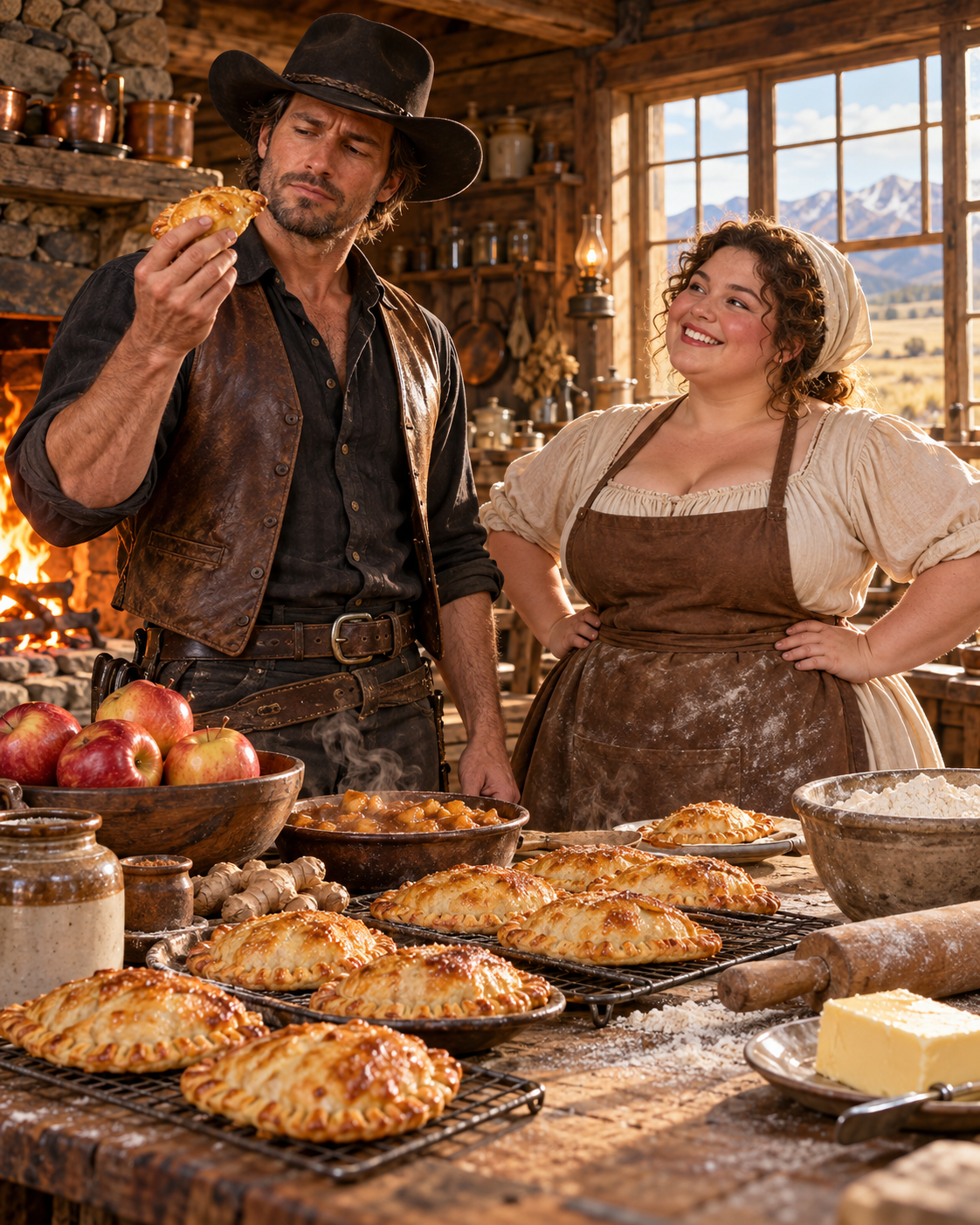
Nell continued folding paper.
“But it will stop a thief from hiding that he was there.”
By sunset, they had baked eighty-four pies.
Mercer required sixty.
Nell wanted twenty-four extra because she had learned what optimism cost.
The problem came at eight that night.
Owen returned from checking the north pasture carrying a folded telegram.
His face told Nell the news before he spoke.
“The railroad office sent this.”
She took it.
Another vendor had filed an objection to Ror Ridge’s bid, claiming the ranch had falsified production capacity and used spoiled fruit.
The complaint was signed by Vance Prior.
“He’s trying to have us disqualified before Mercer submits his report,” Owen said.
Nell read the telegram twice.
Then she began to laugh.
Not because it was funny.
Because she finally understood.
“What?”
Owen demanded.
“He filed too soon.”
The foreman frowned.
Nell tapped the telegram.
“He says we used spoiled fruit.”
“Yes.”
“How would he know?”
Owen stared at her.
The foreman stared at her.
Then both men turned toward the door as if Vance might still be standing outside.
Nell continued.
“The inspector never announced what he found inside the pies. Only the people beside that crate saw it.”
Owen’s expression changed from anger to satisfaction.
“We send this to Mercer.”
“No.”
Owen blinked.
“No?”
“We give it to Vance.”
For the first time all day, the foreman smiled.
They found Vance at the small boarding house beside the rail siding.
He opened his room door wearing shirtsleeves and irritation.
That irritation became caution when he saw Nell.
Owen remained downstairs.
Nell had insisted.
She wanted Vance to believe she had come alone.
“You should leave Wyoming,” Vance said.
“I tried losing once. I didn’t enjoy it.”
He moved to close the door.
Nell held up the telegram.
His eyes dropped to it.
That was enough.
“You sent your complaint before Mercer reported the damaged pies.”
Vance’s jaw tightened.
“So?”
“So you described spoiled fruit.”
“You told people.”
“No.”
“The ranch hands—”
“Were in the kitchen.”
He glanced down the hallway.
Nell lowered her voice.
“You cut those pies.”
“You can’t prove that.”
“Not yet.”
Vance leaned against the doorframe, recovering some of his confidence.
“Then we have nothing to discuss.”
“We have my old bakery.”
His eyes changed again.
Nell felt something inside her settle.
For three years she had imagined this conversation.
In some versions she screamed.
In others she demanded repayment.
Once, during a winter when she had slept above a laundry because it was the cheapest room she could find, she imagined hitting him with a rolling pin.
Now that the moment had arrived, she discovered she wanted something far more useful.
“The $112 from Owen’s ranch is petty theft,” she said. “My bakery was bigger. How many others?”
Vance smiled faintly.
“You always were ambitious.”
“How many?”
“You think shopkeepers study every sack? Ranchers count every pound? Hotels inspect every barrel?”
He stepped nearer.
“They count money after it’s gone.”
Nell kept her face still.
Behind the half-open door across the hallway, Mercer listened.
So did the county deputy Owen had quietly fetched from town.
Vance continued because arrogant men rarely recognized silence as danger.
“You could have done well if you had learned how business works.”
“I thought business was selling people what they paid for.”
“That is why you lost.”
Nell almost pitied him.
Almost.
“Did you spoil the pies?”
He smiled.
“I improved your chances of understanding the lesson.”
The deputy opened the opposite door.
Vance’s face emptied.
Mercer emerged behind him.
No one spoke for several seconds.
Then Nell stepped aside.
The deputy took Vance by the arm.
As he was led downstairs, he looked back at Nell.
“You still don’t have the contract.”
She met his eyes.
“No.”
Then she smiled.
“But now I have tomorrow morning.”
At four-thirty, lanterns glowed across Ror Ridge.
No one had slept.
The final trays cooled beside the open windows.
The new crates waited on the table.
Nell checked each seal.
One.
Two.
Three.
Four.
All intact.
At five, Mercer arrived.
He carried no smile and offered no reassurance.
Nell appreciated that.
She had stopped wanting reassurance years ago.
She wanted evidence.
Mercer inspected the kitchen first.
He checked flour storage, counted cooling racks, questioned the foreman about output, and asked two ranch hands to repeat Nell’s preparation procedure without her help.
They made mistakes.
But not fatal ones.
That pleased her more than perfect answers would have.
A business that depended entirely on one person was not a business.
It was a trap.
Then came the pies.
Mercer selected three at random.
The first had ridden for nearly ten hours in a saddlebag as part of Nell’s durability test.
The crust remained firm.
The second had been held near the kitchen stove to simulate summer heat.
Its filling remained thick rather than soaking through.
The third came from the overnight batch.
Mercer broke it open.
Apple fragrance rose with ginger and quince.
He tasted it.
No one moved.
Outside, a locomotive whistled at the siding.
Mercer took a second bite.
Then he wiped his fingers on a cloth.
“What is your production cost per pie?”
Nell answered immediately.
“Four and three-quarter cents at current prices. Four and one-half if we buy flour direct from the mill and quince by seasonal agreement.”
“Selling price to the railroad?”
“Eight cents.”
“Breakage allowance?”
“Three percent.”
“Waste?”
“Currently six. I can reduce it below four within a month.”
“How?”
“Standardized cutting, weighed filling, assigned cooling times, and written inventory at the end of every shift.”
Mercer looked at Owen.
“Did you teach her ranch accounting?”
Owen almost smiled.
“She taught me.”
Mercer turned to Nell.
“Suppose apple prices double.”
“We shift one-third of production to dried pear in winter and renegotiate the seasonal mix.”
“Suppose the train is delayed two days.”
“The quince preserves texture longer than ordinary apple filling, but I would still date every shipment and require rotation at each depot.”
“Suppose Ror Ridge loses its cook.”
Nell glanced at the ranch hands.
“Then the recipes remain.”
That answer caused Mercer to pause.
It was the answer Nell had built the entire night around.
Her mother’s recipes had once existed only in one woman’s hands.
After her mother died, Nell nearly lost them.
Her first bakery had existed mostly in Nell’s own memory.
When that bakery disappeared, so did almost everything she had built.
This time she had written the process down.
Ingredients.
Weights.
Temperatures.
Timing.
Costs.
Packing.
A business could not be allowed to vanish merely because one person was absent.
Mercer closed his notebook.
“The railroad will begin with a thirty-day trial.”
No one reacted.
Perhaps nobody understood him.
Owen finally said, “Are you saying—”
“I am saying Ror Ridge receives the catering contract on a provisional basis. Initial order: twelve hundred pies, with additional bread and breakfast biscuits if the first two deliveries meet standard.”
The foreman made a sound somewhere between a cough and a cheer.
Owen extended his hand.
Mercer shook it.
Then Owen turned to Nell.
She had imagined this moment during every sleepless night of the previous eleven days.
She expected triumph.
Instead, she felt something quieter.
Relief.
Not the relief of being rescued.
The relief of discovering that she could still build.
Mercer boarded the train minutes later with two sealed trays in the baggage car.
As the locomotive pulled away, Owen and Nell stood beside the siding.
Morning spread pale gold across the Wyoming grass.
“You did it,” he said.
“We did.”
“I believe our agreement says fifty dollars plus ten percent of initial contract revenue.”
“It does.”
Owen studied her.
“You could stay.”
Nell looked at him.
“I am staying until the first railroad payment clears.”
“I meant longer.”
There was no flirtation in his voice.
It was a business proposition.
That mattered to her.
“Doing what?”
“Running the kitchen.”
“No.”
Owen’s eyebrows rose.
“Running purchasing.”
“No.”
“Then what do you want?”
Nell looked back toward the ranch.
Smoke rose from the kitchen chimney. Ranch hands were carrying flour. The foreman stood in the doorway arguing about storage shelves as though he had been born to manage a bakery.
For the first time, Nell could see the shape of an idea larger than survival.
“I want a partnership.”
Owen laughed once.
“You negotiate like a railroad.”
“I negotiate like someone who has already lost everything once.”
“What kind of partnership?”
“Ror Ridge provides the kitchen, storage, livestock freight, and working capital. I run food production and purchasing. We split net catering profit.”
“What split?”
“Half.”
“Absolutely not.”
“Then sixty for me.”
He stared at her.
“You went the wrong direction.”
“I know.”
By breakfast, they settled at forty percent for Nell, with her fifty dollars and ten percent trial payment unchanged.
Owen complained for an hour.
Then he signed.
Three weeks later, the first railroad payment arrived.
Nell held the bank draft in both hands.
For several seconds, the kitchen disappeared.
She saw her old bakery.
The painted window.
The flour dust on the floor.
Her mother’s recipe book beside the register.
The morning the creditor had removed the ovens.
She had believed then that failure was a door closing.
Now she understood it differently.
Sometimes failure was a room burning down behind you.
Terrible.
Painful.
Unfair.
But once you stopped trying to live inside the ashes, you noticed there were roads leading elsewhere.
Vance Prior’s arrest uncovered records from six businesses across Wyoming and Nebraska. Some losses were small. Others were enough to ruin families.
Nell testified.
She did not enjoy it.
She had once thought justice would feel like revenge finally arriving.
It did not.
It felt like bookkeeping.
Names.
Dates.
Weights.
Invoices.
Facts placed carefully in the correct columns.
That was enough.
By winter, Ror Ridge was shipping pastries to three railroad stops.
Nell hired two women from town and paid them by the week instead of by the batch, because she remembered how uncertainty could hollow out a person’s life.
She taught every employee to read invoices.
She required two people to verify deliveries.
No supplier could change a price without written acknowledgment.
Owen called the system excessive.
Then the annual accounts showed that food costs had fallen by nearly eighteen percent while production had more than doubled.
He stopped calling it excessive.
The following spring, Nell traveled back to Laramie.
Her old bakery still stood on the same street.
Someone had painted the door green.
A young couple now operated it.
For years, Nell had imagined buying the place back.
She had imagined walking inside, laying money on the counter, and reclaiming every inch that had been taken from her.
She stood across the street for ten minutes.
Then she realized she did not want it.
The discovery surprised her enough to make her laugh.
Her mother’s recipes were no longer trapped inside that building.
Neither was her future.
Nell returned to Ror Ridge that evening carrying a new ledger.
On the first page, she wrote:
Ror Ridge Railway Kitchen.
Below it she added:
Nothing enters without being counted.
Nothing leaves without being valued.
Owen read the lines over her shoulder.
“That sounds severe.”
“It’s accounting.”
“It sounds like philosophy.”
Nell closed the ledger.
“Most expensive lessons eventually do.”
Years later, travelers along the western line would come to recognize the little sealed hand pies sold at station counters. Some passengers asked why a star was pressed into the paper wrapping.
Employees usually said it was the mark of Ror Ridge.
That was true.
But Nell knew the fuller answer.
The star had begun as protection against someone who believed deception would always be easier than diligence.
It became a reminder that trust did not mean refusing to verify, and that kindness did not require blindness.
Nell never recovered the bakery she lost.
She built something larger.
And when young merchants occasionally came to her ashamed because a partner had cheated them, or a deal had failed, or a business they loved had collapsed, Nell never told them that losing did not matter.
It mattered.
Loss always mattered.
What she told them was simpler.
“Count what remains.”
Because there was almost always something.
A recipe.
A skill.
A reputation.
A hard-earned lesson.
One honest person willing to work beside you.
Sometimes that was not enough to rebuild the life you had before.
But Nell Whitaker had learned that rebuilding the life you had before was not always the point.
Sometimes the real victory was learning to build the life that could come next.
But even that lesson would be tested again.
Five years after Nell first walked into Ror Ridge Ranch with her mother’s recipes under one arm and nothing certain ahead of her, the railroad sent a letter that changed everything.
By then, the Ror Ridge Railway Kitchen was no longer a desperate experiment.
It had become a respected operation.
Every Monday and Thursday, wagons left the ranch before dawn carrying sealed crates of hand pies, biscuits, cured meat sandwiches, and small loaves wrapped in paper. Railroad crews knew the star-shaped seal. Station masters trusted the delivery times. Travelers asked for the apple-ginger pies by name.
Nell had even begun experimenting with seasonal versions.
Pear and cinnamon in winter.
Cherry and clove in early summer.
Pumpkin, molasses, and ginger after the first frost.
But the apple-ginger pie remained the signature.
It was the thing that had saved them.
Or, as Nell sometimes corrected Owen, the thing that had given them the chance to save themselves.
The railroad letter arrived on a cold March morning.
Owen found Nell in the kitchen office, standing over three invoices with a pencil tucked behind one ear.
“You should read this.”
He handed her the envelope.
The letter was brief.
The railroad intended to consolidate food contracts across the territory.
Instead of working with dozens of local suppliers, it would appoint several regional vendors capable of serving larger sections of the line.
Ror Ridge had been invited to submit a proposal.
The potential value of the new agreement was more than ten times their current railroad business.
Nell read the final paragraph twice.
Owen leaned against the doorway.
“You’re smiling.”
“I am not.”
“You are.”
“I’m calculating.”
“That looks suspiciously like smiling.”
Nell put down the letter.
“We would need another oven.”
“Two.”
“More storage.”
“I already measured the south barn.”
She looked at him.
“You measured it before showing me this?”
“I know you.”
“No, you know what you think I’ll do.”
“And what will you do?”
Nell looked at the letter again.
Five years earlier, she would have answered immediately.
Yes.
Of course.
Take the opportunity before somebody else did.
Work harder.
Sleep less.
Risk everything.
That was how people talked about ambition in the West.
As though bravery meant never stepping away from a larger number.
But Nell had learned to distrust numbers that looked impressive before anyone asked what they cost.
“How many stations?” she asked.
“Fourteen.”
“We serve three.”
“Four currently.”
“Fourteen means more spoilage risk, more wagons, more workers, more flour contracts, more payroll.”
“And more profit.”
“Potential profit.”
Owen folded his arms.
“There she is.”
“Who?”
“The woman who ruined my ability to enjoy a large number without asking seventeen unpleasant questions.”
“Only seventeen?”
“On a good day.”
They spent the next six weeks preparing the proposal.
Nell did not promise the railroad fourteen stations.
She promised eight.
Owen argued.
The foreman argued.
Even some of the workers argued.
The railroad might choose another supplier willing to promise more.
Nell refused to change the number.
“I lost one business because I trusted the wrong supplier,” she told them. “I won’t lose another because I trust the wrong version of myself.”
The room went quiet.
She continued.
“Ambition is not saying yes to everything. Sometimes ambition is knowing what you can still stand behind after the excitement passes.”
They submitted the proposal.
Then they waited.
Two months later, the answer arrived.
They won.
Not all fourteen stations.
Eight.
Exactly what Nell had offered.
Owen read the letter aloud twice.
The kitchen erupted.
Someone pounded on a flour barrel like a drum.
The foreman opened a bottle he had been saving for three years.
Nell allowed herself one glass.
Then she walked outside.
Spring had turned the Wyoming grass green around the ranch buildings.
A train moved across the distance, small against the enormous sky.
Owen joined her.
“You’re doing it again.”
“What?”
“Not celebrating.”
“I’m celebrating.”
“You’re staring at a fence.”
“I like this fence.”
He looked at the fence.
“It needs repair.”
“That is why I like it. It is honest.”
Owen laughed.
For a moment, neither spoke.
They had become close over the years, though not in the way people in town enjoyed speculating.
There had been rumors, of course.
People found it difficult to imagine a man and a woman building a business together without eventually inventing a romance for them.
Sometimes Nell found the gossip irritating.
Sometimes amusing.
The truth was simpler and, to Nell, more valuable.
Owen had become the first business partner she trusted without surrendering her judgment.
He did not ask her to be smaller so he could feel larger.
She did not need him to rescue her.
They argued.
They compromised.
They checked each other’s numbers.
Trust, Nell had learned, was strongest when nobody demanded blindness as proof of loyalty.
“You ever think about leaving?” Owen asked.
She turned.
“Ror Ridge?”
“Yes.”
“Sometimes.”
He nodded as if he had expected that.
“For what?”
“I don’t know.”
“That doesn’t sound like you.”
“It’s becoming more like me.”
He studied her face.
Nell smiled.
“Five years ago, I needed every answer before I moved. Now I know some roads only make sense after you’ve started walking.”
Owen glanced toward the distant railroad line.
“You planning to start walking?”
“Not today.”
“That is reassuring.”
“Don’t become sentimental.”
“Wouldn’t dream of it.”
The expansion changed Ror Ridge.
They hired twelve more workers.
The south barn became a production building with two brick ovens.
Nell designed cooling shelves that allowed air to circulate between trays.
A carpenter in Cheyenne built them standardized wooden shipping cases.
A local print shop produced labels bearing a small star and the words:
ROR RIDGE RAILWAY KITCHEN
MADE FOR THE ROAD
Nell disliked the slogan.
Owen loved it.
He won that argument.
For almost two years, everything went well.
Then came the winter of the great freeze.
Snow arrived early.
Temperatures dropped so violently that water barrels froze inside sheds.
Two railroad sections closed.
Freight stopped moving.
A bridge west of Laramie became unsafe.
Ror Ridge suddenly had hundreds of dollars’ worth of flour, apples, cured meat, and sugar—and almost nowhere to send them.
Workers gathered in the office waiting for Nell’s decision.
Some expected layoffs.
Others expected reduced wages.
Owen stood by the window.
“We can survive two months,” he said quietly.
“Three if we reduce hours.”
Nell looked at the payroll book.
Years earlier, when her bakery failed, she had thought mostly about her ovens, her debts, her building.
Only later had she understood how many people a business failure touched.
The young boy who carried wood.
The woman who washed pans twice a week.
The farmer who sold her eggs.
The widow who bought day-old bread because it was cheaper.
A business was never only the owner.
“How much food will spoil?” Nell asked.
“Some,” the foreman said. “Not the flour. Apples eventually. Meat depending on storage.”
Nell closed the book.
“We keep everyone.”
Owen turned.
“Nell.”
“We keep everyone.”
“With what work?”
She looked toward the kitchen.
“We cook.”
“For trains that aren’t moving?”
“No.”
For the next six weeks, Ror Ridge became something else.
They baked bread for towns cut off by snow.
They sent wagons to isolated farms.
They made soup from beef trimmings and winter vegetables.
The railroad was not buying.
Many families could not pay.
Nell kept records anyway.
Not as debt.
As distribution.
Owen complained at first.
Then he quietly added two steers to the food supply.
The foreman donated potatoes from his own cellar.
Workers brought beans, onions, preserves.
People in town began doing the same.
Nobody called it charity.
That word made some proud people refuse help.
They called it winter accounting.
If you had extra, it went on one side of the ledger.
If you needed something, it went on the other.
“We’ll balance it in spring,” Nell said.
Nobody asked how.
When the railroad reopened, a superintendent came to Ror Ridge.
Nell expected a discussion about missed deliveries.
Instead, he handed her a folder.
Inside were reports from station masters and railroad workers describing what Ror Ridge had done during the shutdown.
“You fed three rail crews that weren’t even under your contract,” he said.
“They were hungry.”
“You fed passengers stranded four days at Rock Creek.”
“They were also hungry.”
“You didn’t invoice us.”
“We had food.”
The superintendent stared at her for a moment.
Then he smiled.
“You are a difficult woman to reimburse.”
“I have been called worse.”
The railroad paid anyway.
Not for everything.
Enough.
More importantly, they renewed Ror Ridge’s contract for another five years.
By then, Nell was forty.
She no longer looked like the woman who had arrived at the ranch with dust on her skirt and failure following close behind.
There were silver strands at her temples.
A faint burn scar crossed one wrist from an oven accident.
Her hands remained flour-rough.
But people no longer introduced her as the woman who lost a bakery.
Now they said:
“That’s Nell Whitaker. She built the Ror Ridge kitchen.”
The change bothered her more than she expected.
Not because she disliked respect.
Because she knew how dangerous a simple story could become.
People wanted success to make sense.
They wanted one dramatic failure, one clever idea, one brave decision, one victory.
Real life had not happened that way.
Ror Ridge had survived because of thousands of ordinary choices.
Checking invoices.
Training replacements.
Saving cash.
Rejecting bad contracts.
Treating workers well enough that they stayed through difficult seasons.
Admitting mistakes before those mistakes became disasters.
Success was less glamorous than people imagined.
It was usually repetition.
One afternoon, a young woman named Clara Ames arrived at the ranch.
She was twenty-four and carried a leather satchel filled with papers.
“I want to speak to Mrs. Whitaker.”
“Nell,” Nell corrected.
Clara hesitated.
“I was told you might understand my situation.”
She owned a small dry-goods shop with her brother.
Their business was failing.
Her brother had borrowed money without telling her.
A supplier had raised prices.
Customers owed them unpaid accounts.
Clara had not slept properly in weeks.
“I need to save it,” she said.
Nell looked through the papers.
“Why?”
Clara blinked.
“Because it’s my business.”
“That tells me what it is. Not why you need to save it.”
“My father started it.”
“Your father is dead?”
“Three years.”
“Would he want you ruined preserving his shelves?”
Clara’s eyes filled with anger.
“You don’t understand.”
Nell leaned back.
“I lost my mother’s bakery.”
Clara’s expression changed.
“I know.”
“No. You know the ending.”
That quieted her.
Nell turned the papers toward Clara.
“Your shop can be saved.”
Clara inhaled.
“But I’m not sure it should be.”
The young woman looked almost offended.
Nell continued.
“You have debt. Your brother is unreliable. Your supplier has leverage. The building needs repairs. Your strongest asset is not the shop.”
“What is?”
“You.”
Clara said nothing.
“You know purchasing. You know your customers. You can keep books. You understand inventory. Those skills survive even if the building doesn’t.”
Clara looked down.
“If I close, everyone will say I failed.”
“Yes.”
The answer startled her.
Nell did not soften it.
“Some people will.”
“Doesn’t that matter?”
“For a while.”
“And after?”
“You become too busy living to hear them.”
Clara stayed at Ror Ridge for two days.
When she left, she had a plan.
Not to save the store.
To close it before the debts grew worse, sell the remaining stock, settle what she could, and take a purchasing position at a hotel in Cheyenne.
Two years later, she wrote Nell.
She had become the hotel’s business manager.
Her salary was twice what the shop had ever earned.
At the bottom of the letter she wrote:
I thought closing the store would mean my father’s work had been wasted.
Now I think he built it so I could learn enough to build something else.
Nell read the sentence three times.
Then she tucked the letter into her mother’s old recipe book.
Years passed.
Rail lines multiplied.
Towns grew.
Some stations disappeared while others became cities.
Ror Ridge changed with them.
The railroad eventually stopped buying hand pies in wooden cases and demanded larger standardized shipments.
Nell adapted.
When regulations changed, she changed the kitchen.
When refrigeration improved, she changed storage.
When cheaper competitors appeared, she refused to chase prices so low that quality collapsed.
Some contracts they lost.
Others they won.
The business grew.
Then, eventually, Nell decided to leave it.
She was fifty-seven.
Owen nearly dropped his coffee when she told him.
“You’re retiring?”
“No.”
“Then what do you call leaving the company you built?”
“Leaving.”
“For what?”
“I bought a building.”
Owen stared.
She smiled.
“In Laramie.”
His eyes narrowed.
“Not the old bakery.”
“No.”
She had considered it once.
Then rejected the idea.
Instead, she bought an empty brick building two streets away.
Larger windows.
Better ovens.
A classroom at the back.
“What are you going to do with it?”
“Teach.”
Owen looked horrified.
“You hate explaining yourself.”
“I hate explaining myself to you.”
“That is different?”
“Entirely.”
Nell’s new place was called Whitaker House.
It was part bakery, part kitchen school, part business office.
Young cooks learned bread and pastry.
Shopkeepers learned bookkeeping.
Farmers learned pricing.
Widows learned how to calculate costs before agreeing to contracts.
Railroad cooks came to study preservation and large-volume production.
Nell taught recipes, but she also taught the lesson that had cost her the most.
Never confuse trust with ignorance.
Never confuse growth with health.
Never confuse one failure with the full measure of a life.
Above the classroom door, she hung the original Ror Ridge star seal.
Students often asked about it.
Nell told them the story.
Not as a legend.
Not as a tale about revenge.
She told them about Vance.
About the missing $112.
About the sabotaged pies.
About the railroad inspector.
About working through the night.
And she always emphasized the part people least expected.
“The contract was not the most important thing I won,” she said.
“What was?” someone inevitably asked.
“The ability to trust myself again.”
That was the real theft Vance had committed.
Not flour.
Not money.
Not even the bakery.
For years after the doors closed, Nell had doubted her own judgment.
Every decision became frightening.
Every supplier looked suspicious.
Every risk felt like a trap.
Winning the railroad contract had mattered because it proved something no court could have restored for her.
She could still make good decisions.
She could still create value.
She could still begin.
Near the end of her life, Nell returned once more to Ror Ridge.
Owen had died several years earlier.
The ranch now belonged to his nephew.
The original kitchen had been preserved beside the larger production building.
The old oven remained.
So did the battered table where Nell had once rolled pastry while arguing over costs.
She ran her hand across the wood.
The nephew stood nearby.
“My uncle kept everything.”
“He kept too much.”
“He said you would say that.”
Nell laughed.
On the wall hung a framed copy of their original partnership agreement.
Forty percent to Nell.
Sixty to Owen.
She remembered how fiercely they had argued.
Below it was the first railroad acceptance letter.
And beside that, protected behind glass, was a stained piece of paper bearing the first star-shaped seal.
Nell stood before it for a long time.
Outside, a train passed in the distance.
The sound was different now.
Faster.
Heavier.
But somehow familiar.
“Do people still remember the pies?” she asked.
The nephew smiled.
“They still make them.”
Nell turned sharply.
“What?”
“Your recipe. Apple, ginger, quince.”
“That recipe belongs to Ror Ridge.”
“So we make it.”
“Who?”
He pointed toward the new kitchen.
Nell followed him.
Inside, six young workers stood at long tables.
Apples.
Ginger.
Dough.
Cooling racks.
The process had changed.
The spirit had not.
One worker pressed a small star into the paper around each finished pie.
Nell watched quietly.
Nobody there knew exactly how frightened she had been that first morning.
Nobody remembered her empty purse.
Her anger.
Her shame.
The nights she woke wondering whether losing the bakery had proved she was not as capable as she once believed.
They only knew the system she left behind.
And suddenly that seemed right.
A life’s work did not need to preserve every wound.
Only what the wounds had taught.
Before leaving, Nell asked for one pie.
She carried it outside and sat on the fence near the road.
The crust was slightly different from hers.
Too much butter, she thought.
Then she smiled.
She had spent decades teaching people not to worship tradition merely because it was old.
The filling was excellent.
The ginger came through first.
Then apple.
Then the faint floral tartness of quince.
She ate slowly.
The evening sky stretched across Wyoming, enormous and clear.
For a moment she could almost see herself at thirty-three.
Dusty.
Angry.
Determined.
Holding a recipe book and demanding fifty dollars plus ten percent from a rancher who thought she was impossible.
Nell wished she could speak to that younger woman.
She would not tell her everything would be fine.
That would have been a lie.
There would be hard winters.
Bad contracts.
People she trusted who died.
Employees who disappointed her.
Decisions she regretted.
Years when success felt strangely empty.
Moments when the old bakery still appeared in dreams.
Life had not become easy.
It had become hers again.
That was different.
The sun dropped toward the horizon.
Nell finished the pie and brushed crumbs from her skirt.
Near the old kitchen door, the star symbol caught the last light.
What began as a mark to reveal tampering had become a mark people associated with reliability.
That seemed to Nell like the perfect summary of everything.
Pain could become caution.
Caution could become wisdom.
Loss could become structure.
And sometimes the thing created to protect you from being hurt again became the thing that helped other people trust.
Nell stood.
She was nearly at the wagon when a young kitchen worker ran after her.
“Mrs. Whitaker!”
Nell turned.
The girl looked about nineteen.
Flour covered one sleeve.
“I wanted to ask you something.”
“What?”
“Is it true you started all this because somebody cheated you?”
Nell considered the question.
“No.”
The girl seemed confused.
“But everyone says—”
“Someone cheating me is why one chapter ended.”
Nell looked back at the kitchen.
“I started all this because I decided that wasn’t where the story had to end.”
The girl was silent.
Then she nodded.
Nell climbed into the wagon.
As it rolled away from Ror Ridge, she did not look back again.
She did not need to.
Some places belong behind you without being lost.
Some failures remain part of your story without remaining the definition of it.
And some victories are not about recovering what was taken.
They are about discovering that what was taken was never the last thing you were capable of creating.
Years later, after Nell Whitaker was gone, a small brass plaque appeared beside the entrance of Whitaker House in Laramie.
It carried no list of contracts.
No mention of railroad revenue.
No record of how many kitchens she had built or businesses she had advised.
Only a sentence copied from the first page of one of her old ledgers:
COUNT WHAT REMAINS.
Students touched the plaque as they entered.
Most did not know the full story.
They did not need to.
They understood the meaning soon enough.
When a dream collapses, count what remains.
When trust is betrayed, count what remains.
When money disappears, when plans fail, when a door closes and embarrassment tells you that everyone else is moving forward without you, count what remains.
Skill remains.
Experience remains.
Character remains.
The ability to learn remains.
Sometimes one person remains willing to believe in you.
Sometimes only you remain.
That can still be enough.
Not enough to recreate yesterday.
Enough to begin tomorrow.
And that, more than the railroad contract, more than the pies, more than the ranch or the money, became Nell Whitaker’s true legacy.
She had once believed losing her bakery meant losing the life she had worked for.
In the end, she understood that losing one life had forced her to discover another.
Not a replacement.
Not a consolation prize.
Something wider.
Something built with clearer eyes.
Something no dishonest supplier could ever invoice away.
And every time the star seal appeared on a package leaving Ror Ridge, the lesson traveled with it:
What breaks you may change you.
What is taken may never return.
But neither loss nor betrayal gets to write the final line unless you hand it the pen.
Nell never did.
THE END.