Wyoming Territory, 1880s. Out beyond the last row of wooden storefronts, where the prairie rolled toward the mountains and winter wind could strip paint from a barn in a single season
The signature belonged to Josephine’s father.
At least, that was what Elias Jud wanted everyone in the room to believe.
Three mornings after the town feast, Josephine stood inside the bank with her gloves tucked beneath one arm while Jud calmly pushed a cream-colored document across his polished walnut desk.
Outside the tall front windows, wagons rattled through the main street. A freight driver shouted at a stubborn mule. Somewhere farther down the block, a blacksmith’s hammer rang against iron.
Inside the office, the only sound was the faint ticking of a brass clock.
“Your father borrowed against the eastern acreage in 1877,” Jud said. “The note came due years ago.”
Josephine did not sit.
“My father never borrowed from you.”
“Not from me personally.”
Jud tapped the paper.
“From the bank.”
Josephine stared at the signature.
Thomas Cartwright.
The letters had been shaped carefully enough. The long stroke on the T leaned forward. The final t crossed high, just as her father had usually written it.
But something was wrong.
Her father had injured his right hand when Josephine was sixteen. A horse had crushed two fingers against a corral post. After that, his handwriting had changed. The old sharp angles became uneven, especially in the final letters of his surname.
The signature on Jud’s document looked like the way Thomas Cartwright had written before the accident.
The date printed beside it was two years afterward.
Josephine raised her eyes.
“This is false.”
Jud gave a small sigh, almost sympathetic.
“I expected you might say that.”
“You copied an old signature.”
“You should be careful with accusations.”
“I am careful.”
She leaned both hands on his desk.
“That is why I know you forged it.”
For an instant, something cold appeared behind Jud’s expression.
Then it vanished.
“The county records recognize this debt,” he said. “Unless payment is made within thirty days, the bank can petition for possession of the land pledged as security.”
“How much?”
Jud named a figure large enough to empty Josephine’s savings and still leave her short.
She laughed once.
Not because it was amusing.
Because the number revealed what he truly wanted.
“You don’t want payment.”
“I want what the bank is owed.”
“You want my water.”
Jud’s eyes narrowed.
The eastern section of Josephine’s property held a creek that continued running even during dry summers. Whoever controlled it could support thousands more cattle across the surrounding range.
Caleb Montgomery had understood that the moment Josephine showed him the map the previous evening.
Now Josephine understood something else.
Jud had not been buying random parcels.
He had been assembling them around the creek.
Her ranch was the missing piece.
Jud leaned back in his chair.
“Thirty days, Miss Cartwright.”
Josephine picked up the document.
“I’m taking this.”
“That is bank property.”
“Then arrest me.”
Jud smiled again.
“You may discover the law less friendly than you imagine.”
Josephine folded the paper once and slipped it into her coat.
“The law and you aren’t the same thing.”
She walked out before he could answer.
Caleb was waiting beside the hitching rail across the street.
He took one look at her face and abandoned whatever greeting he had planned.
“What did he do?”
Josephine handed him the paper.
He read it beside his horse.
“This signature?”
“Forged.”
“You’re certain?”
“My father couldn’t write like that by the date printed there.”
Caleb studied the page again.
“We take this to the county judge.”
“We need more than my word.”
“Your word matters.”
“Not enough.”
She glanced toward the bank windows.
Behind the glass, Jud stood watching them.
Josephine lowered her voice.
“He has spent years making himself respectable. I’ve spent years giving this town reasons to call me difficult. If this becomes his reputation against mine, he knows exactly who they’ll believe.”
Caleb folded the document carefully.
“Then we don’t give them a choice.”
Over the next week, they began searching.
Josephine rode to the county clerk’s office and examined property books until candlelight blurred the ink. Caleb visited ranchers who had sold land to Jud and asked why they had done so.
A pattern emerged.
Each seller had faced some sudden pressure shortly before the sale.
One man had been told an old loan was overdue.
Another discovered unexpected taxes supposedly attached to his acreage.
A widow named Martha Bell had been warned that a boundary survey placed her barn on neighboring property.
Every problem vanished after Jud purchased the land.
Most people had been too relieved—or too embarrassed—to ask further questions.
Josephine did.
She compared dates.
Amounts.
Witnesses.
Signatures.
By the second week, she had a notebook filled with names.
Then her barn burned.
Josephine woke shortly after midnight to the sound of cattle bawling.
Orange light flickered against her bedroom wall.
She reached the yard barefoot beneath her boots, coat thrown over her nightdress, and saw flames climbing the south side of the barn.
The wind was carrying sparks toward the hay shed.
She ran.
There was no time to think.
Josephine kicked open the livestock door and drove terrified horses into the yard. One mare refused to leave her stall, eyes rolling white in the smoke.
Josephine wrapped an arm around the animal’s neck and pulled until both of them stumbled through the doorway.
Neighbors arrived twenty minutes later.
Caleb came among the first, riding hard enough that his horse was covered in foam.
Together they formed a bucket line from the well.
By dawn, the barn roof had collapsed.
Half the winter feed was gone.
Josephine stood in black mud, soot streaked across her face.
Caleb approached carrying something between two fingers.
A strip of cloth soaked with kerosene.
He did not need to explain.
Josephine looked toward the road.
“Jud?”
“Maybe.”
“Not maybe.”
“We still need proof.”
She turned toward him sharply.
“Every time someone tells me I need proof, he gets another night to destroy something.”
“And if you ride into town and shoot him?”
“I didn’t say I would shoot him.”
“You were thinking loudly.”
Despite everything, Josephine nearly smiled.
Then Caleb’s expression changed.
“I’m not asking you to be patient because I think you’re weak,” he said. “I’m asking because Jud wants you angry. He wants this town to see exactly the woman they already think you are.”
Josephine looked at the smoking ruins.
“A woman who refuses to bow?”
“A woman he can call dangerous.”
That struck deeper than she wanted to admit.
All her life, people had mistaken strength for violence simply because it lived inside a woman they found inconvenient.
If she charged into Jud’s office, he would use that story against her before the smoke from her barn had cleared.
So Josephine waited.
But she did not stop.
Two days later, she found the first real crack in Jud’s scheme.
It came from an old bank ledger.
The bank’s former bookkeeper, Henry Vale, lived alone outside town after losing his eyesight. Josephine remembered her father speaking kindly of him, so she and Caleb rode out to his cabin.
Vale could no longer read the forged note, but when Josephine told him its date and amount, he frowned.
“Thomas Cartwright never took that loan.”
Josephine leaned forward.
“You remember?”
“I remember because Jud wanted him to.”
Caleb exchanged a glance with her.
Vale continued.
“Your father came to the bank seeking money for fencing. Jud offered a loan against the eastern section. Thomas refused when he saw the terms.”
“Was anything signed?”
“An application, perhaps. Nothing securing the land.”
Josephine’s heart began beating faster.
“Would the application have his signature?”
“Yes.”
There it was.
The source Jud had copied.
“Do you know where the old records are?”
Vale hesitated.
“When Jud became manager, he ordered certain ledgers moved from the main vault. Said they were useless.”
“Moved where?”
“There’s a records room under the bank.”
Caleb frowned.
“A basement?”
“Behind the coal storage.”
Josephine stood.
“We need the sheriff.”
Vale shook his head.
“Sheriff Colton keeps his campaign money in Jud’s bank.”
That evening, Josephine and Caleb sat in her kitchen beneath a smoking lamp.
Rain struck the windows.
“We cannot break into the bank,” Caleb said.
“I wasn’t suggesting breaking in.”
“You have the expression you wear before suggesting something worse.”
“We ask Jud to show us the records.”
“He’ll destroy them first.”
“Then we make him believe we already have them.”
Caleb stared at her.
Josephine explained.
The following morning she entered the general store when it was busiest.
She purchased flour, lamp oil, coffee, and nails.
Then, in a voice just loud enough to reach Mrs. Wilkins beside the fabric counter, Josephine told the clerk she would soon have proof that her father’s note had been copied from another document.
By noon, half the town had heard.
By evening, all of it had.
At ten that night, a rider left Josephine’s property and headed toward town.
Caleb, waiting on the ridge, saw him.
The man had been watching the ranch.
Exactly as Josephine expected.
She and Caleb followed at a distance.
Instead of going home, the rider entered the rear alley behind the bank.
Minutes later, a lamp appeared in a basement window.
Josephine whispered, “He’s destroying the records.”
They hurried toward the sheriff’s office.
Sheriff Colton was not there.
His deputy, Samuel Price, listened with visible discomfort.
“You want me to search the bank because you saw a light?”
“Because Jud has a forged mortgage and a former employee who says the original records contradict it,” Josephine replied.
Price rubbed his jaw.
“That might get me removed.”
Josephine stepped closer.
“And doing nothing might let him steal half the county.”
Price looked at Caleb.
Caleb said nothing.
That mattered.
Caleb could have used his status to speak over Josephine.
Instead he allowed the decision to rest on her evidence.
Finally Price reached for his coat.
They found the bank’s rear door unlocked.
The basement smelled of coal, damp stone, and smoke.
A metal waste bin burned near the far wall.
Beside it stood Elias Jud.
For the first time since Josephine had known him, he looked frightened.
Deputy Price drew his revolver.
“Step away.”
Jud recovered quickly.
“These are private financial records.”
“Then you can explain why you are burning them at midnight.”
Jud glanced at Josephine.
She saw hatred there now, naked and complete.
They saved three ledgers from the flames.
One contained Thomas Cartwright’s original loan application.
His signature matched the mortgage perfectly.
Even the tiny blot beneath the second r appeared in both places.
The forged document was finished.
But Jud was not.
By morning, Sheriff Colton returned.
And instead of arresting the banker, he announced that the evidence was insufficient.
The original application proved Josephine’s father had once discussed a loan, he argued. It did not prove who had created the later mortgage.
Jud claimed someone else might have forged it.
More importantly, he announced that the bank’s cash reserves had been robbed during the night.
Nearly every dollar belonging to local depositors was gone.
And the rear door had been found open after Josephine entered the building.
By noon, rumors turned poisonous.
Some said Josephine had staged the entire confrontation to gain access to the bank.
Others claimed Caleb had financed the robbery.
Sheriff Colton searched Josephine’s ranch.
In her tool shed, beneath a stack of grain sacks, his men found a canvas bag containing bank currency.
Josephine stared at it.
Caleb swore.
Colton lifted the bag.
“Miss Cartwright, I’m placing you under arrest.”
The crowd outside her gate watched silently.
For years Josephine had imagined the town turning against her.
She had never imagined how quiet it would be.
Caleb stepped toward Colton.
“This is planted.”
“Move aside.”
“You know it is.”
Colton’s hand drifted toward his revolver.
Josephine touched Caleb’s arm.
“No.”
He looked at her.
“If you fight them here,” she said softly, “Jud wins twice.”
They took her to the county jail.
Rain returned after dark.
Josephine sat on the narrow bunk listening to water run from the roof.
Around midnight, footsteps stopped outside her cell.
Elias Jud appeared beyond the bars.
Sheriff Colton was nowhere in sight.
Jud removed his hat.
“This has gone further than I intended.”
Josephine laughed quietly.
“My barn burned.”
“You were supposed to sell.”
“You robbed your own bank.”
His expression did not change, but Josephine saw the answer anyway.
“You think people care who emptied the vault?” Jud said. “By tomorrow they’ll care only that their savings are gone.”
“And you’ll blame me.”
“I already have.”
“Where is the money?”
Jud smiled.
“You should worry about your land.”
He removed a folded document from his coat.
“Sign this deed. Sell the eastern acreage to my company. I will discover evidence proving someone else robbed the bank.”
Josephine stared at him.
“You really believe I’m going to sign?”
“I believe you finally understand your position.”
She stood and walked to the bars.
Jud expected anger.
Instead, Josephine smiled.
“What?”
“You made one mistake.”
“Which one?”
“You came here yourself.”
Behind Jud, a floorboard creaked.
Deputy Samuel Price stepped from the dark office.
Jud went pale.
Price had been hiding there at Josephine’s request.
Earlier that evening, when he brought her supper, she had told him Jud would visit if the planted money was part of a larger plan.
Price had doubted her.
But he had stayed.
Now he had heard enough.
Jud lunged toward the door.
Price grabbed him.
Jud struck the deputy with his elbow and ran.
Josephine shouted as Price stumbled.
Jud disappeared into the storm.
Minutes later Caleb arrived, having been summoned by Price before midnight.
The deputy unlocked Josephine’s cell.
“He’ll run for the money,” Josephine said.
Caleb nodded.
“Where?”
Josephine thought of Jud’s purchases.
The surrounding ranches.
The creek.
The roads.
Then she remembered something Henry Vale had mentioned: before becoming banker, Jud had operated a failed freight business west of town.
“He has an old freight warehouse near Dry Creek.”
They rode into the rain.
Deputy Price followed with two men he trusted.
Lightning split the sky over the open prairie.
The abandoned warehouse stood beside the creek like a black box beneath the storm.
Jud’s horse was outside.
Josephine dismounted first.
Caleb caught her wrist.
“Stay behind me.”
Josephine looked at his hand.
Caleb immediately released her.
“Poor choice of words.”
“Very.”
They entered together.
Inside, lantern light revealed wooden crates stacked against the walls.
One had been forced open.
Bank notes filled it.
Town savings.
Mortgages.
Gold coins.
Everything Jud had supposedly lost.
A movement sounded above them.
Jud stood on the loft stairs with a revolver.
“Get out.”
Price raised his weapon.
“It’s finished, Elias.”
“No.”
Jud pointed the gun toward Josephine.
“None of this would have happened if she had sold.”
Josephine felt strangely calm.
“That is what men like you always say. Someone refuses you, so whatever you do afterward becomes their fault.”
Jud’s jaw tightened.
“You have no idea what that land is worth.”
“I know exactly what it’s worth.”
“No, you don’t. A rail spur is coming through this county. The creek will supply stockyards. Warehouses. Thousands of cattle. Your ranch could make a fortune.”
“My ranch already has value.”
“To you.”
“Yes.”
Jud laughed harshly.
“You would choose sentiment over progress?”
“I choose the right to decide.”
For a moment, no one moved.
Then a horse outside screamed.
Jud turned his head.
Only for a second.
Josephine moved.
She grabbed a wooden loading hook leaning against a crate and swung it upward.
The hook struck Jud’s wrist.
The gun fired into the roof.
Caleb tackled him from the stairs.
The rotten railing broke.
Both men crashed onto the warehouse floor.
Jud rolled free and reached for the fallen revolver.
Josephine reached it first.
She kicked it beneath a crate.
Jud stared up at her.
Rain hammered the roof.
“You,” he whispered.
“Yes,” Josephine said. “Me.”
Deputy Price placed him in irons.
The sheriff’s involvement unraveled within days.
Records found inside the warehouse showed payments from Jud to Sheriff Colton, including money connected to previous forced land sales.
Colton fled toward Colorado but was arrested at a rail station.
The stolen bank deposits were returned.
Several fraudulent debts were canceled.
Families who believed their savings were gone recovered nearly all of them.
And Josephine’s forged mortgage became the center of the case against Jud.
The town changed quickly after that.
Too quickly for Josephine’s taste.
People who had ignored her suddenly greeted her warmly.
Women who had whispered behind her back brought pies.
Men who once joked that no husband would tolerate Josephine Cartwright now spoke admiringly about her courage.
One afternoon Mrs. Wilkins appeared at the ranch carrying a peach cobbler.
“I suppose we owe you an apology,” she said.
Josephine looked at the cobbler.
“Is that what this is?”
Mrs. Wilkins flushed.
“It was meant to help.”
Josephine accepted the dish.
“Then help by remembering what happened the next time this town decides someone is guilty because they’re easier to dislike.”
Mrs. Wilkins had no answer.
That was all right.
Josephine had stopped needing everyone to have one.
Winter came early.
Caleb visited often.
Sometimes he brought lumber and helped rebuild the barn.
Sometimes he came with no excuse at all.
They argued about fencing methods, horse breeding, railroad prices, and whether coffee needed to be boiled long enough to become strong enough to dissolve a spoon.
One evening, while snow drifted against the kitchen window, Caleb placed a small box on the table.
Josephine looked at it.
“No.”
“I haven’t even asked anything.”
“That is a ring box.”
“It is.”
“You have been carrying that around for three weeks.”
Caleb stared.
“How did you know?”
“You keep touching your coat pocket whenever you become nervous.”
“I do not become nervous.”
“You do around me.”
He laughed.
Then his face became serious.
“I don’t want your ranch.”
“Good.”
“I don’t want to rescue you.”
“Better.”
“And I don’t want you to become smaller so I can feel larger.”
Josephine said nothing.
Caleb opened the box.
“I want to build something beside you. Not over you. Not for you. Beside you.”
For once, Josephine Cartwright had no immediate reply.
All her life she had learned to hear hidden conditions.
You can belong if you soften.
You can be loved if you change.
You can be respected if you become easier to accept.
Caleb offered none of them.
She looked at him.
“If I marry you, the eastern pasture remains mine.”
“Yes.”
“My cattle remain mine.”
“Yes.”
“If we disagree about ranching—”
“We will.”
“I wasn’t finished.”
“I know. But we will.”
Josephine tried not to smile.
“And if the town starts saying you finally tamed Josephine Cartwright?”
Caleb considered it.
“I’ll tell them you’ve been trying to tame me.”
She laughed then, loudly enough that the horses in the nearby stable stirred.
“Yes,” she said.
They married the following spring.
There was no grand ballroom and no attempt to transform Josephine into someone the town considered more bridal.
She wore a simple cream dress beneath a dark riding coat and boots polished especially for the occasion.
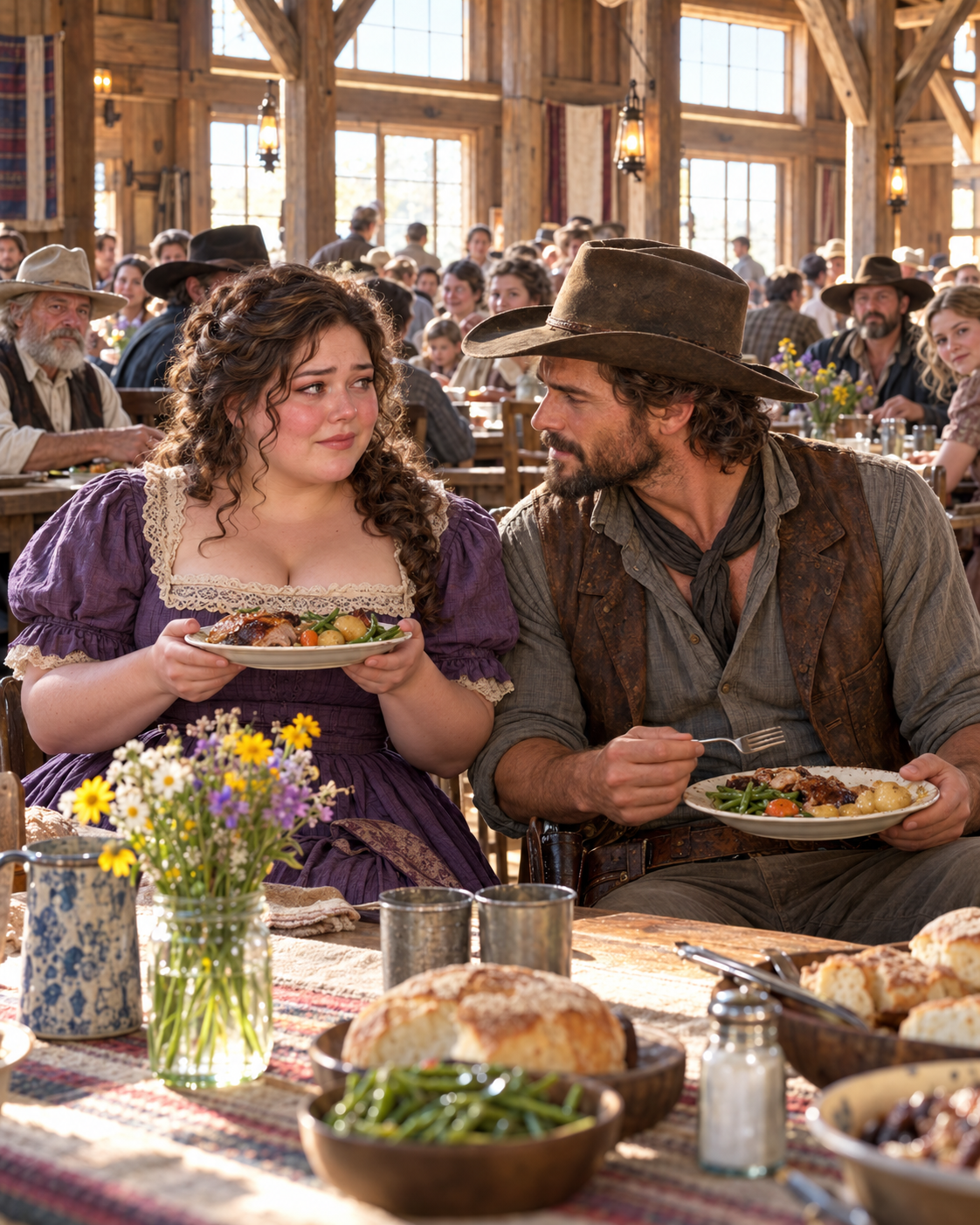
Caleb wore the same expression he had worn the night of the town feast: the expression of a man who knew exactly where he wanted to stand.
Beside her.
Most of the town attended.
Henry Vale sat near the front.
Deputy Price, now elected sheriff after Colton’s removal, stood with the witnesses.
Mrs. Wilkins brought another peach cobbler.
Josephine’s land remained in her name.
Caleb’s remained in his.
Together they negotiated shared grazing rights, expanded the creek channels, and built a new barn where the old one had burned.
Years later, when the railroad finally reached the county, Jud’s prediction proved partly correct.
Land values climbed.
Stockyards came.
Merchants arrived.
The little town grew.
Josephine received offers large enough to make people gasp.
She refused most of them.
But she leased a narrow strip for the rail line at a price she chose herself and required the company to build a public watering station accessible to smaller ranchers.
Some businessmen called her stubborn.
By then, the word had lost its power.
One summer afternoon, Josephine stood on the ridge above the ranch watching cattle move slowly through the grass.
A group of children from town had come to help during branding season.
Among them was a broad-shouldered twelve-year-old girl named Clara who had been mocked at school because she was taller and stronger than the other girls.
Josephine found her lifting a heavy gate while two boys stared.
“You’re strong,” Josephine said.
Clara immediately lowered her eyes.
“Sorry.”
Josephine went still.
That one word carried years inside it.
She crouched beside the girl.
“Never apologize for strength.”
Clara looked up.
“What if people don’t like it?”
“Then they can learn.”
“What if they don’t?”
Josephine glanced across the valley toward the creek that Elias Jud had once tried to steal.
“Then you learn something about them.”
Clara smiled.
Josephine stood and handed her the gate latch.
“Now show those boys how it’s done.”
That evening Caleb found Josephine sitting on the porch.
The sunset had turned the Wyoming sky copper and violet.
He lowered himself into the chair beside her.
“You look pleased.”
“I am.”
“With what?”
Josephine thought about the bank.
The fire.
The jail.
The warehouse.
The years of whispers before any of it had happened.
Then she thought about Clara.
“Nothing was ever wrong with me,” she said.
Caleb looked puzzled.
Josephine smiled.
“I just spent too many years asking the wrong people to confirm it.”
He reached for her hand.
She let him take it.
Below them, cattle moved through grass glowing gold in the last light.
Josephine’s victory had never truly been about saving a ranch.
The ranch mattered.
The water mattered.
Her father’s legacy mattered.
But something larger had been at stake.
Elias Jud believed isolation made people weak.
He believed that if a community mocked someone long enough, ignored them long enough, and doubted them long enough, eventually that person could be robbed without anyone objecting.
For a while, he had nearly been right.
What defeated him was not Caleb’s money.
It was not Josephine’s strength alone.
It was the moment people finally began questioning the story they had been told about someone who did not fit comfortably inside their expectations.
And Josephine learned something too.
Accepting an ally did not diminish her independence.
Love did not require surrender.
Partnership was not rescue.
A person could stand firmly on her own feet and still allow someone worthy to stand beside her.
Years afterward, travelers passing through Wyoming sometimes heard the story of Josephine Cartwright—the ranch woman who exposed a crooked banker, recovered a town’s stolen savings, and refused to surrender the land everyone said she could not protect.
Some versions exaggerated the gunfight.
Some added three bank robbers instead of one.
One storyteller even claimed Josephine threw Elias Jud through a window.
Caleb enjoyed that version.
Josephine always corrected it.
“There wasn’t a window,” she would say.
Then she would look across the ranch she had nearly lost, toward the creek still running beneath the cottonwoods, and smile.
Because the most important part of the story required no exaggeration.
When a powerful man tried to convince an entire town that Josephine Cartwright was too strange, too difficult, too stubborn, and too alone to matter, he made the mistake of believing that being unwanted meant being powerless.
Josephine proved otherwise.
And from that day forward, whenever someone in that Wyoming town was dismissed for being different, there was always at least one person who remembered what had happened when everyone underestimated the woman on the ranch beyond the ridge.
Sometimes strength is the ability to fight.
Sometimes it is the courage to accept help without surrendering yourself.
And sometimes the greatest victory is reaching a place where you no longer need the people who once judged you to tell you what you are worth.
Years passed, but the story did not disappear.
If anything, it grew with the town.
The railroad brought strangers first.
Then merchants.
Then land agents in fine coats who carried folded maps and spoke about progress as though progress were something that belonged only to men who arrived late and talked loudly.
Josephine recognized the type immediately.
Some came to her porch with offers.
Others came with warnings disguised as advice.
A few tried to explain to her what her own ranch might someday become.
She listened to all of them.
Then she made her own decisions.
Caleb never answered for her.
That became one of the things people noticed about their marriage.
At public meetings, when someone asked Caleb what Josephine planned to do with the Cartwright acreage, he would turn toward her and say, “You’d better ask Josephine.”
The first few times, men laughed.
After a while, they stopped.
Not because Caleb demanded it.
Because Josephine had become impossible to ignore.
The case against Elias Jud went to trial the following winter.
It drew people from three counties.
Farmers came.
Ranchers came.
Widows whose land had been taken through suspicious debts came carrying old papers wrapped in cloth.
Men who had once defended Jud sat in the back rows and stared at the floor.
Josephine testified for nearly three hours.
Jud’s lawyer tried to make her angry.
He asked whether she had threatened Jud.
She said yes.
He asked whether she had taken documents from the bank without permission.
She said yes.
He asked whether she had struck Jud with a loading hook inside the warehouse.
“Yes,” Josephine replied.
The lawyer smiled.
“So you admit you are a violent woman.”
Josephine looked at the jury.
“I admit that a man holding a revolver was about to shoot someone.”
The smile vanished.
The courtroom laughed.
The judge struck his gavel.
Jud was convicted of fraud, conspiracy, theft, and falsifying financial documents.
Sheriff Colton received a separate sentence for bribery and obstruction.
But the trial revealed something more troubling than either man.
They had succeeded for so long because people preferred convenience to questions.
Jud had not hidden every lie particularly well.
He had simply counted on people being afraid to challenge a banker.
He had counted on embarrassed borrowers staying silent.
He had counted on widows believing they had no power.
And most of all, he had counted on Josephine being disliked enough that no one would listen to her until it was almost too late.
The town could punish Jud.
It could not imprison the weakness that had allowed him to thrive.
That part had to be changed.
Slowly.
By people.
Deputy Price, now Sheriff Price, began requiring independent witnesses for property seizures.
County records were opened for public inspection twice each month.
A committee of ranchers and shopkeepers formed to review disputed debts.
Josephine disliked committees, but she joined anyway.
“Someone has to stop them from talking themselves to death,” she told Caleb.
He laughed.
She attended every meeting.
At first, people deferred to Caleb whenever the two of them entered the room.
That irritated Josephine.
It irritated Caleb more.
One evening, after a merchant directed three consecutive questions about Josephine’s creek lease to him, Caleb finally said, “You seem determined to ask me questions about land I do not own.”
The merchant looked embarrassed.
Caleb pointed toward Josephine.
“The owner is sitting directly in front of you.”
Josephine leaned back in her chair.
“Now that we’ve found me, shall we continue?”
After that, things improved.
Not perfectly.
But enough.
The years changed the ranch too.
The new barn grew silver beneath Wyoming winters.
Cottonwoods thickened along the creek.
Josephine introduced better breeding stock and built a second corral farther east.
Caleb experimented with new irrigation channels, ruined two of them, and spent three days insisting the failures had been “educational.”
“They taught me something,” he said.
“That you should have listened to me?”
“That too.”
Their arguments became part of ranch life.
They argued over horses.
Over fence posts.
Over which pasture should rest each season.
Over whether a storm cloud looked serious enough to move cattle.
Josephine won often.
Caleb claimed she remembered only those occasions.
Neither ever regretted the partnership.
They had a daughter in their fourth year of marriage.
They named her Rose after Caleb’s mother.
Three years later came Thomas, named for Josephine’s father.
Parenthood frightened Josephine in a way Elias Jud never had.
A corrupt banker could be fought.
A fire could be extinguished.
A frightened horse could be calmed.
But children required a different kind of courage.
Rose was small and stubborn.
Thomas was quiet and observant.
By the time Rose was six, she had fallen from three horses and climbed back onto all of them.
By eight, she had begun asking why boys were allowed to do certain things she was discouraged from doing.
Josephine answered simply.
“Sometimes people inherit foolish rules the same way they inherit old furniture.”
Rose considered this.
“What do you do with foolish rules?”
“Depends.”
“On what?”
“Whether they can be repaired.”
“And if they can’t?”
Josephine smiled.
“Then you throw them out.”
Caleb overheard from the doorway.
“You are going to create trouble with that child.”
Josephine looked at him.
“That child was already trouble.”
Rose grinned.
Years later, when she became the first young woman in the county to manage a cattle sale without a male relative present, Josephine pretended not to be proud.
No one believed her.
Thomas was different.
He loved books more than horses.
For a while Josephine worried.
Not because she thought there was anything wrong with books, but because ranch life demanded skills Thomas showed little interest in learning.
Then one autumn evening she saw him at the kitchen table studying county maps.
He had marked water sources, grazing patterns, and winter routes with remarkable precision.
“What are you doing?”
“Finding out where we lose the most cattle during hard winters.”
Josephine studied the map.
Thomas pointed toward a narrow valley.
“If we moved the herd through here before the first heavy snow, we could cut losses.”
Josephine looked at him for a long moment.
He shifted nervously.
“Is it foolish?”
“No.”
She pulled out a chair.
“Show me.”
That winter, his plan saved more cattle than any method Josephine had used before.
She learned another lesson then.
Strength did not always arrive in the form she recognized.
Sometimes it carried a rope.
Sometimes it carried a pencil.
The town continued growing.
A schoolhouse was built.
Then a larger church.
Then a hotel near the rail depot.
People began speaking of the settlement as if it had always been destined to survive.
Josephine knew better.
Towns were fragile things.
They could be destroyed by winter.
By drought.
By greed.
Or by silence.
Every year on the anniversary of the bank robbery, Sheriff Price placed the old forged mortgage in a glass case inside the courthouse.
Beneath it was a handwritten note:
“A document may carry a seal and still contain a lie.”
Josephine hated the display.
“It makes me look like a museum exhibit,” she complained.
Caleb liked it.
“You’re history.”
“I am alive.”
“History can be alive.”
“Not when people point at it while eating peanuts.”
Still, she allowed the document to remain.
The next generation needed to see it.
Not because of her.
Because of how easily authority could be manufactured on paper.
Henry Vale died peacefully one spring.
At his funeral, Josephine stood beside his grave longer than anyone else.
Without his memory of her father’s application, she might have lost everything.
Caleb came to stand beside her.
“He was a good man,” he said.
“He was afraid.”
“So were we.”
Josephine looked at him.
“You were afraid?”
“Frequently.”
“You hid it well.”
“I married you. I learned quickly.”
She nudged him with her shoulder.
Then he became serious.
“Courage isn’t being unafraid, Josephine.”
She looked toward Vale’s grave.
“No.”
“It’s deciding fear doesn’t get the last word.”
Josephine remembered that sentence.
She would repeat it years later.
Not to Rose.
Not to Thomas.
To Caleb.
He was sixty-two when the doctor found something wrong with his heart.
There was little medicine could do.
The man who had ridden miles through rain to stand beside her when her barn burned now tired walking from the house to the corral.
Josephine hated it.
She hated helplessness more than she had ever hated Elias Jud.
Caleb, however, approached illness with irritating patience.
One evening they sat on the porch watching thunderclouds build over the mountains.
“You’re staring at me,” he said.
“I am not.”
“You have been staring at me for ten minutes.”
“I’m thinking.”
“That is worse.”
She looked away.
Caleb reached across and took her hand.
“Josephine.”
“What?”
“You cannot fight everything.”
She swallowed.
“I can try.”
“I know.”
“That usually works.”
“I know that too.”
His thumb moved across her knuckles.
“But one day, trying to stop something and loving someone through it become different things.”
Josephine’s eyes filled.
She hated crying.
Caleb had learned never to mention that.
“I don’t know how to do this,” she whispered.
“Yes, you do.”
“No.”
“You stayed beside your father when he was dying.”
“That was different.”
“Everything is different when it happens to us.”
The storm moved across the horizon.
Caleb looked toward the fields.
“Do you remember the feast?”
Josephine laughed weakly.
“You sat beside me and ruined Elias Jud’s evening.”
“I thought you were going to throw your plate at someone.”
“I considered it.”
“I know.”
“Why did you sit there?”
Caleb thought for a moment.
“Because everyone else was watching to see who would avoid you.”
“That’s not an answer.”
“Yes, it is.”
Josephine waited.
He continued.
“I realized if I sat anywhere else, I would be helping them make you invisible.”
She tightened her hand around his.
“You barely knew me.”
“I knew enough.”
“What?”
“That you were standing alone because people had chosen not to stand beside you.”
Caleb looked at her.
“And I knew I did not want to be one of them.”
Josephine cried then.
She did not apologize.
Caleb died the following winter.
Snow covered the ranch.
The creek froze at its edges but continued running beneath the ice.
Nearly the entire town attended the funeral.
Josephine stood between Rose and Thomas.
She wore black.
She did not collapse.
She did not give a speech.
She simply placed one hand on Caleb’s coffin before it was lowered into the ground.
“Beside me,” she whispered.
No one heard.
That was all right.
The words were not for them.
For months afterward, the ranch felt impossibly large.
Josephine would enter the kitchen expecting Caleb to be sitting by the stove.
She would hear hoofbeats and turn toward the window.
She would wake in the night and reach across the bed.
There are losses strength cannot prevent.
She learned to live with that.
Not overcome it.
Not defeat it.
Live with it.
Rose eventually married a schoolteacher named Daniel who moved onto a small property near town.
Thomas took over much of the Cartwright ranch but refused to rename it.
“This was Grandfather’s land,” he told Josephine. “Then yours.”
“And eventually yours.”
“Eventually.”
“But?”
“It should still be Cartwright.”
Josephine pretended she had dust in her eye.
At seventy-three, she stopped riding alone in winter.
At seventy-six, she ignored that rule twice.
At seventy-eight, she began using a cane and despised it.
When Rose suggested she might move into town, Josephine looked at her as if she had proposed selling the moon.
“I have spent my entire life keeping this ranch.”
“I know.”
“And you think I’m leaving because stairs annoy me?”
“You nearly fell yesterday.”
“I did not fall.”
“You grabbed the railing.”
“That is what railings are for.”
Rose sighed.
Thomas, who understood negotiations better, built a small bedroom downstairs.
Josephine accepted that solution without admitting anyone had won.
One autumn, a young journalist came from Cheyenne to interview her.
He had heard stories about the bank robbery.
By then, the tale had become legend.
He arrived carrying a notebook.
“Mrs. Montgomery,” he began.
Josephine frowned.
“Cartwright.”
He hesitated.
“I understood your married name was Montgomery.”
“It was.”
“But you prefer Cartwright?”
“I have always been Josephine Cartwright.”
The young man corrected his notes.
He asked about Jud.
The warehouse.
The forged mortgage.
The gunshot.
Caleb.
Finally he asked the question people had been asking Josephine for decades.
“When did you know the town had finally accepted you?”
Josephine looked toward the window.
Outside, workers moved cattle through the far pasture.
A girl rode at the front of the group.
Josephine smiled.
“They didn’t.”
The journalist blinked.
“I’m sorry?”
“Some did.”
She leaned back.
“Some didn’t.”
“But after you saved their money—”
“That didn’t make everyone suddenly wise.”
He seemed disappointed.
Josephine almost laughed.
Young people liked stories with clean endings.
Life rarely provided them.
“So what changed?” he asked.
“I did.”
“How?”
“I stopped treating acceptance like permission.”
His pencil paused.
Josephine continued.
“When I was young, every whisper felt like a door closing. Every insult felt like proof I had failed some test.”
She looked toward the hills.
“Eventually I understood I had never agreed to take their test.”
The journalist wrote quickly.
“Was exposing Jud your greatest victory?”
“No.”
“Saving the ranch?”
“No.”
“Then what was?”
Josephine considered the question.
“Knowing that I could love someone without becoming less myself.”
The journalist looked surprised.
Josephine smiled.
“That answer won’t sell as many newspapers, will it?”
He laughed.
“Probably not.”
“Then write about the warehouse.”
He did.
But he included her answer.
Josephine lived another four years.
On her final morning, the sky over Wyoming was clear.
Rose opened the bedroom curtains.
Josephine asked to sit outside.
Thomas carried a chair onto the porch.
They wrapped a blanket around her shoulders.
The ranch spread before her.
The barn.
The cottonwoods.
The creek.
The ridge where she and Caleb had once watched Jud’s rider cross the prairie.
Children played near the corral.
Grandchildren now.
Life continuing without asking whether Josephine was ready.
She watched them for a long time.
Rose sat beside her.
“Mother?”
“Yes?”
“Do you ever wish you had sold?”
Josephine turned slowly.
“The ranch?”
“Yes.”
“When?”
“Before Jud. Before the fire. Before everything.”
Josephine smiled.
“No.”
“Not even once?”
“Oh, I wanted to leave plenty of times.”
Rose laughed softly.
“That sounds more believable.”
Josephine looked toward the creek.
“There is a difference between wanting to run and wanting to surrender.”
Rose took her hand.
Josephine’s fingers had lost much of their old strength.
But her grip remained deliberate.
“Promise me something.”
“What?”
“Don’t keep this land because I kept it.”
Rose frowned.
“What do you mean?”
“If keeping it becomes right, keep it.”
Josephine looked at Thomas, standing near the porch rail.
“If selling some of it becomes right, sell it.”
Thomas nodded.
“This ranch was never meant to be a prison.”
Rose’s eyes filled.
Josephine continued.
“The whole point was having the right to choose.”
That afternoon she slept.
Near sunset, she woke once.
Thomas was there.
Rose was there.
Through the open window came the sound of horses.
Josephine turned toward it.
For a moment, Rose thought her mother was confused.
Then Josephine smiled.
A peaceful, almost amused smile.
“He always did ride too fast,” she whispered.
Those were her final words.
Josephine Cartwright died as the Wyoming sun disappeared behind the ridge.
She was buried beside Caleb.
The stone between their graves was simple.
At Josephine’s request, it carried no mention of the robbery.
No mention of the trial.
No mention of how many acres she owned.
It read:
JOSEPHINE CARTWRIGHT
SHE STOOD HER GROUND.
CALEB MONTGOMERY
HE STOOD BESIDE HER.
Years later, the original Cartwright ranch was divided among descendants.
Part remained cattle land.
Part became a public grazing cooperative.
The creek Josephine had protected became the center of a conservation agreement that guaranteed water access to surrounding family ranches.
The old house was preserved.
So was the barn.
Visitors occasionally came to see the place where the famous Josephine Cartwright had lived.
Guides told them about Elias Jud.
About the forged document.
About the burning barn.
About the stolen bank money.
About the warehouse confrontation.
Those were exciting stories.
But people who truly understood Josephine remembered something quieter.
They remembered that she had been judged long before anyone had a reason to judge her.
They remembered that power had almost succeeded because prejudice had prepared the ground for it.
They remembered Caleb not because he rescued her, but because he understood something rare for his time:
Standing beside a strong person does not make them weaker.
And loving an independent person does not require taking away their independence.
Most importantly, people remembered the sentence Josephine gave a frightened girl many decades earlier.
Never apologize for strength.
Clara—the girl who once struggled with the gate—became a teacher.
She repeated Josephine’s words to her own students.
One of those students became a lawyer.
Another became a ranch owner.
Another became the first woman elected to the county council.
None of them knew exactly how far the words had traveled.
That is often how change works.
Not as a great speech.
Not as a single victory.
But as one person refusing to accept a lie about their worth, then giving someone younger permission to do the same.
Elias Jud believed land was the most valuable thing Josephine possessed.
He was wrong.
The land could be measured.
The creek could be mapped.
The cattle could be counted.
Josephine’s true inheritance could not.
It existed in every person who learned that being mocked did not make them ridiculous.
Being isolated did not make them powerless.
Being different did not make them wrong.
And needing another person did not make them weak.
Decades after Josephine’s death, an old photograph remained on the wall of the Cartwright house.
It had been taken shortly after her wedding.
Josephine stood in front of the rebuilt barn.
Caleb stood beside her.
Neither was smiling much.
Photography required stillness then.
But Josephine’s hand rested openly inside Caleb’s.
Behind them stretched the Wyoming land that someone once tried to steal with ink, money, fear, and lies.
The land remained.
But more importantly, so did the lesson.
A person’s worth is not decided by the crowd.
Strength does not need permission.
And the right person will never ask you to become smaller in order to stand beside them.
That was the real story of Josephine Cartwright.
Not that she saved a ranch.
Not that she exposed a banker.
Not even that she forced a town to see her differently.
Her greatest victory was simpler.
After a lifetime of being told she was too much, Josephine never agreed to become less.
And in the end, that was the one thing no one could ever take from her.
THE END.