When Prudence Halloway laughed as I was refused a sack of lime outside Sage Hollow’s general store, I already knew someone had sabotaged my winter shelter.
The shadow stopped moving.
For one long moment, none of us breathed.
Then someone knocked on the door.
Not loudly. Not impatiently.
Three measured taps.
Wendell rose from the floor, his hand hovering over the wooden handle of his toolbox. I could hear the fire crackling behind us, each small pop sounding like a gunshot in the silence.
“Who is it?” I called.
A man’s voice answered from the other side.
“Hattie Wickham?”
I stiffened.
Nobody in Sage Hollow called me by my husband’s name anymore. To most of them, I was simply Hattie—the poor widow with the crooked back, the swollen hands, and the foolish dream of building a stone house into a mountain.
Wendell glanced at me.
“Don’t open it,” he whispered.
The voice came again.
“We know you’re in there. We only want to talk.”
I recognized it.
Bo Coulter.
My stomach tightened.
Silas stirred near the fire. Addie, who had been half-asleep against my shoulder, lifted her head.
“Ma?”
I put a finger to my lips.
Wendell stepped toward the door.
“Go back to town, Coulter.”
Bo laughed softly.
“That your voice, Ashcraft? I thought you’d gone soft in your old age.”
“I said go.”
There was a pause.
Then another voice spoke.
This one was quieter, rougher, and unfamiliar.
“Wendell, you know why we’re here.”
Wendell’s face turned pale.
He looked at the manual on the table as though it had become a dangerous object.
“Stay away from this place,” he said.
Bo answered, “That depends on what’s inside it.”
I felt something cold move through me.
“What do you mean?” I called.
Wendell shook his head sharply.
“Not now.”
But Bo had heard me.
“Hattie, your father left something behind. Something valuable. He hid it somewhere in that ridge, and he made certain nobody could find it without his drawings.”
I looked at the stone walls surrounding us.
My father’s shelter.
The strange symbol beneath the final page.
The secret Wendell had carried for twenty years.
“What are you talking about?”
Bo’s voice became almost pleasant.
“Open the door, and we can discuss it like neighbors.”
I had spent too many years watching men like Bo Coulter decide what happened to women who could not fight them. I knew what his pleasant voice meant.
It meant he believed the outcome already belonged to him.
Wendell reached for the manual.
“Where is the back entrance?” I whispered.
He stared at me.
“There is no back entrance.”
“There must be.”
He opened the book again and pointed to the symbol.
“It’s not a symbol. It’s a map.”
I leaned closer.
The drawing showed the ridge from above. There was the shelter, the slope, and a narrow line running behind the stone wall. At the end of that line was a small mark shaped like an arrow.
“An underground passage,” I whispered.
Wendell nodded.
“Your father called it the winter escape.”
A loud thud struck the door.
Addie gasped.
“Ma!”
I gathered her into my arms.
“Silas, get the blankets.”
My son was already on his feet.
“Where are we going?”
“Somewhere they can’t reach us.”
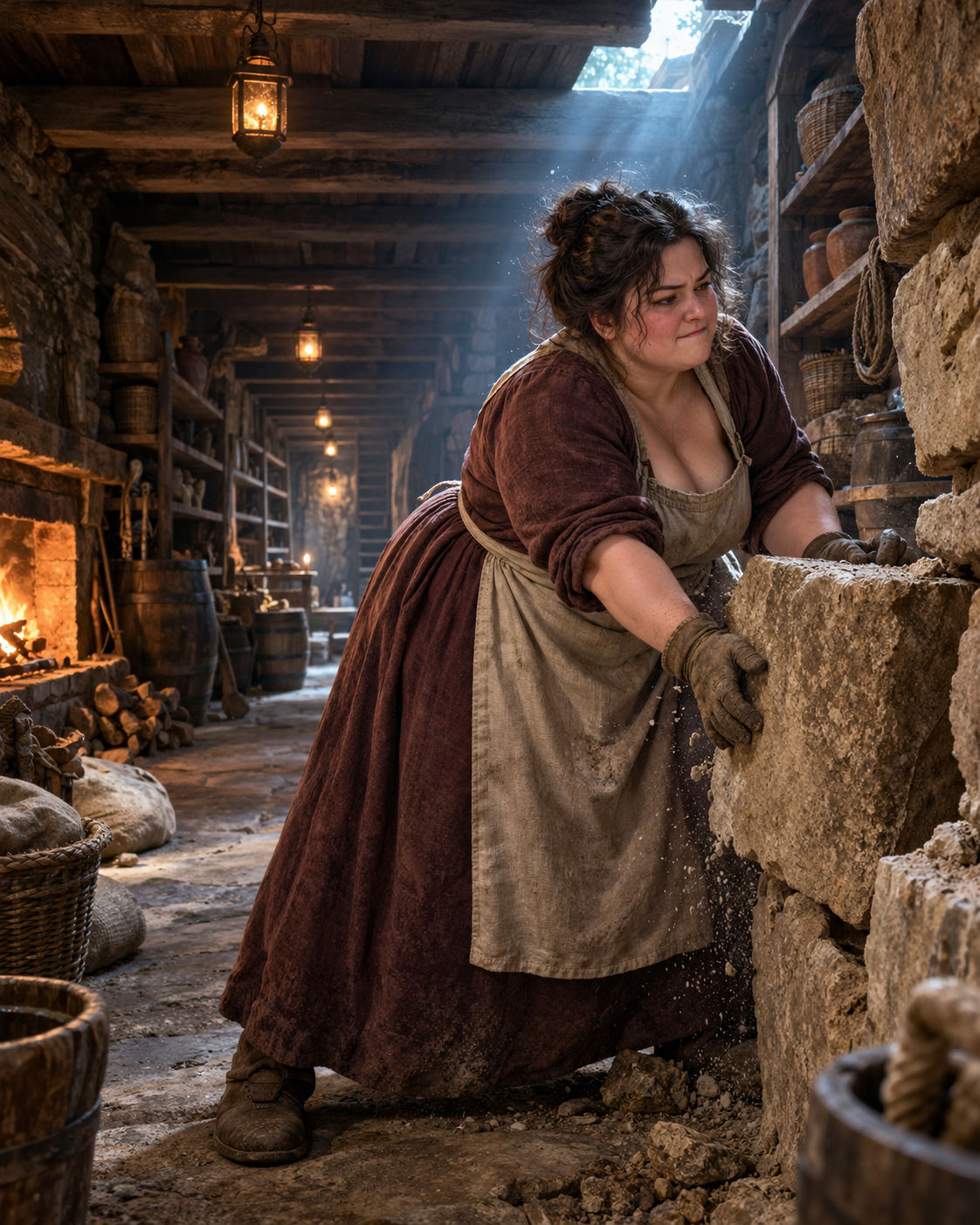
Wendell pushed aside a stack of stones near the rear wall. Beneath them, hidden behind a wooden plank, was a narrow opening in the earth.
Cold air breathed from it.
I stared at Wendell.
“You knew about this?”
“I knew your father planned it. I never knew whether he finished it.”
Bo struck the door again.
The wooden frame groaned.
“We won’t get another chance,” Wendell said.
He lowered himself into the opening and disappeared.
I helped Addie down next, then Silas. Before I followed, I looked once more at the shelter we had built with our bleeding hands.
For weeks, I had believed those walls were the answer to everything.
Now they felt like a trap.
I took the manual and slipped it beneath my coat.
Then I climbed into the darkness.
The passage was barely wide enough for a grown man. Its walls were rough sandstone, and the floor was covered with frozen dirt. Wendell crawled ahead, holding a small lantern. Silas followed him, and I kept Addie close behind me.
Above us, the door finally broke.
Boots entered the shelter.
Someone shouted.
“Search the place!”
I pressed my palm against Addie’s mouth as she began to whimper.
We moved through the passage without speaking.
The air smelled of wet stone and old earth. Water dripped somewhere ahead, making a slow, steady sound.
After several minutes, Wendell stopped.
The passage ended at a wooden door.
He pushed it open.
We emerged into a narrow ravine on the far side of the ridge, hidden beneath a shelf of rock. Snow had gathered along the opening, but the wind could not reach us.
Wendell extinguished the lantern.
“Stay low.”
We crouched beneath the stone shelf and listened.
Far above us, voices echoed from the ridge.
“They’re gone!”
“Find them!”
Bo shouted something I could not make out.
Then a gunshot cracked through the night.
Addie buried her face against my chest.
Silas gripped my sleeve.
“Are they shooting at us?”
“No,” I whispered, though I did not know if it was true.
Wendell looked toward the darkness beyond the ravine.
“They won’t stop.”
“Why?” I demanded. “What did my father hide?”
He did not answer immediately.
Instead, he stared at the manual beneath my coat.
“Your father was not only a builder, Hattie.”
I frowned.
“He worked with stone. He repaired barns and built chimneys.”
“He did those things. But he also knew how to survey land. He understood water lines, mineral seams, underground channels. Men came to him when they wanted to know what lay beneath the earth.”
I felt my heartbeat quicken.
“What does that have to do with Bo?”
Wendell lowered his voice.
“Your father discovered something in this ridge.”
“What?”
“Silver.”
The word seemed to hang in the frozen air.
Silas looked up.
“Silver?”
Wendell nodded.
“A vein large enough to make men wealthy. Your father believed the land belonged to the people who had settled here, not to men who could buy a judge or frighten a widow. He refused to reveal its location.”
I thought of Bo’s cattle, his enormous ranch, his men riding through town as though every road belonged to him.
“And he hid the location in the shelter?”
“Not exactly. He built the shelter over the first entrance to the mine. The drawing in your manual shows the route to the lower chamber.”
I stared at him.
“Why would he hide it there?”
“Because he knew that if he placed the entrance somewhere obvious, men would tear the ridge apart looking for it. The shelter was meant to conceal the passage.”
I remembered my father’s handwriting.
If winter cannot get around you, it must break itself trying.
Those words had always sounded like advice about survival.
Now they seemed to carry another meaning.
My father had not merely designed a house.
He had designed a hiding place.
A place where something dangerous could remain untouched.
“Why didn’t you tell me?” I asked.
Wendell looked down.
“Your father made me promise. He said that if the wrong men found the silver, they would own the town. He wanted you and your mother to live without knowing any of it.”
“My mother died when I was twelve.”
“I know.”
“Then why did you keep the secret from me for all these years?”
“Because your father made me swear that I would speak only when the ridge was threatened.”
I looked back toward the shelter.
“Is that why you came?”
Wendell’s expression tightened.
“I came because I received a letter from your father’s old partner. He said Bo had begun searching the ridge. He feared the secret had been discovered.”
“Who was his partner?”
Wendell hesitated.
“Elias Vane.”
I had heard the name before.
Elias Vane had owned a small assay office near the railroad settlement. He had died in a mining accident years earlier, or so people said.
“Elias is dead.”
“Yes.”
“Then who sent the letter?”
Wendell did not answer.
Before I could ask again, a horse whinnied in the distance.
Someone was coming through the ravine.
Wendell pulled us farther beneath the rocks.
A lantern appeared between the snow-covered bushes.
Then a man stepped into view.
He was tall and thin, wearing a dark coat and a wool hat pulled low over his face.
He stopped beside the ravine entrance.
“Wendell,” he called.
Wendell’s hand moved toward the knife at his belt.
The stranger continued.
“I know you have the widow with you.”
I felt Addie tremble.
The man turned his head slowly, scanning the rocks.
“Your father trusted the wrong people, Hattie.”
I did not recognize the voice.
But Wendell did.
“Elias,” he whispered.
The man smiled.
“No one has called me that in years.”
I stared at him.
“You’re alive?”
“Alive enough.”
Wendell stepped forward.
“Stay away from her.”
Elias laughed.
“Thomas Wickham left you a promise, and you kept it for twenty years. Admirable. But promises do not buy food, Wendell. They do not keep men from freezing. They do not stop Bo Coulter from taking what he wants.”
“You’re working for him,” Wendell said.
“I’m working for myself.”
Elias looked toward the ridge.
“Bo wants the silver. I want the records. Your father kept detailed notes about the mineral deposits, the water rights, and the boundaries of this territory. Those records could make a man rich without ever lifting a pickaxe.”
I stepped out from beneath the rocks.
“Then why come after me?”
Elias’s eyes settled on my face.
“Because you have the manual.”
I felt the book beneath my coat.
“I don’t know what you think is in it.”
“Your father hid the final instructions in the binding. He knew that no one would look twice at a widow carrying an old book.”
Wendell moved between us.
“Let her go.”
Elias sighed.
“You still think this is about protecting her. It isn’t. It’s about correcting a mistake your friend made.”
“What mistake?”
“Thomas believed ordinary people could hold land against powerful men. He believed that if he hid the truth long enough, justice would catch up.”
Elias stepped closer.
“Justice is slow, Wendell. Greed is not.”
He drew a pistol.
Silas moved in front of Addie.
I grabbed his shoulder and pulled him back.
Then, from somewhere above the ridge, a second gunshot rang out.
Elias turned sharply.
A bullet struck the stone beside his head.
He stumbled backward.
Wendell seized the moment.
“Run!”
We fled into the ravine.
Snow slid beneath our boots. Addie cried out when she fell, and I lifted her without stopping. Silas ran beside me, his breath coming in sharp bursts.
Behind us, men shouted.
The ravine narrowed until we reached a frozen stream. Wendell led us across the ice, toward a stand of pine trees on the opposite bank.
A gunshot cracked behind us.
Then another.
The ice beneath Silas’s feet shattered.
He dropped through the surface with a terrible cry.
“Silas!”
I threw myself forward.
His hands clung to the edge of the ice, his body submerged in black water.
Wendell grabbed my coat.
“Don’t move too fast!”
But I was already on my knees.
I reached for Silas’s wrist.
His fingers were numb and slippery.
“Hold on to me!”
“I can’t feel my hands!”
I wrapped my other arm around a tree root and pulled.
Wendell dropped beside me and seized Silas beneath the shoulders.
Together, we dragged him from the stream.
His clothes were soaked, his lips blue.
I pressed him against my chest.
“Stay awake, baby. Stay awake.”
“I’m cold,” he whispered.
“I know.”
Wendell stripped off his own coat and wrapped it around my son.
Then he looked toward the trees.
“We have to move.”
I wanted to scream at him.
Silas could barely stand.
But the men were coming.
I lifted my son’s arm over my shoulder.
“Come on.”
We staggered through the trees until the sounds behind us faded.
At last, we reached an abandoned hunting cabin.
Its roof had partially collapsed, but the walls were still standing.
Wendell forced open the door.
Inside, the air smelled of dust and old smoke.
We built a fire with broken furniture and dry branches from beneath the floorboards.
Silas lay beside it, wrapped in blankets.
Addie sat close to him, holding his hand.
I knelt beside my son and rubbed his feet.
His eyes were closed.
“Will he be all right?” Addie asked.
“He will.”
I said it firmly, because I needed the words to become true.
Wendell examined Silas’s hands and face.
“He needs warmth. Slowly. If we rush it, we could hurt him.”
I nodded.
For nearly an hour, none of us spoke.
The fire grew.
Silas began to shiver.
It was a terrible sound, but I welcomed it.
When he finally opened his eyes, he whispered, “Did we get away?”
“For now.”
He looked at Wendell.
“Are they still after us?”
“Yes,” Wendell answered.
Silas swallowed.
“Why?”
Wendell looked at me.
I shook my head.
My son had already endured enough.
But Silas was twelve, and twelve-year-old boys in Wyoming learned early that adults did not always tell the truth.
“Because your grandfather hid something,” I said.
“Silver?”
I stared at him.
“How did you know?”
“I heard you talking.”
He turned toward the fire.
“Is that why Bo laughed at us?”
I sat beside him.
“Maybe.”
Silas was quiet for a long time.
Then he asked, “If there’s silver in the mountain, why are we poor?”
I had no answer.
Wendell looked into the flames.
“Because finding wealth and possessing it are two different things.”
Silas frowned.
“That doesn’t make sense.”
“It will when you’re older.”
I looked down at my hands.
My father had known about the silver.
He had chosen not to take it.
He had chosen to build houses, repair wells, and help settlers survive.
But he had also left behind a secret that had become a weapon in the hands of greedy men.
I wondered whether he had understood how dangerous silence could become.
The next morning, we returned to the ridge by a hidden path Wendell knew from years before.
We waited until the men had left the shelter.
The door hung broken from its hinges.
Our tools were scattered across the floor.
The unfinished roof had been torn apart.
Someone had overturned the stone piles, searching beneath them.
I stood in the doorway, staring at the wreckage.
This place had been our hope.
Now it looked as though a storm had passed through it.
Addie began to cry.
I knelt and pulled her close.
“They broke our house.”
“No,” I said.
I looked at the stone walls.
“They broke the things inside it. That isn’t the same.”
Wendell entered the shelter and began searching through the debris.
After a few minutes, he found a small metal box beneath the foundation stones.
He handed it to me.
The box was rusted, but the lock had not been broken.
I recognized it immediately.
My father had kept it in his workshop when I was a child.
I had always assumed it contained nails.
Inside was a folded map, a brass key, and a letter.
The letter was addressed to me.
My hands shook as I opened it.
My dearest Hattie,
If you are reading this, then the ridge has become unsafe, and I have failed to keep a promise I made to myself.
I wanted you to live without fear of the men who believe land, labor, and lives belong to whoever has the most money.
I wanted you to believe that a person could build a good life with honest hands.
But there are men who will destroy a good life simply because they cannot bear to see someone else possess what they desire.
The silver beneath this ridge is real. But it is not the treasure you must protect.
The true treasure is the water beneath the mountain.
There is a deep underground spring running through the stone. Whoever controls it can control every farm and settlement in this valley.
The silver is only a distraction.
If Bo Coulter finds the spring, he will own Sage Hollow.
The brass key opens the old survey chamber. There you will find the records proving that the water rights belong to the settlers who first built their homes here.
Do not trust anyone who tells you that wealth is the same as power.
And remember this: a shelter is not made strong by the stones that surround it. It is made strong by the people willing to stand together inside it.
Your loving father,
Thomas.
I read the letter twice.
Then I looked up at Wendell.
“He lied to everyone about the silver.”
Wendell shook his head.
“He hid the silver because he knew men would fight over it. But the water was what mattered.”
“Why didn’t he tell the settlers?”
“He tried. He brought the records to the county office. They disappeared.”
I folded the letter.
“Bo knows.”
“Yes.”
“And Elias?”
“Elias helped your father survey the spring. He wanted to sell the information. Thomas refused.”
I looked toward the ridge road.
“Then why is Elias working with Bo?”
“Because Bo has money, and Elias has no conscience.”
The brass key lay in my palm.
It was small, cold, and heavy with the weight of everything my father had kept hidden.
“We have to find the chamber.”
Wendell nodded.
“There may not be much time.”
We descended beneath the shelter through the passage.
At the far end, the tunnel divided into two branches.
One led toward the ravine.
The other disappeared into darkness beneath the mountain.
Wendell held up the lantern.
“Your father’s map should tell us which way to go.”
I spread it across a flat stone.
The drawing showed a series of marks, each one corresponding to a feature in the tunnel.
A split rock.
A narrow ledge.
A shaft where water had once flowed.
Then a chamber marked with a circle.
We followed the map for nearly an hour.
The passage grew colder.
Water trickled along the walls.
At last, we reached a stone door.
A brass keyhole gleamed in its center.
I inserted the key.
The lock turned with a deep metallic click.
The door swung inward.
Beyond it was a room carved into the mountain.
Shelves lined the walls.
On them sat ledgers, rolled maps, sealed letters, and metal containers.
At the far end, a narrow channel carried clear water through the stone.
The spring.
I stepped forward, stunned.
The water moved silently beneath the lantern light.
Wendell approached the shelves.
“These are the original land records.”
He lifted a ledger.
“Names. Boundaries. Agreements. Every settlement in the valley.”
I touched the edge of one map.
My father had spent years gathering proof that the water did not belong to a single rancher.
The chamber was not a treasure vault.
It was a record of everything people had built together.
Then we heard footsteps.
Wendell extinguished the lantern.
Someone was coming through the tunnel.
A voice echoed from the darkness.
“Your father always did love hiding things in complicated places.”
Elias.
He entered the chamber with a lantern in one hand and a pistol in the other.
Behind him stood Bo Coulter.
Bo looked around at the shelves, then at the spring.
For the first time since I had known him, he did not smile.
“So it’s true,” he whispered.
Wendell stepped in front of me.
“Leave.”
Bo raised his pistol.
“You don’t understand, Ashcraft. This valley is changing. The railroad is coming closer. Men will pay fortunes for land with water. I can turn Sage Hollow into a proper town.”
“You mean you can own it,” I said.
Bo’s eyes narrowed.
“I mean I can make it prosperous.”
“By taking the water from everyone else?”
He looked at me as though I were a child.
“People need someone strong to organize their lives.”
“People need water,” I said.
Elias moved toward the shelves.
“Enough of this. We take the records and the survey notes. The rest can burn.”
Wendell looked at the spring.
“If you damage that channel, the whole ridge could flood.”
Elias laughed.
“Then we’ll be careful.”
Bo stared at the water.
“What happens if the spring is diverted?”
“Every farm downstream dries up,” Wendell said. “The valley dies.”
Bo’s expression changed.
For a moment, I saw uncertainty.
Then greed swallowed it.
“Not if I control the channel.”
He stepped toward the stone ledge.
I looked at the shelves.
At the records.
At the spring.
Then I noticed something on the floor near the water.
A small wooden wedge.
My father had marked it on the map.
It was not a support.
It was a floodgate.
If removed, the spring would rush into the lower tunnel.
The chamber would fill.
Bo and Elias were standing between us and the only exit.
I glanced at Wendell.
He followed my eyes.
He understood.
“No,” he whispered.
I shook my head.
There was no other way.
I stepped toward Bo.
“You want the water?”
He turned.
“What?”
“You want the valley to belong to you?”
He smiled.
“Now you’re learning.”
“Then take the records. Take the silver. Take everything.”
Wendell stared at me.
Elias lowered his pistol slightly.
Bo looked suspicious.
“What’s the trick?”
“There is no trick.”
I pointed toward the ledgers.
“My father spent years protecting those papers. If you want them, take them.”
Bo approached the shelves.
As he passed the spring, I moved toward the wooden wedge.
Elias saw me.
“Hattie!”
He lunged.
I pulled the wedge free.
For a moment, nothing happened.
Then the mountain groaned.
Water burst through the channel with tremendous force.
The spring flooded the stone floor.
Bo shouted.
Elias fired.
The bullet struck the wall above my head.
Wendell tackled him.
The lantern fell and shattered.
Darkness swallowed the chamber.
Water rushed around our boots.
I grabbed Addie and pulled her toward the tunnel.
Silas seized the ledgers and shoved them beneath his coat.
“Leave them!” I shouted.
“They belong to everyone!”
Bo slipped on the flooded floor.
He reached for a shelf, but the wood tore away from the wall.
Elias struggled with Wendell.
The water rose to their knees.
“Get out!” Wendell yelled.
We ran.
Behind us, Bo screamed that he could not swim.
I heard Elias shouting his name.
Then the chamber door slammed shut under the force of the water.
The tunnel shook.
Rocks fell from the ceiling.
We crawled through the darkness as water chased us.
Wendell came last, dragging Elias by the collar.
Bo was nowhere behind him.
At the split in the passage, the ground collapsed.
Wendell pushed us toward the ravine.
“Keep moving!”
We emerged beneath the stone shelf just as the ridge gave a deep, thunderous roar.
Snow slid down the mountainside.
A crack opened across the face of the ridge.
Water burst from the rocks and poured into the ravine.
For a long time, we stood there, unable to speak.
The mountain had not fallen.
But the hidden spring had found a new path.
It flowed around the ridge, down toward Sage Hollow.
Wendell looked at the water.
“Your father would have hated what we did to the chamber.”
I looked at the rushing stream.
“He would have understood why.”
Elias lay on the ground, coughing.
His face was bruised, and one arm hung awkwardly at his side.
I walked toward him.
“Where is Bo?”
Elias looked away.
“He was behind me.”
“Did you leave him?”
“He fell.”
I stared at him.
“You left him there.”
Elias said nothing.
Wendell looked toward the ridge.
“We have to get help.”
But I could not move.
Bo Coulter had threatened us.
He had destroyed our shelter.
He had hunted us through the snow.
Yet the thought of him trapped beneath the mountain filled me with something I did not understand.
Not forgiveness.
Not pity.
Something heavier.
The knowledge that a person could become so consumed by wanting more that he could lose the ability to recognize the lives he was destroying.
“We go back,” I said.
Wendell turned.
“Hattie—”
“We go back.”
We found Bo near the collapsed passage.
He was trapped beneath a fallen beam, his leg pinned.
Water swirled around his waist.
He had lost his pistol.
When he saw me, he began to laugh weakly.
“You came back for me?”
I knelt beside the beam.
“Don’t make me regret it.”
Wendell and I worked until our hands bled.
Silas helped carry stones away.
Even Elias, pale and shaking, pushed against the beam with his good arm.
At last, the wood shifted.
Bo pulled free.
He collapsed against the wall.
For several minutes, he could not speak.
Then he looked at me.
“Why?”
I wiped mud from my face.
“Because my father taught me that a shelter is only as strong as the people willing to stand together inside it.”
Bo looked away.
“I don’t deserve your help.”
“No,” I said. “But my children deserve to grow up without becoming like you.”
We carried him to the ravine.
By dawn, the valley had changed.
Water ran through the lower fields.
The stream that had been dry for years now moved beneath the first light of morning.
When we reached Sage Hollow, people gathered along the road.
They had heard the mountain roar.
They had seen the water.
They had assumed the ridge had broken open.
I walked into the general store with the ledgers wrapped in my coat.
The shopkeeper stared at me.
“What happened?”
I placed the records on the counter.
“My father left proof that the water belongs to the settlers.”
He looked at the books.
Then at me.
“Where did you get these?”
“From the mountain.”
Word spread quickly.
By noon, half the town had gathered in the meeting hall.
The ledgers were opened.
Names were read.
Boundaries were measured.
Old agreements were compared with the county records.
The evidence was clear.
The spring belonged to the valley.
No single rancher had the right to control it.
Bo was taken to the doctor, where his leg was set and his wounds treated.
Elias was placed under guard until the territorial authorities could be contacted.
Neither man spoke much.
Perhaps they had finally realized that the mountain had no interest in their wealth.
It had nearly buried them both.
For days, the people of Sage Hollow worked together.
They cleared the new streambed.
They repaired the irrigation channels.
They built a wooden bridge across the ravine.
The same men who had once laughed at my stone shelter came to help rebuild it.
Some brought timber.
Some brought tools.
Some brought food.
The shopkeeper arrived with a sack of lime.
He set it beside the broken wall and lowered his eyes.
“I should have sold it to you when you asked.”
I looked at him.
“Yes,” I said.
He nodded.
“I’m sorry.”
I did not tell him that an apology could not erase the forty-mile walk, the fever, or the fear that had followed me into the mountain.
But I accepted the lime.
Not because he deserved to feel forgiven.
Because my children needed a home.
The shelter was finished before Christmas.
Its walls were thicker than before.
The roof was reinforced with timber.
A stone channel carried spring water past the entrance, keeping the floor dry.
Wendell stayed for several weeks to help us complete the work.
He taught Silas how to shape stone and showed Addie how to read the markings on a survey map.
At night, we sat beside the fire, and the children listened as he told stories about my father.
Stories I had never heard.
My father had once built a bridge for a family whose wagon had broken down.
He had repaired a schoolhouse roof without asking for payment.
He had spent an entire winter helping settlers dig a well.
He had believed that a person’s worth was measured by what he left standing after he was gone.
I thought about the shelter.
It had begun as a desperate attempt to keep my children warm.
But it had become something larger.
It had brought a hidden truth into the light.
It had forced a town to remember that survival was never an individual achievement.
Even the strongest wall needed hands to build it.
Even the deepest spring needed people willing to protect it.
One evening, as the sun sank behind the ridge, Silas stood outside the shelter and watched the stream.
“Ma?”
“Yes?”
“Do you think Grandfather knew this would happen?”
I looked at the water moving through the valley.
“I think he knew that secrets could be dangerous.”
“Then why did he hide everything?”
“Because he was afraid the wrong people would find it.”
Silas considered that.
“Was he wrong?”
I thought about the chamber.
The ledgers.
The silver.
The men who had nearly killed one another over something buried beneath the earth.
“No,” I said. “But he learned something too late.”
“What?”
“That protecting something forever is not the same as protecting it wisely.”
Silas nodded slowly.
Then he looked at the stone wall.
“Are we going to stay here?”
I placed my hand on his shoulder.
“Yes.”
“Even after what happened?”
I smiled.
“Especially after what happened.”
The first winter night we slept inside the completed shelter, the wind struck the ridge with all its old fury.
Snow pressed against the roof.
The stream froze along its edges.
But no cold entered our room.
Addie slept beside the stove, her cheeks warm.
Silas lay beneath two blankets, one arm thrown over his face.
I sat near the fire with my father’s manual open in my lap.
The final page was still there.
The little symbol remained beneath the drawing.
But now I understood what it meant.
It was not a warning about treasure.
It was a reminder that every shelter had two purposes.
One was to keep danger outside.
The other was to give frightened people a place where they could gather their courage.
I turned the page and found a blank space beneath my father’s last words.
For a long time, I held the pencil without writing.
Then I added a sentence of my own.
A house can keep the snow away, but only love can make it a home.
I closed the manual.
Outside, the wind continued to rage.
But inside, my children were safe.
And for the first time in years, I no longer felt that I was merely surviving the winter.
I felt that I had built something that could outlast it.
Months later, when spring returned to Sage Hollow, the valley was greener than anyone remembered.
The stream flowed steadily through the fields.
New fences rose along the banks.
People who had once argued over every patch of ground now worked together to maintain the water channels.
The town established a small council to protect the spring and preserve the records.
My father’s ledgers were copied and stored in the meeting hall.
The originals remained in the shelter, sealed behind a stone panel.
Not because we wanted to hide them again.
Because some things needed to be remembered carefully.
Bo Coulter survived.
His ranch lost much of its power after the water rights were settled, and the people of Sage Hollow no longer bowed when he rode through town.
He never apologized publicly.
But one afternoon, he came to our door carrying a bundle of firewood.
He set it beside the wall.
“I heard your roof needs another beam,” he said.
I looked at him.
“It does.”
He nodded toward the ridge.
“I can help.”
For a moment, I considered sending him away.
Then I opened the door wider.
“Bring your tools tomorrow.”
He looked surprised.
“Tomorrow?”
“I have work to do today.”
A faint smile touched his mouth.
“Yes, ma’am.”
I watched him walk away.
Forgiveness, I learned, was not always a feeling.
Sometimes it was simply refusing to let another person’s cruelty decide what kind of person you would become.
And sometimes, it meant allowing someone to work for the chance to become better.
As for Elias, he was taken away before summer.
The records he had tried to steal became evidence against him.
No one in Sage Hollow spoke his name with affection.
But his betrayal remained a warning.
A man could know the value of every stone in a mountain and still fail to understand the value of a human life.
Wendell left when the roads cleared.
Before he mounted his horse, he handed me a small wooden box.
Inside was a compass.
“It belonged to your father,” he said.
I ran my thumb across the worn brass.
“He gave it to you?”
“Years ago. He told me to return it when you no longer needed someone to show you the way.”
I looked toward the ridge.
“I still don’t know where I’m going.”
Wendell smiled.
“Neither does anyone else.”
Then he rode away.
I stood beside the road until he disappeared beyond the cottonwoods.
The compass needle trembled in my palm before settling toward the north.
I thought of the day I had stood outside the general store with an empty flour sack.
I had believed the town’s laughter was the worst thing a person could endure.
I had believed poverty meant weakness.
I had believed that if I worked hard enough, I could protect my children from every cruel thing in the world.
I was wrong about all three.
Poverty could make a person tired, but it could not make them worthless.
Cruelty could wound a person, but it did not have to define them.
And no mother, no matter how strong, could shield her children from every danger.
What she could do was teach them how to stand.
How to recognize injustice.
How to ask for help.
How to offer it.
How to build something lasting with whatever they had.
That autumn, when the next cold wind came down from the ridge, I stood outside our shelter with Addie and Silas beside me.
The stone walls were pale in the morning light.
The stream ran clear below the slope.
Smoke rose from the chimneys of Sage Hollow.
Addie held my hand.
“Ma, do you remember when we first started building?”
“I do.”
“You said we had to.”
I nodded.
“Did you know it would become this?”
I looked at the valley.
At the houses.
At the fields.
At the people moving along the roads.
“No,” I said. “I only knew we needed somewhere safe to sleep.”
Silas leaned against the wall.
“Sometimes that’s how things begin.”
I smiled.
“Yes.”
The wind moved around us, cold and restless.
But the shelter stood firm.
Not because the mountain had surrendered.
Not because winter had become gentle.
And not because we had discovered silver.
It stood because frightened hands had kept laying one stone after another.
Because a stranger had stopped to help.
Because a town had finally learned that a widow’s work was not lesser work.
Because truth, once brought into the open, could become stronger than greed.
I placed my hand against the wall.
The stone was cold.
Solid.
Real.
Then I turned toward the door.
“Come inside,” I told my children.
They followed me.
Behind us, the wind continued to test the ridge.
Ahead of us, the fire waited.
And in that small shelter built by a widow who had once been laughed at outside a general store, we found the one thing no man could steal, no winter could destroy, and no mountain could bury forever.
A home.
THE END.