When Lydia Ren arrived at Kenworth Hall, she did not expect music to become the one thing standing between a broken past and an uncertain future.
Lydia did not know who had decided that she should never play the fourteen compositions in public.
But she knew something had changed.
The morning after Rowan heard the first completed piece, the atmosphere inside Kenworth Hall became noticeably colder.
Servants who had once smiled at her suddenly found reasons to look away.
Conversations stopped when she entered a room.
And Lady Fontaine, a longtime family acquaintance whose influence reached far beyond the Kenworth household, began appearing at breakfast with a politeness that felt more dangerous than anger.
“You have been very helpful to Rowan,” Lady Fontaine said one morning.
Lydia lowered her eyes to the tea in front of her.
“I only played the piano.”
“No,” Lady Fontaine replied. “You did considerably more than that.”
Lydia said nothing.
Lady Fontaine smiled.
“People in Rowan’s position cannot afford to confuse sympathy with affection.”
The words were gentle.
The warning was not.
Lydia understood then that the problem was no longer the notebooks.
It was Rowan.
And whatever had begun to change between them was being noticed.
Rowan, however, seemed less willing than ever to obey the rules surrounding him.
Several nights later, Lydia was alone in the music room when she heard footsteps behind her.
She turned.
Rowan stood in the doorway.
“I want you to teach me.”
Lydia stared at him.
“You already know how to play.”
“Not like you.”
“That isn’t true.”
“It is.”
He walked toward the piano.
For a moment, neither of them spoke.
Then Rowan placed his hands awkwardly on the keys.
“I haven’t played seriously since my mother died.”
Lydia looked at his hands.
They were steady, but his breathing was not.
“Then we start slowly.”
That was how the secret lessons began.
There were no grand declarations.
No romantic promises.
Only music.
Rowan learned scales he had once considered beneath him.
He struggled with simple passages.
He became frustrated.
Lydia corrected his fingers.
Sometimes they laughed.
Sometimes neither of them spoke for several minutes.
And slowly, something changed.
Rowan began talking about his mother.
Not about the public Catherine Aldcroft, admired by collectors and musicians.
He talked about the woman who used to leave handwritten notes beside his breakfast plate.
The woman who hated thunderstorms.
The woman who could never resist playing the same melody twice when she was happy.
The woman who had promised him she would finish her latest compositions.
Then she died.
And the promise died with her.
“I thought the notebooks were all she left,” Rowan admitted one evening.
Lydia looked at him.
“Perhaps they weren’t.”
“What do you mean?”
“Perhaps she left something you couldn’t hear until now.”
He did not answer.
But his eyes moved toward the fourteen notebooks resting on the piano.
The secret lessons continued.
So did the pressure.
Lady Fontaine had already begun arranging a different future for Rowan.
There was a young woman from an influential family.
The match was considered practical, respectable, and advantageous.
No one asked whether Rowan wanted it.
They simply assumed he would accept.
When Lydia learned about the arrangement, she decided to distance herself.
She returned to playing only during dinner.
She stopped lingering in the music room.
She stopped asking Rowan whether he had practiced.
And when he approached her after one lesson, she closed the piano lid.
“You shouldn’t be here.”
“I came because you told me to practice.”
“That was before.”
“Before what?”
“Before everyone began watching.”
Rowan’s expression hardened.
“Let them watch.”
“You can say that because you have nothing to lose.”
He looked at her for a long moment.
“That’s not true.”
Lydia wanted to ask what he meant.
Instead, she walked away.
The next weeks were filled with preparations for Christmas at Kenworth Hall.
The annual gathering was more than a family celebration.
It was one of the most anticipated social events of the season, bringing together old American families, influential patrons, musicians, academics, and guests from across the country.
This year, Lady Fontaine intended to use the occasion to announce Rowan’s future marriage.
Lydia knew what that meant.
She also knew the fourteen notebooks were scheduled to remain hidden.
But then Rowan did something unexpected.
He asked Catherine’s family for permission to have the compositions examined.
At first, they refused.
The notebooks were too personal.
The works were unfinished.
And no one knew whether the missing passages Lydia had written were faithful to Catherine’s intentions.
Lydia herself understood their hesitation.
She had never claimed to possess the right answers.
She had simply listened to the music and responded.
But then Catherine’s younger sister, Margaret, came to Kenworth Hall.
She was an older woman now, but when she opened the first notebook, her hands began to tremble.
“I remember this,” she whispered.
Lydia stood quietly beside her.
“My sister played this melody the summer before she died.”
Margaret turned the page.
Then another.
She listened as Lydia played the unfinished section.
Tears filled her eyes.
“She would have ended it exactly there.”
Those words changed everything.
For the first time, someone from Catherine’s own family publicly acknowledged that Lydia’s work had not erased the original compositions.
It had helped reveal them.
Still, another problem remained.
Someone had begun spreading questions about Lydia’s family.
Whispers circulated about her father’s financial dealings.
Some suggested that the ruin of the Ren family had not been caused by circumstances beyond their control.
Others hinted that Lydia’s father had hidden information from investors.
The allegations were old.
But they were suddenly becoming useful.
Lydia realized that someone wanted her reputation damaged before Christmas.
She considered leaving Kenworth Hall.
It would have been easier.
But then she remembered her father’s face on the last night before everything collapsed.
He had told her that sometimes the truth became buried not because it was weak, but because someone powerful preferred silence.
She had never understood what he meant.
Now she wondered.
Rowan investigated quietly.
He contacted attorneys.
He requested old financial records.
He asked questions no one in his family expected him to ask.
And eventually, the name of a former business associate appeared repeatedly.
The man had connections to people who had benefited from the collapse of Lydia’s family’s company.
There was no immediate proof of deliberate wrongdoing.
But there were inconsistencies.
Missing documents.
Unexplained transfers.
Statements that did not match the records.
The more Rowan discovered, the less accidental Lydia’s family’s downfall appeared.
Still, the Christmas gathering could not be stopped.
On Christmas Eve, Kenworth Hall filled with guests.
Candles burned along the grand staircase.
Evergreens framed the doors.
Snow covered the grounds outside the windows.
Inside, conversations moved from politics to art to family alliances.
Lydia stood alone behind the curtain of the music room.
The fourteen notebooks were on the piano.
Her hands were cold.
She could hear Lady Fontaine speaking in the main hall.
Then Rowan appeared.
“You don’t have to do this.”
Lydia looked at him.
“Yes, I do.”
“Why?”
“Because the music deserves to be heard.”
He smiled faintly.
“And if they don’t understand it?”
“Then at least they will have heard it.”
He reached for her hand.
This time, she did not pull away.
“I’ll be there,” he said.
The doors opened.
The room became silent.
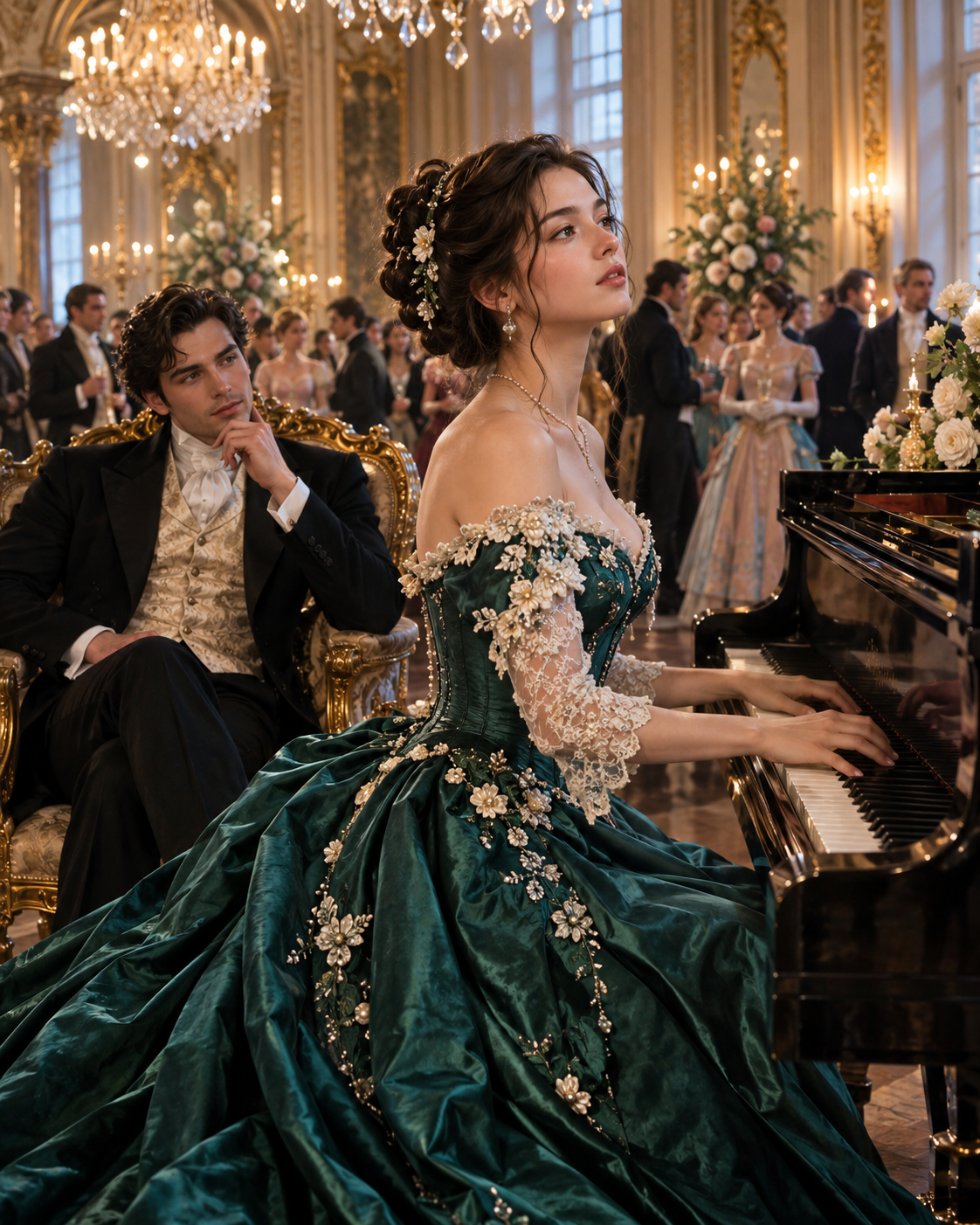
Lydia walked to the piano.
No announcement described the scandal surrounding the Ren family.
No one explained the years of grief behind the compositions.
The audience was simply told that fourteen unfinished works by Catherine Aldcroft would be performed for the first time in their completed form.
The first notes were almost painfully quiet.
Lydia did not play them like a performance designed to impress.
She played them like a conversation.
A conversation between a mother and a son.
Between a past and a future.
Between grief and the possibility of healing.
The first composition ended.
There was silence.
Then applause.
The second began.
By the fourth, guests had stopped whispering.
By the seventh, even those who had expected an ordinary Christmas recital were completely absorbed.
The eighth composition contained a melody Catherine had apparently written shortly before her death.
Margaret covered her mouth.
Rowan closed his eyes.
And when Lydia reached the bridge she had completed herself, the music seemed to cross an invisible distance between eleven years of silence and one moment of truth.
By the fourteenth composition, no one in the room was untouched.
When the final chord faded, Lydia kept her hands on the keys.
For several seconds, nobody moved.
Then Margaret stood.
She applauded first.
Others followed.
Soon the entire room was standing.
But Lady Fontaine remained seated.
Her expression had changed.
The performance had made the compositions impossible to dismiss.
Catherine’s family could no longer treat them as private fragments of grief.
They were now a body of work.
A legacy.
And perhaps something even more important.
A bridge between people who had spent years refusing to speak.
After the applause faded, Margaret approached Lydia.
“I want our family to publish them.”
Lydia looked surprised.
“All fourteen?”
“All fourteen.”
The decision was later supported by Catherine’s surviving relatives.
The manuscripts would be carefully preserved, edited, and published with Lydia’s completed passages clearly documented as restorations rather than original compositions.
For Lydia, that distinction mattered.
She did not want Catherine’s voice replaced by her own.
She wanted Catherine’s voice heard.
The publication created a wave of attention.
Musicians across the United States began discussing the unusual story behind the compositions.
Music journals wrote about the notebooks.
Performances were planned.
Universities expressed interest in preserving the manuscripts.
And Lydia, who had once believed her life had ended with her family’s financial collapse, suddenly found herself standing at the beginning of something entirely new.
But there was still one unfinished matter.
The investigation into her father’s name.
The official inquiry took months.
Records were reviewed.
Witnesses were interviewed.
Financial transactions were examined.
Eventually, investigators concluded that the most serious allegations against Lydia’s father were unsupported by the evidence.
The records revealed that key information had been withheld from him and that several transactions associated with the collapse had been misrepresented.
The finding did not restore everything Lydia’s family had lost.
It could not return the years they had spent struggling.
But it restored something money could not buy.
Her father’s name.
Lydia’s independence returned with it.
She no longer needed to remain at Kenworth Hall because she had nowhere else to go.
She could choose.
That realization frightened her more than poverty ever had.
One evening, she found Rowan waiting in the music room.
The fourteen notebooks were open on the piano.
“You’re leaving,” he said.
Lydia looked at him.
“I don’t know.”
“You can.”
“Yes.”
He nodded.
“I know.”
There was no attempt to stop her.
That surprised her.
Instead, Rowan walked to the window.
“My whole life, I thought love meant keeping someone close.”
Lydia said nothing.
“Now I think it means giving them enough freedom to choose whether they want to stay.”
She looked at him for a long moment.
“And if I choose to leave?”
“I’ll be grateful you chose honestly.”
“And if I stay?”
He turned toward her.
“Then I’ll spend the rest of my life trying to deserve it.”
Lydia smiled through tears.
“You’ve finally learned something.”
“Piano?”
“Something much harder.”
He laughed softly.
She walked toward him.
The distance between them disappeared without either of them rushing.
Their marriage was not announced as a grand social arrangement.
There was no strategic alliance.
No calculation about family names or property.
It was simply a choice made by two people who had learned that love could not be built on silence.
They married after the winter season, surrounded by the people who had become part of the story.
But the wedding was not the end.
It was the beginning of their shared work.
Lydia and Rowan decided that Kenworth Hall would become more than a family estate.
Part of it would be transformed into a music school.
The school would offer lessons to children and young musicians who could not otherwise afford them.
The first room they restored was the old music room where Catherine’s notebooks had been discovered.
The fourteen compositions were preserved in an archive.
A piano stood in the center.
On the wall hung a simple inscription:
“Some unfinished things are waiting for patience, not abandonment.”
Years later, students would ask Lydia why she had completed Catherine’s music when she had no guarantee that anyone would understand it.
Her answer never changed.
“I didn’t finish it because I knew how the story ended.”
She would pause.
“I finished it because I believed the silence deserved an answer.”
Rowan would sometimes hear her say those words from the doorway.
He understood them better than anyone.
His grief had not disappeared.
Neither had Lydia’s memories of the life her family had lost.
Healing had never meant forgetting.
It meant learning how to carry the past without allowing it to decide the future.
The fourteen compositions eventually became known far beyond Kenworth Hall.
But for Lydia, their greatest achievement was never the applause.
It was the people they brought back into conversation.
A son who finally spoke about his mother.
A family that recovered a forgotten artistic legacy.
A woman who reclaimed her father’s name.
Two people who stopped confusing grief with loneliness.
And a house that once held years of silence became a place where young musicians filled the halls with sound.
On the anniversary of Catherine’s death, Lydia and Rowan returned to the original music room.
The fourteen notebooks rested safely behind glass.
Rowan stood beside Lydia.
“Do you ever wonder what would have happened if you had never opened that door?”
She smiled.
“Sometimes.”
“What do you think?”
“I think the notebooks would still be here.”
“And the music?”
“Still waiting.”
Rowan looked at the piano.
“Maybe that’s what people are sometimes.”
Lydia turned toward him.
“Waiting?”
“Waiting for someone to listen.”
She took his hand.
Outside, winter snow covered the grounds of Kenworth Hall once again.
Inside, a student began practicing in the next room.
The notes were imperfect.
The rhythm was uneven.
The young musician stopped, started again, and tried once more.
Lydia smiled.
She did not correct the child immediately.
She listened.
Because she had learned something years ago that no prestigious concert hall could have taught her.
Not every unfinished thing is broken.
Some things are unfinished because life interrupted them.
Some because fear stopped them.
Some because grief became too heavy to continue.
And sometimes, all they need is someone willing to sit beside them long enough to hear where the music wants to go.
That was what Lydia had done for Catherine.
What Rowan had done for Lydia.
And, eventually, what they did for countless young musicians who walked through the doors of Kenworth Hall.
Their story did not end with a perfect life.
It ended with a meaningful one.
A life in which loss was not denied, mistakes were not hidden, truth was not buried forever, and love was not treated as a possession.
The fourteen notebooks remained unfinished in one sense.
Their original pages still contained Catherine’s handwriting.
Lydia’s additions remained clearly marked.
The past stayed the past.
But the music continued.
And perhaps that was the most beautiful ending of all.
Because sometimes, healing does not arrive by erasing what happened.
Sometimes it arrives when someone finally has the courage to continue the song.
The years that followed did not erase what had happened at Kenworth Hall.
They gave it meaning.
The music school grew slowly at first.
There were only twelve students in the beginning, most of them children from nearby towns whose families could never have afforded private lessons in Boston or New York.
Lydia taught them herself.
She taught scales, technique, discipline, and the importance of listening before playing.
But she also taught them something no examination could measure.
“You don’t have to play perfectly,” she often told them. “You have to play honestly.”
Rowan helped with everything that had nothing to do with music.
He repaired old rooms.
He arranged funding.
He opened parts of the estate that had once been reserved for family guests.
And, perhaps most importantly, he made sure that no student ever felt that the Kenworth name stood above them.
The old estate changed.
The formal dining room became a rehearsal hall.
A neglected wing became a small library.
The garden room became a place where students could study composition.
And the music room where Lydia had first discovered Catherine’s notebooks remained untouched.
It became a kind of sanctuary.
Visitors came from across America to see the original manuscripts.
Some expected to find a romantic story.
Others expected scandal.
But those who spent time with the music discovered something quieter.
They discovered grief.
They discovered tenderness.
They discovered a woman who had begun composing at a time when few people around her understood how deeply she needed music.
And they discovered another woman, years later, who had listened carefully enough to help the unfinished melodies breathe again.
The published collection eventually became known as The Kenworth Manuscripts.
The first edition sold far beyond expectations.
A portion of the proceeds went directly to the music school.
Another portion was placed into a scholarship fund.
Lydia insisted on one condition.
The scholarships could not be limited to children from wealthy families.
“No student should have to prove they were born into the right house before they are allowed to make music,” she said.
Rowan agreed.
The first scholarship was given to a fourteen-year-old girl from Ohio whose parents had been working two jobs to keep their family afloat.
She arrived at Kenworth Hall carrying one battered suitcase and a violin case with a broken latch.
She was terrified.
Lydia recognized the expression immediately.
She had once worn it herself.
“You don’t need to be afraid,” Lydia told her.
The girl looked toward the enormous staircase.
“I’ve never been anywhere like this.”
“Neither had I.”
The girl looked surprised.
“But you live here.”
Lydia smiled.
“That’s not where my story began.”
The girl never forgot those words.
Neither did Lydia.
Because despite everything that had changed, she never allowed herself to forget the months when her family had lost almost everything.
The memory remained painful.
But it was no longer shameful.
Her family’s financial ruin had once seemed like the end of her identity.
Instead, it had forced her into a life she could never have imagined.
It had brought her to Kenworth Hall.
It had brought her to the fourteen notebooks.
And, eventually, it had brought her to Rowan.
Years later, Rowan still teased her about their first meeting.
“You barely noticed me.”
Lydia laughed.
“You were sitting at the far end of the dining room looking as though you wanted everyone to disappear.”
“I was grieving.”
“You were also rude.”
“I was grieving and rude.”
“That is more accurate.”
He would smile.
Then he would ask the same question.
“Would you have believed me if someone had told you that night we’d end up here?”
“No.”
“Neither would I.”
Their marriage was never without difficulty.
They argued.
They disagreed about money, school policies, renovations, performances, and occasionally about things that had nothing to do with any of them.
But they learned not to hide conflict behind politeness.
That lesson had taken years.
Rowan had spent too much of his childhood watching adults protect appearances while avoiding difficult truths.
Lydia had spent too much of her early adulthood watching one crisis after another remain unspoken until it became impossible to contain.
Together, they chose something different.
If something hurt, they talked about it.
If they were angry, they said so.
If they were afraid, they admitted it.
And when they made mistakes, they apologized.
The Kenworth family noticed.
Some approved.
Others never did.
Lady Fontaine, in particular, disappeared from their daily lives after the Christmas performance.
She had not forgiven Lydia for changing Rowan’s priorities.
But time softened even some of those tensions.
Years later, when Lady Fontaine became seriously ill, Lydia received a letter.
It contained only a few lines.
There was no apology.
No dramatic confession.
Only a sentence that Lydia read several times.
“I did not understand what you were protecting until I realized what I had spent my life protecting.”
Lydia never knew whether Lady Fontaine meant her family, her reputation, or herself.
She decided she did not need to know.
She wrote back anyway.
Sometimes peace did not require agreement.
Sometimes it simply required letting an old argument stop being carried into the future.
The greatest surprise came much later.
A young composer named Daniel arrived at Kenworth Hall one autumn afternoon.
He had heard the story of the fourteen compositions and wanted to study with Lydia.
He brought with him a folder containing dozens of unfinished pieces.
“I can’t complete them,” he said.
Lydia opened the folder.
“Why not?”
“I don’t know where they’re supposed to go.”
She studied the first page.
Then she looked at him.
“Neither did Catherine.”
Daniel frowned.
“But she was a great composer.”
“Yes.”
“So she should have known.”
Lydia smiled.
“Being talented doesn’t mean knowing everything.”
She pointed to the page.
“Play this.”
Daniel sat down.
He played the opening melody.
It was beautiful.
Then he stopped.
“I don’t know what comes next.”
“Good.”
He looked confused.
“Why is that good?”
“Because now you have to listen.”
He played again.
Lydia said nothing.
She let the silence remain.
Eventually, Daniel found three notes.
They were not perfect.
Then five more.
He stopped.
Looked at Lydia.
And smiled.
“That sounds better.”
“It sounds like yours.”
That afternoon became the beginning of another tradition at Kenworth Hall.
Every unfinished composition brought to the school was treated not as a failure, but as a question.
Students learned that an unfinished work could still contain value.
That uncertainty was not the enemy of creativity.
That sometimes the most important part of creating was having the courage to continue without knowing exactly where the road ended.
The philosophy spread beyond the school.
Music teachers adopted parts of Lydia’s approach.
Scholarships expanded.
Concerts were held.
Former students returned as professional musicians.
Some became teachers themselves.
Others became composers.
One became a conductor for a major American orchestra.
Another founded a community music program in Detroit.
A former scholarship student eventually returned to Kenworth Hall with her own students.
Every generation carried something forward.
Not just music.
A way of seeing people.
A way of understanding loss.
A way of believing that circumstances did not have to dictate the final chapter of a life.
And then, one spring morning, almost twenty years after Lydia had first discovered the notebooks, Margaret Aldcroft returned to Kenworth Hall.
She was much older now.
Her steps were slower.
Her hair had turned completely white.
But she still remembered every detail of her sister’s music.
Lydia met her in the old music room.
The fourteen notebooks remained behind glass.
Margaret stood before them for a long time.
“I used to think these were the saddest things in the house,” she said.
Lydia stood beside her.
“What do you think now?”
Margaret smiled.
“I think they are the happiest.”
Lydia looked at her.
Margaret touched the glass protecting the notebooks.
“Because they made people remember her.”
Then she turned.
“And because they taught Rowan how to live after losing her.”
Lydia’s eyes filled with tears.
“He taught me too.”
Margaret nodded.
“I know.”
Outside the room, the sound of children practicing filled the corridor.
One played scales.
Another struggled through a difficult passage.
Someone laughed.
A teacher called for quiet.
The house was alive in a way Catherine’s generation could never have imagined.
Margaret listened.
“She would have loved this.”
“Yes,” Lydia whispered.
“I think she would.”
That evening, after Margaret had gone, Lydia found Rowan sitting alone in the music room.
He had aged.
The dark hair he had worn when she first met him was now streaked with silver.
But his expression was still unmistakably his.
“You’re getting sentimental,” he said.
“I’ve always been sentimental.”
“No. You hid it well.”
She sat beside him.
For a while they listened to the distant music.
Then Rowan reached into his coat pocket.
He pulled out a small envelope.
“I found this.”
Lydia opened it.
Inside was a single sheet of Catherine’s handwriting.
For a moment, Lydia could not breathe.
“Where did you find it?”
“In an old desk upstairs.”
She read the few lines.
It was not another composition.
It was a note Catherine had written to Rowan when he was young.
She had apparently never given it to him.
The words were simple.
She wrote that she hoped her son would never measure his life by what he had lost.
She hoped he would learn that love was not proved by holding on forever.
And she hoped that, one day, he would build something beautiful from whatever remained.
Rowan looked away.
“I never knew.”
Lydia folded the letter carefully.
“Maybe she knew you’d find it eventually.”
He smiled.
“Do you really believe that?”
“No.”
He laughed.
“Good.”
“I believe some things take longer to reach us.”
That night, they placed the letter beside the fourteen notebooks.
Not because it belonged to the collection.
It did not.
It was simply another piece of Catherine’s story.
Another fragment that had survived.
Another unfinished sentence finally reaching the person for whom it had been written.
Years later, Lydia would sometimes wonder whether the story could have gone differently.
If she had never entered that unlocked room.
If she had never opened the first notebook.
If Rowan had never heard the first completed composition.
If the rumors about her father had remained unanswered.
If she had chosen fear instead of curiosity.
There were too many possibilities to count.
But life, she came to understand, was not a piano composition.
There was no way to return to the beginning and play a different sequence of notes.
There was only the next measure.
The next choice.
The next moment in which a person could decide whether to stop or continue.
On the final anniversary of Catherine’s death that Lydia and Rowan celebrated together at Kenworth Hall, the school held a concert.
Former students returned from across the country.
The hall was filled.
At the center of the program were the fourteen compositions.
Lydia did not perform them herself.
She sat in the audience.
A young pianist who had never met Catherine played the first piece.
Another student played the second.
By the fourteenth, nearly every generation of the school had contributed something.
When the final note faded, Lydia looked at Rowan.
He was holding her hand.
Neither spoke.
They didn’t need to.
They had heard the answer.
Not an answer to one particular question.
An answer to all the years between grief and hope.
The audience stood.
Applause filled Kenworth Hall.
But Lydia noticed something beyond the applause.
A little girl in the front row was crying.
Beside her, her mother was smiling.
The girl wiped her face and whispered something.
Lydia could not hear it.
But she could read the shape of the words.
“Again.”
Lydia smiled.
The music had done what it was always meant to do.
It had made someone want to hear more.
After the concert, the students gathered in the hallway.
Some talked excitedly.
Some argued about which piece they liked most.
Others were already discussing what they wanted to play next.
Rowan stood beside Lydia near the staircase.
“Are you happy?”
She thought about the question.
There had been a time when she would have answered immediately.
Now she understood that happiness was not a single feeling that stayed forever.
It was made of moments.
Some loud.
Some quiet.
Some painful.
Some ordinary.
She looked around the hall.
“I am grateful.”
Rowan smiled.
“That wasn’t what I asked.”
“I know.”
She rested her head against his shoulder.
“That’s my answer.”
He kissed the top of her head.
Outside, the night air moved through the trees surrounding Kenworth Hall.
Inside, someone began playing the piano again.
The notes drifted through the old corridors.
They were not Catherine’s.
They were not Lydia’s.
They belonged to someone new.
Someone whose story had not yet been written.
And that was exactly how it should be.
The fourteen notebooks had begun as symbols of loss.
They had become a bridge.
Then a legacy.
Then a school.
And finally, they became something even larger.
Permission.
Permission to grieve without being trapped by grief.
Permission to begin again after losing everything.
Permission to admit that some answers arrive years late.
Permission to believe that an unfinished chapter is not necessarily a failed story.
Lydia had once thought the greatest tragedy of her life was losing the future she had expected.
She eventually learned that sometimes the future we lose is simply the future that was never meant to be ours.
What comes after can be frightening.
It can be uncertain.
It can even begin in a place where we feel invisible.
But that does not mean it will remain small.
Sometimes the most important chapters begin quietly.
A girl sits at an unfamiliar piano.
A forgotten notebook lies open.
A melody stops.
For a moment, there is only silence.
Then someone places their hands on the keys.
And plays one more note.
Then another.
And another.
Until, slowly, the unfinished music becomes a song.
And the song becomes a life.
And the life becomes a gift passed to someone else.
That was Lydia’s legacy.
Not that she had completed fourteen compositions.
Not that she had married a duke.
Not that her family name had been restored.
Those things mattered.
But they were not the heart of her story.
The heart was that she had once believed everything was over.
And she had been wrong.
So had Rowan.
So had Catherine, in a different way.
Their lives had all been interrupted by loss.
None of them could change what had happened.
But they could choose what happened next.
And that choice changed everything.
Long after Lydia and Rowan were gone, the music school at Kenworth Hall would continue.
Students would walk through the same doors.
Teachers would tell the same story.
Fourteen notebooks would remain carefully preserved.
And somewhere in the building, a young pianist would occasionally become frustrated by a difficult passage and wonder whether they were good enough to continue.
Then they would remember the words written above the old music room.
“Some unfinished things are waiting for patience, not abandonment.”
They would sit down again.
Take a breath.
And begin.
Because the music had never truly been about finishing the past.
It had always been about finding the courage to continue.
And at Kenworth Hall, the music never stopped.
THE END.