When Josephine stepped from the train at Cheyenne Depot, every cowboy laughed at her size, and I coldly sent her away—because I already knew someone had betrayed me.
I looked toward the kitchen, where Josephine was laughing softly with the ranch hands.
For the first time, I wondered whether the woman I had almost sent away had not come to save my ranch by accident.
Maybe someone had sent her here for a reason.
And whatever that reason was, it had just found us.
I folded the letter and slipped it inside my coat before Josephine could see my face.
I wanted to tell her immediately.
I wanted to walk into that kitchen, place the paper in her hands, and ask the question that had suddenly become heavier than the mortgage itself.
Who was your father?
But something stopped me.
Not fear.
Not distrust.
Instinct.
If the bank manager had paid men to steal my cattle and had somehow been involved in bringing Josephine to Wyoming, then this was bigger than a debt.
Someone had spent years hiding something.
And men did not bury secrets that deeply unless they were afraid of what would happen when the truth came out.
That night, after everyone had gone to bed, I sat at my desk beneath the yellow light of an oil lamp.
I unfolded the list again.
There were seven names.
Caleb Mercer.
Elias Vane, manager of the Cheyenne Territorial Bank.
Two cattle buyers from Denver.
A lawyer from St. Louis.
A railway agent.
And one name that made my stomach tighten.
Samuel Whitmore.
Josephine’s supposed uncle.
The man whose letter had convinced me to accept a mail-order bride.
I read the sentence beneath the list again.
She must never discover who her father really was.
I turned the paper over.
Nothing.
I held it closer to the lamp.
A faint impression marked the back, as if another sheet had once been written on top of it.
I rubbed a piece of charcoal across the paper.
Letters slowly appeared.
Not enough to form a sentence.
But enough to make out three words.
Broken Spur.
Black Creek.
1891.
I knew Black Creek.
Everyone in Wyoming knew it.
It was where a wagon train had been attacked eleven years earlier.
The newspapers had called it an Indian raid.
My father had always called it something else.
Murder.
He had told me once that the men who died there had been carrying gold from the railroad.
I had been sixteen.
I never understood why he seemed angry whenever the subject came up.
Now I did.
Or at least I thought I did.
The next morning, I rode into town alone.
I told Josephine I was going to speak with the bank.
She looked at me for a long moment.
“You’re lying.”
I stopped halfway through tying my horse’s reins.
“I am?”
“You only touch your hat that way when you’re worried.”
I looked at my hand.
She was right.
“I found something last night.”
“What?”
“Not yet.”
Her eyes narrowed.
“Then don’t go alone.”
“Josephine—”
“No.”
She stepped closer.
“I have spent my whole life being told that people know what is best for me. I am finished listening to that.”
I almost smiled.
“You intend to follow me?”
“I intend to make certain you return.”
There was something in her voice that left no room for argument.
So we rode together.
The journey to Cheyenne was quiet.
Neither of us spoke much.
But once we reached town, I noticed something strange.
The bank door was locked.
It was ten in the morning.
A crowd stood across the street.
Someone had been arrested.
When we approached, I saw Caleb being dragged from the sheriff’s office in chains.
“Caleb!” I shouted.
He turned.
His face was bruised.
“They know,” he called.
“Know what?”
“The bank!”
One of the deputies struck him across the back.
“Keep moving.”
Josephine grabbed my sleeve.
“Giannis, don’t.”
I watched Caleb disappear into the jail.
Then a man in a black coat stepped from the bank.
Elias Vane.
He looked directly at me.
Then at Josephine.
For one second, his face changed.
Not surprise.
Recognition.
He knew her.
Josephine saw it too.
“Do you know me?” she asked.
Vane’s expression hardened.
“I have never seen you before.”
She stepped forward.
“You’re lying.”
The bank manager smiled.
“Madam, I suggest you return to your husband’s ranch.”
“My husband?”
His eyes shifted to me.
“You have married quite beneath yourself, Mr. Wells.”
I took one step toward him.
“Say that again.”
Josephine caught my arm.
“Don’t.”
Vane’s smile widened.
“You have no idea what you married into.”
Then he walked away.
I watched him enter a waiting carriage.
Josephine remained still beside me.
“Giannis.”
“Yes?”
“What did he mean?”
I looked at her.
“I don’t know.”
That was only partly true.
I knew one thing.
Vane had been afraid when he saw her.
And fear was often more honest than words.
We went to the jail.
Caleb sat behind the bars with blood on his collar.
“The bank framed me,” he said.
“I know.”
“No, you don’t.”
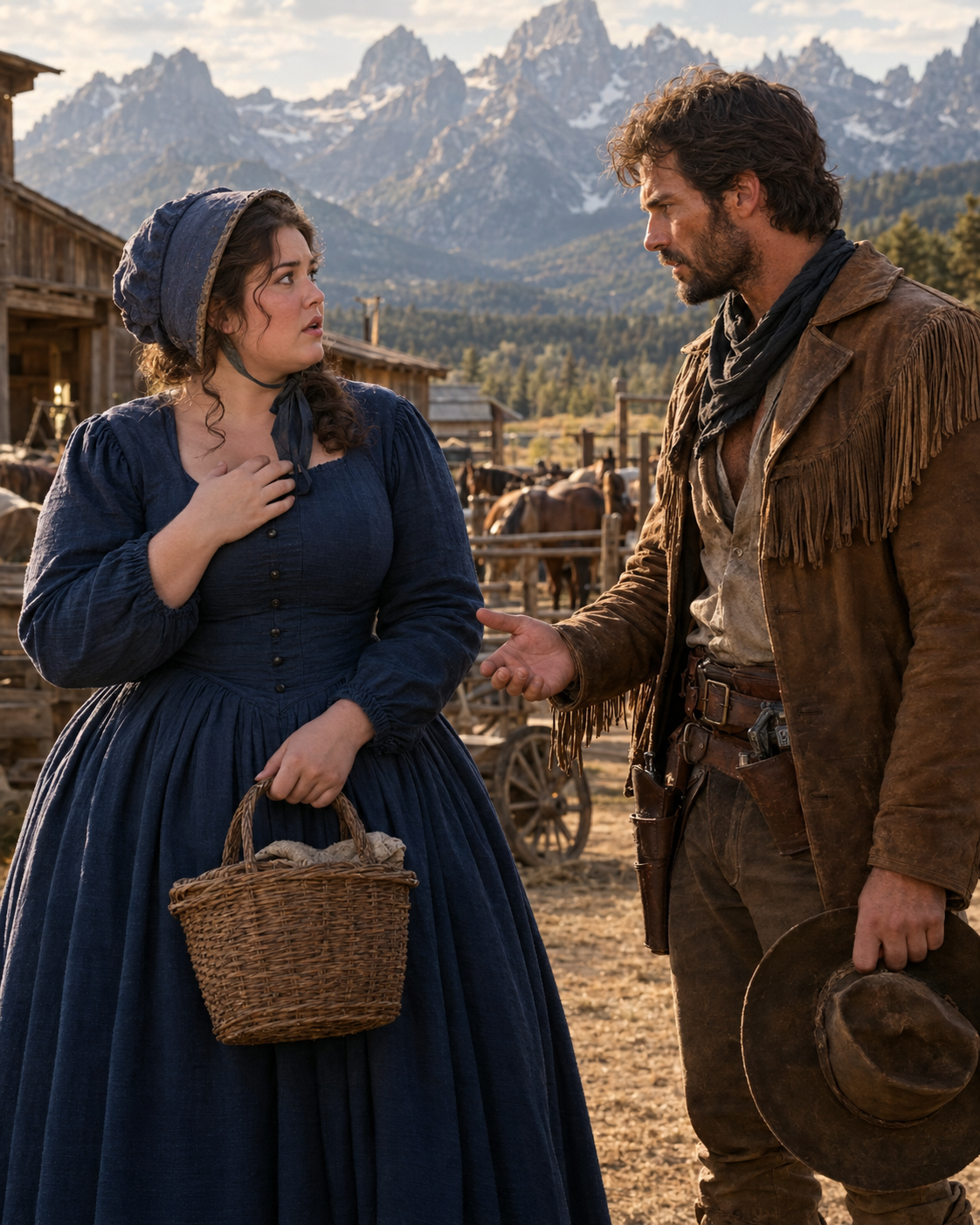
He leaned forward.
“They found the stolen cattle in my barn.”
“You were involved.”
“I was.”
Josephine’s eyes hardened.
Caleb looked at her.
“I stole some. I won’t lie.”
“Why?”
“Because they threatened my daughter.”
Silence fell.
“They said if I didn’t cooperate, she’d disappear.”
I felt my jaw tighten.
“Where is she?”
“Denver.”
“Alive?”
“I hope so.”
Josephine stepped toward the bars.
“What does my father have to do with this?”
Caleb looked at her as if she had struck him.
“You know?”
“Know what?”
He closed his eyes.
“Nothing.”
“Caleb.”
He shook his head.
“You don’t want the truth.”
Josephine’s voice became very quiet.
“That is my decision.”
Caleb looked at me.
Then at her.
Finally, he whispered,
“Your father was Daniel Whitmore.”
Josephine stopped breathing.
I knew the name.
Everyone in the territory knew it.
Daniel Whitmore had been one of the wealthiest cattlemen in Wyoming before disappearing in 1891.
Officially, he had died at Black Creek.
But no body had ever been found.
Josephine shook her head.
“My father was Samuel Whitmore.”
“Samuel was your uncle,” Caleb said.
“No.”
“Samuel told you he was your father because Daniel was supposed to be dead.”
She gripped the bars.
“Where is Daniel?”
Caleb looked at me.
Then he looked toward the window.
“Somewhere the bank never thought to search.”
“Where?”
“Your ranch.”
My heart stopped.
“What?”
Caleb swallowed.
“Daniel Whitmore owned the Broken Spur before your father.”
I stared at him.
“No.”
“Your father bought the ranch from the bank after Daniel disappeared.”
“Why didn’t he tell me?”
“Because he made a promise.”
“To whom?”
“Daniel.”
The room seemed to tilt.
Josephine stepped back.
“My father is alive?”
Caleb nodded.
“At least he was eleven years ago.”
“Where?”
“I don’t know.”
“You do.”
“I swear I don’t.”
She turned away.
I had never seen her look so lost.
I wanted to hold her, but I was afraid to touch her.
Then she said something that chilled me.
“The ranch.”
“What?”
“If my father owned the Broken Spur, then the answer is there.”
We rode home before sunset.
Neither of us spoke.
When we reached the ranch, Josephine went directly to the old barn.
I followed.
She walked to the northern wall and stopped.
“Why here?”
“My uncle once told me something strange.”
“What?”
“He said my father had hidden something beneath a floorboard.”
We searched until midnight.
Nothing.
Then Josephine noticed a loose plank beneath the hay rack.
She knelt.
I pulled it free.
Underneath was a narrow wooden box.
Inside lay three things.
A silver pocket watch.
A photograph.
And a letter.
Josephine picked up the photograph first.
Her hands began to shake.
A young man stood beside a woman.
The woman was unmistakably Josephine.
Older.
Pregnant.
The man beside her was Daniel Whitmore.
On the back of the photograph were six words.
My daughter, if you ever find this.
Josephine covered her mouth.
She opened the letter.
The paper was yellow with age.
“My dearest daughter,
If you are reading this, then I failed to return to you.
I need you to know that I never abandoned you.
I was hunted because I refused to sell the Broken Spur to men who intended to control the water rights across this valley.
They wanted the land, but more importantly, they wanted the creek.
Your mother died believing I was dead.
Samuel promised to protect you.
I believed him.
That was my mistake.
The men behind this are not ordinary thieves.
They are bankers, lawyers, and politicians who have been buying ranches through debt for years.
If they cannot buy you, they will destroy you.
If you ever find yourself at the Broken Spur, trust the man who carries your father’s watch.
He will know what to do.
Daniel.”
Josephine looked at the pocket watch.
Then at me.
I slowly reached beneath my shirt and pulled out the watch I had worn since childhood.
The same silver engraving.
D.W.
Her eyes filled with tears.
“My father gave this to your father,” I said.
She whispered,
“Why?”
“Because my father knew him.”
“Where is he?”
“I don’t know.”
She turned toward me.
“You have to find him.”
“I will.”
“No.”
Her voice broke.
“You don’t understand.”
She pressed the letter against her chest.
“I have spent twenty-seven years believing my father didn’t want me.”
“I know.”
“No, you don’t.”
She wiped her tears angrily.
“Every birthday, I wondered if he remembered me. Every time I heard a horse outside, I thought perhaps he had come back. And all these years…”
She couldn’t finish.
I stepped toward her.
“He loved you.”
“How can you know?”
“Because he left this for you.”
She looked at me.
“And because he trusted my father.”
That was when the lantern went out.
We both froze.
A sound came from outside.
Hooves.
Several horses.
I reached for my shotgun.
Josephine picked up the silver watch.
Then we heard a gunshot.
The barn door exploded inward.
“Down!”
We dropped behind the feed trough.
Bullets tore through the wooden wall.
I fired toward the doorway.
Someone shouted.
Josephine crawled toward the side exit.
“Go!”
“What about you?”
“I said go!”
She grabbed my hand.
“No.”
Another bullet struck the post above us.
I looked into her eyes.
“I am not losing you.”
We ran.
Outside, Caleb was already firing from the bunkhouse.
The ranch hands joined him.
The attackers scattered into the darkness.
One rider escaped toward the creek.
I mounted my horse.
Josephine climbed behind me.
We chased him through the cottonwoods.
He rode fast.
Too fast.
Then he turned toward Black Creek.
I knew immediately what he was doing.
He wasn’t escaping.
He was leading us somewhere.
We followed.
The moon emerged from behind the clouds.
The rider disappeared into an old mining tunnel.
I dismounted.
Josephine grabbed my arm.
“Wait.”
“What?”
She pointed.
There were footprints leading inside.
Fresh ones.
We entered.
The tunnel opened into a large underground chamber.
And there, beneath a lantern, sat an old man with a rifle across his knees.
His hair was white.
His face was thin.
But his eyes were unmistakable.
Josephine stopped.
The rifle fell from his hands.
“Josie?”
She couldn’t move.
The man stood slowly.
“My God.”
She whispered,
“Dad?”
He took one step.
She ran.
He caught her.
For several seconds, neither spoke.
Then Daniel Whitmore buried his face against his daughter’s hair and wept.
I turned away.
Some moments belonged to people who had waited too long for them.
Later, Daniel told us everything.
He had survived the attack at Black Creek.
He had discovered that the bank planned to seize dozens of ranches by manipulating loans, buying cattle cheaply, and controlling the only reliable water sources.
He had tried to expose them.
They shot him and left him for dead.
My father found him.
Together, they made a plan.
Daniel disappeared.
My father bought the Broken Spur.
The ranch became a hiding place.
But when my father died, Daniel remained hidden because Vane had threatened Josephine’s life.
“Why didn’t you come for me?” Josephine asked.
Daniel lowered his head.
“I thought distance would keep you alive.”
“It didn’t.”
“I know.”
“You let me believe you were dead.”
“I know.”
She cried.
He cried.
And I realized something then.
Secrets did not always begin with evil.
Sometimes they began with fear.
But fear, when carried long enough, could wound people just as deeply as cruelty.
We returned to the ranch before dawn.
Daniel carried evidence against the bank.
Ledgers.
Contracts.
Names.
Proof of bribery and fraud.
But Vane was still free.
And he knew we had found Daniel.
By noon, the sheriff arrived.
Behind him rode twelve federal marshals.
Vane had fled Cheyenne.
He had tried to cross the state line.
He did not make it.
Caleb’s daughter was found alive in Denver two weeks later.
The bank collapsed shortly afterward.
The men who had stolen from ranchers were arrested.
Some went to prison.
Others lost everything.
But Daniel refused to reclaim the Broken Spur.
He placed the deed in Josephine’s hands.
“This was always meant to be yours.”
She stared at the paper.
“What about you?”
“I spent eleven years hiding from men who wanted this land.”
He smiled sadly.
“I’m too old to spend another eleven protecting it.”
She looked at me.
Then at the ranch.
Then at the twenty-five men standing near the barn.
“What do you think?”
I smiled.
“I think the ranch has been waiting for you longer than I have.”
She laughed through her tears.
Spring came again.
The Broken Spur changed.
We repaired the fences.
We expanded the garden.
We built a smokehouse.
Josephine started a small kitchen where ranchers passing through could eat for a few coins.
She refused to let anyone go hungry if she could help it.
Daniel stayed in a small house near the creek.
Caleb returned to work after the sheriff cleared his name.
And I learned something I should have understood the day Josephine stepped off the train.
A person’s worth could not be measured by appearance.
Nor by money.
Nor by the usefulness someone else imagined they might provide.
I had looked at Josephine and seen a burden.
She had looked at the Broken Spur and seen a home.
Years later, people would ask me how the ranch survived the winter of ’93.
They expected some clever business answer.
A new cattle contract.
A lucky harvest.
A loan.
I always gave them the same answer.
“It survived because one woman refused to leave.”
Sometimes they laughed.
Sometimes they thought I was being sentimental.
They never knew the truth.
The Broken Spur had nearly died because I had been too proud to admit I was afraid.
Josephine taught me that courage was not the absence of fear.
It was the decision to stay when leaving would have been easier.
One evening, many years after that terrible October night, we stood together on the porch.
Our children were playing near the creek.
Daniel sat beneath the cottonwood tree, reading an old newspaper.
The sun was setting over the Wyoming hills.
Josephine leaned against my shoulder.
“Do you remember the day we met?”
I laughed.
“Unfortunately.”
She smiled.
“You told me I couldn’t survive Wyoming.”
“I was an idiot.”
“You were.”
“And you were angry.”
“I was furious.”
“Why did you stay?”
She looked across the land.
“Because I had spent too much of my life letting other people decide where I belonged.”
She took my hand.
“And because I knew something you didn’t.”
“What?”
She smiled.
“Sometimes the place that rejects you at first is the place where you were meant to change everything.”
I looked at her.
“Do you regret coming?”
She shook her head.
“Never.”
Then she kissed my cheek.
Behind us, the ranch hands began calling the children in for supper.
The smell of bread drifted through the evening air.
I looked at the woman beside me and remembered the frightened girl I had sent away at the train station.
I remembered the suitcase.
The cold wind.
The laughter of the cowboys.
And the way her eyes had remained steady even when mine had been cruel.
If I could return to that day, I would tell my younger self one thing.
Be careful how quickly you decide what another person is worth.
You may be looking at the very person who will save you.
The train that brought Josephine to Wyoming had arrived carrying one woman and one battered suitcase.
But she had brought something far greater with her.
Not wealth.
Not luck.
Not even the secret of her father’s name.
She brought the courage to stay.
And sometimes, when everything you built is collapsing around you, that is the most valuable thing anyone can bring.
The Broken Spur never became the richest ranch in Wyoming.
It didn’t need to.
It became a place where no man was turned away because he was poor, no woman was judged before she spoke, and no child was taught that fear was the same thing as wisdom.
Above the kitchen door, Josephine eventually hung a wooden sign.
I had carved it myself.
It contained only one sentence.
“Never decide someone’s value before you know their story.”
Years later, people would ask who wrote it.
Josephine would smile.
“My husband did.”
Then she would add,
“But I taught him why.”
And whenever the evening wind moved across the fields, carrying the smell of grass and woodsmoke toward the mountains, I would remember the first night she arrived.
I had thought she was a burden.
I had thought I was sending away someone who could not survive.
Instead, she became the reason the Broken Spur survived.
And the greatest lesson of my life was not about ranching, money, marriage, or even love.
It was this:
Sometimes the person you are most certain you do not need is the person who will show you who you really are.
And sometimes the door you almost close in someone’s face is the very door that leads you home.