When Gideon Slade called me a filthy fraud before forty miners in Copper Ridge, he smiled like a victor, unaware I had proof of his secret crime.
The old man’s words seemed to steal every bit of warmth from my kitchen, and for a moment I could hear nothing but the rain dripping from his coat onto the wooden floor.
My father had not died in the mine.
For twenty years, I had carried the image of a man buried beneath hundreds of tons of Colorado rock, a man whose face I remembered only through a faded photograph my mother kept beside her bed.
Now a stranger stood in my doorway holding his silver watch and telling me that everything I had believed was wrong.
“Who are you?” I whispered.
The old man removed his hat with trembling fingers.
“My name is Samuel Whitaker, Miss Callahan, and I worked beside your father the night Gideon Slade ordered the northern mine sealed.”
Caleb stepped closer, studying the stranger with the cautious expression he wore whenever something troubled him.
“Samuel Whitaker was listed among the dead after that collapse,” he said quietly.
The old man’s mouth tightened.
“That’s what Slade paid the newspapers to print.”
I looked down at the watch resting in my palm.
Its glass was cracked, and the silver case bore the scratches of years spent in a working man’s pocket, but the initials E.C. were unmistakable.
Elias Callahan.
My father’s name.
I remembered sitting on Mother’s lap in our little St. Louis kitchen while she described how he used to wind that watch every evening before kissing her goodnight.
She had told me it was lost in the accident.
“Where is he?” I asked.
Samuel looked toward the dark street before answering.
“First, you need to understand why Slade wanted him gone.”
I closed the door and guided him toward the stove, where the last of the morning’s soup was still warm.
His hands shook as I placed a bowl before him.
For several minutes, he ate without speaking, and I recognized the desperate hunger of a man who had spent too many years surviving instead of living.
Caleb quietly checked the windows while I waited.
Finally, Samuel set down his spoon.
“Your father wasn’t an ordinary miner, Mabel, and that was the beginning of his trouble.”
He explained that Elias Callahan had worked as a surveyor before accepting a position at the Copper Ridge mine.
He understood underground formations, ventilation shafts, and the dangerous weaknesses hidden inside seemingly solid mountains.
When Gideon Slade’s father began expanding the northern workings, Elias discovered that the company had been digging beyond the boundaries of its legal claim.
Worse, the new tunnels ran beneath land belonging to several families who had never agreed to mining operations.
The company had discovered a rich copper vein and wanted to extract it before anyone questioned the ownership.
My father refused to falsify the survey.
“He said the truth belonged on paper, even when powerful men wanted it buried,” Samuel told me.
I felt a painful smile touch my lips.
That sounded like something Mother would have loved about him.
Samuel continued, explaining that Elias had gathered copies of the original land records and intended to take them to the territorial authorities.
But before he could leave, Gideon Slade discovered what he was doing.
The company ordered the northern tunnel closed during a night shift, claiming the supports had become unsafe.
Elias, Samuel, and another worker named Peter Dugan were still underground when the entrance was deliberately blocked.
I gripped the edge of the table.
“You mean they tried to kill them?”
Samuel lowered his eyes.
“They knew we were inside.”
For a moment, I could not breathe.
I had spent my childhood imagining a terrible accident, never suspecting that my father’s death had been arranged by men who feared what he knew.
Samuel explained that a narrow drainage passage had allowed the three workers to escape into the mountains.
Peter Dugan had broken his leg during the collapse, and Elias had nearly died helping him through the freezing water.
They reached an abandoned trapping cabin two days later.
By then, the newspapers were already reporting their deaths.
“Why didn’t he come home?” I asked, unable to keep the hurt from my voice.
Samuel’s expression changed.
“Because Slade knew where your mother lived.”
He told me that a company agent had intercepted a letter Elias tried to send from Denver.
Soon afterward, Elias received a message claiming that his wife and little daughter would suffer if he returned to St. Louis.
My father had tried to secure protection from the authorities, but the evidence disappeared, and the one official willing to help him was transferred.
“He believed staying away was the only way to keep you alive.”
I stared at the old man.
For twenty years, I had believed my father had abandoned us only through death.
Now I was being asked to accept that he had remained alive while Mother worked herself into exhaustion and I grew up wondering what his arms would have felt like around me.
“Did my mother know?” I whispered.
Samuel nodded.
“Eventually.”
The answer struck me harder than I expected.
I remembered the nights Mother sat beside the window long after the lamps had burned low, holding letters she never allowed me to read.
I remembered how she sometimes cried when she thought I was asleep.
She had known.
And she had carried the truth alone.
Caleb pulled out a chair beside me.
“Mabel, whatever happened, none of this was your doing.”
I wanted to believe him, but grief had already tangled itself with anger.
Mother had died three years earlier.
There would never be another chance to ask why she had kept such a terrible secret.
Samuel reached into his coat and withdrew a small envelope.
“Your mother wrote this shortly before she passed away, but she made me promise not to deliver it unless Slade came after you.”
My hands shook as I recognized her careful handwriting.
On the front were three words.
For my Mabel.
I opened the envelope slowly.
Inside was a single page, worn along its folds.
My darling girl, it began, if you are reading this, then the past has finally found you.
I read the letter twice before I could understand all of it.
Mother explained that she had learned Elias was alive several years after the mine disaster.
He had written to her through trusted friends, promising to return when he could prove Slade’s crimes.
But the years passed, the threats continued, and the evidence remained hidden.
She had wanted to tell me.
She had feared that a frightened child might accidentally reveal something that would lead Slade’s men straight to us.
Then, as I grew older, she had become afraid that knowing the truth would send me searching for a man who could not safely be found.
Her final words blurred beneath my tears.
I taught you to keep honest records because truth is the one thing dishonest men cannot afford to leave behind.
I pressed the letter against my chest.
For the first time since her funeral, I felt as though Mother were standing beside me again.
Samuel waited until I could speak.
“Where is my father now?”
He looked toward Caleb.
“That’s the part I came to tell you.”
Before he could continue, someone pounded against the front door.
Three sharp blows rattled the glass.
Caleb crossed the room and opened it to find Thomas Bell standing outside, breathing hard.
“Slade’s men are at the warehouse,” Thomas said.
“They’re burning records, and somebody saw them loading crates onto wagons.”
Samuel rose so quickly his chair scraped across the floor.
“They know I’m here.”
Caleb reached for his coat.
“Then we need the sheriff.”
Thomas shook his head.
“Sheriff Mercer left town yesterday, supposedly on business in Denver.”
The timing was too convenient.
I looked toward the envelopes containing the miners’ wage statements, the forged invoice, and the survey Caleb had inherited.
Slade had already tried to ruin my business.
Now he was destroying whatever might prove his crimes.
I knew what he expected.
He expected a frightened woman to hide behind her locked door until the danger passed.
But I had spent my entire life being told where I belonged, what I deserved, and how much space I was allowed to occupy.
I was finished allowing other people to make those decisions.
“Thomas, gather the miners who signed statements about their missing wages,” I said.
“Caleb, can you find someone trustworthy to carry copies of our evidence to the Denver lawyer?”
He nodded.
“My ranch foreman can leave before noon.”
I turned toward Samuel.
“And you are going to tell me where my father is.”
The old man hesitated.
Then he spoke a name I had never heard before.
“Jonathan Reed.”
I frowned.
“Who is Jonathan Reed?”
Samuel’s eyes filled with sorrow.
“That’s the name your father has been living under for the last twelve years.”
The room fell silent.
Samuel explained that Elias had spent years moving between mining settlements, gathering evidence of Slade’s illegal operations.
Eventually, he settled in a remote mountain community west of Copper Ridge, working as a carpenter and repairing equipment for small prospectors.
He had grown older, quieter, and increasingly convinced that he would never see his family again.
“He’s alive?” I asked.
Samuel nodded.
“He was when I left him four days ago.”
I covered my mouth.
Four days.
My father had been alive four days ago.
Somewhere beyond those mountains was a man who might still remember the little girl he had left behind.
I wanted to run to him immediately.
But Samuel’s next words stopped me.
“Slade has been searching for him, and I believe someone finally told him where to look.”
By afternoon, Copper Ridge had changed.
Word of the stolen wages spread through the mining camps, and men who had once been afraid to challenge Gideon Slade began arriving at my shop carrying pay statements and delivery receipts.
Some had lost only a few dollars.
Others had been cheated for months.
One miner showed me deductions taken from his wages during a week when he had been injured and unable to work.
Another brought a letter from his wife describing how their children had gone hungry because the company store claimed he owed more than he earned.
I listened to every story.
Then I wrote everything down.
Names.
Dates.
Amounts.
Witnesses.
By sunset, my ledger contained enough evidence to show a pattern of deliberate fraud.
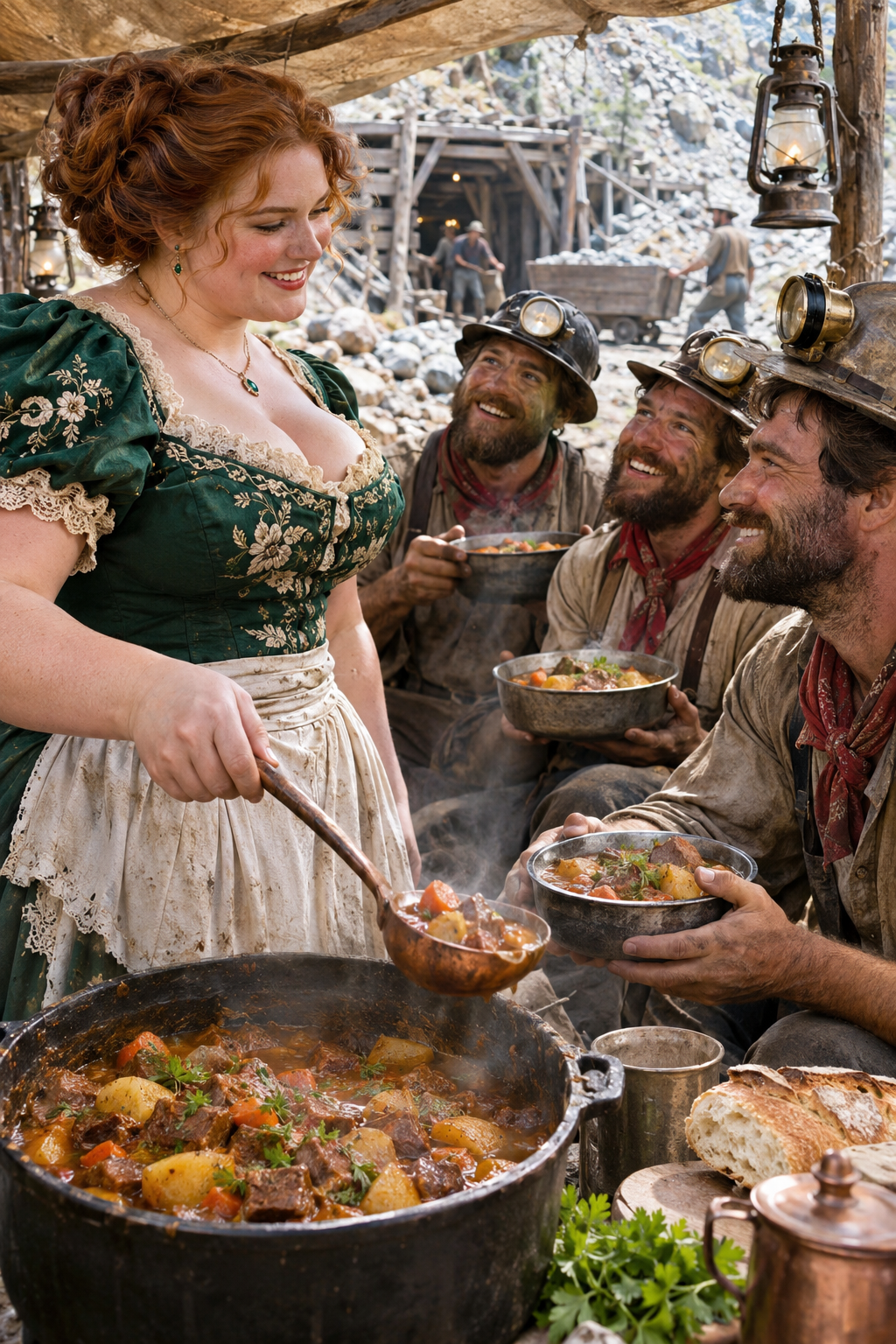
Thomas and two miners signed a written statement describing the destruction of records at Slade’s warehouse.
Caleb arranged for his foreman to carry copies to Denver, while the originals remained hidden in separate locations.
I refused to let one fire or one dishonest official erase everything.
That evening, a messenger arrived from the mining company’s office.
He carried a notice declaring that my soup shop was operating on land supposedly controlled by Slade’s provisions company.
I read it carefully.
The document claimed that the building’s previous owner had transferred the property years earlier as part of an unpaid commercial debt.
The signature looked suspicious.
The date was wrong.
And the description of the property included a storage shed that had not existed until the previous spring.
I almost laughed.
Slade was so accustomed to frightening people with paperwork that he had forgotten paperwork could also expose him.
I placed the notice beside my lease and made another entry in my ledger.
Caleb watched me from across the table.
“You’re remarkably calm.”
“I’m not calm,” I answered.
“I’m furious.”
He smiled faintly.
“That explains the way you’re holding your pen.”
I looked down and realized I had nearly snapped it.
For the first time that day, I laughed.
It felt strange and wonderful.
Caleb reached across the table and gently covered my hand with his.
“You don’t have to fight every battle alone.”
I studied his face.
He had never asked me to become smaller, quieter, or more agreeable.
He had never treated my body as something shameful or my independence as an insult.
He simply stood beside me.
“I know,” I whispered.
And for once, I meant it.
We left Copper Ridge before sunrise the following morning.
Thomas remained behind to organize the miners, while Caleb, Samuel, and I traveled west in a covered wagon.
The road climbed through pine forests and narrow mountain passes, where patches of old snow still clung to the shadows.
I carried Mother’s letter inside my coat.
Every mile brought me closer to a man I had mourned for twenty years.
And every mile made me more afraid.
What if he no longer wanted a daughter?
What if he had built another family?
What if the man I found was nothing like the father I had imagined?
Samuel seemed to understand my silence.
“Your father kept a picture of you,” he said.
I turned toward him.
“A picture?”
“Your mother sent it when you were fourteen.”
I remembered that photograph.
I had worn my best blue dress, although I hated the way it stretched across my rounded stomach.
The photographer had instructed me to turn sideways because he thought the pose would make me appear slimmer.
Mother had refused.
She had insisted I stand straight and look directly into the camera.
“Your father carried it until the edges wore thin,” Samuel continued.
I looked away before he could see me crying.
By late afternoon, we reached a small settlement called Pine Hollow.
There were perhaps twenty buildings scattered along a narrow creek, with a blacksmith’s shop, a general store, and a handful of cabins beneath the trees.
Samuel directed us toward a modest house at the edge of the settlement.
Smoke rose from its chimney.
My heart began pounding.
Then I noticed the door hanging open.
Caleb saw it too.
He climbed down from the wagon and approached carefully.
Inside, a chair lay overturned beside a broken table.
Drawers had been emptied.
Papers covered the floor.
A dark stain marked the wooden boards near the stove.
I stood in the doorway, unable to move.
“Father?”
No one answered.
Samuel searched the back room.
Caleb examined the broken furniture.
Then he found a piece of paper beneath the table.
It was a note written in hurried handwriting.
The evidence is safe.
Trust the woman with the iron pot.
I stared at those words until the room blurred.
My father knew about my soup shop.
He knew where I was.
And somehow, despite everything, he had trusted me.
Caleb found tracks outside the cabin leading toward the northern timber road.
There were signs of a struggle, but no wagon marks.
Samuel believed Elias had escaped into the forest before Slade’s men could capture him.
We searched until darkness made the trails impossible to follow.
That night, we stayed at the settlement’s boardinghouse.
I lay awake listening to the wind against the shutters, wondering whether my father was somewhere outside in the cold.
Just before dawn, Caleb knocked softly on my door.
“Mabel, there’s someone you need to meet.”
I followed him downstairs.
An elderly woman stood beside the stove, wearing a faded green shawl.
She introduced herself as Ruth Bennett, the settlement’s former postmistress.
She had known Jonathan Reed for nearly a decade.
When I told her my real name, she began to cry.
“He spoke about you whenever the winter nights grew long,” she said.
“He told me his daughter was the bravest person he’d ever known.”
I swallowed painfully.
“He hasn’t seen me since I was seven.”
Ruth nodded.
“He said you were brave even then because you kept trying to make your mother smile when the world had given her so little reason.”
I remembered those years.
Mother coming home exhausted.
Me warming soup on the stove.
Both of us pretending we weren’t frightened about tomorrow.
Ruth reached into her shawl and produced a small brass key.
“Jonathan asked me to give this to you if anything happened.”
The key opened a locked compartment beneath the floorboards of his cabin.
Inside, we found a metal document case wrapped in oilcloth.
It contained original mining surveys, land deeds, correspondence, and payment records connecting Slade’s company to the illegal excavation.
There were also letters documenting threats against my parents.
One carried Gideon Slade’s signature.
Another showed that his father had paid a company official to declare the missing miners dead.
But the most important document was a signed statement from Peter Dugan, the third man who had escaped the collapse.
Peter had died several years earlier, yet before his death he had described the deliberate sealing of the tunnel and identified the men who ordered it.
The evidence was finally real.
Not rumor.
Not suspicion.
Proof.
Caleb examined the papers carefully.
“With these, the authorities can reopen the investigation.”
I should have felt relieved.
Instead, I stared at the empty cabin.
“What good is proving the truth if my father doesn’t live long enough to see it?”
Samuel placed a hand on my shoulder.
“Then we find him.”
We spent the next two days searching the mountain trails.
On the second evening, a young trapper arrived at Pine Hollow carrying news of an injured man sheltering near an abandoned sawmill.
He described an older stranger with gray hair and a badly wounded shoulder.
My breath caught.
Caleb hired two horses, and we followed the trapper through the forest as twilight settled over the mountains.
The sawmill stood beside a frozen stream, its roof sagging beneath years of neglect.
Inside, a small fire burned in a stone hearth.
A man sat against the wall, his left arm bound with a bloodstained cloth.
He looked up when we entered.
His face was lined and weathered.
His beard was almost entirely gray.
But his eyes were the same warm brown eyes I saw whenever I looked into my own reflection.
For a moment, neither of us spoke.
Then he whispered my name.
“Mabel?”
I had imagined this meeting a thousand different ways.
I had imagined running into his arms.
I had imagined demanding answers.
I had imagined being angry enough to turn away.
Instead, I stood frozen in the doorway, staring at a stranger who somehow felt painfully familiar.
He struggled to rise.
I crossed the room before he could fall.
His hands touched my cheeks with such tenderness that something inside me finally broke.
“My little girl,” he whispered.
I began to cry.
Not the quiet tears I had learned to hide in St. Louis.
Not the restrained tears I had swallowed when Mother died.
I cried with the terrible, helpless grief of a child who had waited twenty years for someone to come home.
“Why didn’t you come back?” I asked.
His face crumpled.
“I tried, sweetheart.”
He told me about the letters that never reached us, the officials who refused to help, and the years spent gathering evidence while Slade’s men followed every lead.
He admitted that fear had eventually become something harder to escape than any mountain prison.
Each year he delayed, returning became more difficult.
He had convinced himself that I would be safer believing him dead.
Then Mother died, and he learned of it too late to attend her funeral.
“I failed both of you,” he whispered.
I wanted to tell him he hadn’t.
But that would have been a lie.
He had failed us.
And still, looking at his trembling hands and wounded shoulder, I understood that his absence had not been caused by a lack of love.
Sometimes fear made prisoners of people who had never stopped fighting.
“I needed you,” I said.
He bowed his head.
“I know.”
I held his hand.
“And I need you to stop hiding now.”
He looked at me through tears.
“I will.”
Caleb helped us bring him back to Pine Hollow, where Ruth cleaned and dressed his wound.
The injury was painful but not life-threatening.
Elias explained that two men had broken into his cabin searching for the documents.
He had escaped through the rear window, but one attacker had struck him with a rifle before he reached the woods.
He recognized both men as employees of Gideon Slade.
By morning, we were ready to return to Copper Ridge.
But before leaving, my father took my hand.
“There’s something else you need to know.”
He explained that the illegal northern mine had not merely enriched Slade’s family.
The disputed land included a narrow but valuable mineral claim originally registered to my maternal grandfather.
When the company expanded its tunnels, it had concealed that ownership.
My father had discovered the fraud while examining the old surveys.
Mother had been entitled to a share of the proceeds from the copper extracted beneath her family’s land.
After her death, that claim had passed to me.
I stared at him.
“Are you telling me Slade has been stealing from my family for twenty years?”
He nodded.
“And the amount may be considerable.”
I thought about Mother repairing worn dresses by candlelight.
I thought about the winters when she watered down soup so I could have the larger portion.
I thought about the humiliation of being dismissed from my job because someone found my appearance unpleasant.
All those years, Slade’s family had profited from something that belonged to ours.
But money was not the first thing I felt.
It was grief.
Grief for the life Mother might have lived if she had received what was rightfully hers.
When we reached Copper Ridge, the town was waiting.
Thomas stood outside my soup shop with nearly sixty miners gathered around him.
Several had brought their wives and children.
The Denver lawyer, Mr. Henry Lawson, had arrived with a deputy United States marshal and a county official.
Caleb’s foreman had delivered the documents safely.
And the evidence had been strong enough to bring an investigator to town.
For the first time, Gideon Slade was no longer the only man with influence in Copper Ridge.
The authorities had already secured several warehouse records and questioned employees about the missing provisions.
Two workers admitted that Slade had ordered them to destroy invoices after the miners began demanding an accounting.
Another confirmed that the forged property notice against my soup shop had been prepared at Slade’s direction.
When my father entered the room, Gideon Slade went completely still.
He had been sitting beside his attorney, looking angry but confident.
Then he saw Elias Callahan.
His face turned the color of ashes.
“You’re supposed to be dead,” he whispered.
My father looked directly at him.
“That’s what your family wanted.”
The hearing lasted most of the afternoon.
Mr. Lawson presented the wage statements, original surveys, forged invoices, and correspondence linking Slade’s company to the illegal mining operations.
Samuel testified about the deliberate sealing of the tunnel.
My father described the threats that had kept him away from his family.
I testified about the attempts to destroy my business and the false accusations made against me.
For once, nobody interrupted me.
Nobody commented on my appearance.
Nobody suggested that I should be grateful simply to have a place in the room.
They listened because I had brought facts that could not be dismissed with a sneer.
Slade denied everything at first.
He blamed dead employees, dishonest suppliers, and his father’s business practices.
But when the marshal produced a warehouse clerk’s sworn statement describing the recent destruction of records, his excuses began collapsing.
Then Thomas stood and presented the miners’ collective accounting of their missing wages.
The room grew silent as the total was read aloud.
It represented years of stolen earnings.
Years of hungry children.
Years of men working underground while their families struggled above it.
Slade’s attorney leaned toward him and whispered urgently.
For the first time, Gideon Slade looked smaller than the people he had spent his life intimidating.
The marshal ordered him taken into custody pending further proceedings.
As he was escorted toward the door, Slade stopped beside me.
“You think you’ve won because you found some old papers?” he hissed.
I looked at him calmly.
“No, Mr. Slade.”
I thought of Mother’s iron pot, my father’s watch, and the miners who had trusted me enough to bring their evidence.
“I think you’ve lost because you believed nobody would ever stand together against you.”
He had no answer.
The legal proceedings continued for months.
Investigators uncovered additional fraudulent transactions, and several former employees agreed to testify.
Slade was eventually convicted of crimes connected to the wage fraud, falsified records, and efforts to obstruct the investigation.
The older mining conspiracy required separate proceedings, but the surviving evidence established the company’s wrongdoing and supported civil claims against its remaining assets.
The miners recovered much of their stolen wages through court-supervised restitution.
My property dispute was dismissed.
And after a lengthy settlement, I received compensation for the copper taken from my family’s claim.
It was more money than I had ever imagined possessing.
Yet the first thing I purchased was not a fine dress or a grand house.
I bought the building next door.
Then I knocked down the dividing wall and expanded my soup shop into a proper dining room.
I hired three women who had been turned away from respectable establishments because they were widowed, older, or considered too plain for fashionable service.
I paid them fairly.
I kept careful books.
And I made certain every employee had a written agreement explaining exactly what they would earn.
The miners helped build new tables.
Thomas repaired the kitchen shelves.
Caleb supplied beef and vegetables under a contract that was fair to both of us.
And my father, whose shoulder gradually healed, spent his mornings repairing chairs and teaching the younger workers how to recognize unsafe mine supports.
We did not pretend the missing years could be restored.
Some mornings, I still felt angry when I looked at him.
Sometimes he would begin telling a story about my childhood and stop because he realized he had not been there to witness it.
But we learned to live with those painful spaces.
We learned that forgiveness was not the same as forgetting.
It was the decision to stop allowing yesterday’s wounds to steal every possibility of tomorrow.
One spring evening, nearly a year after Slade’s arrest, Caleb arrived carrying a small wooden box.
I was standing beside Mother’s iron pot, stirring a batch of beef-and-barley soup.
He waited until I finished serving the last customer before placing the box on the counter.
“What’s this?” I asked.
“Something I’ve been meaning to give you.”
Inside was a simple silver ring.
My heart began pounding.
Caleb looked suddenly nervous, which was remarkable for a man who could face a stampeding herd without flinching.
“Mabel, I fell in love with you before I knew anything about your family’s money or your father’s past.”
I felt tears gathering.
“I know.”
He smiled.
“I fell in love with the woman who could feed forty hungry miners, argue over the price of potatoes, and frighten a dishonest businessman with a ledger.”
I laughed through my tears.
He took my hand.
“I don’t want to rescue you, Mabel, because you’ve never needed rescuing.”
His voice softened.
“I want to build a life beside you, if you’ll have me.”
For a moment, I remembered the young woman standing in a St. Louis kitchen while her employer explained that her appearance made her unsuitable for respectable company.
I remembered the humiliation.
The loneliness.
The terrible certainty that nobody would ever choose me without wishing I were someone else.
Then I looked at Caleb.
He was not asking me to change.
He was asking to stay.
“Yes,” I whispered.
He slipped the ring onto my finger.
And when he kissed me, I finally understood that love was not something I had to earn by becoming smaller.
It was something I deserved simply because I was human.
We married that autumn beneath the cottonwood trees beside the creek.
Thomas stood with the miners.
Ruth traveled from Pine Hollow.
Samuel arrived wearing a freshly pressed coat.
And my father walked beside me, his silver watch tucked into his vest pocket.
Before the ceremony, he stopped beneath the trees and looked at me with tears in his eyes.
“Your mother would have been so proud of you.”
I squeezed his hand.
“She already was.”
After the wedding, we returned to the dining room, where the tables were crowded with food and laughter.
Mother’s iron pot stood in its usual place on the stove.
I had polished its handles that morning, but I left the old scratches untouched.
They belonged to its history.
Just as the scars in my own heart belonged to mine.
Years later, people would tell stories about the woman who defeated Gideon Slade and built the most successful eating house in Copper Ridge.
Some would mention the money I recovered.
Others would talk about the miners whose wages were restored.
A few would remember the scandal of the supposedly dead surveyor who returned after twenty years.
But whenever someone asked what had truly changed my life, I gave the same answer.
It was not the settlement.
It was not Slade’s arrest.
It was not even finding my father alive.
It was the morning I opened my little shop with seventy-three dollars, my mother’s iron pot, and the stubborn belief that I deserved a chance.
Because cruel people can steal money.
They can spread lies.
They can make you question your appearance, your abilities, and your place in the world.
But they cannot decide your worth unless you surrender that decision to them.
One evening, long after the last customer had gone, I found my father sitting alone at a table near the window.
He was holding Mother’s photograph.
I sat beside him.
For several minutes, neither of us spoke.
Then he reached across the table and placed his hand over mine.
“I wish I could give you back those twenty years.”
I looked toward the kitchen, where Caleb was laughing with Thomas while they carried in a basket of fresh bread.
Beyond the window, the mountains glowed beneath the last light of sunset.
I thought about everything we had lost.
Then I thought about everything we had built.
“You can’t, Papa,” I whispered.
“But you can stay for the years we still have.”
He began to cry, and I held his hand until the tears passed.
That night, before closing the shop, I opened Mother’s old recipe book.
On the final page, beneath a faded recipe for beef-and-barley soup, I discovered a sentence written in her familiar handwriting.
I had read that book hundreds of times, yet somehow I had never noticed it.
A woman’s greatest strength is not that she never falls, but that she learns she is worthy of standing again.
I traced the words with my fingertips.
Then I closed the book, turned down the lamps, and went home to the people I loved.
For the first time in my life, I was no longer trying to prove that I belonged somewhere.
I had built a place where nobody had to prove they belonged at all.
I thought that finding my father, marrying Caleb, and watching Gideon Slade face justice would finally bring peace to Copper Ridge, but I soon discovered that building a good life required more than defeating one cruel man.
The following spring, a terrible storm swept through the mountains, washing away bridges and leaving several mining families stranded without food or supplies.
For the first time since opening my soup shop, I looked at Mother’s iron pot and understood that it had become something much greater than a reminder of home.
It had become a promise that nobody who entered my kitchen would be forgotten.
Caleb brought wagons from the ranch, Thomas organized the miners, and my father helped repair the damaged road leading into town.
For six days, we worked from sunrise until long after midnight, preparing soup, baking bread, and carrying meals to families who could not reach us.
Some people offered money, others brought firewood, and those who had nothing simply helped wherever they could.
One evening, a young widow arrived carrying a little girl whose shoes were soaked through.
She stood nervously in the doorway, counting the few coins in her palm.
“I don’t think I have enough for two bowls,” she whispered.
I looked at the child, whose trembling hands reminded me painfully of my own childhood.
Then I remembered Mother quietly giving me the larger portion of supper while insisting she wasn’t hungry.
I placed two steaming bowls on the counter and pushed the coins gently back toward the woman.
“Tonight, your money stays in your pocket.”
Her eyes filled with tears.
“But how will I repay you?”
I smiled and handed her a warm loaf of bread.
“When someone else needs help, remember how this felt.”
She began crying, and I realized that the greatest inheritance Mother had left me was never the disputed mining claim or the money recovered from Slade.
It was the ability to recognize another person’s suffering without making them feel ashamed of it.
By summer, Copper Ridge had recovered, and the townspeople decided to establish a permanent community kitchen funded by local businesses and voluntary contributions.
I helped organize it, insisting on transparent accounts, fair wages, and a governing committee that included miners, ranchers, and working women.
I had learned too much about unchecked power to allow any single person, including myself, to control something the entire community depended upon.
My father became the committee’s most careful record keeper, and sometimes I caught him smiling over the ledgers as though he recognized Mother’s stubbornness in every column.
Caleb continued running his ranch, but he always returned before supper whenever he could, usually carrying fresh vegetables or some small gift he pretended was merely an extra delivery.
Our marriage was not a perfect fairy tale.
We disagreed about expenses, worried about difficult winters, and sometimes carried our exhaustion into conversations that deserved more patience.
But we learned to apologize without surrendering our dignity, and we never allowed anger to become cruelty.
One autumn afternoon, I received a letter from the St. Louis restaurant where I had once worked.
My former employer had heard about the success of my business and wanted to offer me a position managing his new dining establishment.
He promised excellent wages and described the opportunity as a chance to return to respectable society.
I read the letter twice before placing it beside Mother’s recipe book.
Years earlier, those words would have made me cry with gratitude.
Now they made me smile.
I wrote a brief reply thanking him for his interest and declining the position.
I explained that I already owned a successful business where every employee was treated with respect, regardless of appearance.
Then I added one final sentence.
“I have no need to return to a place that could not recognize my worth when I stood before it.”
I sealed the envelope and never thought about his offer again.
As the years passed, my little soup shop became a gathering place for the entire valley.
Children grew up sitting at our tables, miners celebrated their retirements beneath our roof, and travelers often arrived having heard stories about the woman who challenged Copper Ridge’s most powerful businessman.
I never cared much for those stories.
They made me sound fearless, and I knew better.
I remembered every sleepless night, every trembling hand, and every moment when surrender seemed easier than continuing.
Courage had never meant that I was unafraid.
It meant that fear was not allowed to make my decisions.
My father lived long enough to watch the town change, and the years we shared became a quiet gift neither of us took for granted.
On his final Christmas, he gave me his silver watch, carefully repaired and polished until its old engraving shone again.
“I carried this while I was lost,” he told me.
“Now I want it to belong to someone who found her way.”
I held him tightly, understanding that some wounds never disappeared completely but could become less painful when surrounded by love.
When he passed away peacefully the following spring, Caleb stood beside me at his grave while the miners removed their hats in silence.
I placed Mother’s photograph inside my father’s coat before we buried him.
After twenty years of separation and several precious years together, they would finally rest near one another.
That evening, I returned to the kitchen alone.
The familiar smell of onions, beef, and fresh bread filled the room.
I lifted Mother’s iron pot onto the stove, poured in water, and began preparing the soup that had carried me through the hardest years of my life.
As the fire warmed the kitchen, I thought about the frightened young woman who had arrived in Copper Ridge with seventy-three dollars and no one waiting to welcome her.
I wished I could reach back through time and tell her that the cruel voices she carried inside her heart were wrong.
She was not too large to be loved.
She was not too ordinary to succeed.
She was not too wounded to build something beautiful.
And she had never needed anyone’s permission to matter.
Caleb found me standing beside the stove with tears on my cheeks.
He did not ask me to stop crying.
He simply wrapped his arms around me and stayed until I was ready to speak.
“I miss them both,” I whispered.
“I know,” he answered.
I leaned against him and watched the soup begin to simmer.
Outside, the lights of Copper Ridge glowed against the mountains, and somewhere down the street, children were laughing as they hurried home for supper.
Life would bring other storms, other losses, and other moments when I would have to choose courage over fear.
But I no longer faced the future believing that hardship meant I was unworthy of happiness.
I had learned that the people who truly love us do not demand that we become smaller to make them comfortable.
They make room for us to stand as we are.
And sometimes the most powerful victory is not watching the person who hurt you fall.
It is building a life so full of purpose, kindness, and love that their cruelty no longer has a place in it.
I stirred Mother’s soup one final time, turned toward Caleb, and smiled.
For twenty years, I had searched for a place where I belonged.
In the end, I had created one.
And whenever a hungry stranger opened my door, I made certain they could find a place there, too.
THE END.