When forty cowboys walked out of Silver Ridge Ranch without touching my stew, Luke Harrison laughed coldly, but I soon discovered their cruelty hid a secret.
Nathan did not move.
For several seconds, neither did I.
The winter wind slipped through the open doorway and lifted the corner of the letter between my fingers.
His eyes remained fixed on the handwriting.
“Where did you get that?” he asked.
His voice was so quiet that it frightened me more than a shout would have.
“It was beneath my door.”
He stepped inside and closed the door behind him.
“Amelia, give me the letter.”
I held it against my chest.
“No.”
His jaw tightened.
“You don’t understand.”
“Then explain.”
He looked at me, and for the first time since I had arrived at Silver Ridge, I saw something I had never seen in Nathan Walker.
Fear.
Not anger.
Not grief.
Fear.
He glanced toward the window.
“Did anyone see you read it?”
“No.”
“Good.”
I stared at him.
“Why is that good?”
Nathan walked to the stove and stood with both hands pressed against the edge.
“My wife wrote that letter.”
My breath caught.
I looked down at the paper again.
The handwriting was unmistakable.
My mother had always written her letters with a slight curve beneath the final words, as though she couldn’t bear to let a sentence end too abruptly.
The same curve appeared beneath the warning.
“Your wife knew my mother?”
Nathan closed his eyes.
“Yes.”
The room seemed to tilt.
“How?”
He didn’t answer.
I stepped closer.
“How did your wife know my mother?”
Nathan finally looked at me.
“Because your mother lived here.”
I felt the blood leave my face.
“That isn’t possible.”
“She came to Silver Ridge before you were born.”
“My mother told me she had never been west of Nebraska.”
“She lied.”
The word struck harder than I expected.
I backed away.
“Why?”
Nathan’s expression became hollow.
“Because she was trying to keep you alive.”
Before I could ask another question, the kitchen door burst open.
Luke stood there, breathing hard, snow melting across his shoulders.
“Nathan.”
Nathan turned.
“What happened?”
“Three riders at the south gate.”
Luke looked at me.
“They’re asking for Amelia.”
My fingers tightened around the letter.
“Who are they?”
Luke shook his head.
“They wouldn’t say.”
Nathan immediately reached beneath the counter and pulled out an old revolver.
“Get the men into the barn.”
Luke didn’t move.
“You think they’re here for her?”
Nathan looked at him.
“I know they are.”
The warmth of the cookhouse suddenly felt like an illusion.
The forty men who had once frightened me were now gathering outside with rifles in their hands.
Luke came toward me.
“Amelia, you need to leave.”
“Where?”
“Anywhere away from this ranch.”
I shook my head.
“No.”
Nathan stared at me.
“This isn’t a discussion.”
“You told me my mother lived here. You told me she was trying to keep me alive. And now strangers have come looking for me.”
I held up the letter.
“I deserve the truth.”
Nathan’s face hardened.
“You deserve to live.”
“Those aren’t the same thing.”
Silence fell.
Luke looked at Nathan.
“She has a right to know.”
Nathan slowly lowered the revolver.
Then he walked to the old cabinet near the fireplace.
From behind a stack of flour sacks, he pulled out a small wooden box.
He placed it on the table.
The lock had already been broken.
Inside were photographs, letters, and a silver necklace.
I recognized the necklace immediately.
I had seen it in my mother’s jewelry box all my childhood.
I reached for it with trembling fingers.
“She left this here?”
Nathan nodded.
I looked at the photographs.
There was my mother.
Young.
Smiling.
Standing beside Nathan’s wife beneath the peach trees.
And beside them stood a man I had never seen before.
Luke leaned over my shoulder.
His expression changed.
“That’s Elias Crowe.”
Nathan nodded.
“He owned half the land in this valley.”
“Owned?” I asked.
“Until he died.”
I picked up another photograph.
On the back were three words.
“They know about her.”
My stomach tightened.
“Who are they?”
Nathan sat down heavily.
“Men who believed your mother had stolen something from them.”
“What?”
He looked at the fire.
“Evidence.”
The word seemed too small for the fear in his voice.
Nathan told me the story slowly.
Six years before my mother died, she had come to Silver Ridge Ranch to work for Nathan’s wife, Clara.
At the time, Elias Crowe controlled several ranches, a mining operation, and most of the trade routes through the valley.
But Crowe had built his fortune through stolen land.
He had forged deeds, bribed officials, and threatened families who refused to sell.
Clara discovered the truth when she found a ledger hidden beneath the floorboards of the ranch office.
The ledger contained names.
Payments.
Dates.
Signatures.
Enough evidence to expose him.
“My mother found it?” I asked.
Nathan nodded.
“She knew Clara was in danger.”
“What happened?”
Nathan’s eyes filled with an old sorrow.
“Crowe’s men came one night.”
The room seemed colder.
“Clara was killed?”
Nathan nodded.
“She was found in the orchard.”
I looked toward the window.
The peach trees stood bare beneath the snow.
“And my mother?”
“She escaped with the ledger.”
“Where did she take it?”
Nathan looked at me.
“She took it east.”
“Then why did she leave this letter?”
“Because she knew Crowe’s men would search for her.”
“But Crowe is dead.”
“He died.”
Nathan’s voice dropped.
“His men didn’t.”
A horse screamed outside.
Everyone in the cookhouse froze.
Then came a gunshot.
The window shattered.
I dropped to the floor.
Luke grabbed me and pulled me behind the stove.
Another shot struck the wall.
The cowboys outside returned fire.
For several minutes, the ranch became a storm of gunfire and shouting.
Then silence.
Luke looked at Nathan.
“They’re testing us.”
Nathan nodded.
“There’s more coming.”
I looked at the broken window.
“How many?”
“Enough.”
Luke turned toward me.
“You’re going to the cellar.”
“No.”
“Amelia—”
“If they came for the letter, hiding won’t solve anything.”
Nathan stared at me.
“You have something they want.”
I looked at the wooden box.
“The ledger.”
His expression changed.
“What?”
“You said my mother took the ledger east.”
“Yes.”
“She wouldn’t have left it with you.”
Nathan slowly shook his head.
“She didn’t.”
I opened the box again.
Beneath the photographs was a folded piece of cloth.
Inside it was a small brass key.
I stared at it.
Luke frowned.
“What does that open?”
I remembered my mother’s recipe book.
My heart began pounding.
I ran to my room and returned with the worn book.
I flipped through the pages.
Most were stained with years of use.
But one page had never been touched by flour or grease.
It was glued to the binding.
I used the brass key to lift a tiny metal clasp hidden beneath the leather.
The back cover opened.
Inside was a narrow compartment.
And inside that compartment was a folded ledger.
Nobody spoke.
Nathan slowly stood.
“Your mother carried it all these years.”
I unfolded the pages.
Names covered every line.
Some belonged to ranchers.
Some belonged to judges.
Some belonged to lawmen.
At the bottom of the final page was a signature.
Elias Crowe.
Luke read over my shoulder.
“This could destroy them.”
Nathan shook his head.
“No.”
He looked toward the door.
“It could destroy everyone.”
I closed the ledger.
“Then we take it to the sheriff.”
“There are men on the sheriff’s payroll,” Nathan said.
“Then we find someone we can trust.”
Luke’s eyes met mine.
“I know someone.”
Three hours later, the storm worsened.
We prepared to leave before dawn.
Nathan wanted me to go with Luke.
I refused to leave him behind.
“You’ve protected this ranch for years,” I said. “I’m not letting you face this alone.”
Nathan stared at me.
“You still don’t trust me.”
“No.”
The answer surprised him.
“I don’t.”
He nodded slowly.
“Fair enough.”
Then he handed me the revolver.
I stared at it.
“You’ll need it.”
“I don’t know how to use one.”
“Then don’t point it unless you’re prepared to pull the trigger.”
Luke looked at Nathan.
“That’s comforting.”
Nathan almost smiled.
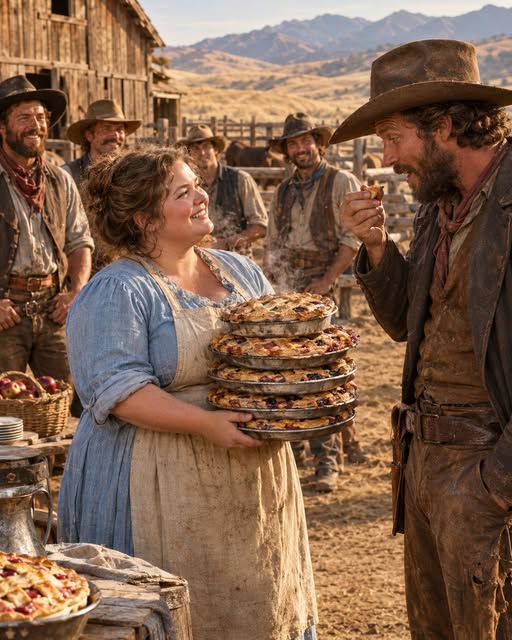
For a moment, he looked like the man who had once sat across from me eating peach pie.
Then we heard horses.
Many horses.
Luke looked through the window.
“They’re here.”
The cowboys gathered in the barn.
Forty men.
Forty rifles.
Forty people who had once refused my stew.
I suddenly understood something.
They hadn’t become family because I had fed them.
They had become family because, slowly, we had learned to tell each other the truth.
I stepped into the barn.
Every man turned toward me.
“I need you to listen.”
Luke stood beside me.
“The men outside are looking for this ranch.”
I held up the ledger.
“They believe this book can protect them.”
One cowboy spat into the snow.
“Then let’s burn the damn thing.”
“No.”
They looked at me.
“If we destroy it, the truth dies with it.”
A young cowboy named Samuel spoke.
“Then what do we do?”
I looked at Nathan.
Then Luke.
“We take it to Cheyenne.”
A murmur passed through the barn.
“That road will be watched.”
“I know.”
“It’s thirty miles.”
“I know.”
“We may not make it.”
I looked at the men who had once walked away from my dinner.
“Then help me make it.”
Nobody spoke.
Then Samuel picked up his rifle.
“I’ll ride.”
Another man stepped forward.
“So will I.”
Then another.
Soon every cowboy in the barn was standing.
Luke looked at me.
“You’ve got your forty.”
I smiled faintly.
“No.”
I looked around the barn.
“We’ve got each other.”
We left before sunrise.
The storm covered our tracks for several miles.
Luke and I rode at the front while Nathan followed with the ledger hidden beneath his coat.
But by noon, we saw smoke rising behind us.
They had found the ranch.
I looked back.
Silver Ridge disappeared beneath the snow.
For the first time since I had arrived, I realized I might never see the cookhouse again.
I thought of the peach orchard.
Of my mother’s recipe book.
Of the forty bowls of untouched stew.
And strangely, I wasn’t afraid.
Then a gunshot cracked through the trees.
Luke pulled his horse sideways.
“Down!”
Bullets tore through the branches.
Our riders scattered.
Men appeared on the ridge.
At least twenty.
Luke fired.
Nathan returned fire.
I ducked behind my horse and felt something tear through my coat.
“Amelia!”
Luke grabbed my arm.
“Stay down!”
Then Nathan shouted.
“Go!”
Luke looked back.
Nathan had stopped his horse.
“What are you doing?”
“Getting them away from you.”
“Dad!”
The word escaped Luke before he could stop it.
I stared at him.
Nathan looked toward him.
For the first time, I understood why Luke had always followed Nathan without question.
Why their silences were so similar.
Why Nathan had looked at Luke with the same sadness he had shown when speaking of Clara.
Nathan was his father.
Luke turned to me.
“He adopted me after my parents died.”
Another gunshot.
Nathan’s horse reared.
Luke moved forward, but I caught his sleeve.
“He wants us to go.”
Luke looked at his father.
Nathan nodded.
“Take her.”
Luke’s eyes filled with anger.
“No.”
“Luke.”
“No!”
Nathan shouted.
“That’s an order.”
Luke’s face broke.
Then he turned his horse.
We rode.
Behind us, gunfire continued.
I didn’t look back.
Not until the ridge disappeared.
We rode for hours.
By nightfall, only twelve riders remained with us.
The rest had taken different routes to confuse our pursuers.
Luke and I stopped beside an abandoned church.
He dismounted and leaned against the wall.
“He’s dead.”
I knew who he meant.
“We don’t know that.”
“Yes, we do.”
His voice cracked.
“He knew exactly what he was doing.”
I stepped toward him.
“Your father didn’t sacrifice himself because he wanted to die.”
Luke looked at me.
“He did it because he wanted you to live.”
He stared at the snow.
After a long silence, he said, “My mother died in that orchard.”
I said nothing.
“Clara wasn’t just Nathan’s wife.”
He swallowed.
“She was the only mother I’d ever known.”
I understood then why the peach trees had always felt sacred to him.
Why he had never spoken about them.
Why he had been angry the first night I arrived.
He hadn’t hated my stew.
He had hated the memories it brought back.
I sat beside him.
“Luke.”
He looked at me.
“Your father told me something once.”
“What?”
“That grief isn’t the opposite of love.”
Luke lowered his eyes.
“Then what is?”
“Proof that love was there.”
He didn’t answer.
But he took my hand.
At dawn, we reached Cheyenne.
The courthouse was already surrounded by men.
Word had traveled faster than we had.
Luke looked at the ledger beneath my coat.
“We’re too late.”
“No.”
I looked at the courthouse.
“We’re exactly where we’re supposed to be.”
Inside, the sheriff refused to listen.
He demanded the ledger.
I refused to hand it over.
Then I remembered something.
The final page.
The signature.
And beneath it, a list of names.
One of them belonged to the sheriff.
He went pale.
“You don’t know what you’re holding.”
“I know exactly what I’m holding.”
I placed the ledger on the desk.
“You can arrest me.”
He stared at me.
“But then everyone in this room will know why.”
Behind me, the doors opened.
The cowboys entered.
Not forty.
Not twelve.
More than thirty.
They had survived the ride through different trails and arrived one by one.
Samuel stepped forward.
“We’ll testify.”
Another man nodded.
“So will I.”
Then another.
The sheriff looked around the room.
For the first time, he realized the ledger was no longer the only evidence.
There were witnesses.
Living witnesses.
Men who had spent years being afraid.
The truth finally had a voice.
By sunset, the sheriff had been taken into custody.
The surviving men connected to Crowe began disappearing from the valley.
Some fled.
Some were arrested.
Others came forward and confessed.
The ledger became part of the official investigation.
Months later, the stolen land was returned to the families who had been cheated.
It did not happen quickly.
Justice rarely does.
But it happened.
And Silver Ridge Ranch survived.
Nathan did too.
He returned in early spring with a scar across his shoulder and a tired smile.
Luke was the first to see him.
They embraced without saying a word.
I stood in the doorway of the cookhouse, unable to stop my tears.
Nathan looked at me.
“I suppose you still don’t trust me.”
I smiled.
“Not completely.”
He laughed.
“Fair enough.”
That evening, I cooked stew again.
Forty bowls sat on the long wooden table.
This time, nobody walked away.
Luke tasted the first spoonful.
He looked at me seriously.
“It needs something.”
I narrowed my eyes.
“What?”
He reached across the table and stole a piece of bread from my plate.
“More bread.”
The entire room erupted in laughter.
Later that night, we walked to the orchard.
Spring had begun.
Tiny green leaves covered the peach trees.
Nathan stood beneath Clara’s favorite tree.
He touched the trunk gently.
“She would have liked you.”
I smiled.
“I think I would have liked her.”
Nathan nodded.
Then he walked away, leaving Luke and me alone.
Luke looked at the trees.
“Do you ever regret coming here?”
I thought about the cold night when forty men had rejected my food.
I thought about the letter.
The gunfire.
The ledger.
The fear.
Then I looked at the peach blossoms beginning to open beneath the moonlight.
“No.”
Luke smiled.
“Even after everything?”
“Especially after everything.”
He took my hand.
“What did your mother teach you?”
I thought for a moment.
“Never let another person decide what your hands are worth.”
Luke squeezed my fingers.
“And what did you learn here?”
I looked toward the cookhouse.
“That sometimes people reject what they need because accepting it means admitting they’re hurting.”
Luke nodded.
“And?”
I smiled.
“And that family isn’t always the people you’re born with.”
A breeze moved through the orchard.
Several pale blossoms fell around us.
For years, I had believed my journey west was about finding a place where I belonged.
I had been wrong.
Home was not a place waiting for me at the end of a road.
Home was something people built together, often from broken pieces.
The men at Silver Ridge had not needed a perfect cook.
They had needed someone willing to stay long enough to see the wounds beneath their anger.
I had not needed forty men to accept my stew.
I had needed to learn that rejection did not make my hands worthless.
And the secret my mother had carried to her grave had taught me something even greater.
Truth can be buried.
It can be hidden inside an old book, beneath a floorboard, or behind years of silence.
But truth does not disappear simply because people are afraid to speak it.
Sometimes, all it needs is one person brave enough to open the door.
The next autumn, the peach orchard bloomed brighter than anyone remembered.
We held a supper beneath the trees.
There were children running between the tables, old ranchers telling stories, and cowboys laughing so loudly that the horses in the nearby pasture lifted their heads.
In the center of the table sat a large iron pot.
My stew.
Luke lifted the lid.
Everyone waited.
He tasted it.
Then he smiled.
“Still not ranch food.”
I laughed.
Nathan shook his head.
Samuel threw a napkin at him.
And for the first time, nobody was afraid of the silence that followed.
Because it was no longer the silence of rejection.
It was the peaceful silence of people who had finally found a place where they could belong.
And beneath the peach trees Clara had planted, I finally understood the lesson my mother had been trying to give me all those years.
Sometimes the door that closes in your face is not the end of your story.
Sometimes it is the moment that forces you to build a better one.
Years passed quietly after that autumn.
Not every year was easy.
There were harsh winters when the cattle nearly froze in the fields, summers when the rain refused to come, and spring floods that carried away fences and half a dozen wagons.
There were also mornings when Amelia woke before sunrise, stepped into the cookhouse, and found herself wondering how the same room that had once felt like the loneliest place in the world had become the place where she felt safest.
Silver Ridge changed with the years.
The old ranch grew larger.
New families settled nearby.
The road to town became busier.
Children who had once been carried in their mothers’ arms eventually ran through the orchard with muddy boots and scraped knees.
And every autumn, when the peaches ripened, Amelia made enough pies to feed everyone.
But there was one thing she never forgot.
The first night.
Forty men.
Forty untouched bowls.
And one door that had seemed to close forever.
Sometimes Luke would tease her about it.
“You know,” he said one evening while they sat beneath the peach trees, “I still think your first stew was terrible.”
Amelia looked at him.
“You ate three bowls.”
“I was starving.”
“You said it wasn’t ranch food.”
“It wasn’t.”
“What was wrong with it?”
Luke smiled.
“You were cooking for forty men.”
“And?”
“You should have known better than to expect forty cowboys to admit they liked something on the first try.”
She laughed.
“Cowards.”
“Exactly.”
They had been married for three years by then.
Their daughter, Clara Amelia Walker, was asleep inside the ranch house.
They had named her after the woman who had planted the first peach tree and after the woman whose courage had carried the truth across half a continent.
Luke looked through the window toward the house.
“She’ll grow up knowing everything.”
Amelia frowned.
“Everything?”
“About her grandmother.”
Amelia became quiet.
She had spent years wondering whether she should tell her daughter about the secrets her mother had carried.
Eventually, she realized that hiding painful history did not protect anyone.
It only gave fear another generation to live in.
“She’ll know the truth,” Amelia said.
Luke nodded.
“Even the ugly parts?”
“Especially those.”
He looked at her.
“Why?”
“Because I want her to know that courage doesn’t mean never being afraid.”
Amelia touched the wedding ring on her finger.
“It means refusing to let fear decide what you do next.”
Luke smiled.
“You sound like your mother.”
“I hope so.”
A sudden cry came from the house.
Luke stood.
“I’ll get her.”
“No.”
Amelia laughed softly.
“You always make her cry louder.”
“That is slander.”
“You’re her father.”
“Exactly. She loves me.”
“She loves you until you try to put her socks on.”
Luke sighed.
“Women are impossible.”
Amelia watched him disappear into the house.
Then she turned back toward the orchard.
The last light of sunset rested on the branches.
For a moment, she thought she saw her mother standing among the trees.
Young.
Smiling.
Holding the old recipe book against her chest.
Amelia blinked.
The orchard was empty.
But she smiled anyway.
She had stopped asking whether memories were ghosts.
Some things did not need explanations.
The following spring, Nathan announced that he was leaving the ranch.
Luke didn’t take the news well.
“You’re retiring?”
Nathan nodded.
“I’ve been managing this place for thirty years.”
“You’re sixty.”
“Exactly.”
“You’re acting like you’re eighty.”
Nathan laughed.
“I want to see something besides cattle before I die.”
Amelia placed a cup of coffee in front of him.
“Where will you go?”
“West.”
Luke stared at him.
“You’ve spent your entire life going west.”
Nathan smiled.
“Then perhaps I’ll finally discover where it ends.”
He left two weeks later.
There was no dramatic farewell.
No speeches.
Just forty cowboys standing near the gate, pretending they weren’t emotional.
Nathan shook every hand.
When he reached Amelia, he paused.
“You saved this ranch.”
She shook her head.
“No.”
He raised an eyebrow.
“You did.”
“No.”
She smiled.
“The ranch saved me.”
Nathan looked toward the cookhouse.
“You still don’t trust me completely, do you?”
Amelia laughed.
“No.”
“Good.”
He hugged her.
“Never trust anyone completely.”
Then he looked at Luke.
“But know who has earned your trust.”
Luke nodded.
Nathan mounted his horse and rode away.
He never returned to Silver Ridge.
But every Christmas, a letter arrived.
Sometimes it contained a few lines.
Sometimes only a pressed flower.
Once, it contained a ridiculous drawing of a mountain goat.
The children loved those letters.
Years later, Amelia would understand that Nathan had finally found what he had been searching for too.
Not forgiveness.
Not escape.
Peace.
The ranch continued without him.
Then came the year of the great drought.
The grass turned brown.
The wells sank.
Cattle began dying.
Neighbors sold their land.
Some families packed everything they owned into wagons and headed east.
Luke stood over the ranch accounts one night with a candle burning beside him.
“We have enough money to survive until winter.”
Amelia looked at him.
“And after winter?”
He didn’t answer.
They both knew.
Silver Ridge might not survive.
For the first time since Amelia had arrived, she felt the old fear return.
Not fear for herself.
Fear for everyone who had made this place home.
The next morning, she walked into the cookhouse.
There were only twelve men at breakfast.
Ten years earlier, forty men had filled the room.
Now there were twelve.
She placed bread on the table.
Nobody spoke.
Then an old cowboy named Samuel cleared his throat.
“What are we going to do?”
Amelia looked around.
She remembered another room.
Another silence.
Another night when everyone had been too afraid to speak.
She set down the coffee pot.
“We do what we’ve always done.”
Samuel frowned.
“What?”
“We stay.”
He stared at her.
“That isn’t a plan.”
“No.”
She smiled.
“It is a beginning.”
The ranch hands started digging new wells.
The women planted vegetables.
The children carried water.
Luke sold several horses to buy seed.
Neighbors who had once been rivals began sharing supplies.
One ranch gave Silver Ridge hay.
Another gave them flour.
In return, Silver Ridge sent meat when the others needed it.
The drought lasted almost two years.
But the ranch survived.
Not because anyone became rich.
Not because someone arrived with a miracle.
It survived because people stopped thinking only about what belonged to them.
They began thinking about what they could preserve together.
When the rain finally came, it arrived in a violent storm.
Water poured from the sky.
The dry earth swallowed it greedily.
Children danced barefoot in the mud.
Men shouted.
Women laughed.
Amelia stood beneath the porch roof, crying.
Luke came up behind her.
“Why are you crying?”
“Because it’s raining.”
He laughed.
“You’ve seen rain before.”
“Not like this.”
She looked at the fields.
“Sometimes you don’t know how much you needed something until it finally comes.”
Luke wrapped his arms around her.
“I think that applies to more than rain.”
She leaned against him.
“Yes.”
That night, Amelia opened her mother’s recipe book.
The pages were worn almost transparent.
Between the recipes were notes Amelia had never noticed.
Small sentences.
Fragments.
Memories.
She read them one by one.
Some were about food.
Some were about Clara.
Some were about Nathan.
And some were about Amelia herself.
Then she found one final sentence written beneath the recipe for peach pie.
“If my daughter ever finds this book, I hope she understands that I did not leave her because I loved her too little. I left because I loved her enough to become the villain in her childhood if that was the price of keeping her alive.”
Amelia’s vision blurred.
She pressed her fingers against the page.
For six years, she had believed her mother’s silence had been abandonment.
Now she understood it had been sacrifice.
Not every sacrifice was fair.
Not every decision was perfect.
But love sometimes took forms that were impossible to understand until many years later.
Luke found her crying at the table.
He sat beside her.
“What happened?”
She handed him the book.
He read the sentence.
Then he closed it gently.
“She loved you.”
“I know.”
Amelia wiped her eyes.
“I just wish she had lived long enough for me to tell her I understood.”
Luke took her hand.
“Maybe she knew.”
Amelia looked at him.
“How?”
He nodded toward the orchard.
“Look.”
Outside, the first peach blossom of the season had opened.
One small flower.
Perfect against the darkness.
Amelia smiled through her tears.
Years later, when Amelia was old and her hair had turned silver, people still came to Silver Ridge Ranch asking about the legendary peach orchard.
They wanted to know if the stories were true.
They wanted to see the tree where Clara had planted the first seed.
They wanted to hear about the forty cowboys who had once refused to eat the stew.
Amelia always laughed.
“The story has become much bigger than it really was.”
But the visitors never believed her.
They wanted the legend.
So sometimes she told them.
And sometimes she told them something else.
She told them that the most important part of the story was not the ledger.
It wasn’t the gunfight.
It wasn’t the men who came looking for revenge.
It wasn’t even the peach orchard.
“The important part,” she would say, “was what happened after people had every reason to remain bitter.”
She would look at the children sitting around her.
“Anyone can become cruel after being hurt.”
The children listened.
“But it takes courage to remain kind without becoming weak.”
She would pause.
“That’s what I learned.”
One autumn evening, Amelia walked alone beneath the peach trees.
Her daughter was grown.
Her grandchildren were running the ranch.
Luke had died peacefully years before, with his hand in hers.
Nathan’s letters had stopped long ago.
Samuel had become the oldest man in the valley.
The cookhouse still stood.
The tables were still there.
And on the wall hung an old wooden sign Luke had carved for her.
It read:
HOME IS WHERE PEOPLE CHOOSE TO STAY.
Amelia touched the letters.
Then she heard footsteps behind her.
Her granddaughter came running through the orchard.
“Grandmother!”
Amelia turned.
“What is it?”
“There are people at the ranch.”
“Who?”
“They’ve come from town.”
“Why?”
The girl smiled.
“They want peach pie.”
Amelia laughed.
“How many?”
“Forty.”
For a second, Amelia could not speak.
Then she looked toward the old cookhouse.
Forty people.
Forty plates.
Forty chances to remember how far they had come.
She took her granddaughter’s hand.
“Then we’d better start baking.”
They walked toward the cookhouse together.
Behind them, the wind moved gently through the branches.
A peach fell from the oldest tree and landed softly in the grass.
Amelia stopped for a moment.
She looked back at the orchard.
And in the fading light, she whispered the words she had carried inside herself for most of her life.
“Thank you, Mama.”
Then she went inside.
The fire was lit.
The oven warmed.
The tables filled.
Voices rose around her.
Someone began laughing.
Someone else asked for more coffee.
The smell of cinnamon and peaches drifted through the open windows and across the ranch.
And for the first time, Amelia understood that the story had never really been about a woman who arrived at Silver Ridge Ranch with one suitcase and three dollars.
It had been about what happened when a lonely person walked through a closed door and decided not to close her heart.
The forty cowboys had once walked away from her food.
Years later, their children and grandchildren gathered around the same table.
They ate from the same plates.
They told the same stories.
And nobody remembered the taste of that first stew.
But everyone remembered the woman who had stayed.
Because sometimes the greatest victory is not proving someone wrong.
It is becoming strong enough that their rejection no longer defines you.
Sometimes forgiveness does not mean forgetting what happened.
It means refusing to let what happened control what comes next.
And sometimes the place that breaks your heart is the very place where you discover how to build a home.
Outside, the last peach blossoms moved in the evening wind.
Inside, Amelia lifted another pie from the oven.
She smiled.
And Silver Ridge Ranch, which had once been a place of secrets, grief, and fear, was filled with something far more powerful.
People who had chosen, despite everything, to stay.
THE END.