When Captain Mercer shoved me away from the burning wreck in front of the whole crew and called me useless, I already knew the dragons weren’t hunting us—they were starving.
The signal blinked across the Cinder Drift’s navigation screen every eleven seconds.
Three short pulses. Two long. One short.
A distress code so old that our computers had to search the archives to recognize it.
Captain Mercer leaned over the console, his face illuminated by the red warning light.
“Identification?”
Our communications officer, Lieutenant Vale, swallowed.
“Human Colonial Emergency Protocol. First generation.”
“How old?”
She hesitated.
“Seventy-three years.”
Nobody spoke.
Seventy-three years ago, humanity had barely begun exploring this region of space. According to official records, no human vessel had ever landed on this planet before us.
Yet something beneath the valley was calling for help.
And whatever it was, it knew we had returned.
“Could be an automated system,” our engineer, Collins, suggested.
Vale shook her head.
“Automated beacons repeat continuously. This one activated exactly fourteen seconds after our convoy entered orbit.”
Mercer turned toward me.
“Bray?”
Three months earlier, he would have ordered me to prepare breakfast.
Now he was asking what I thought.
I studied the signal.
“Someone’s been waiting.”
Outside the viewport, the planet rolled beneath us, its black valleys scarred by long-dead rivers.
The valley where we had crashed looked smaller from orbit.
Almost peaceful.
Then another signal appeared.
Not from the ground.
From one of our cargo ships.
“Captain,” Vale whispered. “Someone just transmitted our coordinates to an unknown receiver.”
Mercer straightened.
“Which ship?”
“The Harvest Moon.”
Our largest freighter.
The one carrying nearly half the food intended for the dragons.
Before Mercer could respond, the Harvest Moon’s engines ignited.
It broke formation and accelerated toward the surface.
“Captain!” its pilot shouted over the emergency channel. “We’ve lost navigation control! Someone’s flying us remotely!”
The transmission dissolved into static.
On the screen, the freighter plunged toward the valley.
And directly beneath it, the ancient distress beacon began flashing faster.
Mercer slammed his hand against the console.
“Battle stations!”
I watched the descending ship, then glanced at the refrigerated cargo manifests.
Forty thousand tons of protein.
Enough to keep the hatchlings alive through the coming dry season.
If the Harvest Moon crashed, we would lose more than supplies.
We would lose the promise we had made.
“Get us down there,” I said.
Mercer looked at me.
“Already working on it.”
We entered the atmosphere behind the freighter, our hull shaking under the pressure.
Through the clouds, I saw the valley.
Then I saw the dragons.
Dozens of them were circling above the old landing site.
The hatchlings had grown.
Their wings, once too weak to lift them, now carried them confidently through the hot air.
And at the center of their formation flew the matriarch.
Her broken horn was unmistakable.
For one ridiculous moment, I smiled.
Then the Harvest Moon fired its landing thrusters.
Straight at the dragons.
“It’s going to burn them!” Collins shouted.
Mercer seized the controls and drove the Cinder Drift between the freighter and the flock.
Our shields flashed white.
The impact threw everyone sideways.
The matriarch roared.
Her voice carried through the hull, deeper than thunder.
She recognized our ship.
But she couldn’t understand why another human vessel was attacking her children.
“Open the galley vent,” I shouted.
Collins stared.
“What?”
“The smoke dispersal system! Open it!”
We had installed a new smoker aboard the Cinder Drift before the journey, along with an industrial ventilation system.
I sprinted to the galley, grabbed a container of rendered livestock fat, and threw it onto the heated grill.
Thick, fragrant smoke filled the chamber.
“Vent it outside!”
The exhaust released a dark ribbon into the sky.
Seconds later, the matriarch turned.
She followed the smoke straight toward us.
Her enormous eyes appeared beside the viewport.
I pressed my palm against the glass.
“Hello, old girl.”
She tilted her head.
Then she spread her wings and roared toward the other dragons.
They scattered away from the freighter’s path.
The Harvest Moon struck the ground beyond the ridge.
The explosion shook the entire valley.
A column of black smoke rose toward the clouds.
But the freighter hadn’t been trying to land.
Someone had deliberately crashed it.
And as our scanners searched the wreckage, Collins discovered something worse.
“The distress beacon is directly underneath the impact site.”
Mercer’s expression hardened.
“So the beacon lured us here.”
“No,” I said quietly.
I looked at the old signal repeating across the screen.
“It lured the freighter.”
We landed beside the stone cooking pits the dragons had built after our departure.
There were dozens now.
Some were carefully shaped into circles, others covered with flat slabs of polished black stone.
The hatchlings had learned.
They had continued cooking without me.
The matriarch approached as soon as I stepped onto the ground.
She lowered her scarred jaw against my shoulder, nearly knocking me over.
I laughed despite the fear twisting my stomach.
“Missed you too.”
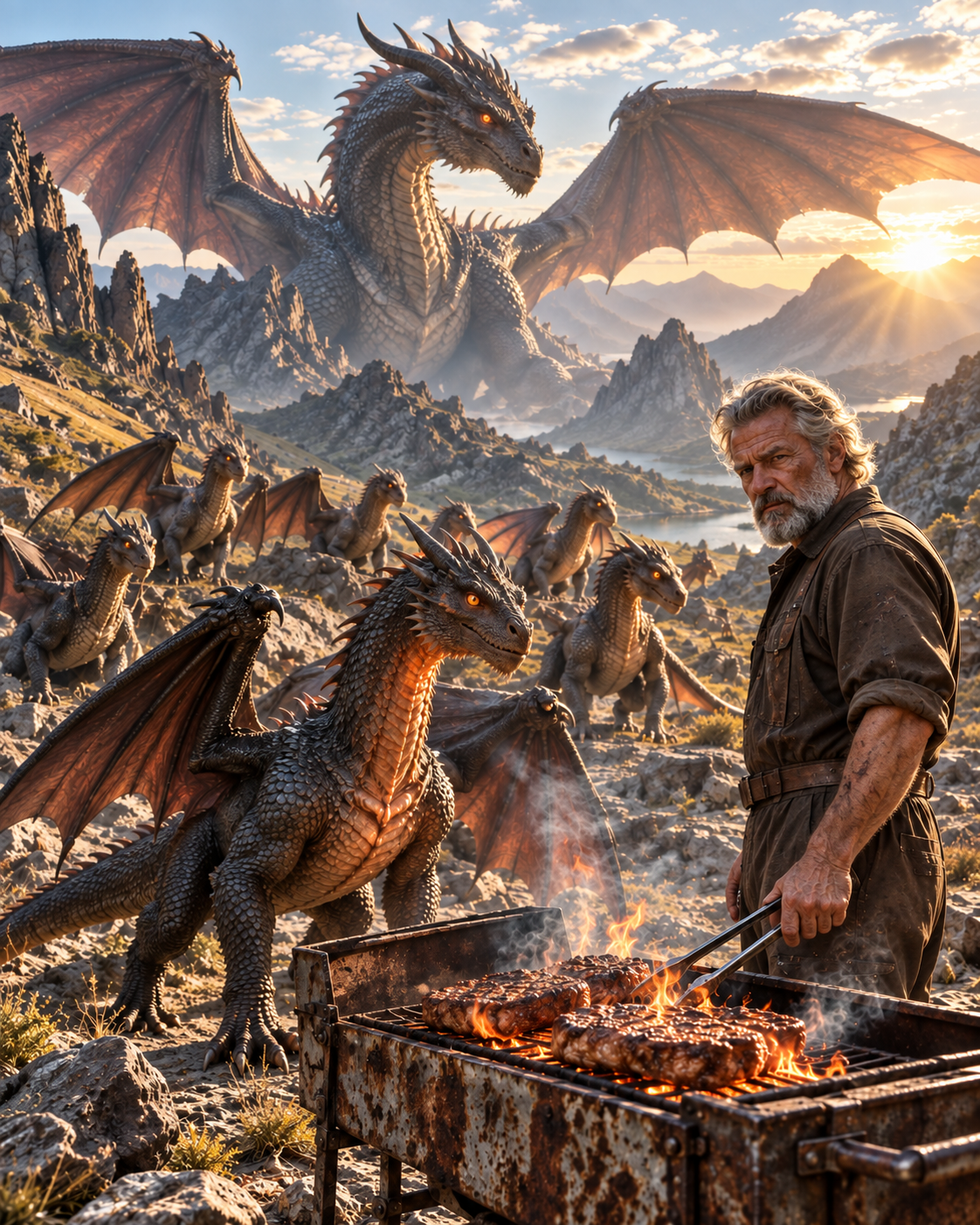
Then she pulled away and made a sound I had never heard before.
Three low clicks followed by a trembling whistle.
The hatchlings immediately retreated behind her.
I looked toward the distant crash.
“You know something, don’t you?”
She turned and began walking toward the ridge.
Mercer approached with a rifle.
“Bray, we need to secure that beacon.”
I watched the matriarch.
“She’s taking us somewhere.”
“Could be dangerous.”
“She knows that.”
Mercer studied her for a moment.
Then he lowered his weapon.
“Fine. We follow your friend.”
We traveled for nearly two hours across the black plains.
The matriarch walked slowly enough for us to keep pace, occasionally stopping to scrape the ground with her claws.
At first, I thought she was marking a trail.
Then I noticed the shapes.
Circular indentations.
Perfectly symmetrical.
Artificial.
Collins knelt beside one and scanned it.
“Metal beneath the soil.”
“How much?”
He looked up.
“About three kilometers.”
The ground beneath us was not natural.
We were walking over something enormous.
A buried installation.
The matriarch stopped beside a broken ridge and began digging.
Her claws tore through layers of hardened ash.
Eventually, a rusted metal door appeared.
Stamped across its surface was an emblem I recognized from history books.
The insignia of the First Expansion Authority.
Humanity’s earliest colonial organization.
Below the emblem, someone had scratched three words into the steel.
DO NOT FEED.
My blood went cold.
Mercer read them aloud.
“Do not feed what?”
The matriarch backed away.
And something underneath the ground knocked.
Once.
Twice.
Then hundreds of answering knocks echoed beneath our feet.
Collins stumbled backward.
“Captain, there’s movement down there.”
Mercer raised his rifle.
I stared at the warning.
Do not feed.
The dragons were starving when we arrived.
Someone had deliberately deprived them of food.
And now I was beginning to wonder why.
We forced the door open using a cutting torch.
Inside was a staircase descending into darkness.
The air smelled of rust, dust, and something faintly sweet.
Like spoiled grain.
We descended with six soldiers, Collins, and Mercer.
The matriarch remained outside.
She refused to cross the threshold.
That frightened me more than anything.
After twenty minutes, we reached a cavernous chamber illuminated by emergency lights.
Rows of transparent cylinders lined the walls.
Most were broken.
Others contained bones.
Human bones.
A recording began playing as we passed a sensor.
“Welcome to Project Hearth. Agricultural Research Division. Year 2189.”
A woman’s voice, cheerful and professional.
“Our goal is to establish a sustainable ecosystem capable of supporting future human settlement.”
Images flickered onto a wall.
A green planet.
Wide grasslands.
Dense herds of grazing animals.
Then dragons flying beneath a bright sky.
I stepped closer.
They were beautiful.
Healthy.
Their scales shone like polished obsidian, and their wings stretched across valleys filled with life.
“These creatures possess extraordinary thermal regulation,” the recording continued. “Their digestive systems can neutralize otherwise toxic native proteins when exposed to sustained external heat.”
I frowned.
“External heat?”
Collins examined the data.
“They weren’t always breathing fire to cook their food. Their ancestors used geothermal vents.”
The recording advanced.
“Following the collapse of geothermal activity, experimental metabolic enhancements have been approved.”
The images changed.
Dragons strapped to operating platforms.
Needles entering their throats.
Glowing glands implanted beneath their jaws.
Then a dragon screaming as white fire exploded from its mouth.
My stomach twisted.
“They gave them fire.”
Collins nodded slowly.
“And it cost them.”
The next files revealed everything.
The modification demanded enormous amounts of energy.
The dragons could breathe fire, but doing so consumed more calories than they could naturally replace.
Worse, fear triggered the glands involuntarily.
Each frightened breath pushed them closer to starvation.
Humans had created the very hunger we later mistook for aggression.
Then came the final experiment.
A synthetic organism designed to replenish the planet’s vanishing grazing herds.
A self-replicating biological nutrient source.
Project Hearth called it the Evercrop.
But the experiment had escaped containment.
The organism spread underground, consuming mineral deposits and organic matter.
Within decades, it had swallowed forests, poisoned rivers, and destroyed the grazing populations it was designed to replace.
The researchers abandoned the planet.
And the dragons were left behind.
Mercer stared at the final report.
“They knew.”
His voice was barely audible.
“They created this and left them to die.”
Before anyone could answer, a new recording began.
This one was not cheerful.
An elderly woman appeared on the screen, her face pale and exhausted.
“If anyone finds this facility, please listen carefully.”
She looked directly into the camera.
“The Evercrop is not dead.”
A violent crash sounded behind her.
“We attempted to starve it by removing all accessible nutrients. That is why the surface became barren. But the organism adapted.”
She swallowed.
“It learned to recognize energy sources.”
The screen flickered.
“Heat. Movement. Biological activity.”
My gaze drifted toward the ceiling.
Toward the valley above.
Toward the cooking pits.
“The dragons,” I whispered.
The woman continued.
“Whatever you do, do not introduce concentrated food supplies near the containment chamber.”
Then her expression changed.
She looked toward something beyond the camera.
“Oh, God.”
The recording ended in a scream.
At that exact moment, the floor shook.
A deep mechanical groan echoed through the chamber.
Collins checked his scanner.
His face drained of color.
“Captain, the Harvest Moon didn’t simply crash.”
He turned the display toward us.
“The impact ruptured the containment layer.”
Beneath the installation, something enormous was rising.
The Evercrop had been starving for seventy-three years.
And we had just delivered forty thousand tons of food directly into its mouth.
We ran.
Behind us, the floor split open.
Something pale and wet pushed through the cracks.
At first, it resembled a root.
Then it moved.
A thick tendril struck one of the soldiers and wrapped around his leg.
He screamed as it dragged him backward.
Mercer fired.
The tendril burst apart, spraying clear fluid across the floor.
The pieces kept moving.
“Don’t shoot the fragments!” Collins shouted. “They’re still alive!”
I grabbed a fallen emergency torch.
The flame touched the tendril.
It recoiled.
For half a second, relief washed over me.
Then the creature changed color.
Its translucent surface darkened.
The torch flame shrank.
The tendril was absorbing the heat.
I dropped it.
The organism surged forward.
“Run!”
We raced up the staircase as the installation collapsed behind us.
Mercer shoved the final soldier through the doorway just as a massive root slammed into the stairs.
I heard the matriarch roar outside.
We stumbled into daylight.
The ridge was moving.
Not shaking.
Moving.
Entire sections of black soil lifted as enormous pale tendrils pushed toward the surface.
The crashed freighter had vanished beneath a swelling mound of organic tissue.
And the mound was growing.
The matriarch placed herself between us and the approaching mass.
Her throat glowed.
“Don’t!” I shouted.
She hesitated.
The Evercrop was attracted to energy.
Fire might hurt it briefly, but its biology would eventually turn that heat into fuel.
The matriarch lowered her head.
Behind us, the ground split.
A tendril lunged toward the smallest hatchling.
The little creature stumbled.
I recognized the scar around its mouth.
It was the first dragon I had ever fed.
The one that had approached my smoker while Mercer aimed his rifle.
Without thinking, I ran.
The tendril struck my shoulder, knocking me into the dirt.
I grabbed the hatchling and rolled.
The creature’s root slammed down where we had been.
The matriarch screamed.
White fire poured from her jaws.
The tendril disintegrated.
But beneath the surface, the Evercrop brightened.
It had tasted her energy.
And now it wanted more.
Mercer dragged me upright.
“Bray, we need to evacuate!”
I looked across the valley.
The dragons were gathering around the cooking pits.
They had no ships.
No way to escape the planet.
Even if we loaded every hatchling aboard our convoy, the adults would be left behind.
And the Evercrop would eventually spread beyond the valley.
“We can’t leave,” I said.
Mercer stared at me.
“You saw what happened down there.”
“Yes.”
“Then you know we can’t fight it.”
I looked at my hands.
At the black grease beneath my fingernails.
At the burns I had collected from decades of working over hot grills.
Something about the laboratory recording wouldn’t leave my mind.
The Evercrop consumed heat.
But the original researchers had described it as a nutrient source.
Food.
And food could be changed.
Cooked.
Spoiled.
Rendered useless to whatever needed to eat it.
“Collins,” I said, “what happens when the Evercrop gets too hot?”
He frowned.
“It absorbs thermal energy.”
“Not what I asked. Everything has a limit.”
He searched the research files.
The ground trembled beneath us.
Then his eyes widened.
“At extreme temperatures, its nutrient-production enzymes denature.”
“How extreme?”
“Higher than normal combustion. About eighteen hundred degrees Celsius.”
I turned toward the matriarch.
Her white fire had melted a raider’s cannon.
It could reach those temperatures.
But exposing the Evercrop to a sudden blast would only destroy its surface.
The rest would absorb the energy and grow.
We needed something else.
“Low heat first,” I murmured.
Mercer looked confused.
I almost laughed.
The answer was the same lesson I had taught the dragons.
When bitter carcass scraps were heated slowly, their toxins broke down.
Temperature mattered.
Timing mattered.
And so did what happened before the final blast.
I pointed toward the abandoned cooking pits.
“We’re going to smoke it.”
Collins stared at me.
“Bray, that thing is the size of a city.”
“Then we build a city-sized smoker.”
For the next hour, the valley became a battlefield of desperate engineering.
The remaining cargo ships landed along the ridge.
We unloaded industrial heating units, mineral salts, chemical stabilizers, and thousands of empty protein containers.
Collins studied the Evercrop’s biological structure.
It had adapted to absorb intense heat, but its digestive membranes remained vulnerable to sustained exposure to certain mineral compounds.
Especially sulfur-rich smoke.
At low concentrations, the smoke would only irritate it.
At higher concentrations, combined with slow heating, the compounds could disrupt its ability to process energy.
A final burst of extreme heat might then destroy it before it could recover.
Might.
That was the word Collins kept using.
I didn’t tell the crew how much it frightened me.
We had no better option.
The dragons helped us construct enormous trenches around the exposed organism.
They dragged broken hull plates into position, creating channels beneath the ground.
The surviving freighters supplied heating elements and ventilation fans.
The smaller dragons carried stones.
The larger ones shaped the trenches with carefully controlled flames.
And the matriarch watched everything.
She seemed to understand what we were preparing.
At sunset, Mercer approached me.
His wounded shoulder had healed into a thick scar.
“Bray, command wants the convoy evacuated.”
“Then evacuate anyone who wants to go.”
“They’re demanding I remove you.”
I looked at him.
“Are you going to?”
He stared toward the dragons.
For a long moment, he said nothing.
Then he removed his command insignia and placed it on a supply crate.
“Three months ago, I nearly got us killed because I thought the loudest man with a weapon knew best.”
He picked up a shovel.
“I’m done making that mistake.”
We worked through the night.
By dawn, the trenches were ready.
The Evercrop had spread across nearly half the valley.
Its enormous body pulsed beneath layers of black soil.
We activated the heating units.
Thick mineral smoke began pouring through the underground channels.
The organism reacted immediately.
Its tendrils thrashed.
The ground rose and fell like the chest of a dying giant.
Collins monitored the readings.
“Membrane function dropping. Twenty percent.”
The hatchlings huddled beside the matriarch.
“Forty percent.”
A massive tendril struck one of our ventilation towers.
The structure collapsed.
Smoke escaped into the open air.
“Pressure’s falling!” Collins shouted.
I sprinted toward the damaged trench with Mercer.
Together, we dragged a sheet of hull plating over the breach.
A second tendril lashed out.
Mercer shoved me clear.
The root wrapped around his waist.
“Captain!”
He dropped his shovel and drew his sidearm.
“Finish it, Bray!”
The tendril pulled him toward the swelling mound.
I chased him, slipping on ash.
My hands caught his wrist.
For one desperate second, we held each other.
Then the ground opened beneath us.
We fell.
I struck a metal beam and lost my breath.
Below us, the Evercrop’s interior glowed with absorbed heat.
Hundreds of translucent membranes expanded and contracted around a central mass.
Mercer hung from a twisted cable, unconscious.
And beneath him waited a chamber of pulsing white tissue.
I understood then.
The thing had a stomach.
Not a human stomach, not even an animal one, but a central processing chamber where all the absorbed energy and nutrients converged.
And the slow smoking had weakened the membranes surrounding it.
If we could introduce the final heat directly into that chamber, the entire organism might collapse.
I activated my communicator.
“Collins, I found the core.”
His voice crackled.
“Bray, get out of there!”
“Can the matriarch reach my position?”
A pause.
“Through the opening, maybe. But her fire would kill you.”
I looked at Mercer.
He was barely breathing.
Above us, the matriarch’s silhouette appeared against the pale sky.
She peered into the opening.
Her enormous eyes found mine.
I remembered our first meeting.
Her torn wings.
Her broken horn.
The way she had lowered her head to accept my final slab of meat.
She had trusted me when every instinct told her not to.
Now I had to trust her.
I pointed toward the core.
Then I placed my palm against my chest.
Then I pointed upward.
She watched.
For a moment, nothing happened.
Then she turned and roared.
The answering calls of dozens of dragons filled the valley.
They began pulling.
Claws tore through soil and broken plating.
A large dragon caught Mercer’s cable in its jaws and hauled him upward.
The matriarch lowered her neck toward me.
I jumped.
My hands caught the scarred ridge beneath her broken horn.
She lifted me from the darkness.
Below us, the Evercrop surged.
Its enormous tendrils reached toward the sky.
Collins shouted through the communicator.
“Bray, the membranes are failing! If we hit it now—”
“Not yet!”
A large tendril wrapped around the matriarch’s rear leg.
She screamed.
We plunged sideways.
I struck her scales and nearly lost my grip.
Her fire glands began glowing.
Fear.
Pain.
Hunger.
The old cycle was beginning again.
I crawled toward her jaw.
“Easy,” I whispered.
She could barely hear me over the chaos.
I pressed my palm against the familiar scar.
“Not from fear.”
Her eyes shifted toward mine.
The white glow dimmed.
Her breathing slowed.
Then she understood.
She twisted her body, positioned her jaws directly above the exposed core, and waited.
I checked Collins’s readings.
The smoke concentration was still climbing.
Seventy percent membrane failure.
Eighty.
Ninety.
“Now!” Collins screamed.
The matriarch opened her mouth.
White fire erupted downward in a single concentrated stream.
The valley turned brighter than noon.
The Evercrop convulsed.
Its enormous roots lifted from the ground, twisting in a silent struggle.
The core flashed brilliant blue.
Then came a sound like an ocean collapsing into a hole.
The organism began folding inward.
Its tissues blackened and crumbled.
The roots around the valley disintegrated into gray dust.
The matriarch beat her wings furiously, carrying us away from the collapsing chamber.
We reached the ridge just as the central mound imploded.
A shock wave rolled across the plain.
Every remaining cooking pit collapsed.
The ground shook for nearly a minute.
Then everything became still.
The Evercrop was gone.
For several seconds, I heard nothing except my own breathing.
Then a small dragon nudged my leg.
The scarred hatchling.
It pressed its warm snout against my hand.
I sank to my knees and held it.
Behind me, Mercer coughed.
He was alive.
The crew erupted into exhausted cheers.
But the matriarch did not celebrate.
She stood beside the ruined valley, staring at the enormous crater.
I approached her slowly.
“You saved us.”
She lowered her head.
Her breathing was shallow.
The final blast had consumed almost everything she had left.
Her ribs showed beneath her scales.
Her wings trembled.
She had spent the last of her strength protecting us.
I called for food.
The crew brought cooked protein from the surviving ships.
I placed it before her.
She sniffed it.
Then turned away.
My chest tightened.
“Come on, old girl.”
She closed her eyes.
For a moment, I thought I had lost her.
Then the smallest hatchling approached.
It carried a strip of smoked meat in its mouth.
Not from our supplies.
From one of the cooking pits the dragons had built themselves.
The hatchling placed the food beneath the matriarch’s nose and nudged her gently.
She opened one eye.
Then, slowly, she ate.
One bite.
Then another.
The other hatchlings gathered around her, bringing their own scraps.
It was clumsy.
Messy.
Beautiful.
The children were feeding their mother.
And for the first time, I realized the lesson had become something greater than survival.
They were learning how to care for one another.
Three weeks later, the first green shoots appeared.
The Evercrop had consumed much of the planet’s mineral reserves, but its destruction released stored nutrients back into the soil.
Scientists from the colonies arrived to investigate.
They found dormant seeds beneath the ash.
They found underground water channels beginning to flow again.
And they found evidence of a recovering ecosystem.
Restoring the planet would take generations.
The dragons still needed food.
They still needed protection.
And humanity owed them more than a few supply convoys.
Mercer personally delivered the evidence from Project Hearth to the Colonial Council.
The resulting investigation exposed decades of concealed experiments and falsified planetary records.
The First Expansion Authority’s successor organizations were forced to establish a permanent restoration program.
But what surprised me most was what the dragons did next.
They began building cooking pits farther beyond the valley.
Not because I instructed them.
Because they had learned that food could be prepared, preserved, and shared.
One afternoon, I watched the scarred hatchling carefully heat a stone beneath a slab of tough native meat.
It used a tiny controlled flame.
No panic.
No wasted energy.
When the meat was ready, it carried the first portion to the matriarch.
I felt something tighten in my throat.
Mercer stood beside me.
“You know,” he said, “the Council wants to give you a medal.”
I shook my head.
“I don’t need one.”
“They’re also offering you a research position.”
I laughed.
“I’m a cook.”
Mercer smiled.
“Yes. Apparently, that’s exactly what this planet needed.”
A year later, the valley was no longer black.
Grass spread between the stone pits.
Small grazing animals had returned from protected breeding reserves.
The dragons hunted occasionally, but they no longer hunted desperately.
Their flames became tools rather than cries of pain.
And beside the original crash site stood a building made from salvaged starship metal and polished volcanic stone.
Above its entrance hung a simple sign.
THE FIRST HEARTH.
It was part kitchen, part research station, part gathering place.
Humans worked beside dragons.
Scientists studied native plants while hatchlings warmed cooking stones.
Engineers repaired equipment while the matriarch rested beneath a canopy overlooking the valley.
Travelers came from distant colonies to see the creatures they once believed were monsters.
Most arrived afraid.
Almost all left changed.
One evening, a young cadet approached me while I prepared dinner.
He watched a dragon carefully rotate a slab of meat over glowing stones.
“Is it true,” he asked, “that you saved this entire planet with a smoker?”
I considered the question.
I thought about the burning wreck.
Mercer’s rifle.
The starving hatchlings.
The buried laboratory.
The monstrous thing humanity had created and abandoned.
Then I looked toward the matriarch.
She was watching the sunset while three young dragons slept beneath her wings.
“No,” I said.
“I just noticed they were hungry.”
The cadet frowned.
“That doesn’t sound like enough.”
I handed him a tray of cooked meat.
“Go feed them.”
He hesitated.
Then he carried the tray toward the dragons.
The scarred youngster approached him, sniffed the food, and gently took a piece.
The cadet laughed.
And just like that, a little more fear disappeared from the universe.
That night, as the stars appeared above the valley, the matriarch settled beside my smoker.
She rested her enormous head near my feet.
I scratched the scar beneath her jaw.
“Funny, isn’t it?” I whispered. “All those ships, all those weapons, all those brilliant scientists. And nobody thought to offer you dinner.”
She released a small, warm puff of smoke.
I smiled.
Somewhere beyond the stars, humanity was still discovering new worlds.
There would be creatures we didn’t understand.
Dangers we couldn’t explain.
Mistakes we would be tempted to hide.
And there would always be people ready to call something a monster simply because it frightened them.
But I had learned that fear was a terrible translator.
Sometimes a scream meant anger.
Sometimes fire meant pain.
And sometimes the most terrifying creature in the valley was simply a mother trying to keep her children alive.
I added another piece of wood to the smoker.
The matriarch closed her eyes.
Around us, humans and dragons shared a meal beneath an open sky.
No weapons were raised.
No one was running.
For one small evening, the universe was exactly as it should be.
And I finally understood something I wished I had known when I first boarded the Cinder Drift.
You don’t have to be the strongest person in the room to change the world.
You don’t have to be the smartest, the loudest, or the one holding the gun.
Sometimes, all you need is the courage to look at something everyone else fears and ask a different question.
Not, “How do we destroy it?”
But, “What does it need?”
Because a little understanding can turn an enemy into a friend.
A little kindness can become a promise.
And sometimes, when the entire universe is burning, the bravest thing you can do is build a fire for someone else—and invite them to sit beside it.
THE END.