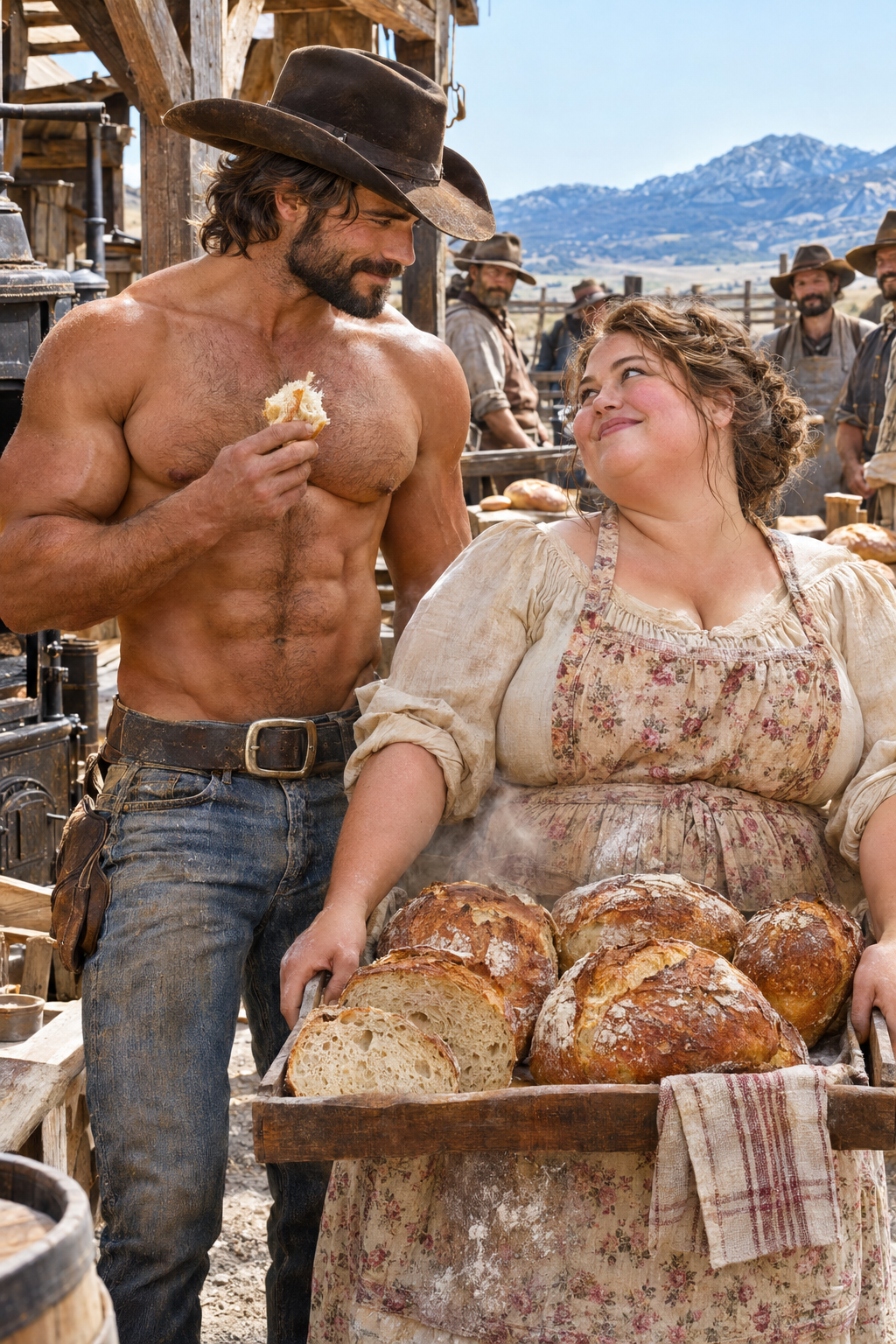
Walter Briggs held up Emily Hart’s loaf of bread in front of half the town and asked if she had baked it or pulled it from the bottom of a river.
Daniel turned the paper toward her.
“Before you leave this room, there’s something I want you to consider.”
Emily looked down.
It was a contract.
Not a dismissal notice. Not a list of complaints. A contract offering her permanent responsibility for the Mercer Ridge cookhouse, with a monthly salary, a share of the profits from supplying the ranch’s trail crews, and a small house on the property.
For several seconds, she couldn’t find her voice.
“I don’t understand,” she finally whispered.
Daniel leaned back in his chair.
“Twenty men went out on the trail with your food. They came back three days later with empty lunch bags, no complaints about spoiled supplies, and enough energy to finish a day’s work. My foreman tells me you’ve reduced our food waste by nearly half.”
He tapped the contract.
“That’s worth more than a few loaves of bread.”
Emily stared at the paper.
“But people have been telling you things about me.”
“I’ve heard.”
“And you’re not worried?”
Daniel studied her for a moment.
“I’m worried about men who judge a person’s character by rumors instead of actions. I’ve got enough of those already.”
Emily swallowed.
“May I ask why you’re offering me this?”
“Because I need someone who knows how to make something useful out of what other people throw away. And because you haven’t asked me for a favor once since you arrived.”
He paused.
“Those are qualities I don’t find often.”
Emily lowered her eyes, fighting the sudden sting behind them.
She had spent nearly a year believing that the worst thing someone could say about her would always follow her wherever she went.
Now a man who barely knew her was offering her a future.
“I’ll need a little time,” she said.
“Take the evening.”
Daniel stood and opened the office door.
“And Emily?”
She turned.
“Whatever happened in Grey Elk, you don’t have to explain it to earn your place here.”
For the first time, Emily wondered whether she might finally be safe.
But the trouble with old wounds was that they rarely stayed buried when someone else knew where to dig.
The following morning, Emily signed the contract.
She did not celebrate with champagne or invite anyone to congratulate her. Instead, she went straight to the cookhouse, tied on her apron, and began preparing breakfast.
The ranch hands soon learned that she expected punctuality, clean utensils, and no unnecessary waste.
She also learned their names.
There was Thomas, who had a bad knee and preferred softer bread. There was young Samuel, who had lost two fingers in a cattle accident and struggled with certain kitchen tasks. There was old Mr. Cooper, who complained about everything but quietly repaired the cookhouse stove whenever it malfunctioned.
Emily remembered all of it.
Within two weeks, the cookhouse had changed.
The shelves were organized. The flour was stored in sealed containers. The men received meals packed according to the length of their journeys, and nothing was thrown away without a reason.
Daniel noticed the difference.
He also noticed that Emily never took credit for the improvements alone. Whenever someone complimented her, she mentioned the men who had helped.
One afternoon, he found her outside the cookhouse, repairing a wooden crate.
“You know,” he said, “most people would hire someone to do that.”
Emily smiled.
“Most people have more money than sense.”
Daniel laughed.
It was the first time she had heard him laugh without restraint.
“You’re getting comfortable here.”
“I’m getting useful here. There’s a difference.”
He looked at her for a moment.
“Perhaps. But you deserve to be comfortable, too.”
Before Emily could answer, a rider appeared at the far end of the yard.
His horse was covered in dust. He pulled to a stop beside the stable and asked for Daniel Mercer.
The rider carried a letter.
Daniel read it once, then again.
His expression hardened.
“What is it?” Emily asked.
“Trouble in town.”
“Bad trouble?”
“Walter Briggs has been telling people that you’re stealing supplies from my ranch.”
Emily’s hands went still.
Daniel folded the letter.
“Apparently, he’s also telling merchants that I’m using my position to protect you.”
Emily looked toward the distant road.
She had known Walter would not forget the embarrassment of that first day. But she had not expected him to follow her all the way to Mercer Ridge.
“Perhaps I should leave,” she said quietly.
Daniel’s head turned sharply.
“Why?”
“I don’t want your business suffering because of me.”
“My business was suffering before you arrived. That’s why I hired you.”
“But people might stop trading with the ranch.”
“Then they’ll have to explain why they’re willing to lose money because of a rumor.”
Emily looked down at the crate.
“I’ve learned that some people would rather destroy someone than admit they were wrong.”
Daniel’s expression softened.
“Then let them be wrong. You keep doing your work.”
He walked away before she could respond.
But the letter had unsettled him more than he admitted.
Walter Briggs was not simply a loud man with a cruel sense of humor. He owned the largest supply store in Red Willow, controlled several cattle contracts, and had friends in the county office.
He was used to getting his way.
And he had never forgiven anyone who challenged him.
Three days later, the consequences arrived.
A delivery wagon that usually brought flour, salt, and dried beans to Mercer Ridge failed to appear.
Daniel sent a rider to town.
The driver returned that evening with an explanation.
Briggs had persuaded the supplier to cancel the ranch’s account.
“On what grounds?” Daniel asked.
“Claims we’re behind on payments.”
Daniel frowned.
“We’re not behind on anything.”
The rider shook his head.
“Briggs says he has records.”
Daniel looked toward Emily, who stood near the kitchen entrance.
She understood immediately.
Walter was trying to make her employment expensive enough that Daniel would regret hiring her.
“I can make the flour last,” she said.
Daniel shook his head.
“This isn’t about flour anymore.”
“No,” Emily replied. “It’s about whether he gets to decide who deserves to work.”
For a moment, neither spoke.
Then Daniel gave a short nod.
“All right. Let’s find out what he’s really after.”
The answer came sooner than expected.
That Saturday, a notice appeared outside the general store announcing a public meeting about the ranch’s outstanding debts and alleged misuse of supplies.
Walter Briggs intended to present evidence.
By noon, half the town had gathered.
Emily did not want to attend.
She had spent too many months standing in rooms where people had already decided she was guilty.
But Daniel asked her to come.
“Not because I need you to defend yourself,” he said. “Because I think you should hear what he’s claiming.”
When they arrived, Walter stood on the steps of the general store, holding a thick ledger.
He smiled when he saw Emily.
“Well, look who’s here. Our little baker.”
A few people laughed nervously.
Walter raised the ledger.
“These are the records of Mercer Ridge. According to the figures, the ranch has been receiving more supplies than it has paid for. And I have reason to believe some of those supplies have disappeared into the hands of its new cook.”
Emily felt the crowd turn toward her.
Daniel stepped forward.
“Show me the invoices.”
Walter opened the ledger.
“Gladly.”
He displayed several pages covered in handwritten figures.
Daniel studied them.
Then he frowned.
“These aren’t my records.”
Walter’s smile faltered.
“They’re copies.”
“Of what?”
“Your purchases.”
Daniel looked at the crowd.
“My accounts are kept by the county bookkeeper. Every payment is recorded there. If Walter has discovered a debt, he should have no trouble showing the original invoices.”
Walter shut the ledger.
“Are you accusing me of lying?”
“I’m asking you to prove what you said.”
A silence settled over the crowd.
Then Walter turned toward Emily.
“Perhaps the problem is that Mercer has become too sentimental. He’s hired a woman with a questionable past and now expects everyone to believe her.”
Emily felt her stomach tighten.
Daniel took a step toward him.
But she touched his sleeve.
“Let me speak.”
Daniel looked at her, then moved aside.
Emily faced the crowd.
“I know some of you have heard stories about me. Some of them may sound convincing. Some of them may even contain pieces of the truth.”
She took a breath.
“But I won’t stand here and pretend I have never made a mistake. I have. I have trusted the wrong people, and I have stayed quiet when I should have spoken.”
Walter gave a mocking smile.
“How touching.”
Emily continued.
“But I have never stolen from anyone. I have never taken money that wasn’t mine. And I have never asked anyone to believe me without giving them a reason.”
She looked directly at Walter.
“If you have proof, show it. If you don’t, then stop using my name to hide your own business.”
The crowd became restless.
Walter’s face reddened.
“You have no idea who you’re speaking to.”
“Perhaps that’s the problem,” Emily replied. “You think everyone should be afraid of you.”
A voice rose from the back.
“She’s right.”
Everyone turned.
It was Mr. Cooper, the old ranch worker.
He stepped forward, holding a folded document.
“I worked for Briggs before I came to Mercer Ridge,” he announced. “And I know something about those records.”
Walter’s expression changed.
“Sit down, Cooper.”
The old man ignored him.
“Last winter, Briggs charged several ranchers for flour that was never delivered. He told us the supplier had raised prices. But I later learned he had been keeping the difference.”
Murmurs spread through the crowd.
Walter pointed at him.
“That’s a lie.”
Mr. Cooper unfolded the paper.
“This is a copy of the original delivery record. I kept it because I was the one who signed for the supplies. The quantities don’t match what Briggs charged us.”
Daniel stepped forward and examined it.
Then another man spoke.
“I had the same problem.”
A second voice followed.
“So did I.”
Within minutes, several townspeople were comparing old invoices and receipts.
Walter tried to interrupt them, but his confidence was disappearing.
Then the most unexpected person stepped forward.
A young woman named Clara Bennett, who worked at the county office, carried a leather folder against her chest.
“I’ve been waiting for the right moment to say something,” she said.
Walter stared at her.
“Clara, you should be careful.”
She opened the folder.
“These are the original financial records for Mercer Ridge. Mr. Mercer has no outstanding debt with Briggs. In fact, Briggs received payment for the last three deliveries, even though the supplier never received the full amount.”
She placed the documents on the table.
Daniel examined them.
His jaw tightened.
“Where did you get these?”
“They were filed with the county clerk. I made copies after noticing the discrepancies.”
Walter took a step backward.
The crowd had gone completely quiet.
Emily watched him.
For the first time, she saw fear in his eyes.
Not fear of losing an argument.
Fear of losing control.
Walter suddenly pointed at her.
“This is all because of you! You came into this town and stirred up trouble!”
Emily did not move.
“No, Mr. Briggs. The trouble was here before I arrived. I simply stopped pretending not to see it.”
The sheriff, who had been standing near the edge of the crowd, approached Walter.
“I think you’ll need to come with me and answer a few questions.”
Walter protested.
He shouted about lies, conspiracies, and ungrateful people.
But nobody stepped forward to defend him.
As the sheriff led him away, the crowd slowly began to disperse.
Emily stood beside Daniel, feeling strangely empty.
She had imagined that confronting Walter would bring satisfaction.
Instead, she felt exhausted.
Daniel glanced at her.
“You all right?”
She nodded.
“I think so.”
“Good. Because there’s something else I need to tell you.”
Emily turned.
“What?”
“Your bread has become rather popular.”
She blinked.
“What does that have to do with anything?”
“Three ranchers approached me this morning. They want to purchase it for their crews.”
Emily stared at him.
“How many loaves?”
“More than you can make alone.”
For the first time that day, she laughed.
“Then I’ll need help.”
Daniel smiled.
“That’s what I was hoping you’d say.”
The weeks that followed brought a change to Red Willow.
Walter’s business was investigated, and several false accounts were uncovered. He eventually faced charges for fraud and financial misconduct. Some of the merchants who had supported him quietly admitted that they had known something was wrong but had been too afraid to challenge him.
Others apologized to Daniel.
A few even apologized to Emily.
She accepted their words politely, but she did not pretend that apologies erased everything.
She had learned that forgiveness did not require her to forget.
Meanwhile, the demand for her bread grew beyond what the ranch cookhouse could manage.
Daniel helped her rent an unused building near the railroad depot.
It had a leaky roof, cracked windows, and a crooked sign hanging above the entrance.
Emily loved it immediately.
She spent her savings repairing the interior, bought a second oven, and hired two women from town.
One was Mrs. Ellis, a widow who had been struggling to support three children.
The other was Clara Bennett, who had decided that she wanted a life beyond county paperwork.
Emily taught them her recipes.
She also taught them something she considered even more important.
“Never throw away something useful simply because it isn’t beautiful,” she told them. “And never assume a person has nothing to offer because their life doesn’t look the way you expected.”
They began producing bread for ranches, railway workers, and travelers passing through Red Willow.
Emily called the business Hart & Hearth.
The name was simple.
But every time she saw it painted above the door, she felt something inside her settle.
For the first time, she was building something that belonged entirely to her.
Daniel visited often.
At first, he came to discuss orders and delivery schedules.
Then he began appearing with questions that had nothing to do with business.
He would ask whether the oven was working properly, whether the new roof had stopped leaking, or whether she had eaten lunch.
Emily noticed.
She also noticed that he never tried to make decisions for her.
He offered help, but he did not assume she needed rescuing.
One evening, after the bakery had closed, he found her sitting on the back step with a cup of tea.
The sun was setting behind the distant hills.
“You’ve done well,” he said.
Emily smiled.
“We’ve done well.”
Daniel sat beside her.
“Do you ever think about going back to Grey Elk?”
Her smile faded slightly.
“Sometimes.”
“Do you miss it?”
She considered the question.
“I miss the person I thought I was going to become there. I don’t miss what happened.”
Daniel nodded.
“There’s a difference.”
Emily looked at him.
“Why did you ask?”
“Because I wondered whether you’d stay in Red Willow.”
She studied his face.
“I have a business here.”
“I know.”
“And people who depend on me.”
“I know that, too.”
“Then why are you asking?”
Daniel looked toward the hills.
“Because I would like you to stay for reasons that have nothing to do with bread.”
Emily’s fingers tightened around the cup.
She had not expected him to say it so plainly.
“Daniel…”
“You don’t have to answer now.”
He stood, brushed the dust from his trousers, and started toward his horse.
But before he mounted, Emily called his name.
“Wait.”
He turned.
She looked down at the cup in her hands, then back at him.
“I spent a long time believing that being loved meant someone would eventually decide what was best for me.”
Daniel said nothing.
“I don’t want that again.”
“Then don’t have it,” he replied.
“I want to make my own decisions. I want to keep the bakery. I want to keep working.”
“Good.”
“And if someone wants to stand beside me, I need them to understand that.”
Daniel smiled gently.
“I wouldn’t have it any other way.”
Emily looked at him for a long moment.
“Then perhaps you should come back tomorrow.”
“To discuss business?”
“Perhaps.”
He laughed.
“I’ll bring my order book.”
“Bring something better than that.”
“What would you suggest?”
Emily’s cheeks warmed.
“Something that isn’t made of paper.”
Daniel tipped his hat.
“I think I can manage that.”
The next morning, he arrived with a small bouquet of wildflowers and a fresh notebook.
Emily laughed when she saw it.
“You brought paper anyway.”
“For the business.”
“And the flowers?”
“For the woman who keeps the business running.”
She accepted them.
Neither said anything more.
They didn’t need to.
Months passed.
Hart & Hearth became one of the most successful small businesses in the county. Emily introduced new varieties of bread, including a hearty trail loaf made with oats, dried fruit, and a little molasses. It stayed fresh for days and became a favorite among traveling crews.
She refused to compromise on quality, even when demand increased.
She also refused to forget why she had started.
Every Friday, she set aside several baskets of bread for families who could not afford to buy it.
Mrs. Ellis once asked why she did not simply sell the extra loaves at a discount.
Emily smiled.
“Because sometimes people need help without having to explain why they need it.”
The women in the bakery never forgot that answer.
One winter morning, a stranger arrived at the shop.
He was thin, poorly dressed, and looked as though he had been walking for days.
He stood near the counter, staring at the bread.
Emily recognized the expression immediately.
It was the look of someone who wanted something but was afraid to ask.
“Good morning,” she said.
The man cleared his throat.
“How much for a loaf?”
Emily named the price.
He reached into his pocket, counted a few coins, and looked embarrassed.
“I don’t have enough.”
Emily picked up a warm loaf and wrapped it in cloth.
“Then this one’s already paid for.”
The man frowned.
“I can’t take charity.”
“Neither can I,” Emily replied. “So consider it payment for telling me whether the bread travels as well as they say.”
He looked confused.
Then he smiled faintly.
“I suppose I can do that.”
She handed him the loaf.
As he left, Daniel, who had been waiting near the window, watched her quietly.
“You still do that,” he said.
“Do what?”
“Find a way to help people without making them feel small.”
Emily shrugged.
“Someone once helped me when I had almost nothing.”
Daniel smiled.
“Then I suppose the kindness traveled farther than the bread.”
She looked toward the road where the stranger had disappeared.
“Perhaps that’s what good bread is supposed to do.”
A year after the day Walter Briggs had humiliated her in front of the general store, Red Willow held its annual harvest gathering.
The town square was decorated with lanterns, ribbons, and tables filled with food.
Hart & Hearth had been asked to provide the bread for the entire celebration.
Emily stood behind a long wooden table, arranging baskets of golden loaves.
The mayor approached her with a smile.
“Your business has done more for this town than you realize.”
Emily thanked him.
But she was looking across the square.
A little boy had stopped in front of the table.
His clothes were patched, and his mother was trying to pull him away.
“Come along, sweetheart. We can’t afford that.”
Emily bent down.
“Would you like a roll?”
The boy looked at his mother.
She hesitated.
“It’s all right,” Emily said. “He can have one.”
The boy took it carefully.
Then he looked up at Emily.
“Did you make this?”
“I did.”
“How?”
Emily smiled.
“With flour, water, salt, and a little patience.”
The boy considered that.
“Can I learn?”
“Of course.”
His face brightened.
She pointed toward the bakery.
“Come by next Saturday. I’ll show you.”
His mother thanked her, and they walked away.
Emily watched them disappear into the crowd.
Daniel came up behind her.
“You’ve started something.”
She glanced at him.
“Only bread.”
He shook his head.
“No. Something bigger.”
Before she could answer, the mayor tapped a glass and called for everyone’s attention.
He announced that the town council had decided to recognize Hart & Hearth for its contribution to the community.
Emily was invited to stand at the front of the square.
She felt uncomfortable as people applauded.
She had never wanted recognition.
She had only wanted a place where she could work without being humiliated, earn an honest living, and live without being defined by the worst thing someone had ever said about her.
The mayor handed her a small wooden plaque.
It read:
“For feeding the hands that build our town, and reminding us that dignity belongs to everyone.”
Emily ran her fingers over the words.
Then she looked at the crowd.
“I don’t know if I deserve all this,” she began.
The square grew quiet.
“But I do know that a year ago, I stood in this town with a loaf of bread that people laughed at. I thought that loaf was the only thing I had left to offer.”
She paused.
“Someone saw its value when I couldn’t. And someone else tried to convince the world that I had none.”
Her eyes moved across the faces before her.
“I learned that people will sometimes judge you before they know your story. Some will even make a business out of your shame. But their opinions are not the measure of your worth.”
She held the plaque against her chest.
“I also learned that you don’t have to become cruel just because someone has been cruel to you. You don’t have to prove your worth by making another person feel worthless.”
A few people nodded.
“The best thing we can build is not a business, a house, or even a successful ranch. It’s a community where people have the chance to begin again.”
The applause that followed was warmer than the first.
Daniel stood near the edge of the crowd, watching her with unmistakable pride.
When the gathering ended, he walked her home.
They passed the general store.
The old wooden table where Walter had once dropped her bread was gone.
In its place stood a small notice board displaying announcements for local work, community events, and the names of families offering assistance to anyone in need.
Emily stopped.
“Who put that there?”
“The town council,” Daniel replied. “They thought it was time the square became useful to everyone.”
She smiled.
“That’s a good idea.”
They continued down the road.
At the corner, Daniel stopped beneath a lantern.
“I’ve been meaning to ask you something.”
Emily raised an eyebrow.
“Is it about a business order?”
“No.”
“Then I’m listening.”
He reached into his coat and took out a small ring.
It was simple, with a modest stone set in silver.
Emily stared at it.
Daniel looked almost nervous.
“I don’t have a speech prepared. And I won’t promise you a life without trouble, because I don’t believe anyone can make that promise.”
He took her hand.
“But I can promise that I’ll never ask you to become smaller so I can feel bigger. I’ll stand beside you when things are difficult, celebrate what you build, and let you be exactly who you are.”
His voice softened.
“Emily Hart, would you let me share the rest of my life with you?”
For a moment, she could not speak.
She thought of Grey Elk.
Of the whispers.
Of the ruined loaves in the ranch cookhouse.
Of the first time Daniel had tasted her bread while everyone else laughed.
She had once believed that a new beginning meant escaping her past.
Now she understood that it meant choosing what kind of future she wanted, even when the past had left its marks.
She smiled through her tears.
“Yes.”
Daniel slipped the ring onto her finger.
Then he kissed her beneath the lantern while the town settled into the quiet of evening.
They married the following spring.
It was a modest ceremony held outside Mercer Ridge, beneath a wide cottonwood tree. The ranch hands attended, along with the women from Hart & Hearth, the mayor, and nearly everyone who had once watched Emily struggle to find her place.
There were flowers, music, and more bread than anyone could possibly eat.
Mr. Cooper gave a short speech that made everyone laugh.
Clara cried.
Mrs. Ellis brought her children, who ran around the yard until the ceremony began.
Emily wore a simple cream-colored dress and carried a bouquet of wildflowers.
She did not look like a woman who had finally been rescued.
She looked like a woman who had built a life and chosen someone to share it.
And that was exactly what she was.
Years later, people in Red Willow would still tell the story of the day Walter Briggs had laughed at Emily’s bread.
Some remembered the way he had dropped the loaf onto her table.
Others remembered Daniel buying every loaf without hesitation.
But the children who grew up around Hart & Hearth remembered something different.
They remembered Emily teaching them to knead dough.
They remembered the warm bread she gave to struggling families.
They remembered the way she treated every worker with respect, whether they were wealthy ranchers or exhausted travelers.
And they remembered the sign above her bakery door.
It had changed little over the years.
The paint had faded, and the wooden frame had been repaired more than once.
But the words remained clear:
HART & HEARTH — GOOD BREAD, HONEST WORK, AND A PLACE FOR EVERYONE.
One evening, long after the bakery had closed, Emily stood inside the quiet kitchen.
A young employee had left a misshapen loaf on the counter.
It was too small on one side, too dark on the other, and hardly fit for display.
She picked it up and smiled.
Daniel entered through the back door.
“Another disaster?”
Emily turned the loaf in her hands.
“No. Just a loaf that needs someone to understand what it can become.”
He looked at her, then at the bread.
“You’re still talking about bread?”
She laughed.
“Mostly.”
Outside, the last light of the day rested on the hills.
Emily placed the loaf in a basket beside the oven, where it would be used for the next morning’s breakfast.
She had learned something that no rumor, insult, or rejection could ever take away.
A thing did not lose its value because someone failed to recognize it.
And neither did a person.
Sometimes the world would laugh at what was plain, imperfect, or unfamiliar. Sometimes it would judge a life by a single mistake, a difficult season, or a story told by someone who had never bothered to learn the truth.
But worth was never decided by the loudest voice in the room.
It was revealed by what a person chose to do when nobody was applauding.
Emily had started with a few loaves of ordinary bread and the courage to stand behind a little table.
She had built a business, helped a town, and found a love that never demanded she surrender herself.
Most importantly, she had learned that kindness was not weakness, that dignity did not need permission, and that a fresh start did not require a perfect past.
It only required the courage to begin.
And every morning, when the ovens warmed and the first loaves rose beneath their clean linen cloths, Emily remembered the lesson that had changed her life:
Never let someone else’s inability to see your worth convince you that you have none.
Because sometimes, the very thing they laugh at today becomes the thing that feeds an entire town tomorrow.