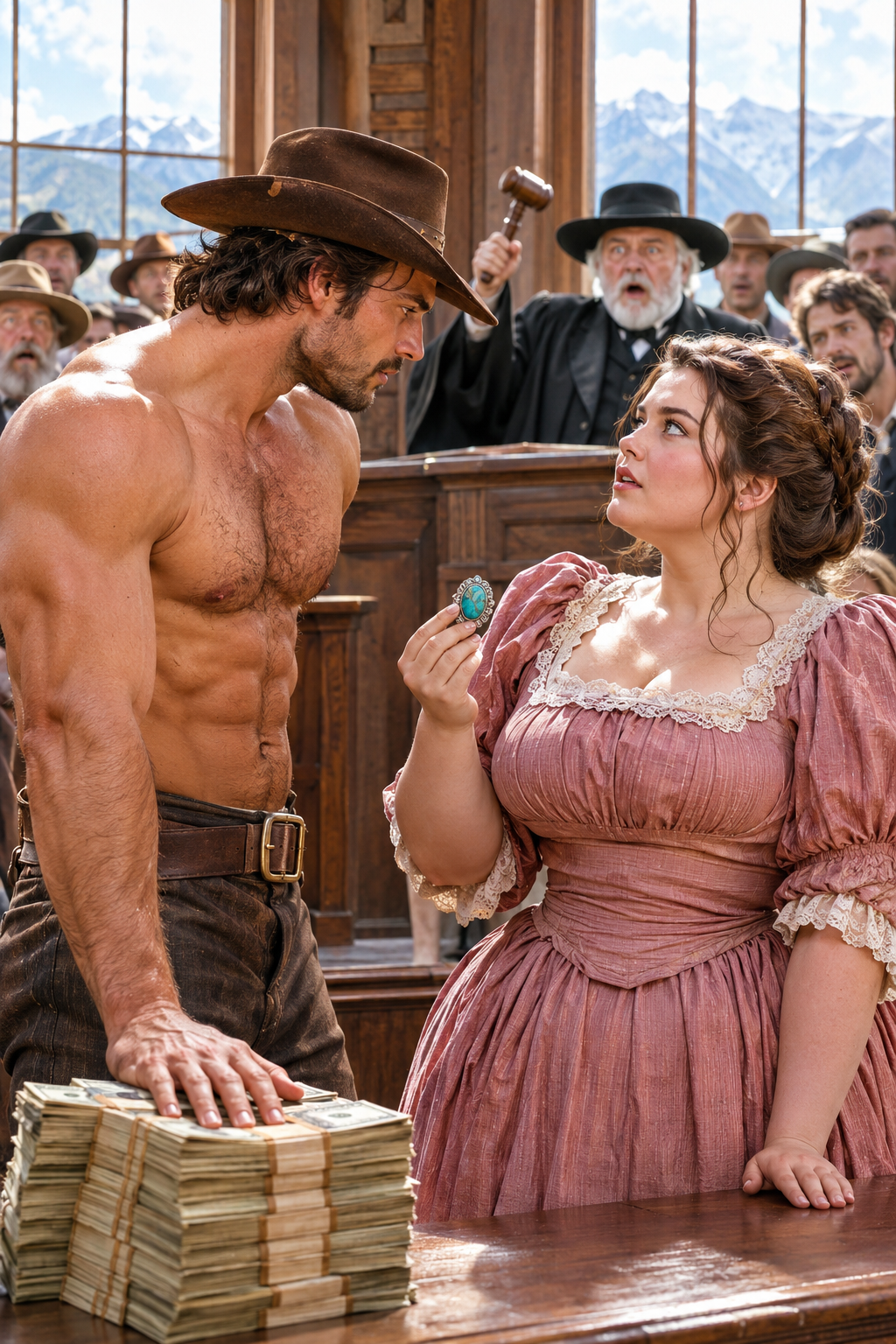
“Twenty-five dollars,” Grant Walker said, raising his hand.
“The man who sent your father up this mountain,” Grant said quietly, “was the same man who stood beside his grave and promised to take care of you.”
Rebecca felt the cold settle somewhere deeper than her bones.
“Silas Whitmore?”
Grant nodded.
For a moment, the howling wind seemed to disappear. Silas Whitmore owned the bank, the general store, and half the land surrounding Pine Hollow. He had paid for her father’s funeral. He had extended credit when Lucy first became ill. Only yesterday, he had offered to purchase their little cabin, claiming it would spare Rebecca the burden of another winter.
“You’re lying,” she whispered.
“I wish I were.”
“Then why didn’t you tell me three years ago?”
Grant looked away.
“Because I was afraid.”
The admission struck harder than any excuse he could have offered.
Rebecca opened the leather pouch with trembling fingers. Inside lay a folded letter, a small brass key, and a silver pocket watch she recognized immediately.
Her father had carried that watch every day of his life.
She opened it.
The hands had stopped at eleven seventeen.
Beneath the watch lay a sheet of paper covered in her father’s familiar handwriting.
Rebecca unfolded it carefully.
If anything happens to me, do not trust Silas Whitmore. The deeds are false. The valley belongs to the families who settled it, not the man who claims to own it.
Her breath caught.
At the bottom, another sentence had been written so hurriedly that the ink had blurred.
The proof is beneath the place where the river sings without water.
“What does that mean?” she asked.
“I’ve spent three years trying to find out.”
Rebecca looked up sharply.
“Three years?”
Grant swallowed.
“Your father discovered Whitmore had been forging property records. He was taking land from families who couldn’t read the legal documents they signed. Your father found evidence, but Whitmore learned about it before he could reach the territorial judge.”
“And you were there.”
“I was supposed to help him escape.”
Rebecca stared at him.
Grant’s voice grew rough.
“We arranged to meet at Miller’s Pass. But when I arrived, Whitmore’s men were already waiting. Your father had been wounded. He gave me that pouch and told me to ride.”
“You left him?”
“He ordered me to.”
“You could have gone back!”
“I tried.”
Grant’s eyes filled with a pain she had never seen in them.
“By the time I returned with help, the storm had buried everything.”
Rebecca stepped away.
For three years, she had imagined a hundred reasons for Grant’s disappearance. None had involved her father’s final moments.
“Why didn’t you come home?”
“Whitmore accused me of stealing cattle and threatened to have me hanged if I returned. I went south, worked under another name, and gathered enough money to buy the Walker ranch when it went into foreclosure. I thought owning land would give me the power to fight him.”
“And you never thought I deserved the truth?”
Grant lowered his head.
“I thought I was protecting you.”
“You were protecting yourself from having to face me.”
He had no answer.
Before Rebecca could speak again, a horse screamed outside.
Both turned toward the ruined logging camp.
A gunshot cracked through the storm.
Grant seized his rifle.
“Stay here.”
Rebecca caught his arm.
“Don’t you dare leave me behind again.”
Together, they hurried toward the wagons.
The two remaining drivers stood beside the horses, their faces pale. One of them, a young man named Peter Collins, was bleeding from the shoulder.
The other driver, Amos Reed, was nowhere to be seen.
“What happened?” Grant demanded.
Peter pressed a hand against his wound.
“Amos took the horses. Said he’d been paid to make sure the grain never reached Pine Hollow.”
“Paid by whom?”
Peter shook his head.
“He didn’t say. When I tried to stop him, he shot me.”
Rebecca examined the tracks disappearing into the trees.
“Whitmore,” she murmured.
Grant’s expression darkened.
The grain was intended for families whose winter supplies had run out. Whitmore controlled the town’s remaining food stores, and his prices had tripled since the first snowfall.
If Grant’s shipment arrived, Whitmore would lose his hold over the desperate townspeople.
If it didn’t, people might starve.
“We have to get those wagons moving,” Rebecca said.
Grant glanced at the buried trail.
“There’s no road.”
“There is another way.”
He turned toward her.
Rebecca pointed beyond the logging camp, where a narrow ridge vanished into the snow.
“My father called it Widow’s Crossing. It leads down to the old silver mine.”
Grant stared.
“That mine collapsed twenty years ago.”
“Not all of it.”
“How do you know?”
Rebecca touched the pocket watch.
“Because my father took me there when I was a little girl.”
A distant memory stirred.
Water dripping through darkness. Her father’s laughter. A strange humming sound rising from beneath the rocks.
The place where the river sings without water.
Rebecca suddenly understood.
“The proof,” she whispered. “He hid it in the mine.”
Grant studied her face.
“You’re certain?”
“No. But it’s the only place that makes sense.”
They had barely begun preparing the wagons when Peter stumbled toward them.
“Mr. Walker,” he said, his voice shaking. “There’s something else.”
Grant turned.
“Amos wasn’t alone.”
From the forest came the unmistakable sound of approaching horses.
Six riders emerged through the snow, their faces concealed beneath scarves.
The man in front carried a rifle across his saddle.
“Grant Walker!” he shouted. “Step away from the wagons!”
Grant raised his weapon.
“Who sent you?”
The rider laughed.
“You already know.”
Rebecca recognized his voice.
Caleb Voss.
Whitmore’s chief enforcer.
Three years earlier, Caleb had helped carry her father’s coffin.
Now he was pointing a gun at her heart.
“Miss Dawson,” he called pleasantly. “Mr. Whitmore sends his regards.”
Grant moved in front of her.
“What do you want?”
“The pouch. And every paper inside it.”
Rebecca felt the leather beneath her coat.
Caleb smiled.
“Your father caused a great deal of trouble over those documents. It would be unfortunate if his daughter made the same mistake.”
Grant fired.
The shot struck Caleb’s rifle, knocking it from his hands.
Chaos erupted.
The horses reared. Peter threw himself behind a wagon. Bullets shattered the frozen branches overhead.
Grant grabbed Rebecca and pulled her toward the logging camp.
“Run!”
They sprinted through the trees while gunfire followed.
Rebecca knew the mountain better than any of Whitmore’s men. She led Grant between two enormous boulders and down a narrow ravine hidden beneath hanging branches.
Behind them, Caleb shouted orders.
“They’re heading toward the ridge!”
Rebecca stopped abruptly.
A wooden footbridge stretched across a deep gorge.
Its boards were rotten, and one supporting rope had snapped years earlier.
Grant looked at it in disbelief.
“We can’t cross that.”
“We don’t have a choice.”
Rebecca stepped onto the bridge.
It groaned beneath her boots.
Halfway across, a board broke loose and vanished into the darkness.
Grant caught her waist before she fell.
“Keep moving,” he whispered.
They reached the opposite side just as Caleb appeared behind them.
“Stop!”
Rebecca turned and drew the hunting knife from her belt.
With one swift motion, she severed the remaining support rope.
The bridge collapsed into the gorge.
Caleb stumbled backward, cursing.
Rebecca watched him disappear behind the falling snow.
“That will slow them down.”
Grant stared at her.
“Your father taught you that?”
“He taught me never to wait for a man to rescue me.”
Despite everything, Grant almost smiled.
Then Rebecca’s expression changed.
“But he also taught me that courage means nothing if you abandon the people depending on you.”
She looked toward the wagons they had left behind.
“We’re going back.”
They circled the ridge through an old hunters’ path, reaching the logging camp nearly an hour later.
The wagons were still there.
So was Peter.
But he was lying motionless beside a wheel.
Rebecca rushed to him.
His eyes opened faintly.
“Thought you’d forgotten me.”
“Not a chance.”
Grant knelt and examined the wound.
“The bullet passed through. He’ll live if we get him warm.”
Peter gripped Grant’s sleeve.
“Amos came back.”
Rebecca froze.
“When?”
“After the shooting. He took the last good team and headed toward town.”
Grant looked at the remaining horses.
They had four animals for two heavily loaded wagons.
Not enough to haul both through the deep snow.
Rebecca studied the grain sacks.
“How much can we carry?”
“Maybe half,” Grant answered.
“Then we take half.”
“We’ll lose thousands.”
Rebecca met his eyes.
“People are worth more than grain.”
Grant held her gaze.
Then he nodded.
They spent the next two hours transferring supplies onto the strongest wagon. Peter lay beneath blankets while Rebecca bound his shoulder with strips torn from her underskirt.
By late afternoon, they reached Widow’s Crossing.
The path was barely wide enough for the wagon wheels.
On one side rose a wall of black stone. On the other, the mountain dropped into a valley swallowed by clouds.
Grant walked beside the horses, guiding them carefully.
Rebecca rode ahead, searching for the landmarks her father had shown her.
At last, she saw it.
A crooked pine growing from a split in the rock.
Beyond it stood the entrance to the abandoned silver mine.
Rebecca dismounted.
“We’re here.”
The entrance was half buried beneath snow and fallen timber.
Grant helped her clear the opening while Peter rested beside the wagon.
Inside, the darkness smelled of damp stone and ancient wood.
Rebecca lit a lantern.
The mine stretched before them like the throat of some sleeping creature.
“Stay close,” she said.
Grant followed.
They passed rusted tracks and abandoned mining tools. Water dripped from the ceiling, freezing into delicate spears along the walls.
Then Rebecca heard it.
A low, musical humming.
She stopped.
“The river.”
Grant listened.
“I don’t hear water.”
“That’s why Father called it the river without water.”
She raised the lantern.
Wind was passing through narrow openings in the rock, producing a haunting melody.
Rebecca remembered sitting on her father’s shoulders while he explained how the mountain could sing.
Tears blurred her vision.
“He brought me here on my tenth birthday.”
Grant said nothing.
“He told me that someday, when I was frightened and didn’t know which way to turn, I should listen for the mountain’s voice.”
She wiped her cheeks.
“I thought he’d forgotten that promise.”
They followed the sound into a small chamber.
At its center stood a stone pillar marked with an old miner’s symbol.
Rebecca knelt beside it.
The brass key from the pouch fit a narrow opening beneath the symbol.
She turned it.
Something clicked.
A hidden compartment slid open.
Inside lay a metal box wrapped in oilcloth.
Grant’s breath caught.
Rebecca lifted the lid.
There were dozens of documents: property deeds, bank records, letters bearing Whitmore’s signature, and a ledger filled with payments to men who had threatened or killed settlers.
One entry made Rebecca’s blood turn cold.
October 14. Dawson. Eliminate before hearing. Payment: $200.
Her father’s death had not been an accident.
It had been purchased.
Rebecca pressed the ledger against her chest.
For a long moment, she could not speak.
Grant reached toward her, then hesitated.
“Rebecca…”
She looked at him.
“Did you know?”
“I suspected.”
“Did you know Whitmore ordered his murder?”
“No. I swear I didn’t.”
She searched his face.
For the first time in three years, she believed him.
Then another sound echoed through the mine.
Slow footsteps.
A voice emerged from the darkness.
“How touching.”
Silas Whitmore stepped into the chamber, holding a revolver.
Caleb Voss appeared behind him.
Rebecca instinctively backed toward Grant.
Whitmore smiled.
“I wondered whether your father had hidden those papers somewhere clever. I must admit, Miss Dawson, you’ve exceeded my expectations.”
Grant raised his rifle.
Caleb pressed his own weapon against Peter’s head.
The injured driver stood between two armed men near the chamber entrance.
“Put it down,” Whitmore ordered.
Grant obeyed.
Rebecca’s heart pounded.
“You killed my father.”
Whitmore sighed.
“Your father was an unfortunate man who confused stubbornness with righteousness.”
“He was trying to protect people.”
“He was interfering with progress.”
“You stole their homes!”
“I acquired land from people incapable of managing it.”
Rebecca held up the ledger.
“And paid men to murder anyone who objected?”
Whitmore’s smile vanished.
“Give me the box.”
“No.”
His revolver shifted toward Grant.
“Don’t make this difficult.”
Rebecca looked at Grant.
His eyes pleaded with her to surrender the documents.
But something else caught her attention.
Behind Whitmore, a narrow crack ran through the chamber wall.
Cold air whistled through it.
Above the crack hung a rusted iron chain attached to an old mining support.
Her father had once warned her about that chain.
Never pull it unless you want the whole mountain to wake up.
Rebecca slowly lowered the box.
“You win,” she whispered.
Whitmore extended his hand.
She stepped forward.
Then she threw the lantern at his feet.
Glass shattered.
Flames burst across the oil-stained floor.
Whitmore screamed and stumbled backward.
Rebecca seized the hanging chain.
“GRANT, GET DOWN!”
She pulled.
A deafening crack split the chamber.
The ancient wooden supports gave way.
Rocks thundered from the ceiling.
Grant tackled Peter and dragged him toward the entrance as the mine began to collapse.
Rebecca grabbed the metal box.
Whitmore lunged for her.
His fingers closed around her coat.
“You little fool!”
He struck her across the face.
She fell, dropping the box.
Papers scattered across the stone.
Whitmore scrambled after them.
Rebecca struggled to rise.
A massive beam crashed between her and the exit.
Grant appeared through the dust.
“Rebecca!”
“Go!” she shouted.
He climbed over the fallen timber.
“I’m not leaving you!”
Another explosion shook the mine.
Rebecca saw Whitmore trapped beneath a collapsed support, his leg pinned against the ground.
The ledger lay inches from his hand.
He reached desperately toward it.
“Help me!” he screamed.
Rebecca stared.
This was the man who had destroyed her family.
The man whose greed had left Lucy shivering beneath thin blankets.
The man who had ordered her father killed.
For one terrible moment, she wanted to walk away.
Then she remembered her father’s voice.
The measure of a person isn’t how they treat those who love them. It’s what they choose when hatred would be easier.
Rebecca turned toward Grant.
“Help me lift this beam.”
Grant stared at Whitmore.
“He’ll kill us.”
“Not if we get him out first.”
Together, they heaved the timber upward.
Whitmore dragged his injured leg free.
Grant pulled him toward the exit while Rebecca gathered the ledger and as many documents as she could carry.
Behind them, the chamber collapsed.
They stumbled into the snow just as the mine entrance disappeared beneath a roaring cloud of dust.
Rebecca fell to her knees.
For several seconds, nobody spoke.
Then Whitmore began laughing.
“You think you’ve won?”
Grant turned toward him.
Whitmore wiped blood from his mouth.
“The sheriff belongs to me. The judge owes me money. Half the town survives because I allow it.”
Rebecca stood slowly.
“Then we’ll find someone you don’t own.”
Whitmore smiled.
“You won’t live long enough.”
He reached inside his coat.
Grant moved first.
A single gunshot echoed across the valley.
Whitmore collapsed.
His revolver slipped from his fingers.
Grant stood above him, smoke rising from his rifle.
For a moment, Rebecca thought Whitmore was dead.
Then the banker groaned.
The bullet had struck his shoulder.
Grant lowered his weapon.
“You’ll stand trial,” he said.
“And this time, the truth won’t be buried.”
They bound Whitmore’s hands and Caleb’s as well, using rope from the wagon.
By nightfall, the storm had begun to ease.
The stars emerged above the mountains, cold and brilliant.
Rebecca sat beside a small fire while Grant checked the horses.
Peter slept beneath blankets, his breathing steady.
The metal box rested between them.
Grant approached quietly.
“Your cheek is swelling.”
“I’ve had worse.”
He sat beside her.
For a while, they watched the flames.
Finally, Grant spoke.
“I loved you, Rebecca.”
She closed her eyes.
“Don’t.”
“I loved you when I left. I loved you every day I was gone.”
“Love doesn’t excuse disappearing.”
“I know.”
“You could have written.”
“I was afraid Whitmore would intercept the letters.”
“You could have found another way.”
“Yes.”
His simple agreement surprised her.
Grant stared into the fire.
“I spent three years convincing myself that returning wealthy would make up for leaving you alone. I thought if I could defeat Whitmore, you’d forgive me.”
Rebecca’s voice softened.
“You should have trusted me enough to let me decide.”
“I should have.”
He reached into his coat and withdrew the turquoise brooch.
Its silver edges glimmered in the firelight.
“Your mother gave this to your father on their wedding day,” he said.
Rebecca looked up.
“How do you know?”
“Your father told me. He said she bought it with money she’d saved for winter boots.”
A small, broken laugh escaped her.
“That sounds like Mother.”
“He told me she wore it whenever she needed courage.”
Grant placed it on the blanket beside her.
“I didn’t buy it because I thought you needed saving. I bought it because I couldn’t bear to see Whitmore’s clerk bidding against you.”
Rebecca looked sharply at him.
“Whitmore wanted it?”
“His clerk was bidding until I raised the price. I think Whitmore suspected your father had hidden something inside it.”
Rebecca picked up the brooch.
She turned it over.
A tiny scratch marked the back.
Not a scratch.
A letter.
L.
Her mother’s name had been Eleanor.
Rebecca frowned.
Then she pressed the turquoise stone.
A small silver plate sprang loose.
Inside was a tightly folded scrap of paper.
Grant leaned closer.
Rebecca unfolded it.
There were only six words.
Trust the woman at Blackwater Station.
Beneath them was a name.
Margaret Hale.
Grant stared at the message.
“Margaret Hale is the territorial circuit judge.”
Rebecca’s heart quickened.
“Then Father knew whom to trust.”
Grant nodded slowly.
“And Blackwater Station is two days east.”
Rebecca looked toward the sleeping Peter, the exhausted horses, and the wagon filled with grain.
“We can’t reach it before Whitmore’s men come looking.”
Grant studied the stars.
“Maybe we don’t have to.”
By dawn, they had devised a plan.
They would return to Pine Hollow openly, bringing Whitmore and Caleb as prisoners.
But the documents would travel separately.
Peter, whose wound had been carefully bound, volunteered to carry the ledger and the most important papers to Blackwater Station.
He would ride Grant’s fastest horse along a sheltered route through the southern foothills.
Rebecca hesitated.
“You’re injured.”
Peter smiled weakly.
“My brother lost his farm to Whitmore last spring. I’ve been waiting for a chance to do something about it.”
Grant placed the metal box in his hands.
“Ride carefully.”
Peter nodded.
Then he disappeared into the morning mist.
Rebecca and Grant began the slow descent toward Pine Hollow.
They reached town shortly before sunset.
Smoke rose from the chimneys.
Children played near the frozen well.
Everything looked ordinary.
But the moment the townspeople saw Silas Whitmore bound to the wagon, the street fell silent.
The sheriff emerged from his office.
“What in God’s name is this?”
Grant dismounted.
“Silas Whitmore is under arrest for fraud, conspiracy, and murder.”
The sheriff’s face turned pale.
“You can’t arrest Mr. Whitmore!”
“Then perhaps you’d like to explain why.”
Whitmore straightened despite his injuries.
“Sheriff, release me.”
The sheriff reached for his revolver.
Rebecca stepped forward.
“Before you do that, ask yourself how many people here have lost their land because of him.”
A crowd began gathering.
Old Mrs. Bennett pushed through the people.
“My husband died believing he’d signed away our farm because he couldn’t pay his debts.”
A blacksmith named Thomas Gray spoke next.
“Whitmore took my workshop after claiming I owed interest I never agreed to.”
More voices rose.
The sheriff hesitated.
Whitmore’s expression hardened.
“These people are liars!”
Rebecca climbed onto the wagon.
“My father discovered that Whitmore forged deeds and paid men to threaten anyone who resisted. That’s why my father was murdered.”
The crowd went still.
“Where’s your proof?” the sheriff demanded.
“On its way to Judge Margaret Hale.”
Whitmore’s eyes widened.
For the first time, Rebecca saw genuine fear on his face.
Then a familiar voice cut through the crowd.
“Rebecca!”
Lucy stood outside the general store.
Her face was pale, and she was wrapped in a blanket.
Rebecca jumped from the wagon.
“Lucy!”
Her sister staggered toward her.
“I tried to stop them.”
Rebecca caught her.
“Stop whom?”
Lucy’s lips trembled.
“Whitmore’s men. They came to the cabin looking for Father’s papers.”
Rebecca felt her stomach drop.
“What happened?”
“They burned it.”
The words struck like a physical blow.
Their home.
Their mother’s quilts.
Their father’s books.
Every memory they had struggled to preserve.
Gone.
Rebecca turned toward Whitmore.
He looked almost pleased.
“Some lessons,” he said softly, “are expensive.”
Grant seized him by the collar.
But Rebecca caught Grant’s wrist.
“No.”
Her voice was steady.
“He doesn’t get to turn us into people like him.”
She faced the crowd.
“Whitmore thinks he owns this town because he owns its buildings. But a town isn’t made of buildings. It’s made of people.”
She looked at the faces surrounding her.
“And if we keep letting fear decide what we do, he’ll never need another gun.”
For a moment, nobody moved.
Then Mrs. Bennett stepped forward.
“The girls can stay with me.”
Thomas Gray raised his hand.
“I’ve got spare lumber. We can build another cabin.”
The baker offered bread.
The stable owner offered blankets.
One by one, the townspeople stepped forward.
Rebecca began to cry.
Not because she had lost her home.
But because, for the first time since her father’s death, she no longer felt alone.
Three days later, Judge Margaret Hale arrived in Pine Hollow with six territorial marshals.
Peter rode beside her, pale but smiling.
He had delivered the documents.
The judge called a public hearing in the church, the only building large enough to hold the crowd.
Whitmore sat between two marshals, his shoulder bandaged.
Caleb Voss had already confessed.
The ledger, forged deeds, and bank records were presented before the townspeople.
One by one, witnesses described threats, false debts, and stolen property.
Then Judge Hale read aloud the entry ordering Rebecca’s father’s death.
A terrible silence filled the church.
Rebecca sat beside Lucy, gripping her sister’s hand.
For three years, she had wondered whether her father had died because of a mistake.
Now she knew.
He had died because he refused to abandon what was right.
When the hearing ended, Judge Hale rose.
“Silas Whitmore, you will be held for trial on charges including conspiracy to commit murder, fraud, and unlawful seizure of property.”
The marshals escorted him outside.
As he passed Rebecca, he stopped.
“You think this changes anything? You’ll still be poor.”
Rebecca looked at him calmly.
“Maybe.”
Then she smiled.
“But I’ll never be as empty as you.”
Whitmore lowered his eyes.
Within weeks, Judge Hale secured orders preventing further sales of the disputed properties while the territorial court reviewed their ownership.
Families who had spent years living in fear began returning to their homes.
Grant opened his grain stores and sold supplies at cost, allowing families without money to repay him after spring.
Rebecca organized a community kitchen in the church, where nobody was turned away hungry.
Lucy slowly recovered.
And when the first warm winds began melting the snow, the townspeople gathered at the remains of the Dawson cabin.
They came carrying hammers, saws, boards, and buckets of nails.
Grant arrived with two wagons of timber.
Rebecca stood beside the ruined foundation, overwhelmed.
“You don’t have to do all this,” she whispered.
Thomas Gray laughed.
“Your father helped build half the homes in this valley. It’s about time we returned the favor.”
By sunset, the new walls were standing.
By the end of the week, there was a roof.
And by the first Sunday of spring, Rebecca and Lucy had a home again.
One evening, Rebecca found Grant repairing the front steps.
He had been coming by every day, helping wherever he was needed.
But he had never asked her for anything.
“Grant,” she said.
He looked up.
“Do you ever think about leaving again?”
He set down his hammer.
“Every time I remember what I did to you, I think perhaps you’d be happier if I stayed away.”
Rebecca sat beside him.
“For a long time, I thought forgiveness meant pretending the hurt never happened.”
Grant waited.
“But I don’t believe that anymore. Forgiveness means deciding the hurt doesn’t get to control the rest of your life.”
She looked toward the mountains, now glowing beneath the setting sun.
“I can’t promise I’ll forget those three years.”
“I wouldn’t ask you to.”
“And I can’t promise everything will be easy.”
“I don’t expect it to be.”
Rebecca reached for his hand.
“But if you want to stay, you’ll have to learn something.”
Grant’s voice was barely a whisper.
“What’s that?”
“How to face the hard things beside me instead of trying to carry them alone.”
He closed his fingers around hers.
“I think I can learn.”
Rebecca smiled.
“Good. Because the fence behind the barn needs fixing.”
Grant laughed.
It was the first time she had heard that sound without feeling the ache of what they had lost.
A year later, on a bright morning in early June, the little church in Pine Hollow filled with flowers.
Rebecca walked down the aisle wearing her mother’s turquoise brooch.
Lucy stood beside her, healthy and radiant.
Grant waited at the altar, his eyes shining.
Their wedding was simple.
There were no expensive decorations, no grand promises of an effortless future.
Only two people who had learned how costly silence could be, and how precious honesty was.
After the ceremony, Rebecca and Grant rode to the hill overlooking the valley.
They stopped beside a small stone marker beneath an old pine.
Her father’s grave.
Rebecca knelt and placed a handful of wildflowers against the stone.
“We did it, Papa,” she whispered.
“The valley is free.”
Grant stood quietly behind her.
Rebecca touched the turquoise brooch.
For years, she had believed her father’s greatest gift was the courage he had taught her.
Now she understood there had been something greater.
He had taught her that courage was not the absence of fear, and love was not the absence of mistakes.
Courage meant choosing what was right when fear demanded silence.
Love meant staying, telling the truth, and doing the difficult work of rebuilding trust.
And forgiveness did not require surrendering justice.
It required refusing to let bitterness become the final chapter.
Rebecca rose and took Grant’s hand.
Below them, Pine Hollow stretched across the green valley.
Smoke curled from chimneys.
Children chased one another through the fields.
The land her father had fought to protect was alive with possibility.
Grant kissed her forehead.
“Ready to go home?”
Rebecca looked toward their little cabin, where Lucy was waiting with supper and the promise of another ordinary, beautiful evening.
Then she smiled.
“Yes.”
Together, they rode down the hillside.
And behind them, the mountains stood silent beneath the golden sky, keeping their ancient secrets.
But the truth that mattered most had finally found its way home.
Because in the end, the greatest wealth a person could possess was never the land beneath their feet or the money locked inside a bank.
It was the trust they earned, the people they stood beside, and the courage to do what was right even when doing so might cost them everything.
The years that followed brought changes to Pine Hollow that Rebecca could never have imagined during that terrible winter.
The town grew stronger. Families who had once feared losing everything began planting crops again, repairing their homes, and building futures for their children.
Grant kept his promise to Rebecca. He never again allowed fear or pride to stand between them. Whenever trouble came, they faced it together.
Lucy eventually became the town’s first schoolteacher. She taught her students to read, write, and understand the documents they signed, determined that no one in Pine Hollow would ever again lose their home simply because they could not recognize a dishonest man’s words.
Rebecca and Grant welcomed two children, a daughter named Eleanor and a son named Henry, named after Rebecca’s parents.
On summer evenings, Rebecca often sat on the porch with her children, telling them stories about their grandfather.
She never described him as a fearless man.
Instead, she told them that he had been an ordinary man who sometimes worried, sometimes made mistakes, and sometimes doubted himself.
But when the moment came to choose between protecting himself and protecting others, he had chosen what was right.
One evening, little Henry looked up at his mother.
“Was Grandfather a hero?”
Rebecca smiled and brushed the hair from his forehead.
“Yes, sweetheart. But not because he was stronger than other men.”
“Then why?”
“Because he understood that doing the right thing matters most when doing the wrong thing would be easier.”
Henry considered this seriously.
“Can ordinary people become heroes?”
Rebecca looked across the yard.
Grant was helping Eleanor repair a broken wooden gate. Lucy was walking up the path carrying books for the schoolchildren.
Beyond them, the valley glowed beneath the setting sun.
“Every single day,” Rebecca answered.
Many years later, when Rebecca’s hair had turned silver and her children had families of their own, the turquoise brooch remained her most treasured possession.
Its silver had grown dull, and the stone carried tiny scratches from decades of wear.
But Rebecca never had it polished.
Every mark reminded her of a chapter in her life: the winter she nearly lost everything, the mountain that revealed her father’s secret, the man who returned to earn her trust, and the neighbors who taught her that family could extend far beyond blood.
When Eleanor’s daughter married, Rebecca placed the brooch in her granddaughter’s hands.
“This belonged to your great-grandmother,” she said. “It has traveled through more sorrow and happiness than you can imagine.”
Her granddaughter examined the beautiful turquoise stone.
“Is it valuable?”
Rebecca smiled.
“Not in the way most people measure value.”
“Then why have you kept it so long?”
“Because it reminds me of something I never want our family to forget.”
“What is it?”
Rebecca gently closed the young woman’s fingers around the brooch.
“That you may lose your money, your home, or even the people you love. Life can take things from you that you never believed you could survive without.”
Her granddaughter listened silently.
“But as long as you hold on to your integrity, your compassion, and the courage to begin again, you have not lost everything.”
Outside, the church bells began to ring.
Rebecca turned toward the window, where the mountains stood beneath the clear blue sky.
For an instant, she remembered herself as a frightened young woman standing at an auction, watching the last precious reminder of her mother pass into another person’s hands.
She had believed that day marked the beginning of her final defeat.
Instead, it had been the beginning of a life she could never have imagined.
And at last, she understood something her father had tried to teach her long ago.
The darkest moments of our lives do not always announce the end of our story.
Sometimes, they are simply the place where our greatest courage begins.
THE END.