“Touch that motorcycle again, kid, and you’ll regret it,” the biker growled.
Frank’s silence frightened Leon more than the biker’s question.
The boy had learned that adults asking about home usually meant trouble. Sometimes they meant police officers. Sometimes they meant strangers who promised help and disappeared. And sometimes they meant being sent somewhere he couldn’t find his way back from.
“I’m okay,” Leon whispered.
The biker studied him. “That wasn’t what I asked.”
Leon tightened his grip on the minibike’s rusty handlebars.
Frank stepped forward. “His mother passed away last winter. His father’s been gone longer than that.”
“Frank,” Leon pleaded.
The mechanic’s expression crumpled. “I’m sorry, son. But we can’t keep pretending everything’s fine.”
The biker slowly rose to his full height.
“Where does he sleep?”
Frank looked toward the abandoned gas station across the highway.
The biker followed his gaze.
For the first time since entering the shop, the enormous man’s face showed something other than anger.
It showed fear.
“Tell me that kid isn’t sleeping over there.”
Leon immediately interrupted. “It’s not that bad. The roof only leaks when it rains hard.”
The biker closed his eyes.
His name was Gabriel Mercer, although most people along the desert highways knew him as Bear.
At forty-six, Bear had spent twenty-three years riding motorcycles, sixteen years leading a brotherhood called the Iron Guardians, and nearly a decade convincing himself that nothing could hurt him anymore.
But one sentence from an eight-year-old boy had just reached a place inside him that had been silent for years.
“The roof only leaks when it rains hard.”
Bear looked at the hundred-dollar bill on the workbench.
Suddenly, it seemed like the smallest thing in the world.
“Frank,” he said quietly, “get the kid something to eat.”
Leon shook his head. “I’m not hungry.”
At that exact moment, his stomach growled.
Frank pretended not to hear.
Bear didn’t.
“Kid, I once rode four hundred miles on an empty stomach. Almost passed out at a stoplight. Being hungry doesn’t make you weak.”
Leon glanced toward the refrigerator in the corner.
Frank opened it and pulled out a sandwich, an apple, and a bottle of water.
“Sit down, son.”
Leon obeyed reluctantly, but before taking a bite, he looked at Bear.
“Are you going to take my minibike?”
Bear frowned. “Why would I do that?”
“Because people usually take things back when they find out about me.”
The words settled heavily between the three of them.
Bear crouched again.
“That machine belongs to you. Frank gave it to you, and I heard him. Nobody’s taking it.”
Leon nodded, though his expression remained suspicious.
Bear stood and turned toward Frank.
“We need to talk.”
They walked outside, leaving the shop door open so Leon could still see them.
Under the merciless afternoon sun, Bear asked the question Frank had been dreading.
“How long has this been going on?”
Frank rubbed his forehead.
“His mother, Maria, died eleven months ago. Worked at the diner down the road. Good woman. Hard worker. She and Leon lived in a little trailer behind the gas station.”
“What happened to the trailer?”
“Landlord sold the property. New owner had it hauled away. Leon disappeared before anyone could arrange something proper.”
“Nobody reported him missing?”
“Maria had no family nearby. Leon kept telling everyone an uncle was coming.”
Bear looked through the doorway.
The boy was eating with the desperate concentration of someone trying not to seem desperate.
“And you believed him?”
Frank’s eyes filled with shame.
“No. But whenever I brought up getting help, he’d run. I tried letting him sleep in the storeroom, but the building inspector warned me about keeping anyone there overnight. I gave him food, clothes when I could, and work to make him feel like he was earning it.”
“He’s eight years old, Frank.”
“I know.”
“He’s not supposed to be earning his dinner.”
Frank stared at the dirt.
“I know that too.”
Bear wanted to shout. Instead, he looked at the old mechanic’s exhausted face and realized Frank had been keeping his failing business alive while trying to keep a frightened child from disappearing completely.
“Then we do this the right way,” Bear said.
Frank looked up. “What does that mean?”
“It means he doesn’t spend another night in that gas station.”
Inside, Leon had stopped chewing.
He had heard every word.
And by the time Bear returned, the boy was gone.
The sandwich lay unfinished on the chair.
The minibike was missing.
“Leon?” Frank called.
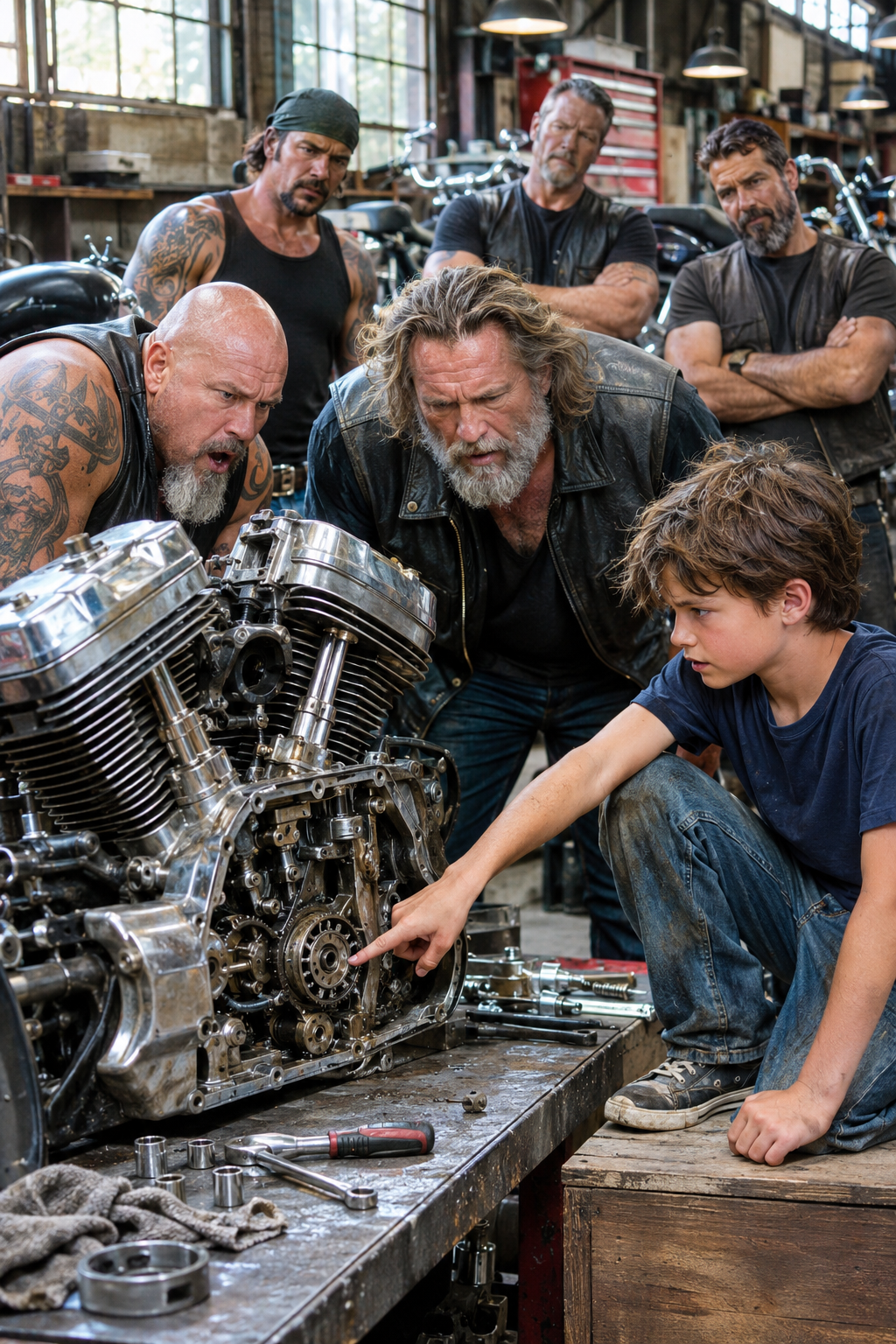
No answer.
Bear hurried to the back door.
Beyond the shop stretched a maze of junked vehicles, rusted fences, and sun-scorched service roads.
A small trail of dust was rising toward the abandoned gas station.
“He’s running,” Frank said.
Bear grabbed his helmet.
“No,” he replied. “He’s scared.”
They found Leon twenty minutes later behind the gas station, dragging the minibike toward a broken storage shed.
His face was wet with tears, although he angrily wiped them away when Bear approached.
“You said it was mine!”
“It is yours.”
“Then leave me alone!”
Bear stopped several feet away.
“Okay.”
Leon blinked.
“What?”
“I said okay. I’m not going to grab you.”
The biker sat on an overturned concrete block.
For a long moment, neither spoke.
Then Bear noticed something wedged into the minibike’s damaged seat.
A photograph.
A young woman with dark curly hair held a toddler in front of a Christmas tree.
Both were smiling.
“Your mom?” Bear asked.
Leon quickly covered the photograph.
“Don’t touch it.”
“I won’t.”
Another silence followed.
Then Leon whispered, “She said if anything happened, I should find someone good.”
Bear swallowed.
“She sounds smart.”
“She was.”
“Did you find anybody?”
Leon looked toward Frank’s shop.
“Frank’s good. But he’s getting old, and sometimes he doesn’t have money for food.”
Bear glanced at the minibike.
“And why do you care so much about fixing that thing?”
Leon hesitated.
“Because Mom said Dad knew everything about motorcycles. She said he could hear when an engine was sick.”
“Sounds like you inherited something.”
Leon shook his head.
“I never met him. Mom said he left before I was born.”
Bear felt something move inside his chest.
Not suspicion.
Memory.
His younger brother, Daniel, had vanished from his life eleven years earlier after a terrible argument about money, responsibility, and the kind of man Daniel wanted to become.
Daniel had been a gifted mechanic.
He also had been stubborn, reckless, and painfully proud.
Bear had spent years searching for him.
Then the letters stopped.
And eventually Bear stopped looking.
“Leon,” Bear asked carefully, “what was your father’s name?”
The boy lowered his eyes.
“Daniel.”
Bear’s breath caught.
“Daniel what?”
“Mom said his name was Daniel Mercer.”
For a moment, the desert seemed to stop breathing.
Bear stared at the child.
“Mercer?”
Leon nodded.
“My last name too.”
The biker slowly removed his sunglasses.
Eleven years ago, Daniel Mercer had walked out of a garage in Phoenix after Gabriel accused him of stealing money from the family business.
The accusation had been wrong.
Gabriel discovered the truth three months later, when the accountant confessed to taking the money.
By then, Daniel had disappeared.
Gabriel had written letters, searched old addresses, and visited every garage where Daniel might have found work.
But he had never found his brother.
And now a hungry child sat before him with Daniel’s eyes, Daniel’s dark hair, and Daniel’s extraordinary ability to diagnose a motorcycle by listening.
Bear gripped the edge of the concrete block.
“Your mother,” he asked, “was her name Maria Alvarez?”
Leon froze.
“How do you know?”
Bear could barely speak.
Because he remembered her.
A young waitress in Phoenix who loved Daniel when nobody else believed he deserved love.
A woman who once stood in Gabriel’s garage doorway and told him, “One day you’ll regret how you treated your brother.”
Gabriel looked at Leon.
“Kid, I think your dad was my little brother.”
Leon stepped backward.
“You’re lying.”
“I wish I had known about you sooner.”
“Then where is he?”
The question struck harder than any punch Bear had ever taken.
“I don’t know.”
Leon shook his head fiercely.
“Mom said he was coming back.”
Bear stared at the photograph.
“Maybe he was trying.”
“No! She said he loved me!”
“I’m not saying he didn’t.”
“Then why didn’t he come?”
Bear had no answer.
And that was when he realized the most painful part of meeting his nephew wasn’t discovering how Leon had been living.
It was understanding that the boy had spent his whole life waiting for a man who might never return.
Bear took out his phone.
“Frank, bring your truck. And call someone who can help us arrange a safe place for Leon to stay.”
Leon panicked.
“No! Please!”
Bear immediately lowered the phone.
“Listen to me. Nobody gets to promise you something they can’t guarantee. But I can promise this: I’m going to find out what happened to your father. And I’m not walking away from you today.”
Leon stared at him.
“Even if I’m trouble?”
Bear’s voice broke.
“Especially then.”
That evening, Bear made three phone calls that changed everything.
The first went to a county child welfare worker, who agreed to meet them at Frank’s shop and begin arranging emergency care.
The second went to an attorney named Evelyn Brooks, who had helped several members of the Iron Guardians through difficult family situations.
The third went to a man named Marcus Reed.
Marcus had ridden beside Bear for eighteen years. He was a former military investigator, a father of three, and the only person Gabriel trusted to uncover the truth without frightening Leon.
“Find Daniel,” Bear told him.
Marcus paused.
“Gabriel, we’ve been looking for your brother for years.”
“Then look again.”
“Something changed?”
Bear watched Leon sleeping on Frank’s office couch after finally accepting a full dinner.
“Everything changed.”
By midnight, Bear learned that Daniel had not simply disappeared.
He had been arrested nine years earlier in Nevada for possession of a stolen motorcycle.
The charges were dismissed when the actual thief was identified, but Daniel had lost his job and fallen behind on bills.
After that, records became scattered.
A hospital admission in Arizona.
Temporary employment in New Mexico.
A mechanic’s license application in Colorado that was never completed.
And then nothing.
Marcus called again at sunrise.
“I found something you need to see.”
Bear stepped outside.
“What?”
“Daniel’s last known mailing address was a veterans’ rehabilitation residence outside Flagstaff.”
Bear went still.
“Daniel never served.”
“I know.”
“Then why was he living there?”
“Because the residence also accepted civilians with traumatic brain injuries.”
Bear leaned against the shop wall.
Marcus continued.
“There was a traffic accident seven years ago. Daniel was riding as a passenger in a delivery truck. The driver lost control on an icy road.”
“Was Daniel seriously hurt?”
“Very.”
“Is he alive?”
A long silence.
“I don’t know yet.”
Bear closed his eyes.
For years, he had imagined confronting Daniel, demanding explanations, making apologies, perhaps finally repairing what had been broken.
He had never imagined his brother might have been unable to find his way home.
Inside the shop, Leon was already awake.
He stood beside the minibike, studying its bent chain guard.
When Bear entered, the boy glanced up.
“Did you find him?”
Bear knelt.
“Not yet. But I found a place where he might have been.”
Leon’s face brightened.
“Can we go?”
“First, we need to make sure you’re safe.”
The child looked disappointed.
Bear continued, “And we need to fix something else.”
“What?”
“That minibike.”
For the first time since meeting him, Leon smiled without fear.
Over the next three days, Frank’s shop became something it hadn’t been in years.
Busy.
Eight members of the Iron Guardians arrived with tools, food, replacement tires, and enough spare parts to rebuild three motorcycles.
Marcus brought a new chain.
A rider named Duke donated a miniature helmet.
Another member, Samuel, found a replacement carburetor.
The child welfare worker, Ms. Carter, visited daily.
She helped document Leon’s circumstances, locate his birth records, and arrange temporary placement in an approved foster home nearby while Bear’s family relationship and suitability for kinship care were evaluated.
Leon hated the idea of leaving the shop.
But Bear came every afternoon with Ms. Carter’s permission.
And every afternoon, they worked on the minibike.
Frank watched from his workbench, quietly overwhelmed by the sight of a child who had once hidden behind tires now asking questions without apologizing.
On Thursday, Leon discovered that the replacement carburetor had a sticking float.
“Bear, this one won’t work right.”
Duke laughed.
“Kid, that thing came out of a working engine.”
Leon pointed toward the fuel inlet.
“Look. The needle doesn’t move when the float drops.”
Duke examined it.
His smile disappeared.
“Well, I’ll be damned.”
Frank chuckled.
“Told you he notices things.”
Bear put one broad hand on Leon’s shoulder.
“Your father used to do exactly that.”
Leon smiled.
Then asked, “Do you think he’d like me?”
Bear turned toward him.
For a second, he saw Daniel at twelve years old, standing beside their father’s broken truck, waiting desperately for someone to say he had done something right.
“He’d be proud of you,” Bear answered.
But that night, Marcus called with news that threatened to destroy the fragile hope they had built.
“I found Daniel.”
Bear sat upright.
“Where?”
“A long-term care facility in northern Arizona.”
“Alive?”
“Yes.”
Bear covered his mouth.
“But Gabriel, there’s something else.”
“What?”
“Daniel suffered significant memory loss after the accident. He had no reliable identification when he arrived at the hospital. They spent months trying to establish his identity.”
Bear struggled to breathe.
“Why didn’t anyone contact us?”
“His records were incomplete. He was transferred under a provisional name. Eventually, they located old employment documents, but his emergency contact information was outdated.”
“And now?”
“He’s regained some memories. But there are things he can’t remember clearly.”
“Does he know he has a son?”
Marcus’s voice softened.
“I don’t think so.”
Bear sat in the darkness for a long time.
Then he looked across the room at a photograph of himself and Daniel, taken when they were teenagers.
Two brothers on an old motorcycle.
Two boys convinced they would always have each other’s backs.
He began to cry.
Not because Daniel was alive.
But because his brother had been alive all those years, suffering alone, while Gabriel had allowed guilt and pride to convince him there was nothing more he could do.
The following morning, Bear met Ms. Carter and Evelyn.
Together, they arranged a supervised visit to Daniel’s care facility.
Leon was told the truth gently.
His father was alive.
He had been injured.
And he might not remember everything.
The boy listened without interrupting.
Then he asked, “Does he still know how to fix motorcycles?”
Bear gave a shaky laugh.
“I guess we’ll find out.”
They drove north before sunrise on Saturday.
Leon sat in the back seat of Bear’s truck, holding his mother’s photograph in both hands.
Outside, the desert gradually gave way to pine-covered mountains.
For most of the journey, Leon remained silent.
Then, less than twenty miles from the facility, he spoke.
“What if he doesn’t want me?”
Bear glanced at him in the mirror.
“Leon, nothing about what happened to your father was your fault.”
“But he might not remember me.”
“He may never have known you were born.”
Leon considered this.
“Then I’ll tell him.”
Bear nodded.
“That’s a good place to start.”
The care facility stood beside a quiet road lined with tall pines.
Inside, a nurse named Patricia welcomed them.
“Daniel’s been nervous since we told him his family was visiting.”
Bear swallowed.
“Does he know who I am?”
“He recognizes your name. But please don’t overwhelm him. His memory can be unpredictable.”
They entered a bright recreation room.
A thin man sat near the window, carefully sorting wooden blocks into separate piles.
His hair was streaked with gray.
A long scar crossed his forehead.
His right hand trembled slightly.
But Bear knew him instantly.
“Daniel?”
The man looked up.
His eyes narrowed.
Then widened.
“Gabe?”
Bear stopped walking.
Nobody had called him Gabe in years.
Daniel slowly stood.
“You’re bigger.”
Bear laughed through his tears.
“And you’re still ugly.”
Daniel smiled uncertainly.
Then his expression changed.
“Did I do something wrong?”
Bear felt his heart collapse.
“No, Danny.”
Daniel looked down.
“I remember shouting. At the garage. You were angry.”
“I was wrong.”
“I tried to tell you.”
“I know.”
Daniel’s hands began trembling more violently.
Bear stepped closer.
“I’m sorry, little brother.”
Daniel stared at him.
Then whispered, “I waited for you.”
Bear pulled him into his arms.
For several seconds, neither man could speak.
Leon stood near the doorway, watching.
His father was real.
Not a photograph.
Not a story.
Not a promise.
Real.
But when Daniel noticed the child, he looked confused.
“Who’s that?”
Bear released him.
“This is Leon.”
Daniel studied the boy.
“Hello, Leon.”
Leon’s lower lip trembled.
“I’m your son.”
Daniel froze.
The nurse moved closer.
Bear gently explained that Maria had given birth to Leon after Daniel’s accident and that their family had only recently found one another.
Daniel stared at the photograph Leon offered him.
His fingers brushed Maria’s face.
“Maria,” he whispered.
A memory flickered.
He remembered her laughing in a tiny kitchen.
He remembered promising to return after finding steady work.
He remembered a letter he had started writing, telling her about a better job.
Then he remembered nothing.
His face twisted.
“She died?”
Leon nodded.
Daniel pressed the photograph against his chest.
“I’m sorry.”
Leon took a hesitant step forward.
“Mom said you loved motorcycles.”
Daniel looked up.
“I did.”
“She said you could tell what was wrong with them just by listening.”
Daniel smiled faintly.
“Sometimes.”
Leon reached into his pocket and pulled out a small metal bolt.
“I fixed a Harley last week.”
Daniel’s expression changed.
“What was wrong with it?”
“A wire was rubbing against a bracket. It made a clicking noise and smelled like burning plastic.”
For the first time, Daniel’s smile became unmistakably genuine.
“Electrical short.”
Leon nodded excitedly.
“Exactly!”
Daniel laughed.
It was a small, fragile sound.
But Bear hadn’t heard it in eleven years.
Then Daniel held out his hand.
“Would you show me how you found it?”
Leon approached.
And when Daniel carefully took the boy’s hand, something inside the room seemed to settle into place.
They stayed for two hours.
Daniel remembered fragments of his past, but not everything.
He became tired quickly.
Sometimes he confused dates.
Once, he asked whether Maria was waiting outside.
Leon looked frightened, but Patricia gently explained what was happening.
Before leaving, Leon handed his father a drawing.
It showed three motorcycles traveling along a desert road.
One large.
One medium.
One very small.
At the bottom, in crooked handwriting, he had written:
“WE CAN RIDE TOGETHER SOMEDAY.”
Daniel held the paper with both hands.
“Can I keep this?”
Leon nodded.
“Forever.”
Daniel pressed it against his chest.
“Then I’ll keep it forever.”
Outside, Bear sat behind the steering wheel without starting the truck.
Leon climbed into the passenger seat.
For several minutes, they watched the pine trees moving in the wind.
Then Leon asked, “Is Dad going to get better?”
Bear considered his answer carefully.
“He’s already come a long way. But nobody knows exactly how much more he’ll recover.”
Leon nodded slowly.
“Can we still visit?”
“As often as we can arrange.”
“And if he forgets me?”
Bear turned toward him.
“Then we’ll remind him.”
Leon looked down at the photograph resting in his lap.
“Mom would’ve liked that.”
Bear’s eyes filled again.
“Yeah, kid. I think she would.”
But the hardest part of their journey was still ahead.
Three weeks after the visit, Bear received a letter from an attorney representing the company that owned Frank’s property.
The shop was being sold.
Frank had thirty days to vacate.
He had fallen nearly six months behind on rent.
And the property’s new owner planned to demolish the building for a commercial development.
When Bear arrived, Frank was sitting alone beside the silent Harley workbench.
A cardboard box held forty years of photographs, invoices, and faded certificates.
“Guess that’s it,” Frank said.
Bear looked around the shop.
“What happened?”
Frank shrugged.
“Business slowed. Repairs got expensive. I kept giving discounts to people who needed them.”
“You should’ve told me.”
“Wasn’t your problem.”
Bear stared at him.
The words sounded painfully familiar.
Daniel had once said the same thing.
And Gabriel had let him walk away.
Not this time.
“How much do you owe?”
Frank shook his head.
“Too much.”
“Give me the number.”
Frank hesitated.
“Just over eighteen thousand.”
Bear frowned.
“That’s not nothing.”
“No.”
“But it’s not the end of the world either.”
Frank laughed bitterly.
“To a man my age, it’s close enough.”
That evening, Bear called an emergency meeting of the Iron Guardians.
Twenty-seven motorcycles gathered outside the shop.
Frank emerged from the office, looking bewildered.
“What is all this?”
Bear stood before the group.
“This shop gave my nephew food when he was hungry. It gave him shelter when the world turned its back. And it gave me my family back.”
Frank’s eyes reddened.
“Bear, don’t.”
Bear continued.
“We can’t repay what matters with money. But we can make sure Frank doesn’t lose everything trying to help other people.”
The riders began placing envelopes on the workbench.
Some held fifty dollars.
Some held five hundred.
A few held considerably more.
By midnight, they had raised thirteen thousand dollars.
Bear covered the difference.
But when Evelyn contacted the property owner, they learned the rent wasn’t the real problem.
The demolition permit had already been requested.
Paying the debt would not guarantee Frank could remain.
For one terrifying day, it appeared that their efforts had accomplished nothing.
Then Leon asked a question nobody expected.
“Why don’t we open another shop?”
Bear looked at him.
“Where?”
Leon pointed toward the deserted warehouse across the road.
“The old tire place.”
Frank sighed.
“That building’s been empty forever.”
“Exactly,” Leon said. “Nobody’s using it.”
Bear stared through the window.
The warehouse was larger than Frank’s shop, with three service bays, a fenced yard, and a small office.
It needed repairs.
Lots of repairs.
But it had potential.
Within forty-eight hours, Evelyn located the owner and negotiated a long-term lease with an option to buy.
The Iron Guardians volunteered labor.
A retired electrician named Walter inspected the wiring.
A contractor donated surplus drywall.
Local businesses contributed paint, shelving, and tools.
Someone started a community fundraiser after hearing about Leon’s discovery beneath the Harley’s fuel tank.
The story spread through nearby towns.
People who had never met Frank sent donations.
Former customers arrived with stories about repairs he had performed when they couldn’t afford a mechanic.
An elderly woman brought twenty dollars and a handwritten note.
“Frank kept my husband’s truck running through his cancer treatments. Please keep his shop alive.”
Frank read the note three times.
Then sat down and cried.
Four weeks later, the new sign went up.
MERCER & FRANK MOTOR WORKS.
Beneath it, in smaller letters, were the words:
“REPAIRS. RESTORATION. SECOND CHANCES.”
Frank insisted that Leon’s name belonged on the sign someday.
Bear promised they would discuss that when the boy was old enough to choose his own future.
Meanwhile, the kinship placement process was moving forward.
Bear completed background checks, home inspections, parenting classes, and interviews.
He had to answer difficult questions about his lifestyle, his work, and the motorcycle brotherhood he led.
He didn’t complain.
For the first time in his adult life, proving he was responsible mattered more than proving he was tough.
Eventually, with the court’s approval, Leon moved into Bear’s home under a formal kinship-care arrangement.
His room had a bed with clean sheets, a desk, shelves for model motorcycles, and a small framed photograph of Maria.
The first night, Bear found him sitting on the floor beside the bed.
“Something wrong?”
Leon shook his head.
“Can I really sleep here?”
“Of course.”
“Even if I mess something up?”
Bear sat beside him.
“Kid, you’re going to mess up plenty of things. So am I.”
“Then what happens?”
“We figure out how to fix them.”
Leon considered this.
“Like motorcycles?”
Bear smiled.
“Sometimes harder.”
Months passed.
Leon started attending school regularly.
He struggled at first.
He was behind in reading and mathematics, and he had trouble trusting teachers.
But he loved science.
He loved machines.
And when the school organized a small engineering exhibition, Leon built a model electrical circuit that demonstrated how damaged insulation could cause a short.
He won second place.
Bear displayed the ribbon in the garage.
Frank said it deserved its own shelf.
Leon laughed and told them they were embarrassing.
But he never asked them to take it down.
Every other Saturday, they visited Daniel.
Some days were wonderful.
Daniel remembered Leon’s birthday.
He helped him identify motorcycle parts.
He told stories about growing up with Bear, although the details sometimes wandered.
Other days were difficult.
He became confused.
He forgot conversations.
Once, he called Leon by another name.
The boy left the room in tears.
Bear found him sitting beneath a pine tree.
“He doesn’t know me,” Leon whispered.
Bear sat beside him.
“Sometimes his brain has trouble finding the right memories.”
“Maybe I don’t matter enough.”
Bear gently turned the boy toward him.
“Leon, listen carefully. Someone having trouble remembering you doesn’t mean you’re forgettable.”
Leon stared at him.
“Your dad knows you in ways he can’t always explain. He smiles when you enter the room. He keeps your drawing beside his bed. And when he has a good day, he asks about you before anyone else.”
Leon wiped his eyes.
“Really?”
“Really.”
They returned inside together.
Daniel was sitting at the table, holding a small wooden motorcycle model.
He had made it during occupational therapy.
The wheels were uneven.
The handlebars leaned to one side.
But on the bottom, he had carved two words:
“FOR LEON.”
The boy stared at it.
Then hugged his father carefully.
Daniel closed his eyes and held him.
And for that moment, memory was no longer the most important thing in the room.
Love was.
Nearly a year after Leon first walked into Frank’s shop, the Iron Guardians organized a charity motorcycle gathering to raise money for children experiencing homelessness.
Hundreds of riders arrived from across three states.
The new workshop was decorated with flags, photographs, and handmade signs.
Frank stood near the entrance in a clean blue shirt, shaking hands with customers who had helped save his business.
Bear watched Leon polishing the handlebars of his restored minibike.
The machine was beautiful now.
Its frame was painted deep red.
Its tires were new.
Its engine had been rebuilt with Frank’s supervision.
And Leon knew every bolt by heart.
He was not allowed to ride it on public roads, but Frank had arranged a controlled demonstration area on private property where Leon could safely practice with protective equipment and adult supervision.
The boy looked up.
“Bear?”
“Yeah?”
“Can Dad come today?”
Bear’s expression softened.
“He already has.”
Leon turned.
Near the workshop entrance stood Daniel, accompanied by Patricia and Marcus.
He was using a cane.
His steps were slow.
But he was smiling.
Leon ran toward him, then remembered to slow down before embracing him.
Daniel looked at the minibike.
“Did you build that?”
Leon beamed.
“Frank helped. And Bear. And Duke. And pretty much everybody.”
Daniel laughed.
“Sounds like a good crew.”
Leon took his hand.
“Come see.”
For the next fifteen minutes, father and son examined the machine together.
Daniel pointed out a loose cable guide.
Leon immediately checked it.
Frank watched from a distance, smiling.
Then Bear approached.
“How’s he doing?”
Frank looked at Daniel.
“Better than anyone expected.”
Bear nodded.
“And you?”
Frank surveyed the busy workshop.
“I used to think losing the old shop would kill me.”
“Now?”
“Now I think it saved me.”
The charity event raised enough money to fund emergency supplies, temporary housing assistance, and school materials for several local children.
But the most memorable moment came near sunset.
Bear had been asked to say a few words.
He stood before the crowd, holding a microphone.
A year earlier, he would’ve spoken about loyalty, motorcycles, or the pride of belonging to a brotherhood.
Instead, he looked at Leon.
“I came to Frank’s shop because my Harley wouldn’t start,” Bear began.
A few riders chuckled.
“I thought my problem was a broken motorcycle. Turns out, that was the smallest problem in the building.”
He paused.
“An eight-year-old kid found a damaged wire nobody else had noticed. He saved me from an expensive repair, and maybe something worse.”
Bear glanced at Frank.
“But that boy was living alone, hungry, and frightened. And I nearly rode away without knowing.”
The crowd grew silent.
“I’ve spent a lot of years believing strength meant being the toughest man in the room.”
He swallowed.
“Then I met a little boy who was brave enough to ask for help fixing a motorcycle, but too afraid to ask for food.”
Leon stared at the ground, embarrassed.
Bear continued.
“Real strength isn’t about how loud you can shout or how hard you can hit. It’s about noticing when somebody needs help. It’s about staying when leaving would be easier.”
He looked toward Daniel.
“And sometimes, it’s about admitting you were wrong before it’s too late to make things right.”
Daniel wiped his eyes.
Bear lowered the microphone.
“So if there’s one thing I want everyone here to remember, it’s this: never mistake somebody’s silence for proof that they’re okay.”
The crowd rose to its feet.
Applause rolled across the parking lot.
Frank put his arm around Leon’s shoulders.
Daniel stood beside them, smiling through tears.
And Bear realized something he had never understood before.
Families weren’t always rescued by grand gestures.
Sometimes they were rescued by someone noticing a tiny sound beneath a fuel tank.
After the event, Leon found Bear sitting on a bench behind the workshop.
The boy climbed up beside him.
“Can I ask you something?”
“Always.”
“Are you still mad at Dad?”
Bear looked toward the building, where Daniel was laughing with Frank.
“No.”
“Why not?”
“Because I finally figured out being right doesn’t matter much if you lose somebody you love trying to prove it.”
Leon considered that.
Then he reached into his pocket.
“I made you something.”
He handed Bear a small metal keychain.
It was crafted from the original damaged bracket that had caused the Harley’s electrical short.
Frank had helped smooth the edges and drill a hole through the metal.
On one side, Leon had scratched three words:
“YOU CAME BACK.”
Bear stared at them.
His throat tightened.
“What’s this for?”
Leon shrugged.
“Because when I ran away that first day, you came looking for me.”
Bear pulled him close.
“Of course I did.”
“Most people wouldn’t.”
Bear closed his eyes.
“Well, kid, you’re stuck with me now.”
Leon laughed.
“Even when I grow up?”
“Especially then.”
The boy leaned against his shoulder.
For a while, they watched the sun lower behind the desert mountains.
Then Leon asked one final question.
“Bear, do you think Mom can see us?”
Bear looked at the brilliant orange sky.
He had no certain answer.
But he knew what Maria would’ve wanted for her son.
A warm bed.
Enough food.
A chance to learn.
A father who was being cared for.
And people who would never abandon him.
“I don’t know, kid,” he answered gently. “But I think she’d be happy knowing how loved you are.”
Leon smiled.
“I think so too.”
Years later, people would remember that afternoon at Frank’s shop as the day an eight-year-old boy fixed a motorcycle that no experienced mechanic could diagnose.
They would talk about the tiny clicking noise, the worn wire, and the enormous biker who had placed a hundred-dollar bill on the workbench.
But Leon remembered something different.
He remembered a man who could have walked away.
A man who had every reason to believe the world’s troubles weren’t his responsibility.
A man who saw a frightened little boy and decided that kindness was more important than convenience.
And that decision changed far more than a motorcycle.
It repaired a broken family.
It saved an old mechanic’s livelihood.
It brought a forgotten father back into his son’s life.
And it gave a child who had lost almost everything the one thing he needed most.
Somewhere to belong.
Because sometimes the smallest voice in the room is the one carrying the greatest truth.
Sometimes the person everyone overlooks is the one who sees what nobody else can.
And sometimes, when life gives us a chance to help someone, the greatest thing we can offer isn’t money, advice, or even a solution.
It’s the simple, extraordinary promise that we won’t turn away.
The Harley’s engine had been repaired in less than an hour.
Healing the people around it took much longer.
But when Leon eventually became old enough to understand everything that had happened, he realized that both repairs had begun the same way.
Someone had listened closely enough to notice that something was wrong.
And instead of ignoring it, they had cared enough to make it right.
Ten years later, Leon Mercer stood inside the same workshop where his life had changed forever.
He was eighteen now, tall and broad-shouldered, with dark hair, steady hands, and the same remarkable ability to hear problems hiding inside an engine.
The original vintage Harley-Davidson stood near the entrance, polished and carefully maintained.
Beside it was a small red minibike.
Leon hadn’t ridden that minibike in years, but he refused to sell it.
It reminded him of the boy he had once been. Hungry, frightened, and convinced that every good thing would eventually be taken away.
Now the workshop employed twelve mechanics, trained apprentices, and offered free repairs to families who depended on their vehicles for work.
Frank, nearly eighty, still arrived every morning at seven.
He no longer worked beneath engines, but nobody dared move his favorite chair beside the front counter.
And Bear?
Bear had traded his long-distance riding schedule for something he once believed impossible.
Being home.
Daniel had moved into an assisted-living residence closer to the family. His memory remained imperfect, but he never stopped smiling whenever Leon visited.
On this particular morning, Leon was preparing for the biggest day of his young life.
He had received a full scholarship to study mechanical engineering at a university in Arizona.
The acceptance letter lay on Frank’s desk, beside an old photograph of Maria.
But Leon hadn’t told Bear about one important detail.
He was planning to leave the workshop.
Not because he hated it.
Not because he wanted to forget his childhood.
But because he had discovered something during his final year of high school that had changed the direction of his dreams.
He wanted to design affordable safety systems for motorcycles, especially devices capable of detecting electrical faults before they caused fires or accidents.
The idea had begun with the damaged wire beneath Bear’s fuel tank.
And now it had become his future.
Unfortunately, Leon feared Bear would see his departure as abandonment.
That afternoon, he found Bear standing beside the old Harley.
“Got a minute?” Leon asked.
Bear looked up.
“For you? Always.”
Leon handed him the scholarship letter.
Bear read it carefully.
Then read it again.
For several seconds, his face revealed nothing.
Leon felt his stomach tighten.
“I know you need me here,” he began. “And I know Frank’s getting older. But I thought maybe—”
Bear interrupted him.
“You’re going.”
Leon blinked.
“What?”
“You’re going to that university.”
“But the shop—”
“The shop existed before you were old enough to drive, and it’ll survive while you’re away.”
Leon stared at him.
Bear folded the letter and handed it back.
“You think I spent ten years helping you build a future just so you could spend the rest of your life worrying about mine?”
Leon laughed nervously.
“I thought you might be disappointed.”
Bear shook his head.
“Kid, the only thing that would disappoint me is watching you make your dreams smaller because you’re afraid of leaving people who love you.”
Leon lowered his eyes.
Then Bear added something that made his throat tighten.
“Your mother wanted you safe. Your father wanted you happy. And I want you to become whoever you’re meant to be.”
Leon stepped forward and hugged him.
For a long moment, neither spoke.
Then Frank’s voice rang out from behind the counter.
“If you two are finished crying, somebody needs to fix the transmission on that blue pickup!”
They laughed.
But their celebration was interrupted when an unfamiliar motorcycle rolled into the parking lot.
A thin boy climbed off the passenger seat behind a weary-looking woman.
The boy couldn’t have been older than nine.
His clothes were faded.
His sneakers had holes near the toes.
And he held a small plastic bag containing several broken motorcycle parts.
The woman approached the counter.
“Excuse me,” she said nervously. “I heard you sometimes help families who can’t afford repairs.”
Frank smiled.
“Depends what’s broken.”
The woman glanced toward the parking lot.
“My husband’s motorcycle. It’s the only transportation we have right now. He’s recovering from surgery, and I can’t afford to have it towed anywhere else.”
Leon stepped forward.
“Let’s take a look.”
The little boy remained near the doorway, staring at the motorcycles.
When Leon walked past him, he noticed the child studying the old Harley.
“Like motorcycles?” Leon asked.
The boy nodded.
“My dad used to work on them.”
“What’s your name?”
“Eli.”
Leon smiled.
“Well, Eli, you’ve come to the right place.”
They rolled the damaged motorcycle into the workshop.
Frank watched from his chair while Leon inspected the battery, ignition connections, and fuel system.
After several minutes, Leon reached for a diagnostic tool.
But before he could connect it, a small voice spoke behind him.
“That’s not where the problem is.”
Leon turned.
Eli stood beside the motorcycle, pointing toward the wiring beneath the seat.
“There’s a little clicking noise when you turn the key,” the boy explained. “And the light gets dim.”
Leon froze.
For one extraordinary moment, the years seemed to fold in on themselves.
He saw a frightened eight-year-old hiding behind a stack of tires.
He heard a biker shouting.
He remembered the smell of burning plastic.
Then he looked at Eli.
“Show me what you noticed.”
The boy hesitated.
“You’re not mad?”
Leon slowly crouched beside him.
“Mad? Why would I be mad?”
Eli looked down.
“Sometimes grown-ups don’t like it when kids tell them they’re wrong.”
Leon felt something tighten in his chest.
He glanced toward Bear, who had been watching quietly from the doorway.
Then he turned back to the child.
“Listen to me, Eli. Around here, we don’t care how old somebody is when they notice something important. We care whether they’re willing to speak up.”
Eli’s expression brightened.
Together, they examined the wiring.
The boy had been right.
A loose ground connection was causing an intermittent electrical fault.
Leon showed Eli how to recognize the symptoms and explained why the battery needed to be disconnected before repairs.
Then he completed the repair and checked the motorcycle’s electrical system.
When the engine started, Eli jumped with excitement.
His mother covered her mouth.
“How much do I owe you?”
Leon looked at Frank.
Frank smiled knowingly.
“Nothing today.”
The woman began crying.
“I don’t know how to thank you.”
Leon glanced at the boy.
“Actually, there’s something you can do.”
“What?”
“Bring Eli back next Saturday. We’re starting a weekend workshop for kids who want to learn how machines work.”
Eli looked up.
“Really?”
“Really.”
“Even if I don’t have money?”
Leon smiled.
“Especially then.”
Across the room, Bear quietly removed his sunglasses.
His eyes were wet.
Later that evening, after the last customer left, Leon found him standing beside the red minibike.
“You heard what I said to that kid?” Leon asked.
Bear nodded.
“Every word.”
Leon smiled.
“Sound familiar?”
“A little.”
Bear reached into his pocket and pulled out an old metal keychain.
Its edges were smooth from years of handling.
Three words remained scratched into the surface.
YOU CAME BACK.
Bear placed it in Leon’s hand.
“I think it’s time you kept this.”
Leon stared at it.
“But I made that for you.”
“And it reminded me every day of the kind of man I wanted to be.”
Bear closed Leon’s fingers around the keychain.
“Now it’s your turn.”
Leon swallowed hard.
“I don’t know if I can do everything you did.”
Bear shook his head.
“You don’t have to. You’re already doing something better.”
“What?”
“You’re making sure the next kid doesn’t have to wait ten years to discover he matters.”
Outside, the evening sun painted the desert mountains gold.
Frank switched off the workshop lights.
Daniel sat near the entrance, smiling as Eli’s family rode safely away.
And Leon stood between the two motorcycles that marked the beginning of his life and the beginning of his future.
For the first time, leaving home no longer felt like losing it.
Because home wasn’t simply a building, a town, or a place where someone slept.
Home was knowing there were people who would welcome you back.
People who believed in you when you couldn’t believe in yourself.
People who taught you that your worth had nothing to do with how much money you owned, how old you were, or how many mistakes you had made.
Years earlier, Leon had been a hungry little boy who noticed a damaged wire.
He thought he was saving a motorcycle.
He had no idea he was about to save a family.
And now, as he prepared to begin a new chapter, he finally understood the lesson Bear had spent a lifetime learning.
The greatest way to repay someone who once helped you isn’t simply to thank them. It’s to become the kind of person who helps someone else.
That Saturday, the first children’s workshop opened with fourteen students.
Eli arrived twenty minutes early.
Leon greeted him at the door and handed him a small toolbox.
On its lid, he had placed a simple handwritten message.
“Every great mechanic starts by noticing.”
Eli read the words and smiled.
Then he asked, “Do you really think I could become an engineer someday?”
Leon knelt beside him.
“I know you can try. And we’ll help you learn.”
From his chair near the window, Frank watched the scene unfold.
He turned toward Bear.
“Remember the day you came in here yelling about your Harley?”
Bear laughed softly.
“Hard to forget.”
Frank looked toward Leon.
“Funny how one broken wire changed so many lives.”
Bear smiled.
“It wasn’t the wire, Frank.”
“What was it, then?”
Bear watched Leon guide Eli toward the workbench, patiently explaining the difference between a bolt and a screw.
Then he answered.
“It was somebody finally deciding to listen.”
And as the workshop filled with children’s questions, laughter, and the quiet sounds of tools being laid across wooden tables, the old biker understood that the best things he had ever repaired weren’t made of steel.
They were made of trust.
Of forgiveness.
Of promises kept.
And of love passed from one generation to the next.
The old Harley still started with a powerful roar.
But whenever Bear heard that engine, he no longer remembered his anger or the hundred-dollar bill on Frank’s workbench.
He remembered a frightened little voice saying, “I think I know what’s wrong.”
And he remembered the decision that changed everything.
He had listened.
THE END.