“Three thousand pounds,” the Duke of Ashborne said coldly. “That is what your desperation is worth to me.”
The letter remained in Almore’s hand, its edges creased beneath his tightening fingers. Briany watched him carefully. She had seen him angry before, but this was different. There was something close to fear behind his controlled expression.
“Tell me,” she said softly. “Whatever it is, I would rather hear the truth than be protected by another silence.”
Almore looked toward the window. Outside, the November rain tapped against the glass, and the distant sound of carriage wheels echoed along the street.
“My uncle has been preparing for this moment for years,” he finally said. “He believes I am unfit to manage my own affairs. He wants control of the Ashborne fortune, the estate, and everything that belongs to my family.”
Briany frowned. “But you have given him no reason to believe such a thing.”
“He doesn’t need a reason if he can persuade enough people to believe one.”
Almore placed the letter on the desk and opened it again.
“Lord Reginald has arranged a formal hearing before several influential members of the family council. He intends to present evidence that I have become reckless, emotionally unstable, and incapable of making sensible decisions.”
Briany felt her stomach tighten.
“Because of me?”
“Partly.”
The word struck harder than she expected.
Almore continued, “He knows about our arrangement. He has discovered that I paid you three thousand pounds. He intends to use that payment as proof that I have been manipulated by a woman with no fortune and no position in society.”
Briany’s cheeks burned.
“So he will tell everyone that I am a fortune hunter.”
“He will say worse.”
“Then let him.”
Almore turned toward her.
“You don’t understand. If the council accepts his petition, he could take control of my finances. He could restrict my movements, dismiss my household staff, and make decisions about the future of Ashborne without my consent.”
“And what would happen to your home?”
“My home would become his.”
For a moment, Briany said nothing.
She thought of the years she had spent protecting her own family’s estate. She knew what it meant to watch someone with more money and influence reach for everything that belonged to you.
Then she looked at Almore.
“Why didn’t you tell me sooner?”
“Because I didn’t want you dragged into this.”
“You already dragged me into it when you asked me to pretend to love you.”
His expression changed.
“I know.”
Briany stepped closer.
“Then stop treating me as though I am too fragile to stand beside you.”
Those words seemed to reach somewhere he had spent years keeping locked away.
Almore looked at her for a long moment before quietly taking her hand.
“Very well,” he said. “From this moment forward, no more secrets.”
But neither of them knew that Lord Reginald had already begun his next move.
The following morning, Briany received an invitation to a private gathering at the residence of Lady Pembroke, one of the most respected women in London’s upper society.
The invitation was written in elegant handwriting and expressed a desire to welcome Briany into a small circle of ladies who wished to become better acquainted with the duke’s chosen companion.
At first, she was pleased.
Perhaps this was her opportunity to show the women of London that she was more than the poor baron’s daughter they whispered about.
But Almore was not pleased when he saw the invitation.
“Do not go.”
Briany raised an eyebrow.
“Why?”
“Lady Pembroke is my uncle’s closest ally.”
“Then surely refusing her invitation would make me look suspicious.”
He considered this.
“I can send someone with you.”
“No.”
“Briany—”
“I have spent too much of my life allowing other people to decide what I should fear. I will attend.”
Almore studied her face.
At last, he nodded.
“Then promise me something.”
“What?”
“If anyone makes you uncomfortable, leave. You owe them nothing.”
She smiled faintly.
“Neither do you.”
That afternoon, Briany arrived at Lady Pembroke’s magnificent townhouse wearing a modest blue silk gown. It was not the most expensive dress in the room, but she had chosen it carefully.
Her mother’s pearl earrings rested against her neck.
She had almost convinced herself that the gathering would be pleasant when Lady Pembroke approached with a smile that never reached her eyes.
“Miss Lindley. How lovely that you could join us.”
“Thank you for inviting me.”
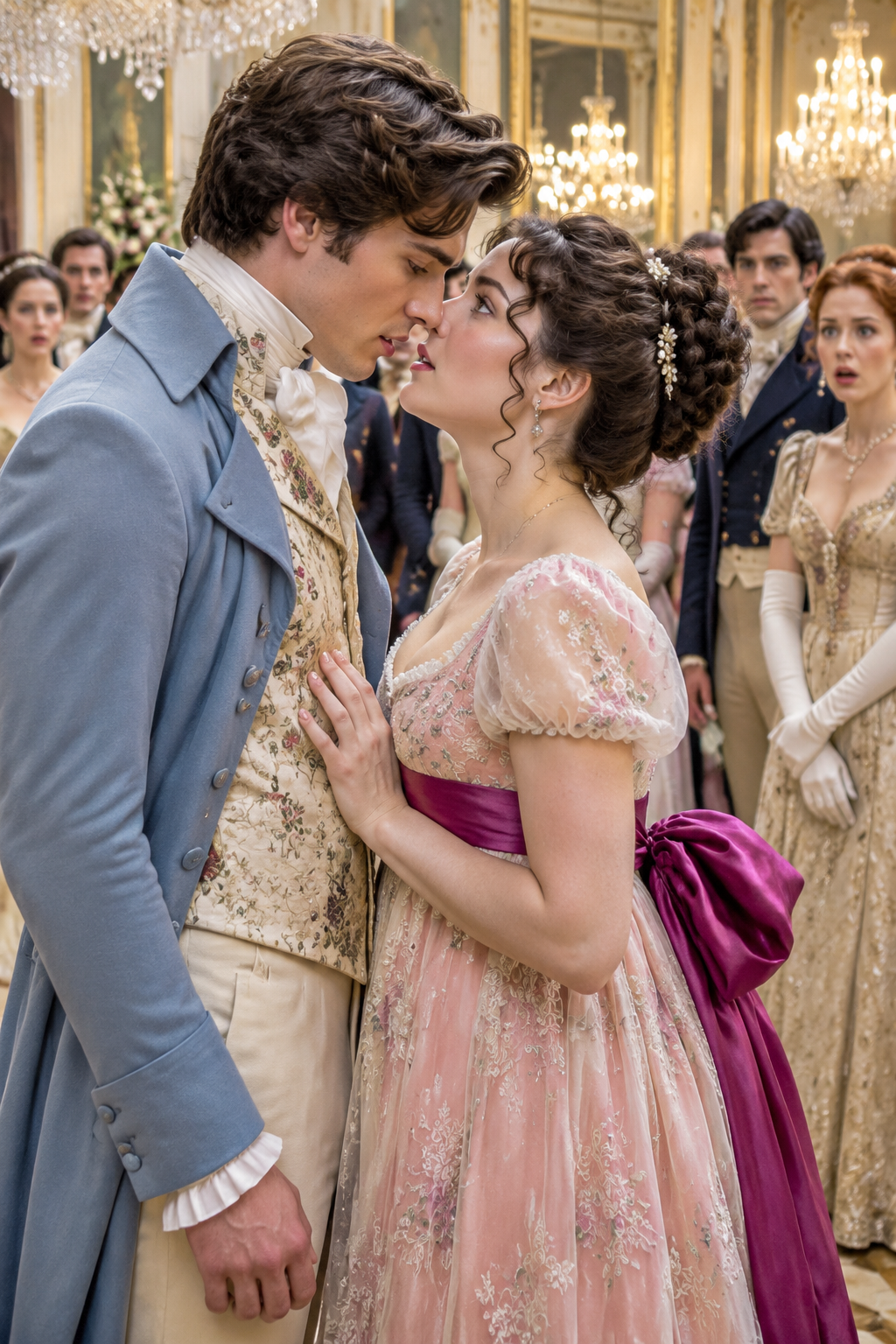
Lady Pembroke gestured toward a group of women seated near the fireplace.
“Come. There are a few people who have been most curious to meet you.”
The word curious sounded more like a warning than a welcome.
Briany followed her.
For the next twenty minutes, she endured questions disguised as compliments.
How long had she known the duke?
Had he always been so generous?
Was it true that she had once lived in a country estate that was now burdened by debt?
And, finally, the question Briany had been expecting.
“Forgive my curiosity,” said Lady Pembroke, stirring her tea. “But do you genuinely believe the Duke of Ashborne intends to marry you?”
The room became noticeably quieter.
Briany held her teacup steadily.
“I believe the duke is capable of making his own decisions.”
One of the older women gave a small laugh.
“How modern.”
Lady Pembroke leaned forward.
“Surely you understand that a man of his position must consider more than affection when choosing a wife.”
“Of course,” Briany replied. “He must also consider character.”
The woman’s smile disappeared for a second.
Before she could respond, another lady entered the room.
It was a young woman with golden hair and a pale green gown. Briany recognized her immediately from several social gatherings.
Miss Eleanor Whitmore.
She was the daughter of a wealthy earl and had been rumored to be Lord Reginald’s preferred match for his nephew.
Eleanor approached Briany with a sympathetic expression.
“Miss Lindley, I hope you won’t misunderstand my presence here.”
Briany set down her cup.
“Why would I?”
Eleanor glanced toward Lady Pembroke.
“I have heard some unfortunate things about your situation. I wanted to speak to you privately.”
There was something sincere in her voice, or at least something that sounded sincere.
The two women stepped toward the adjoining conservatory.
Once they were alone, Eleanor lowered her voice.
“Lord Reginald has been speaking to people about you.”
“I know.”
“He has told several families that the duke’s attachment to you is not genuine. He claims you are being paid to play a role.”
Briany’s heart skipped.
For a moment, she could not answer.
Eleanor watched her closely.
“Is it true?”
Briany remembered Almore’s promise that there would be no more secrets between them.
She also remembered the three thousand pounds.
“Yes,” she said at last. “Our arrangement began as a bargain.”
Eleanor’s expression changed.
“Then you must understand why people are concerned.”
“I understand why they are interested. Concern is another matter.”
Eleanor looked down at her gloves.
“I am not your enemy, Miss Lindley. But Lord Reginald is dangerous. He has been collecting letters, statements, and financial records. He intends to present them at the hearing.”
“Why are you telling me this?”
Eleanor hesitated.
“Because I know what it feels like to have your future arranged by someone else.”
Before Briany could ask another question, the conservatory door opened.
Lady Pembroke appeared.
“Miss Whitmore, your father has arrived.”
Eleanor immediately straightened.
“I must go.”
She gave Briany one final look.
“Be careful. Not everyone who smiles at you wishes you well.”
That evening, Briany told Almore everything.
He listened without interrupting.
When she mentioned Eleanor, his expression became thoughtful.
“Whitmore is a sensible girl,” he said. “Her father has been trying to secure a connection with my uncle for years.”
“Do you think she was telling the truth?”
“I don’t know.”
Briany sat beside the fire.
“Almore, if the hearing goes badly, what will happen to us?”
He looked at her.
“Us?”
She realized what she had said.
For a moment, neither moved.
Then he crossed the room and sat beside her.
“I have spent most of my life believing that needing someone was a weakness,” he said. “My father taught me that affection made a man vulnerable. When he died, I learned that people who claimed to care for you could become the first to abandon you.”
Briany listened quietly.
“My uncle offered to help me manage the estate when I was young. I trusted him. He used that trust to gain influence over nearly every part of my life. By the time I understood what he wanted, I had already learned to keep everyone at a distance.”
She reached for his hand.
“Perhaps you have been protecting yourself from the wrong thing.”
He looked down at their joined hands.
“And what should I have been protecting myself from?”
“Losing the chance to be happy.”
Almore gave a quiet, almost disbelieving laugh.
“You make happiness sound remarkably simple.”
“It isn’t simple. But it should not be something we refuse simply because it might hurt.”
He turned toward her.
“Briany, when I first offered you the bargain, I expected you to be clever, charming, and obedient enough to make my life easier.”
“An excellent description of a paid companion.”
“Indeed.”
“And now?”
“Now I find myself looking for you in every room I enter.”
Her heart began to race.
He lifted her hand and pressed a gentle kiss against her fingers.
“I don’t know when it happened,” he continued. “But somewhere between those ridiculous ballroom appearances and our walks in Hyde Park, I stopped pretending.”
Briany’s eyes filled with emotion.
“Then perhaps we should stop pretending altogether.”
He looked at her as though he wanted to say something more.
Instead, he drew her into his arms.
For the first time, she allowed herself to rest against him without wondering what it would cost her.
But their happiness was short-lived.
Three days before the family council hearing, a scandal appeared in one of London’s most widely read society newspapers.
The headline was cruel.
DUKE OF ASHBORNE PURCHASES THE AFFECTIONS OF AN IMPOVERISHED BARON’S DAUGHTER.
The article claimed that Briany had accepted a large payment to deceive the duke into believing she loved him.
It also suggested that Almore had become so infatuated with her that he could no longer distinguish business from personal judgment.
By noon, everyone was talking.
By evening, Briany’s name had become a source of amusement in drawing rooms across London.
Almore was furious.
He ordered his solicitor to investigate the newspaper’s source and demanded that the editor publish a correction.
But Briany knew a correction would not erase the damage.
The next morning, a letter arrived from her younger sister, Margaret.
It contained only a few lines.
Dear Brian,
A gentleman came to the estate yesterday. He said Charles Danvers had told him that the duke’s payment was proof that you had sold yourself to a wealthy man.
Some people in the village are repeating the story.
Please come home if you can.
I don’t want anyone speaking about you that way.
Your loving sister,
Margaret.
Briany read the letter twice.
She could bear the insults directed at herself.
What she could not bear was the thought of her sisters suffering because of them.
She folded the letter and placed it in her pocket.
That evening, she found Almore in his study.
“I must return to the estate.”
He immediately stood.
“Why?”
“My sisters are being dragged into this.”
“I can send a carriage.”
“I want to speak to them myself.”
“Then I will come with you.”
She shook her head.
“No. Your hearing is approaching. If you leave London now, your uncle will use it against you.”
Almore stepped toward her.
“I am not going to let you face Danvers alone.”
“I’m not asking you to.”
“Then what are you asking?”
She took a breath.
“Trust me.”
He looked at her for several seconds.
Finally, he nodded.
“Very well. But you will take my driver and two servants. And you will send word the moment you arrive.”
She smiled.
“I would have expected at least four servants.”
“Do not tempt me.”
For the first time in days, they both laughed.
The journey to the Lindley estate took most of the following morning.
When Briany arrived, she found Margaret waiting at the front entrance with their youngest sister, Charlotte.
Both girls ran toward her.
“Brian!”
Briany embraced them tightly.
She could see the worry in their faces.
Inside the house, the old furniture had been covered with dust sheets. Several rooms were colder than she remembered, and the servants who remained looked frightened about what the future might bring.
But the house still stood.
And Briany intended to keep it that way.
That afternoon, Charles Danvers arrived without an invitation.
He entered the drawing room as though he owned the place.
“Well, well,” he said. “Our little celebrity has returned.”
Briany stood.
“Leave, Charles.”
He laughed.
“You have become quite bold since finding yourself a wealthy protector.”
“Have you come to collect another payment?”
His smile vanished.
“You would do well to remember that the estate is legally mine if the debt remains unpaid.”
“It has been paid.”
“By the duke. Which makes your position even more embarrassing.”
Briany looked directly at him.
“The duke settled the debt. You received your money. There is nothing left for you here.”
Charles stepped closer.
“You think a few thousand pounds have made you untouchable?”
“No. I think a signed settlement makes your threats meaningless.”
His eyes narrowed.
“You have no idea what is happening in London, do you?”
“What do you mean?”
He smiled again.
“Your duke is about to lose everything. And when that happens, I wonder how quickly he will forget a poor girl like you.”
Briany refused to react.
Charles adjusted his coat.
“Enjoy your little home while you can.”
Then he left.
Margaret appeared in the doorway.
“Is he really going to take the house?”
Briany turned and hugged her.
“No, darling. Not if I have anything to say about it.”
But after Charles departed, Briany discovered something troubling.
The document proving the debt had been settled was missing from the estate’s records.
She searched the study, the old writing desk, and every drawer where her father had kept his legal papers.
Nothing.
She knew Almore had received a signed receipt from Danvers, but the original settlement document had never been returned to her.
A terrible thought crossed her mind.
What if Danvers had given them a false receipt?
What if the debt had never truly been cleared?
That night, she wrote to Almore.
She explained everything and asked him to have his solicitor confirm that the settlement was legally secure.
The following morning, a messenger arrived with his reply.
My dearest Briany,
The settlement is valid. Danvers cannot lawfully claim your estate on the strength of a debt he has already received payment for.
Do not allow him to frighten you.
I miss you more than I care to admit.
Yours,
Almore.
She read the final sentence several times.
Then she pressed the letter against her heart.
For the first time, she allowed herself to imagine a future that did not begin with fear.
But London was preparing for a confrontation that would test everything they had built.
The family council hearing took place on a cold Thursday morning at Ashborne House.
Lord Reginald arrived early, accompanied by two solicitors and several gentlemen who had been invited to witness the proceedings.
He wore a dark formal coat and carried himself with the confidence of a man who believed victory was already his.
Almore entered the room shortly afterward.
He was dressed in black, with a silver watch chain across his waistcoat.
His face revealed nothing.
When Lord Reginald saw him, he smiled.
“My dear nephew. I trust you are feeling well enough to participate.”
“Better than you hoped, apparently.”
A few gentlemen exchanged uncomfortable glances.
The hearing began.
Lord Reginald presented his concerns carefully.
He spoke about the duke’s recent behavior, his refusal to consider suitable marriages, and his growing attachment to a woman whose financial circumstances made her an unsuitable companion.
Then came the three thousand pounds.
He held up a copy of the payment record.
“This sum was transferred to Miss Lindley shortly before she began appearing publicly with my nephew,” he announced.
“Does this not suggest that the entire relationship was purchased?”
Almore remained silent.
Lord Reginald continued.
“He has become distracted from his responsibilities. His judgment is clouded. His decisions are increasingly influenced by a woman who stands to gain financially from his affection.”
One of the council members leaned forward.
“Has Miss Lindley been informed of these proceedings?”
“She has been informed of the allegations,” Reginald replied. “But I believe her presence would only make this unfortunate situation more uncomfortable.”
Almore finally spoke.
“Then I suggest we make it comfortable enough for her to attend.”
Lord Reginald’s smile faded.
Before anyone could respond, the doors opened.
Briany stood in the doorway.
She wore a simple cream-colored dress and carried a small leather folder.
Almore looked surprised.
She had returned to London that morning without warning him.
He stood immediately.
“Briany.”
She approached him.
“I believe I have something to say.”
Lord Reginald gave an irritated sigh.
“This is a private family matter.”
“Then perhaps the family should hear the truth.”
She placed the folder on the table.
Lord Reginald glanced at it.
“And what exactly is that?”
“Evidence that my presence in the duke’s life has not made him incapable of managing his affairs.”
She opened the folder and produced several documents.
The first contained a list of charitable payments Almore had made to local tenants and families facing hardship.
The second contained records showing that the duke had continued to manage his estates, oversee investments, and approve important decisions throughout the social season.
The third was a letter from the steward of Ashborne, confirming that the duke had personally reviewed every major household and estate account.
One of the council members began reading.
Lord Reginald’s expression tightened.
“Anyone can arrange documents to create a favorable impression.”
“Indeed,” Briany replied. “Which is why I have also brought the names of the people who prepared and verified them.”
She looked toward the council.
“I am not asking you to approve of my relationship with the duke. I am asking you not to confuse your personal opinion of me with his ability to govern his own affairs.”
A long silence followed.
Then Lord Reginald stood.
“You speak as though you understand the responsibilities of a great estate.”
“I understand the responsibilities of protecting a home.”
His eyes narrowed.
“You have no title, no fortune, and no influence.”
Briany met his gaze.
“Yet you seem remarkably concerned about what I might say.”
Several men looked down to hide their reactions.
Lord Reginald turned toward Almore.
“This is precisely what I mean. You have allowed a young woman to interfere in matters that should remain within the family.”
Almore rose.
“No, Uncle. I have allowed a young woman to remind me that being a duke does not mean surrendering my judgment to another man.”
The hearing continued for another hour.
Lord Reginald produced letters from several acquaintances, claiming that Almore had become increasingly irrational.
But none provided convincing evidence of actual incapacity.
The council members began asking questions.
Why had Reginald been so eager to take control of the estate?
Why had he collected personal information about his nephew’s relationships?
Why had he been discussing financial matters with people who had no authority over Ashborne?
Reginald’s confidence began to disappear.
Then the solicitor representing the duke requested permission to present one final document.
It was a financial record.
For years, Lord Reginald had been responsible for overseeing certain investments on behalf of the family.
The record showed that several substantial sums had been transferred from accounts connected to the estate into private accounts controlled by Reginald.
The room fell silent.
Almore looked at his uncle.
“Would you care to explain?”
Reginald’s face turned pale.
“These transactions are entirely legitimate.”
“Then you will have no difficulty explaining them.”
Reginald’s solicitor leaned toward him and whispered urgently.
But the older man pushed him away.
“This is an outrageous attempt to discredit me!”
Almore’s voice remained calm.
“You brought us here to question my judgment. I believe it is only fair that we examine yours.”
The council suspended the hearing and ordered an independent review of the financial records.
Reginald was instructed to surrender his access to the relevant accounts until the investigation was complete.
It was not yet a final victory, but for the first time, the duke’s uncle had lost control of the room.
When the gentlemen finally departed, Briany remained beside the window.
Almore approached her.
“You came back.”
“I told you I would stand beside you.”
He took her hands.
“You had no obligation to do that.”
“I know.”
He studied her face.
“Why?”
She smiled through the exhaustion.
“Because I love you.”
The words seemed to stop him completely.
He had heard her speak affectionately before. He had heard her pretend to admire him in crowded ballrooms. But this was different.
There was no audience.
No bargain.
No reason to say it except that it was true.
Almore lifted her hands to his lips.
“And I love you, Briany Lindley. Not because you have made my life easier, but because you have made me want to live it differently.”
He kissed her forehead.
Then, with a tenderness she had never expected from the coldest man in London, he drew her close.
For a moment, the world seemed to have stopped.
But one final problem remained.
The investigation into Lord Reginald’s finances uncovered a connection that neither Briany nor Almore had anticipated.
Charles Danvers.
The duke’s solicitor discovered that Danvers had received money from Reginald shortly before the newspaper scandal appeared.
There were also records showing that Danvers had been encouraged to delay the settlement of the Lindley debt and make the family’s financial position appear more desperate than it truly was.
The purpose was simple.
Reginald wanted Briany dependent on the duke.
He expected that the relationship would become a scandal, damaging Almore’s reputation and making the petition easier to win.
Danvers, meanwhile, hoped to obtain the Lindley estate through deception and intimidation.
But their plan had begun to collapse.
When the solicitor confronted Danvers with the evidence, he denied everything.
Unfortunately for him, one of his own letters had been preserved by a former clerk.
The letter clearly described the arrangement between him and Reginald.
Danvers had written that the duke’s payment would not be enough to save Briany’s reputation, and that the newspaper scandal should be published before the family council hearing.
The evidence was delivered to the appropriate authorities.
Within weeks, the financial investigation confirmed that Reginald had misused family funds and attempted to manipulate the council.
He was removed from his position of authority over the estate.
Danvers was forced to answer for his fraudulent financial dealings and his attempts to claim property through false threats.
The Lindley estate was finally secure.
But the greatest change did not come from the council’s decision or the exposure of two dishonest men.
It came from a conversation Briany and Almore had one quiet evening in the duke’s library.
The fire was burning low.
A small stack of letters rested on the desk.
Almore had been unusually quiet.
“What is troubling you?” Briany asked.
He looked up.
“Something I should have asked you a long time ago.”
She waited.
“When our arrangement began, I paid you three thousand pounds to pretend to be in love with me. That money saved your home and protected your sisters. I would never take that away from you.”
“I know.”
“But I don’t want you to remain beside me because you believe you owe me.”
Briany slowly put down her book.
“Almore—”
“Let me finish.”
He came around the desk.
“You are free to leave. I will make sure your family’s estate remains secure. Your sisters will never be asked to repay a penny. If you decide that you want a life away from me, I will accept it.”
His voice was steady, but his eyes betrayed him.
“I will be heartbroken,” he admitted. “But I would rather lose you than keep you through a debt you never owed me.”
Briany stared at him.
For the first time, she understood how much he had changed.
The man who had once treated affection as a transaction was offering her the one thing he had always struggled to give.
Freedom.
She stepped toward him.
“You truly believe I would leave because the money has been repaid?”
“I don’t know what you might choose.”
“Then perhaps you should listen to me.”
She reached into her small handbag and produced a folded document.
Almore frowned.
“What is that?”
“A copy of the original agreement.”
He recognized it immediately.
The contract that had started everything.
Briany unfolded it, walked to the fireplace, and held it over the flames.
Almore watched as the paper slowly darkened and curled.
“What are you doing?”
“Ending the bargain.”
The last piece of the document fell into the fire.
Briany turned toward him.
“I came to you because I needed three thousand pounds. I stayed because I found a man who was worth knowing beneath all that pride and coldness.”
He looked at her without speaking.
“I don’t want to be your paid companion, Almore. I don’t want to be the woman you present at parties to silence other people. I want to be the woman you choose when there is no audience.”
His eyes softened.
“And if I choose you?”
“Then choose me honestly.”
He reached for her.
“I do.”
She smiled.
“Then you may ask me properly.”
For a moment, he looked almost amused.
“Miss Lindley, would you do me the honor of becoming my wife?”
Briany pretended to consider it.
“Will there be a financial agreement?”
“Of course.”
She laughed.
“What sort?”
“You will have complete control over your personal fortune, your family estate, and any income you wish to earn. No one will ever have the right to take those things from you.”
“And what will you expect in return?”
He looked at her with an expression that made her heart ache.
“Only that you allow me to spend the rest of my life loving you.”
Briany’s eyes filled with tears.
“Yes.”
Almore smiled.
It was not the polite smile he had used at balls or the confident expression that had frightened half of London.
It was the smile of a man who had finally found something he had never believed he deserved.
He kissed her, and this time there was no need to pretend.
The wedding took place several months later at a small church near the Lindley estate.
Briany had refused an enormous ceremony.
She wanted her sisters beside her, a few trusted friends, and the people who had remained loyal when her family’s name had become the subject of gossip.
Margaret served as her maid of honor, while Charlotte scattered flowers along the aisle.
Almore stood at the altar, looking more nervous than he had ever appeared during the family council hearing.
When Briany reached him, he whispered, “I was less frightened confronting my uncle.”
She smiled.
“Perhaps you should have asked me to marry you in front of the council.”
“I considered it.”
The ceremony was simple, but the promises they exchanged were anything but.
They promised to listen when it was difficult, to speak honestly when silence would be easier, and never to use love as a weapon.
After the wedding, Briany returned to the Lindley estate with her husband.
But she did not abandon the life she had fought so hard to protect.
She worked with the estate’s steward to restore the neglected grounds, repair the old cottages, and reopen the village school that had been closed during the financial crisis.
Almore supported her without trying to take control.
He also began changing the way Ashborne House operated.
Instead of treating the tenants as names in a ledger, he visited their homes, listened to their concerns, and made sure their families were treated fairly.
His staff noticed the difference.
The duke who had once dismissed every social gathering as a waste of time now welcomed guests into his home.
He still disliked pointless gossip and matchmaking mothers.
But he no longer believed that keeping people at a distance was the same as being strong.
Margaret eventually married a kind young gentleman who had worked with the estate’s solicitor.
Charlotte grew into a confident young woman who often reminded Almore that she had been the first person in the family to approve of him.
“Only because you gave me sweets,” he would protest.
“And because you make Brian happy,” Charlotte always replied.
Years later, on the anniversary of their wedding, Almore took Briany for a walk through Hyde Park.
The same park where their false courtship had once begun.
The afternoon was bright, and the trees moved gently in the breeze.
Briany slipped her hand into his.
“Do you remember our first walk here?”
“I remember that you nearly laughed when I tried to compliment your dress.”
“I thought you sounded like a man reading from a list of approved phrases.”
“I was trying to be convincing.”
“You were terrible.”
He laughed.
Then he stopped beside a bench and turned toward her.
“Do you ever regret it?”
“Regret what?”
“The bargain. The three thousand pounds. Everything that brought us together.”
Briany considered the question.
“I regret that we were both so desperate that we believed we had to trade something to deserve a better life.”
He nodded slowly.
“And what do you believe now?”
She looked at him.
“That love should never make someone feel indebted. It should make both people feel free.”
Almore kissed her hand.
“I believe I was a very fortunate man.”
“You were,” she teased.
He laughed again.
Then they continued walking, their hands joined.
Briany had once believed that saving her family’s home was the greatest thing she could accomplish.
It had been important, certainly. That old house held her father’s memories, her mother’s pearls, and the laughter of her sisters. It represented everything she had struggled to protect.
But she eventually discovered that a home was not made valuable by its walls, its land, or the family name written on its gates.
A home was made valuable by the people who made it a place of safety, honesty, and belonging.
And Almore learned something just as important.
A title could command respect, money could purchase comfort, and power could silence enemies.
But none of those things could buy genuine affection.
He had paid three thousand pounds to begin a pretend romance.
What he received in return was something no fortune could ever purchase.
A love built not on obligation, fear, or social position, but on trust, courage, and the freedom to choose one another every single day.
And that, Briany believed, was the richest inheritance either of them could ever leave behind.
THE END.