“Three dollars for that quilt?” Miles Pike laughed. “Throw in a husband for the widow, and somebody might take it.”
“Rebecca, I didn’t hire you because I felt sorry for you,” Benjamin said quietly. “I hired you because I needed someone I could trust. And after watching you these past two weeks, I’ve come to realize I need something more.”
Rebecca tightened her grip on her suitcase.
“What exactly are you saying, Mr. Ward?”
Benjamin hesitated, a rare uncertainty crossing his usually composed face.
“I’m saying that for the first time in eight years, I find myself looking forward to coming home. Not because of the ranch or the horses or the money I’ve made. Because there’s someone in my kitchen who makes this place feel alive again.”
Rebecca stared at him.
She had expected an explanation about wages, perhaps an apology for the rumors. She had not expected this.
“You hardly know me.”
“I know you rise before sunrise to make bread for men who rarely remember to thank you. I know you put aside the softest biscuits for old Samuel because his teeth trouble him. I know you pretend not to notice when young Tommy sneaks an extra slice of pie because he’s still growing.”
Benjamin stepped closer, though he kept a respectful distance.
“And I know you worked three nights repairing a quilt for a man who couldn’t afford a proper blanket.”
Rebecca’s eyes widened.
“How did you know about that?”
“Samuel told me. He cried when he showed it to me.”
She looked away, embarrassed.
“Anyone would have done the same.”
“No,” Benjamin replied. “They wouldn’t.”
For a moment, the only sound was the wind brushing against the windows.
Then Rebecca shook her head.
“Kind words don’t change what people are saying.”
“Since when did Miles Pike become the authority on your worth?”
“He hasn’t. But you don’t understand what it’s like to walk into a room and know everyone is laughing at you.”
Benjamin’s expression hardened, not with anger toward her, but with something that looked painfully familiar.
“You’re right,” he said. “I don’t know what it’s like to be mocked for the way I look. But I know what it’s like to have people decide who you are without bothering to learn the truth.”
Rebecca studied him.
“What do you mean?”
Benjamin glanced toward the dark hallway.
“Eight years ago, my wife died giving birth to our son. The boy lived only three hours.”
Rebecca’s hand loosened around the suitcase handle.
“I didn’t know.”
“Most people don’t. They know my wife died. They know I buried her. But they don’t know about the boy.”
His voice grew rough.
“Afterward, people called me fortunate because I had money. They told me I could marry again, have more children, start over. As though a family were a broken wagon wheel you could simply replace.”
Rebecca felt something shift inside her.
She had heard stories about Benjamin Ward’s wealth, his cattle, his enormous house. Nobody had mentioned the two small graves beneath the cottonwood tree behind the ranch.
“I’m sorry,” she whispered.
Benjamin nodded.
“I didn’t tell you to make you pity me. I told you because I want you to understand something. People can be wrong about a person for years. That doesn’t make them right.”
He picked up the envelope of wages she had abandoned and placed it in her hand.
“You earned every penny. Whether you stay or leave, that money belongs to you.”
Rebecca looked at the envelope.
“And if I stay?”
“Then tomorrow morning, you’ll have thirty hungry cowboys waiting for breakfast.”
Despite herself, she laughed.
Benjamin smiled.
It was a small smile, but it transformed his face.
Rebecca set down her suitcase.
“I suppose somebody has to keep those fools from burning down your kitchen.”
“Then I’ll see you at breakfast, Mrs. Hail.”
As he turned to leave, she stopped him.
“Benjamin?”
He looked back.
“Thank you for telling me about your family.”
His smile faded into something gentler.
“Thank you for listening.”
That night, Rebecca lay awake longer than usual.
For the first time since her husband’s death, she wondered whether the future might hold something besides survival.
But outside Black Elk Ranch, trouble was already gathering.
Miles Pike had not forgotten the humiliation at the auction.
He owned the largest general store in Cedar Pass and controlled nearly every freight delivery entering the valley. For years, ranchers had tolerated his inflated prices because there was nowhere else to purchase essential supplies.
Benjamin Ward was the exception.
He had recently begun ordering directly from merchants in Cheyenne, cutting Miles out of several profitable contracts.
And now Benjamin had publicly embarrassed him over a widow.
Miles considered both offenses unforgivable.
Three mornings later, Rebecca discovered that the ranch’s flour shipment had not arrived.
Neither had the salt, coffee, dried beans, or winter provisions.
The supply wagon returned empty.
“Pike refused to release the goods,” the driver explained. “Claims there’s an unpaid account.”
Benjamin frowned.
“What account?”
“He says you owe him four hundred dollars from last spring.”
Benjamin’s jaw tightened.
“That account was settled in May.”
Rebecca watched the men exchange uneasy glances.
Winter was approaching. Without supplies, feeding the ranch hands would become difficult within days.
“I’ll go into town,” Benjamin said.
Rebecca stepped forward.
“I’m coming with you.”
“This is business, Rebecca.”
“And feeding your men is my business.”
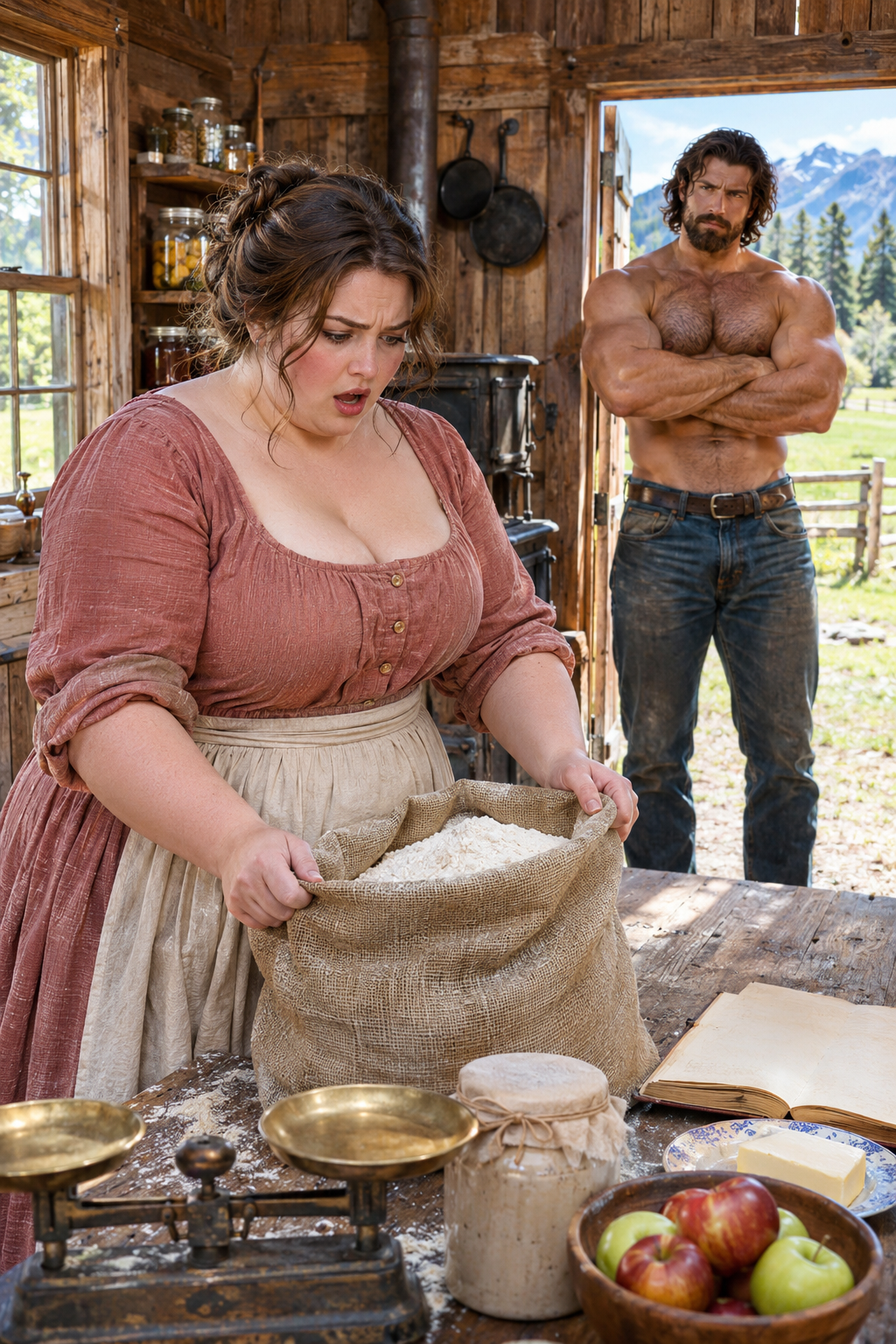
He looked at her for a moment before nodding.
They rode into Cedar Pass beneath a gray November sky.
Miles Pike stood behind his counter when they entered his store.
“Well, well,” he said, grinning. “The rancher and his little kitchen companion.”
Benjamin placed a folded receipt on the counter.
“Your account was paid six months ago. Release my supplies.”
Miles barely glanced at the paper.
“Records can be mistaken.”
“Then correct yours.”
Miles leaned forward.
“Perhaps I’d be more cooperative if certain people learned to show respect.”
Rebecca felt Benjamin stiffen beside her.
Before he could speak, she stepped forward.
“Mr. Pike, how much flour do you have in your storeroom?”
Miles blinked.
“What?”
“Flour. How many sacks?”
“What’s that got to do with anything?”
“Because if you’re refusing to honor a paid order, I’ll need to purchase supplies elsewhere. And I’d like to know whether you’re deliberately withholding goods or simply incapable of fulfilling your obligations.”
Several customers turned to listen.
Miles flushed.
“You watch your mouth, woman.”
Rebecca smiled pleasantly.
“I’ve spent years listening to you use yours, Mr. Pike. I believe I’ve earned a turn.”
A muffled laugh came from the back of the store.
Miles slammed his palm against the counter.
“Get out.”
Benjamin collected his receipt.
“With pleasure.”
Outside, he turned toward Rebecca with an astonished expression.
“You realize you’ve just made an enemy of the most spiteful man in Cedar Pass?”
“He was already my enemy.”
Benjamin laughed.
It was the first time Rebecca had heard him laugh without restraint.
The sound warmed her more than the wool shawl around her shoulders.
But their victory was short-lived.
By the following week, every merchant in Cedar Pass had been warned against supplying Black Elk Ranch.
Miles had threatened to cancel their credit if they did business with Benjamin.
Worse, rumors began spreading that Benjamin was nearly bankrupt.
Some claimed he had mortgaged his cattle.
Others insisted he was secretly selling land to pay gambling debts.
None of it was true.
But lies traveled faster than wagons.
One afternoon, Benjamin received a letter from the bank demanding immediate repayment of a substantial loan.
He read it twice before crushing it in his fist.
Rebecca found him standing in his office, staring at the wall.
“What’s happened?”
“The bank is calling in a loan that isn’t due until next summer.”
“Can they do that?”
“Under certain conditions.”
“And those conditions?”
Benjamin looked at her.
“If they believe the ranch is financially unstable.”
Rebecca understood immediately.
“Miles.”
“Most likely.”
“How much?”
“Twelve thousand dollars.”
The number made her stomach drop.
It was more money than she could imagine possessing.
Benjamin sank into his chair.
“If I sell enough cattle now, I can pay it. But winter prices are terrible. I’d lose nearly half their value.”
Rebecca considered the problem.
“How long do you have?”
“Thirty days.”
She looked toward the window, where snow was beginning to settle over the fields.
“Then we have thirty days to find another way.”
Benjamin shook his head.
“Rebecca, this isn’t your burden.”
She crossed her arms.
“You hired me to manage the kitchen. And I intend to have a kitchen worth managing when spring arrives.”
He looked at her for a long moment.
Then he smiled faintly.
“You’re a stubborn woman.”
“That’s what my husband used to say.”
The words slipped out before she could stop them.
Benjamin’s smile softened.
“Was he a good man?”
Rebecca looked down.
“Daniel was kind. He never made me feel I had to apologize for taking up space in the world.”
Her voice trembled.
“When he died, I thought the best part of my life had gone with him.”
Benjamin rose slowly.
“Perhaps the best part of your life hasn’t happened yet.”
Their eyes met.
For one dangerous, beautiful moment, Rebecca thought he might kiss her.
Instead, a loud crash sounded from outside.
A ranch hand burst through the office door.
“Mr. Ward! The north barn’s on fire!”
Benjamin was running before the man finished speaking.
Rebecca followed.
Flames climbed the barn walls, swallowing dry timber with terrifying speed. Horses screamed inside, kicking against their stalls.
Men rushed forward carrying buckets, but the wind drove the fire toward the main stable.
Benjamin grabbed a wet blanket and disappeared through the smoke.
“Benjamin!” Rebecca screamed.
Seconds passed.
Then a minute.
The roof began to groan.
Rebecca seized another blanket and moved toward the entrance.
Samuel caught her arm.
“You can’t go in there!”
“He’s still inside!”
Before Samuel could stop her, Benjamin emerged leading two terrified horses.
His coat was burning at the shoulder.
Rebecca threw her blanket over him, smothering the flames.
He stumbled to his knees, coughing violently.
Behind him, the barn roof collapsed in an explosion of sparks.
For several moments, Rebecca could do nothing but hold his face between her hands.
“You foolish, impossible man!”
Benjamin coughed again.
“The horses—”
“Are alive! And you nearly weren’t!”
His eyes found hers through the smoke.
“You were worried about me?”
Rebecca’s throat tightened.
“Don’t you dare make a joke.”
He reached up and covered her hand with his.
“I won’t.”
By dawn, the barn was gone.
Four horses had suffered injuries, and Benjamin’s shoulder was badly burned.
But every ranch hand survived.
When the ashes cooled, Samuel discovered something troubling near the rear wall.
A shattered lantern.
And beside it, a length of cloth soaked in kerosene.
The fire had been deliberately set.
Benjamin stared at the evidence.
“Miles wouldn’t dare.”
Rebecca wasn’t so certain.
“A man who enjoys hurting people rarely stops simply because they refuse to cry.”
Benjamin sent Samuel to notify the sheriff.
But Sheriff Collins seemed remarkably uninterested.
“Barn fires happen,” he said when he arrived.
“Lanterns don’t usually wrap themselves in kerosene-soaked cloth,” Rebecca replied.
The sheriff frowned.
“Mrs. Hail, I’d advise you to leave law enforcement to those who understand it.”
Rebecca met his gaze.
“And I’d advise you to examine evidence before deciding it doesn’t matter.”
Collins turned away.
Benjamin watched him leave, his expression grim.
“He owes Pike money,” he said quietly.
“How much?”
“Enough that he won’t investigate anything involving him.”
Rebecca looked at the burned remains of the barn.
For the first time, she understood how dangerous Miles Pike truly was.
The next evening, while Benjamin rested his injured shoulder, Rebecca opened the ranch’s supply ledgers.
She had been studying the entries for weeks, trying to understand why so much food had disappeared before her arrival.
Now something caught her attention.
Several invoices bore the same freight company stamp.
Pike Mercantile.
But the quantities listed did not match the ranch’s receiving records.
She compared one page with another.
Then another.
Her pulse quickened.
For nearly two years, Miles had charged Black Elk Ranch for supplies it had never received.
Flour, grain, harness leather, tools, even medicine.
The missing goods totaled thousands of dollars.
Rebecca carried the ledgers to Benjamin’s office.
“Look at this.”
He studied the figures.
His face darkened.
“That thieving son of a gun.”
“There’s more.”
She showed him several signatures.
The same name appeared repeatedly beside the false deliveries.
Arthur Bell.
Benjamin frowned.
“Bell was my former bookkeeper.”
“Where is he now?”
“Left last summer. Said his mother was ill.”
Rebecca turned another page.
“Did you ever verify that?”
Benjamin shook his head slowly.
The following morning, Rebecca traveled to Cedar Pass alone.
She visited the telegraph office, where a young operator named Clara Finch had once been a regular customer at her eating house.
Clara greeted her warmly.
“Mrs. Hail! I haven’t seen you in ages.”
“I need a favor.”
Rebecca explained what she had discovered.
Clara listened carefully.
Then she lowered her voice.
“Arthur Bell didn’t leave to visit his mother.”
Rebecca froze.
“What?”
“He was sent to Denver. Mr. Pike paid for his ticket. I know because I handled the telegram arranging it.”
“Do you remember who received the message?”
Clara hesitated.
Then she opened a drawer and removed an old transmission book.
“Pike made me keep copies of all his business telegrams.”
She found the entry.
Rebecca read the message twice.
It instructed Arthur Bell to destroy certain financial records before leaving town.
And it was signed by Miles Pike.
“This could prove everything,” Rebecca whispered.
Clara looked frightened.
“If he discovers I showed you—”
“He won’t hear it from me.”
But someone had already seen Rebecca enter the telegraph office.
By the time she returned to the ranch, Miles knew she was asking questions.
That night, a rock shattered her bedroom window.
Wrapped around it was a piece of paper.
LEAVE CEDAR PASS BEFORE SOMEONE GETS HURT.
Rebecca read the message beneath the lamplight.
Her hands shook.
For several minutes, she considered packing her belongings.
She had survived Daniel’s death, loneliness, and years of humiliation. She could survive leaving Cedar Pass.
But then she thought of Samuel, Tommy, Clara, and the men whose livelihoods depended on Black Elk Ranch.
She thought of Benjamin risking his life to save frightened horses.
And she thought of Miles Pike standing in the community hall, laughing while everyone watched.
She folded the threatening note and placed it inside her Bible.
Then she went downstairs.
Benjamin was sitting beside the fireplace, his injured arm resting in a sling.
He looked up.
“Can’t sleep?”
Rebecca handed him the note.
His expression changed instantly.
“Who gave you this?”
“Someone threw it through my window.”
Benjamin rose.
“I’m taking you somewhere safe.”
“No.”
“Rebecca—”
“I won’t be chased away.”
He approached her.
“This isn’t about pride. Someone could hurt you.”
She looked directly into his eyes.
“Then help me stop him.”
Benjamin was silent.
Finally, he nodded.
“What do you need?”
“A trip to Denver. And someone who knows how to find Arthur Bell.”
Three days later, Benjamin arranged for a trusted attorney named Nathaniel Brooks to investigate the former bookkeeper.
Meanwhile, Rebecca continued working, refusing to let fear govern her days.
But something between her and Benjamin had changed.
He began joining her for coffee before sunrise.
Sometimes they talked about the ranch.
Sometimes about their childhoods.
And sometimes they sat together in comfortable silence.
One snowy morning, Benjamin found her repairing the old quilt he had purchased at the auction.
“I thought you bought that for three dollars,” she teased.
“I did.”
“Then why is it back in my sewing basket?”
“Because I wanted to ask whether you’d finish it for me.”
Rebecca examined the fabric.
It was a patchwork of faded blue, cream, and burgundy squares, each stitched with careful precision.
“Who is it for?”
Benjamin hesitated.
“For my son.”
Rebecca’s hands stilled.
“I never had anything made for him,” Benjamin explained. “Everything happened so quickly. I thought perhaps I could place it in the little chest where I keep his things.”
Rebecca looked up.
“Of course.”
His voice softened.
“Would you help me choose something to embroider on it?”
She considered for a moment.
“What was his name?”
“Jonathan.”
Rebecca smiled sadly.
“Then perhaps his name should be enough.”
For the next several evenings, she worked on the quilt.
She stitched Jonathan Ward’s name into one corner, surrounded by tiny golden stars.
When she finally gave it to Benjamin, he stood motionless.
Then he pressed the quilt against his chest.
Rebecca had never seen a grown man look so vulnerable.
“It’s beautiful,” he whispered.
He reached for her hand.
“Rebecca, there’s something I’ve wanted to tell you.”
Her heart began beating faster.
But before he could continue, hoofbeats thundered outside.
A rider appeared at the door.
It was Nathaniel Brooks.
His face was pale.
“We found Arthur Bell,” he announced.
Benjamin stepped forward.
“Where?”
“Denver. But there’s a problem.”
Nathaniel removed his hat.
“Someone tried to kill him yesterday.”
The room went silent.
“He survived,” Nathaniel continued. “Barely. Before he lost consciousness, he gave me a sealed packet.”
He placed a leather envelope on Benjamin’s desk.
Inside were copies of fraudulent invoices, bank transfers, and signed agreements between Arthur Bell and Miles Pike.
But the final document was the most shocking.
It revealed that Miles had secretly purchased Benjamin’s bank debt through a third party.
The bank’s sudden demand for repayment had not been an ordinary financial decision.
It was part of a scheme to force Benjamin into foreclosure.
Miles intended to purchase Black Elk Ranch at auction for a fraction of its value.
Rebecca felt sick.
“He wanted the ranch all along.”
Benjamin nodded.
“And the fire was meant to weaken us.”
Nathaniel looked grim.
“There’s enough evidence to bring charges. But Pike has friends in the county courthouse. We need a federal marshal or a judge outside his influence.”
“How long?” Benjamin asked.
“Perhaps two weeks.”
Rebecca glanced at the calendar.
The bank’s deadline was only nine days away.
They might win the criminal case and still lose the ranch.
That night, Benjamin sat alone in his office.
Rebecca found him staring at the papers.
“I can sell the southern pasture,” he said.
“Would that cover the debt?”
“Most of it.”
“And afterward?”
He gave a humorless smile.
“We’d survive. Barely.”
Rebecca sat opposite him.
“Benjamin, what if the people of Cedar Pass helped?”
He shook his head.
“They’re frightened of Pike.”
“Not all of them.”
She thought of Clara, Samuel, and the small merchants who had suffered under Miles’s control.
Then an idea came to her.
“What if we held an auction?”
Benjamin looked up.
“An auction?”
“Not for cattle. For everything the ranch can produce. Beef, horses, winter feed, handmade goods. People could pay in advance for spring deliveries.”
“Rebecca, we’d need hundreds of buyers.”
“Then we’d better invite everyone.”
Benjamin stared at her.
“You truly believe this could work?”
She smiled.
“Three dollars bought you a quilt. Perhaps a few thousand more can save a ranch.”
For the next five days, Rebecca worked harder than she ever had.
She organized the ranch hands, prepared lists of goods, and sent invitations across three counties.
Clara spread the word through the telegraph office.
Small farmers offered produce.
Local women donated quilts, preserves, and knitted clothing.
Even merchants who feared Miles began quietly contributing.
They were not simply helping Benjamin.
They were challenging the man who had controlled their town for years.
When Miles learned of the auction, he was furious.
He visited the community hall and threatened to ruin anyone who participated.
But something unexpected happened.
Old Mrs. Abernathy, a widow who owned a modest dairy farm, stood up in front of everyone.
“You’ve been threatening people in this town for twenty years, Miles Pike,” she declared. “And I’m tired of being afraid.”
Others began speaking.
A blacksmith described unfair debts.
A farmer revealed how Miles had seized his wagon over a disputed bill.
A shopkeeper admitted paying illegal fees to keep his business open.
By the end of the meeting, Miles stood alone.
He stormed out, promising they would regret it.
The auction was scheduled for Saturday.
But Friday evening brought the worst blizzard Cedar Pass had seen in fifteen years.
Snow buried the roads.
The temperature plunged.
Wagons could not travel.
Benjamin stood at the ranch window, watching the storm.
“It’s over,” he said.
Rebecca refused to answer.
She put on her coat.
“Where are you going?”
“To town.”
“Rebecca, you’ll freeze.”
“Then come with me.”
They traveled by sleigh through the storm, guided by lanterns and the steady strength of Benjamin’s horses.
When they reached Cedar Pass, Rebecca went straight to the community hall.
Only a handful of people had gathered.
Her heart sank.
Then Clara appeared, breathless.
“The telegraph lines are still working!”
Rebecca turned.
“Can you send messages to the surrounding towns?”
“Yes, but nobody can travel in this weather.”
“They don’t have to.”
Rebecca hurried to the auction table.
“We’ll take bids by telegram.”
Benjamin stared at her.
“Can that be done?”
“There’s only one way to find out.”
By morning, Clara had contacted buyers throughout the territory.
Ranchers bid on cattle.
Merchants purchased future deliveries.
Families ordered winter supplies.
The telegraph machine clicked without stopping.
Inside the hall, volunteers recorded every offer.
By noon, they had raised eight thousand dollars.
By two o’clock, ten thousand.
But as evening approached, the total stood at eleven thousand four hundred dollars.
Six hundred dollars short.
And the deadline was Monday morning.
Rebecca stood beside the auction table, exhausted.
The crowd had grown quiet.
Then the doors opened.
Miles Pike entered, brushing snow from his expensive coat.
“Well,” he announced, “looks like your little miracle came up short.”
Benjamin stepped forward.
“You’re not welcome here.”
Miles smiled.
“I’m a businessman. And I happen to have an offer.”
He placed a document on the table.
“I’ll pay the remaining debt. In exchange, Ward signs over the southern grazing lands and agrees never to challenge my freight contracts again.”
Rebecca stared at him.
“You’d steal his land and call it generosity?”
Miles leaned toward her.
“Careful, widow. You already made yourself enough trouble.”
Benjamin reached for the document.
Rebecca caught his wrist.
“Don’t.”
He looked at her.
“We’re out of time.”
“No,” she whispered. “We’re not.”
She turned toward the crowd.
“Does anyone remember the quilt auction?”
A few people nodded.
“Mr. Pike offered three dollars because he believed my work was worthless. He thought if he made everyone laugh at me, I’d believe it too.”
Her voice grew stronger.
“For years, he’s done the same thing to this town. He’s convinced us that we’re small, helpless people who need his permission to survive.”
Miles scoffed.
“Spare us the sermon.”
Rebecca ignored him.
“But look around. Every dollar raised today came from people who decided to help one another. That’s something Mr. Pike has never understood.”
She reached into her bag and removed a small bankbook.
“My husband left me a little money. I’ve been saving it to reopen my eating house someday.”
Benjamin shook his head.
“Rebecca, no.”
She opened the book.
“Six hundred and twenty-three dollars.”
The room fell silent.
Benjamin stepped toward her.
“I won’t take your savings.”
“Then don’t take them,” she replied. “Accept them as an investment.”
“An investment in what?”
Rebecca smiled through tears.
“A future where people like Miles Pike don’t get to decide who deserves a chance.”
Benjamin looked at her for a long moment.
Then he took her hand.
“Only if we put the agreement in writing. You’ll own a share of Black Elk Ranch.”
“Agreed.”
The room erupted in applause.
Miles’s face turned crimson.
“This isn’t finished!”
A deep voice answered from the doorway.
“No, Mr. Pike. It certainly isn’t.”
A tall man wearing a dark coat stepped inside.
A silver star gleamed beneath his lapel.
“Deputy United States Marshal Thomas Reed,” he announced. “Miles Pike, you’re under arrest for conspiracy, fraud, and attempted murder.”
Nathaniel Brooks entered behind him.
Arthur Bell had regained consciousness in Denver and provided a sworn statement identifying Miles as the man who ordered the attack.
The marshal had also obtained evidence connecting Miles to the barn fire.
Miles lunged toward the back door.
Samuel blocked his path.
For a moment, the two men stared at each other.
Then Samuel folded his arms.
“Going somewhere, Pike?”
The room filled with laughter.
This time, nobody was laughing at Rebecca.
Miles was taken away in handcuffs.
By Monday morning, Benjamin’s debt was paid, the bank’s fraudulent demands were under investigation, and Black Elk Ranch belonged to a man who had nearly lost everything—and a woman who had refused to let him surrender.
Winter passed slowly.
The barn was rebuilt.
The ranch prospered.
Rebecca reopened her eating house with help from Benjamin and several local families.
She named it The Open Door.
Anyone could purchase a hot meal there, but those who could not afford one were never turned away hungry.
A small wooden sign hung beside the entrance.
“Everyone deserves a place at the table.”
One spring afternoon, Benjamin arrived carrying a familiar quilt.
Rebecca looked up from her baking.
“Don’t tell me you’ve torn it again.”
He smiled.
“Not exactly.”
He unfolded the quilt across a table.
Jonathan’s name still shone beneath the golden stars.
But Benjamin had added something.
In one corner, beneath Rebecca’s careful stitching, were the words:
LOVE DOES NOT END. IT MAKES ROOM.
Rebecca touched the embroidery.
“Benjamin?”
He took her hands.
“For eight years, I believed loving someone again would mean forgetting the people I’d lost.”
His voice trembled.
“Then you walked into my kitchen and taught me that a heart doesn’t have to close when it’s been broken.”
Rebecca’s eyes filled.
“I was afraid too,” she admitted. “Afraid that if I let myself be happy, it would mean Daniel mattered less.”
Benjamin shook his head.
“Daniel helped make you the woman you are. How could I ever wish that away?”
He reached into his pocket and withdrew a small velvet box.
Inside was a simple gold ring.
“Rebecca Hail, I don’t need a cook, a housekeeper, or someone to make my life easier. I want a partner. Someone who will argue with me when I’m wrong, laugh with me when life gets difficult, and remind me that kindness is worth more than every acre I own.”
He paused.
“Would you consider marrying me?”
Rebecca looked at the ring.
Then at the man standing before her.
A year earlier, she had believed she was too old, too large, too ordinary, and too broken to be loved again.
Now she understood that those judgments had never been truths.
They were merely cruel opinions she had carried for too long.
“Yes,” she whispered.
Benjamin smiled.
“Yes?”
She laughed through her tears.
“Yes, Benjamin Ward. But I have conditions.”
He chuckled.
“Of course you do.”
“I keep my eating house.”
“Absolutely.”
“I continue managing my own money.”
“I wouldn’t dream of interfering.”
“And if you ever suggest I’m worth only three dollars—”
Benjamin pulled her gently into his arms.
“I’ll remind you that three dollars was the greatest bargain of my life.”
They married beneath the cottonwood tree at Black Elk Ranch.
Rebecca insisted that Jonathan and Benjamin’s first wife be remembered with flowers.
She also placed a small photograph of Daniel beside the wedding table.
There was no shame in honoring the people who had loved them before.
The entire town attended.
Even those who had laughed at Rebecca during the first auction came forward to apologize.
She accepted their apologies without pretending their cruelty had never hurt.
Forgiveness, she had learned, did not require forgetting.
It simply meant refusing to let old wounds control the future.
After the ceremony, Samuel stood to make a toast.
“I’ve worked for Mr. Ward for twenty years,” he announced. “And I can tell you one thing. This ranch has never been richer than it is today.”
Everyone raised their glasses.
Benjamin looked at Rebecca.
She was laughing, surrounded by friends, her cheeks glowing in the afternoon sunlight.
And he knew Samuel was right.
Years later, when children asked how their grandparents had fallen in love, Benjamin always began with the same story.
“I bought a quilt for three dollars.”
Rebecca would shake her head.
“And then he spent the rest of his life trying to convince me it was worth a fortune.”
But the truth was far more beautiful.
The quilt had never needed Benjamin’s money to become valuable.
Rebecca had never needed a wealthy rancher’s approval to become worthy of love.
And Benjamin had never needed another person to erase his grief.
They had simply found the courage to recognize what had been there all along.
A woman whose kindness was stronger than cruelty.
A man whose heart was braver than his sorrow.
And a town that discovered, at last, that standing together was more powerful than standing above one another.
The old quilt remained in their home for the rest of their lives, carefully preserved in a cedar chest.
Beside it lay the original auction receipt.
Three dollars.
Whenever Rebecca saw it, she smiled.
Not because it reminded her of the day someone had humiliated her.
But because it reminded her of the day she began to understand something that would change her life forever.
Your worth is not determined by the people who fail to see it. And sometimes, the greatest love begins when someone reminds you of the value you possessed all along.
And as the years passed, Rebecca came to understand that the greatest gift Benjamin had given her was not the ranch, the ring, or even the love they shared.
It was the courage to believe in herself again.
Together, they transformed Black Elk Ranch into more than a prosperous cattle business. They made it a refuge for people who had nowhere else to turn.
Widows struggling to feed their children found work in Rebecca’s kitchen. Young men who had lost their way were given honest employment. Families passing through Cedar Pass during harsh winters always found a warm meal and a place to rest.
Benjamin never questioned Rebecca when she offered help to someone in need.
He had learned that generosity was not measured by how much a person gave, but by how much dignity they allowed another person to keep.
One evening, nearly twenty years after their wedding, Rebecca sat on the porch watching the sun disappear behind the mountains.
Her hair had turned silver at the temples, and Benjamin’s once-powerful shoulders had begun to stoop with age.
Yet when he stepped outside carrying two cups of coffee, he still looked at her with the same tenderness he had shown that spring afternoon when he asked her to marry him.
“Penny for your thoughts?” he asked, settling beside her.
Rebecca smiled.
“I was thinking about that terrible auction.”
Benjamin chuckled.
“After all these years?”
“Sometimes I wonder what would have happened if you hadn’t spoken up.”
He considered her question.
“Someone else might have.”
“Perhaps. But nobody did.”
Benjamin took her hand.
“Rebecca, I may have spoken up that day, but you’re the one who changed everything afterward. You stood against Pike. You saved the ranch. You gave this town a reason to believe it could become better.”
She rested her head against his shoulder.
“We did those things together.”
Benjamin kissed her silver hair.
“Yes,” he whispered. “We did.”
A little girl suddenly appeared at the porch steps, carrying a small, crooked patchwork blanket.
It was their granddaughter, Elizabeth, who had spent the afternoon learning to sew.
“Grandma Rebecca, look what I made!”
Rebecca accepted the blanket and examined its uneven stitches.
Some squares were crooked. Others barely held together. One corner had been sewn completely backward.
But Rebecca smiled as though she were holding the finest quilt in the world.
“It’s beautiful, sweetheart.”
Elizabeth frowned.
“It isn’t. The other girls said it was ugly.”
Rebecca glanced at Benjamin.
He gave her a knowing smile.
She drew the little girl onto her lap.
“Elizabeth, would you like to hear a story about a quilt that someone once said was worth only three dollars?”
The child nodded eagerly.
And beneath the fading golden light, Rebecca began telling her granddaughter about a crowded community hall, a cruel man named Miles Pike, and a quiet rancher who had stepped forward when everyone else remained silent.
But when she reached the part where Benjamin purchased the quilt, Elizabeth interrupted.
“Grandma, did Grandpa make everyone see that your quilt was beautiful?”
Rebecca thought carefully before answering.
“No, darling. Your grandfather was kind enough to see its beauty when others refused to look. But I had to learn something even more important.”
“What was that?”
Rebecca gently straightened one of the crooked squares on Elizabeth’s blanket.
“That something doesn’t become beautiful just because someone praises it. And it doesn’t become worthless because someone laughs at it.”
Elizabeth looked down at her work.
“Even if the stitches are crooked?”
“Especially then. Crooked stitches can be repaired. But a kind heart is something far more precious, and you must never let cruel people convince you to hide yours.”
The little girl smiled and hugged her grandmother.
Benjamin watched them quietly, his eyes shining.
Later that evening, after Elizabeth had gone inside, he reached for Rebecca’s hand.
“Do you ever regret anything?” he asked.
Rebecca considered the question.
She remembered the loneliness after Daniel’s death, the humiliating laughter, the nights she had cried herself to sleep, and the terrible fear that she would never again be loved.
Then she looked through the window at the family gathered around their dining table.
“I regret the years I spent believing other people’s opinions mattered more than my own happiness,” she said softly. “But I don’t regret the road that brought me here.”
Benjamin squeezed her hand.
“Neither do I.”
They sat together until the stars appeared above the mountains, two people who had once believed their happiest days were behind them.
And somewhere inside the house, carefully folded in its cedar chest, lay the quilt that had started everything.
Its colors had faded, and its fabric had grown delicate with age.
But its meaning had only become stronger.
For the people of Cedar Pass, it became a reminder that cruelty could be challenged, that kindness could change a community, and that even the most wounded hearts could find the courage to love again.
And for Rebecca, it remained proof of one simple truth:
Never allow someone else’s cruelty to become the measure of your worth. The right people will recognize your value, but the most important person who must believe in it is you.
Because sometimes, what the world dismisses as worthless turns out to be the very thing that makes life beautiful.
And sometimes, a story that begins with three dollars ends with something no amount of money could ever buy.
A lifetime of love, dignity, belonging, and peace.
THE END.