They married Clara Winslow to a man everyone else had already condemned.
The warning beneath the door had been scratched into the dust with such force that the final letter had cut through to the stone.
Clara crouched and examined it.
RUN.
Not a plea. Not an invitation.
An order.
She lifted her eyes toward the brass lock. Unlike the other fixtures in Ashborne Hall, it had been polished recently. Someone had taken considerable care to maintain a door in a corridor the household pretended did not exist.
“Your Grace?”
Clara turned.
The elderly servant from breakfast stood several paces behind her, his face drained of color.
“Mr. Bell,” she said calmly. “Who occupies this room?”
“No one, Your Grace.”
“Then why is it locked?”
“His Grace’s orders.”
“And the writing beneath it?”
Bell looked down.
For one terrible instant, Clara thought he might collapse.
“Please,” he whispered. “Some questions are best left unanswered.”
Before she could respond, footsteps sounded at the far end of the corridor.
Simon appeared from the shadows, leaning on his cane.
His expression hardened when he saw where she stood.
“Leave us, Bell.”
The servant obeyed immediately.
Clara rose.
“Someone has been inside.”
“Yes.”
“Someone wrote a warning.”
“I can read.”
“Then perhaps you can explain it.”
Simon approached until only a few feet separated them.
“Some doors are locked because what lies behind them should never escape.”
Clara held his gaze.
“And some are locked because someone is afraid of what might be discovered.”
Something flashed across his scarred face.
Pain, perhaps.
Or recognition.
“Stay away from this corridor, Clara.”
It was the first time he had spoken her name.
She found she disliked how much she noticed.
“Is that a command from my husband?”
“It is a warning from a man who knows what happens to curious people in this house.”
He turned away.
But before he reached the stairs, Clara spoke again.
“Then you should know something about me, Your Grace.”
Simon stopped.
“I have never been particularly obedient.”
For the briefest moment, she thought she heard him laugh.
Then he disappeared.
By evening, Clara had uncovered three irregularities in the estate accounts.
By midnight, she had found seven.
And by dawn, she knew that Ashborne Hall was not merely neglected.
Someone was deliberately destroying it.
Payments had been issued to laborers who did not exist. Timber had been sold at a fraction of its value. Rent collected from tenant farms had vanished before reaching the estate books.
Most troubling of all were the monthly payments marked simply W.C.
The same amount.
The same date.
For six consecutive years.
Clara stared at the figures until the candles burned low.
Six years.
That was how long Simon Grafton had lived in disgrace.
How long society had called him the Butcher of Westmand.
How long rumors had circulated that he had murdered his younger brother, Edward, during a fire at the family’s hunting lodge.
Edward’s body had never been recovered.
And Simon had never defended himself.
Clara knew these things because her father had repeated them throughout the negotiations that had sold her into marriage.
“A ruined duke is still a duke,” Lord Winslow had told her. “Your duty is to accept what has been arranged.”
She remembered asking why Simon had agreed.
Her father had smiled.
“Because even monsters need heirs.”
Now, staring at the accounts, Clara wondered whether monsters usually allowed their fortunes to be stolen so openly.
At breakfast, she placed the books beside Simon’s plate.
“I need the names of everyone who has managed your estate over the last six years.”
Simon glanced at the ledgers.
“Why?”
“Because someone has stolen nearly forty thousand pounds from you.”
His face did not change.
“That is a considerable accusation.”
“It is a considerable sum.”
“And you believe you can recover it?”
“I believe I can discover where it went.”
Simon leaned back.
“Perhaps I already know.”
Clara froze.
“Do you?”
For several seconds, neither moved.
Then Simon said quietly, “Perhaps knowing is not the same as being able to stop it.”
Before Clara could question him further, the dining room doors opened.
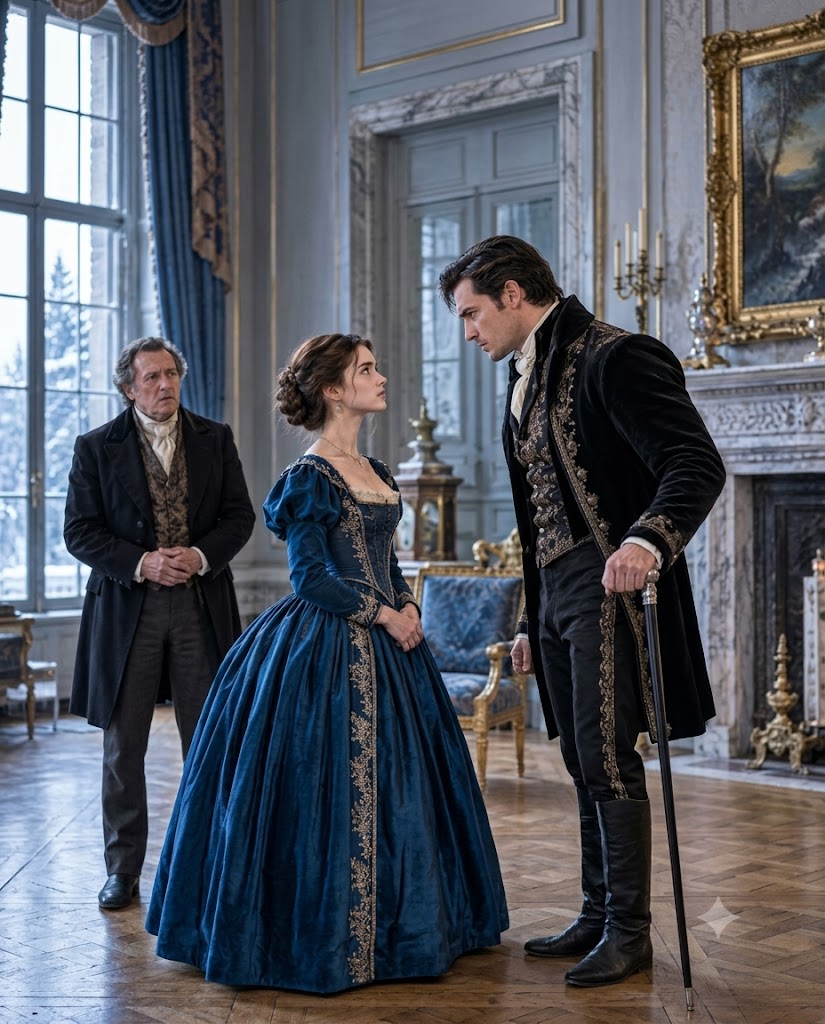
A tall, silver-haired gentleman entered without announcement.
He wore an elegant dark coat and carried himself with the easy confidence of a man accustomed to being welcomed.
“Simon, my dear boy!”
The stranger stopped when he noticed Clara.
His expression brightened.
“And this must be your beautiful bride.”
Simon did not rise.
“Clara, allow me to introduce my uncle, Lord Edmund Grafton.”
Edmund bowed over her hand.
“A pleasure beyond description. I confess, we had begun to despair of seeing happiness return to Ashborne.”
His smile was charming.
His eyes were not.
Clara felt his thumb press lightly against her wedding ring before he released her hand.
“Such a delicate creature,” he murmured. “I do hope this house does not frighten you.”
“Only its bookkeeping, my lord.”
Edmund’s smile faltered.
Simon lowered his cup to conceal an expression Clara could not quite identify.
“Bookkeeping?”
“Yes. I have found several troubling discrepancies.”
“How unfortunate. These old estates are dreadfully difficult to maintain.”
“Particularly when money disappears.”
Silence settled around the table.
Edmund’s gaze slid toward the ledgers.
Then he laughed.
“How admirable. A duchess with an interest in arithmetic.”
Clara smiled pleasantly.
“A necessary skill when one wishes to distinguish misfortune from theft.”
For a moment, she saw something cold and ugly beneath his polished manners.
Then it vanished.
“Do be careful, my dear. Ashborne has already suffered enough tragedy.”
He remained only twenty minutes.
After he departed, Simon stood abruptly.
“Never discuss the accounts with my uncle again.”
Clara stared at him.
“Because he might be implicated?”
“Because I asked you not to.”
“That is not an answer.”
“No,” Simon said. “It is the only protection I can offer until you understand what you’re dealing with.”
He left before she could reply.
That afternoon, Clara received her first threatening letter.
It arrived folded beneath her bedroom door.
There was no signature.
Only seven words.
The last duchess asked questions too.
Clara read them twice.
Simon had never been married before.
But his mother, the previous Duchess of Westmand, had died during the same fire that supposedly claimed Edward.
Clara immediately sought Mrs. Vale, the housekeeper.
The woman was arranging linen when Clara entered.
“Tell me about the late duchess.”
Mrs. Vale’s hands stopped moving.
“She was a kind lady.”
“Did she die in the hunting lodge?”
A long pause.
“That is what they said.”
“What do you say?”
Mrs. Vale looked toward the doorway.
Then she stepped closer.
“Her Grace discovered something dreadful before the fire.”
“What?”
“I don’t know. But the night before she died, she told me that if anything happened to her, I must protect Master Simon.”
“From whom?”
Tears filled the woman’s eyes.
“From his own blood.”
A floorboard creaked outside.
Mrs. Vale immediately stepped away.
“Please forgive me, Your Grace. I have duties.”
Clara turned.
Through the narrowing doorway, she glimpsed a dark coat disappearing around the corner.
Someone had been listening.
That night, Clara waited until the household slept.
She took a candle, the smallest knife from her writing desk, and a hairpin.
The lock on the west corridor door proved more stubborn than she expected.
Twice, the hairpin slipped.
On her third attempt, something clicked.
The door opened.
Cold air rushed against her face.
Beyond it lay a narrow chamber lined with shelves, its furniture covered in white sheets.
A portrait hung above the fireplace.
Three figures stood beneath an enormous oak tree.
A woman with gentle eyes.
A young Simon, untouched by scars.
And a smiling boy who could only be Edward.
Someone had slashed the mother’s face from the canvas.
Clara approached the desk.
Its drawers were empty except for a small wooden box.
Inside lay a silver locket, several old letters, and a child’s blue ribbon.
She unfolded the first letter.
My dearest Margaret,
I fear Edmund has discovered that I know about the transfers. He insists Edward signed the documents, but Edward was only sixteen. The signatures cannot possibly be his.
If anything happens, the evidence is hidden where the bells cannot ring.
Clara read the final sentence again.
Where the bells cannot ring.
Suddenly, the floor creaked behind her.
She turned.
A shadow filled the doorway.
The candle went out.
A hand seized her throat.
Clara drove her elbow backward and heard a grunt. Her attacker stumbled, but immediately lunged again.
A blade flashed in the darkness.
She screamed.
The door slammed against the wall.
“Get away from her!”
Simon’s voice thundered through the room.
A struggle followed.
Wood splintered.
Someone fell.
Then rapid footsteps retreated down the corridor.
Simon struck a match.
Clara stood against the desk, gasping, with a shallow cut across her sleeve.
Simon crossed the room and seized her shoulders.
“Are you hurt?”
She shook her head.
His gaze dropped to the blood on her arm.
For one instant, his composure broke completely.
“I told you to stay away.”
“Someone tried to kill me.”
“Yes,” he said, his voice shaking with controlled fury. “And now they know you found it.”
Clara held up the letter.
“Your uncle forged Edward’s signature.”
Simon closed his eyes.
When he opened them, he looked older.
“You have no idea how many people have died because of those papers.”
“Then tell me.”
He hesitated.
“Please, Simon.”
Her use of his name seemed to undo the final thread holding his silence together.
He sank into the chair beside the desk.
“My mother discovered that Edmund was using the estate to secure enormous personal debts. He had borrowed against land he did not own. When she confronted him, he threatened Edward.”
Clara sat opposite him.
“What happened at the lodge?”
Simon stared at his scarred hand.
“Edmund invited us there, claiming he wished to reconcile. I arrived late. The building was already burning.”
His breathing grew uneven.
“I heard my mother screaming. I went inside. I found Edward near the stairs, unconscious. I tried to carry him out, but the roof collapsed.”
Clara barely moved.
“When I woke, I was outside. My mother was dead. Edward was gone.”
“And Edmund?”
“Standing beside the doctor.”
Simon gave a bitter smile.
“He told everyone I had quarreled with Edward over inheritance. That I’d started the fire. There were witnesses willing to swear they had heard us fighting.”
“Why didn’t you defend yourself?”
“Because Edmund sent me Edward’s signet ring three days later.”
Clara felt the blood drain from her face.
“With a note,” Simon continued. “Confess nothing. Accuse no one. Obey, and your brother lives.”
“Edward is alive?”
“I don’t know.”
The words emerged like broken glass.
“For six years, I’ve paid men to follow every rumor. I’ve allowed Edmund to drain the estate because he promised Edward would remain unharmed.”
Clara looked toward the accounts.
“W.C.”
“Westmere Cottage. The payments are supposed to support Edward.”
“Have you ever seen him?”
Simon shook his head.
“Then your uncle has kept you imprisoned with hope.”
He looked at her, devastated.
“Hope was all I had.”
Clara reached across the desk.
For a long moment, Simon stared at her hand.
Then he took it.
His fingers were cold.
“You should leave,” he whispered. “I can arrange a carriage before sunrise.”
“And abandon you?”
“This marriage was never meant to become your punishment.”
Clara looked at the scars crossing his face.
For the first time, she no longer saw the frightening duke her father had described.
She saw a man who had sacrificed his reputation, his fortune, and six years of his life for someone he might never see again.
“My father taught me that a wife’s duty is obedience,” she said softly.
Simon gave a humorless laugh.
“And do you believe him?”
“No.”
She tightened her hold on his hand.
“I believe loyalty is something one chooses. And I am choosing to stay.”
Something changed in his expression.
He raised her injured hand carefully to his lips.
Then he kissed her knuckles.
Neither spoke about it.
Neither needed to.
The following morning, Clara ordered every bell in Ashborne Hall inspected.
The servants regarded her with alarm.
The estate had once possessed a complicated system of servant bells, connected through concealed wires to rooms throughout the house.
Most no longer worked.
One, however, had never been connected at all.
It hung in the abandoned nursery beside the west corridor.
Clara climbed onto a chair and examined it.
Behind the decorative bell plate, she discovered a narrow compartment built into the wall.
Inside rested a bundle wrapped in oilcloth.
She brought it to Simon’s study.
They unwrapped it together.
There were original land deeds, falsified loan agreements, and a private journal belonging to Simon’s mother.
On the final pages, Margaret Grafton had written:
Edmund believes the money is the secret. He does not know what Edward saw. If my youngest son speaks, his uncle will hang.
Clara turned the page.
A single sentence followed.
Edward witnessed the murder of Mr. Whitcombe.
Simon gripped the edge of the desk.
“Whitcombe was our solicitor. He disappeared shortly before the fire.”
Clara reached for another document.
A receipt bearing Edmund’s signature.
Beneath it appeared the initials W.C.
Not Westmere Cottage.
“Whitcombe,” Clara whispered.
A horrible understanding began to form.
The payments were not supporting Edward.
They were payments connected to the dead solicitor.
Someone had been using his name to hide stolen money.
And Edward’s disappearance had served as the perfect distraction.
Before she could speak, Mrs. Vale burst into the study.
“Your Graces, Lord Edmund has returned.”
Simon immediately gathered the documents.
“Where is he?”
“In the courtyard.”
Mrs. Vale hesitated.
“He has brought gentlemen with him.”
“How many?”
“Six.”
“And?”
Her voice trembled.
“They are carrying restraints.”
From below came a sharp, authoritative voice.
“By order of the magistrate, we demand entry!”
Simon went very still.
Clara looked at him.
“What is happening?”
He turned toward the window.
“Edmund has decided he no longer needs me alive.”
A heavy pounding shook the front door.
The magistrate entered with six constables and a physician Clara recognized from their wedding breakfast.
Edmund followed, looking appropriately distressed.
“My dear Simon,” he began, “I had hoped we might avoid this unpleasantness.”
The magistrate unfolded a document.
“Simon Grafton, Duke of Westmand, a formal petition has been submitted questioning your mental capacity and alleging violent conduct against your household.”
Clara stepped forward.
“On whose testimony?”
“Lord Edmund Grafton, Dr. Harcourt, and three servants.”
“Which servants?”
The magistrate hesitated.
Edmund sighed.
“Clara, my dear, everyone knows Simon’s condition has deteriorated.”
“He is perfectly sane.”
“Then how do you explain the injuries to your arm?”
Clara went cold.
Edmund’s eyes rested on her torn sleeve.
The same injury she had received during the attack.
Someone had reported it.
“His Grace attacked his new wife,” Edmund told the magistrate gravely. “She is frightened to admit the truth.”
Simon started forward.
Clara caught his wrist.
If he showed anger, they would use it against him.
She understood that much.
“May I see the physician’s report?” she asked.
Dr. Harcourt frowned.
“That is hardly appropriate.”
“Neither is declaring a duke incapable of managing his affairs when the only man benefiting financially is the petitioner.”
Edmund’s expression hardened.
“Enough.”
He turned toward the constables.
“Remove him.”
Two men moved toward Simon.
Clara stepped between them.
“If you restrain my husband without examining the evidence, every newspaper in London will know exactly how this inquiry was conducted.”
The magistrate hesitated.
It was all she needed.
She reached into her pocket and produced one of Margaret’s original deeds.
“Here is proof of fraudulent transfers made under Lord Edmund’s authority.”
Edmund’s eyes widened.
For the first time, he looked genuinely afraid.
Then he smiled.
“My dear girl, where did you find that?”
“In a place you overlooked.”
His expression became almost tender.
“How unfortunate.”
He nodded toward Dr. Harcourt.
The physician moved suddenly.
A cloth pressed against Clara’s mouth.
She smelled something sharp and sickly sweet.
Simon shouted her name.
She tried to struggle.
The room tilted.
The last thing she saw was Edmund drawing a pistol from inside his coat.
Then darkness swallowed everything.
When Clara awakened, she was lying on a narrow bed in a room that smelled of damp plaster.
Her wrists were tied.
Outside, rain struck the windows.
A single candle burned beside the door.
She recognized the room immediately.
The abandoned nursery.
The bell hung above her head.
Edmund sat near the fireplace.
“You have made this unnecessarily difficult,” he said.
Clara struggled upright.
“Where is Simon?”
“Being transported somewhere his temper will no longer inconvenience us.”
“You mean murdered.”
Edmund smiled.
“Such an ugly word.”
“Where is Edward?”
The smile vanished.
Clara forced herself to continue.
“You never supported him. You used Whitcombe’s name to conceal your transactions.”
Edmund studied her.
Then he laughed quietly.
“You are cleverer than your father suggested.”
Her stomach tightened.
“My father?”
“Lord Winslow owed me a considerable sum. I suggested a marriage would settle the matter.”
Clara felt the room contract around her.
“You arranged it.”
“Naturally. Simon needed a wife who would provide an heir, or at least appear willing to do so. A quiet, obedient young woman would have been ideal.”
“And if she died?”
Edmund spread his hands.
“Tragedy follows the Graftons, unfortunately.”
Clara stared at him.
She had been brought here to strengthen Simon’s apparent instability.
A frightened wife.
A convenient witness.
Perhaps another corpse.
“Why are you telling me this?”
Edmund rose.
“Because there is no longer any reason to conceal it.”
He approached the window.
“Edward died six years ago, Clara.”
Her chest tightened.
“You’re lying.”
“He survived the fire. Barely. I kept him alive for three months. He was quite useful while Simon believed he might recover.”
Edmund’s voice remained almost conversational.
“Eventually, the boy became troublesome.”
Clara felt sick.
“What did you do?”
“I ended his suffering.”
For a moment, the only sound was rain.
Then Clara asked, “Does Simon know?”
“Not yet.”
Edmund turned toward her.
“But perhaps I shall tell him before the end.”
Clara lowered her head.
Not in defeat.
To hide the way her fingers were working against the rope.
The small blade she had hidden in the seam of her sleeve had survived the search.
She had carried it since the attack.
Now its edge pressed into the cord.
“What happened to your mother?” she asked.
Edmund’s face darkened.
“My sister-in-law was an interfering woman.”
“You burned the lodge.”
“She forced my hand.”
“And Mr. Whitcombe?”
“He discovered the forged deeds. I had hoped to persuade him to be reasonable.”
Clara sawed harder.
The rope loosened.
“You murdered him.”
Edmund shrugged.
“He made his choice.”
“So have you.”
He turned.
Clara pulled her hands free.
She seized the candlestick and hurled it toward his face.
Edmund cried out.
Clara ran.
The corridor was dark, but she knew the way.
Behind her, Edmund shouted for the guards.
She reached the staircase.
A pistol fired.
Plaster exploded beside her head.
She stumbled, recovered, and raced downward.
At the landing, Mrs. Vale appeared.
“This way!”
The housekeeper dragged Clara through a servants’ passage.
They emerged in the kitchen, where Mr. Bell stood holding a heavy iron poker.
“His Grace?” Clara gasped.
“Taken toward the old mill,” Bell replied. “But I sent word to the tenant farmers.”
Clara stared at him.
“You knew?”
Bell lowered his eyes.
“We suspected Lord Edmund for years. But his men threatened our families.”
Mrs. Vale gripped Clara’s shoulders.
“We should have spoken sooner.”
“Then speak now,” Clara said. “All of you.”
A gunshot rang through the hallway.
They had no more time.
Clara seized her cloak.
“Where is the nearest magistrate who isn’t Edmund’s friend?”
Bell looked at her.
“Sir Thomas Hensley, in Northmere.”
“How far?”
“Eight miles.”
Clara turned toward the stable door.
“Then we ride.”
They reached Northmere just before dawn.
Clara’s hands were blistered from gripping the reins.
Her clothes were soaked.
But she carried Margaret’s journal beneath her cloak and the forged agreements against her heart.
Sir Thomas Hensley, awakened by the commotion, listened without interruption.
He examined the documents.
Then he looked toward Bell and Mrs. Vale, who stood beside Clara.
“Will you swear to what you’ve told me?”
Mrs. Vale lifted her chin.
“On my life.”
Bell nodded.
“And mine.”
Sir Thomas stood.
“Then we have enough to act.”
Clara caught his sleeve.
“Please. My husband may already be dead.”
The magistrate’s expression softened.
“Then we had better move quickly.”
At the old mill, Simon sat bound to a chair beneath a leaking roof.
His cane lay broken beside the wall.
Dr. Harcourt stood near the door, visibly nervous.
Edmund arrived shortly after sunrise.
His forehead was bandaged.
There was blood on his collar.
Simon looked up.
“Where is Clara?”
Edmund smiled.
“Your wife has proved remarkably resourceful.”
Simon surged against his bonds.
“If you’ve harmed her—”
“You’ll do what? Threaten me? Attack me?”
Edmund crouched beside him.
“That temper has always made you so easy to manipulate.”
Simon breathed heavily.
“Where is my brother?”
For the first time, Edmund’s smile faded.
Then he spoke.
“Edward is dead.”
The words seemed to empty the room.
Simon stared at him.
“No.”
“Six years, Simon. Did you truly imagine I would keep him alive indefinitely?”
A sound escaped Simon that barely resembled a human voice.
Edmund stood.
“I must say, your loyalty was extraordinarily profitable.”
Simon lowered his head.
His shoulders shook.
Edmund watched with satisfaction.
Then Simon looked up.
His face was wet.
But his eyes had changed.
“You killed him.”
“Yes.”
“And my mother.”
“Yes.”
Simon became very still.
“Then you have nothing left to threaten me with.”
Edmund raised his pistol.
“I disagree.”
A voice sounded from the doorway.
“So do I.”
Clara stood beneath the broken arch, Sir Thomas and four armed constables behind her.
Edmund spun.
For one heartbeat, nobody moved.
Then Edmund seized Simon by the collar and pressed the pistol against his temple.
“Another step, and he dies!”
The constables stopped.
Clara felt her heart hammering.
Sir Thomas raised one hand.
“Lord Edmund, surrender your weapon.”
Edmund laughed wildly.
“You think I will hang for this? I have friends in Parliament!”
“You also have witnesses,” Clara replied.
She stepped forward.
“Dr. Harcourt knows what you did. Mrs. Vale knows. Mr. Bell knows. And I heard you confess.”
Edmund tightened his hold on Simon.
“Confessions from servants and hysterical women?”
“Then perhaps you’ll prefer the testimony of your own physician.”
Everyone turned toward Harcourt.
He stood pale and shaking.
Edmund stared at him.
“Say nothing.”
Harcourt swallowed.
“I gave Edward the medicine.”
Silence.
“Lord Edmund ordered me to increase the dose. The boy was recovering. He could have lived.”
Simon closed his eyes.
Harcourt began to weep.
“I did what he told me. I was afraid.”
Edmund swung the pistol toward him.
The shot shattered a window.
In that instant, Simon drove his chair backward into Edmund’s knees.
Both men fell.
Clara screamed.
The pistol skidded across the floor.
Edmund reached for it.
Simon caught his wrist.
They struggled through the broken glass.
Then Edmund drew a narrow knife from his boot.
Clara saw the blade rise.
She seized Simon’s fallen cane and struck Edmund’s arm with everything she had.
The knife clattered away.
A constable tackled Edmund.
Another secured the pistol.
It was over.
Yet Simon remained on the floor, staring at the place where his uncle had fallen.
Clara knelt beside him.
“Simon.”
He did not answer.
She untied his wrists.
“Simon, look at me.”
Slowly, he lifted his head.
“My brother,” he whispered.
Clara took his face between her hands.
“I know.”
“I spent six years trying to save someone who was already gone.”
Her throat tightened.
“You spent six years refusing to abandon someone you loved.”
A sob broke from him.
For the first time since she had met him, Simon Grafton allowed another person to see him weep.
Clara held him as the rain fell through the ruined roof.
She did not promise that everything would be all right.
Some losses could never be repaired.
She simply stayed.
The trials began seven weeks later.
Edmund’s network of fraud unfolded with astonishing speed once witnesses realized he could no longer silence them.
Dr. Harcourt confessed to falsifying medical documents, drugging Clara, and administering the fatal medicine to Edward.
The original deeds proved years of theft.
Margaret’s journal established the history of threats.
A former stableman testified that he had seen Edmund’s men carry oil into the hunting lodge on the night of the fire.
And beneath the floor of an abandoned outbuilding, investigators discovered the remains of Mr. Whitcombe.
Edmund was convicted of murder and numerous other crimes.
His associates faced charges of their own.
Lord Winslow’s financial arrangement with Edmund also came to light.
Clara received a letter from her father begging her to protect the family name.
She read it in silence.
Then she fed it to the fire.
Simon watched from the doorway.
“Will you answer him?”
Clara shook her head.
“Some people only understand consequences when no one rescues them.”
Simon crossed the room.
“And what of us?”
She turned.
He looked uncertain.
It was strange to see such vulnerability in a man society had spent years fearing.
“The marriage was arranged under false pretenses,” he said. “If you wish to leave, I will make certain you are provided for.”
Clara looked at him for a long moment.
“Do you want me to leave?”
“No.”
The answer came immediately.
Then he glanced away.
“But wanting has brought me little happiness.”
Clara approached.
“Then perhaps you have been wanting the wrong things.”
He gave a faint smile.
“And what should I want?”
“Something you do not have to purchase with suffering.”
She took his hand.
“Something freely given.”
Simon swallowed.
“Clara, I have nothing beautiful to offer you. This house is ruined. My family is gone. My reputation may never recover.”
She touched the scar beside his eye.
“You have mistaken the evidence of your survival for the measure of your worth.”
His breath caught.
“Before I came here,” she continued, “I believed marriage meant surrendering my future to someone else’s decisions.”
“And now?”
“Now I believe it can mean building a future neither person could have imagined alone.”
Simon lowered his forehead against hers.
“I love you,” he whispered.
The words were almost lost between them.
Clara smiled through sudden tears.
“Then you should know I have fallen rather terribly in love with you.”
He kissed her.
Not with the urgency of a desperate man afraid to lose the last thing he possessed.
But with the tenderness of someone finally beginning to believe that happiness was possible.
Spring arrived slowly at Ashborne Hall.
The estate’s recovery did not resemble a miracle.
There were creditors to negotiate with, damaged farms to restore, and families who had suffered under Edmund’s greed.
Clara insisted that stolen rents be repaid before the grand drawing rooms were repaired.
Simon agreed.
Together, they visited tenants who had once feared the duke.
They listened.
They apologized for wrongs that had been committed in his name.
And they made changes that could be measured in warm houses, fair leases, and food on tables.
Mr. Bell became estate steward.
Mrs. Vale supervised the restoration of the household.
The abandoned nursery was transformed into a schoolroom for the children of estate workers.
And the locked chamber in the west corridor was opened permanently.
Inside, beneath the restored family portrait, Simon placed two small memorials.
One for his mother.
One for Edward.
Clara found him there one evening, standing before the candles.
“Do you ever think about the years you lost?” she asked.
“Every day.”
“Does it still hurt?”
“Yes.”
She moved beside him.
Simon took her hand.
“But it no longer feels as though those years are the only ones I shall ever have.”
Outside, the first roses were beginning to bloom.
Months later, on the anniversary of Clara’s arrival, a carriage approached Ashborne Hall beneath a clear evening sky.
Simon stood beneath the entrance arch, watching the guests arrive for a gathering that would once have been unimaginable.
The house glowed with candlelight.
Music drifted through the open windows.
Laughter rose from rooms that had known nothing but silence.
Clara joined him, her hand resting lightly on his arm.
“Do you remember what you said when I arrived?”
He glanced at her.
“I believe I was rather unpleasant.”
“You asked whether that little case was everything I had brought.”
Simon smiled.
“And you told me, ‘For now.'”
“I was frightened,” she admitted.
“So was I.”
She looked up in surprise.
“You?”
“Terrified.”
“Of what?”
He brushed a loose curl from her cheek.
“That you would look at me and see only what everyone else saw.”
Clara shook her head.
“I nearly did.”
His smile deepened.
“What changed your mind?”
She thought of the ledgers, the locked door, the night he had held her injured hand.
She remembered his grief.
His courage.
His willingness to sacrifice everything for love, even when love offered him no certainty in return.
“You did,” she answered.
Across the courtyard, the old church bells began to ring.
Simon drew her closer.
And for the first time in many years, Ashborne Hall no longer seemed like a place haunted by everything it had lost.
It had become a home.
Years afterward, people would tell the story of the disgraced duke and the young woman who had uncovered the truth.
Some claimed she had saved him.
Others insisted he had rescued her from a loveless future.
Clara always disagreed with both versions.
For she had learned that love was not the act of saving another person from every darkness.
It was the courage to stand beside them while they found their way toward the light.
And Simon had learned something equally important.
A person could be wounded without being worthless.
A reputation could be destroyed without destroying the truth.
And a heart that had endured unimaginable suffering could still find room for joy.
The warning that had once been carved beneath the locked door eventually faded from the stone.
But Clara never forgot it.
RUN.
She had been given every reason to obey.
Instead, she had opened the door.
And beyond it, she had discovered that the most frightening thing in Ashborne Hall had never been the scarred duke whom the world called a monster.
It had been the cruelty of those who believed a good man could be silenced forever.
In the end, their greatest mistake was not underestimating Simon.
It was underestimating the woman who refused to leave him.
Because courage is not always loud, and love is not always gentle.
Sometimes courage is a trembling hand turning a forbidden key.
Sometimes love is a quiet voice saying, “I will stay.”
And sometimes, the beginning of a beautiful life is hidden behind the very door everyone tells you never to open.
THE END.