They laughed when Virgil Tatum dragged me into the courthouse in Cheyenne, but his smile vanished when he realized I knew exactly why he wanted my husband’s ranch.
Josiah did not move.
For several seconds, neither did I.
The fire behind him had burned low, throwing a faint orange light across the room, but his face looked colder than the winter outside.
I held the letter tighter.
“Why did you choose me?”
He closed the door behind him.
“Because I was afraid.”
“Afraid of what?”
“Of losing my children. Of losing the ranch. Of becoming the kind of man who watches everything he loves disappear and does nothing.”
“That isn’t an answer.”
“No,” he whispered. “It isn’t.”
He walked toward the desk, then stopped when he saw the envelope in my hand.
“You should never have found that.”
I almost laughed.
“Apparently, I should never have found quite a few things around here.”
His eyes lowered.
“Clementine, I didn’t marry you because I needed a housekeeper.”
“I know.”
“I didn’t marry you because I needed someone to cook.”
“I know that too.”
“Then what do you think?”
I looked down at the letter.
“I think you knew something about me before I ever stepped onto this ranch.”
Josiah sat heavily in the chair.
For the first time since I had known him, he looked like a frightened man rather than a tired one.
“You remember the advertisement I placed?”
“Yes.”
“I wrote it because I needed a wife. But I didn’t write it alone.”
My stomach tightened.
“Who helped you?”
“Elias Mercer.”
I knew the name.
Everyone in the territory knew it.
Elias Mercer had once been the largest cattle owner in southern Wyoming. He had died five years earlier, leaving behind no wife and no children anyone knew about.
“What does Elias Mercer have to do with me?”
Josiah reached into the desk and pulled out a small leather notebook.
“He came to me six months before he died. He told me he had spent years regretting something he had done in Chicago.”
My fingers went cold.
“Chicago?”
Josiah nodded.
“He said there was a woman there named Clementine Dawson. She worked in a boardinghouse. She was raising two younger siblings after their mother died. She was strong, honest, and stubborn enough to survive things that would have broken most people.”
I stared at him.
“You knew about my family?”
“I knew some of it.”
“How?”
“Mercer had business in Chicago. He met your father once.”
My heart stopped.
“My father?”
Josiah nodded.
“He owed Mercer money.”
I felt the room tilt.
My father had died when I was sixteen. Until that moment, I had believed his debts had simply vanished with him.
“What did he owe?”
“Eight hundred dollars.”
The number struck me like a gunshot.
Eight hundred.
The exact amount of Josiah’s original loan.
I stepped backward.
“No.”
“Clementine—”
“No. Don’t tell me that coincidence.”
“It wasn’t.”
“Then tell me the truth.”
Josiah opened the notebook.
Inside were names, dates, figures, and notes written in Elias Mercer’s sharp handwriting.
On one page was my father’s name.
Below it was mine.
And beside my name were four words.
“Debt paid by daughter.”
I stared at the ink until it blurred.
“What does that mean?”
Josiah’s voice broke.
“Your father borrowed money from Mercer. He died before he could repay it. Mercer could have taken your family’s house, but he didn’t. Instead, he told me that one day he wanted to repay the kindness of a woman who had once saved his life.”
“What woman?”
“My mother.”
I looked at him.
He continued.
“Years ago, when my mother was young, she was traveling west with her parents. Their wagon broke down outside Chicago. Mercer found them. My mother cared for him when he was sick. He never forgot her.”
“So he wanted to repay her?”
“Yes.”
“And he chose me?”
“He believed you were the person who had unknowingly inherited the debt and the kindness.”
I shook my head.
“That makes no sense.”
“It didn’t make sense to me either.”
“Then why did you do it?”
“Because I was desperate.”
His voice was barely audible.
“My first wife had died. I had seven children. The ranch was drowning in debt. I needed someone willing to come here. When Mercer showed me your name, I wrote the advertisement.”
I felt something inside me crack.
“So our marriage was arranged by a dead man.”
“No.”
Josiah stood.
“It began that way.”
He came closer.
“But what happened afterward was ours.”
I looked away.
“Did you know about Virgil Tatum?”
Josiah froze.
“Yes.”
“Before he came to the ranch?”
“Yes.”
“How long?”
“Years.”
I turned back toward him.
“Then tell me everything.”
Josiah took a long breath.
“Virgil wasn’t simply a moneylender.”
“I know.”
“He was Mercer’s partner.”
That explained too much.
The false loan.
The missing receipts.
The threats.
The certainty that he would eventually come for the ranch.
“He wanted your land,” I said.
“Yes.”
“Why?”
“Because of the valley.”
My pulse quickened.
“The mustangs?”
Josiah nodded.
“The valley isn’t ordinary grazing land. Beneath it runs a vein of coal. Mercer discovered it years ago.”
I thought of the coal smoke hanging over Cheyenne.
“He never mined it.”
“He didn’t want to destroy the land. Virgil did.”
“So the foreclosure—”
“Was never about the eight hundred dollars.”
My hands curled into fists.
“Then why didn’t you tell me?”
“Because I thought I could handle it.”
“You couldn’t.”
“I know.”
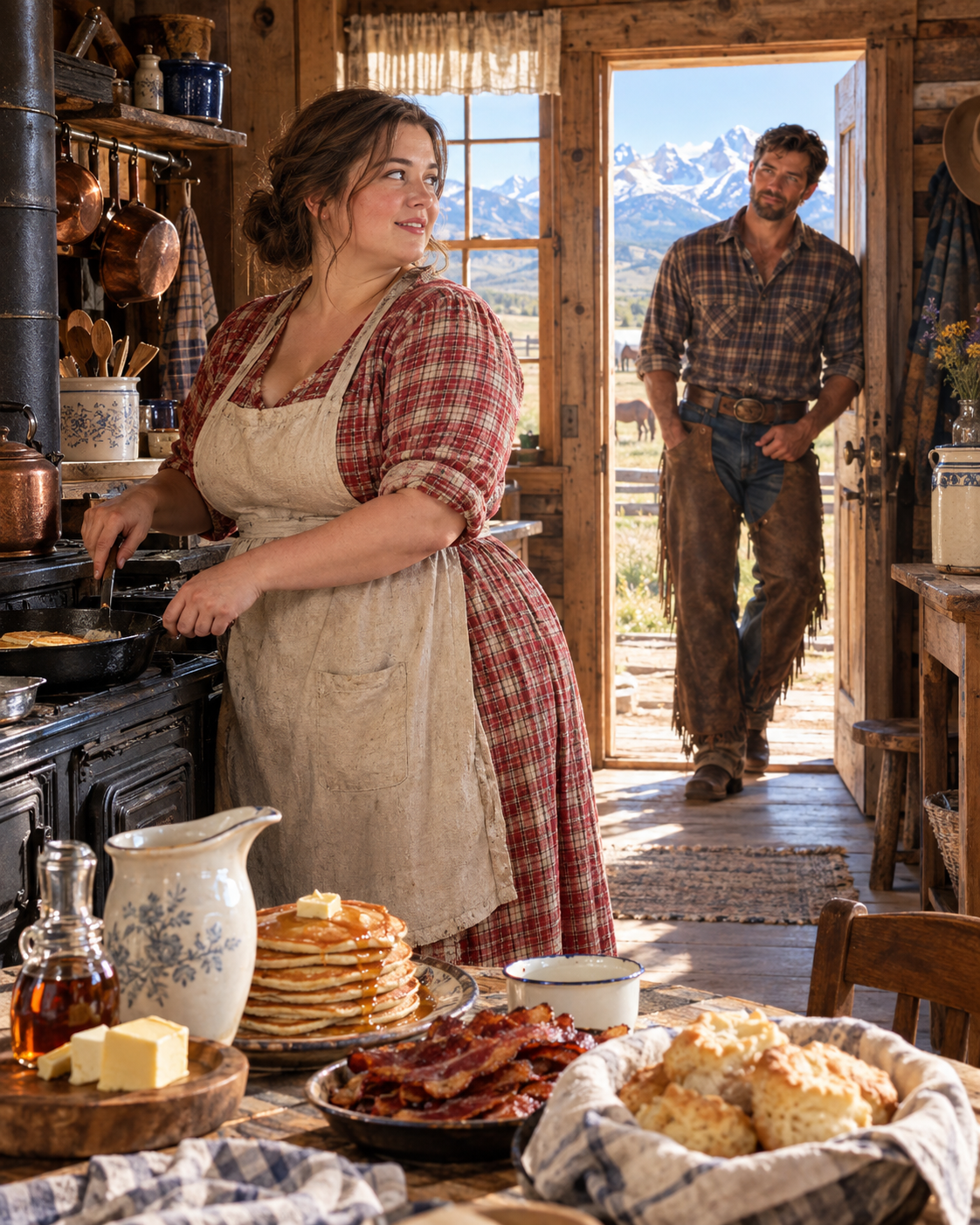
The silence between us was painful.
Then I noticed something else in the notebook.
A map.
The northern ridge was marked in red.
But beneath the valley was another line, stretching toward the eastern boundary of the ranch.
“What is that?”
Josiah’s face changed.
“I don’t know.”
“You do.”
He looked at me.
“I know what Mercer told me.”
“Then say it.”
“He said there was something buried beneath the valley.”
“What?”
“A box.”
My heart began pounding.
“What kind of box?”
“I never found it.”
“What’s inside?”
“I don’t know.”
“Then why does Virgil want it?”
Josiah’s eyes met mine.
“Because Mercer told him about it too.”
The next morning, before sunrise, I woke to the sound of horses.
Not ours.
I dressed quickly and woke Josiah.
We stepped outside.
Three riders stood beyond the fence.
Virgil Tatum was in the middle.
His coat was black.
His smile was gone.
Two armed men sat beside him.
“You should have taken my offer,” he called.
Josiah reached for the rifle.
I stopped him.
“Not yet.”
Virgil laughed.
“Mrs. Caldwell, you have made this unnecessarily difficult.”
“You tried to steal our ranch.”
“I tried to purchase it.”
“With a fraudulent foreclosure.”
“Prove it.”
“I already have.”
His eyes narrowed.
Then he looked toward the children.
“Seven mouths. One winter. How long before they start starving again?”
Samuel stepped beside me.
He was holding the old broom like a rifle.
“I ain’t afraid of you.”
Virgil smiled.
“You should be.”
I moved in front of Samuel.
“You came here to frighten children?”
“No.”
He looked at me.
“I came for what belongs to me.”
“The land doesn’t.”
“Perhaps not.”
His gaze shifted toward the ridge.
“But something beneath it does.”
Josiah raised his rifle.
“Leave.”
Virgil’s men reached for their weapons.
Then a voice sounded from behind us.
“Put those guns down.”
Cavalry riders appeared over the hill.
The officer I had spoken with during the auction rode at the front.
Virgil cursed.
“You think soldiers will protect you forever?”
“No,” I answered.
“I think witnesses might.”
He stared at me.
Then he smiled again.
This time, there was something desperate beneath it.
“You still don’t understand.”
“What?”
“The box.”
My blood went cold.
Virgil turned his horse.
“We’ll see who finds it first.”
He and his men disappeared into the gray morning.
We searched the valley that afternoon.
The children helped.
We found broken wagon wheels, rusted tools, animal bones, and old pieces of fence.
Nothing else.
Near sunset, Samuel shouted.
“Ma!”
I ran toward him.
He stood beside the black stallion.
The horse was pawing at the ground.
Again and again.
“That’s strange,” Samuel said.
I knelt.
The earth beneath the horse’s hoof sounded hollow.
Josiah came running.
Together, we cleared away the dirt.
Underneath was a flat stone.
We moved it.
A narrow shaft descended into darkness.
The children stared.
Josiah grabbed a lantern.
“Stay here.”
“No,” I said.
He looked at me.
“Clementine—”
“You’ve kept enough secrets.”
He almost smiled.
“Fair enough.”
We climbed down.
The tunnel was old.
Its walls were reinforced with wooden beams blackened by age.
The air smelled of earth and coal.
After nearly fifty yards, the passage opened into a small chamber.
And there it was.
A metal box.
Josiah lifted it.
It was heavier than it looked.
The lock had already been broken.
Inside were documents.
Land deeds.
Bank records.
Letters.
And one final envelope.
My name was written on it.
Again.
I opened it.
The letter was from Elias Mercer.
“Clementine Dawson,
If you are reading this, then Virgil has already attempted to take the ranch.
Do not trust him.
The land beneath Caldwell Ranch contains more than coal. Years ago, I discovered evidence that Virgil had been falsifying loans and forcing ranchers from their land. I kept copies of his records because I feared he would kill me if I confronted him.
The original records are here.
Take them to the territorial authorities.
Do not sell the land.
Do not let Virgil frighten you.
And remember this:
A debt paid in money can be counted.
A debt paid in kindness cannot.
I once believed wealth was measured by what a man could own.
I was wrong.
It is measured by what he refuses to take from another person.”
I lowered the letter.
Josiah was staring at me.
“What does it say?”
I handed it to him.
He read it silently.
Then he sat on the stone floor.
For several minutes, neither of us spoke.
Finally, he said, “He knew.”
“Knew what?”
“That you would become the person who saved us.”
I shook my head.
“No.”
“What?”
“I didn’t save you.”
I looked toward the tunnel.
“We saved each other.”
We carried the box to town under military escort.
The hearing began two days later.
This time, Virgil Tatum did not smile.
The documents exposed years of fraudulent contracts.
Names of ranchers.
Dates.
Amounts.
Signatures.
Some men had lost their homes because Virgil claimed they had defaulted.
Others had been threatened into silence.
And several of the original receipts had been deliberately altered.
The final evidence was a ledger containing payments Virgil had received from land speculators.
The magistrate stared at the pages for nearly ten minutes.
Then he looked at Virgil.
“Where did you obtain these?”
Virgil said nothing.
The cavalry officer testified.
Then Josiah testified.
Then I did.
When the magistrate asked why I had searched the valley, I told him the truth.
“Because my children were hungry.”
A murmur passed through the courtroom.
“They were not my children by blood,” I continued.
“But hunger does not care about blood. Neither does fear. When people are desperate, they need someone willing to stand beside them.”
Virgil laughed bitterly.
“You expect this court to believe you are some kind of hero?”
I turned toward him.
“No.”
I held up the ledger.
“I expect the court to believe your handwriting.”
The room went silent.
Virgil was arrested before sunset.
The investigation continued for months.
Several ranchers recovered their land.
Some never recovered everything they had lost.
The coal company that had secretly worked with Virgil abandoned its claim on our valley.
The government declared the hidden herd protected until proper ownership could be established.
And the black stallion?
He stayed.
We named him Mercy.
He became the most stubborn horse on the ranch.
Samuel claimed Mercy understood every word he said.
Mercy proved him wrong whenever possible.
Spring came early that year.
The snow melted from the fields.
The children grew taller.
Mary learned to sew.
Thomas learned to read.
Samuel learned that touching a rifle still required permission.
And I learned something far more difficult.
I learned how to trust a man who had once kept a secret from me.
It did not happen overnight.
There were evenings when I still remembered that letter.
There were mornings when I wondered whether Josiah had ever truly chosen me.
One evening, I found him repairing a fence.
I stood beside him.
“Josiah?”
He looked up.
“Yes?”
“If you had known everything you know now, would you still have written that advertisement?”
He thought about it.
Then he smiled.
“No.”
My heart sank.
“Why?”
“Because I wouldn’t need an advertisement.”
I stared at him.
“I would have come to Chicago myself.”
I laughed despite myself.
“That might have frightened me.”
“I was a frightening man.”
“You were a desperate man.”
“Perhaps.”
He looked toward the house.
“You gave my children a mother.”
I shook my head.
“They gave me a family.”
He put down the hammer.
“I love you, Clementine.”
I looked at him for a long time.
The words were simple.
But they carried the weight of every meal we had shared, every winter night, every frightened child, every lie uncovered, every secret forgiven.
“I love you too,” I said.
He took my hand.
We stood there beneath the wide Wyoming sky.
The ranch was still poor.
The barn still needed repairs.
The roof still leaked.
There were bills on the kitchen table.
Life had not transformed into some perfect story simply because justice had finally arrived.
But the children were laughing inside the house.
There was bread in the oven.
The fields were green.
And nobody was coming to take our home away.
Years later, people in Cheyenne still talked about the foreclosure hearing.
Some called me brave.
Others called me foolish.
A few insisted I had been lucky.
They were all partly right.
But they never understood what had truly happened.
I had not arrived in Wyoming looking for adventure.
I had not expected to become a wife, a mother, or the woman who stood against a powerful man in a courthouse.
I had simply known what it felt like to be unwanted.
And when I saw seven hungry children looking at me as though I were their last hope, I could not turn away.
That was the secret Elias Mercer had understood.
Kindness does not always return in the form you expect.
Sometimes it comes back years later.
Sometimes it crosses an entire country.
Sometimes it arrives disguised as a difficult marriage, a frightened husband, seven unruly children, and a ranch that appears destined to be lost.
And sometimes the thing you think is your burden is actually the road leading you home.
One summer evening, Samuel and I rode toward the northern ridge.
He had grown tall enough to look over the saddle horn.
Mercy followed behind us.
Samuel pointed toward the valley.
“Do you think we’re rich now?”
I smiled.
“No.”
He frowned.
“But we have the ranch.”
“Yes.”
“And the horses.”
“Yes.”
“And enough food.”
“Yes.”
“And Dad.”
I looked toward the house.
Josiah was standing on the porch, waving.
Samuel thought for a moment.
“Then maybe rich means something different.”
I looked at him.
“It does.”
“What does it mean?”
I thought of the letter hidden years ago beneath the floorboard.
I thought of the courthouse.
The foreclosure papers.
The hungry children.
The black stallion.
The old box beneath the earth.
And the man who had once believed a person’s worth could be measured by money.
“Rich,” I told Samuel, “means having something worth protecting, and having people worth protecting it with.”
He nodded as if that answer made perfect sense.
Then he kicked his horse forward.
I followed.
Behind us, the sun dropped slowly beyond the mountains, turning the snow on the distant peaks gold.
The wind moved across the valley.
For a moment, I could almost hear the voices of everyone who had come before us.
My father.
Mercer.
Those forgotten ranchers whose names had been buried in a ledger.
And perhaps even the woman who had once saved Mercer’s life without knowing that kindness would travel farther than she ever could.
I finally understood why I had been chosen.
It was not because I was beautiful.
It was not because I was wealthy.
It was not because I knew how to ride or shoot or run a ranch.
I had been chosen because I knew hunger.
I knew rejection.
I knew what it meant to stand at a door and wonder whether anyone would open it.
And when I finally had a door of my own, I decided it would remain open.
That was the inheritance Elias Mercer had left me.
Not the land.
Not the money.
Not the hidden coal.
Not even the ranch.
It was the understanding that the greatest debts in life are rarely the ones written on paper.
A person can repay a loan with money.
A court can erase a debt with a stamp.
A judge can punish a thief.
But kindness works differently.
It moves from one person to another.
It survives years.
It crosses borders.
It finds people who never knew they were connected.
And sometimes, when the world tells you that you are too poor, too ordinary, too unwanted, or too insignificant to matter, kindness is the one thing you can give that no powerful man can ever foreclose.
That night, I returned home to the sound of seven children arguing over supper.
Josiah was laughing.
The fire was warm.
The bread was rising.
I stood in the doorway for a moment and listened.
Once, I had believed I came to Wyoming because I had nowhere else to go.
I was wrong.
I had come because somewhere in the distance, a family was waiting for me.
And sometimes the greatest miracle is not being rescued from the life you have.
It is discovering that the life you thought you were losing was the very life you were meant to build.
For a while, I believed the worst was behind us.
I was wrong.
The first sign came three weeks after Virgil Tatum was arrested.
It was a letter.
No name appeared on the envelope.
No return address.
Only three words were written across the front in dark ink.
“YOU OWE ME.”
I read it twice.
Then a third time.
Josiah stood behind me.
“What is it?”
I handed him the paper.
He read it.
His jaw tightened.
“Clementine, don’t worry about this.”
“I’ve heard that sentence before.”
“This is different.”
“Then tell me how.”
He didn’t answer.
That frightened me more than the letter.
I watched him fold the paper and put it into his pocket.
“Josiah.”
He sighed.
“There was another man involved with Virgil.”
“Who?”
“I don’t know his name.”
“You know something.”
“I know Virgil wasn’t acting alone.”
The room seemed to grow colder.
“What did Mercer say?”
“Nothing about another man.”
“Then who sent this?”
“I don’t know.”
That night, I couldn’t sleep.
Every creak of the house sounded like footsteps.
Every gust of wind sounded like a rider approaching.
At midnight, I heard Mercy screaming from the pasture.
I grabbed my coat and ran outside.
Josiah was already there.
The black stallion was standing near the northern fence, kicking violently at the ground.
Then we saw it.
A lantern.
Someone was riding away beyond the ridge.
Josiah raised his rifle.
“Stay here.”
“No.”
“Clementine—”
“I am not staying behind while someone trespasses on our land.”
We mounted our horses and followed.
The rider disappeared into the darkness.
We found only a torn piece of cloth caught on a branch.
Dark blue.
And beneath the cloth was a brass button.
Josiah turned it over.
There was a symbol engraved on the back.
A small letter T.
“Tatum,” I whispered.
“Maybe.”
“No.”
I looked toward the darkness.
“Not maybe.”
The next morning, we returned to Cheyenne.
Virgil was being held in a county jail awaiting trial.
I demanded to see him.
At first, the guard refused.
Then I told him I had evidence concerning the investigation.
He let me in.
Virgil sat behind the bars.
He looked thinner.
Older.
But when he saw me, he smiled.
“You shouldn’t have come.”
“I have a question.”
“You have many.”
“Who is T?”
His smile disappeared.
For the first time, I saw genuine fear in his eyes.
“Where did you get that name?”
“You tell me.”
He stood slowly.
“Listen to me, Mrs. Caldwell. Whatever you think you uncovered, you haven’t uncovered enough.”
“Then help me.”
“I can’t.”
“Or you won’t?”
He gripped the bars.
“You don’t understand the kind of men you’re dealing with.”
“I’ve dealt with you.”
“That was nothing.”
“Then who is worse?”
Virgil looked toward the guard.
“Leave,” he whispered.
The guard frowned.
“I need to speak with her alone.”
“You don’t get to make that request.”
Virgil turned back to me.
“If you want your family alive, forget about the blue coat.”
My blood went cold.
“What did you say?”
He sat down again.
“Go home.”
I walked out without another word.
But I did not forget.
That evening, I told Josiah everything.
He listened quietly.
Then he opened the old ledger.
There was one name he had never shown me.
Thomas Tatum.
Virgil’s older brother.
I stared at it.
“Your father?”
“No.”
“Then who?”
“His business partner.”
“How long?”
“Since before the ranch loan.”
I turned the pages.
There were payments.
Large ones.
Every few months.
But the names of the recipients had been coded.
Then I noticed something.
The payments stopped five years ago.
The exact year Elias Mercer died.
“Josiah.”
He leaned closer.
“What?”
I pointed to the final entry.
The amount was enormous.
Ten thousand dollars.
Beside it were four words.
“Purchase completed upon death.”
“What was purchased?”
I asked.
Josiah shook his head.
“I don’t know.”
I did.
The valley.
The hidden coal.
The ranches surrounding it.
This had never been about one property.
Virgil and his partners had been trying to control the entire region.
And Elias Mercer had stood in their way.
Until he died.
We spent the next two days examining every document from the box.
Then Mary found something.
She was twelve by then and had inherited her father’s patience but none of his willingness to overlook details.
“Ma?”
“Yes?”
She held up an old photograph.
“Who’s this?”
I looked.
There were five men standing outside a building in Chicago.
One was Elias Mercer.
One was Virgil Tatum.
One was Thomas Tatum.
And beside them stood a man I recognized.
I had seen him before.
Not in Wyoming.
In Chicago.
Years earlier.
He had been a customer at the boardinghouse where I worked.
A quiet man who always wore a dark blue coat.
My hands began shaking.
“Who is he?”
Josiah asked.
I whispered his name.
“Mr. Harlan.”
The next morning, Harlan arrived in Cheyenne.
He did not come to threaten us.
He came to surrender.
He found us in the courthouse.
“I know what you’re looking for,” he said.
I stared at him.
“You sent the letter.”
“Yes.”
“Why?”
“To frighten you.”
“Why?”
“Because I wanted you to stop digging.”
“Did you kill Mercer?”
His face went pale.
“No.”
“Did you help Virgil?”
“Yes.”
The courtroom seemed to disappear around us.
Harlan lowered his head.
“I thought we were buying land. I didn’t know what they intended to do.”
“You knew enough.”
“Yes.”
“Then why tell me now?”
“Because I have a daughter.”
He swallowed.
“And last night I realized I had become the kind of man I would never want her to marry.”
His confession exposed the rest.
Virgil had forged documents.
Thomas Tatum had bribed officials.
Harlan had arranged transactions through banks in Chicago.
And Elias Mercer had discovered the scheme.
They had tried to force him into selling.
He refused.
Then he died under circumstances that had never been fully investigated.
Harlan insisted he had not been present when Mercer died.
But he knew who had been.
Thomas Tatum.
The final piece was found in the old box.
A letter from Mercer to a territorial judge.
It had never been delivered.
In it, Mercer named every man involved.
He also wrote one final sentence.
“If anything happens to me, protect the Caldwell property. The woman connected to that name has done nothing wrong.”
I read the sentence again and again.
He had known.
He had tried to protect me before he had ever met me.
The trial lasted six weeks.
Virgil confessed to fraud.
Harlan testified against Thomas.
Thomas fled Wyoming before he could be arrested.
For months, people searched for him.
Then, one morning in early autumn, a telegram arrived.
He had been arrested in Denver.
The final threat was over.
But the ranch was not the same.
Neither was I.
I had spent so long fighting to keep it that I had forgotten to ask myself what I wanted after the fighting ended.
One evening, Josiah found me sitting alone on the porch.
“What are you thinking?”
“That I don’t know how to stop being afraid.”
He sat beside me.
“You don’t have to stop.”
I looked at him.
“Fear kept me alive.”
“Yes.”
“But it also kept me from living.”
He was quiet.
Then he reached into his pocket.
“I have something for you.”
It was a small key.
“What is it?”
“The old room above the barn.”
I frowned.
“Why?”
“Because I fixed it.”
“For what?”
“For you.”
I followed him.
The room had been transformed.
There was a desk beside the window.
Shelves.
Paper.
Ink.
A small stove.
And on the desk was a stack of blank pages.
“You always wanted to write,” he said.
I touched the paper.
“I never told you that.”
“You didn’t have to.”
He looked embarrassed.
“I noticed.”
I sat down.
For years, I had thought my story was about surviving.
Now I understood it was about choosing what came next.
I began writing.
Not about Virgil.
Not about the foreclosure.
Not even about the hidden valley.
I wrote about seven hungry children who had taught me that love could begin with a loaf of bread.
I wrote about a man who had been too ashamed to ask for help.
I wrote about an old debt that traveled across generations.
And I wrote about how a woman who believed she had been unwanted discovered that she had been needed.
The years passed.
The children grew.
Mary married a schoolteacher.
Thomas became a rancher.
Samuel, stubborn as ever, became the finest horseman in the territory.
The younger children scattered across Wyoming.
The ranch survived.
Then one spring morning, Josiah died.
Quietly.
In his sleep.
He was seventy-two.
I found him before sunrise.
His hand rested on the blanket.
His face was peaceful.
For a long time, I could not move.
Then I sat beside him and held his hand.
I remembered the first time I had seen him.
A tired man standing behind seven hungry children.
I remembered his apology.
His fear.
His laughter.
The way he had looked at me when I told him we were still together.
And I understood something.
Love does not always arrive like thunder.
Sometimes it arrives quietly.
Sometimes it begins with an advertisement.
Sometimes it looks like a practical arrangement between two desperate people.
And sometimes it takes years before you realize that the person standing beside you has become home.
We buried Josiah beneath the cottonwood tree overlooking the valley.
The children came from everywhere.
Grandchildren stood beside them.
Samuel placed his father’s old hat on the coffin.
Then he turned to me.
“Ma?”
“Yes?”
“Are you all right?”
I looked across the valley.
The fields were green.
Horses moved slowly through the grass.
The mountains stood beyond them, unchanged.
“No,” I said.
Samuel’s face fell.
Then I smiled.
“But I will be.”
He hugged me.
For the first time since Josiah died, I cried.
Not because I was weak.
Because I finally understood that grief was simply love that had nowhere to go.
Years later, when I was an old woman, a young girl came to the ranch.
She was the daughter of a poor family traveling west.
Her father had lost his work.
Her mother was sick.
They had almost nothing.
She stood at our kitchen door holding her little brother’s hand.
“Ma’am,” she whispered, “could we have some food?”
I looked at her.
For one brief second, I was back in that courthouse.
I saw seven children against the wall.
I remembered hunger.
I remembered shame.
I remembered being told that I was not enough.
Then I opened the door wider.
“Come inside.”
The girl stared at me.
“But we can’t pay.”
“You don’t need to.”
“Why?”
I smiled.
“Because someone once did the same for me.”
She stepped inside.
Behind her, her little brother smiled when he smelled the bread.
I closed the door.
Outside, the Wyoming wind moved through the grass.
The ranch was old.
The fences needed repairing.
The roof needed replacing.
Life was still imperfect.
But the door was open.
And that was enough.
On my final evening, I sat beneath the same cottonwood tree where Josiah had been buried.
Samuel’s children were playing nearby.
Someone was laughing in the kitchen.
Bread was baking.
The black stallion was long gone, but his descendants still ran through the valley.
I held Mercer’s old letter in my hands.
The paper had become soft with age.
I read the final words one more time.
A debt paid in money can be counted.
A debt paid in kindness cannot.
I folded the letter.
For most of my life, I had believed that the greatest victory was keeping the ranch.
I no longer believed that.
The ranch was only land.
The house was only wood.
The money was only numbers.
What mattered was what happened inside those walls.
A hungry child was fed.
A frightened man was forgiven.
A lonely woman was given a place to belong.
And kindness that should have ended with one generation was carried into another.
That was the true inheritance.
Not the ranch.
Not the coal.
Not the money hidden beneath the earth.
Love.
Courage.
Mercy.
The things no court could seize.
The things no criminal could steal.
The things no foreclosure could ever take away.
As the sun disappeared behind the mountains, I heard a child’s voice from the house.
“Grandma! The bread is burning!”
I laughed.
I stood slowly.
“Then somebody better save it.”
And I walked home.
Not because the past had disappeared.
Not because life had been fair.
But because I had finally learned the truth that had taken me an entire lifetime to understand:
Sometimes the door you believe is closing is the very door that leads you into the life you were meant to live.
And sometimes, when you think you have nothing left to give, the smallest act of kindness becomes the beginning of a legacy that outlives you.
The world remembers fortunes.
It remembers battles.
It remembers the names of powerful men.
But the people who change a life rarely know they have done it.
They simply open the door.
They offer the bread.
They stay when leaving would be easier.
And somewhere, years later, someone else does the same.
That is how kindness survives.
That is how a family is built.
That is how a debt is finally paid.
And that is how I learned that the richest thing a person can leave behind is not land beneath their feet, but love in the hearts of those who remain.
THE END.