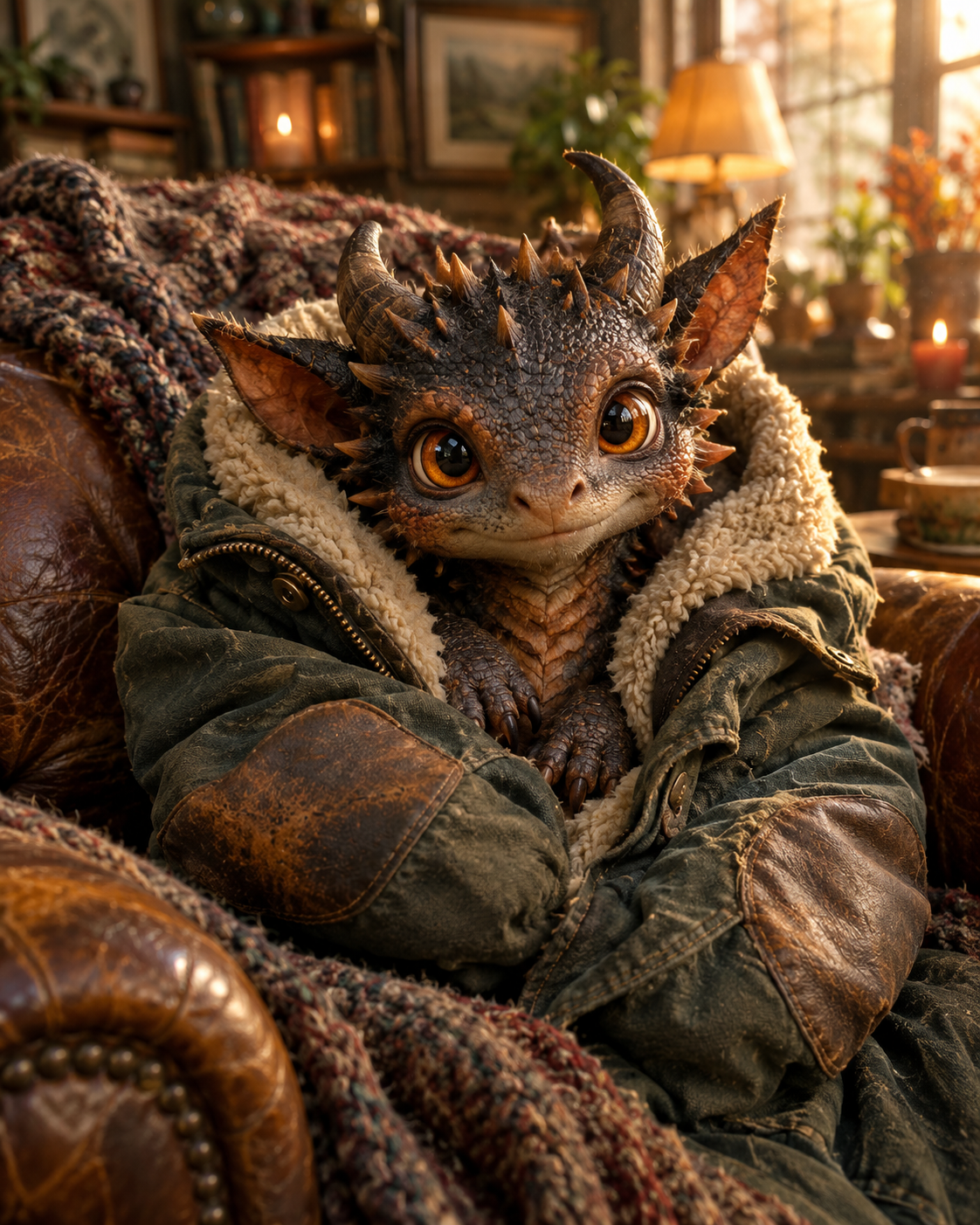
They laughed when the station doors opened and I found a frightened hatchling clutching my father’s green coat, while his mother coldly accused me of stealing it—but she knew the truth.
“Orin.”
The name struck me harder than any alarm.
My father’s name.
Not the name printed on his work badge. Not the name used in the memorial records. The name I had heard only once, years ago, from a stranger who had come to our apartment after the funeral.
A name my father had never allowed me to ask about.
Asha watched my face carefully.
“You know that name.”
I could barely breathe.
“My father was Elias Venn.”
“I know.”
“Then why did Rul just call him Orin?”
Asha did not answer immediately.
Instead, she knelt in front of Rul.
The little hatchling tightened his grip around the green coat.
“Rul,” she whispered, “tell her what you remember.”
Rul’s eyes flicked toward me.
“Green place.”
Asha nodded.
“Go on.”
“Warm hands.”
His claws trembled.
“Metal rain.”
I felt the room tilt.
My father used to tell me stories about metal rain when I was little. He called it a joke from his early days on Haven Station, back when damaged coolant lines sometimes sprayed silver droplets through maintenance shafts.
I had always thought it was just an old mechanic’s story.
Rul continued.
“Orin carried me.”
Asha closed her eyes.
My heart began pounding.
“Carried you where?”
Rul looked confused by the question.
“Home.”
I stared at Asha.
“What is happening?”
She sat down slowly.
“The night Rul was born, there was an accident in the lower agricultural ring. A coolant reactor ruptured. The evacuation doors sealed automatically, but the nursery was on the wrong side.”
She looked at Rul.
“His mother was trapped.”
“And my father?”
“He went in.”
I shook my head.
“No. My father died six years ago.”
“I know.”
“He died in a maintenance accident.”
Asha’s silence was answer enough.
I stood so quickly that the chair behind me scraped across the floor.
“You said he went in.”
“He did.”
“And he came out?”
Asha looked at the green coat.
“Not alive.”
The room became impossibly quiet.
I stared at the coat wrapped around Rul.
For six years, I had believed my father’s death was simple.
A broken maintenance seal.
A decompression event.
One body recovered.
One funeral.
One official report.
One sentence repeated by everyone who knew him:
He died doing his job.
But now a frightened hatchling was sleeping in his coat and calling him by another name.
“Why wasn’t I told?”
Asha lowered her eyes.
“Because the station administration wanted the incident buried.”
“Why?”
“Because your father wasn’t assigned to that sector.”
I frowned.
“What does that mean?”
“He shouldn’t have been there.”
Asha reached into her jacket and pulled out a small metallic cylinder.
She placed it on the floor between us.
“There were three people who knew the real story. Your father. Me. And the station director.”
My throat tightened.
“Why would you know?”
“Because I was the mother trapped in the nursery.”
I stared at her.
Rul made a small sound.
Asha’s face crumpled for just a second before she forced it back into place.
“I was there when the reactor ruptured. I was holding Rul. The doors sealed. The temperature dropped. I thought we were going to die.”
She touched the cylinder.
“Your father opened the emergency hatch manually.”
“And saved you.”
“He saved my son.”
She looked at Rul.
“I didn’t make it out.”
I froze.
“What?”
Asha’s eyes filled with tears.
“The hatch collapsed before I could reach it. Your father pushed Rul through the opening.”
Her voice became almost inaudible.
“He came back for me.”
She looked at the floor.
“He couldn’t get back out.”
The words landed one by one.
“He died because he went back?”
“Yes.”
“Then why did the report say it was a maintenance accident?”
“Because that was easier.”
“For who?”
“For the station.”
I felt anger rising through the grief.
“They let me believe he died because of a random accident.”
Asha nodded.
“And I let you.”
I looked at her.
“Why?”
She finally met my eyes.
“Because I was afraid.”
The little cylinder clicked softly as she pushed it toward me.
“Your father gave this to me before he went back.”
I picked it up.
My fingers were numb.
“What is it?”
“His final recording.”
The cylinder recognized my fingerprint.
A blue light appeared.
Then my father’s voice filled the room.
My knees almost gave out.
“Dar.”
One word.
One impossible word.
I sat down.
His voice was older than I remembered.
Tired.
Warm.
Alive.
“If you’re hearing this, something went wrong.”
I covered my mouth.
Rul crawled closer.
The recording continued.
“I know you’ll be angry. You have every right to be. But if you’re listening to this, please understand one thing.”
There was a pause.
“I didn’t leave you because I wanted to.”
My eyes burned.
“I left because somebody had to go back.”
A metallic groan sounded faintly in the background of the recording.
My father breathed slowly.
“Dar, you always hated goodbyes. So I won’t say goodbye.”
His voice softened.
“I’ll just say this.”
“You were the best thing that ever happened to me.”
The recording ended.
For several seconds, nobody moved.
Then Rul crawled into my lap.
He pressed his head against my chest.
I held him.
Not because he was my responsibility.
Not because I was honoring my father.
Because I suddenly understood that he had been carrying a piece of my father’s last act of kindness without even knowing it.
I looked at Asha.
“Why now?”
“Because the station knows.”
“What?”
“They know Rul remembers.”
My stomach dropped.
“Remembers what?”
“Where your father hid the evidence.”
Asha pointed toward the green coat.
My hands went still.
“The coat?”
She nodded.
“Your father didn’t leave the recording with me by accident. He knew the coat would be searched first.”
I looked down.
The worn green canvas suddenly seemed much heavier.
“Why would evidence be inside a coat?”
“Because nobody searches the belongings of a dead mechanic.”
Asha’s voice was bitter.
“They searched his locker. His tools. His terminal. His apartment.”
She stared at the coat.
“But they never found what he took from the reactor chamber.”
I turned the coat over.
For years, I had noticed nothing unusual.
It was old.
Stained.
Worn at the elbows.
I ran my fingers along the inside seam.
Rul suddenly lifted his head.
“Here.”
His claw touched the lower hem.
I felt something hard beneath the fabric.
My heart began racing.
I grabbed a maintenance knife and carefully cut the stitching.
A tiny black data wafer fell into my palm.
Asha inhaled sharply.
“That’s it.”
“What does it contain?”
“I don’t know.”
“Then how do you know it’s important?”
“Because people have been looking for it for six years.”
A loud sound echoed through the corridor.
Three sharp knocks.
Asha went pale.
Someone knocked again.
This time, the sound was accompanied by a voice.
“Station Security. Open the door.”
Rul immediately crawled under the green coat.
I looked at Asha.
“How did they find us?”
“They were waiting.”
The door lock flashed red.
“Dar,” Asha whispered, “there’s another exit.”
“Where?”
She pointed toward the ventilation panel behind my desk.
“Can Rul fit?”
“He can.”
“Can you?”
Asha gave me a tired look.
“I’ve survived worse.”
The door shook.
“Open immediately.”
I grabbed the data wafer.
Asha lifted Rul.
He clung to her neck.
I pulled the ventilation panel free.
Behind it was a narrow maintenance shaft.
“Go.”
Asha disappeared first.
Rul looked back at me.
I held out the green coat.
He grabbed it.
Then I crawled inside.
The moment the panel closed behind us, my apartment door burst open.
We heard boots.
Then drawers opening.
Metal objects hitting the floor.
Someone shouted.
“Search everything!”
Asha crawled faster.
The shaft was dark and narrow.
My elbows scraped against the metal.
Behind us, footsteps echoed through the vents.
“They’ll follow,” I whispered.
“Not if we reach the old service ring.”
“Why?”
“Because your father built it.”
That stopped me.
“What?”
Asha looked back.
“Didn’t you ever wonder why Haven’s maintenance systems always worked better than they should?”
I shook my head.
“My father was a mechanic.”
Asha almost smiled.
“Your father was a liar.”
I stared at her.
“He told the station he was repairing pipes.”
She crawled forward.
“He was redesigning the station.”
We emerged into a forgotten service chamber beneath the agricultural ring.
The room smelled of dust and old machinery.
Asha closed the hatch.
For a moment, we simply listened.
No footsteps.
No alarms.
Nothing.
Rul climbed out of the coat.
He pointed toward a wall covered in faded markings.
“Green door.”
I looked at the wall.
There was no door.
“Where?”
He placed his claw against a section of metal.
“Here.”
Asha looked at me.
“Your father taught him.”
I pressed my hand against the wall.
Nothing happened.
Then I remembered something from childhood.
My father used to tap three times on our kitchen table before giving me a secret.
I tapped three times.
The wall clicked.
A section slid aside.
Behind it was a small room.
My breath caught.
Inside were dozens of data drives.
Maps.
Engineering plans.
Photographs.
And on the center table was a single handwritten note.
I knew the handwriting instantly.
I picked it up.
Dar,
If you’re reading this, then Rul found you.
My eyes blurred.
I kept reading.
He knows the way.
Trust him.
Not the station.
Not the records.
Not the people who tell you what happened.
Trust the one who remembers being saved.
I lowered the paper.
Rul stared at me.
“You knew my father.”
He nodded.
“Orin.”
“Why did he call himself that?”
Rul pointed toward one of the photographs.
It showed my father standing beside several Dradek workers.
In the corner stood a younger Asha.
Behind them was a large facility.
I recognized it immediately.
The station’s central energy core.
Asha spoke quietly.
“Your father discovered the station was diverting emergency power away from residential sectors.”
“Why?”
“To sell it.”
I stared at her.
“Sell station power?”
“To private mining fleets. During shortages.”
My anger sharpened.
“People were being told to conserve energy while the administration sold it.”
Asha nodded.
“Your father found the records.”
“And the reactor accident?”
“Wasn’t an accident.”
Silence filled the room.
“Someone sabotaged the emergency system after he threatened to expose them.”
Asha looked at the floor.
“Your father realized what was happening too late.”
I looked at the data drives.
“Then why hide all this instead of releasing it?”
“Because the station network was controlled.”
“Could we release it now?”
“Not from here.”
I looked at Rul.
“Then where?”
He pointed at the photograph.
“Core.”
Asha’s face tightened.
“No.”
Rul looked at her.
“Core.”
She shook her head.
“Absolutely not.”
I understood.
“The original reactor chamber.”
Asha stood.
“That’s where your father died.”
“Then that’s where the truth is.”
Before we could move, every light in the chamber turned red.
A voice came through the intercom.
“Dar Venn.”
I froze.
The voice belonged to Station Director Halvek.
“You have something that belongs to us.”
Asha whispered, “He found the room.”
Halvek continued.
“You have ten minutes to surrender the data.”
I looked at the drives.
“Or?”
“Or the residential ring will be sealed.”
Asha’s face went white.
“He’s bluffing.”
But she didn’t sound convinced.
Halvek spoke again.
“We can vent the lower agricultural sector in under four minutes.”
Rul pressed himself against me.
“He’s lying.”
I looked at him.
“How do you know?”
He pointed toward the ceiling.
“Air still warm.”
Asha stared.
Then she understood.
“He’s bluffing.”
I grabbed the data wafer.
“How can you tell?”
Rul’s eyes narrowed.
“Vent would make cold.”
I almost laughed.
The little hatchling had just noticed what three adults had missed.
Asha moved toward the controls.
“Your father taught him more than survival.”
We worked quickly.
The station’s old systems were still connected to the hidden network.
My father’s maps showed maintenance pathways that had been erased from official records.
Asha navigated.
I connected the data wafer.
Rul watched the monitors.
Then the screen flashed.
ACCESS DENIED.
I cursed.
“What?”
Asha leaned over.
“Encryption.”
My father’s handwriting came back to me.
Trust the one who remembers being saved.
I looked at Rul.
“Do you remember anything else?”
He tilted his head.
“Green place.”
“No. Something your mother said. Something my father said.”
Rul closed his eyes.
For several seconds, he was silent.
Then he whispered,
“Three knocks.”
I stared at the terminal.
I tapped the surface three times.
The screen changed.
A password prompt appeared.
I entered the first thing I could think of.
ORIN.
The system accepted it.
Every hidden file opened at once.
Videos.
Financial records.
Emergency logs.
Names.
Transfers.
Orders.
The truth spilled across the screens.
Asha covered her mouth.
“He saved everything.”
I looked at the transmission controls.
“We send it.”
“To whom?”
“Everyone.”
I connected the station network.
Halvek’s voice returned.
“Dar, stop.”
For the first time, there was fear in his voice.
“You’re making a mistake.”
I pressed transmit.
The files began uploading.
Ten percent.
Twenty.
Thirty.
Sirens erupted across Haven Station.
Security doors slammed shut.
Halvek shouted through the speakers.
“Disconnect!”
I kept my hand on the console.
Forty.
Fifty.
Asha looked at the monitor.
“Security is coming.”
Rul stepped forward.
He placed one small claw against the screen.
“Nestkin.”
I looked at him.
“What?”
“Stay.”
I understood.
He wasn’t asking me to stay in the room.
He was asking me not to run from the truth.
Sixty.
Seventy.
Footsteps thundered outside.
The door began shaking.
Eighty.
The lights flickered.
Ninety.
The door burst open.
Halvek stood there with armed security officers.
“Shut it down!”
I pressed the final control.
One hundred percent.
The station network went silent.
Then every screen on Haven Station displayed the same message.
THE OFFICIAL REPORT WAS FALSE.
For several seconds, nobody moved.
Then the public channels exploded.
Messages began appearing faster than we could read them.
Workers.
Families.
Engineers.
People from sectors we had never heard from.
They had received the files.
They had copies.
The truth could no longer be locked inside one station.
Halvek stared at the screens.
“You don’t understand what you’ve done.”
I looked at him.
“I think I finally do.”
Security officers lowered their weapons.
Not because I had defeated them.
Because they had seen the records too.
One of them slowly removed his helmet.
“My brother was in the nursery that night.”
Halvek turned.
“Stand down.”
The officer shook his head.
“No.”
Another officer lowered his weapon.
Then another.
Asha stepped beside me.
Halvek looked around the room and realized he was standing alone.
The investigation lasted eleven months.
Haven Station changed completely.
The director was arrested.
The emergency system was rebuilt.
Families affected by the old power diversion received compensation.
And the records of the dead were corrected.
My father’s name was restored.
Not as a mechanic who died in an unfortunate accident.
As the man who went back when everyone else was told to leave.
But that wasn’t the only thing that changed.
Asha stopped avoiding me.
She stopped apologizing for needing help.
And Rul stayed.
Not for two nights.
Not for three.
He stayed until he was old enough to choose where home was for himself.
He kept the green coat.
At first, I thought he kept it because it smelled like my father.
Later, I realized that wasn’t the whole reason.
He kept it because the coat represented something he could not name when he was small.
Safety.
Sacrifice.
A promise that someone would return.
Years later, when Rul was nearly grown, he gave the coat back to me.
We were standing beside the old heating vent in my apartment.
The nest was long gone.
The blankets had been folded away.
The scarves were worn out.
But the green coat remained.
Rul held it out.
“You need it.”
I smiled.
“Why?”
He looked toward the window, where Haven’s artificial sunrise was beginning.
“Because you are the one who stays now.”
I took the coat.
It felt lighter than I remembered.
For years, I had believed grief was a room I was trapped inside.
I thought loving my father meant keeping his belongings untouched, preserving his memory exactly as it had been, and refusing to let anything new take up the space he left behind.
But Rul had taught me something different.
Love was not a museum.
It was a shelter.
It was something you built for the frightened, the lost, and sometimes for yourself.
My father had given a coat to a child he knew might not survive the night.
That child had carried the memory of his kindness back to me.
And in doing so, he had carried me back to life too.
One evening, years after the truth became public, I visited the memorial wall.
My father’s name was engraved beneath a simple sentence:
HE WENT BACK.
Rul stood beside me.
Asha was on my other side.
For a while, none of us spoke.
Then Rul touched the engraving.
“Orin.”
I smiled.
“Yeah.”
He looked at me.
“He would be proud.”
I swallowed.
“I hope so.”
Rul shook his head.
“No.”
I looked at him.
“He already was.”
The words broke something open inside me, but this time I did not fight the tears.
I let them come.
I let myself remember my father’s laugh.
His rough hands.
His terrible cooking.
The way he used to pretend not to notice when I stole tools from his workbench.
The way he had tapped three times before every secret.
And finally, I understood the lesson he had left behind.
We do not honor the people we love by remaining frozen in the moment we lost them.
We honor them by carrying forward what they gave us.
A little courage.
A little kindness.
The willingness to go back when someone else is still trapped.
The courage to tell the truth when silence would be easier.
And most importantly, the ability to become a safe place for someone else.
Rul slipped his claw into my hand.
We walked away from the memorial together.
Behind us, the station lights glowed across the glass.
Ahead of us was everything we had not yet built.
For the first time, I did not feel afraid of that unknown future.
I had spent six years believing my father had left me with an empty apartment, a green coat, and a wound that would never close.
I had been wrong.
He had left me a door.
Rul had simply been the one brave enough to show me where it was.
And sometimes, I think that is what love really does.
It does not erase the darkness.
It teaches us where to stand when the lights go out.
For a long time, I believed the story had ended at the memorial wall.
I was wrong.
Three weeks after the new memorial was unveiled, Haven Station received a transmission from outside the system.
It arrived at 03:17 station time.
No identification.
No origin.
No authentication code.
Just seven words.
ORIN WAS NOT THE ONLY ONE WHO KNEW.
I was standing in the maintenance corridor when the message appeared on my wrist display.
I read it once.
Then again.
My hands went cold.
Rul noticed immediately.
“What happened?”
I turned the screen toward him.
He read the message.
His expression changed.
Asha came running when she heard us calling.
“What is it?”
I showed her.
For several seconds, she said nothing.
Then she whispered, “That’s impossible.”
“Why?”
“Because Orin destroyed the archive.”
“What archive?”
“The one they were looking for.”
I felt the old weight return to my chest.
“The hidden room?”
“No.”
She shook her head.
“Something much bigger.”
Rul stepped closer.
“Where?”
Asha looked at him.
“I don’t know.”
Then the station lights flickered.
Once.
Twice.
Every screen in the corridor went black.
A voice came through the emergency speakers.
Not Halvek’s.
Not any voice I recognized.
“Dar Venn.”
I froze.
“We know you found the first door.”
Asha grabbed my arm.
The voice continued.
“But your father left three.”
The speakers went silent.
Rul looked at me.
“Three doors.”
I remembered my father’s handwriting.
Trust the one who remembers being saved.
Not the station.
Not the records.
Not the people who tell you what happened.
Trust the one who remembers.
My father had known this might happen.
He had prepared for a future he would never see.
And somehow, I was standing inside it.
“Where would he hide them?” I asked.
Asha shook her head.
“Your father never told me.”
“Think.”
“I’ve been thinking for six years.”
“Then think harder.”
She stared at me.
For a moment, anger flashed between us.
Then she looked away.
“There was one place he never allowed anyone to enter.”
“Where?”
“The old observation deck.”
I knew the place.
It had been closed since before I was born.
The station had been built around it, but the windows had been sealed decades ago.
My father used to take me there when I was a child.
I had thought it was simply an abandoned room.
Now I wasn’t so sure.
We reached the observation deck twenty minutes later.
The corridor was dark.
Emergency power had reduced the station to narrow strips of blue light.
Rul walked between us.
He was older now, taller, stronger.
But whenever the lights failed, he still reached instinctively for the green coat.
I carried it over my arm.
The observation deck door had no electronic lock.
It had an old mechanical handle.
I turned it.
The door opened.
Dust covered everything.
Broken chairs.
Old instruments.
A dead telescope.
A cracked window overlooking the stars.
Asha stepped inside.
“There’s nothing here.”
I walked toward the window.
My father had brought me here when I was seven.
I remembered sitting on his shoulders.
I remembered asking why the stars looked so close.
He had laughed.
“They aren’t close.”
“Then why do they look close?”
“Because distance is a trick.”
I smiled despite myself.
Then I noticed something.
Three small scratches in the metal beneath the window.
One.
Two.
Three.
I touched them.
The wall clicked.
A panel opened.
Behind it was a narrow compartment.
Inside sat a small metal box.
My heart pounded.
I lifted it out.
There was no lock.
Only a handwritten label.
FOR DAR — WHEN THE FIRST TRUTH IS NOT ENOUGH.
I opened it.
Inside was a photograph.
My father stood in the center.
Beside him were six people.
Three humans.
Three Dradek.
I recognized Asha.
But I didn’t recognize the others.
On the back of the photograph, my father had written:
WE WERE SIX.
ONLY TWO SURVIVED THE FIRST NIGHT.
I looked at Asha.
“What does this mean?”
Her face had gone pale.
“I don’t know.”
“You knew them.”
“I knew some of them.”
“Who were they?”
She took the photograph from my hand.
Her fingers trembled.
“Engineers.”
“Working with my father?”
“Yes.”
“On what?”
Asha looked toward the sealed window.
“Something they called the Haven Protocol.”
The words made my stomach tighten.
“What was it?”
“A plan to make the station independent.”
“Independent from the corporation?”
“From everyone.”
She turned the photograph over again.
“Your father believed a station should never depend on people who lived thousands of kilometers away.”
“And the corporation disagreed.”
“They didn’t just disagree.”
She looked at me.
“They were terrified.”
A metallic sound echoed behind us.
We all turned.
The door was closing.
Asha ran toward it.
Too late.
The lock engaged.
Rul rushed to the controls.
“They’re here.”
“Who?”
He pointed toward the corridor cameras.
Six figures appeared on the monitor.
All wearing black environmental suits.
No station insignia.
No identification.
The same voice from the speakers came through the room.
“You have something that belongs to us.”
I stepped toward the monitor.
“You killed my father.”
A pause.
“No.”
The voice answered calmly.
“Your father chose his own fate.”
“Then why did you erase what happened?”
Another pause.
“Because some truths create wars.”
I looked at the photograph.
“Maybe some lies create them.”
The transmission ended.
The observation deck shook.
Rul fell against the wall.
Asha grabbed him.
“What are they doing?”
“Cutting the outer power line,” I said.
“Why?”
I looked at the stars beyond the window.
“Because they want us to choose.”
“Choose what?”
I opened the metal box again.
Beneath the photograph was a data crystal.
I inserted it into the observation deck terminal.
A map appeared.
Haven Station.
Then the image expanded.
The map wasn’t showing the station.
It was showing something beneath it.
A massive structure.
Far larger than Haven itself.
My breath caught.
“What is that?”
Asha stared.
“The second station.”
I turned toward her.
“What second station?”
“The station beneath us.”
She looked terrified.
“Haven wasn’t built to be a home.”
I waited.
“It was built to hide something.”
The lights went out.
A second later, the entire station shook.
A deep vibration moved through the floor.
Rul covered his ears.
“The core.”
I grabbed his shoulders.
“What about it?”
“It’s waking.”
The floor split open.
A section of metal dropped away, revealing a shaft descending into darkness.
Asha looked down.
“We have to go.”
I almost laughed.
“Into that?”
“If the map is right, the third door is down there.”
We climbed.
The shaft seemed endless.
The deeper we went, the warmer the air became.
Then we reached a platform.
A circular door stood ahead.
There was no handle.
No keypad.
Only three small depressions.
Rul walked toward it.
He placed one claw against the first.
Then the second.
Then the third.
The door opened.
Warm air rushed over us.
I stepped inside.
And stopped.
The chamber was enormous.
Thousands of lights covered the walls.
Machines hummed beneath the floor.
At the center stood a transparent chamber filled with liquid.
Inside was a human woman.
Alive.
Sleeping.
I stared at her.
Asha whispered a name.
“Dr. Mira Venn.”
I turned.
“Venn?”
Asha nodded.
“Your father’s sister.”
I felt the blood drain from my face.
“My father said he was an only child.”
“He wanted everyone to believe that.”
The woman inside the chamber opened her eyes.
Asha stepped back.
The system activated.
The lights brightened.
The woman’s eyes focused on me.
Then she spoke through the chamber speaker.
“Dar.”
I couldn’t move.
“How do you know my name?”
She smiled weakly.
“Because your father never stopped talking about you.”
My knees nearly gave out.
“Who are you?”
“Mira.”
She touched the glass.
“Your father’s sister.”
“What happened to you?”
“They thought I was dead.”
“Who?”
“The people who control the station.”
She looked at Asha.
“You finally brought him.”
Asha lowered her head.
“I tried.”
“Too late.”
Mira looked at me again.
“Orin is gone.”
“I know.”
“No.”
Her voice became softer.
“You don’t.”
The chamber opened.
Mira collapsed into my arms.
She was weak, freezing, barely able to stand.
But her eyes were unmistakably like my father’s.
“He didn’t die six years ago,” she whispered.
I froze.
“What?”
“He died before that.”
Asha looked at her in shock.
Mira continued.
“The man who died in the reactor wasn’t Orin.”
I felt the room disappear around me.
“What are you saying?”
“Your father was alive after the accident.”
“Where?”
“Here.”
She pointed toward the machines.
“He spent years building the Haven Protocol.”
“Then why did we find a body?”
“Because they needed you to believe he was dead.”
My voice broke.
“Why?”
“To keep you safe.”
The same words.
The same terrible words everyone had used.
I stepped away.
“No.”
Mira watched me carefully.
“Dar.”
“No.”
I shook my head.
“My father died.”
“I know what you were told.”
“I saw the body.”
“You saw a body.”
I closed my eyes.
The memories came back.
The funeral.
The sealed coffin.
The official report.
The strangers who came and went.
The six years of grief.
Six years built on a lie.
I turned toward Asha.
“You knew.”
She started crying.
“I suspected.”
“That’s not an answer.”
“I didn’t know he was alive.”
“Then where is he?”
Nobody answered.
Mira looked toward the far end of the chamber.
A door opened.
A figure stood in the doorway.
Older.
Thinner.
His hair almost completely gray.
But I knew the way he stood.
I knew the slight bend in his shoulders.
I knew the scar above his left eyebrow.
I knew the hands.
The hands that had fixed my childhood toys.
The hands that had tapped three times before every secret.
The hands that had once carried me to bed when I was afraid of storms.
My father looked at me.
“Dar.”
I couldn’t breathe.
The green coat slipped from my arm.
It hit the floor.
For a moment, neither of us moved.
Then I walked toward him.
Slowly.
One step.
Then another.
I wanted to run.
I wanted to hit him.
I wanted to scream.
Instead, I whispered,
“Why?”
His face broke.
“Because they threatened you.”
“Six years.”
“I know.”
“I buried you.”
“I know.”
“I thought you were dead.”
“I know.”
My voice rose.
“You let me mourn you.”
He closed his eyes.
“I had no choice.”
“Everyone says that.”
“I did.”
“Then why are you here?”
“Because now there is no reason to hide.”
I looked at him.
“Why now?”
He pointed toward the station map.
“The Protocol is ready.”
“What is it?”
“The station’s original purpose.”
Mira stepped forward.
“Haven can become independent.”
My father continued.
“Energy, food, navigation, manufacturing. Everything.”
“The station can survive without the corporation.”
“Yes.”
“Then why did they try to stop you?”
“Because independence means losing control.”
Asha looked at the chamber.
“How long?”
“Twenty years.”
I stared at him.
Twenty years.
He had spent twenty years building a future nobody was allowed to know existed.
Then I saw the red warning lights.
“What happens if we activate it?”
My father’s expression changed.
“We have one problem.”
“What?”
“The corporation has already found us.”
The chamber doors slammed shut.
A countdown appeared.
03:00.
02:59.
02:58.
Mira looked at me.
“If they reach the central core, they’ll destroy the entire Protocol.”
My father grabbed my shoulders.
“Dar, listen to me.”
I looked into his eyes.
“I need you to do something.”
“What?”
“Choose.”
I almost laughed.
“Choose what?”
“The station.”
I stared at him.
“Not you?”
He shook his head.
“Not me.”
“The Protocol?”
“Not even that.”
“Then what?”
He looked toward Rul.
“Choose the people who will live after we’re gone.”
The words silenced me.
My father walked to the control system.
“The Protocol can’t be activated by one person.”
“Then by who?”
“By the people of Haven.”
I understood.
He hadn’t spent twenty years building a machine.
He had spent twenty years building a choice.
The countdown reached two minutes.
The station-wide network activated.
Every resident received a message.
Not from the corporation.
From Haven.
A simple question appeared.
DO YOU WANT HAVEN TO BELONG TO THE PEOPLE WHO LIVE HERE?
YES.
NO.
That was it.
No speeches.
No threats.
No promises.
Just a choice.
For thirty seconds, nothing happened.
Then the first response appeared.
YES.
Then another.
Then another.
Thousands followed.
The corporation tried to block the network.
But the old system my father had built was faster.
The votes continued.
When the timer reached zero, the result appeared.
Haven chose itself.
The station lights changed.
The engines roared.
The corporation’s remote controls disconnected.
For the first time in Haven’s history, nobody outside the station could shut it down.
My father sat heavily against the console.
He looked exhausted.
But he smiled.
I walked toward him.
“You really thought you could disappear for six years and then come back like nothing happened?”
He laughed softly.
“No.”
“Good.”
“I expected you to be angry.”
“I am.”
“I know.”
“Very angry.”
“I know.”
I sat beside him.
For a long time, neither of us spoke.
Then I took the green coat from the floor.
I placed it between us.
He stared at it.
“I thought it was gone.”
“It wasn’t.”
“Rul found it.”
My father looked toward the hatchling.
Rul stood quietly near Asha.
My father smiled.
“He has your stubbornness.”
I laughed.
“No. He has yours.”
For the first time in six years, my father laughed.
It sounded exactly the same.
And somehow, that hurt more than anything.
I leaned against his shoulder.
“I missed you.”
His hand rested gently on mine.
“I missed you too.”
Outside the chamber, Haven Station continued turning through the stars.
But something had changed.
Not the station.
Not the machines.
Us.
The truth had not erased the years we had lost.
It could not give them back.
But it had given us something else.
A chance to stop building our lives around a grave that should never have existed.
Months later, the memorial wall was changed again.
My father’s name remained.
Not because he was dead.
Because the six years I had spent grieving him were real.
The grief was real.
The loneliness was real.
The person I became during those years was real.
We did not erase that either.
Beneath his name, a second sentence was added.
HE CAME BACK.
People asked me whether I forgave him.
For a long time, I didn’t know how to answer.
Eventually, I realized forgiveness wasn’t a door that opened all at once.
It was a corridor.
Some days I walked forward.
Some days I walked backward.
But I kept walking.
Rul grew older.
Asha became one of the leaders who rebuilt Haven’s emergency systems.
Mira taught a new generation of engineers.
And my father finally did what he had wanted to do since the beginning.
He came home.
Not as a hero.
Not as a legend.
Just as my father.
Sometimes, late at night, I would find him sitting beside the old heating vent.
The same place where Rul had once built his nest.
The green coat would be folded beside him.
One evening, I asked,
“Do you ever regret it?”
He looked at me.
“Everything?”
“Leaving.”
He thought for a long time.
“Every day.”
I sat beside him.
“Then why did you do it?”
He looked at the coat.
“Because sometimes love asks you to protect someone even when they hate you for it.”
I shook my head.
“That’s a terrible lesson.”
He smiled.
“Maybe.”
Then he added,
“But there’s another one.”
“What?”
“Don’t confuse protecting someone with deciding their life for them.”
I looked at him.
He sighed.
“That was my mistake.”
For years, he had believed he had to decide what was best for me.
Asha had believed she had to carry everything alone.
I had believed grief required me to stop living.
Rul had believed a nest was simply a place where nobody left.
We had all been wrong in different ways.
A home wasn’t a place where nobody ever left.
A home was a place where you could leave and still know there was somewhere to return to.
I looked at the green coat.
It had been a hiding place.
A nest.
A piece of evidence.
A symbol of a lie.
A reminder of a sacrifice.
And eventually, it became something simpler.
A coat.
Something warm.
Something you put around another person when they’re cold.
My father stood and held it out to me.
“Take it.”
“Why?”
“Because Rul gave it to you.”
I smiled.
“What about you?”
“I have another.”
“Of course you do.”
He laughed.
I put the coat around my shoulders.
It still smelled faintly of cedar and machine oil.
For a moment, I was seven years old again.
Then I heard claws approaching across the floor.
Rul appeared in the doorway.
He looked at the coat.
Then at my father.
Then at me.
“Nestkin.”
I smiled.
“Yeah?”
He opened his arms.
“Come home.”
I looked around the apartment.
At the repaired walls.
At the old photographs.
At the people who had somehow become my family.
Then I understood what my father had spent all those years trying to build.
Not a station.
Not a machine.
Not even freedom.
A place where people could choose to stay.
I walked toward them.
And for the first time in my life, the word home did not remind me of someone I had lost.
It reminded me of everyone who was still there.
The stars outside the window continued moving.
Haven continued through the darkness.
And somewhere beneath its steel walls, the machines my father had built hummed quietly, carrying thousands of lives toward a future nobody could predict.
That was the final lesson I carried from the green coat:
Love is not measured by how tightly we hold on.
Sometimes love is the courage to let someone choose.
Sometimes it is the strength to tell the truth.
Sometimes it is simply staying beside someone while the lights are out.
And sometimes, after years of believing the story is over, you discover that the door you were afraid to open was never the end.
It was the beginning.
THE END.