They laughed when Superintendent Wallace Munn threw my flour sack into the mud at Black Pine Camp, but three days later, every man alive knew I had hidden the truth from them.
The rifle shot cracked through the trees, sharp enough to make every horse beside the hitching rail jerk against its reins.
For one second, Burke and I simply stared at each other.
Then another shot came.
Closer.
Men spilled from the bunkhouse, coats half-buttoned, some carrying axes, others rifles. Wallace was among them, his face losing color when he saw the envelope in my hand.
“What happened?”
Burke pulled me behind the water trough before answering.
“That wasn’t hunting.”
A third shot punched through the wooden sign above the cookhouse.
Splinters rained onto the snow.
That ended the discussion.
“Inside!” Wallace shouted.
The men scattered for cover.
I stayed low beside Burke while my heart hammered against my ribs.
He took the note from me and read it again.
Cordelia, if you are reading this, run.
Nothing more.
No explanation.
No name.
Only a warning written by a dead man and hidden for six years beneath the emergency cedar.
Burke folded the paper carefully.
“Who knew about that cache?”
“The former manager. Me.” I hesitated. “Maybe the company president.”
Burke looked toward the ridge.
“Then somebody just learned you found the note.”
That thought frightened me more than the rifle fire.
The company had praised me in Helena. They had offered me a new position, a salary, authority over regional camps.
And now, less than an hour after returning, someone was shooting at Black Pine.
Wallace crawled toward us through the snow.
“Nobody’s hit.”
“Good,” I said.
He frowned at the note in Burke’s hand.
“What aren’t you telling me?”
I almost said nothing.
Six years of keeping one secret had trained me too well.
But eighteen men had nearly died because Wallace ignored warnings he did not understand.
I would not make the same mistake.
I gave him the note.
His expression changed before he finished reading it.
“You recognize the handwriting?”
“No.”
“Then why do you look like that?”
Wallace glanced toward the cookhouse.
“Because the former manager didn’t quit.”
The cold seemed to deepen around me.
“What?”
“He disappeared.”
I stared at him.
“He told me he was leaving Montana.”
“That’s what the company told everyone.”
Burke’s voice hardened.
“And you knew different?”
Wallace swallowed.
“I knew he vanished after an argument with company men. I was a junior foreman then. I didn’t ask questions.”
“Why not?”
His eyes met mine.
“Because men who asked questions stopped getting work.”
Another shot came from the trees.
This one struck the water trough.
Burke pushed my head down as wood exploded above us.
“They’re walking the shots in,” he said.
“How many?”
“At least two. Maybe three.”
Wallace crawled backward.
“We can hold the buildings until dark.”
“No,” I said.
Both men looked at me.
I thought of the note.
Run.
Not hide.
Not fight.
Run.
The former manager had not meant the bullet fired six years later. He had meant something larger.
Something he expected would still be dangerous if I ever uncovered it.
I grabbed Burke’s sleeve.
“The cedar.”
“What about it?”
“You said you found the note beneath it.”
“Yes.”
“Where exactly?”
“In the storage chest.”
“Was the chest disturbed?”
He thought.
“The boards underneath were loose.”
My stomach tightened.
“We have to go back.”
Wallace stared at me as if the storm had frozen my senses.
“Somebody is shooting at us and you want to walk three miles into the woods?”
“The note wasn’t the secret.”
Burke understood first.
“It was a warning protecting something else.”
I nodded.
The rifleman fired again.
This time Burke smiled without humor.
“Then we’d better hope he doesn’t understand that yet.”
We left through the rear of the cookhouse.
Burke, Wallace, and I crawled beyond the woodpile while six men fired toward the ridge to keep our attackers’ heads down.
Once the buildings disappeared behind the trees, we moved quickly.
Snow reached our knees in places.
The mountain was silent again.
That old silence.
The kind my father had taught me to fear.
After an hour, Black Pine vanished completely behind us.
Burke led through a narrow ravine until the split cedar appeared ahead, bent like an old man beneath the weight of snow.
He stopped suddenly.
“Tracks.”
Three sets.
Fresh.
They led directly to the cedar.
My chest tightened.
“We’re too late.”
Burke raised his rifle.
“Maybe.”
The storage chest beneath the tree stood open.
Food tins, blankets, lamp oil, and medicine had been thrown across the ground.
Wallace crouched beside it.
“They were looking for something.”
I knelt where Burke had found the note.
One floorboard had been pried loose.
Beneath it was frozen dirt.
Nothing else.
Wallace cursed.
Then I noticed the nail.
One nail in the cedar trunk had been driven in crookedly, almost hidden beneath the bark.
It looked familiar.
Six years earlier, the former manager, Elias Vale, had hung his lantern from that same nail while showing me the cache.
I could still hear his voice.
Always remember where the light hangs, Miss Cordelia.
At the time I had thought he was being poetic.
Now I pulled the nail free.
Behind it was a narrow hollow bored into the cedar.
Inside rested a small brass key.
Burke let out a slow breath.
“Smart man.”
“Scared man,” I said.
The key opened nothing in the chest.
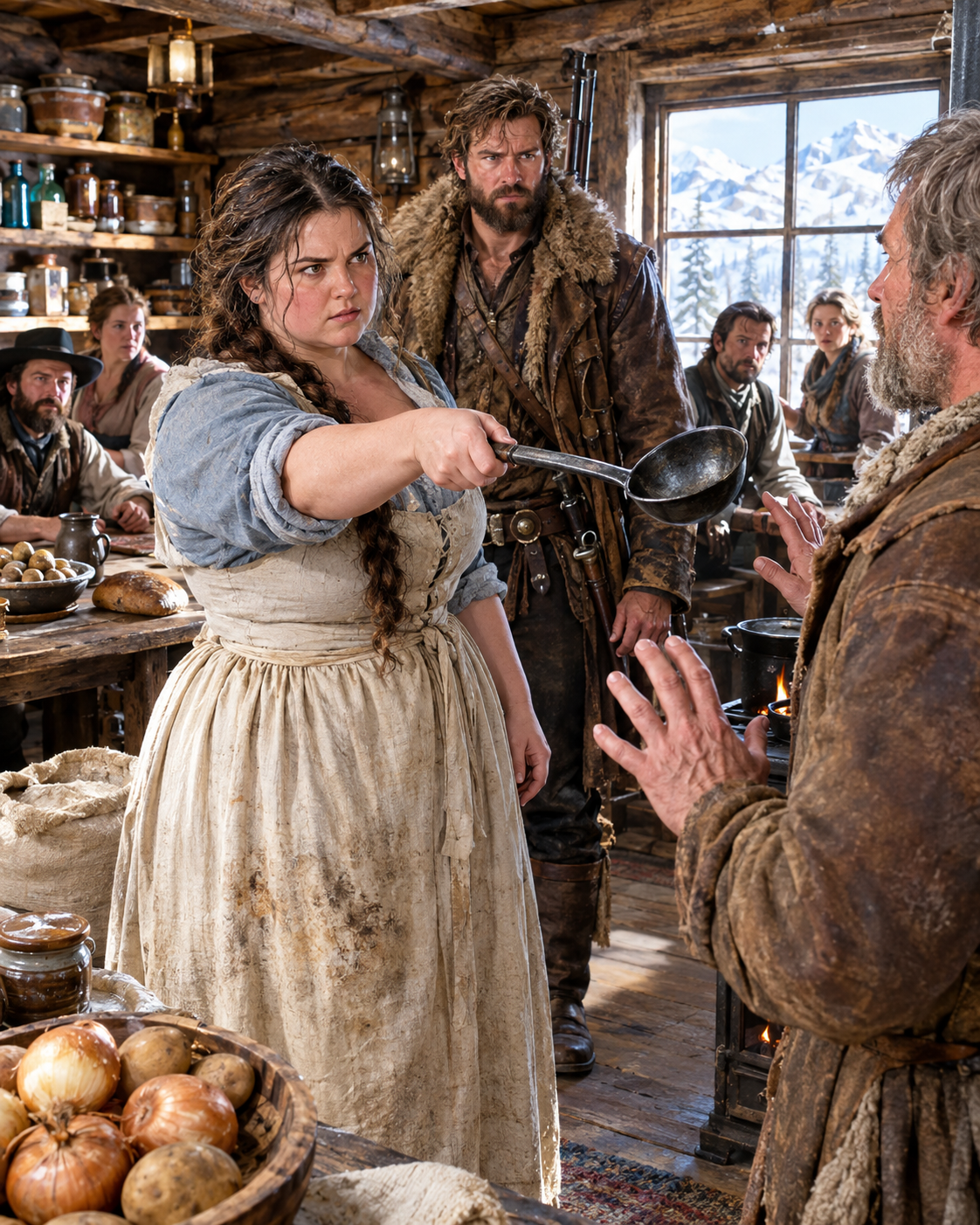
We searched until Wallace found a metal ring buried beneath packed soil three feet from the tree.
Together we pulled.
A square section of earth lifted.
Below it was a ladder.
The hidden chamber smelled of old paper, iron, and damp wood.
Burke went first with a lantern.
I followed.
Wallace came last.
The room beneath the cedar was not a supply cache.
It was an archive.
Ledger books covered an entire shelf.
Survey maps were nailed to one wall.
Crates bore company seals.
In the corner sat a locked iron box.
The brass key fit.
Inside were letters.
Dozens of them.
Names.
Dates.
Payments.
Instructions.
At first, I did not understand.
Then Wallace whispered, “My God.”
I read one page twice.
Black Pine Timber Company had been stealing federal land.
For more than a decade, company surveyors had deliberately moved boundary markers, logging valuable pine from government territory and from homesteads owned by families too poor to fight them.
But that was not the worst of it.
When settlers complained, company agents bought judges, sheriffs, and newspaper editors.
When buying failed, barns burned.
Men disappeared.
Accidents happened.
And one letter contained Elias Vale’s name.
VALe has retained duplicate accounts. Recover them before Helena audit. If he refuses cooperation, authorize permanent resolution.
The letter was signed with initials I recognized immediately.
H.C.
Harland Cresswell.
The president of the timber company.
The man who had smiled across a polished desk in Helena and offered me a job.
The man who had called me the woman who saved eighteen men.
My fingers went cold around the paper.
“He knew,” I whispered.
Burke took the letter from me.
“He knew everything.”
Wallace looked sick.
“He brought you to Helena because he suspected Vale told you something.”
“And the job?”
“A leash,” Burke said.
The truth settled slowly.
Cresswell had not rewarded me.
He had brought me close enough to watch.
The salary, the title, the admiration—it had all been a cage lined with velvet.
A sound came from above.
Snow crunching.
Burke extinguished the lantern.
We stood in darkness.
Voices drifted down through the trapdoor.
“Chest is empty.”
“Check again.”
A third voice answered.
“She came this way. Tracks lead here.”
Burke leaned close to my ear.
“Back exit?”
I shook my head.
I had never seen one.
Wallace whispered, “We’re trapped.”
Then I remembered Elias.
A frightened man did not build a room like this with one door.
I felt along the wall until my fingers touched a cold draft.
Behind the shelf of ledgers, narrow wooden planks concealed a passage.
We moved the shelf just enough to squeeze through.
The tunnel was barely wide enough for our shoulders.
We crawled in darkness while men above tore apart the chamber.
Behind us came a shout.
“They found it.”
Then a gunshot.
The bullet struck somewhere in the tunnel wall.
Burke pushed me forward.
“Move.”
We crawled until my knees bled through my trousers.
The tunnel opened fifty yards downhill behind a wall of fallen rock.
We emerged one by one.
Burke had stuffed three ledgers and as many letters as he could beneath his coat.
I carried the iron box.
Wallace had taken the survey maps.
Behind us, men began forcing their way through the tunnel.
We ran.
The mountain turned into a maze of white trunks.
Shots followed us.
One tore through Wallace’s coat.
Another struck Burke.
He stumbled.
I caught him.
Blood spread across his shoulder.
“I’m fine.”
“You’ve been shot.”
“Which is frequently considered the opposite of fine.”
Even then, I nearly laughed.
Then another bullet hit the tree beside my head.
We kept moving.
Burke led us toward an abandoned logging cut where old timber slides ran down the mountain.
A heavy wooden sled still sat frozen on one track.
Wallace understood immediately.
“No.”
Burke dropped onto the sled.
“You have another idea?”
The men behind us were closing.
I climbed on.
Wallace cursed and joined us.
Burke kicked away the ice holding the runners.
Nothing happened.
Footsteps approached through the trees.
A rifle appeared between two trunks.
I grabbed Wallace’s axe and struck the frozen runner.
The ice cracked.
The sled lurched.
Then the mountain dropped beneath us.
We flew.
Trees blurred on both sides.
Wallace shouted something that the wind tore away.
Burke tried steering with a broken pole.
The sled bounced over frozen ruts and launched into the air.
We came down hard enough to rattle my teeth.
Behind us, our pursuers reached the top of the slide.
One fired.
Another tried climbing onto a second sled.
Then our track curved sharply.
Ahead stood a fallen pine.
Burke pulled left.
The sled did not turn.
“Jump!”
We threw ourselves into the snow.
The sled smashed into the tree and exploded into planks.
I rolled downhill, clutching the iron box against my chest.
For several seconds, the world was only snow and pain.
Then I heard Wallace.
“Cordelia!”
“I’m here.”
Burke was lying twenty feet away.
Blood had soaked half his sleeve.
We dragged him behind a stump.
From above came the cracking of another sled.
Our pursuers were coming down.
Wallace reloaded his rifle.
“Take the papers and go.”
I stared at him.
“What?”
He looked toward the slope.
“I spent half my life obeying men because I was afraid of losing my position.”
He gave a bitter laugh.
“Turns out a position isn’t worth much when you’re lying face down in the snow.”
“You can’t hold them alone.”
“I don’t need to.”
He pointed toward the old logging dam below us.
The slide crossed a narrow bridge above a frozen creek.
A release rope still hung beside the cut.
Burke understood.
“If you drop the bridge—”
“They can’t follow.”
Wallace handed me his rifle.
“For once, Cordelia, let somebody else listen to you.”
I did not want to leave him.
But survival had taught me that courage was not always standing your ground.
Sometimes courage was knowing what must be carried forward.
Burke leaned against me.
We moved downhill.
When the second sled appeared above, Wallace waited.
Closer.
Closer.
Then he cut the rope.
The bridge collapsed.
The pursuing sled struck broken timber and flipped sideways.
Men screamed.
One rifle discharged into the sky.
The mountain swallowed the rest.
Wallace joined us ten minutes later, limping but grinning.
“Still employed?” Burke asked.
Wallace looked at the company papers beneath my coat.
“Probably not.”
By nightfall we reached Black Pine.
The gunmen who had attacked the camp were gone.
But we found one horse they had left behind.
Its saddle carried the company brand from Helena.
That proof mattered.
Everything mattered now.
The men gathered inside the cookhouse.
No one laughed.
I spread Elias Vale’s documents across the same table where, days earlier, we had treated an axe wound.
Eighteen lumberjacks read the records in silence.
Some recognized names.
One man found his brother listed beside the words compensation resolved.
His brother had supposedly drowned three years earlier.
Another found records showing that his parents’ homestead had been burned after they refused to sell timber rights.
Anger moved through the room like fire.
“We ride to Helena,” someone said.
“And tell who?” Burke asked.
“The sheriff?”
He tapped a letter.
“The sheriff is being paid.”
“The judge?”
Another letter.
“Paid.”
“The company newspaper?”
Burke gave him a tired look.
Nobody spoke.
That was the genius of Cresswell’s corruption.
He had not merely broken laws.
He had purchased the people meant to enforce them.
Then I looked at the men around the table.
Not officials.
Not judges.
Workers.
Witnesses.
People Cresswell considered invisible.
I finally understood what Elias had done.
He had not hidden the records because one powerful person could expose them.
He had hidden them because one day enough ordinary people might.
“We don’t take this to one man,” I said.
“We take it to everyone.”
For the next four days, we copied.
Every letter.
Every ledger page.
Every payment.
The men who could write worked beside me at the tables.
Those who could not sharpened pencils, carried paper, guarded doors, and rode messages to neighboring camps.
Copies went to newspapers in Butte, Bozeman, Missoula, Denver, Chicago, and Saint Paul.
Copies went to federal land offices.
Copies went to senators.
Copies went to churches.
Copies went to ranchers whose names appeared in the records.
We sent so many that no single fire, bribe, or bullet could erase them all.
Harland Cresswell arrived on the fifth morning.
He came in a black carriage with eight armed men.
No one fired.
That surprised him.
He stepped into the yard wearing a fur coat finer than anything I had ever owned.
“Cordelia.”
His voice remained warm.
Almost fatherly.
“You’ve caused considerable confusion.”
I stood on the cookhouse steps.
Behind me stood Wallace, Burke with his arm bandaged, and eighteen lumberjacks.
“Did you kill Elias Vale?”
Cresswell’s smile disappeared.
He glanced at the men.
“You don’t understand business.”
“That wasn’t my question.”
He sighed.
“Vale was an unstable man.”
“Did you kill him?”
“You are making accusations that could ruin your future.”
I almost smiled.
“My future?”
“I offered you security. Authority. Respect.”
“No.”
I held up his letter.
“You offered me a cage.”
His men shifted uneasily.
Cresswell took a step closer.
“You are a cook.”
There it was.
The old weapon.
Smallness.
He needed me to become small again.
I looked behind me at the cookhouse, at the reinforced windows, at the stove that had kept eighteen men alive.
Then I looked back at him.
“Yes.”
He seemed confused.
“I am a cook.”
I pointed toward the men.
“And these are lumberjacks.”
Then toward Wallace.
“That is a superintendent.”
Toward Burke.
“That is a mountain man.”
I lifted the copied pages in my hand.
“None of that makes the truth smaller.”
Cresswell’s jaw tightened.
“You think papers will defeat me?”
“No.”
I looked toward the road.
“Hundreds of people reading them will.”
A rider appeared through the trees.
Then another.
Then six more.
Men from neighboring camps.
Behind them came ranchers.
A newspaper correspondent from Butte.
A federal land agent.
Then two deputy marshals sent from Fort Benton after receiving our first copies.
Cresswell turned slowly.
For the first time, I saw fear in his eyes.
Not fear of guns.
Fear of witnesses.
Burke leaned toward me.
“Seems your kitchen got crowded.”
Cresswell was arrested that afternoon.
His trial lasted seven months.
The newspapers called it the Black Pine Fraud.
Federal investigators uncovered stolen timber worth hundreds of thousands of dollars, bribed officials across three counties, and evidence connecting company agents to six deaths, including Elias Vale’s.
Cresswell was convicted of conspiracy, fraud, bribery, and ordering acts of violence.
Several officials fell with him.
The company collapsed.
But that was not the ending I remember most.
A year later, I returned to the split cedar.
Burke came with me.
Snow covered the ground, though the day was bright and still.
The hidden chamber had been emptied and sealed.
Federal agents had taken every remaining record.
Elias’s body had been found far below an old mining shaft, exactly where one of Cresswell’s men finally confessed they had left him.
I placed a small wooden marker beneath the cedar.
ELIAS VALE
HE KEPT THE TRUTH LONG ENOUGH FOR OTHERS TO CARRY IT.
Burke stood beside me.
“He trusted you.”
“I wish he had trusted me enough to tell me everything.”
“Maybe he was trying to protect you.”
I looked at the cedar.
“Secrets rarely protect people forever.”
Burke nodded.
“No.”
He glanced at me.
“But sometimes they protect a truth until someone strong enough finds it.”
The federal government later hired me to inspect remote work camps across Montana and Wyoming.
Not as a cook.
Not exactly.
My official title changed three times over the years.
Safety inspector.
Emergency planning officer.
Regional field supervisor.
Titles never mattered much to me after Black Pine.
What mattered was walking into places where someone had been ignored.
A young worker saying a bridge felt unstable.
A widow insisting a company had stolen her land.
A cook noticing food stores were disappearing too quickly.
A quiet man saying snow sounded wrong on the ridge.
I listened.
That became my real profession.
Wallace stayed at Black Pine after a cooperative of workers bought the remaining legal timber rights.
He never again told anyone to keep to the kitchen.
Burke stayed too, though he claimed it was because someone had to stop Wallace from becoming respectable.
As for me, I kept Elias’s seven-word note for the rest of my life.
Cordelia, if you are reading this, run.
For years, I thought the most important word was run.
It wasn’t.
The most important word was reading.
Elias had left something behind and trusted that someday someone would pay attention.
My father had taught me to listen when the mountain went quiet.
Elias taught me to listen when powerful men told everyone else to be silent.
And Black Pine taught me one final thing.
People often mistake authority for wisdom.
They mistake wealth for strength.
They mistake silence for agreement.
Most dangerously, they mistake an overlooked person for a powerless one.
I had been invisible once.
A woman beside a stove.
A pair of hands making coffee for men who did not remember my name until something went wrong.
But being unseen had taught me to notice everything.
The clouds.
The frost.
The missing birds.
The hidden fear in another person’s face.
The lies powerful men assumed nobody would question.
Years later, young inspectors sometimes asked me how I knew what danger looked like.
I always gave them the same answer.
“Most disasters whisper before they shout.”
Then I would tell them to watch the workers no one notices.
Listen to the person everyone laughs at.
Check the door nobody thinks to open.
Read the note everyone else throws away.
Because storms do not begin when the snow starts falling.
Corruption does not begin when the first man dies.
And courage does not begin when someone finally raises a rifle.
They begin much earlier, in quiet moments when a person must decide whether to ignore what they know or act on it.
At Black Pine, eighteen men survived a blizzard because I prepared before anyone believed me.
Later, hundreds escaped a different kind of storm because we refused to keep the truth locked beneath a cedar.
I learned that saving lives and exposing lies require the same thing.
You must notice what others dismiss.
You must prepare before certainty arrives.
And when the moment comes, you must be willing to stand where everyone can see you.
Even if they once laughed.
Especially then.
Even if they once laughed.
Especially then.
For almost twelve years after Black Pine, I believed that was where the story ended.
I was wrong.
The mountains have a way of keeping one last secret.
It found me in the spring of 1901.
By then, I had gray beginning at my temples and a leather case full of inspection reports that had taken me across more camps than I could remember.
Men no longer laughed when I entered a bunkhouse.
They usually became nervous.
That amused Burke greatly.
He had finally married me three years earlier, after asking five times and receiving four answers he claimed were “unnecessarily complicated.”
We lived outside Helena in a narrow house with a porch facing west.
He repaired rifles, broke horses, and complained about civilization.
I traveled.
It was not a perfect arrangement.
It was ours.
One April morning, a boy from the federal land office arrived carrying a telegram.
I was packing for Wyoming when he handed it to me.
The message contained only a few lines.
ABANDONED SHAFT FOUND NORTH OF BLACK PINE.
PERSONAL EFFECTS RECOVERED.
ITEM BEARING YOUR NAME.
REQUEST IMMEDIATE PRESENCE.
I read it twice.
Burke watched from the doorway.
“Vale?”
“I don’t know.”
He reached for his coat.
“You weren’t invited.”
“Never stopped me before.”
We took the train as far as it could carry us and rode the rest.
Black Pine had changed.
The old cookhouse still stood, though someone had painted it red.
The bunkhouse was larger.
A schoolhouse had been built beside the creek for the workers’ children.
The cooperative had survived.
So had Wallace.
He met us near the yard with more white in his beard than brown.
“You look terrible,” Burke told him.
Wallace grinned.
“Marriage made you polite.”
Then he looked at me, and his expression changed.
“You should see this.”
The shaft lay nearly four miles beyond the old cedar.
A spring landslide had uncovered an entrance hidden for decades beneath rock.
Federal men had gone inside expecting an abandoned prospecting tunnel.
Instead, they found a room.
Not a grave.
A room.
There was a rusted stove.
A cot.
A wooden desk.
Empty food tins.
Two blankets.
And on the desk lay a tin box wrapped in oilcloth.
The officer supervising the site handed it to me.
My name was scratched into the lid.
CORDELIA.
My hands began trembling.
Burke noticed.
He put one hand against my back but said nothing.
Inside the box were three things.
A pocket watch.
A photograph.
And a letter.
The photograph showed Elias Vale standing beside my father.
I stopped breathing.
My father had been dead more than twenty years.
I had never known he and Elias had met.
I unfolded the letter.
The paper was brittle.
The handwriting was unmistakable.
Cordelia,
If this reaches you, then either I have failed or you have succeeded.
Perhaps both.
There are truths I kept from you because your father made me promise.
That sentence struck me harder than any bullet.
I continued reading.
Your father discovered Cresswell’s theft years before I did. He was the first man who tried to stop it.
I lowered the paper.
The tunnel seemed suddenly too small.
Burke watched me.
“What is it?”
“My father knew.”
I kept reading.
He mapped the illegal cuts. He gathered names. He believed that if enough evidence reached the government, the company could be stopped.
Cresswell learned what he was doing.
Your father’s death was not the accident you were told it was.
For twenty-four years, I had believed my father died beneath a falling tree.
I remembered the men bringing his body home.
My mother’s silence.
The closed coffin.
The way people avoided looking at us.
I had been thirteen.
A child.
The letter shook in my hands.
Elias had written more.
Your father knew he was being watched. Before he died, he gave me his records and made me promise two things.
First, preserve the evidence.
Second, keep you away from it.
He feared that if Cresswell knew his daughter understood what he had found, you would die as well.
I kept that promise too long.
When you came to Black Pine years later, I recognized you immediately.
You had his eyes.
You also had his habit of noticing the thing everyone else walked past.
I nearly told you everything many times.
I could not.
Cowardice sometimes dresses itself as protection.
I hope you can forgive me.
I had to stop.
My eyes burned.
Burke gently took the letter before the tears could fall onto it.
He read the final lines aloud.
“Your father used to say that courage is not the absence of fear. It is deciding what deserves to matter more than fear.”
Burke paused.
“He believed you would understand that one day.”
I stared at the photograph.
My father looked younger than I remembered him.
Elias stood beside him, both men filthy from mountain work, both smiling.
On the back, my father had written a sentence.
For Cordelia, when she is old enough to know that listening is also a kind of courage.
I sat down on the cot.
All those years, I had thought my father’s lesson about the mountain was simply survival.
When the mountain goes quiet, girl, listen.
But perhaps he had meant more.
Perhaps he had always meant more.
Wallace stood at the entrance.
“There is something else.”
I looked up.
He seemed almost unwilling to say it.
“What?”
“The men found another tunnel.”
It led deeper into the mountain.
At its end, behind a timber wall, investigators discovered six skeletons.
Elias was not among them.
The bones belonged to workers who had disappeared during Cresswell’s years of control.
Each had been shot.
For two days, we searched the shaft.
Then, on the third morning, an old investigator named Samuel Price called me into the lower passage.
He pointed toward a pile of stones.
Underneath them rested a small metal flask engraved with the initials E.V.
Beside it lay human remains.
Elias.
He had died not in the mine where Cresswell’s men claimed they had left him, but here.
The confession had been another lie.
That evening, I sat beneath the split cedar alone.
Burke eventually found me.
He carried two cups of coffee.
“It tastes awful,” he said.
I took one.
“Then why bring it?”
“To remind you why the camp used to need you.”
I smiled despite myself.
For a while, we said nothing.
The cedar creaked in the wind.
“Do you think Elias was afraid?” I asked.
“Yes.”
I looked at Burke.
He had never lied to comfort me.
It was one of the reasons I trusted him.
“Do you think my father was?”
“Yes.”
I stared at the snow melting around the roots.
“I spent half my life thinking brave people weren’t frightened.”
Burke shook his head.
“Brave people are usually terrified. Otherwise it isn’t bravery.”
He handed me the pocket watch from Elias’s box.
Inside the lid was another inscription.
D.V.
My father’s initials.
“He gave the watch to Elias,” I said.
“Looks like.”
I ran my thumb over the scratched metal.
“Then Elias carried it until he died.”
“And made sure it came back to you.”
I closed the watch.
Something inside me settled.
Not healed.
Some wounds do not heal cleanly.
But they can close.
The investigation into the mine reopened dozens of cases.
Families finally learned what had happened to fathers, brothers, and sons who had disappeared under Cresswell’s rule.
Nothing could return those men.
But truth gave their families something lies never could.
A grave.
A name.
An answer.
We buried Elias near the cedar.
Not because he had died there.
Because that was where he had chosen to keep the truth alive.
The cooperative workers built his coffin.
Wallace spoke.
Burke said nothing.
I gave the final words.
“Elias Vale believed he failed because he was afraid.”
I looked at the workers gathered beneath the trees.
“He did not fail.”
“He kept evidence when destroying it would have been safer.”
“He protected a frightened girl because he believed her life mattered.”
“He carried another man’s truth even when it cost him his own.”
I looked at the grave.
“We should be careful about judging courage only by the moment someone stands and fights.”
“Sometimes courage is hiding a box.”
“Sometimes it is keeping a promise.”
“Sometimes it is surviving long enough to tell someone else what happened.”
“And sometimes it is admitting that silence, even when born from love, can become dangerous.”
The wind moved softly through the pine branches.
No one spoke.
We placed my father’s pocket watch in Elias’s coffin.
I kept the photograph.
Years passed again.
Black Pine eventually stopped being a lumber camp.
The best timber was gone, and the cooperative chose not to strip the remaining slopes bare.
That decision surprised investors.
It did not surprise me.
Men who had nearly died because people failed to respect a mountain had finally learned not to confuse ownership with permission.
The workers turned part of the camp into a forestry station.
The old cookhouse became an office.
On one wall, they hung a framed copy of Elias’s seven-word warning.
Cordelia, if you are reading this, run.
Visitors often laughed at it.
They thought it sounded dramatic.
They never knew how many lives were hidden inside those words.
Burke and I grew old.
Not gracefully.
He became more stubborn.
I became less patient with stubborn men.
This arrangement suited us perfectly.
Wallace died in 1911 while repairing a roof he had been explicitly told not to climb.
Burke said it was the most Wallace-like death imaginable.
At the funeral, I cried so hard I could not answer him.
Burke squeezed my hand until the service ended.
Then came the winter of 1917.
Burke fell ill after helping search for two boys lost in a snowstorm.
Both children survived.
Burke did not fully recover.
By March, I knew.
So did he.
He spent his final days in our house outside Helena, sitting near the window that faced the mountains.
One evening, he called me over.
“You remember the first time I said you were right?”
“You were half frozen.”
“Still meant it.”
“You were delirious.”
“That improved my judgment.”
I sat beside him.
His hand had become thin.
I hated that.
He looked toward the mountains.
“You know what I noticed about you at Black Pine?”
“What?”
“You never asked whether anyone thought you could save them.”
I smiled faintly.
“I was too busy.”
“Exactly.”
His eyes met mine.
“Don’t stop being busy when I’m gone.”
I looked away.
“I don’t want to talk about this.”
“That’s unfortunate. I’ve been waiting thirty years to give orders.”
“You were terrible at it then too.”
He laughed.
Then coughed until he could barely breathe.
When it passed, I held him.
He whispered, “Cordelia?”
“I’m here.”
“Good.”
Those were his last words.
I’m here.
For months afterward, I hated them.
They seemed too small for a man like Burke.
No speech.
No grand declaration.
Just two ordinary words.
Then one morning, I understood.
He had spent his life showing up.
In storms.
In gunfire.
In grief.
Beside a cedar.
Beside a stove.
Beside me.
I’m here was exactly right.
I continued working for another six years.
My knees complained before my mind did.
Eventually, the department informed me that seventy-year-old women were not expected to climb logging slopes in February.
I informed the department that mountains had never shown much interest in expectations.
They retired me anyway.
The last place I visited officially was Black Pine.
By then, young trees covered the slopes where the old company had once cut everything it could reach.
Children ran between the buildings.
The schoolhouse had twice been expanded.
The creek was clear.
I stood outside the old cookhouse while a young woman came down the steps carrying inspection papers.
She was perhaps twenty-five.
Her hair was tied back.
Her boots were muddy.
A group of older workers followed her.
One of them was arguing.
“The eastern bridge has stood for forty years.”
The young woman stopped.
“And the support beam is split.”
“It’s always creaked.”
“Then today is the last day anyone crosses it.”
The man laughed.
I watched her expression.
I knew that expression.
She did not raise her voice.
She simply looked at him.
“No one crosses.”
The laughter stopped.
She noticed me standing nearby.
“Can I help you, ma’am?”
“Probably not.”
I looked toward the bridge.
“You’re closing it?”
“Yes.”
“Why?”
“Something doesn’t feel right.”
The older worker rolled his eyes.
I smiled.
“Good.”
The young woman looked puzzled.
I started walking away.
Behind me, she called, “Wait. Are you Cordelia Hale?”
Burke’s surname had been Hale.
I had kept it after his death.
I turned.
“Depends who’s asking.”
Her eyes widened.
“My father used to tell me about you.”
“Did he?”
“He said you saved Black Pine.”
I looked around at the buildings.
At the workers.
At the children.
At the mountain rising beyond them.
“No.”
I shook my head.
“Black Pine saved itself once enough people started listening.”
That afternoon, the eastern bridge collapsed.
No one was on it.
Not one person was hurt.
The young inspector found me before I left.
She looked shaken.
“I almost let them convince me I was imagining it.”
“But you didn’t.”
“What if I’m wrong next time?”
“You will be.”
She stared at me.
I smiled.
“Many times.”
“Then how do I know when to insist?”
“You don’t.”
She waited.
I pointed toward the fallen bridge.
“Responsibility isn’t knowing with certainty.”
“It’s being willing to act when the cost of ignoring what you see is too high.”
She considered that.
“People will think I’m difficult.”
“They will.”
“They’ll call me stubborn.”
“Almost certainly.”
She smiled a little.
“What did they call you?”
“Cook.”
She laughed.
So did I.
Before leaving Black Pine, I walked one final time to the split cedar.
The tree was dying.
Lightning had taken one of its upper branches.
Its trunk leaned farther than I remembered.
Still, it stood.
Two markers rested beneath it.
One for Elias.
One for my father, placed there after the truth about his death became known.
Burke’s grave was in Helena.
That had once bothered me.
Now it did not.
People are not contained by where we bury them.
I sat between the markers until sunset.
The mountains turned gold.
Then blue.
Then almost black.
Birds moved among the branches.
For once, the mountain was not quiet.
I was grateful.
I took Elias’s original note from my coat.
The paper had become fragile with age.
Seven words.
A frightened man’s warning.
A sentence that had changed everything.
I had spent years wondering whether I should give it to a museum.
Instead, I placed it inside a small glass jar, sealed the lid with wax, and buried it beneath the cedar.
Not hidden.
Not exactly.
Above it, I placed a flat stone.
On the stone I carved three words with my knife.
LISTEN BEFORE FEAR.
That was enough.
I stood.
My joints protested.
I ignored them.
Halfway back to camp, I heard a sound behind me.
A branch breaking.
For one foolish moment, I imagined Burke walking after me.
I nearly turned and told him he was late.
Instead, a deer stepped between the trees.
It watched me.
I watched it.
Then it disappeared.
I continued down the mountain.
I lived nine more years.
I spent most of them writing.
Not because I thought my life important.
Because memory changes when nobody writes it down.
Powerful men had once depended on that.
They erased records.
Changed stories.
Called murder an accident.
Called theft business.
Called fear loyalty.
I had learned what happened when ordinary people allowed someone else to keep the ledger.
So I kept mine.
I wrote about Cresswell.
About Elias.
About Wallace.
About the men whose names had nearly vanished.
About Burke.
Especially Burke.
And I wrote about the storm.
Not as the newspapers told it.
They liked to make me heroic.
The woman who saved eighteen men.
It made a good headline.
But headlines prefer one hero because one hero is easier than the truth.
The truth was eighteen men survived because one person prepared, another risked the storm, others obeyed when obedience mattered, and eventually everyone worked together.
No one survives alone.
No truth survives alone either.
That is what I wanted remembered.
My final journal entry was written on October 3, 1932.
My hand shook by then.
The words were uneven.
I wrote:
If you have read this far, then you know that I spent much of my life being told where I belonged.
A kitchen.
A camp.
A woman’s place.
A worker’s place.
A poor person’s place.
People who benefit from silence are very interested in assigning everyone else a place.
Do not accept yours too quickly.
But do not confuse being heard with being right.
Listen first.
Look carefully.
Prepare.
Question yourself.
Then, when the evidence is clear enough and the danger is real enough, stand.
You may stand alone for a while.
That does not mean you are wrong.
You may also discover that you are wrong.
Have the courage to admit that too.
Truth requires both kinds of bravery.
The journal ended there.
Cordelia Hale died three weeks later in her sleep, according to the woman from the neighboring farm who found her.
On the bedside table were three things.
A photograph of her father and Elias Vale.
Burke Hale’s old hunting knife.
And a small sack of flour.
No one ever discovered why she kept the flour there.
Perhaps it was a joke.
Perhaps it was a reminder.
Years later, Black Pine became a protected forest.
The cookhouse was preserved.
So was the split cedar, though eventually the old tree finally fell during a winter storm.
When workers cleared the broken trunk, they found a glass jar beneath the roots.
Inside was a faded note.
Cordelia, if you are reading this, run.
Beside it was the stone she had carved.
LISTEN BEFORE FEAR.
Today, both are displayed inside the old cookhouse.
Visitors sometimes ask which message matters more.
The warning to run?
Or the instruction to listen?
The people of Black Pine usually give the same answer.
Both.
Listen early enough, and sometimes you can prevent the danger.
Listen too late, and wisdom may mean leaving before pride kills you.
But there is a third lesson, one Cordelia never carved into stone.
Sometimes the thing you must run from is not a storm.
Sometimes it is a lie everyone has agreed to live inside.
And sometimes the bravest thing you can do, after you have escaped it, is turn around, carry the truth back with you, and make sure no one else has to run again.
That was Cordelia’s legacy.
Not that she had never been afraid.
Not that she had always been right.
Not even that she had saved eighteen men during a Montana blizzard.
It was that she paid attention when dismissal would have been easier.
She acted before applause arrived.
And she understood something most people learn too late:
The voices we ignore are often the ones warning us where the ground is already beginning to break.
At Black Pine, they eventually learned to listen.
And because they did, the mountain never had to shout quite so loudly again.
THE END