They laughed when Jeffrey Algate shoved my bread aside at Walker Canyon Ranch, but his smugness hid a betrayal that could ruin every rancher in the county.
The first sentence made every breath leave my body.
“Mrs. Carver, if this letter reaches you, then my father is dead, and you are the only person left who can save the ranch he stole from you.”
I read it twice.
Then a third time.
Levi took one step closer.
“What is it?”
I handed him the letter.
The stranger waited beside the wagon, hat pulled low against the evening wind.
I recognized the name at the bottom before I finished reading.
Elias Algate.
Jeffrey Algate’s younger brother.
The man who had disappeared from Dunore almost seven years earlier.
I looked at the stranger.
“Who are you?”
He removed his hat.
“My name is Thomas Algate.”
Levi’s expression hardened.
“Algate?”
Thomas nodded.
“My father was Jeffrey’s brother.”
I looked down at the letter again.
There were only four paragraphs, but they carried the weight of years.
Thomas explained that Elias had left Dunore after discovering what his brother and Nester Pel were doing.
He had tried to expose them.
Instead, Jeffrey had threatened him, accused him of theft, and forced him out of the county.
Elias had gone north and built a small freight business.
He had spent years collecting evidence against his brother.
But six weeks earlier, he had died unexpectedly.
Before his death, he had written instructions that the final documents were to be delivered to me.
Not Levi.
Not Luther Calder.
Me.
My fingers tightened around the paper.
“Why me?”
Thomas looked toward the sign above the door.
“Because my uncle believed you were the first person who had ever looked at Jeffrey’s numbers and refused to believe them.”
He reached into the wagon and brought out a narrow wooden box.
“It belonged to my father.”
He placed it in my hands.
The box was heavier than it looked.
I carried it inside.
Levi followed.
Thomas closed the door behind us.
I set the box on the kitchen table and examined the lock.
There was no key.
Only a small brass plate engraved with four words.
COUNT WHAT THEY HIDE.
My heart began to pound.
Levi looked at me.
“You know what that means?”
I shook my head.
“No.”
But somewhere beneath the fear, I remembered something.
The first night we had searched Walker Canyon’s records, I had found six years of invoices.
Six years of theft.
Six years of numbers that had seemed impossible.
But there had always been one thing missing.
The actual payments.
We had found invoices.
We had found receipts.
We had found the hidden ledger.
But we had never found the bank records.
I turned toward Thomas.
“Where did your father keep his accounts?”
“Three places,” he said.
“His office, the freight depot, and a bank in Millstone.”
“Does that bank still exist?”
Thomas nodded.
“Most of it does.”
I looked at Levi.
He already understood.
“We’re going tomorrow.”
Thomas shook his head.
“No.”
His voice was firm.
“You’re going tonight.”
He pointed toward the wooden box.
“My father said if the box ever reached you, time would matter.”
The room suddenly felt colder.
“Why?”
Thomas swallowed.
“Because Jeffrey wasn’t the only person making money from those ranches.”
A silence settled over us.
Then came three knocks at the door.
Levi’s hand moved toward the pistol at his belt.
Thomas froze.
I stared at the door.
Three more knocks.
Slow.
Measured.
Levi whispered, “Stay behind me.”
He opened the door.
No one stood there.
Only a folded piece of paper lay on the porch.
Levi picked it up.
He read it once.
Then handed it to me.
The message contained six words.
STOP DIGGING OR LOSE WHAT REMAINS.
I looked at Thomas.
He had gone pale.
“They know I’m here.”
Levi stepped outside and searched the road, but whoever had left the warning was already gone.
That night, none of us slept.
At dawn, we left Dunore.
Levi insisted on coming.
Thomas drove his wagon.
I sat between them with the wooden box resting on my lap.
The road to Millstone ran through dry country where the grass had turned the color of old straw.
For three hours, nobody spoke.
Finally Thomas said, “My father believed Jeffrey had been stealing from the ranches, but he also believed someone had been using those debts to acquire land.”
“Acquire land?” I asked.
Thomas nodded.
“When a ranch couldn’t pay Algate, he didn’t always demand cash.”
He looked at Levi.
“Sometimes he accepted property.”
Levi’s jaw tightened.
“That wasn’t in the ledger.”
“No.”
Thomas looked ahead.
“Because those transactions were recorded under different names.”
I felt the box grow heavier in my hands.
“How many?”
“I don’t know.”
“Then what does your father know?”
Thomas looked at me.
“Everything.”
The bank in Millstone was smaller than I expected.
Its old stone walls had survived two fires and one flood.
The manager recognized Elias’s name immediately.
When I explained why I had come, he locked the front door.
Then he led us into a back room.
There, beneath layers of dust, he produced seven account books.
Elias had paid for copies years ago.
I opened the first.
Payments from Jeffrey Algate.
Payments to Nester Pel.
Payments to three lawyers.
Payments to a land office.
And then I saw another name.
Harlan Voss.
I knew that name.
Every rancher in the county did.
Voss was the largest cattle buyer in the territory.
He had purchased land from struggling ranchers for years.
I turned another page.
The payments matched the dates when ranches had defaulted.
My stomach tightened.
This was bigger than Jeffrey.
Much bigger.
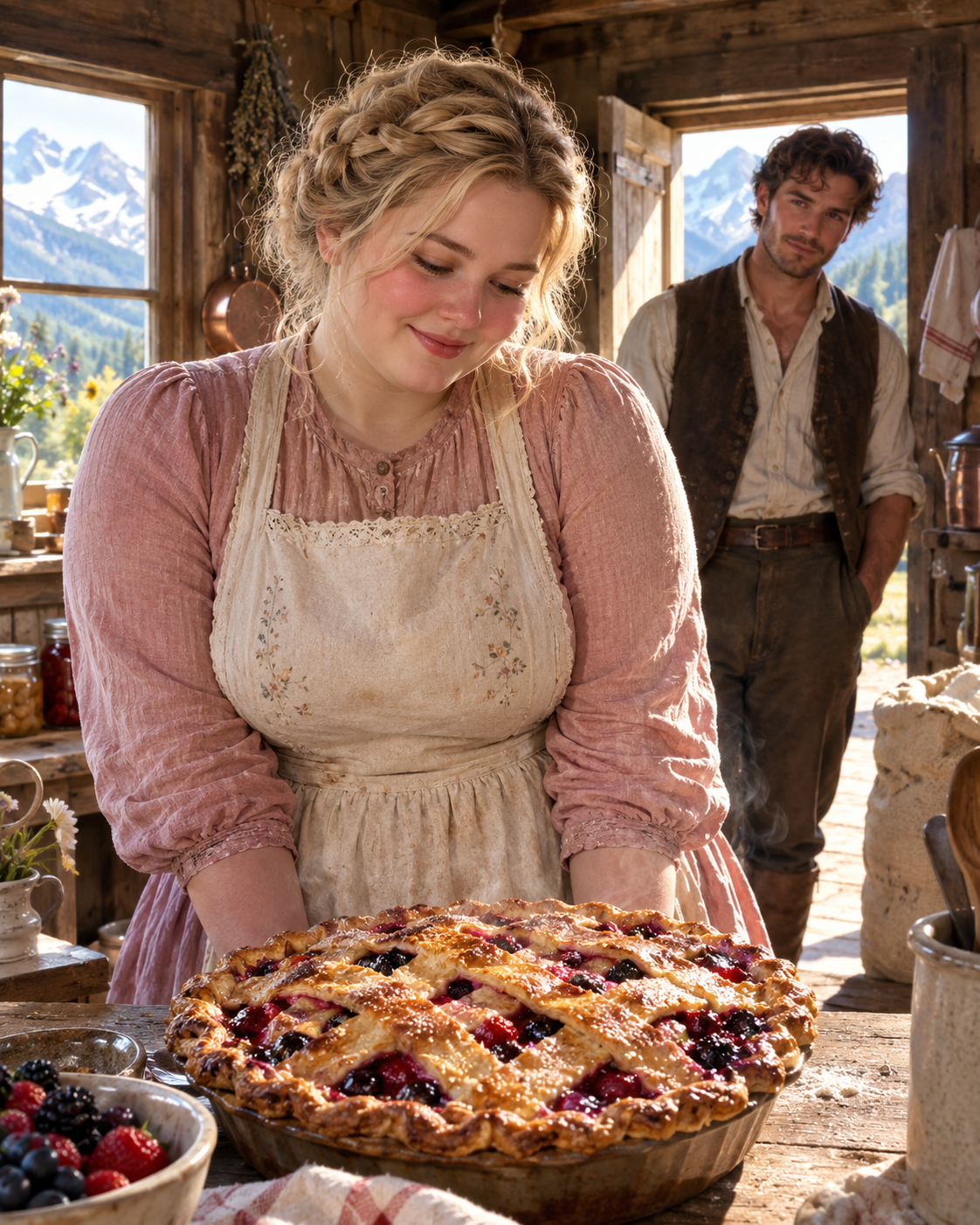
Jeffrey had been overcharging ranchers.
But someone else had been waiting for those ranches to collapse.
Levi leaned over my shoulder.
“He was manufacturing debt.”
Thomas nodded.
“And someone was buying the consequences.”
We stayed in that room until afternoon.
When we finally returned to the wagon, the sun was low.
That was when we discovered the horses were gone.
The wagon stood untouched.
Our horses had been cut loose.
No tracks were visible except those leading toward the dry creek.
Levi crouched beside them.
“They didn’t steal the horses.”
“What do you mean?”
“They released them.”
He looked toward the horizon.
“Someone wants us stranded.”
A rifle cracked.
The bullet struck the wagon wheel.
Thomas dropped behind the seat.
Levi pulled me down.
Another shot tore through the canvas.
“Get low!”
We crawled toward the creek bed.
A third shot struck the dirt beside my hand.
Then silence.
Levi peered over the bank.
“Three riders.”
Thomas whispered, “They have the box.”
I touched my lap.
It was still there.
For several seconds, none of us moved.
Then Levi pointed toward a narrow trail.
“We go on foot.”
We ran.
The trail twisted through dry brush until it reached an abandoned line shack.
We barricaded the door and waited.
Night fell.
Inside the shack, Thomas finally told us the truth.
“My father wasn’t only collecting evidence.”
He looked at me.
“He was planning to testify.”
“Against Jeffrey?”
“Against Voss.”
I stared at him.
“Then why didn’t he?”
Thomas looked down.
“Because he received a letter telling him that if he testified, I would disappear.”
The room became silent.
“I was twelve.”
His voice broke.
“My father chose to protect me.”
I understood then why he had carried the letter all these years.
It wasn’t simply evidence.
It was guilt.
The kind that survives even when you know the choice you made was necessary.
I reached across the table.
“You were a child.”
He looked at me.
“My father knew that.”
Levi sat beside the window, watching the darkness.
“My father used to say a man could survive hunger,” he said quietly.
“But shame was harder.”
Thomas gave a bitter laugh.
“Your father sounds like mine.”
“No.”
Levi looked at him.
“My father died believing silence kept a family safe.”
He glanced at me.
“I learned otherwise.”
At midnight, we heard horses.
Then voices.
“They’re here.”
Levi extinguished the lantern.
We waited.
The door shook once.
Then again.
A voice outside called, “Mrs. Carver.”
I recognized it.
Harlan Voss.
“You have something that belongs to me.”
I stood.
Levi grabbed my wrist.
“No.”
I shook my head.
“He wants me to be afraid.”
I stepped toward the door.
Voss continued.
“Jeffrey made mistakes. Pel made mistakes. But you don’t understand what you’re holding.”
“I understand enough.”
A pause.
“You’re carrying papers that could ruin people.”
“No.”
I looked at the box.
“They already ruined themselves.”
The door burst open.
Everything happened at once.
Levi fired into the ceiling.
Thomas tackled one man.
I grabbed the wooden box and ran through the rear window.
I didn’t know where I was going.
I only knew I had to keep the evidence away from them.
Branches tore at my dress.
My shoes slipped on loose stones.
Behind me, someone shouted.
I reached the creek and stumbled.
Then I saw a light.
A lantern.
A cabin.
I ran toward it and pounded on the door.
An old woman opened it.
She took one look at me.
Then at the men approaching in the distance.
“Inside.”
She pulled me in.
“Hide under the floor.”
I dropped through a loose board just before the riders reached the cabin.
From beneath the floor, I heard Voss enter.
“Did you see a woman?”
“No.”
The old woman’s voice was steady.
“Then you should keep riding.”
Voss cursed.
The men searched the cabin.
One came within inches of the floorboard.
I held my breath.
Then the door slammed.
The horses disappeared into the night.
I remained beneath the floor until morning.
When the old woman lifted the board, sunlight poured across my face.
“You’re Mrs. Carver.”
It wasn’t a question.
I nodded.
She sighed.
“My husband lost our ranch to Harlan Voss.”
She looked at the wooden box.
“Your fight isn’t new, child.”
She helped me find Levi and Thomas.
Both were bruised but alive.
Voss had escaped.
But one of his men had been captured by the sheriff on the road.
That was enough.
The next morning, Luther Calder arrived with territorial deputies.
We gave him everything.
The bank records.
The ledger.
The letters.
Elias’s testimony.
And the name of every rancher whose land had changed hands after default.
Luther read through the documents for nearly two hours.
When he finally looked up, his expression had changed.
“This isn’t a supply fraud.”
“No,” I said.
“It isn’t.”
He closed the ledger.
“This is systematic land theft.”
The investigation lasted months.
Voss was arrested before winter.
Three lawyers were charged.
Two land officials resigned before they could be questioned.
Several deeds were frozen while the courts reviewed them.
And families who had believed their land was gone forever began receiving letters.
Some got their ranches back.
Some received compensation.
Some discovered that the law could not undo every loss.
That was the hardest lesson.
Justice could repair a wound.
It could not return every year stolen from a person’s life.
Walker Canyon survived.
So did Carver’s Boarding Kitchen.
But the kitchen became something larger than I had imagined.
Ranchers came through Dunore carrying account books.
I taught them how to read invoices.
How to compare prices.
How to keep copies.
How to question numbers that didn’t make sense.
I put a sign above the office door.
CHECK THE BOOKS.
Levi laughed the first time he saw it.
“You’ve turned a boarding kitchen into an accounting school.”
“People need both.”
He nodded.
“I suppose they do.”
Our lives changed slowly.
There was no dramatic proposal.
No sudden declaration beneath a moonlit sky.
There were mornings when Levi brought coffee before I asked.
Evenings when he sat at my kitchen table while I counted receipts.
Days when our hands brushed and neither of us moved away.
One spring morning, he arrived carrying a small wooden box.
I stared at it.
“Not another mystery.”
He smiled.
“No.”
He opened it.
Inside was a ring.
Not expensive.
Not decorated with a giant stone.
Just a simple band of gold.
“I don’t want you because you saved Walker Canyon,” he said.
“I don’t want you because you built this place.”
He took a breath.
“I want you because when everything around you tried to make you smaller, you kept becoming more yourself.”
I looked at him for a long moment.
Then I held out my hand.
“That’s the first sensible thing you’ve said all week.”
He laughed.
I laughed too.
And when he placed the ring on my finger, I realized something I had spent years refusing to admit.
Starting over did not mean forgetting what had been lost.
It meant refusing to let loss decide what came next.
Years later, people in Dunore still told stories about Jeffrey Algate.
Some remembered the arrogant man who had mocked a widow’s bread.
Others remembered the ledger.
The hearings.
The ranches that nearly disappeared.
But I remembered something different.
I remembered the first loaf I baked after my husband’s death.
It had been uneven.
Too dark on one side.
Too heavy in the middle.
I had almost thrown it away.
Instead, I ate it.
Because I had learned that something could be imperfect and still worth keeping.
People were much the same.
So were lives.
So were second chances.
The wooden box remained on a shelf above my desk.
I never locked it again.
The red-wax letter stayed inside.
Not because I feared another enemy.
Because I wanted to remember the day I discovered that courage wasn’t always a gun, a courtroom, or a loud voice.
Sometimes courage was simply refusing to look away.
Sometimes it was keeping the receipt.
Sometimes it was asking one more question.
Sometimes it was telling the truth when everyone else had decided silence was easier.
And sometimes, courage was allowing yourself to build a future after believing your best years were already behind you.
One evening, long after the courthouse had become quiet and the ranches had begun to prosper again, I stood outside Carver’s Boarding Kitchen.
The sun was sinking behind the hills.
Levi came to stand beside me.
“You’re thinking too loudly,” he said.
I smiled.
“About what?”
“The sign.”
I looked up.
CHECK THE BOOKS.
The letters were beginning to fade.
“We need to repaint it.”
Levi nodded.
“Tomorrow?”
“Tomorrow.”
He slipped his hand into mine.
Inside the kitchen, someone laughed.
A horse whinnied in the street.
The smell of fresh bread drifted through the open door.
For a moment, I thought about the day Jeffrey had lifted my loaf between two fingers and dropped it as though it were worthless.
I had thought humiliation was the end of something.
It wasn’t.
It had been the beginning.
Because the bread he rejected became the bread that fed a ranch.
The records he mocked became the evidence that exposed him.
And the woman he thought he could embarrass into silence became the woman who taught an entire county to read the numbers written against their names.
I had spent years believing survival meant holding on.
I finally understood that survival was only the first step.
The real victory was learning what to build after the storm.
So I turned toward the warm light spilling from my kitchen, squeezed Levi’s hand, and walked inside.
There would always be men who believed wealth made them untouchable.
There would always be people willing to trade someone else’s suffering for their own comfort.
There would always be numbers designed to frighten those who never learned how to question them.
But there would also be people who kept records.
People who spoke.
People who helped.
People who opened doors for strangers carrying envelopes sealed with red wax.
And as long as those people existed, no injustice was guaranteed to last forever.
I had learned that lesson the hard way.
I had learned it with flour on my hands, grief in my chest, and a box full of secrets beneath my arm.
But I was grateful I had learned it.
Because sometimes the smallest thing in the room is the thing that changes everything.
A loaf of bread.
A receipt.
A question.
A woman who refuses to look away.
And sometimes, that is enough to begin again.
The first sentence made every breath leave my body.
“Mrs. Carver, if you are reading this, then Jeffrey Algate has finally been exposed—or he is about to make one last attempt to destroy the evidence.”
I read the sentence again.
My fingers tightened around the paper.
Levi stepped closer.
“What does it say?”
I couldn’t answer.
The stranger who had delivered the letter stood silently beside his black wagon, watching me with an expression I couldn’t understand.
I looked at the name at the bottom.
Elias Algate.
Jeffrey’s younger brother.
The man everyone in Dunore believed had disappeared years ago.
I looked up.
“Who are you?”
The stranger removed his hat.
“My name is Thomas Algate.”
Levi’s hand immediately moved toward the pistol at his waist.
Thomas noticed.
“I understand,” he said quietly. “If I were you, I’d do the same.”
I held the letter out to Levi.
He read it.
His face hardened.
“Where did you get this?”
“From my father.”
“Your father?”
Thomas nodded.
“Elias.”
A cold feeling moved through me.
“But Elias Algate is dead.”
“Yes.”
Thomas looked toward the road.
“He died three weeks ago.”
For several seconds, nobody spoke.
Then Thomas reached into his coat and pulled out a small wooden key.
“My father told me to bring this to you only after Jeffrey was exposed.”
He placed it in my palm.
“There’s something else.”
He opened the back of the wagon and removed a narrow wooden box.
The box was old, scratched, and blackened along one corner as though it had survived a fire.
He placed it on the table beside my bread basket.
I stared at it.
“What is inside?”
“My father’s records.”
“About Jeffrey?”
“About everyone.”
Levi looked at me.
“Everyone?”
Thomas nodded.
“My father discovered that Jeffrey wasn’t working alone.”
The room seemed to shrink.
I thought of the ledger we’d found.
The names.
The payments.
The officials.
The eleven ranches.
I had believed that was the end.
Apparently, it was only the surface.
Thomas pushed the box toward me.
“There is one more thing my father told me.”
“What?”
“He said you would know what to do with it.”
I almost laughed.
“Your father didn’t know me.”
Thomas shook his head.
“He knew enough.”
I inserted the key.
The lock clicked.
Inside were letters.
Dozens of them.
Some were tied together with string.
Others were folded and sealed.
There were bank statements, copies of land deeds, warehouse records, and handwritten notes.
I picked up the first letter.
The date was six years old.
The handwriting belonged to Elias.
I read.
“Jeffrey believes he is the architect. He is wrong. He is only the hand.”
My stomach tightened.
I read the next line.
“The money comes from Harlan Voss.”
Levi took the page from me.
“Voss.”
I nodded.
Harlan Voss was one of the richest cattle buyers in the territory.
He owned stockyards, freight contracts, and land in three counties.
He had always appeared respectable.
Too respectable.
Thomas watched us.
“My father believed Voss created a system.”
“What system?”
“Debt.”
I looked at him.
“He would arrange for ranchers to borrow money when cattle prices fell. Then Jeffrey would raise the cost of supplies. Pel would make sure complaints went nowhere. When the ranchers couldn’t pay, Voss would buy their land.”
Levi’s face turned pale.
“How many?”
Thomas hesitated.
“More than you know.”
I began sorting through the papers.
One ranch.
Then another.
Then another.
Names appeared from counties I had never visited.
Families.
Children.
Widows.
Men who had lost everything.
Some deeds had been transferred for almost nothing.
Others had disappeared entirely.
Then I found a familiar name.
Walker Canyon Ranch.
I stopped breathing.
“What is it?”
Levi asked.
I handed him the document.
He read it once.
Then again.
“This says Voss owned part of Walker Canyon.”
Thomas shook his head.
“Not anymore.”
Levi looked at him.
“Why?”
“Because my father found out.”
The room fell silent.
Thomas continued.
“He threatened Jeffrey. He threatened Pel. Then he disappeared.”
“And now he’s dead,” I whispered.
Thomas nodded.
“But before he died, he told me something.”
“What?”
“He said the papers weren’t enough.”
I frowned.
“Why not?”
“Because Voss has people in the territorial office.”
Levi looked toward the window.
“Then we can’t trust the county.”
Thomas shook his head.
“My father said there was only one person he trusted.”
I stared at him.
“Who?”
“You.”
I almost laughed again.
“This is absurd.”
“No,” Thomas said quietly.
“This is exactly why he chose you.”
I looked down at my flour-stained hands.
“I am a baker.”
Thomas smiled sadly.
“My father said that’s why you were dangerous.”
I looked up.
He continued.
“People expect powerful men to fear lawyers, judges, guns, and money.”
He glanced at the papers.
“They never expect them to fear a woman who keeps receipts.”
That sentence stayed with me.
By morning, we had decided to travel to Millstone.
That was where Elias had hidden the original banking records.
Levi insisted on coming.
Thomas refused to stay behind.
We left Dunore before sunrise.
The road was quiet.
Too quiet.
I kept looking behind us.
Three hours into the journey, Thomas suddenly pulled the wagon to a stop.
“What is it?”
He pointed ahead.
A broken fence.
Fresh wagon tracks.
Levi climbed down.
He crouched beside the road.
“Someone has been following us.”
“How far?”
“Not far.”
Thomas looked at me.
“We need to turn back.”
“No.”
Both men stared at me.
“If someone is following us, then they already know where we’re going.”
I held the wooden box tighter.
“Going back won’t make us safer.”
Levi studied my face.
Then he nodded.
“Keep moving.”
We reached Millstone just before dark.
The bank manager remembered Elias.
He locked the doors after letting us inside.
For two hours, we searched.
Finally, beneath a false floor in the archive room, we found a metal box.
Inside were account books.
Not copies.
Originals.
I opened the first one.
Money had moved from Voss to Pel.
From Pel to Jeffrey.
From Jeffrey to warehouse owners.
And then back to Voss.
The same pattern repeated year after year.
But the final pages contained something even worse.
Payments made to men who had threatened ranchers.
Payments for fires.
Payments for broken fences.
Payments for cattle that mysteriously disappeared.
I stared at the numbers.
“This wasn’t just fraud.”
Levi’s voice was low.
“No.”
“It was sabotage.”
Thomas looked sick.
“My father knew.”
I turned the page.
There it was.
A list of ranches scheduled to be destroyed.
At the bottom was Walker Canyon.
The date was tomorrow.
My heart stopped.
“Tomorrow.”
Levi grabbed the book.
“What?”
“They planned something for Walker Canyon.”
Thomas looked at the page.
“They’re going to burn it.”
We left immediately.
The horses could barely keep pace.
We rode through the night.
At dawn, smoke appeared on the horizon.
Levi’s horse surged forward.
I saw the ranch.
Barns.
Fences.
The kitchen.
And flames.
Men were running everywhere.
Cattle were breaking through the gates.
Levi jumped from the horse before it stopped.
“Get water!”
I ran toward the kitchen.
Someone had already smashed the windows.
Smoke filled the room.
I grabbed buckets.
Thomas and several ranch hands formed a line.
For nearly an hour, we fought the fire.
When the flames finally died, half the barn was gone.
The kitchen roof had collapsed.
I stood in the ashes, unable to speak.
Levi came toward me.
There was blood on his forehead.
“Are you hurt?”
I shook my head.
He looked at the ruined building.
“I am sorry.”
I looked around.
This was the place where I had rebuilt my life.
The place where my husband’s memory had stopped feeling like a wound.
The place where men who had once sat alone had learned to laugh again.
Someone had tried to destroy it.
I bent down.
Among the ashes, I found one loaf of bread.
Burned almost completely black.
I picked it up.
Levi stared at me.
“What are you thinking?”
I looked at the ruined kitchen.
“I think they’re afraid.”
“Of what?”
I looked at the ledger in my hand.
“Of what happens when people stop being afraid of them.”
That afternoon, Luther Calder arrived.
He saw the burned barn.
Then he read the documents.
His expression changed.
“This is enough.”
“Enough for what?”
“To bring down everyone involved.”
He looked toward the ranch.
“But we need witnesses.”
I thought of the eleven ranches.
The families.
The old woman whose husband had lost everything.
The workers who had watched their wages disappear.
I knew what we had to do.
“We’ll find them.”
And we did.
For three weeks, I traveled from ranch to ranch.
I carried copies of the documents.
I listened to stories.
Some people were angry.
Some were ashamed.
Some refused to believe that the men who had ruined them could ever be punished.
But one by one, they came forward.
A widow from Red Creek brought a deed.
An old rancher from Miller’s Flat brought bank receipts.
A former stable boy brought letters.
A freight driver brought shipping records.
Every story added another piece.
Every piece made the same picture clearer.
Harlan Voss had built his fortune on other people’s desperation.
Jeffrey Algate had been one of his most useful tools.
Nester Pel had protected the system.
And others had been paid to keep it alive.
When the hearing began, the courthouse was packed.
Voss arrived wearing an expensive black coat.
Jeffrey sat beside his lawyer.
Pel looked smaller than I remembered.
Luther presented the evidence.
Bank records.
Land transfers.
Letters.
Witness statements.
The courtroom remained silent.
Then Voss laughed.
“This is ridiculous.”
He pointed toward me.
“You’re allowing a baker to decide how business works?”
I stood.
“No.”
I placed the final ledger on the table.
“I’m showing you what your business was built on.”
He stopped laughing.
The judge looked at the ledger.
Then at Voss.
“Where did this come from?”
I answered.
“From Elias Algate.”
Jeffrey suddenly stood.
“That’s impossible.”
I looked at him.
“You know his handwriting.”
His face changed.
The courtroom erupted.
Jeffrey tried to speak, but no words came.
Then Thomas walked forward.
“My father wrote it.”
Jeffrey stared at him.
For the first time, I saw something that wasn’t arrogance in his eyes.
Fear.
Thomas spoke for nearly an hour.
He told the court about the threats.
The payments.
The hidden accounts.
The night his father was forced to leave.
When he finished, the courtroom was completely silent.
Then the judge turned toward Voss.
“You have anything to say?”
Voss stood.
He looked around.
At Jeffrey.
At Pel.
At the lawyers.
At the people whose lives had been ruined.
Finally, he looked at me.
“You think you’ve won?”
I didn’t answer.
He continued.
“You’ll discover that money always finds another door.”
I looked at the families behind me.
“Then we’ll learn to close that door too.”
The trial lasted months.
Voss was convicted on multiple charges.
Pel received a sentence for corruption.
Jeffrey’s remaining businesses were seized.
The courts reopened dozens of land disputes.
Not every ranch was returned.
Not every loss could be repaired.
Some families had already moved away.
Some people had died before seeing justice.
That was the hardest part.
Justice could punish a thief.
It could not give a widow back twenty years.
It could not return a child’s childhood.
It could not rebuild every burned barn.
But it could stop the theft from continuing.
And sometimes that mattered more than we understood.
Walker Canyon rebuilt.
So did my kitchen.
Only this time, I made it bigger.
The new sign read:
CARVER’S BOARDING KITCHEN
HONEST FOOD. HONEST ACCOUNTS.
People laughed at the second line.
Then they started bringing me their books.
I taught ranchers how to keep records.
How to compare invoices.
How to demand receipts.
How to recognize debts that didn’t make sense.
Women came first.
They always did.
They brought ledgers while their husbands worked cattle.
I showed them how to calculate costs.
How to keep copies.
How to ask questions.
Within a year, the county had changed.
Not because one woman had defeated a powerful man.
But because people had stopped believing they were powerless.
One evening, Thomas came to the kitchen.
He placed a letter on my desk.
“My father’s last letter.”
I opened it.
There was only one paragraph.
“Tell the woman who saved us that she was never merely saving ranches. She was teaching people that dignity begins when they stop surrendering their judgment to those who profit from their ignorance.”
I read it twice.
Then folded it carefully.
Thomas wiped his eyes.
“He was right.”
I looked at him.
“Your father gave us the truth.”
Thomas smiled.
“You gave it a voice.”
After he left, Levi entered.
He had been standing outside.
“You heard?”
“Enough.”
He sat across from me.
For a moment, neither of us spoke.
Then he placed something on the table.
A small leather pouch.
I recognized it.
The same one he had given me months earlier.
I pushed it back.
“What is this?”
“Not money.”
He opened it.
Inside was a simple gold ring.
My heart began to beat faster.
“Levi.”
“I know.”
He smiled nervously.
“I’ve been waiting.”
“For what?”
“For you to stop fighting everyone else’s battles long enough to notice that someone has been standing beside you.”
I looked at him.
He took the ring from the pouch.
“I can’t promise you an easy life.”
“I don’t want one.”
“I can’t promise there won’t be trouble.”
“I know.”
“And I can’t promise I’ll always know what to say.”
I smiled.
“You’ve never been particularly good at that.”
He laughed.
Then his expression became serious.
“But I can promise that I will never ask you to become smaller so I can feel larger.”
That was the moment.
Not the courthouse.
Not the conviction.
Not the rebuilt ranch.
That was the moment I understood I had finally stopped surviving.
I was living.
I held out my hand.
Levi slipped the ring onto my finger.
Then he kissed me.
Outside, the wind moved through the grass.
Inside, bread was still baking.
The smell filled the room.
Years later, people would still tell the story of Jeffrey Algate.
They would say a widow exposed him.
They would say a ledger destroyed a fortune.
They would say a mysterious letter brought the truth to light.
But I knew the real story was simpler.
A man believed nobody would question him.
A clerk decided he could no longer remain silent.
A dead man’s records survived.
A group of frightened families found the courage to speak.
And one woman kept her receipts.
That was all.
There had been no miracle.
Only small acts of courage, repeated until they became something powerful.
I kept the wooden box on a shelf above my desk.
The red-wax letter remained inside.
So did the first receipt I had ever saved.
It was from two years before Jeffrey had insulted my bread.
A sack of flour.
A pound of sugar.
Coffee.
Salt.
Beans.
Nothing remarkable.
Except that it reminded me where everything had begun.
Numbers had saved me.
Bread had saved me.
But people had carried me the rest of the way.
One autumn evening, I stood outside the kitchen with Levi beside me.
The hills were turning gold.
A group of ranch hands laughed inside.
Children ran between the tables.
Someone had burned the first batch of biscuits.
Someone else was arguing about whose fault it was.
I smiled.
Levi looked at me.
“What?”
“Nothing.”
“You’re thinking again.”
“I was just remembering.”
“What?”
I looked toward the kitchen.
“The day Jeffrey threw my bread aside.”
Levi shook his head.
“I still wish I’d been there.”
I laughed.
“No.”
“Why?”
“Because then I might never have learned what I was capable of.”
He looked at me for a long moment.
Then he took my hand.
The sun disappeared behind the hills.
For years, I had believed that the opposite of losing everything was having everything.
I was wrong.
The opposite of losing everything was learning that no person, no fortune, and no powerful name could decide your worth for you.
Jeffrey had looked at my bread and decided it was worthless.
Voss had looked at struggling ranchers and decided their land was his.
Pel had looked at the law and decided it could be bought.
They had all made the same mistake.
They believed value belonged to whoever had the power to name it.
But value was never theirs to give.
It was ours to protect.
The bread I had almost been ashamed of had fed hungry men.
The records I had feared would expose me had exposed the people who deserved to be exposed.
The life I thought had ended when my husband died had become a life I could never have imagined.
And the woman who had once stood silently while a room laughed at her had learned to stand in front of an entire county and tell the truth.
That was my real inheritance.
Not money.
Not the kitchen.
Not even the ranch.
It was the knowledge that fear could be survived.
That truth could be carried.
And that sometimes the smallest person in the room only looked small because everyone else had forgotten to listen.
I turned toward the warm light of the kitchen.
Levi opened the door for me.
I stepped inside.
The bell above the door rang softly.
Someone called my name.
Another customer asked whether there was any fresh bread left.
I smiled.
“There is always bread.”
And as the door closed behind me, I realized that perhaps that was the greatest lesson of all.
Life could burn.
People could betray you.
Years could disappear.
Everything you built could be reduced to ashes.
But if you still had the courage to begin again, you were not finished.
You could knead the dough again.
Light the oven again.
Open the books again.
Trust someone again.
Love again.
And when morning came, you could place something warm on the table and say:
“Here.
Start with this.”
That was how I rebuilt my life.
Not all at once.
Not without scars.
Not without fear.
But one honest number.
One brave truth.
One loaf of bread.
One day at a time.
And this time, nobody was going to tell me what it was worth.
THE END.