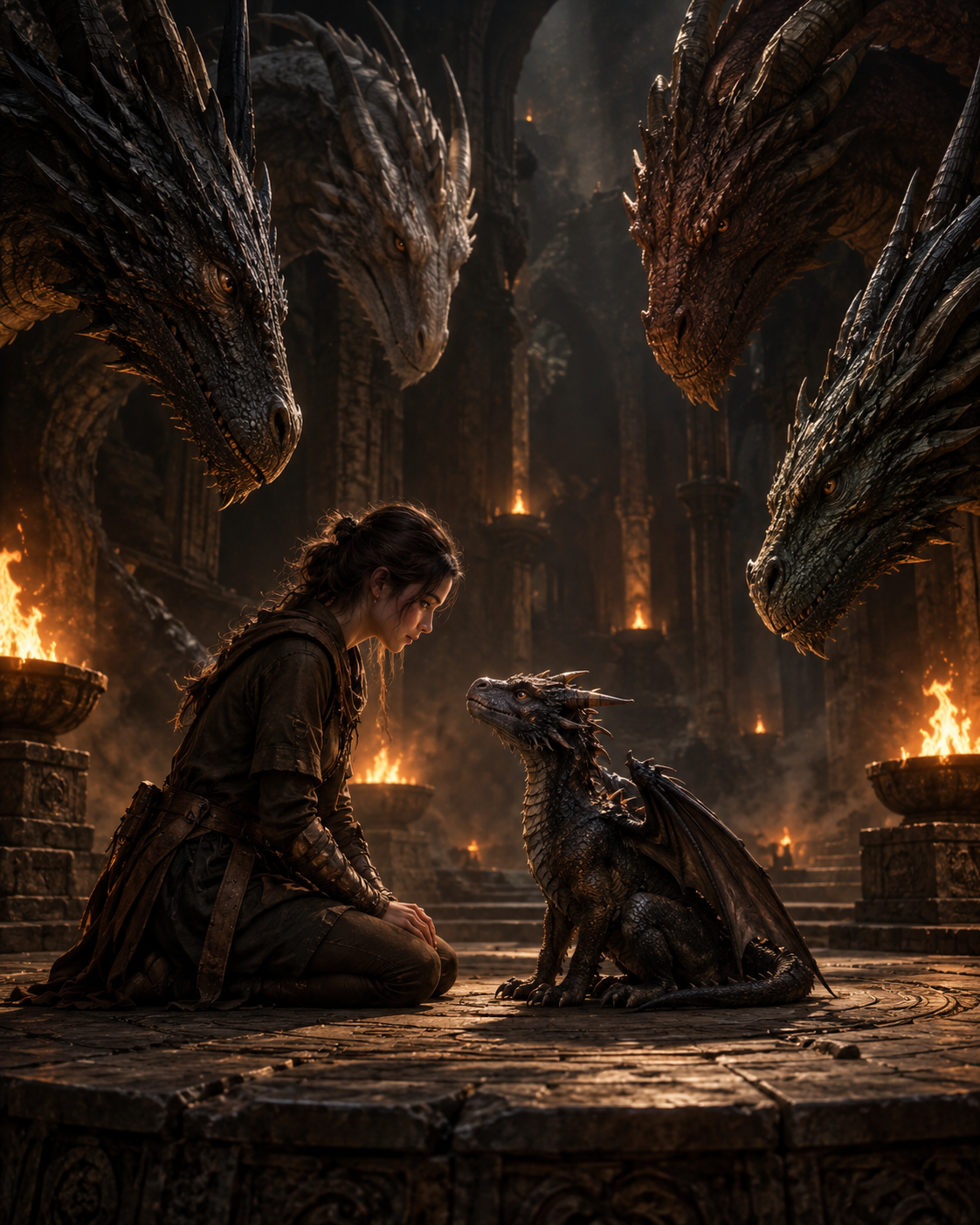
They laughed when I was dragged from the marble floor of the Royal Cavern, but the eldest dragon looked at me coldly because she knew I had just uncovered their greatest secret.
The words seemed to move on the parchment even though the room was perfectly still.
WE ARE STILL HERE.
I read them twice.
Then a third time.
“Ellie,” Zerith whispered, “tell me you recognize the symbol.”
I stared at the mark beneath the sentence. It was a circle split by three crooked lines, almost like a mountain seen through a crack in glass. I had seen it sixty-four years ago.
Not in a dragon archive.
Not on a royal map.
In an old human census ledger.
The missing census ledger.
The very ledger that had led me into the Royal Cavern in the first place.
My mouth went dry.
“I’ve seen it.”
Zerith’s pupils narrowed.
“Where?”
“In the Ashfall courthouse.”
She leaned closer.
“On what?”
“An entry from 1961.”
Her claws tightened around the edge of my desk.
“That’s impossible.”
“I thought so too.”
I opened the bottom drawer of my filing cabinet and pulled out a bundle of old copies I had kept for years. I had never known why I kept them. Perhaps some part of me disliked throwing away records simply because everyone else had decided they were irrelevant.
The top page was yellow with age.
Ashfall Population Census, 1961.
I turned through names, addresses, occupations, births, deaths.
Then I found it.
A small handwritten symbol in the margin.
The same circle.
The same three crooked lines.
Beneath it was a name.
Elias Vale.
Occupation: Surveyor.
Status: Missing.
Zerith went completely still.
“That’s my grandfather’s name.”
I looked up.
“What?”
“My grandfather disappeared before my father was born.”
“You never told me.”
“I never knew the details.”
She took the page from my hands.
Her eyes moved quickly across the faded ink.
“He was human?”
“Yes.”
“My family always said he was a traitor.”
“Why?”
“Because he knew something about the western mountains. Something the royal court didn’t want remembered.”
I felt a cold sensation crawl up my spine.
“And the dragons?”
“My grandfather disappeared sixty-four years ago,” Zerith said. “The same year the royal archives erased that symbol.”
Neither of us spoke.
Outside the office, snow tapped softly against the windows.
For years I had believed records existed to preserve the past.
That night, I understood that sometimes records were also prisons.
Someone had not merely forgotten the truth.
Someone had worked very hard to make sure nobody could find it.
Zerith rolled the parchment closed.
“We’re going beneath the mountains.”
I stared at her.
“Of course we are.”
She gave me a small smile.
“You didn’t even ask where.”
“I’ve known you too long.”
She laughed quietly.
Then her expression became serious.
“If the words are real, Ellie, someone has been waiting for us.”
“That doesn’t necessarily mean they’re friendly.”
“No.”
She slipped the map into a leather case.
“But it means they survived.”
Two days later, we left Ashfall before sunrise.
We told the royal court we were beginning another geological survey.
It wasn’t a complete lie.
The western mountains had always been difficult to cross, even for dragons. The peaks rose like broken teeth against the sky, and winter storms could bury an entire expedition in minutes.
Zerith flew above me for most of the journey.
She had changed enormously since the day I first saw her in the cavern.
Her silver-blue scales now reflected sunlight like polished steel.
Her wings were broad and powerful.
Her fire had eventually appeared, but she rarely used it.
She had discovered something more useful.
She could read the world.
Give her a broken bridge, and she would calculate where it had collapsed.
Give her an ancient ruin, and she could reconstruct its original purpose.
Give her a river, and she could trace its hidden path through miles of stone.
But that morning she barely spoke.
She kept looking toward the mountains.
On the third evening, we reached a narrow valley marked on no modern map.
Zerith landed beside a wall of black stone.
“There.”
I saw nothing.
“Where?”
She touched one claw to the rock.
“The mountain is lying.”
I frowned.
“Mountains can lie now?”
“They can when someone builds a door inside them.”
She pressed a claw against the symbol from the parchment.
For several seconds, nothing happened.
Then the stone trembled.
A thin line appeared.
It widened slowly, revealing a passage descending into darkness.
Cold air rushed out.
Not mountain air.
Something older.
Something that smelled faintly of ash and metal.
Zerith looked at me.
“Ready?”
“No.”
“Good.”
She stepped inside.
I followed.
The passage went downward for what felt like hours.
There were no torches.
No markings.
No signs that anyone had walked there in generations.
Then we found the first skeleton.
It was human.
A rusted surveyor’s compass lay beside its hand.
Zerith stopped.
“Ellie.”
I crouched beside the remains.
The compass was engraved with a name.
E. Vale.
I closed my eyes.
“Your grandfather.”
She didn’t answer.
Instead, she noticed something beneath the skeleton.
A metal box.
Inside was a notebook wrapped in oilcloth.
Most of the pages had been destroyed by moisture, but several remained readable.
The handwriting matched the census ledger.
I read the first surviving entry aloud.
“October 14, 1961. We found the lower settlement today.”
Zerith leaned closer.
“Keep reading.”
“November 2. There are survivors.”
My hands began to shake.
“November 9. They are not dragons.”
I stopped.
Zerith’s expression changed.
“Continue.”
“November 11. They call themselves the First Kin. They say the royal dragons are not the first rulers of this world. They say the mountains were built to hide them.”
The passage seemed suddenly colder.
I turned the page.
“November 18. The elders know about them.”
The next page was almost unreadable.
Then one final sentence appeared.
“They told us the same thing they told the humans before us: forget them, or the kingdoms will burn.”
Zerith closed her eyes.
“My grandfather didn’t betray the royal family.”
“No.”
“He found something they wanted hidden.”
“Yes.”
A sound came from deeper in the tunnel.
A slow metallic scrape.
We both turned.
Something moved in the darkness.
Zerith’s wings opened.
A blue flame gathered between her teeth.
“Who’s there?”
No answer.
Then a voice came from the darkness.
“You came later than we expected.”
I nearly dropped the notebook.
A figure stepped into the faint light.
It was human.
An old man.
His hair was white.
His clothes were made from stitched leather and faded cloth.
Around his neck hung the same symbol.
He looked directly at me.
Then at Zerith.
“Elias Vale?” I whispered.
The old man smiled.
“My grandfather.”
Zerith stared at him.
“You’re not Elias.”
“No.”
“Then who are you?”
“My name is Thomas Vale.”
He looked at me.
“Elias was my father.”
For a moment, nobody moved.
“You knew we were coming,” I said.
“We knew someone would eventually come.”
“Who is we?”
Thomas turned toward the darkness.
“Come and see.”
The tunnel opened into an enormous underground chamber.
I had seen the Royal Cavern.
This was different.
There were buildings.
Homes carved into stone.
Bridges suspended over black water.
Libraries filled with metal tablets.
Gardens growing beneath artificial light.
And thousands of people.
Human.
Dragon.
And creatures I couldn’t name.
They watched us from balconies and doorways.
Some looked frightened.
Others looked curious.
An old woman approached Zerith.
She had silver hair and pale golden eyes.
She carried no weapon.
“You have the eyes of the Marrow line,” she said.
Zerith stiffened.
“You know my family?”
“We knew the first Marrow.”
“My ancestors?”
The woman nodded.
“Before the royal court became a kingdom.”
Zerith’s voice hardened.
“Why were you erased?”
The old woman looked at me.
“Because history is dangerous when only one side is allowed to write it.”
She led us into a circular hall.
Its walls were covered with murals.
I saw dragons.
Humans.
Cities.
Wars.
Treaties.
Then I saw something that made my breath catch.
A dragon kneeling beside a human child.
Not in fear.
Not in submission.
As equals.
The mural continued across the wall.
Humans and dragons building roads together.
Sharing libraries.
Exploring distant lands.
Then came fire.
Armies.
Burned cities.
A crown.
The First Kin disappearing beneath the mountains.
The woman spoke softly.
“The royal dragons were once guardians.”
“What happened?”
“They became rulers.”
Zerith stared at the mural.
“And my family?”
“The Marrows were among the last to oppose the change.”
The woman pointed to a dragon painted in silver-blue.
“Your ancestor refused to participate in the final purge.”
“Purge?”
“Of knowledge.”
The word echoed through the chamber.
“They destroyed maps.”
“They erased names.”
“They buried languages.”
“They rewrote treaties.”
“And when that wasn’t enough, they built the royal trials.”
I understood immediately.
“The fire trials.”
The woman nodded.
“They needed a way to decide who was worthy of power.”
“But Zerith couldn’t breathe fire.”
“Exactly.”
The woman smiled sadly.
“The trial was never designed to discover ability. It was designed to reward obedience.”
Zerith looked at the mural for a long time.
Then she asked the question I knew had been waiting inside her since she was a hatchling.
“Why did I fail?”
The woman looked directly into her eyes.
“Because you were never meant to succeed.”
Silence filled the hall.
Zerith lowered her head.
For years, she had believed her failure was a weakness.
Now she understood that it had been the first evidence of her difference.
She didn’t fit the question.
She had outgrown it.
I placed a hand on her shoulder.
“What happens now?”
The woman looked toward the ceiling.
“Now the truth must return to the surface.”
Zerith shook her head.
“They’ll attack you.”
“Yes.”
“They’ll attack us.”
“Yes.”
“Then why show us?”
“Because hiding saved our lives.”
She looked around the chamber.
“But it also made us prisoners.”
That night, we stayed beneath the mountain.
I couldn’t sleep.
Too many questions crowded my mind.
At midnight, Zerith found me sitting beside the underground river.
“Do you regret coming?”
“No.”
“Even knowing what happens next?”
I looked at her.
“I’ve spent my entire life protecting records.”
She smiled faintly.
“Now you have to protect people.”
“That’s harder.”
“Yes.”
We sat quietly.
Then she said, “I was angry at them.”
“At the elders?”
“Yes.”
“For making me believe I was worthless.”
“You had every right to be angry.”
She stared at the river.
“But I don’t want to spend the rest of my life proving them wrong.”
I understood.
“Then what do you want?”
She smiled.
“I want to make sure nobody else has to stand in that circle.”
The next morning, we returned to Ashfall.
We did not go to the royal palace.
We went to the courthouse.
The same courthouse where I had worked for twelve years.
The same building beneath which I had found the Royal Cavern.
I unlocked the old archive room.
Then I opened every drawer.
Every box.
Every sealed cabinet.
Zerith brought copies of the underground records.
Thomas brought the surviving testimony.
We spent three days comparing documents.
There were contradictions everywhere.
Dates had been altered.
Names had been changed.
Entire settlements had vanished from maps.
But there were patterns.
And patterns were enough.
By the fourth day, we had assembled a complete record.
Not the truth.
Not yet.
But evidence pointing toward it.
Then someone knocked on the archive door.
Three times.
Zerith looked at me.
I nodded.
She opened it.
The eldest dragon from the Royal Cavern stood outside.
The same dragon who had once watched her fail her sixty-fourth trial.
Behind him stood twenty royal guards.
Zerith stepped forward.
“Why are you here?”
The elder looked older than I remembered.
“I came to take you home.”
“No.”
His eyes hardened.
“You don’t understand what you’re dealing with.”
“I understand enough.”
“The First Kin will use you.”
“Maybe.”
“They’ll destroy the kingdom.”
“Maybe.”
“They will expose secrets that could start a war.”
Zerith stepped closer.
“Then perhaps the war has already started.”
The elder looked at me.
“You taught her this.”
“No.”
I shook my head.
“She taught herself.”
For the first time, the elder looked uncertain.
Then he placed a sealed document on my desk.
“What is that?”
“The original royal charter.”
Zerith broke the seal.
Her eyes widened.
“What does it say?”
I took the document.
The first paragraph was clear.
The kingdom was not founded as a monarchy.
It had been created as a council between dragons, humans, and the First Kin.
The royal bloodline had been granted temporary authority during a period of war.
Temporary.
The document had been altered centuries later.
Someone had removed the final clause.
The elder’s voice was barely audible.
“We were supposed to give the power back.”
Zerith looked at him.
“Why didn’t you?”
“Because my ancestors believed they knew what was best.”
“And you?”
He closed his eyes.
“I believed the same thing.”
The courthouse suddenly shook.
A roar came from outside.
Then another.
People screamed in the streets.
Zerith ran to the window.
Black smoke was rising from the western mountains.
Thomas appeared at the doorway.
“They found the settlement.”
“Who?”
“The royal army.”
The elder’s face went pale.
“They weren’t supposed to know.”
I looked at him.
“But they do.”
The next few hours passed like a nightmare.
Dragons filled the sky.
The underground settlement sent warning signals through the mountains.
Royal forces moved toward the hidden entrance.
But something unexpected happened.
People came.
Humans from Ashfall.
Miners.
Teachers.
Farmers.
Shopkeepers.
People who had never known the underground settlement existed.
They gathered outside the courthouse because Zerith had spoken to them.
She stood on the courthouse steps.
No crown.
No armor.
Just the silver-blue dragon who had once been laughed at for failing to breathe fire.
“We have been taught that history belongs to those strong enough to write it,” she said.
“It doesn’t.”
The crowd became silent.
“History belongs to everyone who lived it.”
A dragon landed behind her.
Then another.
Then dozens.
Not royal guards.
Ordinary dragons.
They had heard what happened.
They had seen the documents.
They had begun asking questions of their own.
The elder walked slowly toward Zerith.
He removed the royal crest from his neck.
Then placed it on the courthouse steps.
“I was wrong,” he said.
It was the first time I had ever heard those words from him.
The royal army stopped.
No one knew what to do next.
Then Thomas walked forward.
He held up Elias Vale’s notebook.
“My grandfather died believing this story would disappear.”
He looked at the dragons.
“It didn’t.”
The battle that everyone feared never happened.
Not because everyone suddenly became good.
Not because centuries of hatred vanished in a single afternoon.
It happened because too many people now knew the truth.
And once truth becomes public, violence becomes harder to justify.
The royal court surrendered its claim to absolute authority three months later.
The old charter was restored.
The underground settlement was recognized.
The First Kin were invited to join a new council.
The royal fire trials were abolished.
And every archive in the kingdom was opened.
But opening the archives was only the beginning.
There were arguments.
There were accusations.
There were families who discovered terrible things their ancestors had done.
Some people wanted revenge.
Others wanted the old history erased again.
Zerith refused both.
“We cannot repair a lie by replacing it with another lie,” she said.
So the records remained.
The good.
The bad.
The shameful.
The heroic.
All of it.
For the first time, children learned that history was not a story about perfect heroes and perfect villains.
It was a record of choices.
And choices could be changed.
A year later, I stood in the newly restored archive beneath the courthouse.
The bronze door was no longer hidden.
A plaque had been placed beside it.
THE ARCHIVE OF SHARED HISTORY.
Zerith entered carrying a new map.
She dropped it on my desk.
“I found another passage.”
I laughed.
“Of course you did.”
She smiled.
“Do you want to see it?”
“No.”
She raised an eyebrow.
“You’re getting old, Ellie.”
“I’ve earned the right.”
She laughed.
Then she looked toward the shelves.
Thousands of documents filled them.
Names once erased.
Languages once forbidden.
Stories once buried beneath mountains.
Preserved.
Accessible.
Impossible to quietly destroy again.
I touched the old census ledger sitting on my desk.
The one that had started everything.
“You know,” I said, “I used to think records were just paperwork.”
“And now?”
I looked at her.
“Now I think records are promises.”
“To whom?”
“To people who aren’t here yet.”
Zerith became quiet.
Then she placed her new map beside the ledger.
“What do you think this means?”
I studied it.
At the far edge was the same symbol.
But beneath it, instead of three words, someone had written a new sentence.
WE WERE HERE.
I looked at Zerith.
She smiled.
“Different?”
“Very.”
“Better?”
I thought about it.
“Not necessarily.”
She laughed.
“Good answer.”
We stood together in the archive while sunlight entered through the courthouse windows above us.
For years, I had believed my job was to keep old pages from disappearing.
I was wrong.
My job was to make sure the future had the evidence it needed to ask better questions.
Zerith had once been judged because she could not produce the answer everyone expected.
Her greatest gift had been the courage to ask a different question.
What do you want?
Where did we come from?
Who was erased?
Who benefits when the truth disappears?
And perhaps the most important question of all:
What happens when we stop measuring people by the things they were told to prove?
Zerith folded the map.
“We should go.”
“Where?”
She pointed toward the western mountains.
“There’s another world underneath that one.”
I sighed.
“You realize I’m not young enough for this anymore.”
She grinned.
“You don’t have to be young.”
She opened the bronze door.
“You just have to be willing to look.”
I followed her into the light.
Behind us, the archive remained open.
No locks.
No hidden doors.
No forbidden names.
And on the wall, beneath the old symbol that had once meant secrecy, someone had carved a new inscription:
TRUTH DOES NOT BELONG TO THE POWERFUL.
IT BELONGS TO EVERYONE WHO IS BRAVE ENOUGH TO PRESERVE IT.
I stopped for a moment and read the words.
Then I smiled.
Because I finally understood why a frightened little hatchling had failed sixty-four times.
She had not failed the trial.
The trial had failed her.
And sometimes, the most important thing a person can do is refuse to become the answer to a question that was never fair to begin with.
The western mountains looked different from the last time I had seen them.
Perhaps it was because I knew what lay beneath them now.
Perhaps it was because, for the first time, I was not looking at them as a boundary.
I was looking at them as a door.
Zerith flew ahead while I followed along the narrow mountain trail.
The new map was strapped across my back, protected beneath three layers of waterproof leather.
For six days, we had traveled toward the place marked at its edge.
We had found no village.
No ruins.
No entrance.
Only snow, stone, and a silence so complete that even Zerith had begun to doubt the map.
On the seventh morning, she stopped.
“Ellie.”
I looked up.
She was standing beside a frozen lake.
“What?”
She pointed downward.
I walked closer.
Beneath the transparent ice, far below the surface, something glimmered.
Not stone.
Not metal.
A light.
Then another.
And another.
Hundreds of them.
A city was buried beneath the lake.
I stared.
“That wasn’t on the map.”
“No.”
Zerith unfolded the parchment.
The symbol at the edge of the map was changing.
Not literally, of course.
Maps did not move.
But as sunlight struck the ancient ink, a second layer of writing became visible.
A sentence appeared.
THE FIRST DOOR WAS NEVER THE LAST.
Zerith looked at me.
“I think we found it.”
“That’s what you said seven times this week.”
“This time I’m right.”
“You said that six times too.”
She laughed.
Then the ice beneath us cracked.
We jumped backward as a circular section of the frozen lake sank into darkness.
A staircase appeared.
It descended beneath the water without becoming wet.
I stared at it.
“I hate magical architecture.”
Zerith grinned.
“After everything we’ve seen, that’s your complaint?”
“Yes.”
She stepped onto the first stair.
I followed.
The moment we descended below the ice, the temperature changed.
The air became warm.
The staircase opened into a vast chamber filled with golden light.
At its center stood a structure unlike anything I had ever seen.
It looked like a tree.
But its branches were made of crystal.
Its roots disappeared into the floor.
And suspended from every branch were thousands of small transparent spheres.
Inside each sphere was a memory.
I saw a dragon flying over a city that no longer existed.
A human woman teaching children an ancient language.
A battlefield.
A wedding.
A funeral.
A child laughing.
A king signing a treaty.
A prisoner whispering a name.
A thousand lives.
A thousand moments.
A thousand pieces of history.
Zerith walked toward it slowly.
“What is this?”
A voice answered behind us.
“The Memory Tree.”
We turned.
The old woman from the underground settlement stood there.
But she looked different.
Younger.
Not physically.
There was simply more strength in her eyes.
“You followed the map,” she said.
“Who made it?” Zerith asked.
“You did.”
Zerith frowned.
“I’ve never been here.”
“No.”
The woman pointed toward the crystal tree.
“But you have been expected.”
She touched one of the spheres.
It opened.
Light spilled across the chamber.
A voice emerged.
A young dragon.
Afraid.
Shaking.
Unable to breathe fire.
I recognized her immediately.
Zerith.
But this was not the Zerith I knew.
It was a memory.
Her first royal trial.
Attempt one.
The sphere closed.
Another opened.
Attempt twelve.
Another.
Attempt thirty.
Then sixty-four.
The same child.
The same stone.
The same laughter.
The same failure.
Zerith stepped backward.
“Why are you showing me this?”
“Because you keep thinking your story began in that cavern.”
The old woman looked at her.
“It didn’t.”
She pointed toward the crystal tree.
“Your story began generations earlier.”
A new sphere opened.
This one contained an ancient dragon.
Silver-blue scales.
A young male.
He stood before a council of dragons and humans.
“My name is Araven Marrow,” he said.
“I refuse to erase the First Kin from the royal records.”
The memory changed.
He was older.
He stood before a burning archive.
“If you destroy the records,” he shouted, “you will destroy the kingdom’s memory.”
Then another memory.
Araven placing a crystal sphere inside the Memory Tree.
“If we cannot protect the truth above ground, we will protect it here.”
Zerith’s eyes widened.
“My ancestor.”
“Yes.”
The old woman nodded.
“He knew the royal court would eventually erase his name.”
“So he hid the truth here.”
“He hid more than truth.”
The woman touched the tree.
“He hid a question.”
The crystal branches began to glow.
A doorway appeared inside the trunk.
Zerith stepped toward it.
“What question?”
The old woman looked at me.
“Who should rule?”
I expected Zerith to answer immediately.
Instead, she remained silent.
The doorway opened.
Beyond it was a chamber containing a single stone chair.
No crown.
No throne.
Just a chair.
Behind it was an inscription.
POWER IS A TOOL.
AUTHORITY IS A RESPONSIBILITY.
NEITHER BELONGS TO BLOOD.
Zerith read the words twice.
Then she laughed bitterly.
“The royal family spent centuries fighting over a chair.”
“No,” I said.
“They spent centuries convincing everyone the chair belonged to them.”
She looked at me.
“That is worse.”
The old woman nodded.
“That is why this place exists.”
A deep rumble shook the chamber.
Dust fell from the ceiling.
The Memory Tree flickered.
The old woman turned pale.
“They found us.”
“Who?”
She didn’t answer.
We already knew.
Royal dragons.
But the kingdom had changed.
The old royal government had been dissolved.
The remaining loyalists had disappeared months ago.
They had rejected the new council and retreated into the mountains.
They had called themselves the True Crown.
And now they had followed us here.
A roar echoed through the underground city.
Then another.
Zerith spread her wings.
“How many?”
“Too many,” the old woman said.
I looked at the Memory Tree.
“What are they after?”
“The memories.”
“Why?”
“Because if they cannot restore the old kingdom, they intend to destroy every record proving it ever existed.”
Zerith’s face hardened.
“Then we protect the tree.”
The old woman shook her head.
“No.”
Zerith stared at her.
“What?”
“You still think the tree is the answer.”
She pointed at the thousands of memories.
“The tree is only a container.”
“Then what is the answer?”
“People.”
The first explosion shook the chamber.
Stone cracked above us.
The old woman grabbed my arm.
“Take the memories.”
“All of them?”
“As many as you can.”
I looked at the crystal spheres.
“There are thousands.”
“Then start with the ones they tried hardest to erase.”
Zerith nodded.
We moved.
The old woman opened hidden compartments beneath the tree.
Inside were small metal cases.
I began filling them with memory spheres.
Names.
Treaties.
Maps.
Witnesses.
Testimonies.
Every piece of evidence that could be destroyed.
Zerith carried entire branches at a time.
Then the ceiling exploded.
A dragon crashed through the stone.
Black scales.
Royal armor.
A golden crown painted across his chest.
“The traitor,” he growled.
His eyes fixed on Zerith.
“The failed heir.”
Zerith stepped forward.
“I was never your heir.”
“You were born to serve the crown.”
“No.”
She opened her wings.
“I was born.”
“That is enough.”
The dragon attacked.
Zerith moved faster.
She dodged the first strike and slammed her tail against his chest.
He crashed into a pillar.
Three more dragons entered.
Then five.
The chamber erupted into chaos.
I grabbed the nearest memory case and ran.
Not away.
Toward the Memory Tree.
Because suddenly I understood what the old woman had meant.
The tree could preserve the past.
But only people could carry it forward.
A royal dragon lunged at me.
I ducked.
His claws sliced through the leather case.
Three memory spheres rolled across the floor.
I grabbed them.
One contained the original charter.
Another contained the testimony of Elias Vale.
The third contained something I had never seen.
A memory of the first human-dragon council.
I held all three against my chest.
Then someone knocked me down.
The spheres flew from my hands.
The dragon raised one claw.
A burst of blue fire struck him.
He screamed and fell backward.
Zerith landed between us.
“You’re not touching her.”
The dragon rose again.
“You would fight your own kind for a human?”
Zerith looked at me.
Then at him.
“She is my family.”
The words stopped him.
Not because they were powerful.
Because they were simple.
Zerith had spent her entire life being told that blood determined loyalty.
Now she was choosing loyalty for herself.
The dragon attacked.
Zerith met him in midair.
They crashed through the upper chamber.
The Memory Tree trembled.
Crystals shattered.
Memories flew through the air like pieces of falling stars.
I watched one land near my feet.
Inside it, a little boy was laughing.
I realized then that these were not historical artifacts.
They were people.
Every memory represented someone who had trusted the future to remember them.
I picked up the sphere.
And something inside me broke.
Not from fear.
From responsibility.
I ran toward the central chamber.
“Everyone!”
My voice echoed through the cavern.
The fighting stopped for one second.
“Stop!”
No one listened.
So I screamed.
“STOP!”
The sound of my voice seemed ridiculous beside the dragons.
But it worked.
Everyone looked at me.
I stood beneath the Memory Tree.
Holding one small sphere.
“You want to destroy these?”
I raised it.
“Then tell me what you are afraid of.”
The black-armored dragon stared at me.
“You know nothing about us.”
“I know you came here to destroy records.”
“You are defending traitors.”
“No.”
I held up another sphere.
“I’m defending witnesses.”
His expression changed.
“You think destroying this will change the past?”
He said nothing.
“You think if nobody remembers what happened, then it didn’t happen?”
Still nothing.
I stepped forward.
“That is why you are afraid.”
Zerith landed beside me.
Blood ran from a cut above her eye.
The elder dragon looked around.
Some of his own soldiers were lowering their weapons.
One dropped his sword.
Another removed his royal insignia.
The black-armored leader noticed.
“Pick them up!”
Nobody moved.
He roared.
“PICK THEM UP!”
A young dragon looked at him.
“My grandmother was in these records.”
The leader froze.
“She was executed by the old court.”
The dragon swallowed.
“I was told she died honorably.”
The young dragon stared at the memory sphere in my hand.
“I want to know the truth.”
One by one, others stepped forward.
“My father disappeared.”
“My sister was imprisoned.”
“My village was erased from the maps.”
“My family was told we had never existed.”
The leader backed away.
“No.”
He looked at the Memory Tree.
“No.”
Zerith walked toward him.
“You wanted the past to belong to you.”
She looked around the chamber.
“It doesn’t.”
The old woman stepped forward.
“None of it belongs to us.”
She placed her hand on the Memory Tree.
“It belongs to those who lived it.”
The black-armored dragon lowered his head.
For several seconds, I thought he might surrender.
Instead, he pulled a blade from his belt and lunged toward the tree.
Zerith moved.
Too late.
The blade struck the central trunk.
The Memory Tree shattered.
Thousands of spheres exploded into light.
The entire chamber disappeared beneath a storm of memories.
I saw everything.
Cities rising.
Cities burning.
Children growing old.
Dragons dying.
Humans laughing.
Kings lying.
Farmers planting seeds.
Lovers saying goodbye.
Soldiers refusing orders.
People choosing courage.
People choosing fear.
For one impossible moment, every person in the chamber saw the same history.
Not a royal history.
Not a human history.
Not a First Kin history.
Ours.
The collective past of everyone who had lived beneath these mountains.
Then the light vanished.
Silence followed.
The Memory Tree was gone.
Only a blackened crystal root remained.
The old woman sank to her knees.
“It is over.”
I looked around.
“No.”
She looked at me.
I held up my empty hands.
“The tree is gone.”
“Yes.”
“But the memories aren’t.”
Behind me, a human child was crying.
A dragon was comforting her.
An old royal soldier was staring at the floor.
The memories had escaped.
They were inside everyone now.
No archive could contain them.
No king could lock them away.
No fire could destroy them.
Zerith walked toward the broken root.
She placed one claw against it.
“Maybe this was always the point.”
“What?”
“The tree protected the memories until people were ready to carry them.”
The old woman smiled.
“You understand now.”
The black-armored dragon slowly removed his crown-shaped insignia.
He placed it on the floor.
“I don’t know what to do without the crown.”
Zerith looked at him.
“Neither did anyone else.”
He stared at her.
“What happens now?”
She smiled.
“Now we build something that doesn’t need one.”
Three months later, the first Assembly of Ashfall met in the old courthouse.
There were dragons.
Humans.
The First Kin.
Farmers.
Scholars.
Explorers.
Former royal soldiers.
Families who had lived above ground for centuries.
Families who had lived beneath it for just as long.
No one sat on a throne.
There were no crowns.
No permanent rulers.
Every representative had the same wooden chair.
I found that amusing.
Zerith found it hilarious.
“You know,” she whispered, “someone is going to complain about the chairs.”
“They already have.”
“Good.”
The first vote lasted seven hours.
The second lasted nine.
The third ended in an argument about river rights.
It was messy.
Slow.
Exhausting.
And wonderful.
Because nobody had the power to simply end the discussion by saying, “Because I said so.”
At the end of the first year, the new council created an institution called the House of Memory.
Its purpose was simple.
Preserve everything.
Not just victories.
Not just beautiful stories.
Everything.
Every mistake.
Every crime.
Every act of courage.
Every failure.
Every ordinary life.
They asked me to become its first keeper.
I refused.
Then Zerith looked at me.
I accepted.
Years passed.
The western mountains became a place of pilgrimage.
Children traveled there to see the remains of the Memory Tree.
People called it the Place of Remembering.
But I preferred another name.
The Door.
Because that was what it had always been.
A door between what people knew and what they were afraid to learn.
Zerith continued exploring.
She crossed deserts.
Mapped oceans.
Found cities buried beneath glaciers.
She became known not as the failed heir, but as the dragon who opened the world.
Every few years, she returned to Ashfall.
She always brought another impossible map.
And every time, she placed it on my desk and said the same thing.
“Look what I found.”
I always answered the same way.
“What have you broken this time?”
She would laugh.
Then we would begin again.
But one winter, many years later, Zerith did not return.
The message arrived at dawn.
Her expedition had vanished beyond the eastern sea.
No survivors had been found.
The council called for a search.
Ships were sent.
Dragons flew across the mountains.
Weeks became months.
No trace.
I refused to believe she was dead.
Not because she was immortal.
She wasn’t.
But because Zerith had spent her entire life proving that an unanswered question was not the same thing as an ending.
So I kept her desk exactly as it was.
Her maps remained stacked in the corner.
Her old compass sat beside the window.
Her first explorer’s crown hung on the wall.
One year passed.
Then two.
On the third winter, a package arrived.
No sender.
No seal.
Inside was a map.
I recognized the handwriting immediately.
My hands trembled.
At the bottom of the map were five words.
ELLIE, YOU WERE RIGHT.
THERE IS ALWAYS ANOTHER DOOR.
Beneath the sentence was a drawing.
A coastline.
A mountain.
And a symbol I had never seen before.
I laughed.
Then I cried.
Then I laughed again.
Because somehow, even after everything, she had found a way to turn disappearance into an invitation.
I placed the map beside the old census ledger.
The ledger that had started everything.
The map that had carried us through the mountains.
The final message from Zerith.
Three pieces of paper.
Three different generations.
Three reminders that the truth was never a destination.
It was a responsibility passed from one person to another.
I looked at the empty chair across from me.
For a moment, I imagined Zerith sitting there.
Older.
Smiling.
Impatient.
Waiting for me to complain about another impossible journey.
I smiled.
Then I stood.
Outside, the first snow of winter had begun to fall.
Children were playing in the courthouse square.
A dragon flew overhead.
Humans waved.
The bells of the Assembly rang.
No crown ruled the city.
No archive was sealed.
No name was forbidden.
And beneath the old courthouse, the door to the ancient cavern remained open.
Not because there were no secrets left.
There were countless secrets.
But because we had finally learned that secrets did not become dangerous merely because they existed.
They became dangerous when someone decided other people had no right to know them.
I walked to the window.
On the horizon, beyond the snow-covered mountains, the sun was rising.
I thought about the frightened little hatchling I had met decades ago.
She had been asked to produce fire.
She couldn’t.
Instead, she produced questions.
Those questions changed a kingdom.
They exposed a buried history.
They reunited people who had been separated for generations.
And eventually, they taught an entire civilization that the purpose of knowledge was not to make one person powerful.
It was to make everyone harder to deceive.
I touched the old census ledger one last time.
Then I opened a fresh book.
At the top of the first page, I wrote:
THE STORY CONTINUES.
Because that was the lesson Zerith had taught me.
A story does not end when the hero disappears.
It ends when people stop carrying its meaning forward.
So I wrote about the dragons.
I wrote about the humans.
I wrote about the First Kin.
I wrote about Elias Vale.
I wrote about the sixty-four failures.
I wrote about the Memory Tree.
I wrote about the people who had once tried to bury the truth.
And I wrote about the people who chose to remember it.
At the very end, I wrote one final sentence.
Not because it was the most important sentence.
But because it was the one I wished someone had written for Zerith when she was a frightened child standing beneath the shadow of the royal elders.
I wrote:
YOU DO NOT HAVE TO BECOME WHAT THE WORLD EXPECTS OF YOU TO PROVE THAT YOU MATTER.
Then I closed the book.
Outside, a young dragon was asking her mother a question.
I couldn’t hear the words through the window.
But I knew the expression.
Curious.
Fearless.
Hungry for an answer.
Her mother smiled.
And instead of telling her to stop asking, she took her hand.
Together, they walked toward the mountains.
I watched them disappear into the snow.
Then I looked at the empty road beyond them.
And somewhere far away, beyond the eastern sea, beyond every map we had ever drawn, I knew Zerith was probably standing before another impossible door.
Waiting.
Wondering.
Searching.
And perhaps, someday, someone would find her.
Or perhaps they would find only another map.
Another question.
Another door.
That was all right.
Because after everything we had learned, I no longer believed the greatest secret in the world was hidden beneath a mountain.
It was much simpler than that.
The greatest secret was that no one person could ever own the whole truth.
We could only carry a piece of it.
Protect it.
Question it.
Add to it.
And, when the time came, place it in someone else’s hands.
That was how kingdoms changed.
That was how history survived.
That was how a frightened hatchling who failed sixty-four times became the dragon who taught an entire world to look beyond the question it had been given.
And that was how the door stayed open.
Forever.
THE END.