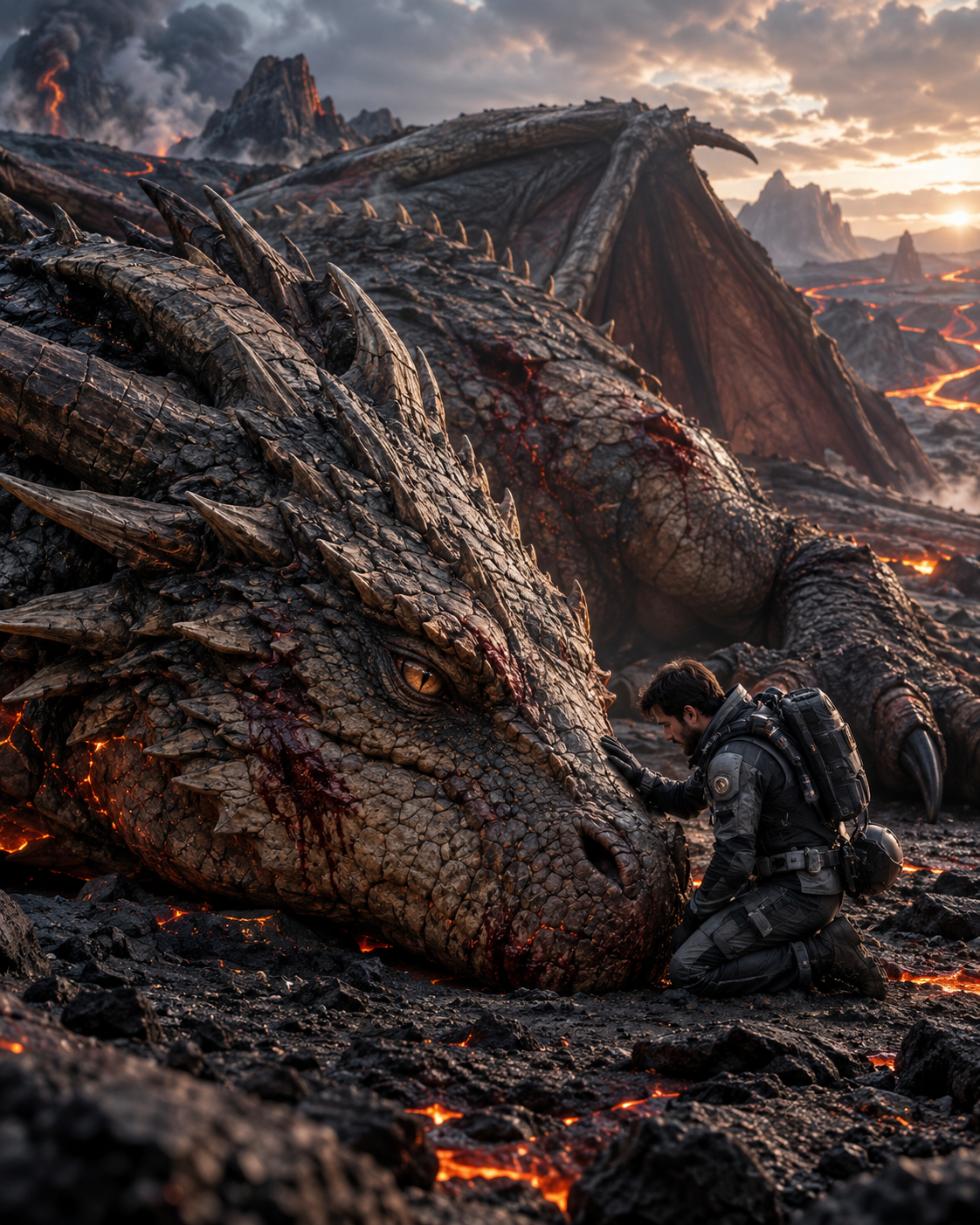
They laughed when I knelt beside the dying enemy outside Fort Mercer, but nobody knew the “monster” begging me for water was their highest-ranking commander.
The name engraved beneath the Sovereignty’s highest command symbol was General Adrian Voss.
My commanding officer.
The man who had stood beside my hospital bed and told me the dragon should have died.
For several seconds, I couldn’t breathe.
I turned the small black object over in my hands, searching for some explanation that wouldn’t make my entire world collapse.
“That’s impossible,” I whispered.
Drosk watched me carefully.
“I once believed so myself.”
“General Voss has led the defense of Fort Mercer for two years. He’s lost soldiers. Friends. His own brother died during the Siege of Harrow.”
“Yes,” Drosk replied. “And he has made certain that thousands more followed.”
My stomach twisted.
I wanted to throw the object back at him.
I wanted to call the guards.
I wanted to believe that the most dangerous commander in the Sovereignty was simply trying to divide us before the negotiations began.
But Drosk wasn’t smiling.
He looked like a creature who had finally discovered the weight of every life he had destroyed.
“What is this?” I asked.
“A command cipher. Sovereignty military intelligence uses them to authenticate communications between our highest officers.”
“And why does it have Voss’s name?”
“Because for eighteen months, General Voss has been receiving information directly from someone inside our High Council.”
The silence that followed seemed to swallow the room.
I stared at him.
“You’re saying he’s a traitor?”
“I’m saying the word traitor is too small for what he has done.”
Outside, boots struck the corridor in disciplined rhythm.
Drosk waited until the footsteps faded.
“Every time peace became possible, something happened. A humanitarian convoy vanished. A border settlement was destroyed. A captured soldier was executed. Each incident carried evidence pointing toward the opposite side.”
I remembered those incidents.
Everyone did.
They were the stories we told around fires when exhaustion made us forget why we were still fighting.
The children killed at East Hollow.
The Coalition transport destroyed above the Neris Valley.
The Sovereignty medical sanctuary burned during a prisoner exchange.
Each tragedy had become another reason to hate.
Drosk leaned closer.
“Those attacks were coordinated.”
“By Voss?”
“By Voss and Sovereignty Councilor Vaelith. They have spent three years feeding both our peoples reasons to continue killing.”
I shook my head.
“Why?”
“Power. Territory. The mineral fields beneath Myra’s Reach.”
He gestured toward the window.
“The red dust outside your fortress contains a rare element called aetherium. Your governments believe it can power entire colonies. Our Council believes it can extend our lives by centuries.”
“And the war?”
“Provides the perfect excuse to claim it without public oversight.”
I stared at the black cipher.
Suddenly, the war seemed uglier than it had an hour earlier.
We hadn’t simply been fighting over territory.
We had been dying so that a handful of powerful men could become richer.
“Why are you telling me?”
Drosk’s golden eyes flickered.
“Because tomorrow, during the peace summit, General Voss intends to murder the delegates.”
My heart stopped.
“How do you know?”
“Because until two days ago, I was helping him.”
There it was.
The confession I hadn’t expected.
Drosk lowered his enormous head.
“I approved the transport routes. I authorized the weapons transfers. I believed destroying Coalition leadership would force your government to surrender.”
“And now?”
“Now I know that the same plan includes the deaths of my own people.”
I stood so quickly that the room tilted.
“You expect me to trust you?”
“No.”
His answer came without hesitation.
“I expect you to understand that if Voss discovers what I have told you, neither of us will survive the night.”
I looked at the door.
General Voss had visited me that morning.
He had congratulated me for surviving.
He had even placed a hand on my shoulder and called me a good soldier.
The memory made my skin crawl.
“What do we do?”
Drosk pushed the cipher closer.
“Find the archive beneath Fort Mercer. The evidence is there.”
“Why don’t you tell the High Council?”
“Vaelith controls their security. Any message I send can be intercepted.”
“And the Coalition?”
“Voss controls communications at this fortress.”
I laughed once, bitterly.
“So we’re trapped.”
Drosk met my eyes.
“We are not trapped yet.”
Then he said the words that changed everything.
“Your sister is alive.”
I stopped moving.
For a moment, I thought I had misheard him.
“What?”
“Your sister. Lieutenant Mara Hale. She was captured seventeen months ago during the evacuation of Kestrel Station.”
I could feel the blood draining from my face.
Mara.
My older sister.
The person who had taught me to repair broken respirators when I was twelve.
The person who had joined the Coalition before I did.
The person whose identification tags had arrived in a sealed metal box.
“She’s dead,” I whispered.
Drosk shook his head.
“No. She’s being held beneath this fortress.”
I grabbed his armor.
“Don’t lie to me.”
His expression didn’t change.
“I have killed many people, medic. I will not dishonor your grief by inventing one.”
“Why would Voss keep her alive?”
“Because she discovered the shipments.”
My hands began shaking.
Drosk continued.
“She intercepted a transport manifest linking Coalition weapons to Sovereignty intelligence. Before she could report it, her unit was ambushed. Voss declared her dead. Vaelith arranged her transfer back to human territory.”
I could barely hear him.
Seventeen months.
Seventeen months of imagining my sister dying alone beneath an alien sky.
Seventeen months of visiting the memorial wall and touching her name.
And she might have been underneath my feet the entire time.
“Where?” I demanded.
“Sublevel Nine. Behind the old atmospheric filtration chambers.”
I moved toward the door.
Drosk caught my arm with one claw.
“Listen carefully. If you rush down there, you will die.”
“Then help me.”
He looked at his restraints.
“I am scheduled for transfer at dawn. Until then, every guard in the fortress will be watching me.”
I followed his gaze.
An idea formed.
A terrible idea.
“Then we need to give them something else to watch.”
Twenty minutes later, I was standing outside the medical ward holding a sealed container of synthetic plasma.
Beside me stood Sergeant Tessa Vale, the only person in Fort Mercer I trusted with my life.
She had dragged me out of two collapsing bunkers, stitched my shoulder without anesthesia, and once threatened to punch a colonel for stealing antibiotics from wounded civilians.
Now she stared at me as though I had finally lost my mind.
“You want to break into a classified detention facility?”
“Yes.”
“With the enemy’s most dangerous commander?”
“Technically, he’s staying behind.”
“That’s supposed to make me feel better?”
I showed her the cipher.
Then I told her about Mara.
Tessa’s expression changed.
She had known my sister.
She had helped me carry Mara’s memorial flag to the ceremony.
For a long moment, she said nothing.
Then she checked the ammunition in her pistol.
“All right.”
I blinked.
“That’s it?”
“If Mara’s alive, we’re bringing her home.”
She glanced toward the security cameras.
“And if Voss really did this, I’m going to need you to stop me from killing him.”
We waited until 0200 hours.
At exactly two, the western power grid failed.
Drosk had arranged it using a coded pulse transmitted through the command cipher.
The resulting blackout lasted only forty-three seconds.
But it was enough.
Tessa and I entered a maintenance shaft behind the surgical wing.
The air grew hotter as we descended.
Every meter took us deeper beneath Fort Mercer, into levels most soldiers didn’t even know existed.
At Sublevel Seven, we found our first body.
A Coalition technician lay beside an open control panel.
His uniform was stained with blood.
He couldn’t have been dead for more than an hour.
Tessa crouched beside him.
“Someone got here before us.”
A sudden metallic click sounded behind us.
We turned.
Three armed soldiers emerged from the darkness.
Their uniforms bore the insignia of Internal Security.
“Hands where we can see them,” the leader ordered.
I slowly raised mine.
“We’re medical personnel. We received an emergency signal.”
The soldier looked at the technician.
Then at the blood on Tessa’s sleeve.
“No emergency was reported.”
He lifted his rifle.
“General Voss ordered that anyone entering this level be detained.”
Tessa sighed.
“Of course he did.”
Then she threw the plasma container.
It struck the soldier’s helmet and burst.
Synthetic blood exploded across his visor.
Before he could react, Tessa slammed him against the wall.
I tackled the second soldier.
We fell hard onto the metal flooring.
His rifle discharged.
The shot ricocheted above my head.
I drove my elbow into his throat, grabbed his weapon, and rolled away.
The third soldier aimed at Tessa.
I fired.
The blast struck his shoulder.
He collapsed screaming.
For a few seconds, the tunnel was filled with smoke and panicked breathing.
I stared at the injured man.
He couldn’t have been older than twenty.
His eyes were wide with terror.
“Please,” he gasped.
Tessa grabbed my arm.
“We have to move.”
I looked at the soldier’s wound.
Blood was pumping through his fingers.
If I left him, he would die.
I knew it.
And suddenly I was back outside Fort Mercer, staring at a dying dragon who had asked for water.
“Cover me,” I said.
Tessa looked furious.
“Daniel.”
“Cover me.”
I knelt beside the soldier.
My hands moved automatically.
Pressure dressing.
Coagulant.
Tourniquet above the wound.
The soldier watched me in disbelief.
“Why?”
I tightened the bandage.
“Because you’re bleeding.”
He swallowed.
“You’re supposed to be arrested.”
“Probably.”
His eyes filled with something I couldn’t identify.
Then he whispered, “Sublevel Nine. The prisoners are being moved. You don’t have much time.”
Tessa helped me up.
The soldier grabbed my sleeve.
“There’s a second elevator behind the coolant pipes. The main one is guarded.”
I nodded.
“Stay awake.”
He gave a weak laugh.
“I’ll try.”
We ran.
By the time we reached Sublevel Nine, the fortress had begun to shake.
Explosions echoed through the upper levels.
Tessa checked her communicator.
“Security alert. They say Sovereignty infiltrators are attacking.”
“Voss is creating his distraction.”
“No,” she whispered, listening.
Her face went pale.
“Daniel, they’re blaming Drosk.”
A recorded announcement crackled through the emergency speakers.
“Attention all personnel. Claw Admiral Drosk has escaped confinement and initiated a hostile assault. All units are authorized to terminate the prisoner on sight.”
I stopped.
Drosk hadn’t escaped.
He had told me he would remain in his cell.
Unless something had gone terribly wrong.
We reached a reinforced door marked ATMOSPHERIC RECLAMATION.
Tessa hacked the control panel.
The door opened with a groan.
Behind it stretched a corridor lined with cells.
Inside were people.
Humans.
Dozens of them.
Some wore Coalition uniforms.
Others wore civilian clothing.
Several were so thin that their bones pushed against their skin.
They stared at us silently.
A woman stepped toward the bars.
“Are you here to kill us?”
My throat tightened.
“No.”
“Then hurry,” she said. “They’ve started the evacuation protocol.”
“What does that mean?”
She pointed toward the ceiling.
Red warning lights flashed.
“Gas.”
Tessa checked the ventilation display.
Her face drained of color.
“They’re flooding the cells with industrial sterilant.”
I ran to the master control.
The screen demanded a command authorization.
GENERAL ADRIAN VOSS.
Of course.
Tessa began tearing open the panel.
“Give me thirty seconds.”
A voice came from the last cell.
“Daniel?”
I froze.
I knew that voice.
Even after seventeen months.
Even through the static of failing speakers and the thunder of distant explosions.
I turned.
A woman stood behind the bars.
Her hair had been cut unevenly.
A long scar crossed her forehead.
She was thinner than I remembered.
But her eyes were the same.
“Mara?”
She pressed both hands against the glass.
For a moment, neither of us moved.
Then I ran.
I slammed my palms against the barrier.
“Mara!”
Her face crumpled.
“Oh, Danny.”
I hadn’t heard anyone call me that since the day she disappeared.
I wanted to tell her everything.
That Mom still kept her boots beside the front door.
That I had joined the medical corps because she once told me the world needed people willing to heal it.
That I had never stopped looking for her.
Instead, all I could say was, “I’m here.”
She pressed her forehead against the glass.
“I knew you’d come.”
Behind us, the ventilation system roared.
Tessa shouted, “Daniel! The gas is already in the pipes!”
Mara looked over my shoulder.
“Listen to me. Voss has a failsafe.”
“What?”
“The summit isn’t his real target.”
My heart hammered.
“What are you talking about?”
“The delegates are a distraction. He’s planted charges beneath the aetherium reservoir.”
Tessa stopped working.
The words hung between us.
Aetherium was volatile.
A large enough detonation could ignite the mineral deposits stretching beneath half the continent.
“How big?” I asked.
Mara’s expression told me everything.
“Fort Mercer. The nearby settlements. The Sovereignty border cities. Millions.”
I stared at her.
“Why would he do that?”
“Because he plans to blame the explosion on the Sovereignty. The Coalition will authorize unrestricted planetary bombardment. Vaelith will use the destruction to seize emergency control of the High Council.”
“And the mineral fields?”
“What’s left becomes theirs. No civilians. No competing governments. No witnesses.”
A sharp hiss rose from the vents.
Tessa cursed.
“Twenty seconds!”
Mara grabbed the bars.
“Daniel, the evidence is stored in my neural implant. Everything. Transfers, recordings, payment chains.”
“We’ll get it out.”
“You have to take it to the summit broadcast array.”
“I said we’ll get it out!”
Her eyes softened.
“You’re still terrible at listening.”
The first wisps of pale gas entered the corridor.
Tessa ripped two cables apart.
Sparks showered her arms.
Every cell door unlocked at once.
People stumbled into the corridor.
I caught Mara as she fell.
She felt frighteningly light.
But she was warm.
Alive.
I held her so tightly she gasped.
“Can’t breathe, little brother.”
I laughed through tears.
“Neither can I.”
Then gunfire erupted at the far end of the corridor.
Tessa shoved us behind a support column.
Six security soldiers entered, their weapons raised.
A familiar voice echoed through the speakers.
“Lieutenant Hale. Sergeant Vale. Medic Hale.”
General Voss.
“I am disappointed.”
Mara gripped my arm.
“Don’t listen to him.”
Voss continued.
“I offered your sister a choice, Daniel. Help us create a lasting peace through decisive victory, or watch millions suffer through endless war.”
“You’re murdering civilians!” I shouted.
“War requires sacrifice.”
“Not theirs to make!”
A pause.
Then Voss spoke quietly.
“Your father understood that.”
Everything inside me went still.
Our father had died twelve years earlier in an industrial accident.
At least, that’s what we had been told.
Mara closed her eyes.
“No.”
Voss laughed softly.
“He discovered the first aetherium extraction program. He tried to expose it. Such a shame what happened to his shuttle.”
My knees almost gave way.
Mara held me upright.
“Daniel, look at me.”
I couldn’t.
The man I had obeyed for years had killed our father.
Imprisoned my sister.
Sent thousands to their deaths.
And he was standing somewhere above us, waiting for the chance to erase the evidence.
Then an explosion tore through the corridor.
Metal screamed.
The soldiers vanished beneath a wave of shattered plating.
A massive black claw ripped through the smoke.
Drosk.
His restraints dangled broken from one wrist.
Silver blood ran down his chest.
His damaged wing dragged behind him.
But his golden eyes burned.
“I believe,” he growled, “your general has become tiresome.”
Tessa stared.
“How did you get down here?”
Drosk looked at the ruined ceiling.
“I took the direct route.”
For the first time in days, I almost smiled.
Then his gaze shifted toward Mara.
“Lieutenant Hale.”
She stiffened.
“Commander.”
He bowed his enormous head.
“I owe you an apology.”
She stared at him.
“You signed the order that destroyed my unit.”
“I did.”
“And you’re apologizing?”
“No,” Drosk said. “I am acknowledging that an apology will never be enough.”
Mara looked away.
For one brief moment, I understood that saving a life didn’t erase what that life had done.
Mercy wasn’t forgiveness.
And forgiveness wasn’t something anyone could demand.
A siren began wailing.
The fortress speakers announced, “Reservoir containment failure. Critical detonation sequence initiated.”
Tessa looked at her wrist display.
“Seven minutes.”
Drosk turned toward me.
“Where is the control chamber?”
Mara pointed toward the western lift.
“Two levels below us.”
He lowered himself.
“Get on.”
We climbed onto his back.
Tessa helped the weakest prisoners toward the emergency stairs while the others followed her instructions.
I hesitated.
“You’re coming with us?”
She shook her head.
“Somebody has to get these people out.”
“Tessa—”
“Go save the world, Daniel. I’ll settle for saving this hallway.”
She flashed the grin I had known for years.
Then she disappeared into the smoke.
Drosk carried Mara and me through the maintenance tunnels.
Every movement made his wounded body tremble.
At the reservoir chamber, we found General Voss waiting.
He wore black combat armor.
Four automated turrets hovered beside him.
Behind him, a vast cylindrical reactor pulsed with violet light.
A timer glowed above the central console.
04:12.
Voss looked at Drosk.
“You disappoint me, Admiral.”
Drosk lowered his head.
“The feeling is mutual.”
“I gave you victories.”
“You gave me graves.”
Voss smiled.
“History will remember the graves as necessary.”
He raised one hand.
The turrets opened fire.
Drosk threw himself between us and the weapons.
The chamber filled with thunder.
Plasma bolts struck his scales.
He roared, his body shuddering under the impacts.
I pulled Mara behind a console.
She grabbed my medical scanner.
“Give me your field interface.”
“What?”
“Your scanner can connect to the reactor’s emergency system.”
I handed it over.
She tore the neural implant from the base of her neck with a grimace.
Blood ran down her collar.
“Mara!”
“I’m fine.”
She shoved the implant into the scanner.
Thousands of files flashed across its display.
Payment records.
Military orders.
Surveillance footage.
Confessions.
The truth of three years of war.
“Upload it,” she said.
“To where?”
“The summit broadcast array. The encryption key is in the implant.”
I activated the transmission.
UPLOAD INITIATED.
12%.
Across the room, Drosk struck one turret from the air.
Another exploded against his wing.
He collapsed onto one knee.
Voss drew his pistol.
“Enough.”
He aimed at Drosk’s exposed throat.
I stepped from behind the console.
“General!”
Voss turned.
I raised my rifle.
For the first time in my life, I wanted to kill someone.
Not because of an order.
Not because he wore the wrong uniform.
Because I hated him.
I hated what he had done to Mara.
To our father.
To every family that had buried someone beneath a flag.
Voss studied my trembling hands.
“You won’t shoot.”
“Don’t test me.”
“You’re a medic, Daniel. You save people.”
I tightened my grip.
“You’re not a person.”
The moment I said it, I heard myself.
I heard everything the Sovereignty had said about humans.
Everything our soldiers had said about dragons.
Every excuse that had turned living beings into acceptable casualties.
Voss smiled.
“There you are. Now you understand.”
He took a step closer.
“Peace is a fairy tale told by people who have never had to protect anything.”
I looked at him.
Then at Drosk, bleeding on the floor.
Then at Mara, desperately trying to finish the upload.
And I realized something.
Voss didn’t simply want me to shoot him.
He wanted me to believe that cruelty was the only language power understood.
Because if he could make me believe that, he would win something even death couldn’t take away.
I lowered my rifle slightly.
“No.”
Voss frowned.
“No?”
“You don’t get to decide what kind of person I become.”
He fired.
The shot struck my shoulder.
Pain exploded through my chest.
I fell backward.
Before Voss could fire again, Mara slammed a steel instrument into his wrist.
His pistol skidded across the floor.
Drosk lunged.
One massive claw pinned the general against the reactor console.
Voss screamed.
“Kill me, then!”
Drosk’s teeth gleamed inches from his face.
For a terrifying second, I thought he would.
And I couldn’t have blamed him.
But Drosk slowly withdrew his claws.
“No.”
Voss stared.
Drosk’s voice was low and terrible.
“You will live long enough to hear the names of everyone you murdered.”
The reactor alarm screamed louder.
01:31.
Mara checked the scanner.
UPLOAD COMPLETE.
The evidence was out.
Across both civilizations, millions of screens were receiving the truth.
But the timer kept falling.
01:19.
“How do we stop it?” I demanded.
Mara examined the console.
“The detonator is integrated into the cooling system. We have to disconnect the primary aetherium feed manually.”
“Where?”
She pointed toward the reactor core.
Behind a transparent shield, violet energy surged through a narrow maintenance chamber.
The radiation warning flashed red.
LETHAL EXPOSURE.
I understood immediately.
Someone had to go inside.
And whoever entered might never come out.
Drosk followed my gaze.
“No.”
I looked at him.
“You’re the only one who can reach the valve.”
“My scales can withstand the radiation,” he said. “For perhaps forty seconds.”
“The valve is damaged. It could take longer.”
“Then I must be quick.”
He began moving toward the chamber.
I caught his arm.
“Drosk.”
He looked down at me.
“You don’t have to die to prove you’ve changed.”
His golden eye softened.
“No, Daniel. I have to live differently to prove that.”
He opened the chamber.
Heat washed over us.
The light inside was blinding.
Drosk stepped forward, dragging his torn wing.
The shield sealed behind him.
01:02.
Through the glass, I watched him seize the emergency valve.
He turned it.
Nothing happened.
He tried again.
The metal bent but refused to move.
00:47.
Silver blood began streaming from beneath his scales.
His legs trembled.
Mara studied the control panel.
“The pressure is locking the valve!”
“Can we release it?”
“Not from here!”
I looked at the auxiliary coolant line running beneath the floor.
Then at my medical pack.
Inside was one small canister of sterile saline, intended for emergency transfusions.
Water.
Not much.
But enough to conduct heat away from an overloaded sensor.
Enough to trigger the backup pressure release if it reached the correct junction.
I ripped the access panel from the floor.
00:31.
“Daniel!” Mara shouted. “What are you doing?”
“Trying something stupid!”
I connected the saline tube to the exposed thermal sensor.
The liquid hissed as it struck the superheated metal.
The sensor flashed.
Then the emergency coolant system activated.
Pressure valves thundered open.
Inside the chamber, Drosk turned the wheel.
This time, it moved.
00:12.
The reactor’s violet glow flickered.
00:08.
Drosk roared and forced the valve through its final rotation.
00:04.
The light vanished.
The timer stopped.
For a moment, there was no sound.
Then the entire fortress shook.
The chamber glass fractured.
I threw myself over Mara.
A wave of hot air slammed us against the floor.
When I opened my eyes, the reactor was dark.
The countdown display showed four frozen zeros.
We had stopped it.
But Drosk lay motionless behind the shattered glass.
I crawled toward him.
My shoulder was bleeding.
My respirator had cracked.
Every breath tasted of chemicals and scorched metal.
I didn’t care.
“Drosk!”
No response.
I climbed through the broken barrier.
His scales were burned almost white.
His golden eyes were closed.
I placed my hand against his neck.
Nothing.
My throat tightened.
Not again.
Not after everything.
I pulled the emergency stimulant from my medical kit and injected it beneath his scales.
No movement.
I began compressions against the vulnerable joint below his chest plate.
Once.
Twice.
Again.
“Come on,” I whispered.
Behind me, Mara shouted something about structural collapse.
I barely heard her.
“Drosk, you stubborn monster, don’t you dare!”
His body remained still.
My arms shook.
The room began to spin.
I thought of the western barricade.
The red dust.
The dying dragon who had asked for water.
I remembered believing that saving him might cost me everything.
And now, kneeling beside him again, I realized something I hadn’t understood before.
Mercy wasn’t a single decision.
It was a promise you had to keep making, especially when it became difficult.
I pressed down once more.
Then Drosk convulsed.
A thunderous gasp tore through his throat.
His golden eye opened.
He stared at me.
For several seconds, neither of us spoke.
Then he rasped, “Water?”
I laughed.
It came out broken and ugly.
“I am never giving you another canister.”
His mouth curved into what I eventually learned was a dragon’s smile.
“Understandable.”
Mara helped me pull him from the chamber.
Rescue teams reached us minutes later.
Tessa was leading them.
She took one look at my bleeding shoulder, Mara’s exhausted face, and Drosk’s burned scales.
Then she shook her head.
“I leave you alone for seven minutes.”
I collapsed into her arms.
“Technically, we saved the planet.”
“Technically, you’re all idiots.”
But she was crying when she said it.
By dawn, the truth had spread across Myra’s Reach.
General Voss was arrested.
Councilor Vaelith attempted to flee aboard a diplomatic cruiser, but his own officers detained him after the evidence reached their command systems.
The bombing orders, the false reports, the stolen shipments, the murdered witnesses—everything was made public.
There were riots.
There were demands for executions.
There were grieving families who wanted answers no tribunal could ever fully provide.
And there were people who refused to believe the truth, because accepting it meant admitting that some of the hatred they had carried was built on lies.
Peace didn’t arrive the next morning.
It didn’t arrive the following week.
The war had lasted three years.
The damage would last generations.
But the fighting stopped.
The prisoners came home.
Human and Sovereignty investigators began searching the battlefields for the missing.
And for the first time, the names of the dead were read aloud without separating them by species.
Six months later, I stood outside Fort Mercer beneath a clear blue sky.
The atmospheric reclamation towers had finally removed enough toxic dust for us to breathe without respirators.
Children played near the newly planted memorial garden.
Human children.
Dragon hatchlings.
At first, they had watched each other suspiciously.
Then one hatchling discovered a ball.
And suddenly the ancient hatred between two civilizations became less interesting than a game.
Mara stood beside me, leaning on a cane.
Her recovery had been slow, but she was alive.
Tessa had been promoted for evacuating thirty-seven prisoners, although she insisted her greatest achievement was surviving the paperwork.
Drosk had resigned from military command.
He now traveled between former enemy settlements, testifying about the atrocities he had ordered and helping families locate their missing.
Many people hated him.
Some always would.
He accepted that.
When he approached the memorial garden, several survivors turned away.
Drosk bowed his head and waited respectfully.
A little human girl wandered toward him.
She couldn’t have been older than six.
She carried a small bottle of water.
“Are you the dragon from the story?” she asked.
Drosk lowered himself onto his front claws.
“Which story?”
“The one where a human saved you.”
His eye flickered toward me.
“Yes.”
She considered this.
“Mom says you were bad.”
Drosk nodded.
“Your mother is right.”
The girl frowned.
“But you helped stop the bomb.”
“Yes.”
“So are you good now?”
The question seemed to hurt him more than any wound.
For a long moment, he looked toward the memorial wall.
Thousands of names had been carved into its surface.
Human.
Dragon.
Soldier.
Civilian.
No ranks.
No victories.
Only lives.
Finally, Drosk answered.
“I am trying to become someone who does more good than harm.”
The girl thought about that.
Then she held out the bottle.
“Do you want some water?”
Drosk went completely still.
I saw his enormous claws tremble.
He looked at the bottle.
Then at me.
And for the first time since I had met him, the great Claw Admiral Drosk began to cry.
Not loudly.
Not dramatically.
Just a few silver tears slipping between the scars on his face.
He accepted the bottle with astonishing gentleness.
“Thank you,” he whispered.
The girl smiled.
“You’re welcome.”
Then she ran back to her mother.
Drosk remained there for a long time.
Eventually, he turned toward me.
“Daniel.”
“Yes?”
“Why did you save me that day?”
I looked across the garden.
At my sister laughing with Tessa.
At the children chasing their ball.
At the memorial wall that reminded us how easily the world could be destroyed.
I thought about every moment when hatred had seemed easier.
Every moment when mercy had cost something.
And every life that had been saved because someone refused to stop seeing another living being as worthy of help.
“Because you were thirsty,” I said.
Drosk lowered his head.
“That simple?”
I smiled.
“Sometimes the most important choices are.”
He looked toward the children again.
Then he said something I have never forgotten.
“Your people believed compassion made you weak. Mine believed power made us strong. We were both wrong.”
I waited.
He touched the scar across his chest.
“Strength is having the power to destroy someone and choosing, instead, to let them live.”
Years later, when people asked me how the war ended, they expected stories of great battles.
They wanted to hear about the conspiracy, the exploding reactor, the captured general, and the dragon who had betrayed his own commanders to save an enemy world.
I told them those stories.
But I always began with the same moment.
A dying creature beneath a shattered transport.
An empty water canister.
And a choice I made without knowing whether I would survive it.
Because the world doesn’t change only when powerful people sign treaties or armies surrender.
Sometimes it changes when an ordinary person refuses to let cruelty decide who deserves kindness.
And sometimes, the life you save becomes the life that saves everyone else.
I still keep that empty canister beside my bed.
Its surface is scratched.
Its seal is broken.
It is worth almost nothing.
But whenever I look at it, I remember the greatest lesson the war ever taught me.
We cannot always choose who stands before us.
We cannot erase what others have done.
And we cannot heal every wound simply by offering mercy.
But we can choose what our own hands will do when someone is suffering.
They can become fists.
They can hold weapons.
Or they can offer water.
And in a universe filled with reasons to hate, I have come to believe that the bravest thing anyone can do is make sure there is still someone willing to offer water.
I thought that was the end of my story.
For almost seven years, I believed it.
The war was over. My sister had built a new life. Drosk had become one of the most unlikely voices for peace in the known systems, and the children who once hid beneath evacuation shelters were growing up without knowing the sound of incoming artillery.
Then, one morning, a package arrived at my home.
There was no sender.
No delivery record.
Only a small silver box bearing the same symbol I had seen on Drosk’s command cipher.
Inside was a photograph.
It showed my father standing beside General Voss and three unfamiliar dragon officers.
Behind them was a machine I recognized immediately.
The aetherium reactor beneath Fort Mercer.
But the photograph had been taken eleven years before the war began.
My hands went cold.
Beneath the photograph lay a handwritten note.
Your father did not die trying to expose the project.
He died trying to stop what was buried underneath it.
I read those words three times.
Then I noticed the date printed on the photograph.
It was taken two days after my father’s supposed death.
For the first time in seven years, I felt the old fear returning.
I called Mara.
She arrived within an hour, still wearing her engineering uniform.
When she saw the photograph, the color drained from her face.
“Where did you get this?”
“It was delivered this morning.”
She examined the image.
Then she sat down.
“Daniel, there’s something I never told you.”
I stared at her.
“What?”
“Before Voss was arrested, I found one final transmission in his private archive. I thought it was corrupted.”
“And?”
“It mentioned something called the First Source.”
I looked at the machine in the photograph.
“What is that?”
Mara swallowed.
“I don’t know. But Voss was terrified of it.”
At that moment, my communicator rang.
Drosk’s identification appeared on the screen.
I answered immediately.
His golden eyes filled the display.
“Daniel,” he said quietly. “Tell me you haven’t opened the box.”
I felt my stomach drop.
“How do you know about the box?”
Drosk closed his eyes.
“Because I received one too.”
“Who sent them?”
“I believe someone who was supposed to be dead.”
He hesitated.
Then he spoke the name I had spent most of my life trying to forget.
“Your father.”
The room seemed to tilt.
Mara gripped the edge of the table.
“That’s impossible.”
Drosk looked older than I remembered.
“The Sovereignty has just intercepted a distress signal from an abandoned research station beneath the northern ice fields.”
He paused.
“The signal uses your father’s personal authorization code.”
I couldn’t speak.
Then Drosk said something that made my blood turn cold.
“And Daniel, the message wasn’t asking for rescue.”
“What was it asking for?”
His voice dropped.
“It was warning us not to come.”
Three days later, we stood aboard a Coalition transport approaching the frozen northern hemisphere of Myra’s Reach.
Beneath us, vast white plains stretched toward the horizon.
The war had left this part of the planet untouched.
No cities.
No roads.
No memorials.
Only ice covering secrets older than either civilization.
Tessa sat across from me, checking her medical equipment.
“I thought we agreed to stop saving the universe,” she muttered.
“We did.”
“Then why am I wearing combat armor?”
“Because you insisted on coming.”
She gave me a tired look.
“Because every time I let you go somewhere alone, somebody tries to destroy a planet.”
Mara smiled faintly.
Drosk stood near the cockpit, his repaired wings folded against his back.
He had changed during the years of peace.
His scars remained, but his movements were gentler.
He no longer carried weapons.
Yet when the transport began descending, I saw the old commander return to his eyes.
Something about this place frightened him.
Our ship landed beside a narrow opening in the ice.
An ancient elevator shaft descended into darkness.
Above it, carved into black stone, were words in an unfamiliar language.
Drosk stared at them.
“What does it say?” I asked.
He hesitated.
“That isn’t Sovereignty writing.”
“Then whose?”
He ran one claw across the inscription.
“It is older than our recorded history.”
Mara activated her translator.
The device struggled.
Then four words appeared on the screen.
COMPASSION IS THE KEY.
Nobody spoke.
I felt the empty water canister hanging from my belt.
I had carried it for years as a reminder of the day everything changed.
Now, for reasons I couldn’t explain, its weight suddenly felt important.
We descended.
The elevator carried us nearly six kilometers beneath the ice.
When the doors opened, we entered a chamber so enormous that our lights couldn’t reach its ceiling.
Hundreds of machines stood in silent rows.
And at the center was a transparent cylinder.
Inside floated a man.
His hair was gray.
His face was older.
But I knew him.
I had known that face from childhood photographs, from dreams, from the last memory of a father kneeling beside my bed to tell me there was nothing shameful about crying.
“Dad?”
My voice broke.
Mara stepped forward.
“Father?”
The man’s eyes opened.
He looked directly at us.
And he smiled.
“My children.”
I ran toward the cylinder.
A barrier of blue light stopped me.
“Dad! We’re getting you out!”
His expression changed.
“No, Daniel.”
“Why?”
“Because I am the only thing keeping the First Source asleep.”
Behind him, something moved.
Deep beneath the transparent floor, a gigantic shape shifted in the darkness.
It was neither human nor dragon.
It looked like a living mountain made of light.
My father watched us carefully.
“Listen to me. The aetherium beneath this planet is not a mineral.”
Mara stared at him.
“Then what is it?”
“A nervous system.”
The chamber fell silent.
“The entire planet,” he continued, “is a living intelligence. Its energy responds to the emotions and intentions of conscious beings.”
Drosk stepped forward.
“The First Source.”
My father nodded.
“For centuries, your civilizations extracted its energy without understanding what they were hurting.”
I looked beneath the floor.
“Is it dying?”
“No. It is waking.”
A deep vibration passed through the chamber.
The lights flickered.
My father closed his eyes.
“Voss discovered that fear and hatred could force the Source to produce enormous amounts of energy. That is why he prolonged the war.”
I felt sick.
“All those deaths…”
“Fed the system,” my father whispered. “But he didn’t understand the consequences.”
Mara approached the cylinder.
“What consequences?”
My father looked toward the darkness.
“When the Source awakens fully, it will defend itself by destroying every civilization that has harmed it.”
An alarm sounded.
The chamber walls began glowing red.
A mechanical voice announced that planetary synchronization had begun.
Drosk examined the control console.
“How long?”
My father answered before the machine could.
“Less than twelve minutes.”
Tessa stared at him.
“Tell us there’s a way to stop it.”
“There is.”
For one brief moment, hope returned.
Then my father looked at me.
“The Source has spent centuries absorbing violence. It no longer understands the difference between those who caused harm and those who wish to repair it.”
I swallowed.
“So we show it.”
My father smiled sadly.
“Exactly.”
He explained that the chamber contained an interface designed to connect a conscious mind directly to the Source.
Someone would have to enter.
Someone would have to let the planet experience their memories.
Not carefully selected memories.
All of them.
Every act of kindness.
Every moment of anger.
Every selfish choice.
Every regret.
And the Source would decide whether our civilizations deserved another chance.
“What happens to the person inside?” Mara asked.
My father said nothing.
That silence was answer enough.
I looked at the glowing interface.
Then I began walking toward it.
Drosk stepped into my path.
“No.”
I met his eyes.
“We’ve been through this before.”
“Daniel, you have already given enough.”
I smiled sadly.
“That’s not how giving works.”
Mara grabbed my hand.
“You don’t have to keep sacrificing yourself.”
“I know.”
And I did.
For the first time in my life, I wasn’t acting because I believed I had to save everyone.
I was acting because I finally understood something.
The world didn’t need another hero who died beautifully.
It needed people willing to face the truth.
I turned toward my father.
“Can more than one person enter?”
He looked surprised.
“Yes. But the system was never designed for multiple minds.”
“Then we’ll change it.”
Mara looked at the console.
Slowly, understanding spread across her face.
“If we connect the chamber to the planetary communication network…”
Drosk lifted his head.
“We could allow millions to share their memories.”
Tessa stared at us.
“You’re talking about asking an entire planet to be honest.”
“Two civilizations,” I corrected.
“Even worse.”
But she was already helping Mara connect the cables.
We transmitted a message across every open communication channel.
Not an order.
Not a threat.
A request.
We told humanity and the Sovereignty what lay beneath Myra’s Reach.
We told them what Voss had done.
We told them the planet was awakening.
And we asked anyone willing to help to share one memory of a moment when they had chosen kindness despite having a reason not to.
At first, nothing happened.
Then a single signal appeared.
A human mother shared the memory of sheltering a wounded dragon hatchling during the war.
Another followed.
A Sovereignty soldier remembered carrying an injured human child through a burning city.
Then hundreds.
Thousands.
Millions.
The chamber began filling with light.
People shared memories of forgiveness, rescue, reconciliation, and impossible choices.
But something unexpected happened.
Alongside those memories came grief.
Guilt.
Shame.
They showed the people they had failed.
The friends they had abandoned.
The enemies they had hated.
The apologies they had never found the courage to offer.
The Source trembled.
The enormous shape beneath the floor began rising.
My father shouted, “It’s rejecting the connection!”
The alarm reached its final warning.
Sixty seconds.
The light inside the chamber turned crimson.
Through the interface, I felt the planet’s anger.
It was vast.
Older than language.
Older than war.
And beneath that anger was pain.
A loneliness so immense that it nearly crushed me.
I suddenly understood.
The Source wasn’t asking whether we were good.
It already knew we weren’t.
It was asking whether we could recognize one another’s suffering.
I pulled the empty canister from my belt.
Then I placed it against the interface.
And I shared one memory.
Not the war.
Not the conspiracy.
Not the moment we saved millions.
Just a dying dragon beneath a shattered transport.
A single mouthful of water.
And the terrible understanding that saving someone might cost me my own life.
The Source saw Drosk’s fear.
It saw my hatred.
It saw the moment my hands moved toward my medical kit anyway.
Then it saw something I had never noticed.
When Drosk lifted me from the red dust, he had been afraid too.
Afraid that our soldiers would kill him.
Afraid that his own people would call him a traitor.
Afraid that mercy had made him weak.
But he carried me anyway.
Two enemies.
Two acts of compassion.
Neither guaranteed to succeed.
Neither performed for reward.
The red light began fading.
Thirty seconds.
Twenty.
The Source moved closer.
And then, through every communicator on the planet, a voice spoke.
It wasn’t human.
It wasn’t dragon.
But somehow, everyone understood it.
“YOU ARE CAPABLE OF HARM.”
Nobody answered.
“YOU ARE CAPABLE OF MERCY.”
The entire chamber became white.
I felt my father’s hand on my shoulder.
I felt Mara holding my arm.
I felt Drosk standing beside me.
And I heard the Source ask one final question.
“WHICH WILL YOU CHOOSE?”
I looked at my family.
At the people who had once been my enemies.
At the fragile world we had struggled so hard to rebuild.
Then I answered.
“Neither choice disappears. But we can keep choosing mercy.”
The light vanished.
The alarms stopped.
The Source slowly descended into the darkness.
Across Myra’s Reach, the ground became still.
The crisis was over.
Behind the glass, my father’s containment cylinder opened.
Mara and I caught him as he fell.
For the first time since childhood, I held my father in my arms.
He was weak.
He was shaking.
But he was alive.
“I thought I’d lost you forever,” I whispered.
He touched my face.
“I know, son.”
Tears ran down his cheeks.
“I’m sorry I missed so much.”
I shook my head.
“You’re here now.”
And for once, that was enough.
In the years that followed, humanity and the Sovereignty stopped treating Myra’s Reach as something to conquer.
They began treating it as something alive.
The aetherium mines were closed.
The ruined lands were restored.
Scientists from both civilizations worked together to understand the First Source without exploiting it.
The memorial gardens grew.
So did the children who played inside them.
Drosk eventually opened a school where human and dragon students learned medicine, history, and conflict resolution together.
Mara helped design clean-energy systems that didn’t require harming living worlds.
Tessa became director of the largest interspecies emergency medical service in the Reach.
And my father spent his remaining years teaching young engineers a lesson he had learned too late.
Just because something can be used does not mean it should be.
As for me, I returned to being a medic.
People never understood that decision.
After everything, they expected me to enter politics.
Become an ambassador.
Command a peacekeeping force.
But I had never wanted power.
I wanted to help people who were hurting.
One afternoon, many years later, a young dragon arrived at my clinic carrying an injured human boy.
The dragon was terrified.
“I didn’t mean to hurt him,” he said. “We were playing, and he fell.”
I took the boy into my arms.
“It’s all right. We’ll help him.”
The dragon watched me work.
Then he noticed the old empty canister standing on my desk.
“What’s that?”
I smiled.
“Something that changed my life.”
He looked puzzled.
“Was it a weapon?”
“No.”
“A special machine?”
“No.”
“Then what was it?”
I picked it up.
“A container for water.”
He stared at me.
“That’s all?”
I looked through the clinic window.
Outside, human children and dragon hatchlings were laughing together beneath trees planted where artillery once fell.
Beyond them stood the memorial wall.
Beyond that, the mountains.
And beneath those mountains slept a living world that had given us another chance.
“Yes,” I answered. “That’s all.”
The young dragon thought for a moment.
Then he asked, “How could something so small change so much?”
I set the canister down.
“Because sometimes the smallest thing you give someone becomes the reason they choose to give something back.”
The dragon nodded slowly.
Then he smiled.
When he left, I remained beside the window for a long time.
I thought about the people we had lost.
The mistakes we couldn’t undo.
The years that would never return.
Our world was not perfect.
There were still disagreements.
Still injustice.
Still people who confused cruelty with strength.
But there were also millions of ordinary people making quiet choices that nobody would ever record in history.
Sharing food.
Offering shelter.
Admitting they were wrong.
Listening when hatred would have been easier.
Choosing not to pass their pain on to someone else.
And I understood, finally, that this was what peace truly meant.
Not a world where nobody could hurt anyone.
But a world where enough people chose not to.
I placed the empty canister beside my father’s photograph.
Then I returned to the medical ward.
Someone was calling for help.
And as long as someone was calling, I knew exactly where I belonged.
Because the greatest victories are not always won by defeating an enemy.
Sometimes, they begin when we refuse to let an enemy die.
And the most powerful thing we can leave behind is not a monument, a title, or a story about our courage.
It is a world where the next person who asks for water doesn’t have to wonder whether anyone will give it to them.
THE END.