They laughed when I fell from the race tower at Cold Harbor, but Howerin’s master rider looked terrified because he knew I had discovered something they’d buried for years.
I could have burned the ledger.
For three nights, I considered it.
The old book sat on my kitchen table beneath the yellow light of an oil lamp, its leather cover cracked, its pages smelling of dust and rain. Every time the wind moved outside, the corners lifted slightly, as if the book were breathing.
My family name was still there.
Not clearly.
Not completely.
But enough.
Three letters beneath the scratched ink.
Three letters that matched the name carved above our farmhouse door.
DUN—
I stared at them until my eyes hurt.
My father found me there on the fourth night.
He stopped in the doorway.
“You found something.”
It wasn’t a question.
I closed the ledger.
“Did you know?”
He looked at the book.
Then at me.
For a long moment, he said nothing.
That frightened me more than any answer could have.
“Know what?”
“That our family found the notch first.”
The silence became enormous.
Outside, a horse shifted in the stable.
Somewhere farther down the valley, Quill gave a low, sleepy rumble.
My father sat across from me.
He looked older than he had that morning.
“I wondered when you’d ask.”
My hands tightened around the edge of the table.
“You knew?”
“I knew there was a story.”
“That’s not what I asked.”
He lowered his eyes.
“Yes.”
The word struck harder than it should have.
All my life, I had believed the shame surrounding our family came from poverty. My grandfather had been a farmhand. My father had spent most of his life repairing fences, tending animals, and selling grain whenever the harvest allowed it.
We had never spoken about dragons beyond what was necessary.
Never about racing.
Never about Kingsford.
Never about Cold Harbor.
And now I understood why.
“What happened to him?” I asked.
“My great-grandfather?”
“The rider.”
My father swallowed.
“His name was Elias Dunore.”
The room seemed to tilt.
“Elias.”
“He was the first person in our family to understand the mountain winds. Not just feel them. Read them. He could predict storms days before they arrived.”
“Then why was his name erased?”
My father looked toward the window.
“Because he wouldn’t keep quiet.”
I opened the ledger again.
“Tell me everything.”
He sighed.
And for the first time in my life, my father told me the story our family had been forbidden to remember.
Elias had been a stable boy at Cold Harbor forty-two years before my birth. He wasn’t wealthy. He wasn’t educated. He couldn’t afford a racing dragon.
But he could read the wind.
During a practice flight, he noticed that the dragons approaching the northern ridge were losing altitude in exactly the same place every time.
He watched for weeks.
Then he discovered the notch.
The hidden current rose between the cliffs, curved around the ridge, and climbed higher than any ordinary updraft.
A dragon entering it at the correct angle could cross the most dangerous section of the Beacon Run without fighting the descending wind.
Elias believed the discovery could save lives.
He reported it to the racing council.
They dismissed him.
So he demonstrated it.
He borrowed a young dragon named Ashwing and flew the route himself.
He survived.
He landed shaking, laughing, and convinced he had finally proved his worth.
The next morning, the Howerin family came to see him.
“They offered him a contract,” my father said.
“A contract?”
“To keep the discovery inside Howerin.”
My fingers stopped moving.
“He refused.”
“Why?”
“Because he wanted the information published. He believed no rider should die because a wealthy family wanted to protect a racing advantage.”
“And then?”
My father stared at the lamp.
“Three days later, Elias died.”
My stomach turned cold.
“An accident?”
“That is what the official record said.”
“But you don’t believe it.”
“No.”
“Why?”
“Because the night before his final flight, Elias came home and told his brother something.”
“What?”
My father leaned closer.
“He said someone had moved the warning markers along the ridge.”
I felt the room go still.
“The markers?”
“Small red flags placed near the notch. They warned riders not to enter the current because the wind could become unstable.”
I looked down at the ledger.
“Someone removed them.”
“Yes.”
“Why?”
“To make Elias’s route look dangerous.”
My heartbeat quickened.
“And his death?”
My father didn’t answer immediately.
Then he said, “His dragon came down from the sky with a broken bridle.”
I stared at him.
“A broken bridle doesn’t happen from wind.”
“No.”
“Was the dragon killed?”
“No. Ashwing survived.”
“Where is he?”
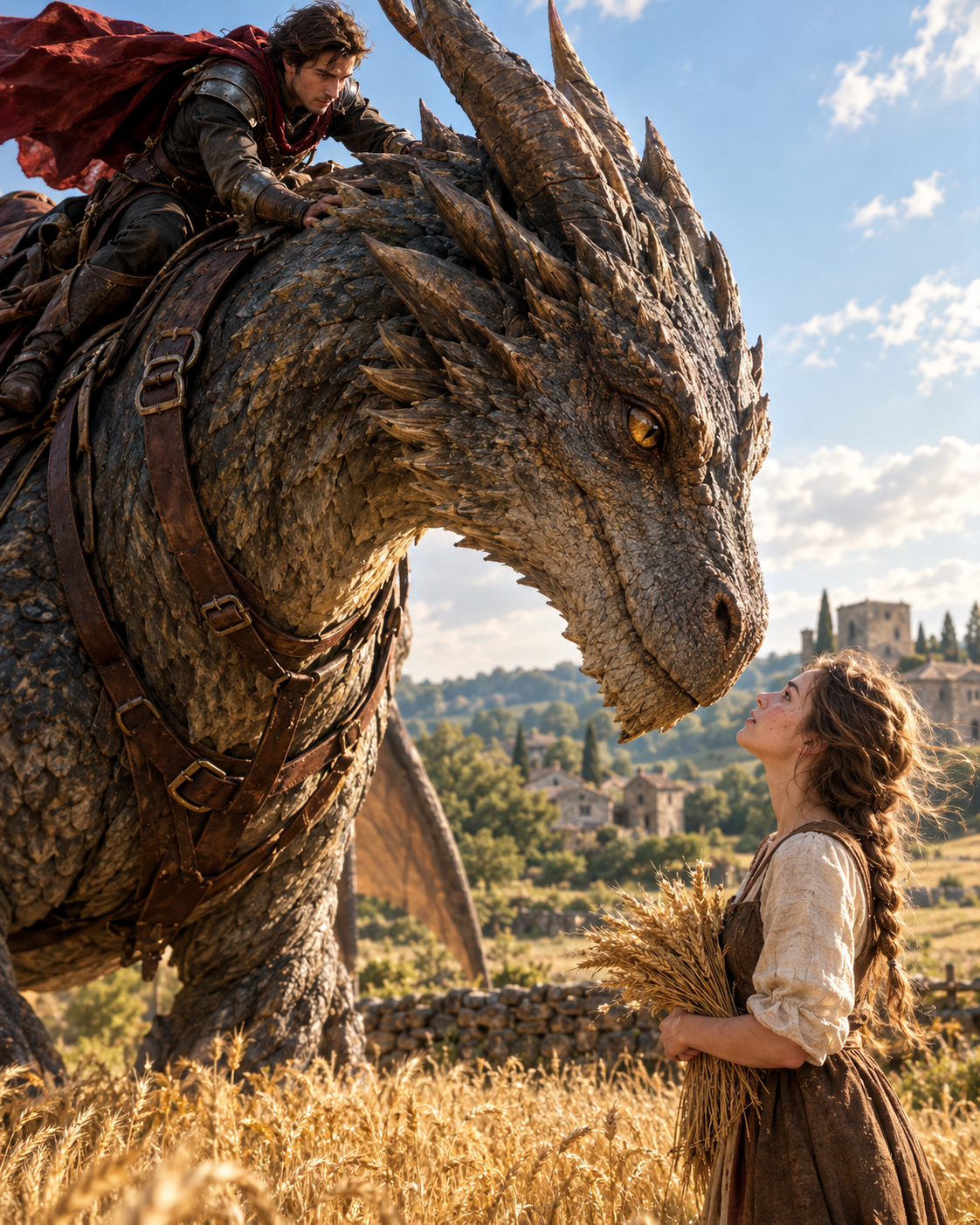
My father gave me a strange look.
“Dead now. But he lived for twenty-six years.”
I pushed back from the table.
“Why didn’t you ever tell me?”
“Because every person who tried to reopen the story disappeared from the racing world.”
“That’s not an answer.”
“It is the only one I have.”
“No.”
My voice cracked.
“You were afraid.”
He looked at me.
“Yes.”
The honesty hurt more than a lie would have.
“I was afraid they would come for you.”
I closed the ledger.
“They already did.”
My father frowned.
“I don’t mean the contract.”
“I mean everything that happened at Kingsford.”
He didn’t understand.
Then I told him about Isolda.
About the page.
About the scratched-out name.
And about the way she had looked at the mountains when she said the first rider had died trying to prove the current existed.
When I finished, my father sat very still.
“She knows,” he whispered.
“Yes.”
“Then she knows more than she told you.”
That sentence followed me into the night.
Three days later, Isolda Howerin came to Cold Harbor.
She arrived alone.
No carriage.
No guards.
No Howerin banners.
Just a dark coat, mud on her boots, and the expression of someone who had finally run out of reasons to lie.
Cal was repairing Quill’s saddle when she entered the barn.
He immediately stepped between us.
Isolda stopped.
“I didn’t come for the dragon.”
“Good,” Cal said.
“I came for her.”
His jaw tightened.
I walked forward.
“What do you want?”
She looked at me.
“To show you something.”
“Why should I trust you?”
“You shouldn’t.”
That answer surprised all three of us.
Isolda reached inside her coat.
Cal’s hand moved toward the knife at his belt.
She slowly pulled out a small metal cylinder.
She placed it on the table.
I recognized the Howerin seal.
“What’s inside?”
“The original race map.”
I stared at her.
“The one from Elias’s flight.”
She nodded.
“Why do you have it?”
“Because my grandfather kept it hidden.”
“Your grandfather?”
“The man who erased Elias’s name.”
The barn became silent.
Even Quill stopped moving.
Isolda’s face had gone pale.
“My family built its reputation on the Beacon Run. For decades, we claimed our champions understood the mountain better than anyone. That was a lie.”
She opened the cylinder.
Inside was a tightly rolled sheet of treated parchment.
I spread it across the table.
The mountains were drawn in dark ink.
The old route.
The ridges.
The ravines.
And there, between two lines of black stone, was the notch.
But there was something else.
A second current.
A narrow line drawn far beyond the first.
It rose from the valley, crossed the northern cliffs, and disappeared into a blank area marked simply:
THE OLD SKY.
“What is this?”
Isolda looked at me.
“The route Elias discovered after the notch.”
My blood ran cold.
“There was another?”
“He believed the notch wasn’t the end. It was only the first doorway.”
“Where does this current go?”
“To the eastern mountains.”
“That makes no sense.”
“It didn’t to my grandfather either.”
She tapped the map.
“Until he found Elias’s notes.”
I looked at her.
“What notes?”
“Pages missing from the ledger.”
“Where are they?”
“Somewhere inside the old Howerin tower.”
Cal stepped forward.
“Why are you telling us this now?”
“Because the tower is going to be demolished.”
My head snapped toward her.
“When?”
“Tomorrow.”
The old racing council had ordered Cold Harbor’s original signal tower and surrounding structures demolished after the Beacon Run.
They claimed the stone was unsafe.
The land would be converted into a new training facility.
But I knew what that meant.
Records would disappear.
The last physical evidence of Elias’s discovery would be gone.
I rolled the map.
“We go tonight.”
Isolda nodded.
Cal looked at me.
“You’re sure?”
“No.”
I smiled despite myself.
“But I’m going anyway.”
We rode through the rain.
The old Howerin tower stood beyond the northern ridge, abandoned since the new signal system had been installed. Lightning flashed behind its broken windows.
The door was locked.
Isolda produced a key.
Inside, the air smelled of wet stone and old paper.
We climbed three floors.
At the top, the tower was almost completely dark.
Then Quill, who had followed us, suddenly stopped.
His ears lifted.
I listened.
Nothing.
Then I felt it.
A faint pressure against my face.
Wind.
Inside the tower.
I walked toward the far wall.
There was a crack between two stones.
Cold air poured through it.
“There,” I whispered.
We pulled the stone free.
Behind it was a narrow chamber.
Inside sat a wooden box.
The lock had already been broken.
Someone had been there before us.
I opened it.
There were dozens of pages.
Weather observations.
Flight sketches.
Names.
Dates.
And one final letter.
I recognized Elias’s handwriting immediately.
My hands trembled as I read.
If anyone finds this, understand this first:
The mountain is not dangerous because it is unpredictable.
It is dangerous because people who claim to understand it have taught others to fear what they cannot control.
The notch is real.
But it is not a shortcut.
It is a passage.
The second current is real as well.
It leads beyond the eastern ridge.
And if I am right, it connects the entire mountain range.
A rider who learns to read it could cross the mountains without fighting them.
But there is a warning.
The current changes when too many dragons enter it together.
The more riders try to dominate the wind, the more violently the wind responds.
The sky cannot be conquered.
It can only be understood.
Below the letter was a final sentence.
If they erase my name, let them.
A name is only ink.
Knowledge survives when someone is brave enough to use it for others.
I lowered the page.
Nobody spoke.
Then we heard footsteps below.
Not one person.
Several.
Isolda’s face changed.
“They followed us.”
“How many?”
“Enough.”
Cal extinguished the lamp.
We heard the tower door slam open.
Voices echoed up the stairs.
“Search every floor!”
I looked at the map.
Then at the narrow opening in the wall.
Then toward the window.
The wind outside was rising.
A terrible idea entered my mind.
Cal saw it immediately.
“No.”
“I haven’t said anything.”
“You don’t have to.”
“There’s a current outside.”
“It isn’t the Run.”
“Exactly.”
He grabbed my arm.
“You don’t know where it goes.”
I looked at him.
“Neither did Elias.”
“That isn’t comforting.”
“It wasn’t supposed to be.”
The footsteps were getting closer.
Isolda picked up the box.
“We have to move.”
We climbed through the opening and emerged onto a narrow ledge outside the tower.
Rain struck my face.
Below us, the mountain dropped into darkness.
Quill stood nearby, restless.
Cal mounted.
I climbed behind him.
“Hold on.”
The men burst through the tower window.
Someone shouted.
An arrow struck the stone beside my head.
Cal kicked Quill forward.
The dragon jumped.
For one terrifying second, there was nothing beneath us.
Then the wind caught.
Not the wind below.
Something stronger.
Something hidden.
Quill’s wings opened.
And instead of falling, we rose.
The current carried us toward the eastern ridge.
Cal looked back at me.
I could see fear in his eyes.
But underneath it was something else.
Trust.
The mountain opened before us.
We flew.
For the first time, I understood Elias’s words.
The notch was not a shortcut.
It was a passage.
The currents connected.
One flowed into another, forming a vast invisible river through the mountains.
Quill followed it instinctively.
The injured wing that had made other riders reject him no longer mattered.
He wasn’t fighting the air.
He was listening to it.
Then the current changed.
The dragon dropped sharply.
Cal pulled the reins.
“What’s happening?”
I looked ahead.
A storm was forming beyond the ridge.
Not ordinary fog.
A wall of dark clouds was moving directly toward us.
The old current was collapsing.
“Turn left!”
Cal did.
Too late.
A violent gust struck Quill.
His injured wing buckled.
He screamed.
The dragon rolled.
The world disappeared into rain and stone.
I saw the ground rushing toward us.
“Quill!”
Cal fought the reins.
The dragon couldn’t recover.
Then I remembered the kites.
Not the racing maps.
Not the ledgers.
The kites I had built from flour sacks.
The way they trembled before a current shifted.
I looked at the rain.
The drops were moving sideways.
Then upward.
“There!”
I pointed.
“Between those cliffs!”
Cal couldn’t see it.
“Trust me!”
He pulled Quill toward the narrow gap.
For one horrible moment, nothing happened.
Then the dragon entered the current.
The force beneath us exploded upward.
Quill climbed.
Higher.
Higher.
The storm passed beneath us.
We emerged above the clouds.
And there, beyond the eastern mountains, was something none of us had ever seen.
A valley.
Green.
Wide.
Untouched.
A river wound through its center.
Dozens of wild dragons flew above it.
Not racing.
Not trained.
Not owned.
Free.
Quill circled once.
Then landed on a cliff overlooking the valley.
We sat there in silence.
Cal finally laughed.
Not because anything was funny.
Because we were alive.
Isolda arrived an hour later with the others.
She landed badly and nearly fell from her saddle.
When she saw the valley, she simply stared.
“The maps were right,” she whispered.
“No,” I said.
She looked at me.
“The maps were incomplete.”
We returned to Cold Harbor two days later.
The story could have ended there.
It didn’t.
The Howerin family tried to contain what had happened.
They couldn’t.
The old records were published.
Elias’s name was restored.
The council denied responsibility for his death, claiming the evidence was inconclusive.
Others disagreed.
There were arguments.
Investigations.
Years of accusations and counteraccusations.
Some people demanded the Howerin family be stripped of its racing privileges.
Others defended them.
I refused to take sides in those battles.
I had learned something more important.
The truth did not need a champion.
It needed witnesses.
So I opened the old farm to anyone who wanted to learn how to read the wind.
Farm children.
Stable boys.
Girls who had been told dragons were not meant for them.
Old riders.
Young riders.
People who had never touched a saddle.
We taught them all the same thing.
Before you command a dragon, learn to listen.
Before you call a current dangerous, learn where it comes from.
Before you decide someone knows nothing, ask what they have been watching while you were busy talking.
Cal became an instructor.
Quill became a legend.
Not because he won the Beacon Run.
But because he taught riders that an injured dragon was not necessarily a useless one.
Sometimes the thing others considered a weakness was simply an adaptation they had never understood.
As for Isolda, she disappeared from racing for nearly a year.
When she returned, she brought the original Howerin records and placed them in the public archive.
She never apologized publicly.
She never asked for forgiveness.
But she signed one document that changed everything.
From that day forward, all major racing routes had to publish their wind maps.
No family could own a current.
No rider could be punished for reporting a dangerous condition.
The sky belonged to everyone.
Years passed.
Cold Harbor changed.
The old racing tower was never demolished.
Instead, we turned it into a school.
On the highest floor, I hung Elias’s letter beside my first flour-sack kite.
The paper had faded.
The kite was torn.
But I wanted them together.
One represented the person who discovered the truth.
The other represented the person who finally understood it.
Sometimes visitors asked me whether I regretted leaving Kingsford.
I always smiled.
Kingsford had offered me a place in a world that already existed.
Cold Harbor gave me the chance to build one that didn’t.
There was a difference.
One evening, many years after the Beacon Run, I climbed the tower alone.
The sun was setting beyond the mountains.
Quill had died the previous winter.
He was old enough that even Cal admitted he had earned the right to rest.
His saddle hung in the barn.
His stall remained empty.
I still missed him.
The wind moved through the tower window.
I closed my eyes.
For a moment, I could almost hear his wings.
Then I noticed something on the floor.
A small envelope.
No seal.
No name.
Inside was a single piece of paper.
Three words were written across it.
The eastern route exists.
I stared at the message.
Below the words was a map.
Not of the valley we had discovered.
Something farther east.
Much farther.
There were mountains beyond mountains.
Currents marked in red.
And at the edge of the page, a symbol I had never seen before.
I should have felt afraid.
Instead, I laughed.
Not because I wanted another adventure.
But because I finally understood the lesson Elias had tried to leave behind.
The dangerous thing was never the wind.
It was believing that knowledge belonged to the people who had power.
I folded the map.
Tomorrow, I would show it to the students.
Not because I knew where the route led.
Not because I wanted to be the first to fly it.
But because no discovery should have to hide in the dark just because someone is afraid of what it might change.
I walked to the window.
Below me, dozens of young riders were preparing their dragons for the evening flight.
Some were rich.
Some were poor.
Some had famous family names.
Some had none.
They all looked up when the first wind bell rang.
For a moment, nobody moved.
They waited.
They listened.
Then the youngest rider raised her hand.
“What do we do now?”
I smiled.
I pointed toward the mountains.
“First,” I said, “we learn the wind.”
And together, they looked toward the open sky.
Because the greatest freedom was never the ability to fly wherever you wanted.
It was knowing that no one had the right to tell you that the sky belonged only to them.
And somewhere beyond the eastern mountains, another current was waiting.
Not to be conquered.
Not to be owned.
Only to be understood.
The eastern route existed.
For three days, I told no one.
Not Cal.
Not Isolda.
Not even my father.
I kept the map folded beneath the loose floorboard in my bedroom, where the old house creaked around it whenever the night wind came down from the mountains.
I told myself I was waiting for the right moment.
The truth was simpler.
I was afraid.
Not of the mountains.
Not anymore.
I was afraid of becoming the person Elias had been.
The person who discovered something extraordinary and believed that proving it mattered more than surviving it.
On the fourth morning, I took the map to Cal.
He was sitting outside the barn, repairing Quill’s old saddle even though Quill had been gone for years.
He looked at the paper.
Then at me.
Then back at the paper.
“You found this where?”
“In the tower.”
“Who left it?”
“I don’t know.”
“Does Isolda know?”
“No.”
Cal sighed.
“That means we’re probably about to do something stupid.”
I folded the map.
“Probably.”
He smiled.
“You haven’t changed.”
“Neither have you.”
“No. I’m just older now.”
“Older doesn’t mean wiser.”
“Unfortunately, I’ve discovered that.”
We laughed.
Then the wind changed.
Cal’s smile disappeared.
I felt it too.
A strange pressure rolled through the valley.
The weather kites hanging from the barn rafters began to tremble.
One lifted.
Then another.
Their strings pulled toward the eastern mountains.
Cal stood.
“That isn’t normal.”
“No.”
The largest kite suddenly snapped its string.
It shot into the air.
I watched it climb higher than any kite I had ever made.
Then it vanished into the clouds.
I looked at the map.
The red line marking the eastern current seemed almost to glow beneath the morning light.
“We’re going,” I said.
Cal stared at me.
“You’re serious.”
“Yes.”
“To find another current?”
“To find out why someone wanted us to find the map.”
That changed his expression.
Because he understood what I had finally realized.
The message hadn’t been an invitation.
It had been a warning.
We left before sunset.
This time, we took no racing equipment.
No banners.
No official dragon harnesses.
Only food, rope, weather instruments, and the oldest maps we could find.
Three young riders insisted on coming with us.
I refused.
They argued.
I refused again.
Then the youngest, Mara, looked me straight in the eye.
“You taught us that the sky belongs to everyone.”
I opened my mouth.
She continued.
“You can’t teach us that and then decide we’re too young to see it.”
I hated how familiar those words sounded.
They were my own words from another lifetime.
So we went together.
Five riders.
Five dragons.
One map.
The first two days were easy.
The mountain currents carried us east.
We crossed valleys I had never seen and cliffs where no human road had ever been built.
On the third morning, the sky turned black.
Not with ordinary storm clouds.
With dragons.
Hundreds of them.
Wild dragons filled the eastern sky.
Some were enormous.
Some were small enough to perch on trees.
Some had wings unlike any breed recorded in the racing books.
They moved as one living cloud.
Mara whispered, “What are they doing?”
I watched them carefully.
“They’re following the current.”
“Where?”
I looked ahead.
Toward a mountain that appeared to have no opening.
“Into the stone.”
We followed.
The mountain split at the last moment.
A narrow canyon appeared.
The wind accelerated.
Our dragons screamed.
“Slow down!” I shouted.
But the current had already caught us.
We were pulled forward.
Then the canyon opened.
And we saw it.
A vast circular valley hidden inside the mountain range.
At its center stood a stone structure older than any tower at Cold Harbor.
Its walls were covered in carvings.
Dragons.
Winds.
Riders.
And hundreds of names.
I landed on a stone platform.
The others followed.
We dismounted.
I walked toward the wall.
My breath stopped.
There was Elias’s name.
Not scratched out.
Not hidden.
Carved deeply into the stone.
But it wasn’t alone.
Below it were dozens of names.
Riders from centuries ago.
People who had discovered the same currents.
People who had tried to protect them.
People whose stories had disappeared from every official record.
Mara touched one of the carvings.
“Why would they erase all of this?”
“Because someone was afraid,” I said.
“Of what?”
I looked around the valley.
“Of losing control.”
Then we heard a voice.
“You finally came.”
We turned.
An old woman stood at the far end of the chamber.
She was holding a lantern.
Her hair was completely white.
Her clothes were patched and worn.
But the symbol around her neck was unmistakable.
Howerin.
Cal stepped forward.
“Who are you?”
The woman smiled.
“My name is Elian Howerin.”
Cal froze.
“Isolda’s grandmother?”
“Yes.”
“She died twenty years ago.”
The woman laughed softly.
“No.”
The sound of wings filled the cavern.
A dragon landed behind her.
Ancient.
Scarred.
Black as the night.
Elian placed a hand against its neck.
“Isolda’s grandmother died twenty years ago,” she said.
“I did not.”
I stared at her.
“You’ve been hiding here.”
“For forty-one years.”
“Why?”
“Because I discovered what the racing families had done.”
She led us toward the center of the chamber.
There was a circular stone table.
On it lay dozens of maps.
“The currents are connected,” she said.
“They cross the entire continent. Long before racing existed, people used them to travel safely through the mountains.”
“Then why hide them?”
“Because people discovered that whoever controlled the currents could control trade.”
She pointed to a map.
“Food.”
Another.
“Medicine.”
Another.
“Military routes.”
Her finger moved across the final map.
“Entire cities.”
I understood.
The currents were not simply useful for dragon racing.
They were the invisible roads of the sky.
Whoever controlled them controlled everything that moved through the mountains.
“Howerin found them,” I said.
“No.”
She shook her head.
“Howerin inherited them.”
“From whom?”
“From people who knew better.”
The answer made my stomach tighten.
“Elian,” I said quietly, “why did you send the map?”
“I didn’t.”
She looked at me.
“I haven’t left this valley in decades.”
My heart dropped.
“Then who did?”
The old woman pointed toward the entrance.
We turned.
Isolda stood there.
She was soaked from the rain.
Her face was pale.
Behind her were six riders wearing Howerin colors.
Cal’s hand moved toward his weapon.
Isolda raised both hands.
“I’m not here to fight.”
“You followed us,” I said.
“Yes.”
“Why?”
“Because someone stole the map from my family archives.”
I stared at her.
“The map was yours?”
“No.”
She shook her head.
“It belonged to Elias.”
“Then why was it in your archive?”
“Because my grandfather spent his entire life trying to find the rest of it.”
Elian closed her eyes.
“Of course he did.”
One of the riders behind Isolda stepped forward.
“Lady Howerin, we should leave.”
She turned.
“No.”
The man frowned.
“You don’t understand what is at stake.”
“I understand perfectly.”
He reached for his sword.
Isolda moved faster.
She struck his wrist.
The weapon fell.
The other riders drew theirs.
Everything happened at once.
Cal pushed Mara behind him.
The dragons screamed.
The cavern filled with echoes.
I grabbed the nearest lantern and threw it against the floor.
Darkness swallowed the chamber.
Someone shouted.
A dragon beat its wings.
Stone cracked.
Then the wind exploded through the cavern.
The hidden current had changed.
I knew that sound.
It was the same sound I had heard before Quill nearly died.
The current was collapsing.
“Everyone outside!” I shouted.
Nobody moved.
“NOW!”
We ran.
The riders stumbled behind us.
The cavern shook.
A massive crack split the stone floor.
One of the dragons fell through.
Its rider screamed.
Cal turned back.
I grabbed him.
“No!”
“We can’t leave him!”
“The mountain is collapsing!”
He looked at me.
Then at the rider.
He made his choice.
He ran back.
Together they pulled the man away from the widening crack.
For one second, I thought we would all die there.
Then I saw it.
A narrow stream of air rising through the collapsing floor.
The current.
Not the old one.
A new one.
Created by the breaking mountain.
I understood immediately.
“Cal!”
He looked at me.
“Fly straight up!”
“What?”
“Trust me!”
We mounted.
Every dragon in the cavern launched.
The wind caught us.
We shot upward through a shaft of broken stone.
The mountain opened above us.
Rain hit my face.
The entire valley was collapsing behind us.
For several seconds, all I could see was sky.
Then I looked down.
The ancient chamber disappeared beneath tons of stone.
The secret was buried again.
But this time, it was not buried by men.
It was buried by the mountain itself.
We landed miles away.
Nobody spoke.
Then Isolda walked toward me.
“You saved my rider.”
I shook my head.
“We all did.”
She looked toward the mountains.
“My family spent generations trying to own what could never belong to anyone.”
“Yes.”
“I don’t know how to fix that.”
I looked at the young riders beside us.
“You start by telling the truth.”
Months later, the full records were released.
Not just the Howerin records.
Everything.
The names.
The maps.
The accounts of the riders who had died.
The evidence of manipulated routes.
The warnings that had been ignored.
The knowledge that had been hidden.
There was outrage.
There were investigations.
There were families who learned for the first time why their ancestors had never returned from certain races.
There were also people who wanted the information locked away again.
They argued that the currents were too dangerous.
That ordinary people couldn’t be trusted with them.
That only experts should decide who could fly where.
I had heard those words before.
They were always spoken by people who believed they were protecting others.
Sometimes they were.
Sometimes they were protecting themselves.
So we created something different.
The Sky Archive.
Every map was copied.
Every dangerous current was documented.
Every route was marked with warnings.
No single family owned the information.
No racing guild controlled it.
No government could erase it without leaving a record.
And every child who came to Cold Harbor learned the same lesson.
Knowledge was not made safer by hiding it.
It was made safer by teaching people how to use it responsibly.
Years later, when I was old enough to have gray in my hair, I returned to the tower one final time.
The school below was quiet.
The young riders had gone home.
The weather kites hung from the ceiling.
Elias’s letter remained on the wall.
Beside it hung Quill’s old saddle.
I placed the eastern map between them.
For a long time, I simply stood there.
Then I heard footsteps.
Mara entered.
She was no longer a child.
She had become one of the finest wind readers in the northern valleys.
“You’re leaving,” she said.
“Yes.”
“Where?”
I smiled.
“Nowhere.”
She frowned.
“Then why does everyone say you’re leaving?”
“Because I won’t be teaching here anymore.”
She looked disappointed.
“What will you do?”
I opened the window.
The evening wind entered the tower.
“I’ll travel.”
“To where?”
I looked toward the mountains.
“Wherever the wind needs someone to listen.”
Mara laughed.
“That sounds like something Elias would say.”
“Maybe.”
I handed her the key to the archive.
She stared at it.
“This is yours.”
“No.”
I closed her fingers around it.
“It belongs to the next person.”
She looked toward the wall.
“Are you afraid?”
I thought about the first time I had fallen from the race tower.
The laughter.
The mud.
The humiliation.
The years I had spent believing I needed someone else’s permission to trust what I knew.
Then I thought about Quill disappearing into the fog.
About Elias.
About the hidden valley.
About every name carved into the ancient stone.
“Yes,” I said.
Mara smiled.
“Good.”
I laughed.
“Why is that good?”
“Because you taught us that being afraid isn’t the same as turning back.”
I looked at her.
And for the first time, I understood that the story had never really been about me.
It had never been about winning a race.
It had never been about defeating Howerin.
It had never even been about the hidden currents.
It was about what happens when people confuse ownership with understanding.
A person can own a map.
They cannot own the wind.
A person can erase a name.
They cannot erase the truth forever.
A person can close a door.
But sooner or later, someone will wonder what is on the other side.
I stepped outside the tower.
The mountains were glowing beneath the last light of evening.
Above them, a flock of young dragons rose into the air.
They climbed together.
Then separated.
Each found its own current.
Each followed its own path.
None of them needed to know where the others were going.
They only needed to listen.
I watched until the last dragon disappeared beyond the ridge.
Then I heard something behind me.
A faint flutter.
I turned.
One of my oldest weather kites had broken loose from the rafters.
It rose through the open window.
The string slipped from my fingers.
The kite climbed higher and higher.
For a moment, I almost chased it.
Then I stopped.
I let it go.
Because after all those years, I finally understood.
Some things are not meant to be held.
Some things are not meant to be owned.
Some things are meant to be released into the world so that whoever comes next can discover them for themselves.
The kite vanished into the evening sky.
And somewhere beyond the mountains, the wind changed.
Not violently.
Not suddenly.
Just enough to remind me that it was still moving.
Still waiting.
Still free.
I smiled.
Then I walked down from the tower and closed the door behind me.
The story of Elias Dunore had once been buried because powerful people were afraid of what the truth would cost them.
My family had spent generations carrying the silence.
But silence was never the same as peace.
And truth was never meant to belong to the person brave enough to discover it first.
It belonged to everyone brave enough to pass it on.
That was the lesson I left in the archive.
That was the lesson I taught every rider who came after me.
And that was the final thing I learned from the wind:
You do not become free by finding a sky with no boundaries.
You become free when you stop believing that someone else has the right to decide how high you are allowed to fly.
Then I walked toward home.
Behind me, the tower stood against the darkening mountains.
Its windows glowed one by one.
Inside, another generation was already learning to read the wind.
And this time, no one was going to erase their names.
THE END.