They laughed when I dropped my broken saddle in Red Hollow’s street, but Nathaniel’s cold stare hurt worse—because the saddle had been sabotaged before I arrived.
The first sentence made my blood run cold.
Nathaniel Carter,
If you are reading this, then either I have failed to reach you myself, or the truth has arrived too late.
I read it twice before I understood what I was seeing.
My father had written to Nathaniel’s father.
Not once.
Not casually.
The letter was six pages long.
I sat on the floor of our bedroom with the toolbox open beside me, the lamp trembling slightly in my hand.
Nathaniel had gone to check the northern fence with Tommy.
I should have waited for him.
Instead, I kept reading.
Your eastern pasture was never merely land, my father had written. It was collateral.
Years ago, when the Carter ranch nearly failed after the drought, you borrowed money from a private lender. The agreement was never filed through the bank. You believed you paid it in full.
You did not.
My stomach tightened.
The lender was Harrison Blake’s father.
I stopped breathing.
For a long moment, all I could hear was the wind pressing against the house.
Then I forced myself to continue.
Blake’s father had apparently loaned Nathaniel’s father money more than twenty years earlier.
The debt had been secured against livestock, equipment, and—if the debt went unpaid—the eastern pasture.
But my father had discovered something while repairing tack for both families.
The final payment had been made.
He had seen the receipt.
More than that, Nathaniel’s father had given him the receipt for safekeeping after becoming suspicious that Blake’s father intended to destroy the record.
The next line felt like a hand closing around my throat.
I kept it because he feared for his life.
The original receipt is hidden where leather protects paper better than any locked drawer.
If the Blakes ever come for the Carter land, look inside the oldest working saddle I made for your family.
I stood so quickly the toolbox tipped over.
Metal tools scattered across the floor.
The oldest saddle.
I knew every saddle in our barn.
I knew which ones Nathaniel had bought, which ones had belonged to his father, which ones had been patched so many times they carried more new leather than old.
And I knew one saddle older than all the others.
The broken one.
The saddle I had repaired the morning Red Hollow stopped laughing at me.
My hands went cold.
I ran.
I did not take a coat.
I did not wait for Nathaniel.
The night had turned sharp and dry, and the barn doors groaned when I pulled them open.
The saddle hung near the back wall.
I lowered it onto the workbench.
For months, I had believed its torn leather and cut straps were part of Blake’s campaign to ruin us.
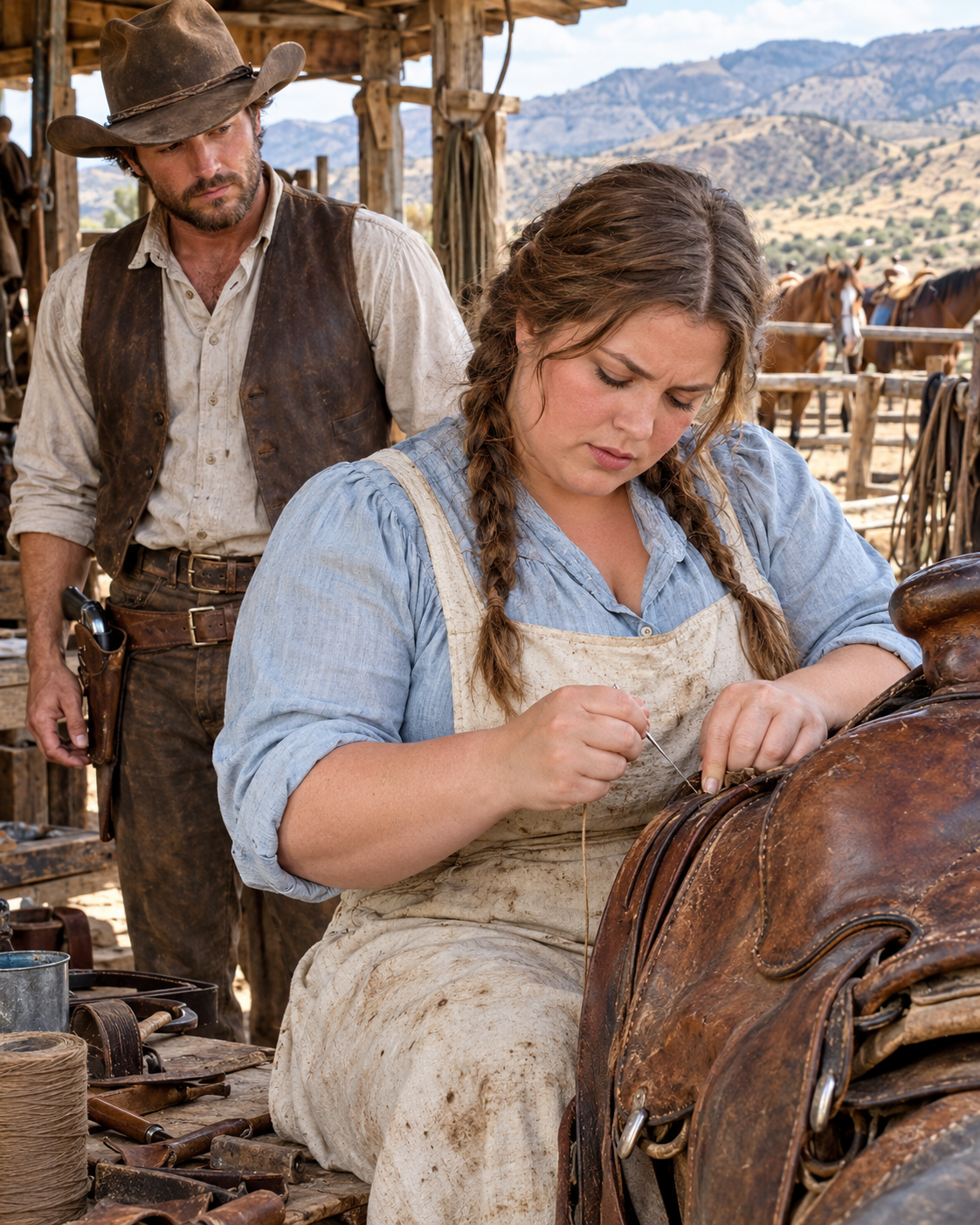
Now I stared at the stitching along the inner skirt.
My father had taught me that stitch.
Three short.
One long.
Three short.
One long.
It was not decorative.
It was a marker.
He used it only when something had been reinforced from the inside.
I grabbed a knife and carefully opened the seam.
A strip of leather folded away.
Inside was a narrow oilskin packet.
I had barely touched it when a voice came from behind me.
“I wondered when you’d find that.”
I turned.
Harrison Blake stood in the barn doorway.
He was alone.
At least, he appeared to be.
His coat was black, his hat low, his expression calm.
Too calm.
I slipped the packet into my apron.
“You make a habit of walking into other people’s barns?”
He smiled.
“I make a habit of protecting what’s mine.”
“The court already decided what was yours.”
“The court decided the boundary.”
His eyes moved toward my apron.
“It did not decide the debt.”
I said nothing.
That told him enough.
Blake stepped inside.
“You found the letter.”
I felt something colder than fear.
Recognition.
“You knew about it.”
“I knew your father had hidden something.”
“That’s why the saddle was cut.”
His smile faded.
“I had men search it. They were careless.”
“They nearly killed someone by cutting the load strap.”
“Nobody died.”
The casual way he said it frightened me more than anger would have.
I moved sideways until the workbench stood between us.
Blake watched me.
“You should give me the packet.”
“No.”
“You don’t know what is in it.”
“I know enough.”
He sighed.
“Your father was a stubborn man.”
I went still.
“You knew my father?”
“Oh, yes.”
Blake removed his gloves slowly.
“He repaired equipment for half this territory. Heard things. Saw things. People forget craftsmen are in the room.”
My father had said that once.
A good worker learns more from silence than a fool learns from questions.
“What happened to him?” I asked.
Blake’s eyes sharpened.
“He died.”
“I know he died.”
“Then why ask?”
Because suddenly I was not certain his death had been natural.
My father had become ill quickly.
Fever, the doctor had said.
An infection.
Within eight days, the strongest man I knew was gone.
At the time, grief had swallowed every question.
Now the questions returned with teeth.
Blake saw them on my face.
He smiled again.
That was his mistake.
“What did you do?”
His expression changed.
Not much.
But enough.
I reached for the heavy shears on the bench.
Blake moved first.
He swept around the table, caught my wrist, and twisted.
Pain shot through my arm.
The shears hit the floor.
“You are becoming inconvenient,” he whispered.
I drove my shoulder into his chest.
He stumbled.
I tore free and ran for the door.
A second man stepped from the darkness outside.
Then a third.
Blake had not come alone.
One caught me by the arms.
I kicked backward, connected with a shin, heard a curse, but the other man grabbed my apron.
The oilskin packet fell.
Blake picked it up.
“Thank you.”
Then he struck me.
Not hard enough to knock me unconscious.
Hard enough to put me on my knees.
The men released me.
Blake opened the packet.
His eyes moved across the paper.
For the first time, confidence left his face.
I smiled through the blood in my mouth.
“Paid in full.”
His jaw tightened.
The receipt bore the signature of Blake’s father.
Payment completed.
Debt satisfied.
No claim remaining.
Blake folded the paper once.
Then twice.
Then he carried it toward the lantern.
“No,” I said.
He held it over the flame.
I lunged.
One of his men caught me.
The edge of the receipt began to darken.
Then a rifle fired.
The lantern exploded beside Blake’s hand.
Glass shattered.
Darkness swallowed the barn.
Someone yelled.
A horse screamed.
And Nathaniel’s voice came out of the black.
“Touch her again and the next bullet won’t hit glass.”
No one moved.
Then Tommy lit another lantern from outside.
Nathaniel stood in the doorway with his rifle raised.
Behind him were four ranchers from town.
Men who had once laughed when I stepped from the wagon.
The old rancher who had tested my first repaired saddle stood among them holding a shotgun.
Blake slowly lifted his hands.
The receipt lay on the ground.
One corner was burned.
The signature remained.
Nathaniel crossed the barn and picked it up.
He looked at me before he looked at Blake.
“Are you hurt?”
“I’m standing.”
Barely, but I was standing.
His eyes moved to the blood on my lip.
Something changed in his face.
I had seen Nathaniel angry before.
This was different.
This was a man finally understanding that patience and surrender were not the same thing.
“You came onto my land,” he said.
Blake gave a bitter laugh.
“Your land?”
Nathaniel held up the receipt.
“Mine.”
“That paper proves nothing.”
“It proves your father was paid.”
“It proves a signature.”
“It proves motive,” I said.
Everyone looked at me.
I wiped blood from my mouth.
“It proves why you forged the deed. Why you sabotaged the ranch. Why you searched the saddle.”
Blake’s eyes narrowed.
“You cannot prove sabotage.”
Tommy stepped forward.
“I can.”
Nathaniel looked at him.
Tommy swallowed hard.
“I saw one of his men near the western feed shed two months ago.”
Blake scoffed.
“And you waited until now?”
“I was scared.”
Tommy’s voice shook, but he did not step back.
“He told me if I talked, he’d say I helped him. Said nobody would believe some hired boy over Harrison Blake.”
The old rancher beside Nathaniel spat into the dirt.
“I believe him.”
Another man nodded.
Then another.
Blake looked around the barn.
For the first time, he seemed to realize something more dangerous than evidence had formed against him.
Witnesses.
People willing to speak.
He had survived for years because everyone feared standing alone.
Now nobody was alone.
Blake turned toward the door.
Nathaniel leveled the rifle.
“You’re staying.”
“On what charge?”
A voice came from the yard.
“Several, I expect.”
The county sheriff stepped into view.
He had arrived behind the others with two deputies.
Blake’s face went flat.
The sheriff looked at the receipt, the broken lantern, my bleeding mouth, and the men around us.
“Seems like I’ve got plenty to hear.”
Blake laughed once.
No humor.
“You think this changes anything?”
He looked at Nathaniel.
“Men like you lose eventually.”
Then he looked at me.
“And women like you get tired.”
I met his eyes.
“Maybe.”
I stepped closer.
“But tired people can still tell the truth.”
The sheriff took him away before midnight.
His men went with him.
That should have been the end.
It was not.
Truth rarely ends trouble.
Usually, it begins a different kind.
The investigation uncovered years of forged contracts, false debts, stolen cattle, and intimidation.
Blake had used his father’s old lending records to pressure three neighboring families into selling land far below its value.
Two families had left Red Hollow believing they had failed.
They had not failed.
They had been cheated.
Nathaniel and I spent weeks going through records with the sheriff and county clerk.
I recognized altered stitching in equipment that had been used to create “accidents.”
Tommy identified two men who had moved stolen feed.
The ranchers who once stayed silent began talking.
One testimony became five.
Five became twelve.
Fear did not disappear all at once.
It simply discovered it was outnumbered.
Then the sheriff came to our house one afternoon holding a small envelope.
“This was found in Blake’s office.”
Inside was a note.
My father’s name was written at the top.
Beneath it were four words.
Stop him from testifying.
I sat down.
Nathaniel read it over my shoulder.
Neither of us spoke.
The sheriff removed his hat.
“We cannot prove exactly what happened to your father.”
I stared at the note.
“But you think Blake was involved.”
“I think his father started something Harrison learned to continue.”
The room became painfully small.
All those years, I had believed my father’s death was one of those cruel events that had no reason behind it.
Now I had a reason.
I hated it.
Nathaniel knelt beside my chair.
“You don’t have to carry this tonight.”
I almost laughed.
Months earlier, he would have said nothing.
He would have tried to solve my grief like a broken fence.
Now he understood there were things a person could not repair.
Only endure.
I turned the note over.
On the back was a date.
Three days before my father became ill.
I closed my eyes.
“I spent years thinking I hadn’t learned enough from him.”
Nathaniel waited.
“I kept remembering everything I hadn’t asked. Every pattern I forgot. Every story I only half listened to.”
I pressed my palm against the letter in my pocket.
“But he kept teaching me anyway.”
Nathaniel looked toward the toolbox.
“Through leather.”
“Through what he knew would last.”
That night, we buried nothing.
I had first thought I would burn the letter, the receipt, the note from Blake’s office.
I wanted the past gone.
Instead, Nathaniel built a small wooden chest.
We placed every document inside.
Not because we wanted to live inside old pain.
Because someone had tried to erase the truth once.
We would not help them do it again.
Blake’s trial came in the spring.
He was convicted of fraud, property theft, intimidation, assault, and conspiracy tied to several incidents across the county.
The court could not prove he had caused my father’s death.
That wound remained without a clean answer.
For a while, I hated that most.
I wanted every injustice measured.
Every wrong named.
Every guilty man punished for every exact thing he had done.
Life does not promise that.
What it gives us, sometimes, is enough truth to stop a lie from surviving.
That had to matter.
The Carter Ranch changed after that.
Not only because the debt was gone.
Not only because our cattle grew strong or the barn roof was finally repaired.
It changed because Nathaniel stopped treating survival like a private duty.
He hired two men from families Blake had cheated.
Tommy became foreman before his twenty-second birthday.
He protested.
Nathaniel ignored him.
“You’re already doing the work,” he said.
“Now you’ll get the pay.”
I converted the old storage shed beside the barn into a leather workshop.
At first, I repaired saddles.
Then harnesses.
Then wagon straps.
Then ranchers started asking me to teach their sons.
One afternoon, a widow named Margaret Hale brought her daughter instead.
The girl was sixteen, quiet, broad-shouldered, and uncomfortable in her own body.
I recognized the way she held herself.
Trying to take up less space.
“What do you want me to teach her?” I asked.
Margaret hesitated.
“Whatever you’d teach a boy.”
I handed the girl a strip of leather.
“Good answer.”
More girls came after that.
Then boys.
Then grown men who pretended they were only there to watch.
I taught them all the same thing.
Measure before cutting.
Reinforce before strain.
Never hide weak work under decoration.
And respect the thing expected to carry weight.
Years passed.
Red Hollow grew.
The feed store expanded.
The road through town became busy enough that strangers started stopping overnight.
Some had heard the story of Harrison Blake.
Most had heard some version of me.
The large mail-order bride who saved a ranch.
I disliked that version.
It was too neat.
I had not saved the ranch alone.
Nathaniel had stayed when selling would have been easier.
Tommy had spoken when fear told him to stay quiet.
Ranchers who once mocked me had chosen to stand in a barn doorway with guns when they could have stayed home.
My father had hidden truth inside leather because he believed someone in the future might need it.
Every life that touched ours had carried part of the weight.
One evening, nearly six years after I arrived in Red Hollow, I stood outside the workshop while the sunset turned the eastern pasture gold.
Nathaniel approached with two cups of coffee.
He handed me one.
“You’ve got twelve students tomorrow.”
“Thirteen.”
“Who is the thirteenth?”
“You.”
He frowned.
“I know leather.”
“You know how to tear it.”
“I’ve improved.”
“Marginally.”
He laughed.
The sound still surprised me sometimes.
The man who had met me beside a wagon without offering his hand now reached for mine whenever he passed close enough.
Not because I needed help standing.
Because he wanted the connection.
We watched Tommy riding across the pasture, shouting instructions at two younger hands.
Nathaniel shook his head.
“He sounds like me.”
“Worse.”
“I was never that loud.”
“You were too busy being miserable.”
He looked offended.
Then he smiled.
After a moment, his expression softened.
“Do you regret coming?”
I knew what he meant.
The advertisements.
The journey.
The laughter.
The sabotage.
Blake.
The truths about my father I had never asked to know.
I looked at the ranch.
At the barn with the straight roof.
At the cattle moving slowly through grass that once barely grew.
At the workshop where voices still echoed from that afternoon’s lesson.
“No.”
Nathaniel watched me.
“Not even the beginning?”
“Especially not the beginning.”
He raised an eyebrow.
I smiled.
“If I hadn’t known what it felt like to be judged before I spoke, maybe I wouldn’t notice when someone else is being silenced.”
The next morning, our newest student arrived.
A boy of perhaps fourteen came with his uncle.
He had a twisted leg and walked with a carved wooden brace.
His uncle did all the talking.
“He won’t be much use with cattle,” the man said. “Can’t ride long. Can’t run. Thought maybe he could do something here.”
The boy stared at the ground.
I felt anger rise.
Not at the boy.
At the phrase.
Something here.
As if skill were where people were sent when strength rejected them.
I set a damaged harness on the table.
“What’s your name?”
“Elias.”
I pushed the harness toward him.
“Tell me where it will break.”
His uncle laughed.
“He doesn’t know anything about—”
“Let him look.”
Elias studied the leather.
One minute passed.
Then two.
He touched the buckle.
“No.”
He moved his finger lower.
“Here.”
“Why?”
“Because the hole’s stretched.”
I nodded.
“What else?”
He found a dry crease near the load point.
Then another.
Within ten minutes, he had noticed a flaw two grown ranch hands had missed.
I gave him a stitching awl.
His uncle frowned.
“He’ll need help.”
“No,” I said.
Elias looked at me.
I pointed toward the chair.
“He’ll need time.”
By winter, Elias could repair a working saddle better than most men in town.
Years later, he opened his own shop.
That became the lesson I remembered most.
Not every person carries weight the same way.
That does not mean they carry less.
On the tenth anniversary of my arrival in Red Hollow, Nathaniel brought the old saddle into the workshop.
The first one.
The sabotaged one.
The one with the hidden compartment.
Its leather was scarred, faded, and smooth from years of use.
“We should retire it,” he said.
I ran my fingers over my father’s three-short, one-long stitch.
“No.”
Nathaniel smiled.
“Knew you’d say that.”
We hung it above the workshop door.
Beneath it, I placed a small wooden sign.
People expected something grand.
A quote about courage.
A warning about greed.
A tribute to my father.
Instead, I carved six words.
Respect what is built to carry.
Students asked what it meant.
I never gave them the same answer.
Sometimes I told them it meant a saddle.
Sometimes a horse.
Sometimes land.
Sometimes a promise.
But when they were old enough to understand, I told them what I believed my father had really taught me.
Every person carries something.
Grief.
Shame.
Debt.
Fear.
Expectation.
The judgment of strangers.
The mistakes of parents.
The silence of people who should have spoken.
Some people carry so much that others mistake their endurance for ease.
That is why you must never laugh at the shape of another person’s burden.
And never assume strength looks the way you were taught to expect.
I had arrived in Red Hollow believing I needed to prove I was useful.
For months, I thought every repaired saddle, every saved horse, every document uncovered, every problem solved was evidence that I deserved my place.
I was wrong.
A person should not have to earn the right to be treated with dignity.
My skills did not make me worthy.
My father’s knowledge did not make me worthy.
Saving the ranch did not make me worthy.
I had been worthy before I stepped from the wagon.
Before anyone laughed.
Before Nathaniel learned to see me.
That realization changed me more than defeating Harrison Blake ever did.
Because villains are easy to recognize once they stand in front of you.
The harder enemy is the voice that remains after them.
The one that whispers you are too large.
Too strange.
Too late.
Too weak.
Too much.
Not enough.
That voice survives only if you believe it deserves the final word.
Mine did not get it.
One autumn evening, long after Red Hollow had stopped feeling like a place I had come to and become simply home, I stood beneath the old saddle while my students cleaned their tools.
A girl asked me why I had never replaced the burned edge of the receipt framed on the wall.
“Because it was damaged,” she said.
“Wouldn’t it look better repaired?”
I looked at the blackened corner.
“No.”
“Why not?”
“Because repair doesn’t always mean making something look untouched.”
She waited.
“Sometimes repair means making sure the damage cannot destroy what remains.”
Her eyes moved from the receipt to the saddle.
Then to me.
I saw understanding begin.
Outside, Nathaniel called my name.
The sun was setting beyond the eastern pasture.
The land Blake had once tried to steal rolled beneath the light, green and open and ours only in the temporary way land belongs to anyone.
I locked the workshop.
Then I paused beneath my father’s saddle and touched the leather once.
For years, I had believed he left me tools.
He had left me more.
He left me a way of seeing the world.
Find the strain.
Protect the weak point.
Do not waste material.
Do not hide damage.
And when something must carry great weight, strengthen it before the burden arrives.
I stepped outside.
Nathaniel offered me his hand.
This time, I took it.
Not because I needed him to lead me.
Not because he needed me to save him.
Because we had finally learned what my father had known all along.
The strongest things are not the ones that carry everything alone.
They are the ones built to share the load.
And together, we walked home.
And together, we walked home.
For a while, I believed that was where the story ended.
I was wrong.
Stories like ours rarely end when the villain is taken away, or when the ranch is saved, or when two people finally learn how to love each other without pride standing between them.
Sometimes the last test comes only after you begin to believe you are safe.
It came in the winter of our twelfth year together.
The cold arrived early.
By November, ice had sealed the water troughs before sunrise, and the wind came down from the northern ridge hard enough to shake the barn doors in their frames.
We had survived worse winters, but this one carried something different.
A sickness moved through the cattle.
At first, it seemed small.
One steer stopped eating.
Then three.
Then seven.
Within a week, cattle from ranches across Red Hollow were coughing, weakening, and dropping where they stood.
Fear spread faster than the illness.
Men rode into town before dawn to buy medicine.
Feed prices doubled.
Then tripled.
The railroad delayed shipments because of snow in the pass.
For the first time in years, I saw that old look return to Nathaniel’s face.
The look of a man silently calculating how much he could lose before everything disappeared.
I found him one night in the kitchen with the ranch books open.
“You are doing it again,” I said.
He did not look up.
“Doing what?”
“Trying to carry the whole ranch in your head.”
“I am looking at numbers.”
“You are suffering at numbers.”
That almost made him smile.
Almost.
Then he pushed the ledger toward me.
“If we lose another thirty head, we can survive.”
“And if we lose more?”
“We sell the western acreage.”
I stared at him.
“No.”
“We would still have enough.”
“No.”
His jaw tightened.
“We may not have a choice.”
I sat opposite him.
“We always have a choice. Sometimes we just hate the choices available.”
His eyes lifted to mine.
“You know something?”
“Not yet.”
That was true.
But I had learned long ago that panic was a poor craftsman.
It cut before measuring.
So the next morning, I walked the sick pens.
Elias came with me.
He was no longer the boy with the wooden brace.
He was a grown man now, broad through the chest, married, and respected across three counties for the quality of his leatherwork.
He still walked with a limp.
He no longer tried to hide it.
We watched one of the sick animals breathe.
“What do you see?” I asked.
Elias frowned.
“Fever.”
“Everyone sees fever.”
He moved closer.
“Raw skin under the jaw.”
“Why?”
He studied the halter.
Then his face changed.
“The straps.”
I knelt.
The leather had stiffened.
The cold had made it worse, but something else was wrong.
A gray residue coated the underside.
“Take that off,” I said.
We removed the halter.
The skin beneath it was inflamed.
Another animal had the same thing.
Then another.
By noon, we had checked twenty.
Nearly every sick steer was wearing a newly purchased halter.
They had all come from the same supplier.
A trading company east of Red Hollow.
I cut one of the straps open.
The leather smelled wrong.
Chemical.
Bitter.
Cheap tanning agents had been used to harden it quickly.
Elias swore under his breath.
“It’s burning them.”
“Maybe.”
“Maybe?”
I stood.
“If the chemicals are irritating the skin, they’re weakening the animals. But that alone doesn’t explain the coughing.”
We sent samples to the county veterinarian.
Three days later, he returned with news.
The cattle had an infection, but the contaminated equipment had made everything worse.
The damaged skin had allowed bacteria to spread rapidly.
The sickness was real.
But the scale of it had been multiplied by bad leather.
Bad work.
Cheap work.
Work designed to look strong until it was tested.
When the truth spread through Red Hollow, people were furious.
The supplier denied responsibility.
Then their lawyer arrived.
He was young, polished, and far too confident.
He stood in the town hall and told us we could not prove the halters caused the outbreak.
Technically, he was right.
Not completely.
Not yet.
The company offered small payments to ranchers willing to sign away future claims.
Some took the money.
They were desperate.
I understood.
Nathaniel did not blame them.
But when the lawyer came to our ranch, I refused to sign.
He glanced around my workshop.
“I hear you are respected here.”
“Sometimes.”
“Then perhaps you understand business.”
“Sometimes.”
He placed the agreement on my table.
“This is generous.”
I did not touch it.
“It is frightened.”
He smiled.
“Excuse me?”
“Generous people do not need signatures before they help.”
His smile vanished.
“You should be careful, Mrs. Carter.”
I almost laughed.
I had heard that sentence before.
From men who believed caution belonged only to the person being threatened.
“You should make better leather.”
He left with the paper unsigned.
Two nights later, my workshop burned.
I woke to Nathaniel shouting.
By the time we ran outside, flames were already climbing through the roof.
Students’ benches.
Tools.
Patterns.
Records.
Years of work.
Everything was burning.
Nathaniel and Tommy formed a bucket line with the ranch hands.
I ran toward the door.
Nathaniel caught me around the waist.
“My father’s tools!”
“No.”
“They’re inside!”
“No.”
I fought him.
For one terrible second, I hated him for holding me back.
Then the roof collapsed.
The sound was enormous.
Sparks rose into the black sky like a thousand dying stars.
I stopped struggling.
Nathaniel held me while the workshop burned.
I did not cry.
Not then.
I watched the flames take the walls I had built with my own hands.
The tables where Elias had learned.
The shelves where the girls from town had stored their first finished straps.
The records that proved how far we had come.
By sunrise, there was almost nothing left.
Charred beams.
Twisted tools.
Ash.
I walked through the ruins after they cooled.
Nathaniel followed several steps behind.
He knew better than to speak.
Near the doorway, something blackened protruded from the rubble.
The old saddle.
My father’s saddle.
One side was burned.
The leather was cracked.
But the main frame had survived.
I lifted it carefully.
The small wooden sign beneath it was gone.
Respect what is built to carry.
The words had burned.
The lesson had not.
I sat in the ash and finally cried.
Nathaniel knelt beside me.
“I am sorry.”
I shook my head.
“No.”
He looked at me.
“This was not an accident.”
“I know.”
The sheriff knew too.
They found lamp oil along the back wall.
Boot prints behind the workshop led to the road.
But snow fell before dawn and erased most of the trail.
The trading company denied everything.
Their lawyer left town the next morning.
Nathaniel wanted to pursue them immediately.
I wanted something else.
“Gather every rancher who bought those halters.”
“For what?”
“Evidence.”
We spent three weeks collecting damaged equipment.
Not stories.
Not anger.
Evidence.
I cut open straps.
Measured chemical staining.
Photographed burns on cattle.
Recorded dates.
Compared stitching.
Compared suppliers.
Elias did the same in his shop.
Margaret Hale’s daughter, Ruth—once the girl afraid to take up space—now worked as a clerk in the county office.
She helped us track invoices.
Tommy spoke with ranchers across the valley.
By January, we discovered something bigger.
The Red Hollow halters were not an isolated bad shipment.
The trading company had sold defective leather across four counties.
Hundreds of pieces.
Possibly thousands.
And complaints had been ignored for more than a year.
Then Ruth found the document that changed everything.
An internal letter.
It had been accidentally included in a shipping archive.
The company knew.
Their own inspector had warned them the tanning process was unsafe.
He recommended destroying the entire batch.
Management sold it anyway.
The reason was written in six cold words.
Loss from disposal exceeds expected claims.
I read the sentence twice.
Then I thought of sick cattle.
Burned skin.
Families selling land to survive.
My workshop in ashes.
All of it weighed against a number in a ledger.
I had spent my life teaching people to respect what carried weight.
These men respected only what carried profit.
The case went to court in spring.
Not our old courthouse this time.
A larger one in the county seat.
The company hired three lawyers.
They arrived in clean coats and carried boxes of documents.
We arrived with ranchers.
Dozens of them.
Some had once mocked me.
Some had once been cheated by Harrison Blake.
Some were people I had never met.
Elias sat behind me.
Ruth carried the invoice records.
Tommy brought testimony from five ranches.
Nathaniel sat beside me and did something that would once have been impossible for him.
He let me lead.
When I testified, the lawyer tried to make me seem emotional.
“Mrs. Carter, your workshop burned shortly after you rejected my client’s settlement.”
“Yes.”
“You are angry.”
“Yes.”
“So your testimony is influenced by resentment.”
I looked at him.
“Does being angry make the documents false?”
He paused.
“No.”
“Does it change the chemical analysis?”
“No.”
“Does it change your client’s letter?”
“No.”
“Then my anger is irrelevant.”
A murmur moved through the courtroom.
The judge silenced it.
The lawyer tried another direction.
“You are not a chemist.”
“No.”
“Not a veterinarian.”
“No.”
“Not an attorney.”
“No.”
“Then what exactly are you?”
I looked at the burned saddle resting on the evidence table.
“A leatherworker.”
He smiled slightly.
“Only that?”
I knew the trap.
Years earlier, I might have fought the word only.
I might have listed everything I had done.
Everything I had survived.
Everything I knew.
Instead, I smiled back.
“That is enough.”
The courtroom went quiet.
I explained leather.
How good hides are cured.
How shortcuts weaken fibers.
How chemical residue remains.
How cold exposes poor workmanship.
How friction reveals hidden defects.
I explained the patterns of skin injury.
The locations.
The pressure points.
The repeated failures.
The company’s own expert disagreed.
Then I handed him one of the halters.
“Pull.”
He frowned.
“What?”
“Pull the strap.”
He did.
Nothing happened.
“Harder.”
He pulled harder.
The leather tore.
Not where everyone expected.
It split along the chemically weakened layer inside.
I handed him a properly tanned strap of the same thickness.
“Again.”
He pulled.
It held.
He used both hands.
It still held.
I looked at the jury.
“That is the difference between something designed to survive strain and something designed to survive inspection.”
The case lasted eleven days.
The verdict took four hours.
The company was found liable.
The settlement paid ranchers across the region.
It covered lost cattle.
Medical treatment for injured animals.
Destroyed equipment.
And my workshop.
The criminal investigation into the fire continued.
Eventually, one of the company’s hired agents confessed.
The lawyer had not ordered the fire.
A regional manager had.
He believed destroying my records would end the complaints.
Instead, he had created witnesses.
Everyone who had trained in my workshop remembered what had been there.
Every rancher who had bought equipment remembered dates.
Every student had learned to recognize the same failures.
He had burned a building.
He could not burn knowledge.
That lesson stayed with me.
We rebuilt the workshop larger.
I did not ask for larger.
Red Hollow decided it for me.
Men brought timber.
Women brought food.
Students hauled stone.
Elias designed a wider entrance.
Ruth organized shelves.
Tommy complained about everything and worked harder than anyone.
Nathaniel carved the new sign himself.
When he showed it to me, I stared.
Respect what is built to carry.
Underneath, he had added another line.
And teach others how to build.
I kissed him before I could stop myself.
Tommy made a dramatic sound from across the room.
“Some of us are working.”
“Then work farther away,” Nathaniel said.
The workshop became more than a repair shop after that.
It became a school.
We taught leatherwork.
Harness safety.
Equipment inspection.
Bookkeeping.
Reading contracts.
Basic land records.
Things I wished people had known before Blake cheated them.
Things I wished my father had lived long enough to teach himself.
The students stopped being only young people.
Widows came.
Farmers came.
Freed laborers moving west came.
Immigrants came.
Men who could not read came.
Women whose husbands insisted they did not need to learn came anyway.
We taught whoever walked through the door.
Years passed again.
Nathaniel’s hair turned gray before mine.
He claimed this was because I caused worry.
I claimed it was because he had been born old.
Tommy married Ruth.
Their arguments became a form of local entertainment.
Elias expanded his shop and eventually hired three apprentices, one of them a girl with only two fingers on her left hand who could stitch faster than anyone I had ever seen.
The ranch grew.
Then, slowly, we began giving pieces of it away.
Not selling.
Giving.
A few acres to Tommy and Ruth.
A small parcel to Elias.
Land for a schoolhouse.
Land for a public grazing route.
Nathaniel surprised people.
They remembered his father fighting to keep every acre.
But Nathaniel had learned something his father never had time to learn.
Owning land and belonging to land are different things.
One is possession.
The other is responsibility.
On our twenty-fifth anniversary, Nathaniel and I rode to the eastern boundary.
The old marker stones still stood.
Weathered.
Half-covered with grass.
The stones that once decided whether we would lose everything.
Nathaniel dismounted slowly.
His knee had started troubling him.
“Getting old,” I said.
He glared.
“Experienced.”
“Slow.”
“Selective.”
I laughed.
We sat beneath the cottonwood tree.
For a long time, neither of us spoke.
Then Nathaniel said, “I was cruel to you when you arrived.”
I looked at him.
He had apologized before.
Many times.
But this was different.
There was no immediate guilt in his voice.
Only reflection.
“You were frightened,” I said.
“That doesn’t excuse it.”
“No.”
“I looked at you and saw another responsibility.”
I smiled faintly.
“I noticed.”
“I thought strength meant needing no one.”
“You were very committed to being wrong.”
He laughed.
Then his eyes became wet.
“I wasted time.”
That hurt more than I expected.
Because he was right.
We both had.
Not only with each other.
With our parents.
With friends.
With versions of ourselves we had once been too ashamed to understand.
“We all waste time,” I said.
“I wish I had seen you sooner.”
“You saw me eventually.”
“Was that enough?”
I looked across the pasture.
The answer mattered.
“Yes.”
He turned toward me.
“Not because late love erases early hurt.”
I touched his hand.
“But because when you finally saw me, you chose not to look away again.”
We sat there until the cold forced us home.
Nathaniel died nine years later.
Peacefully.
In our bed.
His hand in mine.
No gunfight.
No fire.
No great tragedy.
Just an old man whose heart had worked hard for a long time and finally stopped.
I thought grief would feel like the day my father died.
It did not.
My father’s death had been a door slammed shut.
Nathaniel’s was a lamp going out after dawn.
I still missed the light.
But I could see.
At his funeral, Red Hollow seemed too small for the people who came.
Ranchers.
Former students.
Children of former students.
Families we had helped.
Families who had helped us.
People Nathaniel had argued with.
People he had loaned money to.
People he had once been too proud to ask for help.
Tommy spoke.
He was gray-haired himself by then.
“Nathaniel taught me how to ride,” he said.
He stopped.
Cleared his throat.
“She taught him how to live.”
Everyone looked at me.
I shook my head.
“No.”
My voice carried farther than I expected.
“We taught each other.”
After the funeral, I went to the workshop alone.
The burned saddle still hung above the door.
We had never restored it completely.
One side remained blackened.
The hidden compartment had been preserved.
The repaired straps carried several generations of stitching.
My father’s.
Mine.
Elias’s.
Even Nathaniel’s crooked attempt from one winter lesson.
I touched every line.
Three short.
One long.
Three short.
One long.
The old marker.
Reinforced from the inside.
I laughed quietly.
Then I cried.
Years after Nathaniel’s death, my hands began to stiffen.
The first time I dropped an awl, I became angry.
The second time, afraid.
By the tenth, I understood.
Every craft eventually leaves the hands that mastered it.
That is why teaching matters.
I began sitting more.
Watching.
Correcting.
Telling stories students pretended not to enjoy.
One young man finally asked the question I knew would come.
“Mrs. Carter, what was the hardest thing you ever carried?”
He expected me to say the ranch.
Or Blake.
Or my father’s death.
Or the fire.
I thought for a long time.
“My belief that I had to prove I deserved respect.”
He looked disappointed.
“That’s all?”
I smiled.
“That is heavier than cattle.”
He laughed.
Then saw I was serious.
“When did you stop believing it?”
“I don’t know.”
I looked at the students around the room.
“Truth doesn’t always arrive like lightning. Sometimes it wears a path into you.”
I pointed toward the saddle.
“When I first came here, I thought strength was proving everyone wrong.”
They listened.
“Then I thought strength was saving people.”
I shook my head.
“Then I thought strength was surviving.”
“What do you think now?” a girl asked.
I leaned back.
“I think strength is knowing what belongs to you and what doesn’t.”
They waited.
“Your work belongs to you. Your choices belong to you. Your word belongs to you.”
I looked toward the window.
“But other people’s cruelty does not belong to you. Their shame does not belong to you. Their smallness does not become your burden unless you pick it up.”
Nobody spoke for a while.
Then one student wrote it down.
I pretended not to notice.
I lived long enough to see Red Hollow change beyond anything I could have imagined.
The railroad came closer.
The town gained electric lights.
Cars frightened the horses.
Young people began talking about cities I had never seen.
The Carter Ranch became smaller as more land was given to families and public use.
I liked that.
People expected me to mourn the loss of acreage.
I did not.
Land should feed life, not ego.
On my final birthday, I turned eighty-six.
The entire town seemed determined to remind me.
Children brought flowers.
Former students brought tools.
Elias’s granddaughter brought a saddle she had made herself.
Beautiful work.
Strong.
Balanced.
No decoration hiding weakness.
I examined every stitch.
She watched me nervously.
“Well?”
I looked at her.
“Your grandfather taught you?”
“Yes.”
“Good.”
Her shoulders dropped.
“Is it right?”
I ran my fingers along the seam.
Three short.
One long.
Three short.
One long.
My throat tightened.
“Yes.”
She smiled.
“It is right.”
That evening, after everyone left, I asked her to help me outside.
We sat beneath the porch facing the eastern pasture.
The sun was low.
Golden.
Almost exactly the color it had been the evening Nathaniel first asked whether I regretted coming.
“You want a blanket?” she asked.
“No.”
“Water?”
“No.”
“You always say no.”
“That is because people ask too many questions.”
She laughed.
For a while, we watched cattle moving through the grass.
Then she said, “My grandfather says people used to laugh at you.”
“They did.”
“Why?”
I smiled.
“Because people are often afraid of what doesn’t match the picture in their head.”
“Did it hurt?”
“Yes.”
She looked surprised by my answer.
Maybe she expected old people to pretend pain becomes wisdom automatically.
It doesn’t.
Pain is pain.
Wisdom is what you decide to build from it.
“What did you do?”
“I worked.”
“That’s it?”
“No.”
I looked toward the workshop.
“I learned not to confuse being useful with being worthy.”
The girl was quiet.
Then she asked, “Which one is more important?”
“Worthy.”
“Why?”
“Because usefulness can disappear.”
I lifted my old hands.
“One day your hands shake. Your back bends. Your memory slows.”
I touched her chest lightly.
“If your worth depends on what you can produce, then age will steal it from you.”
Her expression softened.
“But worth isn’t produced.”
I smiled.
“Exactly.”
Night came slowly.
Lanterns appeared in windows across the ranch.
Somewhere near the barn, a child laughed.
For a moment, I could hear every life that had passed through mine.
My father’s tools striking a workbench.
Tommy shouting over cattle.
Elias asking questions.
Ruth turning pages.
Nathaniel laughing beside me.
The sound of fire.
The sound of rain.
The sound of courtroom silence before truth finally landed.
I had once feared being forgotten.
By then, I understood that remembering a person did not mean repeating their name.
My father lived in every reinforced stitch I taught.
Nathaniel lived in every burden someone chose to share instead of carry alone.
Tommy lived in every frightened person who decided to speak anyway.
Even Harrison Blake had left a lesson.
Fear survives in silence.
Greed survives when people believe they are powerless separately.
The girl beside me took my hand.
Her palm was warm.
Mine was not.
“Mrs. Carter?”
“Yes?”
“Are you tired?”
I looked at the last light over the eastern field.
“Yes.”
She stood.
“I’ll take you inside.”
For an instant, I remembered Nathaniel at the wagon all those years ago.
He had not offered his hand.
Later, he had offered it every day.
Now another hand waited.
Not because I was weak.
Because that is what people do when they understand love properly.
They carry each other when they can.
I took it.
Before we reached the door, I looked back once more.
At the ranch.
At the workshop.
At the old saddle visible through the open window.
The blackened leather caught the lamplight.
Still scarred.
Still holding.
I smiled.
The next morning, they found me asleep in my chair beside the window.
The blanket folded across my knees.
My father’s awl on the table.
Nathaniel’s wedding ring hanging from a leather cord around my neck.
I had gone quietly.
But the story did not.
Years later, travelers passing through Red Hollow sometimes stopped at the workshop.
By then, it had become a school known across the territory.
Above the entrance hung an old saddle no one was permitted to replace.
Children asked why something so damaged was displayed so proudly.
Teachers told them the story.
Not always perfectly.
Stories change.
Some said I fought three men alone.
Some said I discovered Blake’s fraud in one night.
Some said Nathaniel loved me the moment I stepped from the wagon.
That one always would have made me laugh.
But the important part survived.
Beneath the saddle were two wooden signs.
The first read:
Respect what is built to carry.
The second read:
And teach others how to build.
Years after my death, someone added a third.
No one ever discovered who.
Its words were simple.
You never have to earn your worth.
And perhaps that was the truest ending of all.
Because I had arrived in Red Hollow as a woman strangers measured with their eyes.
Too large.
Too awkward.
Too different.
Too much.
I spent years believing I could defeat those judgments by becoming indispensable.
I repaired their saddles.
Saved their ranches.
Fought their thieves.
Exposed their lies.
Built their school.
Carried their burdens.
And only much later did I understand that none of those things made me deserving of dignity.
They merely revealed what had always been there.
A human being does not become valuable when other people finally recognize her value.
She was valuable before they looked.
Before they approved.
Before they understood.
Before they apologized.
That was the lesson Red Hollow learned.
That was the lesson Nathaniel learned.
And at last, it was the lesson I learned too.
The world will always have people who look at a scar and see weakness.
People who look at difference and see something to mock.
People who look at kindness and mistake it for surrender.
People who believe strength means never needing anyone.
Let them believe it.
A saddle is not strong because it is never strained.
Leather is not strong because it has never been cut.
A family is not strong because it has never suffered.
And a person is not strong because she never falls.
Strength is what remains when pressure reveals the truth.
It is the stitch beneath the surface.
The hand offered after pride is gone.
The voice that speaks when silence is safer.
The truth kept alive when powerful people try to burn it.
The courage to accept help.
The wisdom to give it.
The decision to build something that can carry more than yourself.
Long after every one of us was gone, cattle still crossed the eastern pasture.
Students still sat at wooden benches in the workshop.
Hands still learned to cut, stitch, measure, and reinforce.
And whenever a young apprentice grew impatient, an older teacher would point toward the scarred saddle above the door.
“Look closely,” they would say.
“The strongest part is not what you can see.”
Then the student would lean closer.
And there, beneath the damaged leather, hidden where only someone willing to look carefully would find it, ran the old pattern.
Three short.
One long.
Three short.
One long.
Reinforced from the inside.
Just like all of us.
THE END