They dragged my lame dragon into the red sand at the Oklahoma State Fair while the owner laughed at me, but I knew Salt had recognized someone he had been waiting for.
Salt did not move.
The letter trembled between my fingers, but his golden eye remained fixed on the seven words printed beneath the black seal.
You were never supposed to find him.
Moss had stopped eating.
Cal Mercer noticed it first.
He stood beside the stove in our little postal station, staring at the two dragons through the frosted window.
“Something’s wrong,” he said.
I folded the letter carefully.
“Who would send this?”
Cal didn’t answer.
Instead, he walked to the old cabinet where he kept the photograph of Salt and Moss. He pulled it out and studied the faded faces behind the dragons.
The photograph had always bothered me.
Not because of Salt and Moss.
Because of the boy standing between them.
He was perhaps sixteen, wearing the dark blue uniform of the old postal riders.
I’d seen his face dozens of times.
But that morning, I finally noticed the small silver pin attached to his collar.
The same symbol was stamped into the wax seal.
A circle divided by three lines.
“Cal,” I whispered.
He looked up.
“Where did you get this photograph?”
“You know where.”
“No. I mean before you had it.”
His face changed.
For the first time since I’d met him, the old mailman looked afraid.
“I didn’t take that picture, Hannah.”
“Then who did?”
Cal lowered himself into a chair.
“The Postal Authority.”
I stared at him.
“They kept records of every dragon and rider. Breeding records. Flight routes. Injuries. Transfers.”
“Transfers?”
“That’s what they called them.”
He rubbed his thumb across the edge of the photograph.
“But some dragons weren’t transferred.”
A chill moved through me.
“What happened to them?”
Cal looked toward the window.
“Some disappeared.”
Outside, Salt suddenly struck the ground with one massive claw.
Moss answered with a low growl.
The brothers were staring toward the northern road.
Then we heard it.
Hoofbeats.
Not one rider.
Several.
Cal stood so quickly his chair fell backward.
“Put out the lamps.”
I didn’t ask why.
I extinguished every light.
The station fell into darkness.
Through a crack in the curtain, I saw three black horses climbing the road.
Their riders wore long gray coats.
No badges.
No insignia.
But each carried a silver pin at the collar.
The same symbol.
The riders stopped outside the station.
One of them dismounted.
He walked to the door.
Three slow knocks echoed through the room.
Cal whispered, “Do not open it.”
The man knocked again.
“Hannah Vale?”
I froze.
Nobody in this region knew my full name except the postal office.
The man spoke again.
“We’re here for the dragons.”
Salt growled.
The sound vibrated through the walls.
The stranger smiled.
“We know.”
Then he pulled something from his coat and held it against the window.
A photograph.
Another photograph of Salt.
But this one was different.
Salt was young.
Maybe two years old.
His scales were darker, his wings unscarred.
Beside him stood Moss.
And behind them was the same teenage rider from the first photograph.
Only now I could see his face clearly.
He wasn’t sixteen.
He was younger.
Perhaps thirteen.
And on his wrist was a thin black mark shaped like a flame.
I looked at Cal.
He had gone pale.
“Who is he?” I whispered.
Cal swallowed.
“His name was Elias Vale.”
My heart stopped.
“Vale?”
He nodded.
“Your father.”
For several seconds, the world seemed to disappear.
My father had died when I was eleven.
I’d spent my entire life believing he’d been a traveling farrier who occasionally repaired harnesses for postal riders.
He had never spoken about dragons.
Never mentioned Salt.
Never mentioned Moss.
Never mentioned Elias Vale.
“You’re lying.”
“I wish I were.”
Another knock came.
The stranger’s voice was calm.
“Hannah, your father made an agreement twenty-four years ago. We’re here to collect what belongs to the Authority.”
Salt slammed his shoulder against the stable door.
Wood cracked.
I ran outside.
“Hannah!” Cal shouted.
But I was already moving.
Salt stood between me and the riders.
His wings were half-open.
Moss limped beside him.
The three horses backed away.
The leader raised his hand.
“Easy.”
Salt snarled.
“He’s not going anywhere,” I said.
The man’s eyes moved to me.
“You don’t understand what he is.”
“He’s my friend.”
“He is property.”
I stepped closer.
“No.”
The man sighed.
“Your father said the same thing.”
My blood turned cold.
“What did you say?”
The man removed his glove.
A scar ran across his palm.
“Your father tried to take these dragons away from us.”
“Why?”
“Because he discovered what they were being used for.”
Cal came out of the station holding an old iron shotgun.
The stranger laughed softly.
“Cal Mercer. Still protecting things that don’t belong to you.”
Cal’s voice was steady.
“They belong to themselves.”
The stranger’s smile disappeared.
“Then perhaps you should explain that to the Authority.”
He raised two fingers.
The other riders reached beneath their coats.
I didn’t wait.
“Run!”
Salt understood before the word left my mouth.
He lunged.
Moss followed.
The horses scattered as the brothers charged through the snow.
Cal and I ran after them toward the cliffs.
Behind us came shouting.
Then gunfire.
The first shot struck the stone beside my head.
The second hit the ground.
Salt turned.
His eyes flashed.
He could have attacked.
I knew it.
But instead, he spread his wings and roared.
The sound shook the cliffs.
Every bird in the valley exploded into the sky.
The riders froze.
For one heartbeat, nobody moved.
Then Salt grabbed Moss by the harness and dragged him toward the edge.
I realized what he was doing a second before they jumped.
They fell.
I screamed.
Then two enormous wings opened beneath them.
Salt’s injured leg buckled, but his wings caught the wind.
Moss followed.
The brothers climbed into the storm.
Cal grabbed my arm.
“Come on!”
“Where?”
“Your father’s house.”
“My father didn’t have a house.”
“He did.”
“Where?”
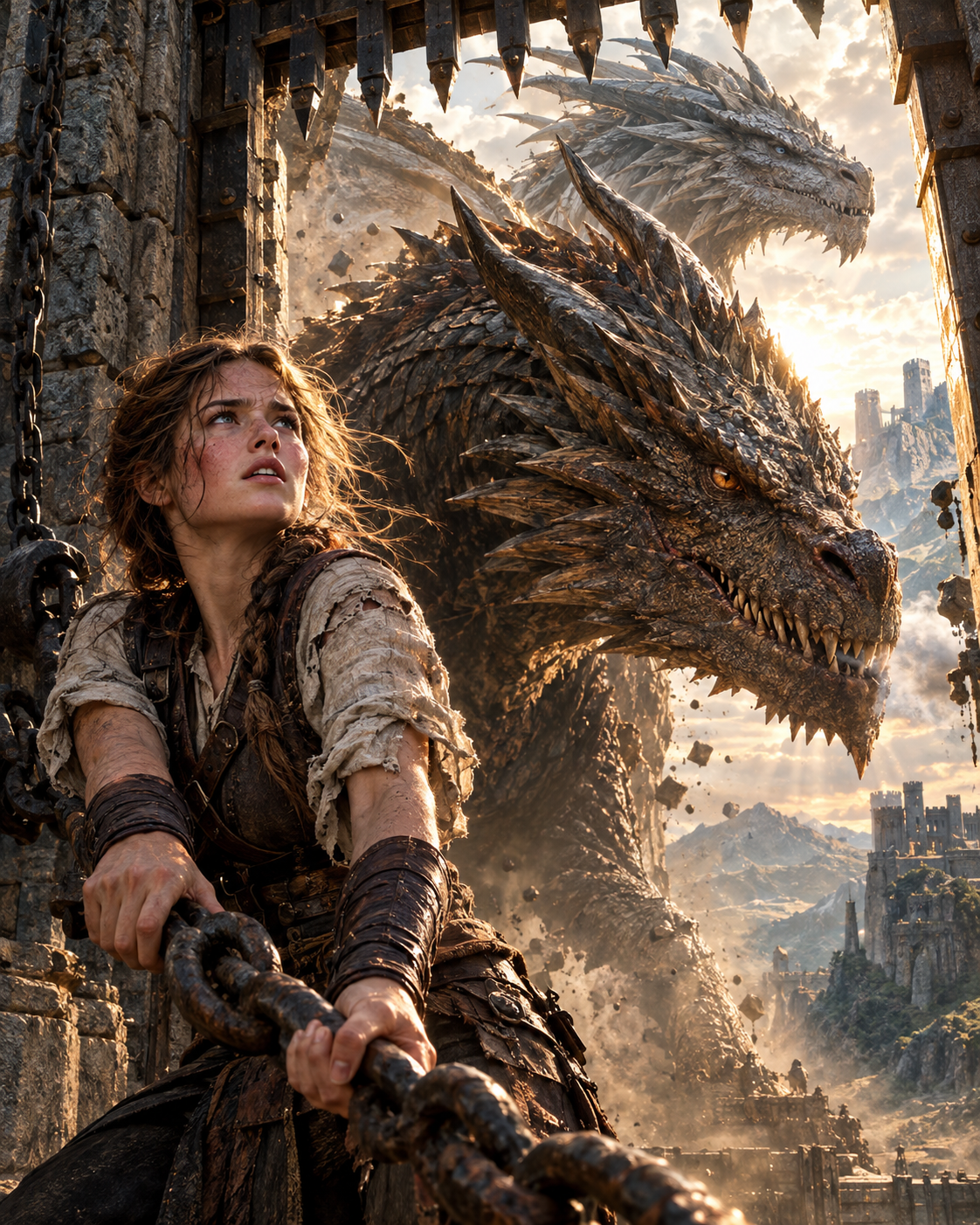
Cal looked south.
“The old postal route.”
We rode through the night.
By dawn, we reached a valley I’d never seen before.
Hidden between black mountains stood a ruined stone building.
The roof had collapsed.
The windows were broken.
But above the door was a symbol.
Three lines inside a circle.
My father’s symbol.
I stepped inside.
Dust covered everything.
A rusted anvil sat beneath a layer of ash.
Beside it was a wooden chest.
My hands shook as I opened it.
Inside were dozens of letters.
All addressed to my father.
Most carried the silver seal.
One had my name.
I opened it.
Hannah,
If you’re reading this, then Salt has found Moss.
I pray that means you are old enough to understand what I couldn’t explain when you were a child.
Your father.
I read the next line twice.
Salt and Moss were never fighting dragons.
They were messengers.
Not for the government.
Not for the postal service.
For people who had no voice.
Years ago, the northern territories were divided by war.
The Postal Authority discovered that dragons could cross borders faster than any horse or ship.
At first, they carried letters.
Then orders.
Then secrets.
Then prisoners’ names.
The Authority realized that controlling the dragons meant controlling information.
So they began breeding them for obedience.
Any dragon that resisted was labeled defective.
Any rider who objected disappeared.
Salt and Moss were among the last dragons trained by riders who believed the old oath:
No letter should be stopped because its message is inconvenient.
My father had been one of those riders.
I sat on the floor.
Cal read over my shoulder.
“There’s more,” he said.
I continued.
Salt and Moss were separated because they refused to carry weapons.
The Authority intended to kill them.
I helped them escape.
But there was another problem.
They had discovered a list of names.
People who had been imprisoned.
People who had disappeared.
People who had been declared dead.
The list proved that the Authority had been secretly using the postal network to move prisoners across the country.
I hid the list.
I trusted only one person with it.
Cal Mercer.
My father.
I stopped reading.
Cal was staring at the floor.
“You knew?”
“I knew enough.”
“Why didn’t you tell me?”
“Because your father begged me not to.”
“He let me grow up believing he was nobody.”
“He wanted you to have a life that didn’t belong to the past.”
I stood.
“What happened to him?”
Cal’s eyes filled with tears.
“He went back for the others.”
“And?”
“He never came home.”
The room became silent.
I looked at the old anvil.
My father had left me almost nothing.
A cracked apron.
A broken anvil.
And now, apparently, a secret that had survived twenty-four years.
A shadow passed over the broken roof.
Salt landed outside.
Moss followed.
Salt lowered his head.
Something was tied around his neck.
A leather tube.
I opened it.
Inside was another letter.
This one was fresh.
The handwriting was unfamiliar.
There is one prisoner still alive.
He knows where the original records are.
If you want the truth about your father, come to Blackwater Station.
Come alone.
I laughed bitterly.
“Of course.”
Cal looked at me.
“It’s a trap.”
“I know.”
“Then don’t go.”
I looked through the doorway at Salt.
His golden eye met mine.
For months, I had thought I was rescuing him.
Maybe he had been leading me here all along.
“I’m going.”
Cal shook his head.
“No.”
“I have to.”
“Then you’re not going alone.”
We left before sunset.
Blackwater Station stood three days north, abandoned since the last war.
The road was frozen.
Snow covered the tracks.
On the second night, Salt stopped.
He stared into the forest.
Moss growled.
Cal reached for his knife.
“Someone’s following us.”
A figure stepped between the trees.
Then another.
Then five more.
I gripped the reins.
The silver symbol appeared on their coats.
The leader from our station walked forward.
“You really should have listened.”
Cal raised his rifle.
The man shook his head.
“We don’t want to hurt you.”
“Then leave,” I said.
“We can’t.”
“Why?”
The man looked at Salt.
“Because your father hid something inside him.”
My breath caught.
“What?”
The man smiled.
“The last route.”
He raised his hand.
Crossbows appeared in the trees.
Salt roared.
Everything happened at once.
Moss charged left.
Cal fired.
I fell from the saddle.
A bolt struck Salt’s shoulder.
He stumbled.
I screamed his name.
The leader approached.
“Enough.”
He raised a metal collar.
Salt backed away.
His wings trembled.
Then Moss stepped between them.
The old dragon was shaking.
His cloudy eyes found Salt’s.
Salt touched his forehead to Moss’s.
Something passed between them.
Memory.
Trust.
A promise.
Moss turned toward me.
Then he roared.
Not at the soldiers.
At the sky.
A second roar answered from the mountains.
Then another.
Then dozens.
The forest shook.
Shapes appeared beyond the trees.
Dragons.
Old postal dragons.
Young dragons.
Scarred dragons.
Dragons wearing abandoned harnesses.
They emerged from caves and ruined barns, from valleys where people had forgotten they existed.
The soldiers lowered their weapons.
The leader whispered, “Impossible.”
Cal smiled.
“Not impossible.”
He looked at me.
“Just forgotten.”
The dragons charged.
The soldiers fled.
We didn’t chase them.
We went to Blackwater Station.
Inside the abandoned station, we found a man chained to a wall.
He was old.
Thin.
His hair was white.
But I recognized the black flame on his wrist.
“Elias,” Cal whispered.
The man looked at me.
His eyes widened.
“Hannah?”
I couldn’t breathe.
“My father?”
He smiled sadly.
“I wondered if you’d come.”
I stepped closer.
“You knew where I was?”
“Your father told me.”
“You’ve been alive all these years?”
“Alive is a generous word.”
I knelt beside him.
“What happened?”
“The Authority captured us. Your father escaped once. He came back for me.”
Elias looked toward Salt.
“And for them.”
He swallowed.
“He believed dragons weren’t property. He believed people weren’t property either.”
“Did he survive?”
Elias closed his eyes.
“No.”
The answer hurt even though I’d known it already.
“What happened?”
“He opened the prison gates.”
“Why?”
“Because the prisoners were going to be moved at dawn.”
“And he?”
“He stayed behind.”
I pressed my fist against my mouth.
Elias continued.
“He told me something before he died.”
“What?”
“One day, Hannah will ask what kind of man I was.”
I looked at him.
“What did he say?”
Elias smiled through tears.
“He said, ‘Tell her I wasn’t brave enough to save everyone. But I was brave enough to try.'”
I broke down.
Cal put his hand on my shoulder.
For a long time, nobody spoke.
Then Elias pointed toward the floor.
“There’s something you need to see.”
Beneath the station was a hidden archive.
Thousands of records lined the walls.
Names.
Dates.
Routes.
Prisoners.
Dragons.
Every secret the Authority had buried for decades.
At the center was one ledger.
The original.
Cal opened it.
The first page contained the names of hundreds of people.
The final page contained only one sentence.
A dragon carries a letter.
A person carries its meaning.
Neither should belong to anyone.
I touched the page.
Then Salt entered the room.
He looked at the ledger.
Then at me.
I finally understood why he had stopped fighting.
Why he had refused to attack Moss.
Why he had dragged himself through arenas, storms, and frozen roads.
He had been carrying something far older than a message.
He had been carrying memory.
And memory, unlike a chain, could not be owned.
We brought the records north.
The truth spread faster than any army.
Former prisoners came forward.
Families found names they thought were lost forever.
The Postal Authority collapsed within a year.
Not because of one battle.
Not because of one hero.
Because too many people finally knew the truth at the same time.
The old postal dragons were released.
Some were too old to fly.
Some had forgotten their routes.
Some had forgotten people.
But none were forced to carry weapons again.
As for Salt and Moss, they stayed with us.
The station became a refuge.
We repaired the old towers.
We rebuilt the stables.
And every morning, the dragons flew together.
Sometimes they carried letters.
Sometimes they carried medicine.
Sometimes they carried nothing at all.
I became a farrier.
Not for weapons.
For dragons.
I learned how to repair wings, straighten claws, and treat scars that healed badly because someone had once decided an animal was worth more in battle than in life.
Years later, children began asking me about Salt.
They always wanted to know if he had ever fought again.
I told them the truth.
“No.”
“Was he afraid?”
I would smile.
“Once, perhaps.”
“Then why didn’t he fight?”
I looked toward the cliffs.
Because Salt had taught me something I had spent my whole life misunderstanding.
Courage was not always the ability to strike back.
Sometimes courage was refusing to become cruel simply because someone else had been cruel to you.
Sometimes victory was walking away.
Sometimes the bravest thing a broken creature could do was protect the part of itself that had not been broken.
Salt grew old.
His silver scales faded.
The scar across his muzzle became almost white.
Moss grew slower too.
But the brothers never stopped flying together.
On their last winter, they disappeared beyond the cliffs just before sunset.
I waited for them.
One hour.
Then two.
A storm came.
They didn’t return.
At dawn, I climbed the highest tower.
There, on the snow, were two sets of footprints leading toward the northern ridge.
Beside them lay Salt’s old harness.
Moss’s broken horn rested on top of it.
They had gone where I could not follow.
I cried that morning.
Not because I believed they were lost.
But because I finally understood they had never truly belonged to me.
They had belonged to the sky.
Years afterward, people still sent letters to our station.
Some were ordinary.
Some were desperate.
Some were addressed to people who had been missing for decades.
And whenever I saw the silver seal, I remembered that first letter.
You were never supposed to find him.
The Authority had been right about one thing.
I was never supposed to find Salt.
I was never supposed to discover Moss.
I was never supposed to learn what happened to my father.
But sometimes the truths people try hardest to bury are the ones that need to be found.
Not because the past can be changed.
It can’t.
My father was still gone.
The prisoners still suffered.
The dragons still carried scars.
But the truth gave those scars a meaning.
It turned silence into testimony.
It turned memory into a warning.
And it turned two discarded dragons into brothers again.
On the anniversary of Salt’s final flight, I stood beside the old tower with a letter in my hand.
There was no name on it.
Only the symbol of the three lines inside a circle.
I opened it.
Inside were seven words.
Thank you for teaching us to remember.
I folded the letter and looked toward the horizon.
For a moment, I imagined two shapes moving through the clouds.
One silver.
One green.
Flying side by side.
No chains.
No handlers.
No arena.
No one shouting for them to fight.
Just two brothers following the same wind home.
And I realized that perhaps that had been the lesson all along.
A life is not measured by how much pain it can endure.
It is measured by what it refuses to become because of that pain.
Salt had been called lame.
Moss had been called useless.
My father had been called a traitor.
I had been called a foolish girl who cared too much.
But none of those names had been true.
They were only names given by people who needed us to believe we were less than we were.
The world had tried to turn dragons into weapons, people into numbers, and memories into secrets.
But the truth survived.
It survived in scars.
It survived in letters.
It survived in the eyes of two brothers who recognized each other after twenty years.
And sometimes, when the wind blows south across the moors, I still hear a distant cry above the clouds.
I never know whether it is memory or imagination.
I don’t need to know.
I simply stand beneath the open sky and listen.
Because somewhere beyond the horizon, two old dragons are still flying.
And for the first time in their lives, nobody is telling them where they have to go.
The wind changed three years after the last letter.
It came from the east instead of the south, carrying the smell of rain and salt across the moors.
I was standing outside the postal station, repairing the buckle on a young rider’s harness, when every dragon in the yard suddenly lifted its head.
They were listening.
Not to thunder.
Not to horses.
To something beyond the cliffs.
Then I heard it.
A roar.
Deep.
Distant.
Familiar.
The young rider beside me dropped the bundle of letters in his arms.
“What was that?”
I didn’t answer.
My hands had already begun to shake.
The sound came again.
One long call followed by another.
Two voices.
One low and rough.
One softer.
I knew those voices.
I had spent half my life knowing them.
I ran toward the cliffs.
Behind me, the dragons followed.
The old tower stood against the gray sky, its stones wet from the rain.
I climbed until I reached the highest platform.
At first, there was nothing.
Only clouds.
Then something moved inside them.
A silver wing appeared.
My heart stopped.
Another wing followed.
Green.
I gripped the stone railing.
“No.”
The shapes came closer.
Two dragons emerged from the mist.
Older.
Thinner.
Scarred by weather and time.
But unmistakable.
Salt.
Moss.
They circled the tower once.
Then Salt landed.
His legs trembled beneath him.
Moss landed beside him.
For several seconds, none of us moved.
I walked toward Salt.
He lowered his enormous head.
I placed both hands against his face.
He was warm.
Alive.
“You stubborn old fool,” I whispered.
His golden eye closed.
A tear rolled down my cheek.
Moss nudged my shoulder.
I laughed through my tears.
“You too.”
The riders gathered behind me.
Nobody spoke.
They had heard the stories.
Everyone had.
But stories were one thing.
Seeing the dragons return was another.
The youngest rider stepped forward.
“Where have they been?”
I looked at Salt.
He turned his head toward the eastern horizon.
Then he released a low call.
Moss answered.
I understood.
“They weren’t lost.”
The young rider frowned.
“Then where were they?”
I smiled.
“Home.”
That evening, Salt and Moss refused to enter the stable.
They stood beneath the stars until midnight.
I sat beside them with a blanket around my shoulders.
Salt looked older than I remembered.
His scales were dull.
His breathing was slower.
But his eyes were still bright.
I touched the scar across his muzzle.
“Did you find what you were looking for?”
He leaned his forehead against mine.
I closed my eyes.
For years, I had wondered what had happened to them after they disappeared.
Now I understood.
They had flown back to the places where their lives had begun.
The valleys.
The old postal routes.
The ruined prison.
The island where they had first been reunited.
They had gone to remember.
And perhaps, in their own way, to say goodbye.
The next morning, Salt left one final message.
Not a letter.
A footprint in the snow.
It led toward the northern ridge.
Moss’s footprints ran beside it.
They stopped at the edge of the cliffs.
Beyond that point was nothing but sky.
I followed the trail until I reached the place where my father had once stood.
The same place where Elias had told me the truth.
The same place where I had once believed grief was the end of a story.
I found something beneath a flat stone.
A small leather pouch.
Inside was my father’s old farrier hammer.
I recognized it immediately.
The handle was cracked.
The metal head was black with age.
But carved into the side were three words.
For what cannot speak.
I sat down.
The hammer rested in my lap.
For a long time, I couldn’t move.
My father had carried it.
He had repaired dragons with it.
He had opened prison doors with the strength in his hands.
And somehow, after all these years, it had found its way back to me.
There was another piece of paper inside the pouch.
The handwriting was my father’s.
Hannah,
If you ever find this, then the dragons have brought you farther than I ever could.
I am sorry for the years I was absent.
I am sorry I could not give you a normal childhood.
But there is something I need you to know.
Never confuse obedience with goodness.
And never confuse silence with peace.
Some people will tell you that the world is safer when everyone follows orders.
They are wrong.
The world is safer when people are willing to ask whether the orders deserve to be followed.
You don’t have to save everyone.
You don’t have to be fearless.
Just don’t look away when someone weaker is being hurt.
That is enough.
Your father.
I read it three times.
Then I folded it carefully and placed it against my heart.
For the first time, I understood why he had left the hammer.
It wasn’t a reminder of him.
It was a responsibility.
Years passed.
The station grew.
More riders came.
More dragons arrived.
Some were rescued from illegal fighting rings.
Others had been abandoned because they were too old.
One had only one wing.
Another couldn’t see.
A third was terrified of people.
We took them all in.
Nobody asked what they could do.
Nobody asked how much money they were worth.
We asked what they needed.
The old fighting arenas slowly disappeared.
The postal routes changed too.
Machines replaced dragons in many places.
But there were still mountains no machine could cross.
There were still villages buried beneath snow.
There were still people waiting for medicine, news, or a simple letter from someone they loved.
So the dragons flew.
Not because they were forced.
Because they chose to.
And that difference changed everything.
One spring morning, a little girl arrived at the station holding a wooden box.
She couldn’t have been more than eight.
“My mother says you can fix dragons,” she said.
“I try.”
She opened the box.
Inside was a tiny silver scale.
“Can you fix this?”
I smiled.
“That’s not broken.”
“Then why is it separated?”
I looked at her.
“Because sometimes something can be separated without being broken.”
She didn’t understand.
Not yet.
So I placed the scale in her palm.
“Keep it.”
“Why?”
“Because one day you’ll understand.”
She closed her fingers around it.
Then she looked toward the stable.
“Is Salt here?”
I hesitated.
“No.”
“Did he die?”
I looked toward the cliffs.
“Moss too?”
I nodded.
The girl looked sad.
“Were they brothers?”
“Yes.”
“Did they stay together?”
“Until the end.”
She smiled.
“Good.”
Then she ran outside.
I watched her disappear into the yard.
Behind the stable, the wind lifted a few silver feathers that had been caught in the grass.
I picked one up.
It was from Salt.
I carried it into the station and placed it beside my father’s hammer.
Those were the only two things I kept.
A hammer.
A feather.
One represented the hands that fought to repair what had been broken.
The other represented the freedom that came after the chains were removed.
Years later, when I became old enough to need a cane, people started calling me the Keeper of the Northern Station.
I never liked the title.
I wasn’t keeping anything.
That was the point.
The dragons came when they wanted.
They left when they wanted.
They chose their riders.
They chose their routes.
They chose when to fly.
Nobody owned them.
Sometimes young riders asked me why.
“Because we learned the hard way,” I told them.
“What did you learn?”
“That love without freedom is another kind of cage.”
They usually went quiet after that.
One evening, during the first snowfall of winter, I sat alone in the station.
The fire was low.
The roads were empty.
There were no letters waiting.
No riders.
No dragons.
Just silence.
Then the door opened.
An old man stepped inside.
I recognized him immediately.
Elias.
He had survived longer than anyone expected.
He leaned heavily on a cane.
“You came back.”
“I promised your father I would.”
He placed a small envelope on the table.
I stared at it.
“What is that?”
“The last one.”
I opened it.
Inside was a photograph.
My father stood beside Salt and Moss.
But they were not young.
This photograph had been taken shortly before my father disappeared.
He was smiling.
Really smiling.
Not the tired smile I remembered from childhood.
A genuine one.
Behind him was the old postal station.
On the back, he had written:
They are not mine.
They never were.
Neither are you.
Elias sat across from me.
“He understood that before any of us.”
I looked at the photograph.
“I spent years wishing he had come home.”
“I know.”
“I was angry.”
“You had every right.”
“I still am.”
Elias nodded.
“That’s allowed too.”
I smiled sadly.
“Did he ever talk about me?”
“Every day.”
That hurt more than anything else.
I looked down.
“Then why didn’t he come back?”
Elias was silent for a long time.
“Because sometimes people have to choose between the life they want and the lives of people who cannot choose for themselves.”
I stared into the fire.
“I don’t know if I could have made that choice.”
“You don’t have to.”
He stood.
“Your father made his choice. Salt made his. Moss made his. You made yours.”
“What was mine?”
Elias looked toward the door.
“You stopped the story from ending with violence.”
After he left, I remained beside the fire until dawn.
Outside, the snow covered the old footprints.
The station was quiet.
But I didn’t feel alone.
I thought of the arena in Oklahoma.
The red sand.
The crowd screaming.
Pike shouting for blood.
Salt standing across from Moss.
Two brothers who could have fought.
Two creatures everyone had taught to obey.
And then, at the last possible moment, they chose not to.
That moment had changed my life.
Not because it was dramatic.
Not because it made them heroes.
But because it proved something I had never understood.
A person can be pushed toward cruelty without becoming cruel.
A creature can be hurt without becoming hateful.
And sometimes refusing to participate in violence is not weakness.
It is the final form of strength.
The next morning, I walked to the tower.
The sun rose over the cliffs.
The sky was clear.
For one brief moment, I saw two shapes high above the mountains.
I knew they weren’t really there.
Or perhaps they were.
It no longer mattered.
I raised my hand anyway.
“Goodbye, boys.”
The wind moved through the tower.
Somewhere far above me, something answered.
I smiled.
Then I returned to the station.
There were letters to deliver.
There were dragons to care for.
There were children who needed to learn that scars were not shameful.
There were old people waiting for news.
There were forgotten names that still deserved to be spoken.
And there was work to do.
I placed my father’s hammer beside the forge.
I hung Salt’s silver feather above the door.
Then I opened the station.
The first rider arrived just after sunrise.
She was seventeen, nervous, and carrying a single envelope.
“Where should I take this?”
I looked at the address.
A village beyond the northern mountains.
“The old route.”
She swallowed.
“That’s dangerous.”
“Yes.”
“What if I’m afraid?”
I smiled.
“Then be afraid.”
She looked confused.
“But go anyway?”
“Only if you choose to.”
She thought for a moment.
Then she climbed onto her dragon.
The animal spread its wings.
Before they left, the rider looked back.
“Why do you do this?”
I looked at the open sky.
“Because once, someone believed a letter was worth risking everything to deliver.”
The dragon leaped.
The rider disappeared into the morning light.
I watched until they became a tiny speck.
Then even that disappeared.
The station fell quiet again.
I stood beneath the doorway with the wind against my face.
For most of my life, I had believed the story was about Salt.
Then I thought it was about my father.
Later, I thought it was about the Authority, or the prisoners, or the dragons who had been forgotten.
I was wrong.
It had always been about a choice.
Every person eventually reaches a moment when the world asks them to become something they do not want to be.
Cruel.
Silent.
Obedient.
Afraid.
That moment may arrive in an arena.
It may arrive in a courtroom.
It may arrive in a family.
It may arrive when nobody is watching.
And when it comes, there may be no crowd cheering for the right decision.
There may be no reward.
There may be no guarantee that everything will turn out well.
Sometimes the only thing you have is the knowledge that you can still choose.
Salt chose his brother.
Moss chose his freedom.
My father chose people he could not save.
Cal chose to tell the truth.
And I chose to keep the door open.
Maybe that was enough.
Perhaps that was all courage had ever been.
Not the absence of fear.
Not victory.
Not glory.
Just the decision to take one more step toward what is right when every voice around you tells you to turn back.
Years later, people would ask me whether I regretted opening that watergate at the Oklahoma State Fair.
I always gave them the same answer.
“No.”
Then they would ask whether I would do it again.
I would look toward the horizon.
“I already did.”
Because every day after that had been another opening gate.
Another choice.
Another chance to refuse the cage.
And somewhere beyond the northern cliffs, where the clouds touched the mountains, I liked to believe two silver-and-green shapes were still flying together.
Not carrying weapons.
Not carrying orders.
Not carrying anyone else’s hatred.
Just carrying the wind.
Just carrying each other.
Just going home.
And that was how the story finally ended.
Not with a battle.
Not with revenge.
Not with the destruction of the people who had caused the pain.
It ended with freedom.
With memory.
With forgiveness that did not erase the past.
And with the quiet understanding that sometimes the greatest victory is not defeating the person who hurt you.
It is becoming someone they could never turn you into.
The world had once called Salt broken.
But he had never been broken.
He had simply been waiting for someone to understand that his refusal to fight was not cowardice.
It was a choice.
And in the end, that choice saved more lives than any victory in an arena ever could.
So whenever the wind comes from the south, I still stand outside the old station.
I still look toward the clouds.
And I still listen.
Because somewhere beyond the horizon, two brothers are flying.
And nobody is telling them where they have to go.
THE END.