They dragged me before the Dragon Emperor in the obsidian throne hall, called me a lying human servant, but the broken wooden dragon in my pocket proved their accusation was hiding something.
I stopped walking.
The corridor outside the throne hall suddenly felt colder than the maintenance tunnels beneath the Citadel.
I looked down at the wooden dragon in my hands.
“Alrix,” I whispered, “what do you mean someone broke him on purpose?”
The little prince glanced behind him.
His silver scales had lost their shine, and his claws scraped nervously against the black stone.
“I saw someone in my room last night.”
My stomach tightened.
“Who?”
“I don’t know. He wore a dark cloak. I thought he was bringing my supper, but then he picked up Ember.”
“What did he do?”
Alrix swallowed.
“He twisted the wheel until it snapped. Then he put something inside.”
I looked at the toy.
“Inside?”
“He said if I told anyone, Mother would disappear like the others.”
The words struck harder than any dragon’s claw.
“What others?”
Alrix’s eyes filled with tears.
“The servants who heard the singing under the floor.”
Before I could ask another question, footsteps echoed behind us.
Alrix immediately straightened.
A royal attendant emerged from the shadows and bowed.
“Your Highness. The Empress is waiting.”
The boy looked at me once more.
“Please don’t let them take Ember.”
Then he disappeared down the corridor.
I stood there holding a child’s wooden toy, suddenly certain that the broken wheel had never been the real problem.
I returned to the maintenance quarters through the lower passages, avoiding the guards who had begun treating me like a visiting ambassador rather than a servant.
My room was barely larger than a storage cupboard.
A narrow bed.
A washbasin.
A workbench covered in salvaged metal.
And a locked drawer containing the only thing I had brought from the human territories: my father’s repair tools.
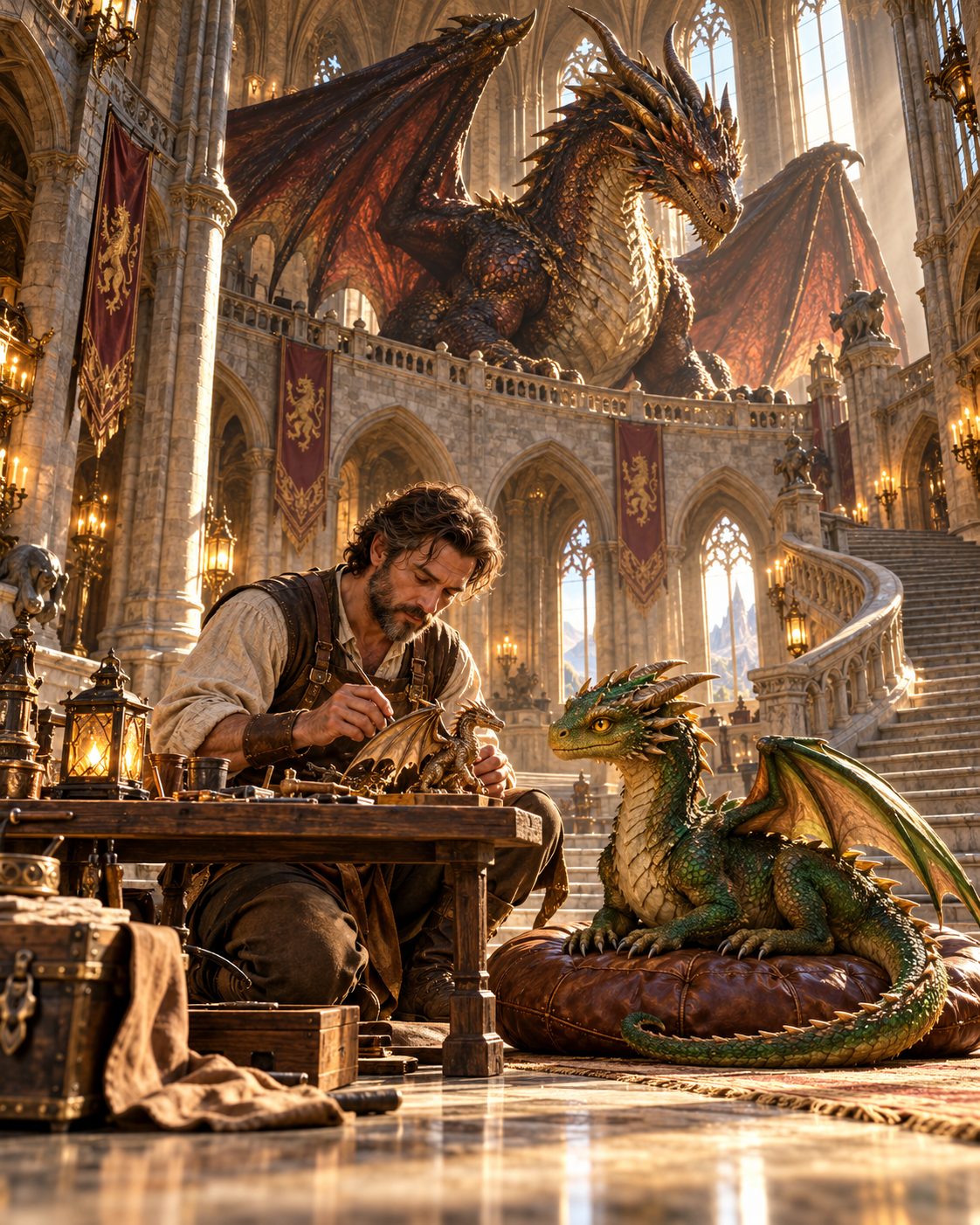
I placed Ember beneath the lamp.
The dragon had been carved from dark cedar, its wings spread proudly, its little wooden wheels designed to let it race across polished floors.
I examined the repaired axle.
Something bothered me.
The brass pin I had inserted fit perfectly, but the surrounding wood showed scratches that had nothing to do with a broken wheel.
Someone had opened the underside and carefully sealed it again.
I reached for my smallest chisel.
A soft click sounded from the door.
I froze.
Another click.
The lock was turning.
I extinguished the lamp.
A dark figure slipped inside.
He moved straight toward the workbench.
Not toward my coins.
Not toward my tools.
Toward Ember.
I stepped from behind the door and drove my shoulder into him.
We crashed against the wall.
The intruder was larger than me, covered in black scales, and carried a curved knife.
He slashed.
Pain exploded across my forearm.
I grabbed a wrench and struck his wrist.
The knife fell.
He hissed and slammed me backward.
His claws closed around my throat.
“Where is the prince’s toy?”
I struggled for breath.
Then I noticed the silver insignia beneath his cloak.
A dragon’s eye surrounded by twelve flames.
The emblem of the High Council.
I kicked the furnace release lever beside my bed.
A blast of scalding steam erupted from the emergency pipe.
The intruder screamed and staggered away.
I seized Ember, ducked beneath his claws, and ran.
Behind me, he shouted something in an ancient dragon dialect.
I understood only three words.
“Before midnight. Kill.”
I didn’t stop until I reached the abandoned bell tower above the eastern foundry.
There, beneath the pale light of two moons, I carefully opened Ember’s wooden belly.
Inside was a black crystal no larger than a fingernail.
Thin red veins pulsed beneath its surface.
And when I touched it, I heard singing.
Not through my ears.
Inside my skull.
A chorus of voices crying beneath an ocean of stone.
Then one voice rose above the others.
“Please. The children are still alive.”
I dropped the crystal.
The singing stopped.
For several seconds, I could only stare.
I had spent six years repairing the Citadel’s ancient heating systems.
I knew its pipes, turbines, furnace chambers, and ventilation shafts better than most dragons knew their own homes.
But beneath the engineering diagrams lay older mechanisms that nobody was permitted to examine.
Sealed tunnels.
Forbidden chambers.
A massive engine beneath the imperial throne.
We called it the Heartfire.
The official explanation was that the Heartfire drew energy from the volcanic mountain.
But the crystal had shown me something impossible.
The power was coming from voices.
I wrapped it in cloth and hurried toward the one person who might understand.
Master Orven lived in the oldest wing of the Citadel.
He was a bronze dragon whose wings had been shattered during a forgotten war, and the only senior engineer who had ever treated me as something resembling an equal.
When I knocked, he opened the door holding a candle.
One look at my bleeding arm made his expression change.
“Aaron, what have you done?”
“I repaired a toy.”
Orven stared.
“Of course you did.”
I placed the crystal on his desk.
His candle slipped from his claws.
The flame died against the floor.
“Where,” he whispered, “did you find that?”
“Inside Prince Alrix’s wooden dragon.”
Orven backed away.
“No. No, that isn’t possible.”
“What is it?”
He shut the door and locked three separate bolts.
Then he whispered a name.
“A soulstone.”
The word meant nothing to me.
Orven looked toward the ceiling as though expecting someone to fall through it.
“Three centuries ago, the first Emperor built the Heartfire to defend Veyr from invading armies. The machine needed tremendous power. Too much for ordinary volcanic furnaces.”
“So they found another source.”
Orven nodded.
“Living dragon magic.”
My mouth went dry.
“You mean prisoners?”
“At first, condemned criminals. Then political enemies. Then anyone whose disappearance could be explained.”
The singing returned to my memory.
“The children?”
Orven closed his eyes.
“Dragon children carry the purest flame. Their magic can sustain the Heartfire longer than an adult’s.”
I thought of Alrix, trembling behind ceremonial crates.
“Who controls it?”
Orven hesitated.
“Councilor Draeven oversees the ancient systems. But the Emperor believes the Heartfire has been dormant for generations.”
“Then why hide a soulstone in Alrix’s toy?”
Orven studied the crystal.
“Because someone wanted it found. Or someone was desperately trying to keep it from being found.”
A deep metallic groan rolled through the Citadel.
Dust fell from the ceiling.
Orven looked toward the window.
The mountain beneath us trembled.
“Something is waking,” he said.
At that moment, the tower bells began to ring.
Twelve times.
Midnight.
Then every flame in Veyr turned blue.
We felt the first explosion beneath our feet.
The floor lurched.
Orven grabbed his desk.
From the distant palace came a roar so powerful that every window shattered.
The Emperor.
I ran into the corridor.
Servants were fleeing toward the outer gates.
Guards shouted conflicting orders.
Above us, enormous wings beat against the darkness.
Then a terrible announcement thundered through the Citadel’s enchanted speaking horns.
“By decree of the High Council, Emperor Vaelor has been poisoned. The human Aaron Veil is wanted for treason and attempted regicide.”
My blood turned to ice.
Orven emerged behind me.
“They’re blaming you.”
“I noticed.”
“Listen carefully. You must leave.”
“Alrix is still inside.”
“Aaron—”
“And whoever tried to steal Ember knows that I have the crystal.”
Orven seized my shoulder.
“You are one human against an empire.”
I looked at the wooden dragon in my hand.
“No. I’m a repairman against a broken machine.”
He stared at me.
Then, slowly, the old dragon smiled.
“Your father would have said something equally foolish.”
I turned.
“You knew my father?”
His smile vanished.
Before he could answer, armed guards appeared at the end of the corridor.
“There!”
Orven spread his broken wings as far as they would go.
“Run, boy.”
I hesitated.
He roared.
“RUN!”
I plunged through the nearest maintenance hatch as flames filled the passage behind me.
For the next twenty minutes, I crawled through pipes barely wide enough for my shoulders.
My injured arm throbbed.
The soulstone burned through its cloth wrapping.
Above me, the entire Citadel shook.
I finally emerged inside a concealed ventilation shaft overlooking the imperial nursery.
What I saw there nearly stopped my heart.
Empress Seralyne lay unconscious beside a shattered window.
Two guards stood over her.
And Councilor Draeven held Alrix by the throat.
The little prince kicked helplessly.
“You promised,” Alrix sobbed.
Draeven leaned closer.
“I promised your mother would live if you obeyed. Unfortunately, you gave the toy to the human.”
“I didn’t know!”
“Of course you didn’t. Children are wonderfully easy to manipulate.”
I gripped my wrench.
Draeven continued.
“The crystal contains records of every soul the Heartfire consumed. Your mother discovered them. She hid the evidence inside your little toy, hoping no councilor would think to examine it.”
Alrix went still.
“Mother?”
“Yes. She was foolish enough to believe your father would listen.”
Draeven’s voice grew colder.
“Tonight the Emperor will die, the Council will inherit Veyr, and the Heartfire will feed on a new generation of royal blood.”
He dragged Alrix toward the door.
I acted before fear could stop me.
The ventilation grate exploded outward beneath my boot.
I landed on Draeven’s back.
We struck the floor.
Alrix escaped his grip.
I swung my wrench at Draeven’s head.
It bounced off his scales.
He laughed.
“A human mechanic?”
He struck me once.
I flew across the room and crashed into a cabinet.
My ribs screamed.
Draeven approached slowly.
“You should have accepted your reward and disappeared.”
I tasted blood.
“You should have left the toy alone.”
He raised one claw.
Then Alrix screamed.
Not in fear.
In anger.
A burst of silver flame erupted from his mouth and struck Draeven across the face.
The councilor staggered, roaring.
I grabbed Alrix and pulled him through the ventilation opening.
We tumbled into darkness.
Behind us, Draeven tore through the wall.
Stone shattered around his claws.
“RUN!” I shouted.
Alrix spread his trembling wings.
“I can’t fly!”
“Then crawl!”
We scrambled through the shaft as the councilor ripped apart the nursery behind us.
The tunnel narrowed.
Draeven couldn’t follow.
But his voice reached us.
“Midnight was only the beginning, little prince. The Heartfire already has your father’s soul.”
Alrix stopped.
“My father?”
I pulled him onward.
“We’re going to get him back.”
“How?”
I looked at the soulstone.
“I think your mother left us instructions.”
We reached an abandoned service chamber beneath the throne.
I set Ember on a metal platform and held the crystal beneath a lantern.
Alrix leaned closer.
When his silver scales reflected in its surface, the crystal suddenly glowed.
Words appeared inside the dark glass.
Not written.
Spoken.
Empress Seralyne’s voice filled the chamber.
“If this message is heard, the Council has moved against the Crown.”
Alrix gasped.
“Mother!”
“The Heartfire cannot be destroyed by force. Every captive soul is bound to the furnace through the imperial bloodline. Breaking the engine while the souls remain trapped will kill them all.”
A pause followed.
Then her voice became softer.
“Vaelor does not know. His father concealed the truth, and Draeven has spent decades maintaining that lie.”
The crystal flickered.
“There is one way to release them. The sovereign must surrender his claim over the Heartfire. Not merely command its destruction. He must willingly relinquish the power it gives him.”
The message faded.
Alrix looked at me.
“Father will do it.”
I wanted to believe him.
But kings were not usually eager to surrender the source of their kingdoms’ greatest strength.
Especially when that kingdom was under attack.
A scraping sound came from behind us.
I spun.
Two golden eyes watched from the darkness.
Emperor Vaelor emerged from the shadows.
His scales were dull.
Black veins crawled across his throat.
One massive wing dragged behind him.
Alrix cried out.
“Father!”
Vaelor fell to one knee as the boy rushed forward.
He caught his son gently.
For a moment, the dying Emperor simply held him.
Then his gaze found me.
“Aaron Veil.”
I lowered my head.
“Majesty.”
“I was told you poisoned me.”
“I didn’t.”
“I know.”
He coughed, and black smoke escaped his jaws.
“The poison was in the ceremonial wine. Draeven delivered it himself.”
“Then why did you come here?”
Vaelor looked at the chamber walls.
“Because I finally remembered where my father brought me when I was young.”
He touched a faded imperial emblem carved above the door.
“He told me the Heartfire was the reason our people were safe. He said a ruler must sometimes accept terrible necessities.”
His voice cracked.
“I never asked what those necessities were.”
I showed him the crystal.
He listened to the Empress’s recording without moving.
When it ended, silence settled over us.
Then Vaelor bowed his enormous head.
“How many?”
I knew what he meant.
“How many souls?”
The crystal glowed.
Thousands of tiny lights appeared across its surface.
I couldn’t count them.
Vaelor stared.
His claws began to tremble.
“All these years.”
He stepped backward.
“I ruled above them.”
Alrix approached his father.
“Can we help them?”
The Emperor closed his eyes.
“Yes.”
A terrible roar shook the mountain.
Draeven had found us.
The chamber doors exploded inward.
He entered surrounded by six armored dragons.
Behind him marched members of the High Council.
“Your Majesty,” Draeven said pleasantly, “you should be dead.”
Vaelor stood.
“Apparently your poison was as weak as your loyalty.”
Draeven smiled.
“Loyalty is a charming word used by rulers who expect others to die for them.”
He gestured toward the ceiling.
“The Heartfire is nearly awakened. Once your blood is added, its power will belong to the Council.”
Vaelor bared his fangs.
“You imprisoned children.”
“I preserved an empire.”
“You murdered innocents.”
“I made the sacrifices you were too sentimental to understand.”
Then Draeven looked directly at Alrix.
“And your youngest son will make an excellent final offering.”
Vaelor roared and charged.
The two dragons collided like falling mountains.
Stone columns fractured.
The guards scattered.
Alrix and I ducked behind a broken turbine as flames swept across the chamber.
Vaelor was larger.
But poison had weakened him.
Draeven struck his wounded wing, sending the Emperor crashing against the wall.
I knew we couldn’t win that fight.
Not with claws.
Not with fire.
So I turned toward the ancient machinery.
The Heartfire’s control chamber lay beyond a steel door marked with forbidden runes.
I recognized the locking mechanism.
Hydraulic pressure.
Obsolete, but repairable.
I grabbed a broken pipe and jammed it into the release valve.
Steam hissed.
The door opened.
Inside, the world seemed to turn upside down.
A vast furnace hung above an abyss filled with blue fire.
Thousands of crystal chains stretched from the engine into darkness.
And along those chains floated ghostly figures.
Dragons.
Humans.
Children.
Some barely older than Alrix.
Their eyes were closed.
Their voices filled the chamber with a terrible, endless song.
Alrix stood beside me, trembling.
“They’re alive?”
“In a way.”
I examined the control pedestal.
An enormous golden lever bore the imperial crest.
Above it were words carved in Old Draconic.
Alrix translated quietly.
“Only the Crown may release what the Crown has claimed.”
I gripped the lever.
It wouldn’t move.
Of course.
I wasn’t the Crown.
Behind us, the chamber shook again.
Vaelor crashed through the doorway, blood streaming from his scales.
Draeven followed.
The councilor saw the open Heartfire and froze.
“No!”
He rushed toward the controls.
I swung my wrench.
He caught my arm and squeezed.
Bones cracked.
I screamed.
Draeven lifted me off the floor.
“You insignificant creature.”
He leaned close enough for me to smell the sulfur on his breath.
“Do you know why humans were forbidden from studying this machine?”
I struggled uselessly.
“Because you were afraid we’d fix it?”
“Because your kind built the first release mechanism.”
His words struck me harder than his claws.
“The original human engineers refused to let their invention become a prison. So the first Emperor slaughtered them and buried their names.”
He threw me toward the abyss.
I caught the edge with my uninjured hand.
Below, thousands of voices rose in anguish.
Alrix screamed my name.
Draeven turned toward the boy.
Then Vaelor moved.
With the last of his strength, the Emperor seized Draeven and dragged him away from the controls.
“Now!” he roared.
“Pull the lever!”
“It won’t move!” Alrix cried.
Vaelor looked toward the abyss.
Then he understood.
The lever required his surrender.
Not his son’s.
Not mine.
His.
Draeven buried his claws in the Emperor’s chest.
Vaelor staggered.
But he did not fall.
Instead, he looked at Alrix.
“My son.”
The little dragon sobbed.
“Father, please!”
Vaelor’s eyes softened.
“I spent so long teaching you how to be strong that I forgot to teach you how to be kind.”
Alrix shook his head.
“You can teach me now.”
The Emperor looked at the lever.
Then at the captive souls.
“Perhaps I can.”
He pushed Draeven backward into a shattered pillar and approached the pedestal.
His blood dripped onto the golden mechanism.
The ancient runes awakened.
Draeven screamed.
“If you release them, our enemies will destroy Veyr!”
Vaelor placed one claw upon the lever.
“Then we shall learn to defend ourselves without stealing the lives of children.”
He pulled.
Nothing happened.
The chamber trembled.
A voice erupted from the furnace itself.
“THE CROWN MUST RENOUNCE ITS CLAIM.”
Vaelor raised his head.
“I am Vaelor, Emperor of Veyr.”
The chains began to glow.
“I surrender every soul claimed in my name, every life stolen by my ancestors, and every power purchased through their suffering.”
The furnace shrieked.
Draeven lunged.
He was too late.
Vaelor pulled the lever down.
The Heartfire cracked.
A blinding wave of silver light burst through the chamber.
The chains shattered.
Thousands of voices cried out together.
Not in pain.
In freedom.
The souls rose like stars.
They streamed upward through the mountain, passing through stone and steel, through throne rooms and watchtowers, until the night sky above Veyr blazed with living constellations.
Draeven screamed as the power he had spent decades stealing vanished from his body.
His black scales turned gray.
His enormous wings crumbled.
For the first time, he looked small.
He fell to his knees.
“No. I gave everything for this empire.”
Vaelor approached him.
“You gave things that were never yours.”
Then the Emperor collapsed.
Alrix raced to his side.
I hauled myself back from the abyss and stumbled toward them.
Vaelor lay motionless.
His breathing was shallow.
The poison had reached his heart.
Alrix pressed his small claws against his father’s face.
“Wake up.”
Nothing.
“Father?”
Vaelor’s eyes remained closed.
The boy looked at me with an expression I would remember for the rest of my life.
“You fix broken things.”
My throat tightened.
“Alrix—”
“Please.”
He pushed Ember into my hands.
“Fix him.”
I knelt beside the Emperor.
His pulse was faint.
I knew machines.
I knew engines.
I knew how to replace a shattered axle or stop a pipe from bursting.
But I didn’t know how to repair a dying dragon.
Then the wooden toy trembled in my hands.
Its little wheels began turning on their own.
The soulstone inside glowed one final time.
A voice whispered from the crystal.
“Kindness given freely is never truly lost.”
Silver light flowed from Ember.
It spread across my hands and into Vaelor’s wounded chest.
Above us, the freed souls paused in their ascent.
Thousands of lights gathered around the fallen Emperor.
I understood then.
They weren’t returning to their prison.
They were choosing to help.
A single soul descended.
It took the shape of a small golden dragon.
A child.
She placed one luminous claw against Vaelor’s forehead.
“Live differently,” she whispered.
Then she vanished.
The Emperor gasped.
His eyes opened.
Alrix threw himself against his father’s chest.
Vaelor wrapped both wings around his son, ignoring the pain.
And for the first time since I had entered Veyr, I saw the Dragon Emperor cry.
By dawn, the Citadel had changed.
Without the Heartfire, the great furnaces went cold.
The defensive towers fell silent.
The enchanted gates lost their power.
But thousands of captive souls had been freed, and their disappearance could no longer be concealed.
The surviving councilors were arrested.
Draeven was stripped of his title and imprisoned to face public judgment for his crimes.
The Empress recovered and testified before the entire kingdom.
Master Orven survived the guards who had attacked him, though he complained bitterly about the damage to his remaining wing.
And I discovered that my father had once worked on the secret mechanisms beneath the Citadel.
He had learned what they were being used for.
He had tried to dismantle them.
The authorities had called his death an industrial accident.
Orven finally told me the truth.
My father had died trying to free the prisoners.
For years, I had believed he left me nothing except a battered collection of tools.
Now I understood what he had really left behind.
A belief that broken things were worth repairing, even when the world insisted they should be thrown away.
Three weeks later, Emperor Vaelor summoned me to the throne hall.
This time, no guards dragged me inside.
The doors opened willingly.
Dragons and humans stood together beneath the obsidian pillars.
Alrix waited beside his parents, holding Ember.
Vaelor descended from the throne.
“Aaron Veil,” he announced, “you have saved my son, my life, and the soul of this empire.”
I shifted uncomfortably.
“Majesty, I mostly repaired a toy.”
A ripple of laughter passed through the hall.
Vaelor smiled.
“Then perhaps our empire has underestimated the importance of small repairs.”
He offered me a golden chain bearing the imperial crest.
“I would make you Lord Protector of Veyr, with lands, wealth, and authority equal to the highest nobles.”
I looked at the chain.
For six years, I had lived in a room barely large enough to stand in.
I had been insulted, overlooked, and treated as expendable.
A part of me wanted that reward.
But another part remembered the servants who had died because no one listened when they reported broken pipes.
I bowed.
“I’d like something else.”
The hall fell quiet.
Vaelor raised an eyebrow.
“Name it.”
“Open the engineering schools to humans. Give workers the right to report dangers without punishment. And let us rebuild the Citadel so it never depends on stolen power again.”
The Emperor studied me.
Then he turned toward the gathered nobles.
“You heard him.”
One councilor shifted nervously.
“Majesty, such reforms would overturn centuries of tradition.”
Vaelor’s expression hardened.
“Then centuries of tradition have brought us to the perfect moment to begin.”
The hall erupted.
Some dragons protested.
Others cheered.
The humans stood speechless.
Alrix simply laughed.
That same bright, wonderful laugh I had heard in the storage chamber.
Months passed.
The Citadel changed slowly.
Not every dragon accepted the reforms.
Not every human trusted the promises.
There were arguments, failures, and days when rebuilding seemed impossible.
But the schools opened.
The servants gained representation.
The ancient tunnels were transformed into workshops and memorial halls.
And the names of those consumed by the Heartfire were carved into a wall that stretched from the eastern gate to the old throne chamber.
My father’s name was among them.
I visited it often.
One evening, while repairing a new water turbine, I heard familiar footsteps behind me.
Alrix appeared, carrying Ember.
His wings had grown stronger.
He could almost fly.
“Aaron?”
I glanced up.
“What did you break this time?”
He grinned.
“Nothing.”
“That sounds suspicious.”
He placed the little wooden dragon on my workbench.
One wheel had come loose again.
I raised an eyebrow.
Alrix sighed.
“I was racing him down the stairs.”
“Imperial stairs?”
“Yes.”
“Against whom?”
“My father.”
I stared.
Alrix burst into laughter.
Then another voice came from the doorway.
“For the record,” Emperor Vaelor said, “I was winning.”
The sight of the great Dragon Emperor standing in a dusty workshop, smiling beside his son, was something I never grew accustomed to.
Alrix climbed onto the workbench.
“Can you fix him?”
I examined the wooden axle.
The old brass pin had finally worn thin.
“Of course.”
As I reached for my tools, Alrix asked a question.
“Aaron, why did you help me that first day?”
I paused.
“Because you were sad.”
“But you didn’t know me.”
“No.”
“And you knew you might be punished.”
“Yes.”
He frowned thoughtfully.
“Then wasn’t it foolish?”
I smiled.
“Probably.”
Vaelor chuckled from the doorway.
I fitted a new pin into the wheel.
Then I looked at the little prince.
“Your Highness, there will always be people who tell you kindness is weakness. They’ll say generosity makes you vulnerable, that trust is dangerous, and that power means never needing anyone.”
Alrix listened carefully.
“Are they wrong?”
“Sometimes being kind will cost you something. Sometimes people will take advantage of it. But that doesn’t make kindness worthless.”
I placed Ember before him.
“It means kindness takes courage.”
Alrix rolled the wooden dragon across the table.
The wheels spun perfectly.
Then he smiled and pushed it toward his father.
Vaelor caught it gently between two enormous claws.
For a moment, the Emperor simply stared at the small toy.
Then he lowered himself beside his son.
“Would you like to race again?”
Alrix’s eyes shone.
“Even if I lose?”
Vaelor touched his forehead to the boy’s.
“Especially then.”
I watched them disappear down the corridor, laughing together.
Outside, the rebuilt furnaces glowed with ordinary fire, tended by dragons and humans working side by side.
No stolen souls.
No hidden screams.
Just honest labor and the warmth it created.
I returned to my tools.
Years later, people would tell stories about the night the Heartfire shattered and thousands of souls filled the sky.
They would speak of the Emperor who surrendered his greatest power, the councilor who betrayed his kingdom, and the human mechanic who stood against dragons.
Some would turn the story into legend.
Others would argue over who deserved the most credit.
But whenever anyone asked me how it truly began, I never mentioned the poisoned wine, the ancient machine, or the battle beneath the throne.
I told them about a frightened little dragon sitting alone behind some crates.
About a broken wooden toy.
About a child who believed mistakes made him unworthy of love.
And about the moment I realized that sometimes the smallest act of kindness can expose the greatest cruelty, challenge the strongest empire, and change the future of everyone living inside it.
Because the world is not always saved by those who possess the most power.
Sometimes it is saved by someone who sees a broken thing, kneels beside it, and quietly says:
“Let me help.”
THE END.