They chained me to the pier at Sheldrake Bight while the company men called me a traitor, but the sea dragon circling my sinking ship knew the truth they feared.
For a long time, I did not move.
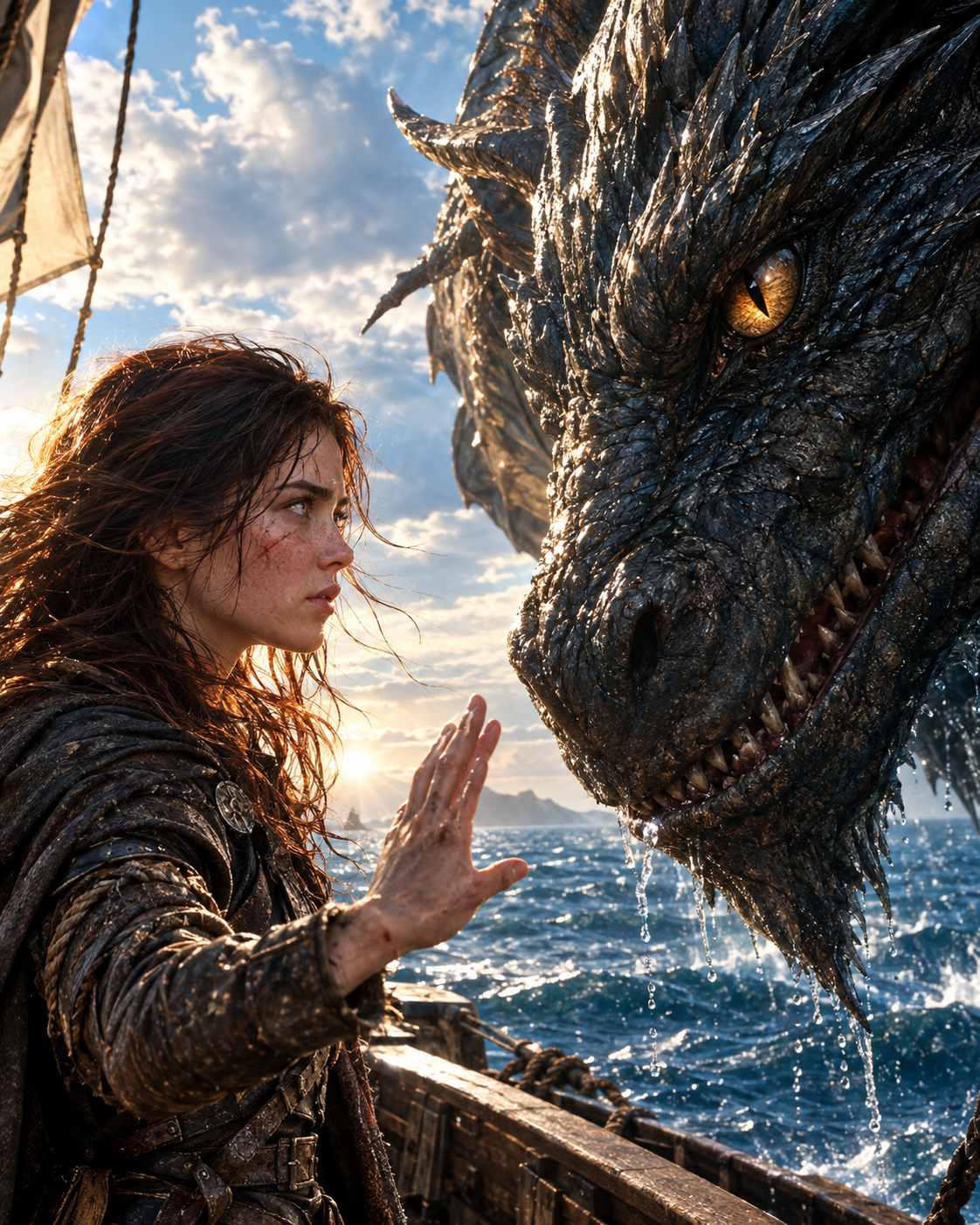
I stood at the railing with one hand gripping the wet wood, listening to the water breathe beneath me.
Four knocks.
Then three.
Then one.
The scarred dragon remained below the surface, its pale eyes barely visible through the black water.
Behind him, dozens of other shapes shifted slowly in the darkness.
They were not attacking.
They were waiting.
Waiting for me.
I looked toward the deepest part of Sheldrake Bight.
Nothing moved there now.
But I could feel it.
A pressure beneath the sea.
A presence so vast that the water itself seemed to bend around it.
Then the surface rose.
Not like a wave.
Like something underneath was standing up.
My knees weakened.
The shape that emerged was wider than my ketch.
Its back broke the surface first, covered in ridges that looked like black stone.
Then another ridge appeared.
And another.
For several seconds, I could not understand what I was seeing.
It was not a dragon.
Not the kind I knew.
Not even the kind sailors whispered about in taverns after too much rum.
This creature was ancient.
Its body seemed to disappear into the darkness beneath it, as though the sea had grown a living mountain.
Then an enormous eye opened.
It was the color of old silver.
And it looked directly at me.
I should have been afraid.
Instead, I felt something I had not felt in years.
Recognition.
Not from the creature.
From me.
I suddenly remembered the first time I had seen the scarred dragon.
The rope around its fins.
The blood in the water.
The way my crew had shouted for me to kill it.
I remembered thinking that the difference between a monster and a victim was sometimes nothing more than who got to tell the story.
The great creature beneath me lowered its head.
The scarred dragon moved forward and touched its snout against the larger creature’s side.
Three knocks sounded through the water.
Boom.
Boom.
Boom.
The great creature answered.
Once.
The sound was so deep that my entire ketch trembled.
Then the other dragons began moving.
One by one, they formed a circle around my boat.
Not a trap.
A shield.
I whispered the only words that came to my mind.
“What do you want from me?”
The scarred dragon lifted its head.
Then it disappeared beneath the surface.
The others followed.
The bay became silent.
For several minutes, I saw nothing.
Then something struck the underside of my ketch.
Not hard.
Three gentle taps.
I laughed despite myself.
“All right,” I whispered.
“I’ll follow.”
I had no idea what I was agreeing to.
I lowered the small boat and rowed toward the center of the bay.
The dragons guided me through water that grew darker with every stroke.
The old wreck of the Marrow Light still lay across the narrow entrance, buried beneath years of coral, kelp, and rust.
I had always thought of her as a grave.
That night, I discovered she was a doorway.
The dragons swam beneath her broken hull.
I followed.
At first, the passage was so narrow that the oars scraped against the wreckage.
Then the darkness opened.
My little boat dropped into a vast underwater chamber.
I stopped rowing.
I could see beneath me.
Far beneath me.
The sea floor was covered in enormous pale stones, arranged in a circle.
At the center stood something that looked like a ruined tower.
Only it wasn’t made of stone.
It was bone.
Huge curved ribs rose from the ocean floor and disappeared into the darkness above.
I had spent fifty years on the water.
I had seen whales, wrecks, storms, reefs, and ships that belonged in museums.
I had never seen bones like those.
The scarred dragon surfaced beside my boat.
He looked at me.
Then he turned toward the bones.
Four knocks came from somewhere below.
The dragon answered with one.
The great creature from the bay emerged behind us.
It was even larger down here.
Its body stretched beyond the edge of my vision.
Slowly, it moved toward the bones.
And then I understood.
They were not the bones of a monster.
They were the remains of another dragon.
An old one.
A very old one.
The largest skeleton had a hollow place between its ribs.
Inside that hollow lay hundreds of smooth black stones.
Eggs.
My breath caught.
Not forty-three.
Not hundreds.
Thousands.
A forgotten nursery.
A place where the dragons had once returned generation after generation.
And then I saw the scars.
Not on the bones.
On the living dragons.
Long parallel cuts ran across their scales.
The same kind of cuts I had seen on the creature I rescued decades earlier.
Harpoon wounds.
I looked toward the entrance.
The company had not discovered only one nest at Sheldrake Bight.
They had discovered the entrance to an entire breeding ground.
The Rendering Company had known.
Perhaps not everything.
But enough.
Enough to understand what was here.
Enough to want it.
My stomach turned.
The scarred dragon touched the side of my boat.
One knock.
I placed my hand against his wet scales.
“Why bring me here?”
He pulled away.
Then I saw something moving between the bones.
A tiny shape.
Then another.
Then dozens.
Young dragons.
Not hatchlings.
Juveniles.
They were learning to swim.
The great creature moved around them slowly, protecting them.
And suddenly the meaning of the four knocks came to me.
Not danger.
Not food.
Not a warning.
Four.
A number.
I looked at the eggs again.
Four clusters.
Four generations.
Four nests hidden beneath Sheldrake Bight.
The company had never known how much remained.
If they found this place, they would destroy everything.
The scarred dragon looked at me.
Then he turned toward the surface.
I followed.
When I reached my ketch, dawn was beginning to color the horizon.
I had one decision to make.
For most of my life, I had believed that keeping quiet was the same as keeping safe.
I had hidden the nests.
Hidden the dragons.
Hidden the truth.
It had worked.
But now I was old.
And secrets die with the people who carry them.
I could protect this place for another few years.
Perhaps ten.
But what happened when I was gone?
I needed to make the truth impossible to erase.
So I sailed to the nearest harbor.
I sold the ketch.
With the money, I bought paper, ink, fuel, and passage on a coastal steamer.
Then I went to the one place I had avoided for years.
The office of the Rendering Company.
The building was taller now.
Cleaner.
The brass on the doors shone in the morning sun.
Inside, a young clerk looked at me with irritation.
“Can I help you?”
“I have information.”
“About what?”
“Dragons.”
He laughed.
I did not.
Eventually, an executive came downstairs.
He was a thin man with silver hair and a black coat.
I knew his face.
He had been a boy when the Marrow Light sank.
His father had signed the order that destroyed my life.
Now he ran the company.
He looked at me for a long moment.
“You should be dead,” he said.
“So should your company.”
His expression hardened.
“What do you want?”
I placed my old brass compass on his desk.
My father’s compass.
The one I had sold decades earlier.
He stared at it.
“I know this.”
“You should.”
He picked it up.
“Where did you get it?”
“I owned it.”
Silence filled the room.
Then I told him everything.
The nests.
The underwater chamber.
The skeletons.
The living dragons.
The eggs.
He listened without interrupting.
When I finished, he smiled.
“You expect me to believe this?”
“No.”
“Then why tell me?”
“Because tomorrow I am telling everyone.”
The smile disappeared.
He leaned toward me.
“You have no proof.”
I looked at the window.
Outside, the harbor was crowded with fishing boats.
People moved along the docks.
Children ran between crates.
“I have more proof than you think.”
That night, I mailed copies of my journal to newspapers, universities, maritime authorities, and every coastal village I could reach.
I included coordinates.
Drawings.
Measurements.
Descriptions of the dragons.
Most importantly, I included the history of the Rendering Company’s hunts.
Names.
Dates.
Ships.
Orders.
Payments.
Every secret I had carried for decades.
Then I went to sleep.
The next morning, the world changed.
The first newspaper called me a liar.
The second called me a lunatic.
The third printed my coordinates on the front page.
By noon, ships began leaving the harbor.
By evening, the government announced an investigation.
The Rendering Company denied everything.
Then one of their former captains came forward.
Then another.
Then another.
Men who had once been afraid to speak began opening old records.
Harpoon inventories.
Shipping manifests.
Payment ledgers.
Photographs.
For decades, the company had told the world that sea dragons were dangerous pests.
Now their own documents showed the truth.
They had hunted them for oil, bone, scale, and eggs.
They had destroyed breeding grounds because the creatures interfered with their fishing routes.
The scandal spread across every coastal town.
For the first time, people began asking the question I had asked myself years earlier.
What if the monster was not the animal?
The company collapsed within months.
Its ships were seized.
Its officers were arrested.
Its remaining hunting licenses were revoked.
But I did not celebrate.
Because by then I understood something important.
Destroying the company would not restore what had been lost.
No law could bring back the dragons that had disappeared.
No court could return the years they had spent hiding beneath the sea.
So I asked for something else.
Protection.
Not for myself.
For the bay.
For the breeding grounds.
For every creature that had survived long enough to reach them.
Sheldrake Bight became a protected sanctuary.
No hunting.
No commercial fishing in the inner waters.
No drilling.
No dredging.
No company was allowed to enter without permission.
The underwater chamber was left unmarked on public maps.
Only a handful of marine researchers were given access.
And even then, only under strict conditions.
The dragons were not captured.
Not tagged.
Not displayed.
They were left alone.
For the first time in generations, they had a place that belonged only to them.
Years passed.
My name slowly changed in the newspapers.
First I was a criminal.
Then a witness.
Then a sailor.
Eventually, some people called me a hero.
I hated that word.
Heroes are supposed to know what they are doing.
I had not known.
I had simply refused to do one terrible thing when it was easier to obey.
That is all.
The scarred dragon continued to visit me.
Not often.
Sometimes once a year.
Sometimes after several winters.
Whenever he came, he tapped the hull once.
I always answered once.
One day.
One sound.
I am here.
You are here.
That was enough.
Then, when I was eighty-seven, my hands became too weak to sail.
I moved into a small house overlooking Sheldrake Bight.
The harbor children knew me as the old man who talked to the sea.
They would bring me fish and ask whether the dragons were real.
I always told them the same thing.
“Real things don’t become less real because you don’t see them.”
One autumn morning, a storm came from the north.
It was stronger than anything I had seen in decades.
The waves climbed over the harbor wall.
Boats broke loose.
Windows shattered.
People ran through the rain carrying ropes and lanterns.
I stood at my window and watched the bay disappear beneath white water.
Then I heard it.
Three knocks.
Boom.
Boom.
Boom.
I smiled.
“Danger,” I whispered.
But this time the danger was not for the dragons.
It was for us.
A distress signal came from the harbor.
A fishing boat had broken its anchor and was drifting toward the rocks.
The rescue crew could not reach it.
The storm was too violent.
Then something enormous rose beyond the harbor wall.
A black shape.
Then another.
Then dozens.
The dragons had come into the storm.
They moved through the waves like shadows.
One pushed the fishing boat away from the rocks.
Another blocked the current.
A third surfaced beside the rescue vessel and guided it toward safer water.
No one understood what they were seeing.
But everyone saw it.
By dawn, the storm had passed.
The fishing boat was safe.
The dragons were gone.
The harbor was silent.
I walked down to the water.
The scarred dragon was waiting.
He was older now.
Much older.
The scars were still there.
So were the pale blue eyes.
He raised his head above the surface.
I placed my hand on the railing.
For a moment, neither of us moved.
Then he tapped the pier.
Once.
I tapped back.
Once.
He lowered himself into the water.
I thought that would be the end.
But before he disappeared completely, he turned.
And for the first time in all the years I had known him, he made a sound.
It was not a roar.
It was not a growl.
It was low and soft, almost like a song carried through deep water.
Then the rest of the dragons answered.
Hundreds of voices rolled beneath Sheldrake Bight.
I closed my eyes.
I finally understood what the first three knocks had meant.
They had never been asking me to save them.
They had been giving me the chance to choose who I wanted to be.
The sea had offered me a choice.
Obey fear.
Or protect life.
I had spent my whole career believing a captain’s duty was to follow orders.
But the sea had taught me something different.
A captain’s duty was to know when an order had become wrong.
Years earlier, I had cut a harpoon line.
That single act had cost me my ship, my home, my money, my reputation, and almost every friendship I had.
At the time, I thought I had lost everything.
I was wrong.
I had lost the life I was expected to live.
What I gained was the freedom to live with myself.
That is a different kind of wealth.
The sun rose over Sheldrake Bight.
The water turned silver.
Far beneath the surface, something moved.
Then another thing.
Then another.
Young dragons.
Hundreds of them.
They emerged from the sanctuary and followed the old scarred guardian toward the open sea.
I watched until the last shadow disappeared beyond the horizon.
I was still standing there when a little girl approached me.
She could not have been more than eight.
“Did you see them?” she asked.
I nodded.
“Are they monsters?”
I looked at the empty sea.
Then I looked at her.
“No,” I said.
“But people can become monsters when they forget that everything alive has a right to survive.”
She thought about that.
Then she pointed toward the water.
“Will they come back?”
I smiled.
“Only if we give them a reason to.”
She took my hand.
We stood together on the old pier while the morning tide rolled beneath us.
Somewhere far beyond the cliffs, three faint knocks traveled through the water.
Boom.
Boom.
Boom.
I never heard them again.
But I never needed to.
Because I finally understood the message.
It had never been about dragons.
It had always been about us.
About the moment when a person is given power over something weaker and must decide whether to use that power for profit, for fear, or for mercy.
The sea does not remember our titles.
It does not care about our money.
It does not know who was captain, who was officer, who was hunter, or who was called a criminal.
The sea remembers only what we leave behind.
A broken ship.
A scar.
A protected nest.
A life saved.
A choice.
And sometimes, if we are fortunate, a small sound beneath the waves reminding us that one good choice can travel farther than we will ever know.
Years later, when I was gone, the children of Sheldrake Bight still told stories about the old captain who had sunk his own ship to save a nest.
Some called the story foolish.
Some called it brave.
Some insisted the dragons had never existed.
But every spring, when the first young dragons returned to the protected waters, the fishermen would find three strange marks scratched into the wet sand along the shore.
Three lines.
Always three.
No one knew who made them.
And no one tried to erase them.
Because the people of Sheldrake Bight had learned what I had learned too late:
Sometimes the greatest act of courage is not defeating a monster.
Sometimes it is refusing to become one.
But there was one thing the people of Sheldrake Bight did not know.
The three marks in the sand were not the end of the story.
They were the beginning of another one.
For thirty years after the sanctuary was created, the dragons remained hidden.
Ships came and went.
Children grew into fishermen.
Fishermen became fathers.
The old company buildings were torn down and replaced by warehouses, schools, and homes.
The sea slowly reclaimed the scars left by the hunters.
Even the wreck of the Marrow Light disappeared beneath the coral.
But the dragons remained.
Every spring, someone would report seeing a dark shape beyond the cliffs.
Every autumn, someone would find strange tracks along the beach.
And every few years, a sailor would swear that something had tapped against his hull three times in the night.
Most people laughed.
The older fishermen never did.
They remembered.
They knew the sea had a long memory.
Then, one winter, everything changed.
A research vessel entered Sheldrake Bight without permission.
It belonged to a company called Northstar Marine.
Officially, they were there to study the seabed.
Unofficially, they were looking for something far more valuable.
The company had discovered fragments of my old journals in an archive.
Among them was a drawing I had made of the underwater chamber.
The drawing did not show the exact location.
But it showed enough.
Enough for someone greedy to start searching.
The vessel anchored outside the sanctuary.
Three days later, divers went down.
The first diver never came back.
The second returned with a broken oxygen line and refused to speak.
The third surfaced screaming.
“There are eyes down there,” he said.
“Thousands of them.”
The captain laughed at him.
Then the sea around the vessel went completely still.
No wind.
No waves.
Nothing.
A crewman looked over the railing.
“Captain…”
“What?”
“There are knocks.”
Everyone listened.
Boom.
Boom.
Boom.
The captain ordered the engines started.
They would not turn.
He tried the radio.
Static.
Then something struck the hull.
Once.
Twice.
Three times.
The crew began shouting.
The captain reached for the emergency signal.
Before he could activate it, the water around the vessel began glowing pale blue.
One light.
Then ten.
Then hundreds.
The entire sea beneath the ship filled with blue eyes.
The crew froze.
A shape rose beneath them.
Then another.
And another.
The largest creature lifted its head beside the vessel.
It was the descendant of the ancient dragon I had seen beneath Sheldrake Bight.
Its scales were darker than the night.
Its eyes were silver.
And across its back ran scars that looked like cracks in stone.
The captain stared at it.
“Fire the harpoon!”
No one moved.
“FIRE!”
One of the crewmen slowly shook his head.
“We’ve seen what happened to people who did that.”
The captain grabbed the weapon himself.
He raised it.
Then a small sound came from behind him.
Tap.
He turned.
A young deckhand stood there.
He was holding an old newspaper.
On the front page was a photograph of me standing beside the harbor decades earlier.
The headline read:
THE CAPTAIN WHO CHOSE THE DRAGONS.
The deckhand looked at the captain.
“My grandfather knew him.”
The captain lowered the harpoon.
“What did he say?”
“He said the old captain wasn’t afraid of the dragons.”
The boy looked at the creatures surrounding them.
“He was afraid of what people would become if nobody stopped them.”
The captain said nothing.
Then the largest dragon disappeared beneath the water.
For several seconds, nothing happened.
Then the vessel’s engines started.
The radio came alive.
The wind returned.
The blue lights vanished.
The dragons were gone.
The Northstar vessel left Sheldrake Bight before sunset.
They never returned.
The incident should have ended there.
It did not.
Because one of the divers had taken something from the underwater chamber.
A single black egg.
He had hidden it inside a metal container before the dragons drove them away.
The company had not abandoned its plan.
It had simply changed it.
They took the egg to a private laboratory far from the coast.
They wanted to know what was inside.
They wanted to know how the dragons reproduced.
They wanted to know whether their scales could be harvested.
Whether their blood could be sold.
Whether the creatures could be controlled.
And most of all, they wanted to know whether there were more eggs.
For six months, nothing happened.
Then, one night, the egg cracked.
The scientist standing closest to it stepped backward.
Something small moved inside.
A tiny black head emerged.
Two pale blue eyes opened.
The scientist smiled.
Then the lights went out.
The emergency system came on.
The laboratory doors locked automatically.
Someone screamed.
By the time security arrived, every camera had stopped working.
The containment room was empty.
So was the egg.
The scientist who had been watching it was found sitting on the floor.
He was alive.
Unhurt.
But when they asked him what had happened, he refused to answer.
He only kept repeating one sentence.
“It wasn’t alone.”
The next morning, the laboratory windows were covered with seawater.
The building was more than two hundred miles inland.
No one could explain it.
Then they found the marks.
Three wet lines on the floor.
Three lines leading toward the exit.
The investigation that followed exposed everything.
The stolen egg.
The illegal expedition.
The hidden laboratory.
The company’s plans.
The government shut Northstar Marine down before another egg could be taken.
The sanctuary was expanded.
The law was strengthened.
And for the first time, an international agreement was signed to protect the dragons beyond Sheldrake Bight.
But that was not the most important thing that happened.
The stolen egg was never found.
For years, people searched.
They searched the rivers.
The coastline.
The caves.
The islands.
Nothing.
Then, twenty years later, a fisherman found something on a remote beach.
A tiny black scale.
Beside it were three marks in the sand.
He sent a photograph to the sanctuary.
The researchers immediately traveled there.
They found more scales.
Hundreds of them.
And footprints.
Not human.
Not fish.
Not anything they could identify.
They followed the trail for nearly a mile.
It ended at a cave overlooking the sea.
Inside, they found a nest.
Seven eggs.
Seven perfect black eggs.
The researchers stood silently in the darkness.
Then one of the eggs moved.
Tap.
Everyone froze.
Tap.
Tap.
Three knocks from inside the shell.
One of the researchers began to cry.
Not from fear.
From understanding.
The dragons had not merely survived.
They had learned.
They had learned where humans could be trusted.
They had learned which waters were safe.
They had learned that not every ship carried a harpoon.
And perhaps, in their own strange way, they had learned the difference between those who wanted to possess them and those who wanted them to remain free.
The sanctuary workers left the cave without touching anything.
They closed the entrance.
They marked the area as protected land.
Then they waited.
Thirty-eight days later, seven young dragons entered the sea.
The oldest was the size of a fishing boat.
The smallest was barely longer than a man’s arm.
They disappeared beneath the waves.
For three days, nothing happened.
On the fourth morning, every radio station along the coast reported the same strange sound.
Three knocks.
No one knew where they came from.
They came through the water.
Through the harbor walls.
Through the hulls of anchored boats.
Boom.
Boom.
Boom.
The sound lasted exactly one minute.
Then stopped.
People came outside.
Fishermen stared at the ocean.
Children ran toward the shore.
Old men removed their hats.
And somewhere beneath the waves, the dragons began their journey toward open water.
A century passed.
Sheldrake Bight changed again.
The old sanctuary became a protected marine reserve.
The reserve became a place where people came not to hunt, but to learn.
Schools brought children to the shore.
Scientists studied the dragons from a distance.
Sailors learned the old warning.
If you heard three knocks beneath your hull, you did not follow them.
You did not chase them.
You did not throw a line.
You stopped your engines.
You waited.
And if you heard one knock afterward, you answered.
Not because anyone knew exactly what it meant.
But because someone long ago had done the same.
I am told that on the anniversary of the sanctuary, people gather at the pier where the Marrow Light once sank.
They light lanterns.
They tell stories.
They remember the hunters.
They remember the ships that disappeared.
They remember the creatures that were lost.
And they remember the old captain who had nothing left to give except one choice.
Sometimes a child will ask:
“Was he really the first person to save the dragons?”
The older people always shake their heads.
“No.”
“He was simply the first person who admitted they needed saving.”
That distinction matters.
Because the truth is, I was not special.
I was not braver than every sailor who came before me.
I was not wiser.
I was not born knowing what to do.
I was simply standing at the edge of one decision.
Kill the creature.
Or cut the line.
Take the eggs.
Or protect them.
Obey the order.
Or refuse.
Most lives are shaped by moments like that.
Not the great battles.
Not the speeches.
Not the moments when everyone is watching.
The quiet moments.
The moments when nobody would blame you for choosing the easier path.
That is where a person’s character is built.
I learned that too late.
But I learned it.
And perhaps that is enough.
One evening, many years after my death, a young marine biologist named Clara walked alone along the old pier.
She had spent her entire life studying the dragons.
She had never seen one.
Not clearly.
She had only seen shadows.
She carried my old journal in her hands.
The sanctuary had given it to her before her first expedition.
She sat at the edge of the pier and opened the final page.
There was only one sentence written there.
If they ever stop fearing us, we may finally deserve their trust.
Clara read it twice.
Then she closed the book.
The sun was setting.
The sea was perfectly calm.
She listened.
Nothing.
She smiled.
“All right,” she whispered.
“I won’t ask you to come.”
She stood to leave.
Then she heard it.
Boom.
She stopped.
Her heart began beating faster.
Boom.
She turned toward the water.
Boom.
Far beyond the pier, a dark shape surfaced.
Then another.
Then another.
Dozens of them.
They moved slowly through the orange light.
At the center of the group was an enormous dragon.
Its scales were scarred.
Its eyes were pale blue.
Clara knew that face from hundreds of drawings.
The oldest living descendant of the dragon that had once followed the Marrow Light.
It lifted its head.
For a moment, Clara thought it was looking directly at her.
Then it disappeared beneath the waves.
She waited.
One second.
Two.
Three.
A single knock sounded beneath the pier.
Tap.
Clara placed her hand on the old wood.
“I am here,” she whispered.
The water remained still.
Then, from far beneath the surface, came one final answer.
Tap.
And that was how the story ended.
Not with a battle.
Not with the death of a monster.
Not with a treasure discovered beneath the sea.
It ended with two living creatures separated by an ocean, acknowledging one another without trying to possess one another.
Perhaps that was the lesson the sea had been trying to teach us all along.
We do not protect something because it belongs to us.
We protect it because it does not.
The dragons never belonged to the fishermen.
They never belonged to the company.
They never belonged to the government.
They never belonged to the scientists.
They belonged to the sea.
And for one brief moment in history, a few humans finally understood that being the most powerful creature in the world did not give us the right to take everything we could reach.
Sometimes power means restraint.
Sometimes courage means saying no.
And sometimes the smallest decision—a severed rope, a closed door, a hand refusing to pull a trigger—can change the fate of something much larger than ourselves.
Long after the people who made those choices are gone, the consequences remain.
In the forests.
In the rivers.
In the mountains.
And beneath the cold, endless water.
So if you ever sail past Sheldrake Bight at dawn, listen carefully.
You may hear the waves striking the hull.
You may hear the wind moving through the rigging.
You may hear the distant cry of seabirds.
And if the sea suddenly becomes quiet, do not be afraid.
Wait.
Listen.
Because somewhere in the darkness below, where generations of dragons still swim beneath the cliffs, there may come three slow knocks.
Boom.
Boom.
Boom.
And if you are wise enough to understand what they mean, you will not reach for a weapon.
You will not chase them.
You will simply place your hand against the hull and answer.
Once.
Tap.
I am here.
And somewhere beneath you, in a world that existed long before you arrived and will continue long after you are gone, something ancient may answer back.
Tap.
You are not alone.
THE END.