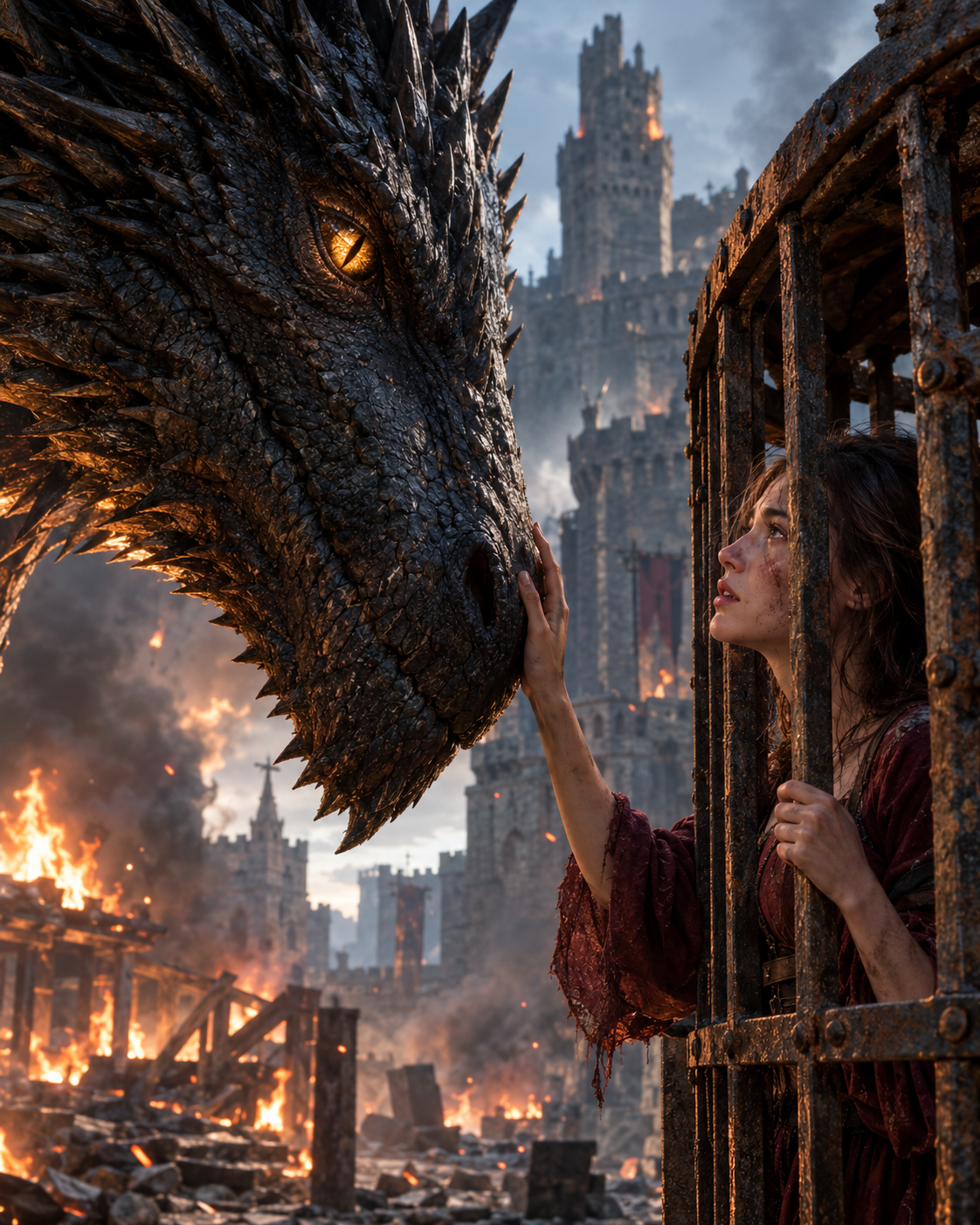
They chained me to the execution post outside the Boston Harbor granary while Marshal Durret laughed, unaware the dragon behind me already knew his biggest secret.
The sound came again.
Three strikes.
Slow.
Deliberate.
The floor beneath my boots trembled.
I looked at Corin.
He had gone pale.
“That isn’t a dragon,” he whispered.
Another three strikes came from somewhere beneath the stone.
This time, I felt them in my ribs.
“What is it?”
Corin closed the shutters.
Then he locked the door.
Only after checking the hallway twice did he turn back to me.
“Years ago,” he said, “before Durret became marshal, before the governor built the new garrison, there was another prison beneath Boston.”
“For prisoners?”
“For experiments.”
I stared at the ring of keys in my hand.
“The dragons?”
“Some.”
His voice dropped lower.
“The others were people.”
A cold sensation moved through me.
“People who survived what?”
Corin hesitated.
“What they did to them.”
I thought of Umber’s scars.
The twisted harness.
The iron pin buried in his jaw.
The strange symbol stamped into every piece of metal.
The same symbol now burned into my memory.
“Take me there.”
Corin shook his head.
“No.”
“Seven dragons are chained beneath this city.”
“Eight.”
I looked up.
He swallowed.
“Umber was the eighth.”
For several seconds neither of us spoke.
“Then why did you say seven?”
“Because one is dead.”
Something inside me tightened.
“How long?”
“Twenty years.”
“And nobody knew?”
“People knew. They just called the noises earthquakes.”
He crossed the room and lifted a loose floorboard.
Beneath it was a narrow iron hatch.
My fingers closed around the keys.
“You’ve been down there.”
“Once.”
“What happened?”
Corin looked at me with an expression I had never seen on his face before.
“I heard someone begging behind a wall.”
“Did you open it?”
“No.”
“Why?”
“Because Durret was standing behind me.”
The memory seemed to choke him.
I crouched beside the hatch and inserted the first key.
It turned easily.
The lock opened with a soft click.
Corin grabbed my wrist.
“Neva, once we go down there, we may not come back.”
I looked at the blackened keys.
“I’ve spent my whole life opening doors.”
I lifted the hatch.
“Maybe some doors were waiting for me.”
The staircase descended farther than it should have.
Twenty steps became fifty.
Fifty became a hundred.
The air grew colder and smelled of salt, blood, and something metallic.
At the bottom, we found a corridor cut directly into the bedrock.
Iron doors lined both sides.
Each carried the same crooked symbol.
I touched the first one.
A sound came from behind it.
A cough.
Human.
I froze.
“Hello?”
Nothing.
Then a woman’s voice whispered,
“Please.”
Corin grabbed my shoulder.
“Keep moving.”
“No.”
“Neva.”
“If someone is alive—”
“You don’t understand.”
I unlocked the door.
Corin closed his eyes.
The room beyond was tiny.
There was a bed.
A bucket.
A rusted chain.
And a woman sitting against the wall.
She looked impossibly old.
Her hair was white.
Her wrists were scarred.
But her eyes were sharp.
Very sharp.
She stared at the keys in my hand.
“How did you get those?”
“Corin gave them to me.”
Her gaze snapped toward him.
“You brought her here?”
“I had no choice.”
The woman laughed bitterly.
“Nobody ever has a choice down here.”
She tried to stand and nearly collapsed.
I caught her.
“What’s your name?”
She looked at me for a long moment.
“Elian.”
“How long have you been here?”
She smiled.
“Long enough to forget what the sky looks like.”
My stomach turned.
“Who put you here?”
“The city.”
“Why?”
“Because I knew how the dragons were made.”
Corin looked away.
I stared at him.
“Made?”
Elian saw the question in my face.
“Yes,” she said. “You thought Umber was born a monster.”
She pointed at the scars on her own wrists.
“He was born wild. They turned him into one.”
She told us everything.
Twenty-four years earlier, Boston’s governors had discovered that dragons could sense underground heat and detect movement through stone. The city had been expanding its granaries, armories, and tunnels, and someone realized that dragons could be used to guard them.
But wild creatures could not be controlled.
So the officials funded a secret project.
They captured dragons.
They bred them.
They experimented on their bodies.
They created harnesses that could trigger pain through pressure points along the jaw and spine.
Then they discovered something worse.
Dragons could be made to obey not through fear alone, but through memory.
“If you hurt them in the right way,” Elian said, “they begin associating certain sounds with pain.”
“The bells,” I whispered.
She nodded.
“The three bells.”
Every time the city bells rang three times, the dragons were trained to attack anyone standing near a marked target.
I remembered the East River Gate.
The third bell.
The guards waiting.
Durret watching.
He hadn’t been afraid that Umber would attack the crowd.
He had been waiting to see whether the conditioning still worked.
“He knew,” I said.
“Of course he knew.”
“Then why did Umber ignore it?”
Elian looked at me.
“Because you touched him first.”
I didn’t understand.
“Your hand broke the pattern.”
“What pattern?”
“Pain. Command. Obedience.”
She pointed toward the corridor.
“They taught the dragons that every human touch meant pain. You gave him something different.”
For a moment I could not speak.
Then another sound echoed through the underground.
A roar.
Not angry.
Terrified.
Elian’s face changed.
“They’ve started moving them.”
“Who?”
“Durret.”
Corin stepped forward.
“Why?”
“Because the hearing is a trap.”
My blood went cold.
“What hearing?”
“The public hearing for Neva.”
Elian looked at me.
“They intend to put you on trial for opening the granary. They will call you a thief, a rebel, a dragon sympathizer.”
She paused.
“And when the crowd gathers, Durret will bring the dragons above ground.”
Corin’s face drained of color.
“He’ll use them to crush the rebellion.”
“Not crush it,” Elian said.
“Start it.”
I understood.
Durret didn’t need to defeat the rebels.
He needed them to attack first.
Then he could declare martial law.
Burn the districts.
Arrest anyone who resisted.
And blame the dead on the dragon.
“How many people know?”
“Enough,” Elian said.
“And how many are working for him?”
“More than you think.”
A distant door slammed.
Then another.
Boots echoed through the corridor.
Corin whispered,
“They’re here.”
I looked at the ring of keys.
There were seven dragons.
Maybe more prisoners.
Maybe an entire city buried beneath ours.
And soldiers were coming.
“Which way?”
Elian pointed down the corridor.
“Past the old cistern.”
“Where does it lead?”
“The dragon chamber.”
“How do we get there?”
She smiled for the first time.
“You open the doors.”
We ran.
The corridor seemed to twist beneath the city like the inside of some enormous machine.
Behind us, soldiers shouted.
Ahead came the sound of chains dragging across stone.
We reached the cistern.
It was enormous.
Black water filled a circular chamber beneath the streets.
Seven iron gates stood around its edge.
Behind the first, something moved.
A pair of golden eyes opened.
Then another.
Then another.
Seven dragons.
Some were enormous.
Some were thin and skeletal.
One had no wings.
Another had scars across both eyes.
A third was so young that its horns had barely formed.
They had been living in darkness for years.
I felt sick.
“How do I free them?”
Corin pointed to the wall.
“Each gate has a release mechanism.”
I looked.
There were hundreds of gears.
Chains.
Counterweights.
Locks.
The whole system was designed to prevent a single person from opening everything.
Unless that person understood locks.
I smiled despite myself.
“Good.”
Corin stared at me.
“Good?”
“They made it complicated.”
I dropped to my knees.
The first lock took ten seconds.
The second took twenty.
The third resisted.
I heard soldiers entering the corridor.
“Faster,” Corin whispered.
“I am going as fast as I can.”
A gunshot cracked through the darkness.
Stone exploded beside my head.
“Neva!”
I twisted the final pin.
The lock opened.
The first gate rose.
The dragon behind it did not move.
It stared at me.
Then it stepped forward.
I opened the second.
Then the third.
The chamber filled with the sound of metal screaming upward.
The soldiers appeared on the stairs.
“STOP!”
I opened the fourth.
A soldier fired.
The bullet struck the chain beside me.
The dragon behind the gate roared.
The soldiers froze.
I opened the fifth.
The sixth.
The seventh.
For one heartbeat, the entire chamber was silent.
Then the dragons moved.
Not toward the soldiers.
Toward the open passage.
Toward the stairs.
Toward the sky they had not seen in years.
The soldiers broke.
Some dropped their weapons.
Others ran.
One man slipped and fell into the water.
The largest dragon stepped over him.
It didn’t kill him.
It simply kept walking.
I watched them disappear into the tunnel.
Then I heard something behind me.
Applause.
Slow.
Deliberate.
I turned.
Marshal Durret stood at the entrance.
He was alone.
“Very impressive,” he said.
Corin stepped in front of me.
Durret smiled.
“You’ve done exactly what I needed.”
My heart sank.
“What?”
“The dragons are loose.”
He held up a small brass device.
Three bells were engraved on its surface.
“Every soldier in Boston has been told that the rebels released them.”
He pressed a lever.
The device rang three times.
Far above us, something roared.
Then another.
Then another.
Durret smiled.
“By morning, the city will beg me to restore order.”
I stared at him.
“You planned this.”
“Of course.”
“You knew I would open them.”
“I knew you couldn’t resist.”
He looked at the keys in my hand.
“People like you always believe every locked door exists to keep something bad inside.”
He stepped closer.
“Sometimes the lock is the only thing keeping the world alive.”
Then he turned.
“Enjoy your freedom.”
The doors slammed behind him.
I ran after him.
Too late.
Iron bars dropped from the ceiling.
Corin pulled me back.
“He’s sealed us in.”
I looked at the dark water.
At the empty cages.
At the tunnels leading toward the city.
Then I heard it.
A distant roar.
Followed by screaming.
Not dragon screams.
People.
Durret had begun the massacre.
“We have to get out.”
Corin shook the bars.
“They’re too thick.”
I examined the mechanism.
The bars were connected to a central locking wheel.
Three pins.
One release.
I smiled.
“What?”
“Nothing is too thick.”
I pulled the wire from my sleeve.
It was bent.
Almost useless.
But not quite.
My hands moved.
Pin.
Gear.
Latch.
Counterweight.
Click.
The bars rose.
We ran.
The city above had changed.
Smoke covered the streets.
People were fleeing toward the harbor.
Soldiers marched in formation.
The bells rang again and again.
And above the rooftops, dragons flew through the smoke.
But they were not attacking people.
They were circling.
Searching.
Waiting.
Then I saw Umber.
He landed on the roof of the granary.
His head turned toward me.
I understood.
He was looking for me.
“Umber!”
He lowered himself.
Corin grabbed my arm.
“That’s impossible.”
“Apparently not.”
We climbed.
The dragon lifted us above the burning streets.
From the roof, I saw what Durret had done.
The garrison gates were closed.
The armory was burning.
But the fires were strangely contained.
The dragons had knocked down soldiers’ weapons instead of attacking civilians.
They were controlling themselves.
Someone was controlling them.
Not through bells.
Through trust.
“Look,” Corin whispered.
At the center of the square stood Durret.
He was surrounded by soldiers.
Bram was there too.
Blood covered his face.
He was kneeling.
Durret raised his sword.
“Your rebellion ends tonight.”
Bram looked up.
“Not if the city sees the truth.”
Durret laughed.
“You think anyone will believe you?”
I stepped forward onto the roof.
“They will believe me.”
Durret looked up.
His face changed.
“Neva.”
The crowd turned.
I held up the ring of keys.
“These were beneath the city.”
Silence spread through the square.
I pointed toward the underground entrance.
“There are people down there who have been imprisoned for decades.”
Durret shouted,
“She’s lying!”
Elian stepped onto the roof beside me.
The crowd gasped.
Some people recognized her.
An old woman whispered,
“Elian?”
Others began to murmur.
Durret’s face went white.
Elian raised her voice.
“I was a physician when they took me.”
She told them about the experiments.
About the dragons.
About the bells.
About the harnesses.
About the prisoners.
One by one, other people emerged from the tunnels.
Some were old.
Some were injured.
Some had been children when they disappeared.
Every one of them carried a story.
Durret’s soldiers began lowering their weapons.
The marshal shouted,
“Do not listen to them!”
A young soldier stepped forward.
“My brother disappeared twelve years ago.”
Durret turned.
“What?”
The soldier stared at him.
“He was nineteen.”
He dropped his rifle.
“I was told he deserted.”
Another soldier lowered his weapon.
Then another.
The square changed in a single breath.
Not because someone had won.
Because people had finally been given the truth.
Durret backed away.
“You fools.”
He looked at the dragons above.
“You think they will protect you?”
Umber landed behind him.
The stones cracked beneath his claws.
Durret turned slowly.
The dragon lowered his head.
For a moment, I thought Umber would kill him.
He could have.
One breath would have ended everything.
Instead, Umber looked at me.
I walked toward him.
Then I looked at Durret.
“Let him live.”
The crowd went silent.
Bram stared at me.
“Why?”
I answered without looking away.
“Because if he dies, people will remember a monster.”
I pointed toward the prisoners.
“If he lives, he has to answer for every person he buried.”
Durret was arrested before sunrise.
The governor resigned two days later.
The underground prison was opened.
The surviving dragons were moved beyond the city, to the northern forests where no harness could reach them.
The bells were taken down.
The cages were melted.
And the black symbol that had once meant obedience became something else.
A warning.
Years later, people still told stories about the night the dragons flew over Boston.
Some called it a rebellion.
Some called it a miracle.
Some called it the beginning of a new age.
I never called it any of those things.
To me, it was the night people learned that a locked door could hide a prisoner, a secret, or a terrible truth.
And that opening it was only the beginning.
I became the keeper of the old tunnels.
Not because I wanted power.
Because I had learned what happened when nobody looked beneath the surface.
Every year, on the anniversary of Umber’s escape, I returned to the East River Gate.
I would stand there alone and listen to the wind.
Sometimes, if the night was clear, I could hear wings far beyond the hills.
I never knew whether it was Umber.
I liked not knowing.
Freedom, I discovered, was not ownership.
It was not command.
It was not the right to decide where another living thing should go.
Freedom was the chance to choose.
And perhaps that was why Umber had looked at me before he flew away.
He had understood something I had only begun to learn.
Saving someone does not mean making them belong to you.
Sometimes, saving them means opening the gate and having the courage to watch them leave.
The city never became perfect.
There were new officials.
New laws.
New locks.
People still lied.
People still became afraid.
And sometimes, people still tried to use fear as an excuse for control.
But whenever someone asked me how the dragons had been defeated, I always gave the same answer.
“They weren’t.”
“They were finally allowed to stop fighting.”
And beneath the city, where the old prison once stood, we carved a single sentence into the stone.
Not a warning.
Not a command.
A reminder.
No creature is born a monster simply because someone profits from treating it like one.
Under those words, I left the first key.
The one that had opened Umber’s cage.
The metal was black with age.
The teeth were worn.
But it still worked.
And that was the lesson I carried for the rest of my life:
Sometimes the strongest person in the room is not the one holding the weapon.
Sometimes it is the one who chooses not to use it.
For twelve years, I believed the story had ended at the East River Gate.
I was wrong.
The city changed after Durret’s fall, but cities do not forget easily.
Neither do people.
The old prison beneath Boston was sealed, then opened again, then sealed once more when the engineers discovered that the tunnels extended far beyond the harbor.
There were passages beneath the granary.
Passages beneath the governor’s house.
Passages beneath churches, warehouses, and streets that had existed long before anyone remembered building them.
Most were empty.
Some contained bones.
And one contained a door no key could open.
I discovered it on a rainy morning in the seventh year after Umber’s escape.
By then, I had become responsible for the underground archives.
It was not a position I had asked for.
Nobody trusted the old tunnels enough to work there, and nobody wanted the keys.
So they gave them to me.
I suppose they thought I was the only person foolish enough to accept.
That morning, I was inspecting a collapsed passage when I found the door.
It was enormous.
Black iron.
No handle.
No hinges.
No keyhole.
Only the crooked symbol.
The same symbol that had been stamped onto Umber’s harness.
I stood there for a long time.
Then I heard something.
Three knocks.
I froze.
The sound came from the other side.
Three slow knocks.
Just like the ones Corin and I had heard years before.
But this time, I was alone.
I placed my palm against the metal.
“Who’s there?”
Nothing.
Then another three knocks.
I ran for the stairs.
By sunset, Corin was standing beside me.
He was older now.
His hair had turned almost completely white.
But when he saw the door, every trace of age seemed to disappear from his face.
“No,” he whispered.
“What?”
“I thought they destroyed it.”
“Destroyed what?”
He didn’t answer.
Instead, he touched the symbol.
His hand trembled.
“Neva, we need to leave.”
I stared at him.
“You knew about this.”
“I knew there was a door.”
“You told me there were seven dragons.”
“I was wrong.”
“How wrong?”
He looked at me.
“There were nine.”
The words seemed to drain the warmth from the room.
“Nine dragons?”
“Eight were captured.”
“And the ninth?”
“Never captured.”
I looked at the door.
“Then what’s behind it?”
Corin swallowed.
“The reason they built the prison in the first place.”
We heard the knocking again.
Three times.
Then silence.
I took out my ring of keys.
Corin caught my wrist.
“You promised yourself you would never open another door without knowing what was behind it.”
“I never made that promise.”
“You should have.”
I smiled faintly.
“Then why did you bring me here?”
He didn’t answer.
Because he knew.
We both knew.
There are some doors that become impossible to ignore once you discover them.
I tried every key.
The first.
Nothing.
The second.
Nothing.
The third.
Nothing.
One by one, I tested all of them.
Nothing.
Then I noticed something strange.
The final key had begun to warm in my hand.
I pulled it away.
The metal was glowing faintly.
Corin stepped backward.
“Put it down.”
“I can’t.”
“Neva.”
The key moved on its own.
Not far.
Only an inch.
But enough.
It slid toward the door.
Then struck the iron.
A sound like a heartbeat echoed through the chamber.
Once.
Twice.
Three times.
The symbol on the door began to glow.
And somewhere deep beneath us, something enormous awakened.
The door opened.
Not outward.
Inward.
Beyond it was darkness.
Then two golden eyes appeared.
Corin stopped breathing.
I did not move.
The creature stepped forward.
It was a dragon.
But unlike any dragon I had ever seen.
Its scales were pale as old bone.
Its wings were scarred.
Its horns were broken.
Chains were wrapped around its body so tightly that they had grown into its flesh.
But its eyes were not wild.
They were tired.
Ancient.
And terribly intelligent.
Corin whispered one word.
“Mother.”
The dragon looked at him.
Then at me.
Then at the keys.
A sound came from deep inside its chest.
Not a roar.
A sigh.
I stepped closer.
“Who are you?”
The dragon lowered its head.
For several seconds, nothing happened.
Then a voice entered my mind.
Not through my ears.
Through something deeper.
A word.
A name.
Aurelia.
I staggered backward.
Corin caught me.
“You heard her.”
I nodded.
“She spoke.”
He closed his eyes.
“Then the old stories were true.”
“What stories?”
“That the first dragons did not come to Boston.”
He looked at Aurelia.
“Boston was built around them.”
The truth unfolded slowly.
Long before the harbor existed, before the first ships arrived, the land beneath the city had been home to dragons.
They had lived beneath the earth because the tunnels were warm.
They had guarded the underground rivers.
They had protected the people who first settled there.
For generations, humans and dragons lived beside one another.
Then came greed.
Someone discovered that dragon blood could withstand enormous heat.
Someone else discovered that dragon bone could strengthen iron.
And eventually, someone realized that a dragon could be turned into a weapon.
The first harness had been made almost a century before Durret.
Every generation had added something to it.
Every generation had forgotten why it was built.
Until the weapon became tradition.
Until cruelty became law.
Until nobody remembered the difference.
Aurelia had been captured because she refused to submit.
She had been chained beneath the city for decades.
The other dragons had been descendants of hers.
Umber included.
I stared at her chains.
“Why didn’t they kill you?”
Corin answered.
“Because they couldn’t.”
Aurelia’s eyes turned toward the tunnel behind us.
Then I heard something.
Voices.
Boots.
Hundreds of them.
Corin looked frightened.
“They found us.”
“Who?”
He looked at the glowing symbol.
“The people who built the old system never disappeared.”
The soldiers entered the chamber.
But they were not wearing the governor’s uniforms.
Their coats were black.
Their weapons were strange.
At their front stood a man I had never seen before.
He was old.
Elegant.
Calm.
He looked at Aurelia without fear.
“Finally,” he said.
Corin stepped in front of me.
“Who are you?”
The man smiled.
“My family owned the original laboratory.”
I felt the blood leave my face.
“Durret worked for your family.”
“Durret worked for whoever paid him.”
The man looked at the dragon.
“And now we are going to finish what he began.”
Aurelia roared.
The entire tunnel shook.
Dust fell from the ceiling.
The soldiers raised their weapons.
I looked at the dragon.
Then at the chains.
Then at the man.
He had made one mistake.
He had assumed Aurelia was still a prisoner.
She wasn’t.
Not anymore.
I had learned something over the years.
Locks were never really about metal.
They were about understanding what held something in place.
I ran toward Aurelia.
“Neva!”
Corin shouted.
I climbed the chains.
The soldiers fired.
Bullets struck the stone around me.
I kept moving.
The first chain was enormous.
Too thick for any ordinary tool.
But near Aurelia’s neck, I saw it.
A locking mechanism.
Old.
Complicated.
Beautiful.
I smiled.
“Hello, old friend.”
I pulled out my wire.
The soldiers were almost upon me.
The mechanism had six pins.
Five moved.
The sixth refused.
I tried again.
Nothing.
Aurelia shifted.
The chain tightened.
I looked into her eyes.
“Hold still.”
She did.
Just as Umber had done years before.
My hands remembered.
The pressure.
The angle.
The tiny movement required to release the pin.
Click.
The chain fell.
The soldiers stopped.
Aurelia lifted her head.
The second chain broke.
Then the third.
The fourth.
The fifth.
Every piece of iron that had bound her for decades crashed against the floor.
The chamber shook.
The man in black raised his weapon.
“Kill them!”
Nobody fired.
Because Umber was standing behind him.
The old dragon had followed us.
His wings filled the tunnel.
His golden eyes burned in the darkness.
Behind him came the others.
Every dragon that had escaped.
They had returned.
Not because they were commanded.
Not because they were trained.
Because they had chosen to come back.
The man looked around.
For the first time, fear entered his face.
Aurelia stepped forward.
Umber moved beside her.
The other dragons formed a circle.
No fire came.
No attack.
Just silence.
I looked at the man.
“You wanted weapons.”
I pointed toward the dragons.
“These are not weapons.”
Aurelia’s voice entered my mind.
They are witnesses.
Then she opened her wings.
The force of it knocked every weapon from the soldiers’ hands.
The man fell to his knees.
And for the first time in generations, the people beneath Boston saw the creatures they had spent centuries trying to control.
Not monsters.
Not weapons.
Not servants.
Witnesses.
The truth spread through the city before sunrise.
The secret organization was dismantled.
Its records were opened.
Its laboratories were destroyed.
Every remaining harness was melted down.
And the last underground chamber was turned into a memorial.
But Aurelia did not remain beneath Boston.
Neither did Umber.
At dawn, the dragons gathered on the cliffs beyond the harbor.
People came to watch.
Thousands of them.
No chains.
No cages.
No soldiers.
Just humans standing quietly as the dragons prepared to leave.
Corin stood beside me.
“Are you sad?”
I watched Umber spread his wings.
“Yes.”
He smiled.
“Good.”
I looked at him.
“Good?”
“It means you understand what freedom costs.”
Umber looked at me one last time.
Then he rose into the sky.
Aurelia followed.
The others disappeared beyond the clouds.
I stood there until they were gone.
Years later, children would ask me whether dragons still lived beyond the northern mountains.
I always told them the truth.
“I don’t know.”
They would look disappointed.
Then I would smile.
“That’s the point.”
Because a creature is not truly free if you must know where it is every hour.
A creature is not truly safe if someone is always standing nearby with a chain.
And a person is not truly powerful because they can force another being to obey.
Real power is the ability to hold a key in your hand and understand that you do not own what it unlocks.
On the anniversary of that final night, I returned to the East River Gate.
The city had built a small stone monument there.
No statue of me.
No statue of Umber.
Only a single open gate carved into the stone.
Beneath it were seven words:
“Leave the door open behind you.”
I placed my old iron key beneath the inscription.
The same key that had opened Umber’s cage.
The same key that had opened Aurelia’s chains.
The metal was worn almost smooth now.
I turned to leave.
Then I heard it.
Three distant knocks.
I stopped.
The sound came from somewhere beyond the harbor.
Three times.
Slow.
Deliberate.
I smiled.
Not because I believed another prison was waiting for me.
Not because I thought the past would return.
I smiled because this time, I knew the difference.
Some doors should be opened.
Some doors should stay closed.
And some doors should never have been built at all.
The important thing is not to fear the lock.
It is to ask who put it there, who benefits from keeping it closed, and what might happen if someone finally finds the courage to turn the key.
I looked toward the mountains.
For one brief moment, something enormous crossed the moon.
Then it vanished into the clouds.
I never saw it again.
And I never needed to.
Because for the first time in my life, I understood that letting something go did not mean losing it.
Sometimes it meant giving it the chance to become what it had always been meant to be.
Free.
THE END.