They called her a disgrace. Her own father decided she was worth less than the family name.
Lena stared at the date beneath her name, feeling an unfamiliar chill spread through her body despite the warmth of the fire.
The envelope had been sealed three years before the day her father claimed her mother had died.
For most of her life, Lena had believed her mother passed away during a terrible winter fever, leaving behind a grieving husband and a frightened little girl.
But the handwriting on the envelope was unmistakable.
She remembered those delicate letters from the birthday cards her mother used to tuck beneath her pillow.
“Why would my mother write this so long before she died?” Lena whispered.
Silas sat across from her, his weathered hands resting heavily on his knees.
“Because she knew something was coming,” he answered.
Lena carefully broke the seal.
Inside was a folded letter, yellowed with age, and a small silver key wrapped in faded blue ribbon.
Her mother’s words began with a sentence that made Lena’s heart ache.
My dearest Lena, if you are reading this, it means someone finally loved you enough to tell you the truth.
Lena pressed a trembling hand against her mouth.
The letter described a life very different from the childhood stories her father had told.
Her mother, Eleanor Whitmore, had inherited a considerable stretch of mountain land from her own parents.
The property included timber rights, a freshwater spring, and nearly two thousand acres of untouched forest bordering the western slopes of the valley.
When Eleanor married Thomas Whitmore, Lena’s father, he had promised to protect the inheritance for their children.
Instead, he secretly began borrowing money against property he did not legally own.
He wanted influence, political connections, and a grand house that would make everyone in the county admire him.
By the time Eleanor discovered the missing money, her husband had already placed the family dangerously close to ruin.
She confronted him and demanded that he return what he had taken.
Thomas refused.
And when Eleanor threatened to expose his dealings, he accused her of embarrassing the family.
Lena stopped reading.
“That’s exactly what he said about me,” she whispered.
Silas nodded without speaking.
She returned to the letter.
Her mother had transferred the remaining protected land into a trust intended for Lena when she reached adulthood.
A local attorney had prepared the documents, and Silas Creed had witnessed Eleanor’s signature.
Thomas never forgave either of them.
Then came the paragraph that changed everything.
If your father ever tells you that my love for you disappeared, do not believe him. Whatever happens, remember that you were the greatest joy of my life.
Tears blurred the ink.
Lena looked up at Silas.
“Did he hurt her?”
Silas lowered his eyes.
“I don’t know everything that happened inside that house,” he said. “But I know she was afraid of him.”
“Then why didn’t you help?”
The question escaped before Lena could soften it.
Silas accepted it without defending himself.
“I tried, Lena. And I failed.”
He rose slowly and walked toward the window, where snowflakes drifted against the glass.
“Your mother came to my cabin one night, carrying that box. She asked me to protect the papers until she could get herself and you somewhere safe.”
“Why didn’t she leave?”
“Because your father threatened to accuse her of kidnapping you. He had friends in the courthouse, men who owed him favors.”
Lena looked down at the silver key.
“What does this open?”
“A strongbox hidden beneath the floor of your mother’s old sewing room.”
Lena stared at him.
“That room was locked after she died.”
“I know.”
For several moments, the only sound was the crackling fire.
Then Lena asked the question she had feared since opening the letter.
“How did my mother really die?”
Silas turned toward her.
“Officially, pneumonia. But Eleanor was perfectly healthy the last time I saw her.”
Lena felt the cabin tilt around her.
Silas approached, stopping far enough away to let her choose whether she wanted him closer.
“I won’t pretend I know what happened,” he said. “I only know that two days after she asked me to help her leave, your father announced she was dead.”
“Did you investigate?”
“I tried. Thomas told the sheriff I had threatened him. I was arrested and held for three weeks.”
“Why?”
“Because he needed me out of the way.”
Lena studied the scar crossing Silas’s left eyebrow.
For years, the town had described him as violent and dangerous.
Now she wondered how much of that reputation had been built by the man who had raised her.
“Why didn’t you tell anyone?”
“I did. Nobody wanted to listen.”
Outside, the wind grew stronger.
Lena folded her mother’s letter and held it against her heart.
For the first time, she understood that the truth might be more frightening than the stories she had been told.
But she also understood something else.
She was no longer willing to live inside those stories.
The following morning, Silas found Lena standing on the porch, watching sunlight spill across the snow-covered mountains.
She wore his spare wool coat, its sleeves rolled several times around her wrists.
“We need to go back to town,” she said.
Silas stopped beside her.
“Your father will be waiting.”
“I know.”
“He’ll try to frighten you.”
“He’s been frightening me my entire life.”
Silas studied her face.
“What are you planning?”
Lena held up the silver key.
“I’m going to find out what my mother left me.”
The journey down the mountain took nearly three hours.
They traveled in Silas’s old pickup truck, its tires crunching along narrow roads carved through pine forests.
By noon, the rooftops of Cedar Hollow appeared beneath a pale blue sky.
The little Colorado town looked exactly as Lena remembered.
There was the white-steepled church, the brick courthouse, the general store with its faded American flag, and the diner where farmers gathered before sunrise.
Yet everything felt different.
For the first time, Lena saw the town without automatically fearing its judgment.
Silas parked behind the old railway depot.
“There’s someone we should speak to before going to your father’s house,” he said.
He led her toward a narrow brick building beside the post office.
A weathered brass plaque beside the entrance read: HENRY CALDWELL, ATTORNEY AT LAW.
Inside, an elderly man with silver hair looked up from a desk crowded with legal papers.
When he saw Silas, the color drained from his face.
“Good Lord,” he whispered. “I never thought you’d come back.”
Silas stepped aside.
“This is Eleanor’s daughter.”
The attorney stared at Lena for a long moment.
“She has her mother’s eyes.”
Lena placed the letter on his desk.
“I need to know what happened to my mother’s land.”
Henry Caldwell removed his spectacles.
“Your father told everyone those documents had been destroyed.”
“They weren’t,” Silas answered.
The old attorney looked between them, then rose and locked the office door.
What followed was a conversation that left Lena shaking.
Henry explained that the trust Eleanor created was still legally valid.
Although Thomas had spent years claiming ownership of the entire mountain property, the protected acreage had never belonged to him.
The original documents were thought missing, but copies of certain records remained with the county.
“What happens if we find the originals?” Lena asked.
Henry leaned forward.
“Then your father may have spent twenty years making claims he had no right to make.”
Lena remembered something from the week before the auction.
Her father had been entertaining businessmen from Denver.
They wore expensive suits, drove polished black cars, and spoke excitedly about a resort development near the western mountains.
She had overheard one of them mention a freshwater source.
Now she understood.
“The spring,” she whispered.
Henry looked sharply at her.
“What spring?”
“The one on my mother’s property. My father was trying to sell the mountain.”
Silas’s jaw tightened.
Henry went to his filing cabinet and removed a thick folder.
“A development company recently requested a title review for land west of Cedar Hollow.”
He opened the folder.
“The proposed purchase is worth several million dollars.”
Lena stared at him.
“And if the land belongs to me?”
“Then your father cannot legally sell it without your authorization.”
The room fell silent.
Suddenly, the auction made a terrible kind of sense.
Her father had not simply wanted to remove the daughter who embarrassed him.
He had needed Lena isolated, discredited, and dependent.
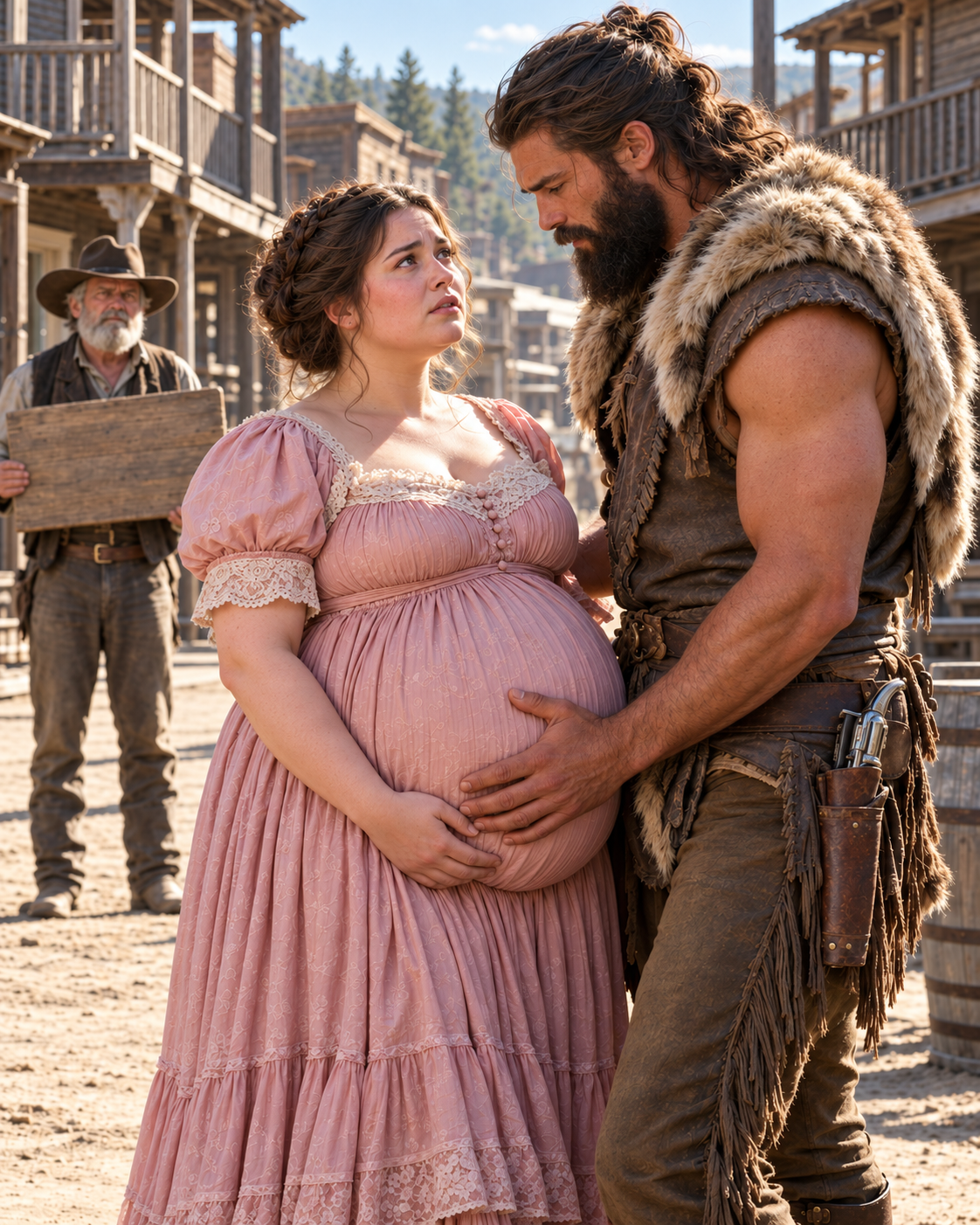
A pregnant unmarried woman publicly handed over to a feared mountain recluse would have little chance of being believed if she challenged a respected businessman.
But Thomas Whitmore had made one mistake.
He had chosen Silas Creed.
Henry accompanied them to the county records office, where they obtained certified copies of Eleanor’s recorded trust documents.
The clerk, a middle-aged woman named Margaret Bell, examined Lena with unmistakable sympathy.
“Your mother was a kind woman,” she said quietly.
Lena looked up.
“You knew her?”
“She taught my youngest daughter to read when we couldn’t afford tutoring.”
Margaret hesitated.
“There’s something else you should know.”
Silas turned toward her.
“Go on.”
“The night your mother died, I was working at the county hospital.”
Lena’s breathing slowed.
“Was she there?”
Margaret nodded.
“She arrived late, brought by your father. She was terribly weak.”
“Did she have pneumonia?”
Margaret pressed her lips together.
“I was only a receptionist, so I couldn’t know her diagnosis. But I remember hearing her ask for someone.”
“Who?”
Margaret looked directly at Silas.
“You.”
Silas went completely still.
“She kept saying that you would know where to find her little girl.”
Lena felt tears spill down her cheeks.
“Why didn’t anyone tell me?”
Margaret’s voice broke.
“Your father said you were too young and that bringing up her last hours would only hurt you.”
Silas gripped the edge of the counter.
After twenty years, he had finally learned that Eleanor had asked for him before she died.
And Lena understood why the mountain man carried so much silence.
He had never stopped believing he could have saved her mother.
They left the records office shortly after three.
But someone was already watching them.
Across the street, a black sedan sat outside the courthouse.
Lena recognized the driver immediately.
It was one of her father’s hired men.
“Silas,” she whispered.
“I see him.”
Before they could reach the pickup, the sedan pulled away.
Silas caught Lena’s arm gently.
“He’s going to tell your father we’re here.”
“Then we’d better move quickly.”
They drove toward the Whitmore estate, a sprawling white farmhouse overlooking the eastern valley.
Its towering columns and polished gates had once made Lena believe her family was important.
Now they looked like the walls of an elaborate prison.
Silas stopped near the old orchard.
“I’ll wait here.”
Lena shook her head.
“I’m not going inside alone.”
“You don’t have to.”
Together they approached the back entrance.
The kitchen door was unlocked.
Lena knew her father would be at his business office until evening, but she still felt her pulse racing as they entered.
Everything remained painfully familiar.
The polished silver.
The heavy curtains.
The portraits of ancestors staring from the hallway walls.
Upstairs, her mother’s sewing room stood at the end of the corridor.
The door was locked.
Lena inserted the silver key into the old brass mechanism.
For a moment, it resisted.
Then the lock clicked.
Inside, sunlight drifted across a room untouched for two decades.
There was a wooden rocking chair beside the window, a sewing machine covered with linen, and a small bookshelf filled with poetry.
Lena approached the floorboards near the fireplace.
Her mother’s letter had described a loose board beneath the corner cabinet.
Silas moved the cabinet aside.
Together, they lifted the board.
A small iron strongbox rested beneath it.
Lena opened it with the second key tied inside the blue ribbon.
Inside were property deeds, letters, receipts, and a leather-bound journal.
She opened the journal.
The first pages described ordinary things.
Summer picnics.
Lena’s first steps.
The flowers Eleanor planted beside the porch.
Then the entries changed.
Thomas had been secretly transferring money.
He had forged Eleanor’s signature on several documents.
And when she confronted him, he threatened to take Lena away.
One passage made Lena stop breathing.
Thomas says that if I leave him, nobody will believe a woman who accuses a respected man of wrongdoing. He has made certain the town thinks I am unstable.
Lena shut her eyes.
Her father had used the same cruelty against both of them.
Then she found the final entry.
If anything happens to me, the truth is in the letters to Judge Bennett. Silas knows where I intended to go. I pray my daughter grows up knowing that love should never require surrendering her freedom.
Before Lena could speak, footsteps sounded in the hallway.
A familiar voice came through the open door.
“Well, isn’t this touching?”
Thomas Whitmore stood at the entrance.
He wore a dark wool suit, his silver hair perfectly combed, his expression almost amused.
Behind him stood two large men.
“Lena,” he said smoothly. “You’ve caused quite enough embarrassment.”
Silas moved slightly closer to her.
Thomas’s smile vanished.
“And you. I should have known you’d come crawling back.”
Lena held the journal against her chest.
“This property belongs to me.”
Thomas laughed.
“You’re confused, sweetheart.”
“Stop calling me that.”
The room grew quiet.
Thomas’s eyes narrowed.
“You’re forgetting who raised you.”
“No,” Lena answered. “I’m remembering exactly who raised me.”
She opened the journal to the pages describing the forged documents.
“I know what you did to Mother.”
Thomas’s expression hardened.
“Your mother was a foolish woman who didn’t understand business.”
“She understood you.”
He stepped forward.
Silas immediately positioned himself between them.
“Don’t.”
Thomas looked at the hired men.
“Remove him.”
Neither man moved at first.
Silas Creed had a reputation that made even armed troublemakers reconsider their choices.
Thomas’s face darkened.
“I’m paying you to do a job.”
One man advanced.
Silas remained still.
“There’s a pregnant woman standing behind me,” he said quietly. “Think carefully about what kind of man you intend to be.”
The younger hired man lowered his eyes.
The older one hesitated.
Then another voice rang from downstairs.
“Thomas Whitmore, this is Sheriff Daniel Mercer.”
Thomas froze.
Heavy footsteps approached.
The sheriff entered with Henry Caldwell and two deputies.
Lena stared in surprise.
Henry gave her a reassuring nod.
“Before coming here, we filed an emergency petition with the county court and notified the sheriff that there might be evidence of fraudulent property transfers.”
Thomas recovered quickly.
“This is my house. These people are trespassing.”
Henry adjusted his glasses.
“Your daughter is a beneficiary of the trust, Thomas. And we have records sufficient to justify preserving the disputed documents pending a court hearing.”
Thomas pointed at Silas.
“That man kidnapped her!”
“No,” Lena said firmly.
Every face turned toward her.
“I came with Silas because I wanted to. I am here because I wanted to come. And I’m leaving because I want to leave.”
The sheriff looked at Thomas.
“She’s an adult. Unless you have evidence of a crime, you cannot force her to return.”
Thomas’s control finally cracked.
“After everything I’ve done for her!”
Lena felt something inside her settle.
For years, those words had frightened her.
Now they sounded hollow.
“You gave me a roof,” she answered. “But you made me believe I had to earn the right to stand beneath it.”
Thomas opened his mouth, but she continued.
“You taught me to fear shame more than cruelty. You taught me that other people’s opinions mattered more than the truth.”
Her voice trembled, yet she did not stop.
“And when I needed a father, you treated me like a problem to be removed.”
Silas stood beside her, saying nothing.
He understood that this moment belonged to Lena.
The sheriff collected the journal and documents for examination, recording their discovery and arranging for Lena to keep certified copies.
Thomas was not arrested that afternoon.
The sheriff explained that accusations required investigation, evidence, and proper legal proceedings.
But for the first time, Thomas Whitmore could not simply command everyone in the room.
He had to answer questions.
As Lena turned to leave, her father called after her.
“You’ll regret trusting that mountain savage.”
She stopped at the doorway.
Then she looked back.
“The only thing I regret is how long I believed you.”
Outside, the afternoon sky had turned a brilliant shade of gold.
Lena walked toward Silas’s truck with tears on her cheeks.
But she was smiling.
For the first time in her life, she had walked away from her father without asking permission.
The weeks that followed were difficult.
Thomas hired attorneys.
Rumors spread through Cedar Hollow.
Some townspeople insisted Lena was being manipulated by Silas.
Others began remembering the kindness of Eleanor Whitmore and questioning the story they had accepted for twenty years.
Henry worked with an independent investigator to examine the forged documents and financial records.
The county hospital’s surviving records confirmed that Eleanor had died after being admitted with a serious illness.
They did not establish that Thomas had caused her death.
Lena struggled with that uncertainty.
One evening, sitting beside the cabin fireplace, she asked Silas whether he thought her father had deliberately harmed her mother.
Silas stared into the flames.
“I’ve spent twenty years wondering,” he admitted.
“Don’t you want to know?”
“Of course.”
“Then why aren’t you angry?”
He gave a tired smile.
“I am angry, Lena. But anger isn’t evidence, and suspicion isn’t the truth.”
She considered his words.
Silas continued.
“Your mother deserves to be remembered for the life she lived, not only for the questions surrounding her death.”
Lena looked at Eleanor’s journal resting on the table.
For the first time, she understood.
Her mother had been more than a victim.
She had been a woman who loved books, helped neighbors, planted gardens, and fought to protect her daughter.
That was the legacy Lena wanted to carry forward.
As winter slowly loosened its grip on the mountains, Lena began building a life of her own.
She learned to drive Silas’s truck along the narrow forest roads.
She helped repair the cabin’s old greenhouse.
She read her mother’s poetry books and wrote letters to women who had known Eleanor.
Most importantly, she began making decisions without apologizing for them.
Silas never questioned whether she would stay.
One morning, he placed a set of keys on the kitchen table.
“Henry found a small cottage in town you could rent,” he explained. “If you’d rather live closer to the doctor and the shops, I’ll help you move.”
Lena stared at him.
“Are you asking me to leave?”
“No.”
“Then why would you arrange that?”
Silas looked almost embarrassed.
“Because I told you that you had a choice. I meant it.”
Lena felt her throat tighten.
Her father had used gifts to demand obedience.
Silas offered kindness without keeping score.
She picked up the keys, examining them thoughtfully.
“Maybe I’ll visit the cottage,” she said.
“Whenever you like.”
“But tonight, I’d rather stay here.”
Silas nodded.
And somehow, that simple exchange meant more to Lena than a hundred promises.
By early spring, the investigation into Thomas’s financial dealings had uncovered forged signatures, fraudulent loan applications, and false representations made during the proposed resort sale.
The development company withdrew its offer.
Civil proceedings began to recover money improperly taken from Eleanor’s estate, while prosecutors reviewed the evidence for possible criminal charges.
The court confirmed that the protected mountain acreage belonged to the trust established for Lena.
Thomas’s attorneys challenged the decision, but the recorded deeds and original documents were difficult to dispute.
The man who had built his life around appearances now faced the consequences of his own decisions.
Yet Lena discovered that winning a legal battle did not erase years of hurt.
Some nights, she still dreamed of standing at the auction house while strangers judged her.
Sometimes she woke believing she had heard her father’s angry voice.
Silas never told her to forget.
He simply reminded her where she was.
One night, when rain tapped softly against the windows, Lena found him carving a tiny wooden cradle beside the fire.
“What’s that?” she asked.
He looked down at his work.
“Thought the baby might need somewhere to sleep.”
Lena smiled.
“You’ve never asked whether it’s a boy or a girl.”
“Doesn’t much matter to me.”
“Why not?”
Silas shrugged.
“Every child deserves to arrive somewhere they’re wanted.”
Lena sat beside him.
For a long while, neither spoke.
Then she rested her hand over his.
“Silas, do you know what frightened me most when I came here?”
He shook his head.
“That someday you’d decide I was too much trouble.”
His knife stopped moving.
“Lena…”
“But you never made me feel that way.”
Silas looked at her, his expression softening.
“You were never trouble.”
She took a shaky breath.
“I spent so long believing I needed someone else’s permission to be happy.”
“And now?”
“Now I think happiness might be something I can choose.”
Silas gently turned his hand beneath hers, letting their fingers rest together.
Neither rushed to define what was growing between them.
Their affection had begun with trust, strengthened through patience, and deepened in the ordinary moments of everyday life.
And Lena knew that whatever their future held, she would never again confuse love with ownership.
Three months later, on a warm June morning, Lena went into labor.
Silas drove her to the county hospital, gripping the steering wheel so tightly that his knuckles turned white.
“You’re more nervous than I am,” Lena teased between contractions.
“That’s not possible.”
“It absolutely is.”
Despite her pain, she laughed.
Hours later, as sunlight poured through the hospital windows, a baby girl entered the world.
She had dark hair, tiny curled fingers, and a surprisingly powerful cry.
When the nurse placed her in Lena’s arms, the young mother began to weep.
Not from shame.
Not from fear.
But from a love so overwhelming that words seemed insufficient.
Silas stood near the doorway, uncertain whether he should approach.
Lena looked up.
“Come meet her.”
He crossed the room slowly.
When he saw the sleeping infant, his weathered face changed.
Something gentle emerged from beneath the years of loneliness.
“She’s beautiful,” he whispered.
Lena smiled.
“Her name is Eleanor Rose.”
Silas closed his eyes.
For a moment, the man who had endured twenty years of isolation looked as though he might cry.
“Your mother would have loved that,” he said.
“I think she would have loved you being here, too.”
Silas shook his head, overwhelmed.
Lena reached for his hand.
“Would you like to hold her?”
He hesitated.
“My hands are rough.”
“Then she’ll know what hardworking hands feel like.”
He carefully accepted the newborn, cradling her as though she were the most precious thing in the world.
And when Eleanor Rose curled one tiny hand around his finger, Silas began to cry.
Quietly.
Without embarrassment.
Lena watched him and realized that the town had been wrong about this man in almost every way that mattered.
They had mistaken silence for cruelty.
Solitude for danger.
And scars for proof that someone was incapable of tenderness.
Later that summer, Henry Caldwell visited the cabin with news.
The court had rejected Thomas’s latest challenge to the trust.
Lena’s ownership rights had been upheld, subject to the remaining legal proceedings over the disputed financial transactions.
Her mother’s property was secure.
Henry also brought a personal letter.
It was from Thomas.
Lena read it alone on the porch.
Her father claimed he had only wanted what was best for the family.
He blamed misunderstandings, bad advice, and the cruelty of public gossip.
But he never clearly admitted what he had done to Eleanor or Lena.
At the bottom, he asked his daughter to visit him.
Lena folded the letter.
For several minutes, she stared across the mountains.
Then she carried it inside and placed it in a drawer.
Silas noticed.
“Everything all right?”
“Yes.”
“Do you want to talk about it?”
“Not today.”
He nodded.
Lena looked at her sleeping daughter.
“Maybe someday I’ll speak to him. But it won’t be because I’m afraid not to.”
Silas smiled.
“That’s a good enough reason to wait.”
The following autumn, Lena made a decision that surprised the entire county.
Instead of selling her inherited land to wealthy developers, she established a small community trust dedicated to preserving the mountain forest.
A portion of the property would support affordable housing and temporary shelter for women and children facing difficult circumstances.
She named the first renovated cottage Eleanor’s Haven.
The opening ceremony drew dozens of people from Cedar Hollow.
Some came out of curiosity.
Others came because they remembered Eleanor’s kindness.
Margaret Bell brought homemade bread.
Henry Caldwell donated books.
Even several people who had stood silently at the auction house arrived to apologize.
Lena accepted their words with grace, though she did not pretend that forgiveness could undo what had happened.
Standing beneath the golden autumn leaves, she addressed the gathering.
“A year ago, I believed my future had already been decided for me.”
Her voice carried across the quiet clearing.
“I thought being rejected meant I had no value. I thought making a mistake meant I didn’t deserve another chance.”
She glanced toward Silas, who stood near the back holding Eleanor Rose.
“But I learned something important from a man this town taught me to fear.”
Silas lowered his head, uncomfortable with the attention.
Lena smiled.
“Kindness doesn’t always arrive wearing a friendly face. And cruelty doesn’t always announce itself with an angry voice.”
The crowd listened silently.
“Sometimes, the people who speak most about honor forget how to show compassion. And sometimes, the people everyone judges are the very ones who understand what it means to protect another human being.”
She paused, looking at the little cottage behind her.
“This place is for anyone who has ever been told they are worth less because of their circumstances.”
Her voice grew stronger.
“Because nobody should have to earn the right to be treated with dignity.”
Applause rose through the trees.
Lena felt tears gathering in her eyes.
But this time, she did not lower her head.
She stood tall.
Beside Silas.
Beside the daughter who would grow up knowing she was loved.
And beneath the mountains her mother had fought to preserve.
That evening, after the last visitors departed, Lena and Silas sat together on the porch of the cabin.
The autumn sky shimmered with stars.
Eleanor Rose slept peacefully inside.
Silas handed Lena a warm cup of tea.
“Your mother would have been proud of you.”
Lena smiled.
“I hope so.”
“She would.”
She leaned gently against his shoulder.
After a long silence, Silas spoke.
“Do you ever wish things had happened differently?”
Lena considered the question.
She wished her mother had lived.
She wished her father had loved her without conditions.
She wished she had never experienced the humiliation of that terrible afternoon.
But she also knew something now that she had not known before.
Pain did not have to become the final chapter of a person’s life.
“I wish some things had been kinder,” she answered. “But I don’t wish away the woman I’ve become.”
Silas looked at her.
“And who is that?”
Lena smiled toward the glowing window where her daughter slept.
“A mother. A woman who can make her own choices. Someone who’s finally learning not to be afraid.”
Silas reached for her hand.
“And someone very brave.”
She squeezed his fingers.
“Someone who had a little help.”
They sat together as the moon rose over the valley.
Lena thought about the day Silas had stepped forward at the auction.
For so long, she believed he had rescued her simply by taking her away.
But now she understood the deeper truth.
He had not saved her by deciding her future.
He had helped her save herself by giving her the freedom to decide it.
And that was the difference between possession and love.
The following spring, Lena and Silas married beneath the flowering apple trees beside the cabin.
It was a small ceremony, attended by close friends, with Eleanor Rose scattering petals from a little woven basket.
Lena walked toward Silas wearing a simple cream-colored dress.
There was no grand ballroom, no expensive jewelry, and no audience waiting to judge her worth.
Only the people who genuinely cared about them.
When the officiant asked whether she freely chose to marry the man standing before her, Lena looked into Silas’s eyes.
“I do,” she answered.
Then she laughed softly through her tears.
“And this time, nobody gets to make that choice for me.”
Silas smiled, his eyes shining.
Their marriage did not erase the hardships behind them.
It did not transform their lives into something perfect.
There were still difficult days, unfinished legal matters, and old wounds that required patience.
But there was laughter in the cabin now.
There were children’s toys beside the fireplace, flowers growing beneath the windows, and neighbors who stopped by without fear.
And every evening, when Silas returned from working in the forest, a little girl with dark curls ran toward him, calling his name.
For a man who had once believed his life would end in loneliness, it was more happiness than he had ever dared imagine.
Years later, when Eleanor Rose was old enough to ask how her parents had met, Lena told her the truth in words a child could understand.
She told her about a frightening day, a lonely man, and a cabin in the mountains.
She told her how people could be wrong about someone simply because they did not know their story.
And she told her that the most important gift a person could offer another was not wealth, status, or even protection.
It was the freedom to be themselves.
Eleanor Rose listened carefully.
Then she asked, “Mama, did Papa save you?”
Lena looked across the porch, where Silas was repairing an old wooden rocking chair.
He glanced up and smiled at them.
Lena kissed her daughter’s forehead.
“He helped me find the courage I already had.”
The little girl thought about that.
“Then you saved each other?”
Lena’s eyes filled with tears.
“Yes, sweetheart. I suppose we did.”
And as the evening sunlight settled over the Colorado mountains, Lena finally understood what her mother had wanted her to know all those years ago.
A person’s worth cannot be measured by reputation, wealth, mistakes, or the judgment of strangers.
True love does not demand surrender.
It does not make freedom the price of belonging.
It offers a safe place to stand while someone discovers their own strength.
Thomas Whitmore had once believed he could give his daughter away and erase his shame.
Instead, he had lost the one thing no amount of money could restore: her trust.
Silas Creed, the man everyone feared, had asked for nothing and found a family.
And Lena, the young woman who had once stood before a crowd believing she was unwanted, became someone who opened doors for others who had nowhere to go.
Her greatest victory was not the land she inherited, the case she won, or even the home she built.
It was the day she stopped believing she needed anyone else’s approval to deserve a beautiful life.
Because sometimes the most powerful ending is not watching the person who hurt you fall.
It is discovering that their power over your happiness has finally ended.
And sometimes, the place where the world expects your story to end becomes the very place where your real life begins.
THE END.