There was something strangely comforting about Alessandro Romano’s house.
“Because they were looking for me.”
Delilah stared at him.
For several seconds, neither of them moved.
The words seemed too simple for what she had just seen.
Her eyes moved from the file on the table to the men standing near the walls, then back to Alessandro.
“Looking for you?”
Alessandro nodded slowly.
“They couldn’t reach me.”
“So they came after me?”
“Yes.”
The answer landed harder than she expected.
Delilah stepped backward.
“Why?”
Alessandro looked toward the windows overlooking Santa Barbara. Morning sunlight spilled across the polished floor, making the room look almost peaceful.
“They knew you mattered to me.”
Delilah’s breath caught.
“No.”
She shook her head.
“No, you don’t get to say that as if it explains everything.”
“I know.”
“You knew they were watching me?”
“I suspected.”
“You suspected?”
Her voice rose.
“You suspected someone might be following me, and you let me keep driving around Santa Barbara like nothing was happening?”
“I had people watching the roads.”
“That doesn’t make me feel safer.”
“I know.”
For the first time, Delilah noticed something she had never seen in Alessandro before.
Fear.
Not fear for himself.
Fear for her.
He walked toward the table and closed the file.
“My mistake was believing I could keep your life separate from mine.”
Delilah stared at him.
“You should have told me.”
“Yes.”
“Before someone tried to take me.”
“Yes.”
“Before I had to race down a mountain road thinking I was going to die.”
His jaw tightened.
“Yes.”
There was no excuse in his voice.
No attempt to deny what had happened.
That somehow made the situation more difficult.
Delilah folded her arms.
“Then tell me everything.”
Alessandro remained silent.
“Everything,” she repeated.
He looked at the men in the room.
“Leave us.”
One by one, they disappeared through the doors.
When the room was finally empty, Alessandro sat down.
Delilah remained standing.
“I was born in California,” he began. “My father came here from Italy when he was young. He built businesses, made friends, and created enemies. Some of those enemies stayed around long after he was gone.”
Delilah listened without interrupting.
“My family became involved in organized crime.”
The words were blunt.
“I inherited more than money.”
He looked at his hands.
“I inherited obligations, rivalries, and people who believed power belonged to whoever was willing to take it.”
Delilah swallowed.
“And you became the boss.”
Alessandro didn’t answer immediately.
“Yes.”
The room seemed colder.
She remembered every strange detail.
The cars.
The men.
The late-night calls.
The locked doors.
The way strangers seemed to lower their voices when Alessandro entered a room.
All those moments suddenly connected.
“You lied to me.”
“I hid the truth.”
“That is the same thing.”
“I won’t argue with you.”
She looked away.
For months, she had believed his kindness was simple.
Now she wondered whether every gesture had been calculated.
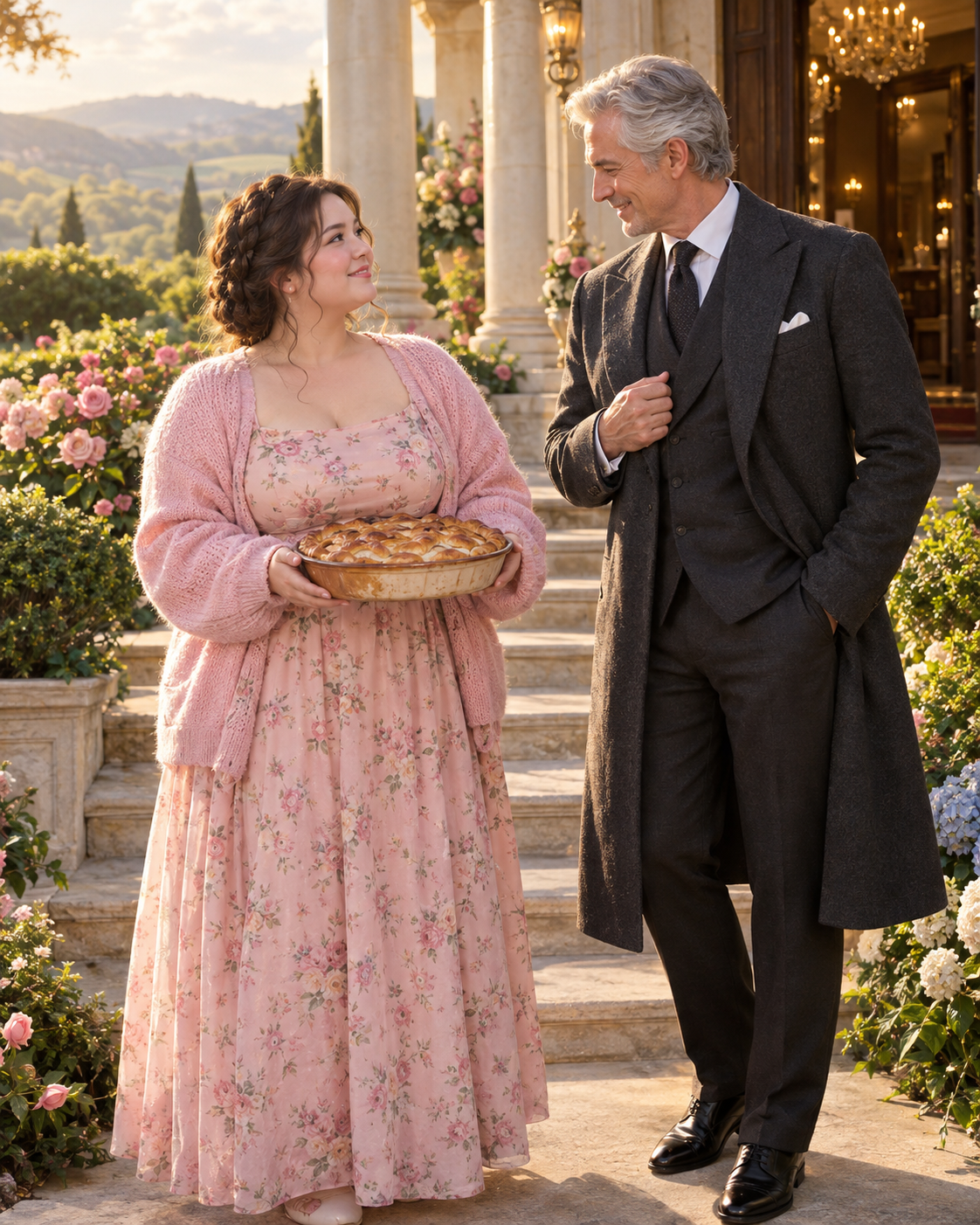
“Were the pies real?”
Alessandro looked genuinely confused.
“What?”
“The pies.”
A faint smile appeared on his face.
“Delilah, I have done many terrible things in my life. Pretending to enjoy your apple pie was never one of them.”
Despite herself, she almost laughed.
Almost.
Then she remembered the chase.
The fear returned.
“Who was behind it?”
Alessandro’s expression hardened.
“Victor Kane.”
The name meant nothing to Delilah.
“To you, he is a stranger,” Alessandro said. “To me, he is the man who has been waiting years for an opportunity to destroy everything I built.”
“Why me?”
“Because he thought you were my weakness.”
“And am I?”
Alessandro looked directly at her.
“You are the reason I want to stop living like this.”
The answer silenced her.
Before she could respond, a phone vibrated on the table.
Alessandro picked it up.
He listened for three seconds.
Then his face changed.
“What happened?”
He stood.
“Where?”
A pause.
“Keep him there.”
He ended the call.
Delilah’s heart began beating faster.
“What is it?”
“Someone was seen near the bakery where you work.”
“My bakery?”
“Yes.”
“I have to go there.”
“No.”
“My things are there.”
“We’ll get them.”
“I can’t just hide here.”
“You’re not hiding.”
“It feels like hiding.”
Alessandro walked toward the window.
Outside, several vehicles were already moving into position.
“Victor wants you frightened,” he said. “He wants you to make a mistake.”
“And what do you want?”
Alessandro turned around.
“I want you alive.”
The answer was quiet.
That night, Delilah stayed at the estate.
She couldn’t sleep.
Every sound seemed louder than before.
At two in the morning, she went downstairs and found Alessandro alone in the kitchen.
He was making coffee.
“You don’t sleep much, do you?”
“Not lately.”
She leaned against the doorway.
“I used to think you were just an old man who couldn’t sleep.”
Alessandro smiled faintly.
“I preferred that version of myself.”
Delilah walked to the counter.
For a moment, neither spoke.
Then she noticed a framed photograph on the shelf.
A young Alessandro stood beside a woman with dark hair and bright eyes.
“Your wife?”
“My sister.”
“What happened to her?”
Alessandro’s expression changed.
“She died because of the life I was born into.”
Delilah said nothing.
“I spent years believing power could protect everyone,” he continued. “Eventually I learned the opposite.”
His voice was low.
“Power can protect people for a while. But if you keep feeding it, eventually it asks for something you cannot give back.”
Delilah looked at him differently.
Not with trust.
Not yet.
But with understanding.
“You can’t undo everything,” she said.
“I know.”
“But you can stop.”
Alessandro looked at her.
“I’ve been trying.”
“Trying isn’t the same as stopping.”
“No.”
A long silence followed.
Then Alessandro pushed the coffee cup toward her.
“You’re right.”
The next morning, a package arrived.
There was no return address.
Inside was a photograph.
Delilah recognized herself immediately.
She was standing outside the bakery two weeks earlier, holding a box of flour.
On the back of the photograph was a single sentence:
WE KNOW WHAT HE LOVES.
Alessandro stared at it.
For the first time, Delilah saw anger replace the calmness in his face.
But he did not shout.
He did not break anything.
He simply picked up the phone.
“Cancel everything.”
The man on the other end protested.
“I said cancel everything.”
He ended the call.
Delilah frowned.
“What did you just do?”
“I was going to confront Victor.”
“And now?”
“Now I’m going to do something different.”
“What?”
“End this without giving him what he wants.”
Over the next forty-eight hours, Alessandro made a decision that surprised everyone around him.
He began dismantling his own organization.
Accounts were closed.
Businesses were transferred.
People who had worked for him for years were told they were free to leave.
Some refused.
Some disappeared.
Some accused him of weakness.
Alessandro accepted all of it.
He had finally understood something Delilah had said without realizing its importance.
Trying wasn’t enough.
If he wanted a different life, he had to build one.
Victor, however, interpreted the changes differently.
He believed Alessandro was vulnerable.
That was exactly what Alessandro wanted him to believe.
Three nights later, a meeting was arranged at an abandoned warehouse near the Santa Barbara waterfront.
Delilah was not supposed to know about it.
But she discovered the truth when she found Alessandro’s jacket hanging near the stairs.
Inside the pocket was a handwritten note.
She read it once.
Then again.
And immediately understood.
She called him.
He answered.
“Where are you?”
“Don’t lie to me.”
Silence.
“Alessandro.”
“I told you to stay at the estate.”
“You’re meeting Victor.”
Another silence.
“I’m coming.”
“No.”
“You don’t get to make that decision anymore.”
“Delilah, listen to me.”
“No. You listen to me. I’m tired of being protected by secrets.”
Her voice trembled.
“I won’t be your weakness. But I won’t be your prisoner either.”
Alessandro closed his eyes.
For once, he had no answer.
“Stay where you are,” he said.
“Then tell me the truth.”
He finally did.
The meeting was a trap.
But not the trap Victor believed it was.
Alessandro had arranged for evidence of Victor’s operations to be delivered to federal investigators through an attorney who had been working with him for months.
He was done fighting one criminal empire with another.
He wanted out.
But Victor had one last move.
As Alessandro arrived at the warehouse, Victor stepped from the shadows.
“You finally understand,” Victor said.
Alessandro looked around.
“You always thought this was about territory.”
“It is.”
“No.”
Alessandro’s voice remained calm.
“It was always about control.”
Victor smiled.
“You sound like a philosopher now.”
“I sound like a man who is tired.”
The two men stood several feet apart.
Victor’s men surrounded the building.
But before anyone moved, sirens echoed outside.
Victor’s smile disappeared.
“What did you do?”
“I gave everything away.”
Alessandro looked toward the warehouse doors.
“Not to another criminal.”
Victor realized what had happened.
“You betrayed us.”
Alessandro shook his head.
“I betrayed the life that created us.”
The doors opened.
Law enforcement officers entered.
The confrontation that followed was chaotic but brief.
Victor was taken into custody along with several of his associates.
Alessandro did not run.
He placed his hands where they could be seen and waited.
When the officers approached, he surrendered.
Outside, Delilah stood beside the attorney who had helped arrange the transfer of evidence.
She watched as Alessandro was led away.
For a moment, their eyes met.
There was no dramatic smile.
No promise.
No easy ending.
Just a quiet understanding.
Months passed.
The estate changed.
Some of the rooms remained empty.
The expensive cars were gone.
Several businesses were sold.
The gardens, however, remained.
Delilah eventually returned to the bakery.
She still baked apple pies.
She still remembered the mountain road.
She still remembered the fear.
But she no longer allowed fear to decide what her life would become.
Alessandro’s legal situation took time.
He cooperated with investigators and accepted responsibility for the parts of his past that could not simply be erased.
Some consequences remained.
Some doors closed permanently.
And some people never forgave him.
He understood that forgiveness was not something he could demand.
One autumn afternoon, Delilah received a letter.
There was no expensive envelope.
No security detail.
Just ordinary paper.
She opened it.
“I used to believe protecting someone meant standing between them and danger.
You taught me that sometimes protection means telling the truth, even when the truth makes you lose the person you want to keep.
I don’t know what happens next.
I only know that I don’t want to build another life around fear.
If you ever decide that you want to speak to me, I’ll be here.
If you don’t, I will understand.”
There was no request.
No pressure.
No promise.
Just honesty.
Delilah folded the letter and placed it inside a cookbook.
Weeks later, she drove toward the coast.
The Pacific was bright beneath the afternoon sun.
She stopped at a small café overlooking the water.
When she entered, she saw Alessandro sitting alone at a table near the window.
He looked older.
Not weaker.
Just different.
He stood when he saw her.
Neither of them spoke for several seconds.
Then Delilah smiled.
“I brought something.”
She placed a small box on the table.
Alessandro opened it.
Inside was a slice of apple pie.
He laughed softly.
“I thought you were done making these for me.”
“I never said that.”
He looked at her.
“Why are you here?”
Delilah took a seat across from him.
“Because I wanted to see who you are when nobody is afraid of you.”
Alessandro lowered his eyes.
“And?”
“I don’t know yet.”
He nodded.
“That is fair.”
She pushed the plate toward him.
“Eat.”
He took a fork.
For the first time in a long time, Alessandro Romano looked completely ordinary.
No guards.
No black cars.
No locked rooms.
No whispered orders.
Just a man sitting across from a woman who had seen his darkest secret and had chosen, carefully, to give him a chance to prove that a person’s past did not have to become their entire future.
Outside, Santa Barbara continued as it always had.
Cars moved along the coastal road.
Waves rolled toward the shore.
People walked beneath the warm California sun, unaware of the history that had almost destroyed two lives.
Delilah watched Alessandro take the first bite.
“Well?”
He smiled.
“Still the best apple pie in California.”
She laughed.
“You’re biased.”
“Probably.”
And somehow, that was enough.
Not because everything had been forgiven.
Not because the past had disappeared.
But because both of them finally understood something neither had known when they met:
A life built on fear can look powerful from the outside, but it is still a prison.
Real strength begins when a person is willing to open the door, accept the consequences, and walk away from the darkness they once believed they needed.
Delilah had entered Alessandro’s world believing kindness was simple.
She left it understanding that kindness could also be courageous.
And Alessandro, who had spent years believing power was the only way to keep people safe, finally learned that the hardest form of protection was not controlling someone’s path.
It was giving them the freedom to choose it.
The past could not be changed.
The scars would remain.
But the future, at last, belonged to them.
The afternoon after their meeting at the café, Delilah returned to the bakery with an unfamiliar feeling in her chest.
For months, every quiet moment had reminded her of danger.
A car slowing outside.
A stranger standing too long near the window.
An unexpected phone call.
Even the sound of tires on the coastal road could make her heart race.
But that afternoon was different.
For the first time, silence did not feel like a warning.
It simply felt like silence.
She tied her apron around her waist and began preparing the dough.
The familiar rhythm comforted her.
Flour.
Butter.
Sugar.
Apples.
Cinnamon.
Simple things.
Things that did not demand secrets.
Near closing time, her younger sister, Claire, walked into the bakery carrying two paper cups of coffee.
“You look different,” Claire said.
Delilah smiled.
“Different how?”
“Like you finally slept.”
“I did.”
Claire placed the coffee on the counter.
“Did you see him?”
Delilah paused.
“Yes.”
“And?”
“He looked different.”
Claire raised an eyebrow.
“That’s not an answer.”
Delilah laughed softly.
“I don’t know what the answer is.”
For once, she didn’t need one.
She had spent too long believing every relationship needed a destination before it was allowed to exist.
Now she understood that some things needed time.
Alessandro was learning how to live without power.
She was learning how to live without fear.
Neither process could be rushed.
Three months passed.
The case against Victor Kane moved through the federal courts.
Several people connected to his organization agreed to cooperate with investigators.
The investigation also revealed how deeply the network had reached into businesses across Southern California.
Alessandro’s cooperation became a complicated part of the proceedings.
He was not innocent.
He never claimed to be.
There were things he had done that could not be explained away by childhood, inheritance, or loyalty.
He accepted responsibility for them.
That mattered to Delilah.
She had once wanted to believe that the man she knew had simply been trapped by circumstances.
The truth was more difficult.
He had made choices.
Some had hurt people.
Some had protected people.
And some had done both at the same time.
Understanding that did not erase his past.
It simply made her stop seeing him as either a monster or a hero.
He was a man.
A complicated one.
A flawed one.
A man trying to become someone different.
One rainy morning in January, Delilah received another letter.
This time, there was no long explanation.
Only an invitation.
A community center in downtown Santa Barbara was organizing a charity event for families affected by organized crime and violent crime.
Alessandro had donated the proceeds from the sale of one of his remaining properties.
He would not attend publicly.
His attorney had arranged the donation anonymously.
But Delilah recognized the handwriting on the note attached to the paperwork.
She stared at it for several minutes.
Then she smiled.
Not because he had donated money.
Money had never impressed her.
She smiled because he had finally learned how to help without demanding recognition.
That evening, she went to the event.
Children ran between tables.
Families ate together.
Volunteers served food.
There were no expensive cars outside.
No men in dark suits.
No whispered conversations.
Just ordinary people trying to rebuild ordinary lives.
Delilah stood near the entrance when she noticed Alessandro across the street.
He was not wearing a suit.
He wore a simple gray jacket and stood alone beneath the glow of a streetlamp.
He didn’t come inside.
He didn’t approach her.
He simply watched for a moment before turning away.
Delilah followed him outside.
“You’re terrible at staying anonymous.”
He stopped.
“I didn’t think you’d notice.”
“I notice everything.”
He smiled.
“I know.”
They walked slowly along the sidewalk.
The rain had stopped, leaving the streets shining beneath the lights.
“You could have come inside,” Delilah said.
“I didn’t want people to think the donation was about me.”
“It wasn’t.”
“No.”
They continued walking.
After a moment, Alessandro spoke.
“I’ve been offered a chance to rebuild some of my businesses legally.”
“That sounds good.”
“It doesn’t feel like enough.”
“What do you mean?”
“I spent years measuring success by how much I controlled.”
He looked toward the ocean.
“Now I measure it by how little control I need.”
Delilah smiled.
“That sounds healthier.”
“I suppose it is.”
They stopped at the corner.
Alessandro looked at her.
“I have something to tell you.”
She waited.
“I’ve rented a small house outside Santa Barbara.”
Delilah blinked.
“You?”
He laughed.
“Yes. Me.”
“With how many guards?”
“None.”
She smiled.
“That’s a big change.”
“It is.”
“What will you do?”
“I don’t know.”
For the first time, he sounded almost amused by the uncertainty.
“Maybe that’s the point.”
A year earlier, Delilah would have found that answer frightening.
Now it sounded hopeful.
Winter passed.
Spring arrived along the California coast.
The hills turned green after the rains, and wildflowers appeared along the roads outside Santa Barbara.
The bakery became busier.
Delilah eventually became a partner in the business.
She developed a new menu centered around homemade pies.
The apple pie remained the favorite.
She never told customers why.
She simply smiled whenever someone ordered it.
One morning, Alessandro appeared at the bakery carrying a small cardboard box.
Delilah looked at him suspiciously.
“What is that?”
“A surprise.”
“I don’t trust surprises anymore.”
He placed the box on the counter.
“Fair.”
She opened it.
Inside was an old recipe book.
The pages were yellowed with age.
“Where did you get this?”
“It belonged to my sister.”
Delilah carefully opened the cover.
Inside were handwritten recipes.
Italian pastries.
Bread.
Cakes.
Pies.
“She used to bake?”
“She loved it.”
Delilah touched one of the pages.
“You never told me.”
“There were many things I never told you.”
She looked up.
“And now?”
“Now I’m trying.”
She nodded.
That was all she needed to hear.
Not a promise of perfection.
Not a declaration that the past had vanished.
Just an acknowledgment that honesty was something a person practiced every day.
Months later, Delilah decided to try one of the recipes.
She made a simple Italian almond cake.
When Alessandro tasted it, he became unusually quiet.
“Well?” she asked.
He smiled.
“My sister would have liked you.”
The sentence carried more weight than any compliment.
Delilah reached across the table and touched his hand.
“Then I’m glad she left the recipe behind.”
Alessandro looked down at their hands.
He didn’t pull away.
Neither did she.
Their relationship changed slowly.
There was no dramatic announcement.
No sudden promise.
No perfect ending.
They simply became part of each other’s lives again.
Carefully.
Honestly.
Without secrets.
There were still difficult days.
Sometimes Delilah woke from nightmares about the mountain road.
Sometimes Alessandro became distant when memories of his old life returned.
When that happened, they talked.
If talking wasn’t enough, they gave each other space.
Neither tried to control the other.
That became the foundation of everything.
One summer evening, they drove along the Santa Barbara coastline.
The windows were down.
Warm ocean air filled the car.
Delilah looked toward the horizon.
“You know what I remember most about the night I came here?”
Alessandro kept his eyes on the road.
“What?”
“How quiet it was.”
He glanced at her.
“I thought quiet meant something terrible was about to happen.”
“I remember.”
“But now?”
She smiled.
“Now I know quiet can just be quiet.”
Alessandro nodded.
They continued driving.
The road curved along the coast as the sun began to disappear into the Pacific.
For a long time, neither spoke.
Then Delilah noticed a small sign ahead.
A roadside farm stand was still open.
“Stop.”
Alessandro laughed.
“Why?”
“Peaches.”
“You want peaches?”
“I want pie.”
He pulled over.
They bought a basket of peaches and drove home.
That night, Delilah baked while Alessandro attempted to help.
He was terrible at it.
“You’re cutting them too thick.”
“I’ve managed businesses with hundreds of employees.”
“Apparently none of them involved peaches.”
He laughed.
The sound filled the kitchen.
It was an ordinary moment.
And perhaps that was why it mattered so much.
Their lives had once been surrounded by people who wanted something from them.
Money.
Power.
Information.
Loyalty.
Now, in a small kitchen overlooking the California hills, they had nothing to prove.
Years later, Delilah would remember that night as the moment she realized the story had truly ended.
Not when Victor was arrested.
Not when Alessandro surrendered.
Not when the estate became quiet.
But when they stood together in a kitchen, arguing over peaches and laughing about something that didn’t matter.
Because a person does not escape darkness simply by leaving a dangerous place.
Sometimes the harder escape is learning to believe that peace is real.
Alessandro had spent most of his life believing love made people vulnerable.
Delilah had once believed trust meant never discovering anything frightening about someone.
They were both wrong.
Love did not guarantee safety.
Trust did not guarantee certainty.
But honesty gave people a choice.
And choice was something neither of them had understood how to value before.
One year later, the old Romano estate was sold.
The money went into several legitimate businesses and charitable foundations.
The property itself was eventually transformed into a private retreat center for families recovering from violence.
The gates remained.
But they no longer existed to keep enemies out.
They existed to give people inside a place where they could finally feel safe.
Delilah attended the opening ceremony.
She stood in the garden beneath the old olive trees.
A plaque had been placed near the entrance.
It carried no family name.
No photograph.
No title.
Only a simple sentence:
“Everyone deserves a chance to begin again.”
She read it twice.
Alessandro stood beside her.
“You like it?”
“Yes.”
“Good.”
She looked at him.
“Did you choose the words?”
“No.”
“Who did?”
He smiled.
“You did.”
Delilah frowned.
“I don’t remember.”
“You said them the first night we talked.”
She thought about it.
Then remembered.
She had told him that people couldn’t change the past, but they could choose what came next.
Alessandro had remembered.
Of course he had.
They walked through the garden together.
The same garden that had once frightened her.
The same house that had once hidden secrets.
Now children were running across the grass.
Families were sitting beneath the trees.
Someone was playing music near the fountain.
The place no longer felt like a fortress.
It felt alive.
Delilah looked back at Alessandro.
“Do you ever miss it?”
“The old life?”
“Yes.”
He thought for a moment.
“Sometimes I miss who I thought I was.”
She waited.
“But I don’t miss who I became.”
That answer stayed with her.
Because perhaps that was the truth about change.
You didn’t always become a completely different person.
Sometimes you simply stopped defending the person you had once been.
Years after the mountain road, Delilah still baked apple pies.
Alessandro still preferred black coffee.
He still listened to classical music.
But now he also knew how to laugh loudly.
He learned how to ask for help.
He learned that saying “I don’t know” was not weakness.
And Delilah learned something equally important.
Being kind did not mean ignoring danger.
Forgiving someone did not mean forgetting what they had done.
Loving someone did not mean surrendering your freedom.
Real love left room for boundaries.
Real trust required truth.
And real change required action.
Their story did not end with everything becoming perfect.
It ended with something more believable.
They had built a life in which perfection was no longer necessary.
On a cool evening in late autumn, Delilah stood on the balcony of their home overlooking the lights of Santa Barbara.
Alessandro came outside carrying two cups of coffee.
He handed one to her.
She took it.
“Black?”
“Of course.”
She smiled.
“You haven’t changed everything.”
“No.”
He leaned against the railing.
“Some things are worth keeping.”
Below them, the city lights shimmered in the distance.
The Pacific was almost invisible beneath the night sky.
Delilah rested her head against his shoulder.
For a while, they said nothing.
There were no sirens.
No engines racing behind them.
No men waiting in shadows.
No secrets waiting behind locked doors.
Just the quiet sound of the ocean.
Alessandro looked toward the horizon.
“I used to think a powerful man was someone nobody could hurt.”
Delilah looked at him.
“And now?”
He took a slow breath.
“Now I think a strong man is someone who can admit he was wrong, face what he has done, and still choose to become better.”
Delilah smiled.
“That sounds like something worth remembering.”
“It is.”
She looked out at the city.
“So what happens tomorrow?”
Alessandro smiled.
“We bake.”
She laughed.
“That’s your plan?”
“For once, yes.”
And that was how their story truly ended.
Not with a gunshot.
Not with revenge.
Not with another chase along a dangerous road.
It ended with flour on a kitchen counter, coffee cooling beside an open window, and two people who had finally learned that the greatest escape was not from another person.
It was from the fear that had once controlled them.
The past remained part of their story.
It always would.
But it no longer controlled the ending.
And sometimes, that is the most meaningful ending a person can hope for:
not becoming someone who never made mistakes,
but becoming someone who refuses to let those mistakes decide who they will be tomorrow.
THE END.