There are rooms in London where a person can disappear without ever leaving their chair.
Beatrice remained standing beside the tall windows of the Duke’s library, staring at the gray London morning beyond the glass.
The city had barely awakened.
Carriages moved through the streets below, their wheels cutting through the damp morning mist. Chimneys sent thin trails of smoke into the pale sky, while somewhere beyond the estate walls, London was already beginning its endless business of gossip, bargaining, ambition, and survival.
Behind her, Alistair Ashborne waited.
He had given her time.
That, more than anything, unsettled her.
Everyone else in her life had demanded an answer before she had even understood the question.
Her father demanded obedience.
Her sisters demanded sacrifice.
Society demanded gratitude.
Yet the Duke simply stood there and allowed silence to exist between them.
Finally, Beatrice turned.
“You bought my father’s debts.”
“Yes.”
“You transferred them to me.”
“Yes.”
“You understand that means I could ruin my own family.”
A faint expression crossed his face.
“I understand that you could finally stop them from ruining you.”
Beatrice studied him carefully.
There was no triumph in his voice.
No amusement.
He spoke as though he were stating a simple fact.
“And what do you want in return?”
“Nothing that you do not freely choose to give.”
She almost laughed.
It was a strange answer coming from a man who had just acquired the most powerful financial weapon her family had ever faced.
“You expect me to believe that?”
“I expect you to decide whether you believe it.”
She looked down at the papers on the desk.
Every debt was listed there.
Loans.
Mortgages.
Private obligations.
Money borrowed against land, harvests, jewels, future inheritances, even the reputation of the Winslow name.
For years, these numbers had been treated like invisible chains.
Now the chains were in her hands.
“What happens if I refuse your proposal?”
Alistair did not hesitate.
“You walk out of this room owing me nothing beyond the legal obligations attached to the debt.”
“And if I accept?”
“You become my partner.”
“Your wife?”
“My equal.”
The word struck her harder than the title.
Beatrice had spent most of her life being told what she was not.
Not beautiful enough.
Not wealthy enough.
Not accomplished enough.
Not useful enough.
Now this feared Duke was offering her a position no one in her own family had ever thought she deserved.
But she refused to let gratitude make the decision for her.
“What does being your equal mean?”
“It means your name will appear beside mine in every matter where your judgment concerns our household, estate, and public obligations.”
“And privately?”
“You will have your own rooms, your own correspondence, your own accounts, and the right to disagree with me.”
She raised an eyebrow.
“Even in front of others?”
“Especially then.”
For the first time, Beatrice smiled.
It was small, but genuine.
“You are a very unusual man, Your Grace.”
“I have been called worse.”
“I am sure you have.”
His expression softened.
“Then, Lady Beatrice, I will ask one final question.”
She waited.
“Do you want this?”
Not the title.
Not the money.
Not the revenge.
The question was simpler than all of them.
Did she want this?
Beatrice looked through the window again.
She imagined returning home.
She imagined her sisters looking at her with suspicion.
Her father demanding that she surrender whatever power she had acquired.
She imagined spending the rest of her life trying to prove that she deserved the smallest corner of a world that had never welcomed her.
Then she imagined something else.
A life in which she did not have to apologize for taking up space.
A life in which kindness did not mean surrender.
A life in which she could stand beside a man rather than behind him.
“Yes,” she said.
Alistair did not smile immediately.
Instead, he extended his hand.
“Then we begin honestly.”
Beatrice placed her hand in his.
“On my terms.”
“On yours as well as mine.”
Their agreement was sealed without witnesses, without ceremony, and without the slightest illusion that trust could be created in a single morning.
But it was a beginning.
Three days later, the Winslow family arrived at Ashborne House.
Beatrice knew they would come.
News traveled quickly among London’s wealthy families, and the transformation of the Winslow debts was too extraordinary to remain secret.
Her eldest sister, Charlotte, entered first.
Behind her came Eleanor.
Their mother followed, pale and furious.
Her father came last.
He looked older than he had a week earlier.
When his eyes found Beatrice standing beside the Duke, something close to disbelief crossed his face.
“Beatrice.”
She inclined her head.
“Father.”
“We need to speak privately.”
“No.”
The single word silenced the room.
Her father blinked.
“You misunderstand.”
“I do not.”
“This matter concerns the entire Winslow family.”
“It concerns the debts I now legally control.”
Charlotte stepped forward.
“You cannot possibly intend to use them against us.”
Beatrice looked at her sister.
“I have not used anything against anyone.”
“Then return them.”
“No.”
The answer came quietly.
That made it more powerful.
Her mother’s voice sharpened.
“You owe your family everything.”
Beatrice felt something old and painful stir inside her.
For years, that sentence had been enough to make her surrender.
This time it did not.
“I owe my family compassion,” she said. “I do not owe them my destruction.”
Her father lowered his voice.
“You would abandon your own blood?”
“No.”
She looked at all of them.
“I am giving you the opportunity to become honest with me.”
Silence followed.
Alistair remained beside her, but he did not speak.
This was Beatrice’s moment.
She opened the ledger.
“I will restructure the debts.”
Her father stared.
“On what terms?”
“The estate will no longer borrow against land without my approval.”
His face tightened.
“Impossible.”
“Then the alternative is foreclosure.”
Charlotte gasped.
Beatrice continued.
“No more selling family jewelry to pay personal gambling debts. No more borrowing from private lenders under my father’s signature. No more arranging marriages for financial rescue without the consent of the person being married.”
Her sisters exchanged glances.
The last condition was the one they understood immediately.
Beatrice looked directly at Charlotte.
“You will not offer me to another man again.”
Charlotte flushed.
“We were trying to save everyone.”
“You were trying to save yourselves.”
No one answered.
Beatrice closed the ledger.
“I will help rebuild Winslow House. But I will not return to being the person who pays for everyone’s choices.”
Her father sank into a chair.
For the first time, Beatrice saw him not as the terrifying authority of her childhood, but as a frightened man who had allowed pride to become habit.
“Why?” he asked.
“Why would you help us after everything?”
She considered the question.
“Because I know what it feels like to be trapped.”
Her voice softened.
“And because having power does not mean I must become cruel.”
Alistair glanced at her.
There was something unmistakably proud in his eyes.
But the peace did not last.
That evening, another letter arrived.
It bore the seal of Lord Whitmore, one of the most influential financiers in London.
The letter was brief.
He requested a private meeting with the Duke.
Alistair read it once and frowned.
“What is it?” Beatrice asked.
“Someone is unhappy with the arrangement.”
“Who?”
“A man who expected your father’s debts to eventually become his profit.”
Beatrice understood.
The debts had not simply represented family misery.
They had represented opportunity for others.
“Can he challenge the transfer?”
“Not legally.”
“Then why are you concerned?”
“Because men who cannot win with contracts sometimes try other methods.”
Beatrice felt the old fear return.
“What kind of methods?”
“Rumors.”
The next morning, London began talking.
By noon, whispers had reached three drawing rooms.
By evening, they had become stories.
Some claimed Beatrice had trapped the Duke.
Others claimed she had manipulated him into buying the Winslow fortune.
One newspaper hinted that the Duchess-to-be had engineered the entire arrangement to escape poverty.
The details changed from house to house, but the message remained the same.
Beatrice was dangerous because she had risen.
For the first time, she understood something about society that no etiquette book had ever taught her.
People tolerated a poor woman.
They even pitied her.
They became uncomfortable when she stopped being poor.
Alistair offered to silence the rumors.
Beatrice refused.
“How?”
“I could threaten the publisher.”
“No.”
“I could purchase the paper.”
“No.”
“I could expose Whitmore.”
“Not yet.”
He looked at her.
“You have a plan.”
“I have a question.”
“Ask it.”
“Who benefits if London believes I am manipulating you?”
Alistair was silent for a moment.
“Whitmore.”
“Then let him believe I am frightened.”
The following week, Beatrice began appearing in public beside the Duke.
She did not hide.
She did not behave defensively.
At dinners, she listened.
At charity meetings, she spoke.
At estate gatherings, she asked questions about accounts that senior men had assumed she would not understand.
Soon, people discovered that the quiet daughter from the Winslow family was neither ignorant nor fragile.
She was simply observant.
And observation, when combined with patience, could be more formidable than anger.
Then came the Ashborne winter ball.
It was the largest gathering London had seen that season.
Hundreds of guests filled the estate.
Musicians played beneath a ceiling covered in painted stars.
Women arrived in silk and diamonds.
Men discussed politics, investments, inheritances, and marriages.
Beatrice entered on Alistair’s arm.
For a moment, the room fell strangely quiet.
Then conversation resumed.
She felt every eye.
But she no longer felt small.
Near midnight, Lord Whitmore approached.
He bowed.
“Your Grace.”
“Lord Whitmore.”
His gaze moved to Beatrice.
“Lady Ashborne.”
Beatrice smiled.
“Lord Whitmore.”
“I hope you are enjoying your new position.”
“I am learning.”
“I imagine there is much to learn when one suddenly acquires responsibilities far beyond her previous station.”
The insult was elegantly delivered.
Several nearby guests pretended not to listen.
Beatrice did not react.
Instead, she asked, “Are you referring to the Winslow accounts?”
Whitmore paused.
“I merely meant that financial affairs can be complicated.”
“Indeed.”
She smiled.
“That is why I reviewed every document personally.”
Something changed in his expression.
“You did?”
“Yes.”
“And what did you discover?”
“That several loans were extended at rates far beyond what the market would normally justify.”
Whitmore’s face became still.
Beatrice continued.
“Some were secured against property already pledged elsewhere.”
A nearby conversation stopped.
Whitmore lowered his voice.
“You should be careful.”
“I am.”
“You may not understand the consequences of accusing an established man.”
“I did not accuse anyone.”
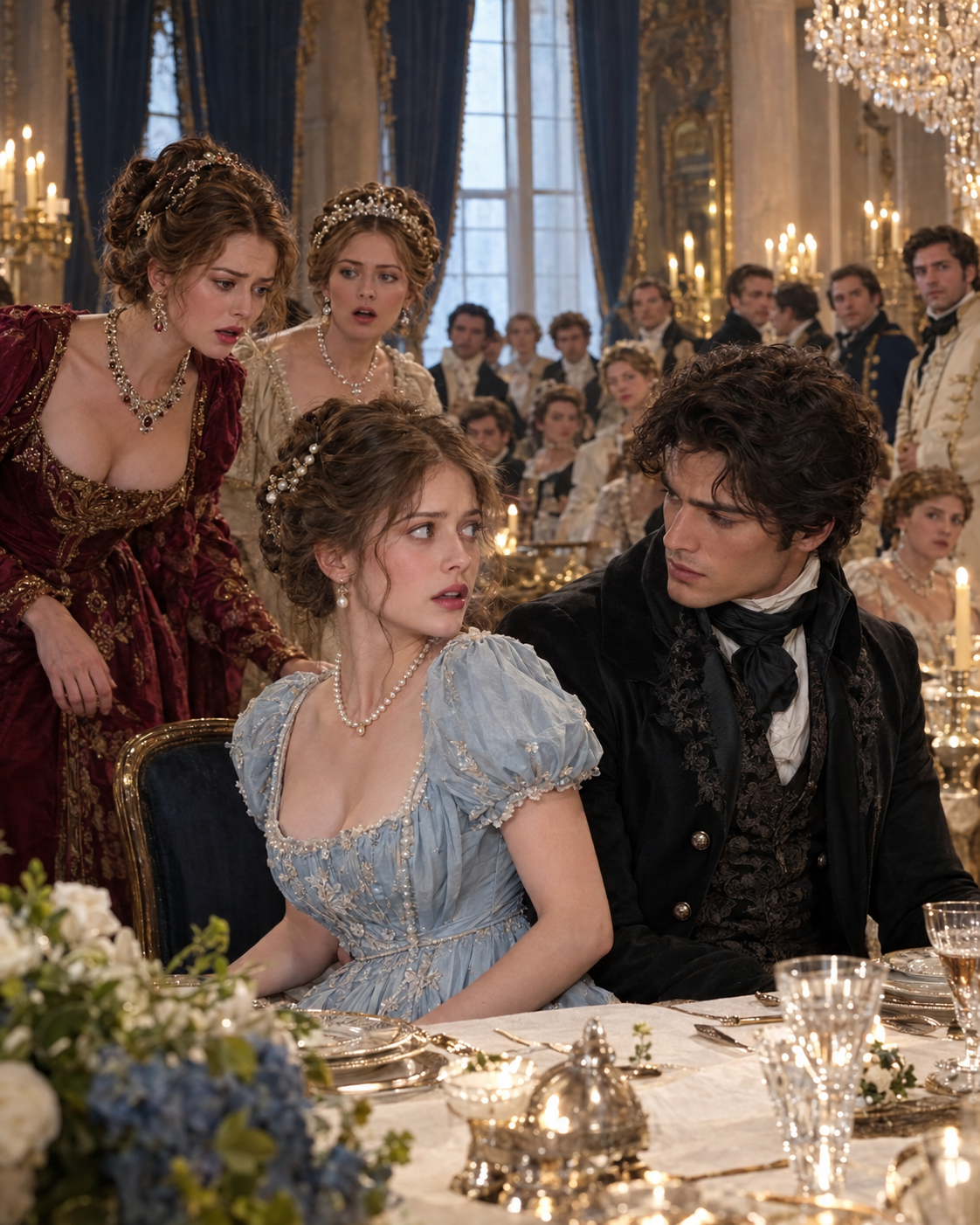
She looked at him calmly.
“I only said I read the documents.”
Whitmore stepped closer.
“You have no idea how quickly society can turn.”
Beatrice held his gaze.
“I spent most of my life being turned away by society.”
A pause.
“I survived.”
Whitmore had nothing to say.
He left.
Alistair approached moments later.
“You knew he would confront you.”
“Yes.”
“You could have embarrassed him.”
“Yes.”
“You chose not to.”
“I want the truth more than I want revenge.”
Alistair studied her.
“That is becoming your greatest strength.”
She looked up at him.
“And yours?”
He smiled faintly.
“My greatest strength?”
“Yes.”
“You.”
Beatrice’s breath caught.
The words were simple.
There was no performance in them.
No audience mattered.
Only the truth between them.
For the first time, she realized the partnership they had entered as an arrangement was becoming something far more difficult to define.
Something chosen.
Something mutual.
Something neither of them had purchased.
But before either could say more, a servant approached with urgent news.
A fire had started at Winslow House.
Beatrice went cold.
They reached the estate before dawn.
Part of the west wing had burned.
No one had died, but several rooms were destroyed.
Among the damaged papers were financial records.
The same records Beatrice had reviewed.
The same records that might expose Whitmore’s dealings.
She stood among the ashes, staring at the blackened remains.
Alistair came beside her.
“This was deliberate.”
“How do you know?”
“Because the fire began in the records room.”
Beatrice closed her eyes.
For a moment, she was the frightened girl who had learned that safety could disappear without warning.
Then she opened them.
“No.”
Alistair looked at her.
“This is not where I stop.”
They searched what remained.
By afternoon, Beatrice discovered something hidden beneath a loose floorboard.
A metal box.
Inside were copies of old contracts.
One carried her father’s signature.
Another carried Whitmore’s.
But the third contained something far more important.
A letter from years earlier.
Her father had not originally borrowed the money from Whitmore.
He had been persuaded to sign after being threatened with public ruin over a private scandal.
The scandal itself had been manufactured.
Beatrice read the letter twice.
Her father had not been innocent.
But he had not been the architect of everything either.
Someone had deliberately kept the family desperate.
Someone had profited from every extension, every emergency loan, every failure.
Whitmore had not simply purchased debt.
He had cultivated dependence.
Beatrice looked at Alistair.
“We can prove it.”
“Yes.”
“But if we expose him, my father’s reputation will collapse too.”
“Yes.”
She looked toward the ruined house.
For a long moment, she said nothing.
Then she folded the letter.
“We tell the truth.”
Alistair nodded.
“And we accept whatever follows.”
The investigation lasted weeks.
Lawyers became involved.
Bankers were questioned.
Old contracts were examined.
Names that had once seemed untouchable appeared in documents.
Whitmore fought back through newspapers and private influence.
But evidence was different from gossip.
The truth did not need to shout.
It only needed to survive examination.
Eventually, the financial arrangements were exposed.
Whitmore faced legal consequences.
The Winslow estate was restructured.
Beatrice’s father surrendered control of the family’s finances.
Her sisters were forced to confront the consequences of choices they had once blamed on everyone else.
But something unexpected happened.
Beatrice did not use her new power to destroy them.
She used it to establish boundaries.
Her family could remain connected to her.
But connection would no longer mean control.
Months later, Ashborne House looked different.
Not because its walls had changed.
Because Beatrice had.
She had begun overseeing charitable accounts, estate investments, and relief programs for families living on the edge of poverty.
She insisted that every contract be understandable to the people signing it.
She created a small fund for women who had been financially trapped by family debts or coercive arrangements.
When someone asked why she cared so deeply about such matters, she answered simply.
“Because desperation makes people easy to control.”
“And what breaks that control?”
Beatrice thought for a moment.
“Knowledge. Choice. And someone willing to believe you deserve both.”
Her marriage to Alistair was not the fairy tale London expected.
There were disagreements.
There were difficult conversations.
There were moments when their different habits and histories collided.
But neither demanded silence from the other.
They learned how to argue without humiliating.
How to compromise without surrendering.
How to love without turning love into ownership.
On the evening of their first wedding anniversary, Beatrice stood on the same balcony where she had once looked at London and wondered what kind of future awaited her.
Alistair joined her.
“You are thinking again.”
“I often think.”
“I have noticed.”
She smiled.
Below them, London glittered beneath the night sky.
“You know,” she said, “when I first came here, I thought you were going to frighten me.”
“I was told I had that effect.”
“You did.”
He looked at her.
“And now?”
She turned toward him.
“Now I know the difference between fear and respect.”
He waited.
“Fear asks you to become smaller.”
She reached for his hand.
“Respect gives you room to become more.”
Alistair smiled.
“And which did I give you?”
Beatrice looked toward the city.
“Room.”
The word settled between them.
Simple.
Certain.
Enough.
Her journey had begun with a chair at a supper table where she had been placed because everyone believed she was expendable.
It had continued through debts, rumors, threats, fire, and betrayal.
Yet the greatest change had never been the money.
It had never been the title.
It had never even been the Duke.
The greatest change was that Beatrice had finally stopped measuring her worth by the way other people treated her.
She had learned that being overlooked did not mean being insignificant.
Being poor did not mean being powerless.
And being offered a place beside someone powerful did not mean she had to surrender her own identity.
A title could open a door.
Money could create choices.
Power could protect a person.
But character determined what happened after the door opened.
Beatrice had been given leverage.
She chose responsibility.
She had been offered protection.
She chose partnership.
She had been given the chance to punish those who had hurt her.
She chose boundaries instead.
And perhaps that was why, months later, when London whispered the name Duchess of Ashborne, the title meant something different from what society had expected.
It did not describe a woman who had been rescued by a powerful man.
It described a woman who had finally been given the freedom to stand where she had always belonged.
Beside him.
Not behind him.
Not beneath him.
Beside him.
And somewhere beneath the glittering chandeliers of London, the same society that had once overlooked Beatrice Winslow had begun to understand a lesson she had learned the hard way:
Sometimes the person everyone sacrifices is the person who eventually discovers the strength to choose her own future.
For a while, Beatrice believed that peace would be enough.
After everything that had happened, she had imagined that the absence of danger would feel like happiness.
But peace, she soon discovered, was not the same as an ending.
London remembered.
Society remembered every scandal, every whispered accusation, every woman who had risen too quickly.
And although Lord Whitmore’s influence had been broken, the people who had benefited from his schemes had not all disappeared.
Some simply became quieter.
Some changed their names.
Some waited.
Beatrice discovered this on an ordinary autumn afternoon when a letter arrived at Ashborne House without a seal.
There was no signature.
Only one sentence.
You were never meant to inherit the truth.
She read it twice.
Then she placed it on the desk.
Alistair entered moments later.
He saw her expression immediately.
“What happened?”
She handed him the paper.
He read it.
His face hardened.
“Where did this come from?”
“I don’t know.”
“Then we find out.”
Beatrice shook her head.
“Not yet.”
He looked at her.
“You think this is connected to Whitmore.”
“I think Whitmore was not the beginning.”
The words remained between them.
For months, she had assumed that the financial scheme surrounding her family had been the work of one ambitious man.
Now she wondered whether he had merely been one part of something older.
Something larger.
Something that had existed before she had ever understood the meaning of a debt.
That evening, Beatrice returned to Winslow House.
Her father was sitting alone in the library.
Age had changed him.
So had shame.
The man who once commanded every room now spent most evenings staring at documents he no longer had the authority to sign.
Beatrice placed the anonymous letter before him.
His hand stopped halfway to the page.
He read it.
The color left his face.
“You know something.”
It was not a question.
Her father looked toward the window.
“I know enough to wish I had known more.”
“Father.”
He closed his eyes.
“There was another man.”
“Who?”
“Not a financier.”
Beatrice waited.
“A solicitor.”
The word sounded harmless.
It was not.
“His name?”
“Edmund Vale.”
Beatrice recognized it.
She had seen the name in old legal correspondence.
“What did he do?”
“He arranged everything.”
Her father’s voice had become almost a whisper.
“Whitmore provided the money. Vale made the contracts appear legitimate. But there was someone else directing them.”
“Who?”
Her father looked at her.
“I never knew.”
Beatrice felt a chill.
“You never knew?”
“No.”
“Then how can you be certain?”
“Because every time I tried to investigate, another debt appeared.”
He swallowed.
“And every time I threatened to expose the arrangement, I received another warning.”
Beatrice stared at him.
“Why didn’t you tell me?”
His answer came slowly.
“Because I was ashamed.”
That answer hurt more than she expected.
Not because it excused him.
It did not.
But because she finally understood how shame could become a prison.
Her father had hidden the truth because he feared being seen as weak.
She had hidden her own suffering for the same reason.
Perhaps that was the cruelest inheritance their family had passed from one generation to another.
Silence.
Beatrice took the letter.
“I am going to find Edmund Vale.”
Her father looked alarmed.
“No.”
“Why?”
“Because if Vale is still involved, he will know what you are doing before you know what he is doing.”
Beatrice stood.
“I am not the frightened daughter you once knew.”
“I know.”
His voice broke slightly.
“That is what frightens me.”
The search lasted nearly a month.
Edmund Vale had disappeared from London years earlier.
His offices had been closed.
His properties had been sold.
His name appeared nowhere in respectable society.
But Beatrice had learned something important.
People could disappear from society without disappearing from records.
With Alistair’s assistance, she followed the trail through old legal papers, property transfers, shipping records, and correspondence.
Eventually, one name appeared again.
Vale had purchased a small estate in Yorkshire.
He had been living there under another surname.
Beatrice wanted to go immediately.
Alistair refused to let her travel alone.
“I wasn’t asking permission.”
“I know.”
“Then why are you arguing?”
“Because partnership does not mean watching you walk into danger while I stay behind.”
She looked at him.
“You’re afraid.”
“Yes.”
The answer surprised her.
Alistair rarely admitted fear.
“Of what?”
“Of losing you.”
The room became quiet.
Beatrice stepped closer.
“You won’t lose me by telling me the truth.”
“I know.”
He reached for her hand.
“That is why I am telling you now.”
They traveled north two days later.
The estate was smaller than Ashborne, but strangely well maintained.
A servant led them into a study.
An elderly man stood beside the fireplace.
Edmund Vale.
He looked at Beatrice for a long time.
Then he smiled.
“So the little Winslow girl survived.”
Beatrice felt anger rise.
She kept her voice calm.
“I am no longer little.”
“No.”
His eyes moved to Alistair.
“You became much more troublesome than anyone anticipated.”
“Why?” Beatrice asked.
Vale poured himself a drink.
“Because your father was supposed to collapse.”
“And when he didn’t?”
“He borrowed again.”
“You encouraged him.”
“I offered opportunities.”
“You created dependence.”
Vale shrugged.
“People rarely need to be forced when desperation does the work for you.”
Beatrice felt disgust, but she did not look away.
“Who was behind you?”
Vale smiled.
“You still think there must be one villain.”
“Isn’t there?”
“No.”
He set down his glass.
“There was an entire system.”
The words struck her.
“Families like yours borrowed from men like Whitmore. Men like Whitmore borrowed influence from people above them. Everyone received something.”
“And who paid?”
“Those at the bottom.”
Beatrice’s voice hardened.
“People like my family.”
“People like your father.”
She stepped closer.
“No. People like me.”
For the first time, Vale’s expression changed.
He looked at her carefully.
“You were never supposed to have a choice.”
Beatrice understood then.
That was the real crime.
Not the money.
Not the contracts.
Not even the deception.
They had built a world in which some people were expected to have choices while others were expected to accept whatever was decided for them.
She looked at Alistair.
He understood too.
Vale had not underestimated her because she was poor.
He had underestimated her because he believed she would remain powerless.
“I want every document,” Beatrice said.
Vale laughed.
“You think you can expose the entire structure?”
“No.”
She smiled faintly.
“I only need enough truth to make people look.”
That frightened him.
Because she was right.
The documents were delivered to London.
Not secretly.
Not through gossip.
Through lawyers, newspapers, Parliament, and every institution capable of examining them.
Beatrice refused to turn the matter into a personal revenge campaign.
She wanted records examined.
Contracts investigated.
Victims heard.
Those responsible held accountable through lawful means.
The process was slow.
Painfully slow.
Some names were cleared.
Others were damaged.
Several powerful men resigned from positions they had once believed untouchable.
Old families discovered that inherited reputation could not erase written evidence.
And Beatrice learned another lesson.
Justice rarely arrived dramatically.
Sometimes it arrived as a document.
A signature.
A hearing.
A quiet verdict.
A door closing.
A man who once believed himself untouchable suddenly discovering that other people had begun asking questions.
Months passed.
Then a year.
Ashborne House became known for something different.
Not scandal.
Not fear.
But fairness.
Beatrice established a legal advisory fund for families facing predatory debt.
She worked with solicitors who explained contracts before anyone signed them.
She insisted that women be allowed to understand their own financial positions rather than being treated as decorative dependents.
At first, society mocked the idea.
Then people began asking for help.
And eventually, other estates copied the model.
Beatrice never called it a revolution.
She simply called it making sure fewer people had to discover the truth as painfully as she had.
Her family changed too.
Charlotte eventually apologized.
Not dramatically.
Not with tears.
Simply by arriving one afternoon and saying, “I was wrong.”
Beatrice appreciated that more than a grand speech.
Eleanor followed months later.
Their relationship did not return to what it had been.
Perhaps it never should.
But something healthier grew in its place.
Boundaries.
Respect.
Choice.
Her father eventually stepped away from managing the estate.
He spent his remaining years restoring the damaged parts of Winslow House and quietly supporting families who had once lived under the same burdens he had helped create.
He never asked Beatrice to forgive everything.
She respected him for that.
Forgiveness, she had learned, was not an obligation.
It was a decision.
And some wounds needed time before they could even be named properly.
As for Alistair, he remained exactly what London had always believed him to be in public.
Controlled.
Powerful.
Difficult to intimidate.
But Beatrice knew the man behind the reputation.
She knew he drank his coffee too strong.
She knew he read the same page of a book three times when worried.
She knew he disliked crowded celebrations but endured them because she enjoyed watching people.
She knew he sometimes stood awake beside the window when he could not sleep.
And she knew that beneath his composure was a man who had learned, perhaps later than he wished, that love could not be built on control.
One winter evening, years after the night that had changed everything, Beatrice returned to the ballroom where they had first entered society together as Duke and Duchess.
The chandeliers were glowing.
Music filled the room.
Young couples danced beneath them.
Beatrice stood near the balcony.
Alistair approached.
“You disappeared.”
“I was thinking.”
“Again?”
She smiled.
“I have been told it is a habit.”
He offered his hand.
“Dance with me.”
“You know I dislike dancing.”
“So do I.”
“Then why?”
“Because you are smiling.”
She looked at him.
“And that is reason enough?”
“For me.”
She placed her hand in his.
They stepped onto the floor.
For a while, neither spoke.
Then Beatrice whispered, “Do you remember the first night?”
“Every detail.”
“I thought everyone in that room hated me.”
“Not everyone.”
“I know.”
She smiled.
“You.”
“I was intrigued.”
“Only intrigued?”
He looked at her.
“No.”
She waited.
“I admired you.”
Her expression softened.
“And now?”
“Now I love you.”
There was no dramatic declaration.
No audience needed to hear it.
After everything they had survived, the simplest words carried the greatest weight.
Beatrice rested her head briefly against his shoulder.
“I used to think being chosen was the greatest thing that could happen to a woman.”
“And now?”
“Now I think choosing is.”
Alistair held her closer.
“And what did you choose?”
She looked around the ballroom.
At the people.
At the lights.
At the life she had once believed belonged to other women.
Then she looked back at him.
“I chose myself first.”
His smile was quiet.
“Good.”
“And then I chose you.”
His expression changed.
Not because he had won something.
Because he understood exactly what she meant.
She had not chosen him because she needed rescue.
She had chosen him because, after becoming free, she still wanted him beside her.
That distinction mattered.
Outside, London continued as it always had.
Carriages crossed wet streets.
Shopkeepers closed their doors.
Servants hurried home.
Families argued.
Young women dreamed.
Young men made plans.
Life continued without knowing how much one quiet woman had changed her own corner of it.
Beatrice sometimes thought about the girl who had once sat beside a feared Duke because her sisters had decided she was expendable.
She wished she could go back and tell that girl something.
Not that a powerful man would save her.
Not that money would solve everything.
Not that society would suddenly become kind.
She would tell her something much simpler.
You are already worth protecting.
You are already worth hearing.
And one day, you will understand that the person who has the greatest authority over your life must be you.
That was the lesson Beatrice carried into every room.
It was the lesson she taught her daughters.
It was the lesson she passed to every woman who came seeking advice.
And it became the quiet legacy of the Duchess of Ashborne.
Years later, people would tell the story differently.
Some would say she had married a powerful Duke.
Some would say he had rescued a poor girl.
Others would remember the scandal, the debts, and the fire.
But those who knew the truth understood something else.
The Duke had opened a door.
Beatrice had chosen to walk through it.
He had offered protection.
She had demanded partnership.
He had given her leverage.
She had turned it into responsibility.
And together, they built something neither of them had possessed at the beginning.
Not a perfect life.
A chosen one.
On the final evening of her life, many years later, Beatrice sat beside the same window from which she had once watched London through the mist.
Her hair was silver.
Her hands were older.
The world outside had changed beyond recognition.
But the city still moved.
Still breathed.
Still carried countless stories.
Alistair sat beside her.
He had aged too.
Yet when he looked at her, there was the same quiet recognition in his eyes.
“You’re thinking,” he said.
She smiled.
“I always am.”
“What about?”
She looked out at the lights.
“The beginning.”
He took her hand.
“Do you regret it?”
“Not one part.”
“Even the supper?”
She laughed softly.
“Especially the supper.”
He squeezed her fingers.
Beatrice leaned against him.
For a long while, neither spoke.
Then she whispered,
“I was afraid that night.”
“I know.”
“But I sat down anyway.”
“Yes.”
“And that was the first choice I made for myself.”
Alistair kissed her forehead.
“Then I am grateful for that chair.”
She smiled.
“So am I.”
Outside, London glittered beneath the evening sky.
And somewhere in that vast city, people who had never known her name continued living in ways she had helped make a little fairer.
Her story did not end with a title.
It did not end with wealth.
It did not end with a Duke choosing her.
It ended with something quieter.
A woman who had once been treated as disposable had spent her life proving that no human being should ever be measured by what others are willing to give them.
She had learned that dignity could survive poverty.
That kindness did not require surrender.
That love was strongest when freely chosen.
And that power meant very little unless it was used to give others the freedom to choose, too.
The world had once placed Beatrice Winslow at the edge of the table because it believed she did not matter.
Years later, her name stood among the stories that changed the way that world understood women, money, family, and choice.
But Beatrice herself never thought of it as a victory.
She thought of it as an answer.
An answer to every person who had ever told her she was less.
An answer to every door that had been closed.
An answer to every moment when she had been expected to accept whatever life placed before her.
Her answer had never been revenge.
It had been a life of her own choosing.
And perhaps that was the greatest power she had ever possessed.
Not the debts.
Not the title.
Not the fortune.
Not even the love of a Duke.
The greatest power was knowing that when the world placed a choice in front of her, she no longer had to ask permission to choose herself.
And with Alistair’s hand in hers, Beatrice closed her eyes.
For the first time, there was nothing left to prove.
Only a life fully lived.
And that, in the end, was enough.
THE END.