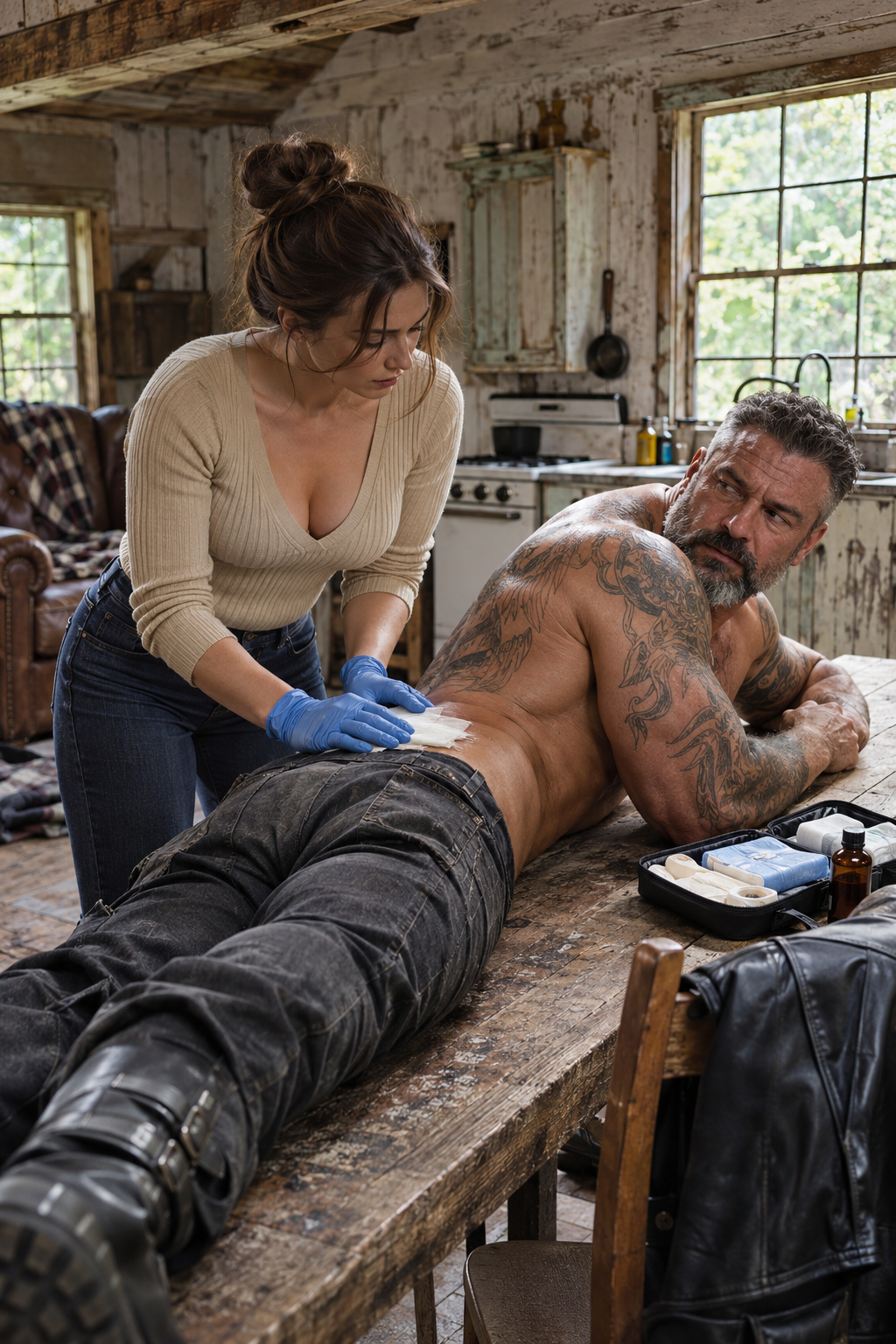
The wounded biker grabbed my wrist and whispered, “If a man named Cole comes to your door, don’t let him in.” Then he passed out on my kitchen floor.
“I’m not interested in what Garrett stole,” Raymond said. “I’m interested in whether he’s still alive to tell me what happened to my son.”
The silence that followed was more frightening than the storm.
Garrett closed his eyes.
“Oh, God,” he whispered.
I looked at him. “What does he mean?”
“His son, Daniel, was one of the men killed at the warehouse.”
Outside, Cole began explaining something, but Raymond interrupted him.
“Let Garrett tell me himself.”
A heavy knock shook the front door.
“Maggie, my name is Raymond. I know you’re in there. I need to speak to Garrett.”
I looked through the narrow opening between the curtains. Raymond was older than Cole, with a gray beard and broad shoulders. Two other bikers stood behind him, their faces partially hidden beneath rain-soaked hoods.
Cole kept his right hand inside his jacket.
Something about that bothered me.
“Does anyone out there have a weapon?” I asked.
Raymond looked directly at the window.
“Probably everyone except you.”
“Then nobody’s coming inside.”
To my surprise, Raymond nodded.
“Fair enough.”
Cole wasn’t nearly as understanding.
“This is ridiculous. She’s interfering in club business.”
Raymond turned toward him.
“She’s keeping a man alive. What have you done tonight?”
Cole’s jaw tightened.
I returned to Garrett, who was struggling to remove his left boot. His fingers were trembling so badly that he couldn’t untie the laces.
I helped him.
Beneath the removable insole was a tiny memory card wrapped in plastic.
“Everything’s on there,” he said. “Messages, payment records, photographs. I copied them from Cole’s computer after the ambush.”
“Why didn’t you go to the police?”
“Because one of the people receiving money was wearing a sheriff’s badge.”
I stared at him.
Suddenly, the isolation of my cabin felt less like an inconvenience and more like a death sentence.
Garrett pressed the memory card into my palm.
“If anything happens to me, don’t give that to Cole. And don’t give it to Raymond until you know what he’s going to do with it.”
“Don’t talk like that.”
“Maggie, listen to me. People are going to die over that little piece of plastic.”
I slipped it into my pocket.
Then the front window shattered.
I threw myself over Garrett as glass scattered across the living room. Something struck the kitchen cabinet with a deafening crack.
A gunshot.
Someone outside shouted.
Another shot followed, and the porch light exploded.
Raymond’s voice thundered through the darkness.
“Everybody down!”
I dragged Garrett toward the bathroom, leaving a trail of blood across the wooden floor. His wound had reopened, and his breathing was becoming irregular.
“Stay with me,” I pleaded.
He tried to answer, but only a weak groan escaped his lips.
My emergency radio crackled again.
“Maggie, this is Raymond. Are you hit?”
“No. Garrett’s bleeding again.”
“Stay away from the windows. We’ve got company.”
“Who?”
Before he could answer, headlights appeared between the trees.
Three vehicles were approaching my cabin.
One was a sheriff’s patrol truck.
For a brief moment, I felt relieved. Then I remembered Garrett’s warning.
The truck stopped beside Cole’s SUV, and a uniformed deputy stepped out.
I recognized him immediately.
Deputy Harris.
He had helped me carry furniture into the cabin when I first moved there. He had brought me firewood before winter and occasionally stopped by to make sure I was managing alone.
He knew my property better than anyone.
“Maggie!” he shouted. “It’s Harris. Open the door. You’re safe now.”
Garrett grabbed my sleeve.
“That’s him.”
My heart sank.
“The deputy?”
“He was at the warehouse. I saw him talking to Cole before the shooting started.”
I couldn’t believe it. Harris had always seemed kind. He had even invited me to Thanksgiving dinner with his family.
But kindness, I was beginning to understand, could be an excellent disguise.
“Maggie!” Harris called again. “These men are dangerous. I need you to cooperate.”
I picked up the radio.
“Raymond, the deputy is involved.”
There was a long pause.
“How do you know?”
“Garrett saw him.”
Raymond swore under his breath.
Then Harris began speaking to someone outside.
“Cole, you said you’d have this handled before we arrived.”
I felt the blood drain from my face.
There was no longer any doubt.
I turned on my phone’s recording function and placed it near the broken window, hoping to capture their conversation.
Raymond must have heard them too.
“You brought the law into this?” he demanded.
Cole laughed bitterly.
“You still don’t understand, old man. The club was falling apart. I found a way to make real money.”
“By selling out your brothers?”
“By making a business decision.”
“My son was twenty-six years old.”
“Daniel was in the wrong place at the wrong time.”
The next sound was a violent struggle.
Someone hit the side of the cabin, and another gunshot rang out.
I grabbed my phone and retreated.
Garrett was barely conscious. His skin felt cold, and his pulse was dangerously weak. Without surgery and a blood transfusion, he wasn’t going to survive much longer.
I had spent fifteen years working in emergency rooms. I knew what death looked like when it was approaching.
And I could see it coming for him.
“Garrett, I need you to tell me something. Is there another way off this mountain?”
He shook his head weakly.
“The bridge is gone.”
Then I remembered something.
Behind the cabin, nearly half a mile through the woods, stood an abandoned forestry lookout. The previous owner had mentioned an old service trail connecting it to a maintenance road on the opposite side of the ridge.
The trail was steep, overgrown, and probably dangerous in the storm.
But it was our only chance.
I gathered blankets, medical supplies, a flashlight, and my emergency backpack. Then I opened the bathroom’s small rear window.
Cold rain blew into my face.
There was no way Garrett could climb through it.
I needed help.
As if answering my thoughts, someone tapped gently against the back door.
“Maggie?”
It was Raymond.
“Cole’s men are covering the front. Open up.”
I hesitated.
“Put your weapon down.”
A metallic object landed on the wooden steps.
I unlocked the door.
Raymond stumbled inside, soaked and bleeding from a cut above his eyebrow. Behind him was one of the younger bikers, a man named Lucas.
The moment Raymond saw Garrett, his expression changed.
He knelt beside him.
“Brother, what happened to Daniel?”
Garrett opened his eyes.
“Raymond, I’m sorry.”
“Tell me.”
“He figured out something was wrong. He tried to warn the others. Cole shot him before the cartel men even came inside.”
Raymond became completely still.
“He shot my boy?”
Garrett nodded.
“I tried to get to him. I swear I tried.”
Raymond lowered his head. His shoulders began shaking.
For several seconds, the powerful man who commanded hundreds of bikers was simply a father grieving his child.
Then he stood and reached toward the back door.
I stepped in front of him.
“Where are you going?”
“To finish this.”
“If you leave, Garrett dies.”
Raymond looked at me with eyes filled with fury.
“You heard what he did.”
“Yes. And killing him won’t bring Daniel back.”
“You don’t know what it’s like to lose a son.”
The words struck somewhere deep inside me.
“No,” I answered quietly. “But I know what it’s like to lose a daughter.”
Raymond stopped.
I hadn’t spoken about Emily to a stranger in nearly three years.
She had been seventeen when a drunk driver crossed the centerline and hit her car. I was working the night she was brought into my hospital.
I recognized her shoes before I saw her face.
For months afterward, I wanted the man responsible to suffer. I imagined confronting him, hurting him, making him feel even a fraction of what I felt.
But none of those thoughts brought Emily home.
They only made it harder for me to remember the person she had been.
“Your son deserves justice,” I told Raymond. “Not another funeral.”
He looked toward Garrett.
Then, slowly, he lowered his hands.
“What do you need?”
“Help me get him out of here.”
Lucas found an old camping stretcher in my storage room. Together, we transferred Garrett onto it and carried him through the back door.
The rain was relentless. Mud swallowed our boots, branches whipped against our faces, and thunder rolled across the mountains.
We had traveled perhaps two hundred yards when an orange glow appeared behind us.
I turned around.
My cabin was burning.
Flames climbed the curtains and spread across the porch. Smoke poured through the shattered window.
Everything I owned was inside that house. Emily’s photographs, her childhood drawings, the letters she had written me, the sweater she wore on her last Christmas.
I stopped walking.
For a moment, I couldn’t breathe.
Raymond followed my gaze.
“I’m sorry, Maggie.”
I wanted to run back. I wanted to save whatever remained of my daughter’s life.
Then Garrett groaned on the stretcher.
I looked at him, and I remembered something Emily used to say whenever I complained about working another holiday shift.
“Mom, somebody needs you more than I do tonight.”
I wiped my eyes.
“Keep moving.”
We continued through the forest.
After twenty minutes, the trees opened onto a narrow ridge overlooking a flooded ravine. The old lookout tower stood on the opposite side, connected to our position by a deteriorating wooden footbridge.
Water raged beneath it.
Lucas examined the bridge.
“This thing might not hold all of us.”
“We can’t go back,” Raymond said.
They carried Garrett across while I followed several feet behind. The bridge creaked beneath our weight, and one of the boards broke loose, disappearing into the violent current.
We were almost across when a flashlight illuminated the trees behind us.
“There they are!”
Cole.
A shot struck the bridge railing.
Lucas cried out and fell against the ropes. Blood spread across his shoulder. Raymond grabbed the stretcher before it could tip.
“Go!” he shouted.
I helped Lucas reach solid ground, then returned for Garrett.
Behind us, Cole stepped onto the bridge. Harris followed with his gun raised.
“Hand over the card!” Cole yelled. “This doesn’t have to get worse!”
Raymond stood between them and us.
“You killed my son, and you’re telling me it doesn’t have to get worse?”
Cole stopped halfway across.
“Daniel should’ve minded his own business.”
Raymond took a step forward.
I grabbed his arm.
“Remember what we talked about.”
His entire body trembled with rage.
Then the mountain seemed to explode.
A massive tree, uprooted by the storm, crashed into the ravine upstream. The current carried it directly toward the bridge.
“Get off!” I screamed.
Harris turned and ran.
Cole wasn’t fast enough.
The tree struck the bridge supports, tearing the structure apart. Cole grabbed a dangling rope as the wooden platform collapsed beneath him.
He swung violently against the rocks, hanging above the raging water.
“Help me!” he screamed.
Raymond stared down at him.
For a moment, nobody moved.
Cole looked up at the man whose son he had murdered.
“Raymond, please!”
Raymond’s face was unreadable.
He could have walked away. Nobody would have blamed him.
Instead, he dropped to his knees and reached for the rope.
“Lucas, help me pull him up.”
Lucas looked stunned.
“Are you serious?”
“Do it!”
Together, they dragged Cole onto the muddy bank. He coughed violently, clutching his injured leg.
Raymond grabbed him by the collar.
“You don’t get to die tonight. You’re going to live long enough to answer for every life you took.”
Cole stared at him, speechless.
We reached the forestry lookout just before dawn. The structure was weathered but intact, and inside was an old emergency communications station.
I found a working radio connected to a backup battery.
After several attempts, a woman’s voice answered.
“Oregon emergency dispatch. Identify your location.”
I nearly cried with relief.
I explained everything, including Deputy Harris’s involvement, and requested state police and medical evacuation.
The dispatcher warned that the storm had grounded rescue helicopters, but a search-and-rescue team was already operating on the maintenance road below the ridge.
They would reach us as soon as possible.
I returned to Garrett.
His pulse was almost impossible to feel.
“Stay awake,” I told him.
He looked at Raymond.
“I’m sorry about Daniel.”
Raymond took his hand.
“You’ve got nothing to apologize for.”
“I should’ve saved him.”
“You tried.”
Garrett’s eyes filled with tears.
Then he looked at me.
“Maggie, why did you open your door?”
“Because you needed help.”
“You didn’t even know me.”
“I didn’t need to.”
He smiled faintly.
A moment later, his eyes closed.
His pulse disappeared.
I immediately began chest compressions. Raymond knelt beside me, following my instructions while Lucas held a flashlight with his uninjured arm.
I refused to stop.
Not after the cabin. Not after the bridge. Not after everything we had endured.
Outside, the rain began to weaken.
Then came the sound of approaching voices.
“Search and rescue!”
Four rescuers rushed inside carrying medical equipment. A paramedic took over compressions while another began advanced resuscitation.
Minutes passed before someone finally shouted the words I had been praying to hear.
“We’ve got a pulse!”
I sank against the wall.
Raymond covered his face with both hands.
Cole watched from the corner, silent and defeated.
State police officers arrived shortly afterward. They arrested him, secured his weapon, and took possession of the memory card and my phone recording.
Harris was captured that afternoon while attempting to leave the county.
Garrett was transported to a trauma center, where surgeons worked for nearly six hours to repair his injuries.
Lucas underwent surgery for his shoulder.
Both survived.
The investigation lasted eleven months. The evidence uncovered a network of corruption involving stolen weapons, drug trafficking, bribery, and multiple murders. Several members of the club were arrested, along with two law enforcement officers.
Cole eventually received a life sentence.
Harris was sentenced to decades in prison.
Raymond testified against both men.
He also stepped down from his position in the club, admitting that his loyalty to the organization had blinded him to things he should have questioned years earlier.
But the most unexpected part of the story happened three weeks after the storm.
I was staying in a small motel outside town, trying to figure out how to rebuild my life, when I heard motorcycles approaching.
Dozens of them.
I opened the door and found Raymond standing outside with Lucas and nearly forty other riders.
Garrett was there too, sitting carefully in the passenger seat of a pickup truck. He looked thinner, but he was smiling.
Raymond handed me an envelope.
Inside was a set of architectural drawings.
“What is this?” I asked.
“Your new house.”
I shook my head.
“I can’t accept that.”
“You lost everything because you helped one of our men. Some of us are carpenters. Some are electricians. Others have construction companies. We’re going to rebuild it.”
I looked at Garrett.
He held up a small wooden box.
“There’s something else.”
Inside were several photographs, a silver necklace, and a partially burned notebook.
My hands began trembling.
The necklace had belonged to Emily. The notebook contained letters she had written during her final year of high school.
“How did you find these?”
“Raymond went through what was left of the cabin after the investigators cleared it,” Garrett explained. “Spent two days digging through the ashes.”
I looked at Raymond.
He shrugged awkwardly.
“I know what it’s like when all you’ve got left are memories.”
I hugged him before he could say anything else.
Six months later, my new cabin stood on the same piece of land. It had stronger windows, an improved emergency communications system, and a wide porch overlooking the mountains.
Above the fireplace hung a photograph of Emily.
Beside it was a photograph of Daniel.
Raymond had asked if he could leave it there.
I told him his son would always be welcome in my home.
Garrett visited often during his recovery. Eventually, he left the club and began working with a nonprofit that helped people escape violent criminal organizations.
He told me he wanted to spend whatever years he had left doing something that mattered.
As for me, I returned to nursing. But I also began organizing first-aid workshops for people living in isolated mountain communities.
Raymond helped fund the program. We named it the Emily and Daniel Emergency Response Project.
On the first anniversary of the storm, Garrett arrived at my cabin carrying a bouquet of wildflowers.
We sat on the porch, watching the sun disappear behind the mountains.
“Do you ever regret opening that door?” he asked.
I thought about the gunshots, the burning cabin, the terrifying journey through the forest, and the photographs I had nearly lost forever.
Then I thought about the lives that had changed because of that night.
“No,” I said. “But next time, I’d appreciate it if you came during daylight.”
He laughed so hard that he grabbed his side.
For the first time in years, I found myself laughing without feeling guilty about it.
Before leaving, Garrett placed something on the porch railing.
It was his old sergeant-at-arms patch.
“I don’t need this anymore,” he said. “I spent too much of my life believing that loyalty meant protecting people from the consequences of their actions.”
He looked toward the mountains.
“You taught me that real loyalty sometimes means standing against the people you love when they’re doing something wrong.”
I watched him drive away until his taillights disappeared between the trees.
That evening, I opened Emily’s recovered notebook. Many of the pages were damaged, but near the back, I found a sentence written in her familiar handwriting.
It was something she had written for a school assignment about courage.
“Being a good person doesn’t mean the world will always be good to you. It means you refuse to let the bad things in the world decide who you become.”
I read those words several times.
Then I closed the notebook and looked around my home.
I had moved to the mountains because I wanted to escape people, pain, and the possibility of losing someone again.
Instead, a wounded stranger had arrived on my doorstep and reminded me that protecting yourself from every possible heartbreak can also prevent you from experiencing the very things that make life worth living.
Raymond had lost his son but chosen justice over revenge. Garrett had risked his life to expose the truth. Even Lucas, wounded and terrified, had refused to abandon a man who needed him.
None of us were perfect.
We had all made mistakes, trusted the wrong people, and carried wounds that nobody else could see.
But when the moment came to decide what kind of people we wanted to be, we discovered that our past didn’t have to determine our future.
Sometimes, the greatest act of courage isn’t fighting someone. It’s refusing to become like them.
Sometimes, family isn’t defined by blood, a uniform, or a patch sewn onto a leather vest. It’s defined by the people who stand beside you when everything falls apart.
And sometimes, the stranger you save on the darkest night of your life becomes the person who helps you find your way back into the light.
I still live in that cabin.
Storms still come through the mountains, and occasionally, thunder wakes me in the middle of the night.
But I’m no longer afraid of the sound of someone knocking at my door.
Because I know that while opening a door can sometimes bring danger into your life, opening your heart can bring something far more powerful.
A reason to live again.
Two years after the storm, another stranger appeared on my doorstep.
This time, it was a young woman holding the hand of a little boy. She looked exhausted, and there was a familiar sadness in her eyes.
“Are you Maggie?” she asked.
“Yes. Can I help you?”
She reached into her purse and pulled out a photograph of Daniel.
“My name is Sarah. Daniel was my fiancé.”
I stared at the photograph, then at the little boy standing beside her. He couldn’t have been more than three years old.
“This is Noah,” she continued. “He’s Daniel’s son.”
For a moment, I couldn’t find my voice.
“Does Raymond know?”
She shook her head.
“Daniel and I had an argument before he died. I moved away, and I found out I was pregnant two weeks after the funeral. I was afraid of the club. I didn’t want my child growing up around violence.”
“Why did you come back?”
Sarah looked down at Noah.
“Because I read about your emergency response project. I saw Raymond’s interview. He talked about his son and how he wished he’d made different choices.”
Her voice broke.
“I thought maybe Daniel’s father deserved a chance to know his grandson.”
I invited them inside and called Raymond.
He arrived forty minutes later, complaining about the traffic and carrying a bag of groceries for me.
Then he saw Sarah.
The bag slipped from his hand.
“Sarah?”
She nodded nervously.
Raymond looked at Noah. The little boy had Daniel’s dark eyes and the same crooked smile I’d seen in the photograph above my fireplace.
“Is he…?”
“Yes,” Sarah whispered.
Raymond sank into a chair.
Noah walked toward him, holding a small toy motorcycle.
“Mommy says you’re my grandpa.”
Raymond covered his mouth. Tears rolled down his cheeks.
“That’s right, little man.”
“Do you have a motorcycle?”
Raymond laughed through his tears.
“I sure do.”
“Can I see it?”
“In a few minutes.”
He looked at Sarah.
“May I hold him?”
She nodded.
Raymond lifted Noah into his arms and held him as though he were the most precious thing in the world.
I quietly stepped onto the porch to give them some privacy.
Through the window, I watched a man who had once been consumed by revenge discover that life still had something beautiful waiting for him.
But our story wasn’t quite finished.
A month later, I received a letter from prison.
The return address belonged to the correctional facility where Cole was serving his sentence.
I almost threw it away.
Instead, I opened it.
Inside was a handwritten letter addressed to Raymond. Cole had sent it to me because Raymond had refused all previous correspondence.
I called Raymond and told him about it.
“Burn it,” he said.
“Are you sure?”
He was silent for a long time.
Finally, he sighed.
“I’ll come over.”
That evening, he sat at my kitchen table and read the letter.
Cole admitted that he had spent months blaming everyone except himself. He blamed the club, the cartel, Garrett, and even Daniel. But prison had stripped away every excuse.
He wrote that he remembered Daniel’s final moments every night.
He remembered the bridge collapsing beneath him.
Most of all, he remembered Raymond reaching down to save him.
“I murdered your son,” Cole had written. “You had every reason to let me die. I still don’t understand why you didn’t. But your decision has haunted me more than any punishment ever could.”
At the bottom of the letter, he asked for forgiveness.
Raymond folded the paper carefully.
“What are you going to do?” I asked.
He stared at Daniel’s photograph.
“I don’t know if I’ll ever forgive him.”
“You don’t have to.”
He nodded.
“But I don’t want to spend the rest of my life hating him, either.”
Three days later, Raymond wrote a reply.
It contained only a few sentences.
“I saved you because I refused to become you. Nothing will undo what you did. Spend the rest of your life taking responsibility for it. As for me, I have a grandson to raise, and I won’t waste another day letting hatred steal time from us.”
He mailed the letter and never spoke of Cole again.
The following spring, our emergency response project opened its first permanent training center. Garrett became one of our instructors, teaching people how to respond to accidents in remote areas. Lucas volunteered on weekends. Sarah managed the organization’s finances, and Raymond spent most of his free time with Noah.
On opening day, more than two hundred people gathered outside the building.
I stood before them, struggling to finish my speech.
Behind me were two large photographs of Emily and Daniel.
Neither of them had lived long enough to see the good their memories would inspire.
Yet their names would now be connected to something that could save hundreds of lives.
After the ceremony, Garrett approached me with an elderly woman.
“Maggie, there’s someone I’d like you to meet.”
The woman introduced herself as his mother.
She took both of my hands.
“My son told me what you did for him.”
I smiled.
“I’m glad he’s doing well.”
She shook her head.
“You don’t understand. Before that night, I hadn’t spoken to him in nine years. I thought I’d lost him forever.”
Garrett lowered his eyes.
His mother continued.
“You didn’t just save his life. You gave him a chance to become my son again.”
She hugged me tightly.
I looked over her shoulder at Garrett, who was wiping his eyes.
For years, I had believed that saving a life meant keeping someone’s heart beating.
Now I understood that sometimes it meant giving someone the opportunity to build a different life entirely.
Five years passed.
Our organization trained thousands of people across Oregon. We provided emergency equipment to isolated communities, helped establish communication networks, and offered scholarships to young people interested in emergency medicine.
Raymond sold his motorcycle repair business and donated part of the money to the project.
Garrett married a wonderful woman named Rebecca. When their daughter was born, they asked whether I would mind if they named her Emily.
I cried when they told me.
Of course, I said yes.
One autumn afternoon, we gathered at my cabin for a family barbecue. Noah, now old enough to ride a bicycle, raced around the yard while little Emily chased him through the fallen leaves.
Raymond stood beside the grill, arguing with Lucas about how to cook hamburgers. Garrett was repairing a loose board on my porch, despite my repeated insistence that it could wait.
I watched them from my rocking chair.
The mountains were painted gold beneath the afternoon sun. Laughter drifted through the trees. The cabin that had once been my hiding place had become a home filled with people.
Raymond eventually sat beside me.
“Thinking about her?” he asked.
I nodded.
“Every day.”
“Me too.”
We watched Noah help little Emily climb onto a wooden bench.
“Daniel would’ve loved this,” Raymond said.
“So would my Emily.”
He smiled.
“You know, Maggie, I used to think being strong meant never needing anybody.”
“What do you think now?”
He looked at his grandson.
“I think being strong means knowing when to reach out your hand.”
As evening approached, everyone gathered around the dinner table. Before we ate, Noah asked why there were photographs of two people above the fireplace.
Raymond lifted him onto his lap.
“One of them is your daddy,” he explained. “The other is Maggie’s daughter.”
“Where are they?”
Raymond glanced at me.
“They’re not here anymore, buddy.”
Noah considered that for a moment.
“Then why do we keep their pictures?”
I smiled through my tears.
“Because people don’t stop being part of our lives just because they’re gone.”
He seemed satisfied with that answer.
Then he climbed down, ran toward the fireplace, and placed a little wildflower beneath Daniel’s photograph.
“For Daddy,” he announced.
Little Emily followed him and placed another flower beneath my daughter’s picture.
Nobody spoke for several seconds.
There was nothing that needed to be said.
Later that night, after everyone had gone home, I sat alone on the porch. The stars were bright, and the forest was peaceful.
I remembered the woman I had been before Garrett arrived. A woman who believed her happiest days were behind her. A mother who had mistaken isolation for safety.
I wished I could tell that woman what was waiting for her.
That grief would never disappear completely, but it would make room for joy. That strangers would become family. That the worst night of her life would lead to some of her most beautiful years.
And that helping someone else wouldn’t erase her pain, but it would remind her that pain wasn’t the only thing she had left to give.
Before going inside, I noticed a small wooden sign Garrett had attached beside my front door.
It read:
“Here, no one is beyond hope.”
I touched the words and smiled.
That sign remained there for the rest of my life.
Because the greatest lesson I learned wasn’t about bikers, criminals, courage, or even survival.
It was about choices.
We cannot always choose what happens to us. We cannot prevent every betrayal, every tragedy, or every loss. But we can choose whether those experiences make us cruel or compassionate.
Cole chose greed and destroyed everything he had.
Garrett chose truth and earned a second chance.
Raymond chose mercy and discovered a future he never imagined possible.
And I chose to open a door.
One simple decision, made on a terrible night, changed more lives than I could ever have predicted.
If there is anything I hope people remember about my story, it is this: never underestimate the power of a single act of kindness. You may never know how far its consequences will travel, how many hearts it will touch, or how many lives it will transform.
The world can be frightening. People can disappoint you. Life can take away things you thought you could never live without.
But as long as you are still here, your story is not finished.
There is always another chance to do something good.
Another opportunity to love.
Another reason to believe that tomorrow can be different.
And sometimes, when you think you have nothing left to offer the world, someone knocks on your door and reminds you that the most valuable thing you possess has been inside you all along.
Your humanity.
That was what saved Garrett.
That was what saved Raymond.
And in the end, that was what saved me.
THE END.