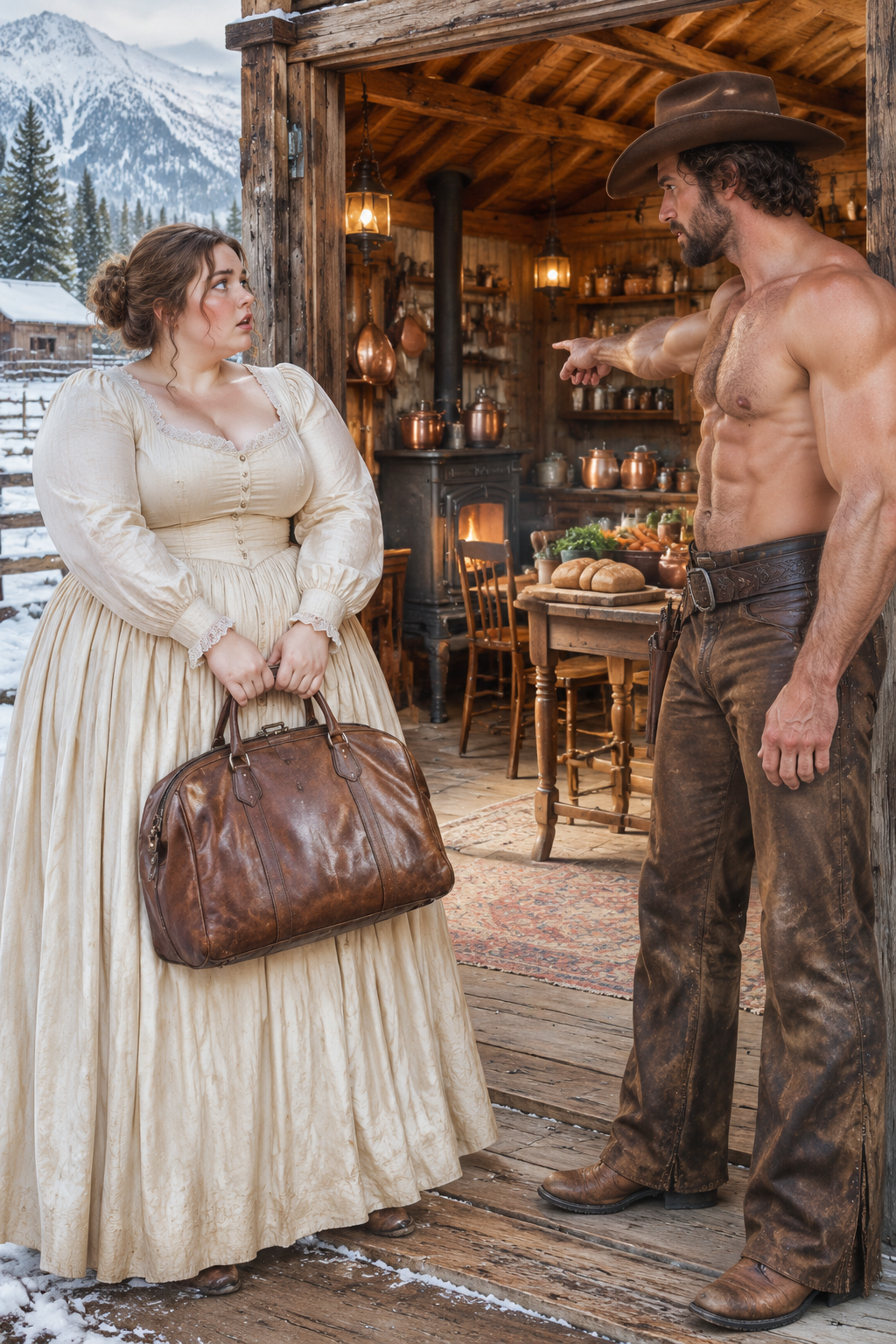
The woman who had promised Rebecca Lane a job was already dead when Rebecca arrived at Tate Ranch
The fire had nearly consumed Miriam’s letter when Benjamin finally turned toward Rebecca.
“What was Benjamin so afraid to tell her?”
Rebecca waited, but he looked away.
“You should go back to the kitchen,” he said.
His voice was quiet, but there was something sharp beneath it.
“Benjamin, I wasn’t trying to read something that didn’t belong to me.”
“I know.”
“Then why are you angry?”
He rubbed a hand over his face. For a moment, the tall, strong ranch owner looked like a man who had been carrying something too heavy for too long.
“Because my sister knew me too well,” he finally said.
Rebecca glanced at the dying flames.
“She must have loved you very much.”
Benjamin gave a bitter little laugh.
“She did. Sometimes I wish she hadn’t.”
Rebecca didn’t understand.
He walked past her without another word.
That evening, Benjamin didn’t come into the kitchen.
The ranch hands noticed his absence, but none of them asked questions. Helen sat quietly at the table, pushing pieces of bread around her plate.
“Is Uncle Ben mad at you?” she finally whispered.
Rebecca pulled out the chair beside her.
“I don’t think he’s mad at me, sweetheart.”
“Then why does he look sad?”
Rebecca had no answer.
She reached across the table and gently covered the little girl’s hand.
“Sometimes grown-ups don’t know how to talk about the things that hurt them.”
Helen studied her face.
“Will you leave when it snows?”
The question caught Rebecca off guard.
“I don’t know yet.”
Helen lowered her eyes.
“Miriam said people who come into our house don’t always stay.”
Rebecca felt a lump form in her throat.
“I can’t promise you everything, Helen. But I can promise I won’t disappear without saying goodbye.”
The girl nodded, although her expression didn’t change.
Later that night, Rebecca lay awake listening to the wind rattle the windows.
She had come to Wyoming looking for work, not a family.
Yet somehow, in just two weeks, she had begun to care about a little girl who had already lost too much.
And she was beginning to care about a man who seemed determined to push everyone away.
The following morning, Benjamin left before sunrise.
He didn’t return until nearly noon, his coat covered in snow and his expression unusually grim.
“Rebecca,” he called from the doorway.
She wiped her hands on her apron.
“Yes?”
“I need you to come with me.”
“Where?”
“To town.”
She frowned.
“Did something happen?”
“There’s a problem with the ranch accounts.”
He hesitated before adding, “And I think you should know about it.”
Rebecca followed him outside.
The cold air stung her cheeks. Benjamin helped her onto the wagon, then climbed up beside her.
For several miles, neither spoke.
Finally, Rebecca asked, “Is this about Miriam’s letter?”
“No.”
“Then what is it?”
Benjamin tightened his grip on the reins.
“Someone has been asking questions about the property.”
Rebecca turned toward him.
“What kind of questions?”
“Questions about ownership. About the house. About whether the ranch can survive another winter.”
“Who?”
“My uncle, Charles Tate.”
Benjamin’s voice hardened.
“He believes the ranch should be sold.”
Rebecca had heard the name before. Some of the ranch hands mentioned Charles whenever they thought Benjamin wasn’t listening.
They said he had money, influence, and a habit of making other people’s troubles worse.
“Can he force you to sell?” she asked.
“Not if I can prove the accounts are sound.”
“And are they?”
Benjamin didn’t answer immediately.
“That’s what we’re going to find out.”
At the town office, Benjamin spread several documents across a wooden desk.
Rebecca wasn’t an accountant, but she had spent enough years managing small household budgets to recognize when numbers didn’t make sense.
She studied the papers carefully.
“Benjamin, why does this payment appear twice?”
He leaned over her shoulder.
“What payment?”
She pointed to two entries.
“The same amount. Same date. Same description.”
Benjamin stared at the page.
“That can’t be right.”
Rebecca compared the figures with the receipts.
“Someone has charged the ranch for the same delivery twice.”
He turned to the clerk.
“Who authorized this?”
The clerk shifted uncomfortably.
“I only record what I’m given.”
Benjamin’s expression grew darker.
Rebecca examined another page.
Then another.
There were several unusual payments, all made to a company she didn’t recognize.
“Benjamin,” she said quietly, “I don’t think this is a simple mistake.”
He looked at her.
“What are you saying?”
“I think someone has been taking money from you.”
The silence that followed was heavy.
Benjamin gathered the papers and placed them in his coat.
“We’re going home.”
On the ride back, Rebecca could feel the anger rolling off him.
When they reached the ranch, he called for his foreman, Thomas.
Thomas was a broad-shouldered man in his fifties who had worked for the Tate family for nearly twenty years.
Benjamin showed him the documents.
Thomas studied them, then slowly shook his head.
“I’ve never approved these payments.”
“Who has access to the books?” Benjamin asked.
“Your uncle, me, and you.”
Benjamin’s eyes narrowed.
“Then someone has been using my name.”
Thomas looked toward Rebecca.
“Where did you find this?”
“At the town office,” she replied.
Thomas nodded thoughtfully.
“There’s something else you ought to know.”
Benjamin waited.
“Charles came here last week while you were out checking the northern fence.”
Rebecca noticed Thomas hesitate.
“What did he want?” Benjamin asked.
“He asked whether Helen had any legal claim to the property.”
Benjamin went still.
“Helen?”
Thomas nodded.
“He said Miriam’s death changed things. He wanted to know whether the child was legally entitled to anything.”
Benjamin’s jaw tightened.
“My sister’s daughter is my responsibility.”
“I know,” Thomas replied. “But Charles seemed to think otherwise.”
Rebecca felt a chill that had nothing to do with the weather.
Helen was not just a quiet little girl grieving her aunt.
She might also be standing between Charles Tate and everything he wanted.
That evening, Benjamin sat alone in the writing room.
Rebecca found him there after putting Helen to bed.
He was holding a photograph of Miriam.
She stood beside a younger Benjamin, both of them laughing beneath the summer sun.
“She looks happy,” Rebecca said.
Benjamin placed the photograph down.
“She was.”
He stared at it for a long time.
“She was the only person who could tell me I was being an idiot and get away with it.”
Rebecca smiled faintly.
“I’m sure she knew exactly what she was doing.”
“She always did.”
For a moment, the room felt almost peaceful.
Then Benjamin spoke again.
“Charles wants this place. He always has. My father left the ranch to me, but my uncle never accepted it.”
“Why?”
“Because he thinks everything should belong to the person with the most money.”
Benjamin leaned back.
“He has spent years waiting for me to fail.”
Rebecca sat across from him.
“And are you going to let him?”
Benjamin looked at her.
“No.”
It was the first time she had heard certainty in his voice.
Over the next several days, Rebecca helped Benjamin organize the household records and old correspondence.
They worked late into the evenings.
Sometimes he brought her coffee without asking.
Sometimes she found him standing in the kitchen doorway, watching Helen laugh while she helped roll dough.
The changes were small, but they mattered.
Helen began talking more.
She even started asking Benjamin questions at supper.
One evening, she asked whether he would teach her to ride a horse when spring came.
Benjamin looked surprised.
“If you’re ready, I’ll teach you.”
“Really?”
“Really.”
Rebecca watched the little girl’s face brighten.
It was the first time she had seen Benjamin smile without trying to hide it.
But happiness at Tate Ranch was still fragile.
Two days later, a black carriage arrived.
Charles Tate stepped down wearing an expensive coat and polished boots.
He was in his late fifties, with silver hair and the cold confidence of a man who had rarely been told no.
Benjamin met him on the porch.
“Uncle.”
“Benjamin.”
Charles glanced past him.
“I see you’ve acquired help.”
Rebecca stood in the doorway.
“Rebecca Lane,” she said.
Charles gave her a thin smile.
“Ah. The new cook.”
“She manages more than the kitchen,” Benjamin replied.
Charles raised an eyebrow.
“Does she?”
He stepped inside without waiting for an invitation.
His eyes moved over the furniture, the staircase, and the walls.
“Your father would be disappointed to see the condition of this place.”
Benjamin didn’t move.
“My father would be disappointed to see you here.”
Charles chuckled.
“Still angry. I see nothing has changed.”
He sat down and placed a leather folder on the table.
“I’ve come to offer you a way out.”
Benjamin looked at the folder.
“I’m not selling.”
“You haven’t even heard the offer.”
“I don’t need to.”
Charles opened the folder.
“The ranch is carrying debts. Your operating expenses are rising. The winter will be expensive. You have no wife, no children of your own, and now you’re responsible for a little girl.”
His eyes briefly moved toward the stairs.
“You can’t manage all this alone.”
Rebecca saw Benjamin’s hands tighten.
“Leave Helen out of this.”
“I’m only stating facts.”
Charles turned to Rebecca.
“And you. How long have you been here?”
“Long enough to know that this family deserves better than threats.”
His smile disappeared.
“You should be careful. People who interfere in family business often find themselves without a place to stay.”
Benjamin stepped forward.
“She stays as long as I say she does.”
Charles slowly stood.
“Then perhaps you should reconsider who has the authority to make that decision.”
He left the folder on the table.
“Read the papers. I’ll return in three days.”
When the door closed, Benjamin remained motionless.
Rebecca picked up the folder.
“What does he want?”
Benjamin opened it.
The documents proposed a sale of the ranch, with Charles offering to pay off the outstanding debts in exchange for control of the property.
But there was another page.
It concerned Helen.
Charles was challenging the arrangement that allowed Benjamin to care for her.
“He wants guardianship?” Rebecca asked.
Benjamin nodded.
“He thinks he can take her away from me.”
“Can he?”
Benjamin looked at the papers.
“I don’t know.”
That night, Helen woke from a nightmare.
Rebecca found her crying in bed, clutching Miriam’s old shawl.
“He’s coming back,” Helen whispered.
“Who, sweetheart?”
“Mr. Charles.”
Rebecca sat beside her.
“Did he say something to you?”
Helen shook her head.
“He told me Uncle Ben might not be able to keep me.”
Rebecca’s heart sank.
She held the child close until her breathing slowed.
When Benjamin came to the doorway, he saw Helen asleep against Rebecca’s shoulder.
For a long moment, he simply watched them.
Then he quietly said, “I won’t let him take her.”
Rebecca looked up.
“Then we need to find out what Miriam wanted.”
Benjamin frowned.
“What do you mean?”
“The letter.”
He turned away.
“I burned it.”
“Not the only letter she ever wrote.”
Benjamin stopped.
Rebecca remembered the writing room, the old photograph, and the way Miriam’s belongings had been left untouched.
“Your sister knew her brother. She knew what he was capable of. Maybe she left something behind.”
Benjamin looked toward the stairs.
For the first time, he seemed willing to consider it.
The following morning, they searched Miriam’s old room.
Most of her things were still there. Dresses hung neatly in the wardrobe. Books filled the shelves. A small wooden box sat on the bedside table.
Inside were photographs, receipts, and several letters.
Benjamin recognized the handwriting immediately.
He sat down on the edge of the bed.
“She kept everything.”
Rebecca picked up a bundle tied with blue ribbon.
There were letters from friends, notes about the ranch, and a few documents signed by Benjamin’s father.
Then she found an envelope marked with Benjamin’s name.
He opened it carefully.
The first page was dated six months before Miriam’s death.
She wrote about Helen, about the ranch, and about Charles.
But one paragraph made Benjamin stop reading.
She explained that she had discovered irregularities in the ranch accounts.
She believed Charles had been using a company under another name to divert money from the family business.
Rebecca looked at him.
“That matches what we found.”
Benjamin continued reading.
Miriam had also written that she was worried Charles would try to gain control of the ranch after her death.
She had spoken to a lawyer and arranged for certain documents to be kept somewhere safe.
But she had not written where.
The letter ended with a simple sentence.
If anything happens to me, trust the person who is willing to stay when staying becomes difficult.
Benjamin lowered the paper.
Neither spoke for several moments.
Then Helen appeared at the door.
“Are you looking for Aunt Miriam?”
Benjamin looked up.
“Yes, sweetheart.”
Helen walked into the room and pointed toward the old wooden box.
“She told me there was something special inside.”
Rebecca knelt beside her.
“What did she say?”
Helen thought carefully.
“She said if Uncle Ben ever got sad, I should help him find the little blue key.”
Benjamin frowned.
“The blue key?”
Helen nodded.
“She hid it somewhere only I would remember.”
The little girl led them toward the back of the wardrobe.
She reached behind a loose wooden panel and pulled out a small blue key tied to a ribbon.
Benjamin stared at it.
“I’ve never seen that before.”
Helen smiled sadly.
“Aunt Miriam told me it was important.”
They searched the room again.
Behind the wardrobe was a small cabinet with a lock.
The key fit.
Inside lay a leather-bound journal, several official documents, and a sealed envelope bearing the name of Miriam’s lawyer.
Benjamin opened the envelope.
The documents included copies of financial records, evidence of unauthorized payments, and a signed statement confirming that Miriam had discovered the scheme months earlier.
There was also a letter from the lawyer explaining that Miriam had made arrangements to protect Helen’s interests.
Benjamin read every page twice.
Then he looked at Rebecca.
“This could change everything.”
But before they could examine the remaining papers, someone knocked sharply at the front door.
Thomas entered the room a moment later.
“Benjamin, Charles is back.”
Benjamin stood.
“Already?”
Thomas nodded.
“And he brought someone with him.”
When Benjamin reached the porch, Charles was standing beside a well-dressed man carrying a briefcase.
“This is Mr. Whitaker,” Charles announced. “He represents the people interested in purchasing the ranch.”
Benjamin folded his arms.
“You were told I wasn’t selling.”
Charles smiled.
“Perhaps you should hear what he has to say.”
Mr. Whitaker opened his briefcase.
“Mr. Tate, there are some legal matters that need to be settled before any transaction can proceed.”
Benjamin looked at the papers.
“What legal matters?”
“The question of guardianship, for one.”
Charles stepped forward.
“I believe the child would be better off with someone who can provide her with a secure future.”
Benjamin’s voice dropped.
“Helen is not a piece of property.”
“No, she’s a child who deserves stability.”
Charles looked toward Rebecca.
“And I doubt a temporary employee is qualified to decide what’s best for her.”
Rebecca felt the sting of the insult but kept her composure.
“Neither is someone who has spent years trying to take her home away.”
Charles’s expression changed.
“You should mind your place.”
Benjamin stepped between them.
“She knows her place. She’s standing beside people who need her.”
For the first time, Charles looked genuinely unsettled.
Benjamin took the documents from the lawyer.
“I have evidence that you have been stealing from this ranch.”
Charles laughed.
“That’s a serious accusation.”
“I have Miriam’s records. I have the original payment entries. And I have her statement.”
The smile disappeared from Charles’s face.
Mr. Whitaker glanced at him.
“Is there something I should know?”
Charles said nothing.
Benjamin continued.
“You have three days to explain these payments before I take everything to the authorities.”
Charles stared at his nephew.
“You wouldn’t dare.”
“Try me.”
The meeting ended badly.
Charles left without another word, but Benjamin knew he wouldn’t give up easily.
That night, the ranch hands gathered in the kitchen.
Thomas brought out a bottle of cider, and the men raised their cups to Miriam.
Rebecca served a large pot of stew.
Helen sat beside Benjamin, smiling as he helped her cut her bread.
For a little while, the house felt whole.
But Rebecca noticed Benjamin watching her.
When the others had gone, he approached her by the stove.
“I owe you an apology.”
“For what?”
“For making you feel unwelcome when you first arrived.”
Rebecca smiled faintly.
“You had just lost your sister.”
“That doesn’t excuse how I treated you.”
She placed a plate on the counter.
“I wasn’t expecting you to trust me right away.”
Benjamin took a breath.
“Miriam believed I would push you away.”
“She knew you well.”
He almost smiled.
“She also knew I was afraid.”
“Of what?”
“Of losing someone again.”
Rebecca’s expression softened.
Benjamin looked down at his hands.
“When Miriam died, I promised myself I wouldn’t let anyone get close enough to hurt me like that again. Then Helen needed me. And you came here, making this house feel like a home when I had forgotten what that meant.”
He paused.
“I don’t know what to do with that.”
Rebecca stepped closer.
“You don’t have to know everything tonight.”
He looked at her.
“What if I ask you to stay?”
She held his gaze.
“Then I would need to know you’re asking because you want me here, not because you need someone to cook your meals.”
Benjamin gave a quiet laugh.
“I think I can manage my own meals.”
“Can you?”
“Probably not as well as you.”
They both smiled.
For the first time, the silence between them felt comfortable.
But the fight with Charles was not over.
Two days later, Benjamin received a letter from the lawyer.
Charles had filed a formal petition challenging the guardianship arrangement and demanding an investigation into the ranch’s financial condition.
The documents Miriam had hidden were important, but they needed to be verified.
Benjamin would have to appear before a judge.
The hearing was scheduled for the following week.
Rebecca knew what that meant.
If the court ruled against Benjamin, Helen could be placed elsewhere while the case continued.
And if Charles succeeded in proving the ranch was unstable, the entire property could be lost.
Benjamin tried to hide his worry.
But Rebecca saw it in the way he stared at the fireplace long after everyone else had gone to bed.
One evening, she found him outside the barn.
Snow was falling lightly.
“Are you all right?” she asked.
He shook his head.
“I’m afraid.”
Rebecca stood beside him.
“Of losing the ranch?”
“Of losing Helen.”
He looked toward the house.
“She has already lost her mother. Then Miriam. I don’t know if I could watch her lose another home.”
Rebecca reached for his hand.
“Then don’t fight alone.”
Benjamin looked down at their joined hands.
“I don’t want you caught in this.”
“I already am.”
“Rebecca—”
“I came here because I needed work. I stayed because I cared about the people in this house. That includes you.”
He didn’t answer immediately.
Then he gently squeezed her hand.
“Whatever happens, I don’t want you to leave.”
Rebecca smiled.
“Then we’ll face it together.”
The next morning, the first real snowstorm of the season arrived.
The roads disappeared beneath white drifts. The ranch hands worked through the storm to secure the livestock and reinforce the barn.
Rebecca kept the kitchen warm and made sure everyone had enough food.
Helen helped her prepare biscuits, laughing whenever flour covered her nose.
Benjamin came in late that afternoon with snow frozen along his shoulders.
He looked exhausted.
“Roads are blocked,” he said. “No one is getting into town until the storm passes.”
Rebecca handed him a cup of coffee.
“Then we’ll stay here and keep each other warm.”
He looked at her for a long moment.
“You make it sound simple.”
“It isn’t. But it doesn’t have to be impossible.”
That evening, the storm grew worse.
A loud crack sounded from the northern pasture.
Thomas rushed into the kitchen.
“The old fence is down. Two horses are missing.”
Benjamin grabbed his coat.
“Get the men.”
Rebecca stood.
“I’m coming.”
“No.”
“Benjamin, the men will need food and supplies. I can help.”
He hesitated, then nodded.
She packed bread, blankets, and hot coffee into a basket.
Outside, the wind howled.
Benjamin and the ranch hands searched for hours.
At last, they found the horses near a frozen creek.
But one of the men had slipped and injured his leg.
Rebecca helped Thomas get him onto the wagon.
By the time they returned, the house was quiet.
Helen had fallen asleep on the sofa, waiting for Benjamin.
Rebecca covered her with a blanket.
Benjamin stood in the doorway, watching.
“You didn’t have to wait up,” he said.
“I wanted to.”
He approached her.
“Thank you.”
She looked at him.
“For what?”
“For staying.”
The words were simple, but they carried everything he had struggled to say.
He reached for her hand.
And this time, neither of them pulled away.
The following week, the storm finally cleared.
The roads reopened, and Benjamin traveled to town for the hearing.
Rebecca stayed with Helen.
Before he left, Helen hugged him tightly.
“Come back soon, Uncle Ben.”
He knelt and kissed her forehead.
“I promise.”
Rebecca watched him climb into the wagon.
She wanted to believe everything would be all right.
But she knew promises were easier to make than to keep.
At the courthouse, Charles arrived with two lawyers.
Benjamin brought Miriam’s documents, the financial records, and the letter from her attorney.
The hearing lasted several hours.
Charles claimed he had only tried to protect the family business.
He argued that Benjamin was too emotionally attached to the ranch to make sound decisions.
He also questioned Rebecca’s role in the household, suggesting she had influenced Benjamin for her own benefit.
Benjamin remained calm.
When asked about the accounts, he presented the duplicate payments and the records showing the unauthorized transfers.
Then he submitted Miriam’s written statement.
The judge examined the documents carefully.
Charles’s lawyers requested more time.
The judge agreed to postpone the final decision until the financial records could be independently reviewed.
Benjamin returned to the ranch that evening with no final answer.
Rebecca met him on the porch.
“How did it go?”
“Not well enough.”
“Did you lose?”
“No.”
“Then we keep going.”
He looked exhausted, but he smiled.
“You always find a way to make things sound possible.”
“Someone has to.”
The next morning, a telegram arrived from Miriam’s lawyer.
The independent review had uncovered a series of transfers linked to Charles’s company.
More importantly, the lawyer had found the original legal document Miriam had signed before her death.
It confirmed that Helen’s long-term care had been entrusted to Benjamin, with specific protections against anyone attempting to remove her without proper cause.
The document also named a trusted family friend as a backup guardian, ensuring Helen would never be left without someone to protect her.
Benjamin read the telegram twice.
Then he sat down.
For the first time in weeks, he allowed himself to breathe.
But the message contained one final detail.
The lawyer wanted Benjamin and Rebecca to come to town together.
There was something else Miriam had arranged, and he believed they both needed to hear it.
Benjamin looked at Rebecca.
“What do you think she left us?”
Rebecca glanced toward Helen, who was drawing pictures at the kitchen table.
“I think we should find out.”
Three days later, they traveled to town.
Miriam’s lawyer greeted them in his office.
He was an older man with kind eyes and a careful manner.
He placed a sealed envelope on the desk.
“Your sister was a remarkable woman, Benjamin.”
Benjamin swallowed.
“She was.”
The lawyer opened the envelope.
Inside was a letter addressed to both Benjamin and Rebecca.
Rebecca looked surprised.
“To me?”
The lawyer nodded.
“She asked that this be given to you if you both remained at the ranch through the first snowfall.”
Benjamin looked at Rebecca.
Together, they unfolded the paper.
Miriam’s handwriting filled the page.
She wrote that she had known Benjamin was lonely long before her death.
She had watched him build walls around himself, believing that independence was the same as strength.
She had also met Rebecca briefly before arranging the job offer.
Miriam had liked her kindness, her honesty, and the way she spoke about people who had been overlooked.
She had hoped Rebecca might help Benjamin understand that love was not something to fear.
But the letter was not a request for Rebecca to stay out of pity.
Miriam had made that clear.
She wrote that Rebecca deserved a life of her own, and that Benjamin had no right to ask her to sacrifice it.
Then came the words that made Benjamin lower the paper.
Family is not made by keeping people from leaving. It is made by giving them a reason to stay, while loving them enough to let them choose.
Rebecca felt tears gather in her eyes.
The lawyer placed another document on the desk.
It was Miriam’s final arrangement for the ranch.
She had left a portion of her personal savings in a protected trust for Helen’s future, with Benjamin as trustee.
The money was enough to cover the child’s education and provide security without putting the ranch at risk.
She had also instructed her lawyer to help Benjamin investigate any financial wrongdoing connected to the property.
The lawyer looked directly at Benjamin.
“Your sister wanted to protect Helen. But she also wanted to protect you from making decisions out of fear.”
Benjamin stared at the letter.
For a long time, he couldn’t speak.
Finally, he folded it carefully and placed it inside his coat.
On the journey home, he was unusually quiet.
Rebecca watched the snowy fields pass.
“She really did think of everything,” she said.
“Almost everything.”
Rebecca turned toward him.
“What do you mean?”
Benjamin looked at her.
“She couldn’t tell me how to make you stay.”
Rebecca smiled sadly.
“No. That was something you had to figure out yourself.”
When they arrived, Helen ran out to meet them.
“Did you win?”
Benjamin knelt and lifted her into his arms.
“We’re going to be all right, sweetheart.”
Helen wrapped her arms around his neck.
“Does that mean I can stay?”
Benjamin closed his eyes for a moment.
“You’re home, Helen. You’re always home.”
Rebecca watched them, her heart full.
The final court hearing took place two weeks later.
This time, the evidence was clear.
The financial investigation confirmed that Charles had authorized unauthorized transfers through his company and had concealed the transactions from the ranch accounts.
The judge dismissed his challenge to Benjamin’s guardianship and referred the financial evidence to the proper authorities.
Charles lost his attempt to gain control of the property.
The ranch remained in Benjamin’s hands.
More importantly, Helen’s place in the family was secure.
When Benjamin returned, the ranch hands gathered in the yard.
Thomas slapped him on the shoulder.
“Looks like the old place is staying right where it belongs.”
Benjamin smiled.
“That’s the plan.”
That evening, Rebecca prepared a special supper.
There was beef stew, fresh skillet bread, and spiced dried apples.
The same meal she had made on her first night.
The ranch hands filled the long table, laughing and telling stories.
Helen sat beside Benjamin, proudly announcing that she would learn to ride in the spring.
After supper, the men gradually returned to their quarters.
Rebecca began clearing the plates.
Benjamin stopped her.
“Leave them.”
She raised an eyebrow.
“Since when?”
“Since tonight.”
He took a plate from her hands and placed it on the counter.
Then he turned toward her.
“I have something to ask you.”
Rebecca’s heart began to beat faster.
“All right.”
“I don’t want you to stay because Miriam arranged it. I don’t want you to stay because Helen needs another person to care for her. And I certainly don’t want you to stay because I can’t cook.”
Rebecca laughed softly.
“That’s probably a wise decision.”
Benjamin smiled.
“I want you to stay because I love having you here. I love hearing you move around the kitchen in the morning. I love the way Helen looks for you when she wakes up. I love that this house feels alive again.”
He took a breath.
“And I think I’ve fallen in love with you.”
Rebecca stood very still.
She had imagined hearing those words, but never expected them to come so simply.
“Benjamin, I didn’t come here looking for love.”
“I know.”
“I came here because I needed a job.”
“I know that too.”
“And I don’t want to become someone else’s responsibility.”
Benjamin nodded.
“Then don’t. Be my partner. Build something with me, if that’s what you want.”
Rebecca looked around the kitchen.
At the warm stove.
At the wooden table where Helen had learned to laugh again.
At the doorway where eleven hungry men had once watched her uncertainly.
She thought about how close she had come to leaving that first night.
Then she looked back at Benjamin.
“I think I’d like that.”
He reached for her hand.
“Are you sure?”
Rebecca smiled.
“I wouldn’t still be standing here if I weren’t.”
He leaned down and kissed her gently.
There was no grand declaration, no audience, no dramatic promise.
Just two people who had spent too long believing they had to face everything alone.
And for them, that was enough.
Spring arrived slowly in Wyoming.
The snow melted from the pastures, the creek ran clear again, and the ranch began to wake beneath the warmer sun.
Benjamin kept his promise to Helen.
He taught her to ride a gentle mare named Daisy.
At first, she was afraid to climb into the saddle.
Rebecca stood nearby, holding the reins.
“You don’t have to be brave all at once,” she told her. “You just have to try one little step.”
Helen nodded.
Benjamin lifted her onto the horse.
For a moment, she sat stiffly, her hands gripping the saddle.
Then Daisy took a few slow steps.
Helen laughed.
A bright, carefree sound that seemed to travel across the entire pasture.
Benjamin looked toward Rebecca.
His eyes were shining.
“She sounds like Miriam,” he said.
Rebecca slipped her hand into his.
“I think Miriam would be happy.”
Benjamin nodded.
“I wish she could see this.”
“She can, in the ways that matter.”
That afternoon, they planted a small garden near the kitchen.
Helen chose the flowers.
Benjamin built the fence.
Rebecca planted herbs and vegetables.
They worked side by side, getting dirt on their hands and laughing when Helen accidentally dropped an entire basket of seeds.
It wasn’t a perfect family.
There were still difficult days.
Helen sometimes woke from dreams about her aunt.
Benjamin still had moments when old grief returned without warning.
And Rebecca occasionally worried that she had given up too much of her independence by staying.
But they learned to talk about those fears instead of hiding them.
They learned that love did not mean never feeling afraid.
It meant choosing honesty even when the truth was uncomfortable.
Months later, the ranch hosted a small gathering to celebrate the end of the season.
The kitchen was full of food, the yard was crowded with neighbors, and laughter drifted through the open windows.
Rebecca stood at the stove, stirring a pot of stew.
Benjamin approached from behind and placed a gentle kiss on her cheek.
“Still making enough for an army?”
She smiled.
“Someone has to feed your hungry ranch hands.”
He looked around the room.
Helen was helping Thomas arrange the plates.
The men were laughing.
The house was warm.
Then Benjamin glanced toward the empty chair near the fireplace.
Miriam’s chair.
He walked over and placed her photograph on the small table beside it.
For a moment, he stood quietly.
Rebecca joined him.
“Missing her?” she asked.
“Every day.”
He looked at the photograph.
“But I don’t feel like I’m losing her all over again.”
Rebecca took his hand.
“That’s because you finally let yourself remember the good things too.”
Benjamin nodded.
“I spent so long thinking that if I loved someone, losing them would destroy me.”
“And now?”
He looked toward Helen, who was laughing with the ranch hands.
“Now I think losing someone is painful because having them in your life mattered. That doesn’t mean you should stop letting people in.”
Rebecca rested her head against his shoulder.
Outside, the evening sun settled over the Wyoming hills.
The ranch was no longer the lonely place Rebecca had found on that cold, rainy afternoon.
It had become a home again.
And perhaps the greatest gift Miriam had left behind was not the money, the documents, or the protection she had arranged.
It was the reminder that love cannot be forced, grief cannot be hurried, and family is not always defined by blood.
Sometimes, family begins when someone opens a door to a stranger and decides to give them a chance.
Sometimes, the person who arrives looking for a job becomes the person who helps an entire household find its way back to happiness.
And sometimes, the bravest thing a lonely heart can do is stop building walls and finally allow someone to stay.
Because home is not simply the place where you live.
It is the place where you are welcomed, where your presence matters, and where you never have to earn the right to be loved.
THE END.