The winter came early to Pine Ridge, Dakota, the kind of winter old timber men remembered years later with a distant look in their eyes.
It was a bell.
Faint at first, nearly swallowed by the wind, then unmistakable.
Three short rings.
A pause.
Two more.
Alex Wade stood frozen in the doorway while snow swept across the yard in ghostly sheets.
“Horse bell,” murmured Jacob Miller, one of the oldest men in camp.
“No horse could make it through that,” another man said.
The bell sounded again.
This time it was followed by a human voice.
Weak.
Somewhere beyond the stable.
Alex snatched his coat from a peg.
“Lanterns. Ropes. Six men with me.”
Kora tried to move from the table.
Alex turned on her.
“You stay.”
“I can walk.”
“You can barely stand.”
Her eyes hardened, but for once she did not argue.
The men tied themselves together with rope before stepping into the storm. Snow reached their knees before they had crossed the yard. Beyond the stable it rose to their thighs.
They followed the bell.
Twenty yards.
Thirty.
Then Jacob’s lantern found the horse.
The animal had collapsed into a drift, its sides trembling violently. Behind it lay the remains of a small freight sled, tipped on one runner.
A man was half buried beside it.
They dragged him into camp.
His name was Samuel Hart, a freighter from Rapid Creek. He had left the settlement five days earlier with two horses and a load of flour, bacon, dried peas, lamp oil, medicine, and mail intended for several winter camps along the timber line.
One horse had died the previous afternoon.
The second had carried him until dark.
His freight, however, was still somewhere on the ridge.
“Four crates,” Samuel whispered as Kora wrapped blankets around him. “Three sacks flour. Maybe forty pounds bacon. Lost the sled when the runner broke.”
Thirty hungry men stared at one another.
Forty pounds of bacon.
Three sacks of flour.
Enough to change everything.
Alex saw the thought spreading through the room.
He also saw Kora watching him.
“Where?” Alex asked.
Samuel described the ridge.
Jacob swore under his breath.
“That is two miles out.”
“One and a half,” Samuel corrected.
“In summer.”
No one spoke.
Outside, the storm continued beating against the walls.
Then Pete Lawson, a broad young logger from Minnesota, stood up.
“We go at daylight.”
Kora shook her head.
“You go at daylight and half of you don’t come back.”
Pete frowned. “Those provisions could keep us alive.”
“They won’t keep dead men alive.”
Her voice was quiet, which made everyone listen more carefully.
Alex looked toward the shelves.
He knew exactly what remained.
So did Kora.
Finally, he said, “We wait until the wind drops.”
Nobody liked it.
Nobody challenged him.
Samuel Hart survived the night.
Kora almost didn’t.
At dawn, Alex found her on the floor beside the stove.
Eli was kneeling beside her, crying without sound.
For several seconds Alex could not understand what he was seeing.
Kora had always seemed permanent to him, as fixed in Pine Ridge as the stove itself.
Then he noticed how thin her face had become.
He lifted her carefully.
She weighed far less than he expected.
“When did you last eat?” he demanded after she woke.
Kora turned her head.
“When?”
No answer.
Eli answered for her.
“Ma gives me her supper.”
Kora closed her eyes.
Alex felt something cold and furious settle inside him.
“You’ve been starving yourself.”
“We were short.”
“We are all short.”
“You work harder than anyone here.”
“That doesn’t make my stomach more important.”
“It makes it necessary.”
She tried to rise.
Alex pushed her gently back.
“No.”
“There is bread to make.”
“Pete can make it.”
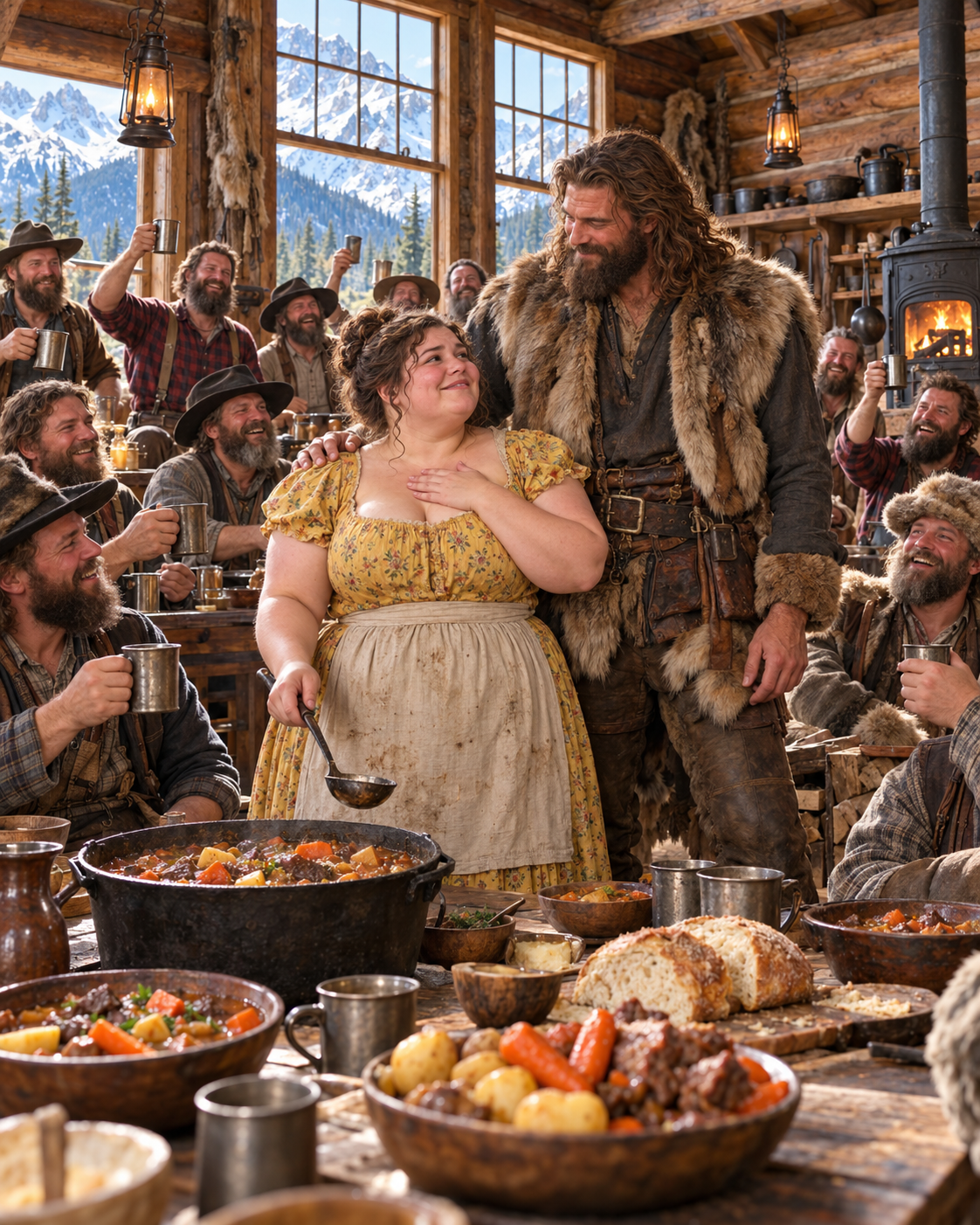
From across the room Pete stared at him in alarm.
Kora almost smiled.
“That boy would burn water.”
“Then he’ll learn.”
For the first time since she arrived, Kora stayed in bed while another person prepared breakfast.
It was terrible.
The biscuits came out hard enough to hammer nails.
No one complained.
When Pete placed a plate beside Kora containing one biscuit, potatoes, and a sliver of bacon, she tried to refuse.
Thirty men stopped eating.
Jacob folded his arms.
“Ma.”
Kora glared at him.
“Eat.”
She looked around the room.
Every face waited.
Some embarrassed.
Some stubborn.
All determined.
Slowly Kora picked up the biscuit.
Only then did thirty men return to their own plates.
By midday the storm weakened.
Alex chose eight men for the freight run.
He tied them into two rope teams and ordered every man to carry blankets, axes, matches sealed in wax, and enough food for one day.
Kora, still pale, made him repeat Samuel’s directions three times.
“Ridge bends north after the split pine,” she said. “If you reach the burned stand, you’ve gone too far.”
Alex nodded.
“And Alex?”
“Yes?”
“If you can’t find it before dark, come home.”
“We need those supplies.”
“I need thirty living fools more than I need three sacks of flour.”
He smiled despite himself.
“Yes, Ma.”
That was the first time he called her that.
She noticed.
She said nothing.
The journey took four hours.
The sky cleared, but the cold sharpened until every breath hurt.
They found the broken sled almost completely covered in snow.
One flour sack had split.
Another was wet along one side.
The bacon had frozen solid.
The medicine crate was intact.
So was the mail.
Alex studied the load.
They could not carry everything.
“Food first,” Pete said.
Jacob shook his head and lifted the medicine box.
“There are camps farther north.”
“They’re not here.”
“They are still men.”
Alex looked over the ridge.
In clear weather, smoke from neighboring camps might have been visible.
There was nothing.
Only white country stretching beneath a hard blue sky.
He thought of Pine Ridge.
Then of strangers farther into the Dakota wilderness waiting for supplies that might never arrive.
“We take the flour, bacon, medicine, and mail,” he said.
“What about the lamp oil?”
“If we can.”
They built a drag from pieces of the broken sled.
The journey back took twice as long.
Near sunset, Pete stepped through a crusted drift and vanished to his waist.
His leg twisted beneath him.
He cried out.
The team stopped.
Pete could not stand.
Alex looked at the darkening sky.
They had perhaps forty minutes of usable light.
“Leave the drag,” Pete said through clenched teeth.
Nobody moved.
“Leave it and get me back.”
Jacob looked toward Alex.
Alex looked at the supplies.
Three sacks of flour.
Food.
Medicine.
Perhaps survival.
Then he remembered Kora’s words.
I need thirty living fools more than I need three sacks of flour.
“Cut the load in half,” Alex ordered.
They abandoned one sack of flour and most of the lamp oil.
Pete was placed on the drag instead.
The remaining supplies were divided among the men.
They reached camp two hours after dark.
When the cookhouse door opened, the cheer shook snow from the roof beams.
Kora didn’t cheer.
She saw Pete on the drag and immediately ordered a table cleared.
His ankle was badly sprained, not broken.
Samuel’s medicine crate contained laudanum, quinine, bandages, and several small bottles marked for camps farther north.
Kora used only what Pete needed.
The rest she sealed again.
With the recovered flour and bacon, Pine Ridge had time.
Not comfort.
Time.
Kora recalculated everything.
Half rations remained.
Nobody argued anymore.
More important, the men began watching Kora as carefully as she watched them.
A strange reversal occurred.
If she skipped breakfast, Jacob noticed.
If her supper plate looked too clean, Pete noticed.
If she tried giving Eli part of her biscuit, Eli himself pushed it back.
“You said no wasting food,” he told her solemnly.
The cookhouse erupted in laughter.
Kora pointed at him.
“You are getting too clever.”
Eli smiled.
It was the first strong smile Alex had seen from the boy.
Yet winter was not finished.
February passed slowly.
Then March arrived with a cruel trick.
Three days of warmer weather softened the snow.
Men began talking about spring.
On the fourth night, the temperature plunged.
The meltwater froze into hard crust.
Then came another storm.
Not as large as January’s blizzard, but colder.
On the second morning, one of the loggers, Tom Reed, failed to return from checking a distant timber marker.
Alex organized a search immediately.
Kora stood in the doorway as the men prepared.
“No heroics,” she said.
Alex gave her a tired smile.
“You’ve said that before.”
“You didn’t listen before.”
“We came back.”
“With Pete tied to a broken sled.”
Pete, still limping, called from a bench, “She’s got you there, boss.”
The men laughed.
Alex raised both hands in surrender.
They found Tom three hours later beneath a fallen spruce.
His left arm was trapped.
He was alive but dangerously cold.
Freeing him required cutting through a branch thicker than a man’s thigh.
By the time they returned to camp, Tom was barely conscious.
For two days Kora fought for him.
She warmed stones by the stove, wrapped them in cloth, kept them near his body, spooned broth between his lips, and refused to allow the men to crowd around his bunk.
Eli became her assistant.
“More water,” she would say.
He brought it.
“Clean cloth.”
He found it.
“Firewood.”
He dragged small pieces from the stack.
Something had changed in the boy.
His cough remained, but strength was returning to his face.
Perhaps it was the medicine Samuel had carried.
Perhaps the steady heat.
Perhaps the improved food.
Perhaps simply the knowledge that Pine Ridge had become a place where thirty men silently considered him their little brother.
Tom eventually opened his eyes.
His first words were, “Did I miss supper?”
Kora answered, “Three of them.”
He groaned.
The camp knew he would live.
But Tom’s accident revealed another problem.
Their firewood was running low.
The men had assumed frozen timber scraps near the cutting site would last.
Much of it was now buried beneath hardened snow and ice.
Without fire, food meant little.
Without fire, Eli would not survive a single bitter night.
So Pine Ridge changed its routine.
Every able man spent part of each day collecting fuel.
They tore apart unused crates.
They burned damaged furniture.
Alex sacrificed the door of his own small office.
Pete suggested burning the cookhouse tables.
Kora threatened to break his other ankle.
By late March, the camp looked stripped to its bones.
But smoke still rose from the chimney.
Then came the night everyone remembered.
Alex woke shortly before dawn to shouting.
He ran outside.
The storage shed was burning.
Flames climbed one wall where a lantern had fallen.
Men formed a line, throwing snow onto the fire.
Inside the shed were the remaining flour, potatoes, bacon, tools, and medicine.
Alex and Jacob rushed inside.
Smoke filled the cramped building.
They dragged out two flour sacks.
Then a beam cracked overhead.
“Out!” someone yelled.
Alex stumbled outside coughing.
Through the smoke he saw Kora.
She was running toward the shed.
He grabbed her.
“What are you doing?”
“The medicine.”
“Forget it.”
“Eli’s bottle is in there.”
For an instant Alex felt her entire body strain against him.
Not the strength of the stern cook.
The strength of a terrified mother.
Then part of the roof collapsed.
Sparks flew into the night.
Kora stopped fighting.
The men saved most of the food.
The medicine was lost.
By sunrise, the shed was black timber and frozen ash.
Eli still had a cough.
No medicine remained.
Kora stood staring at the ruins.
Alex came beside her.
“He’s stronger now.”
“He could get worse.”
“Yes.”
She looked at him sharply.
He did not soften the truth.
“But spring is coming.”
“You don’t know that.”
“No.”
Kora wrapped her arms around herself.
For the first time Alex saw fear completely unguarded on her face.
“I buried his father in November,” she said.
Alex said nothing.
“He got fever on the Missouri road. Three days. That was all.”
This was the first time she had spoken of him.
“I took work wherever I could after that. Laundry. Kitchens. Freight houses. Men would look at me, then look at Eli, and tell me they had no room for a woman with a sick child.”
Alex watched smoke drift from the burned shed.
“Why didn’t you tell me?”
“Would it have changed anything?”
“No.”
“That is why.”
She turned toward him.
“I wasn’t trying to be noble when I stopped eating. I was afraid.”
“Of what?”
“That if the men got hungry enough, you would send us away.”
Alex stared at her.
Even after months at Pine Ridge, even after being called Ma, some part of her had still believed her place depended on making herself smaller.
Taking less.
Needing nothing.
“You thought I would send you and Eli into a Dakota winter?”
“I’ve seen kinder men do worse when their families were hungry.”
Alex looked toward the cookhouse.
Through the window, thirty rough timber workers were moving around breakfast.
Pete was trying to flip a pancake.
Jacob was laughing.
Eli sat at the table wrapped in a blanket, explaining something with both hands while three men listened with exaggerated seriousness.
Alex said, “Look.”
Kora looked.
“That isn’t my camp anymore,” Alex said.
She frowned.
“It hasn’t been for months.”
Kora’s eyes filled, though she quickly turned away.
“Don’t start talking foolish.”
“I wouldn’t dare.”
The thaw began four days later.
At first it was nothing more than dripping from the roof.
Then snow slid from south-facing slopes.
The creek beneath the ice began to murmur.
Birds appeared.
The men stood outside listening to them as though they were musicians from New York.
One morning Jacob walked into the cookhouse carrying a tiny green shoot he had found beside a dark patch of earth.
He placed it next to Kora’s flour bin.
“What’s that for?”
“Proof.”
“Of what?”
“That hell froze over and we lived through it.”
By the second week of April, Alex believed the trail might be passable.
He chose four men to attempt the journey toward Rapid Creek.
Kora packed food for two days.
This time no one complained about portions.
The men left at dawn.
They returned the following evening with six horses, a wagon, and twelve people from the settlement.
The supply wagon rolled into Pine Ridge to shouting loud enough to frighten birds from the trees.
There was flour.
Fresh meat.
Sugar.
Coffee.
Dried apples.
Medicine.
Even oranges.
Most of the men had not seen fresh fruit since autumn.
Pete held one up like gold.
Kora took the first orange.
Everyone went silent.
She peeled it carefully.
Then she divided it into small pieces and handed one to every man standing nearby.
Pete groaned.
“Ma, that is thirty ways to ruin an orange.”
“Thirty-one,” she corrected, giving Eli a piece.
“What about yours?”
Kora popped the final section into her mouth.
The room cheered.
That evening she cooked the largest meal Pine Ridge had seen all winter.
Biscuits.
Gravy.
Roast beef.
Potatoes.
Beans sweetened with molasses.
Apple cobbler.
Men ate until belts were loosened and chairs creaked.
Afterward Alex stood.
He held a tin cup.
“Quiet.”
The room reluctantly settled.
Alex was not a man who enjoyed speeches.
Everyone knew it.
That made them listen.
“In December,” he said, “we hired a cook.”
Several men laughed.
“In January, we discovered we’d hired a jailer.”
More laughter.
Kora crossed her arms.
“In February, we discovered the jailer was apparently willing to starve herself because none of us had the sense to notice.”
The laughter disappeared.
Alex continued.
“In March, I learned something else.”
He looked at Kora.
“A camp isn’t timber, tools, wages, or a company stamp on a ledger. It’s people who decide nobody gets left outside.”
No one moved.
“Kora taught us that.”
Jacob raised his cup.
“To Ma.”
Thirty cups rose.
“To Ma.”
Kora stared at the table.
Eli smiled at her.
She wiped one eye with the back of her wrist.
“Eat your cobbler before it gets cold,” she muttered.
The men laughed again.
Spring transformed Pine Ridge quickly.
Mud replaced snow.
The creek flooded its banks.
Teams returned to the cutting grounds.
The timber company sent word that Alex’s crew had fallen behind quota.
Alex read the letter twice and threw it into the stove.
By May, Pine Ridge was alive with axes, saws, wagons, and profanity.
Kora’s kitchen returned to full portions.
Pete gained back every pound he had lost and several more.
Tom Reed’s arm healed.
Samuel Hart eventually continued north to deliver what remained of his mail.
Before leaving, he shook Kora’s hand.
“You saved me.”
“So did thirty other people.”
“Still.”
“Then remember thirty-one.”
Eli improved with the warmer weather.
He began running.
At first only across the yard.
Then to the creek.
Then everywhere.
Kora shouted at him constantly.
“Stay away from those horses!”
“Put that axe down!”
“If you fall in that creek, don’t expect me to jump after you!”
Everyone knew she would have jumped without removing her apron.
In June, a letter arrived from the timber company’s office.
Alex brought it to Kora.
She read slowly.
The company planned to close Pine Ridge after the summer cut and move operations farther west.
“You knew?” she asked.
“I suspected.”
“What happens to the men?”
“Some will go west. Some south. Some home.”
“And you?”
“I’ve been offered another camp.”
Kora folded the letter.
“Congratulations.”
Alex leaned against the table.
“They need a cook.”
She gave him a look.
“I thought I was a jailer.”
“Position has been renamed.”
She smiled.
Then the smile faded.
“I don’t know.”
“Why?”
“Eli needs a town. A school. A doctor close enough that it doesn’t take five days and two dead horses to reach him.”
Alex nodded.
He had already known.
“You should go.”
Kora looked surprised.
“You aren’t going to argue?”
“No.”
“You argue about everything.”
“I learn slowly.”
By August, the last major timber drive left Pine Ridge.
The camp began emptying.
Men packed blankets and tools.
Some headed toward Wyoming.
Others toward Minnesota and Wisconsin.
Jacob planned to return to Iowa to see grandchildren he had never met.
Pete claimed he was going to Chicago.
Nobody believed him.
On Kora’s final morning, every man appeared for breakfast early.
Suspiciously early.
They ate in near silence.
When Kora went outside, she found a wagon waiting.
Inside it were sacks of flour, blankets, preserved meat, cooking tools, and a wooden box.
“What is this?”
Pete shrugged.
“Supplies.”
“I can see that.”
Jacob handed her the box.
It was heavy.
Inside were coins and folded bills.
Kora’s face changed.
“No.”
“Yes,” Jacob said.
“I won’t take this.”
“Then we’ll put it in Eli’s pocket.”
“You will do no such thing.”
Pete grinned.
“He has several pockets.”
Kora looked around.
Thirty men stood there.
Men she had once fed.
Men who had once mocked her.
Men who had watched her nearly disappear while keeping them alive.
“How much?”
“Enough,” Alex said.
“For what?”
“A beginning.”
She shook her head.
“I earned wages.”
“This isn’t wages.”
“What is it?”
Jacob smiled.
“Back pay for all the times you called us idiots and were correct.”
Kora laughed.
Then she cried.
Not quietly.
Not politely.
She covered her face, and thirty hardened timber workers suddenly became extremely interested in boots, wagon wheels, clouds, distant trees, and anything else that allowed them not to admit their own eyes were wet.
Eli climbed onto the wagon.
“Ma, are we rich?”
“No.”
Pete called, “Compared to us, you are.”
Kora pointed at him.
“Don’t teach him nonsense.”
Alex drove them to Rapid Creek.
The settlement was small but growing, a scattering of wood buildings, corrals, shops, and houses along a muddy road.
Kora rented a narrow storefront beside the freight office.
By October, a sign hung above the door.
KORA’S TABLE
MEALS — COFFEE — BREAD
Underneath, in smaller letters painted by Eli:
NO MAN GETS SECONDS BEFORE EVERYONE GETS FIRSTS.
Travelers laughed at the rule.
Regular customers understood it.
Years passed.
The railroad pushed farther across Dakota.
Towns grew where open prairie had been.
Timber camps disappeared.
Men married, aged, moved, prospered, failed, tried again.
But every winter, letters arrived at Kora’s Table.
From Jacob in Iowa.
From Pete, who somehow really had reached Chicago.
From Tom in Montana.
From men whose handwriting she barely recognized.
Some letters contained money.
Some contained photographs.
Some contained nothing but a few lines:
Still eating, Ma.
Still remember Pine Ridge.
Eli grew tall.
He attended school.
Later he studied medicine.
When he left Dakota for college, Kora pretended she had dust in her eyes for nearly a week.
Alex visited Kora’s Table whenever work brought him near Rapid Creek.
Sometimes he stayed an hour.
Sometimes a month.
He never again ran a camp quite like Pine Ridge.
He said no other place had taught him so much about hunger.
Not hunger for food.
The other kind.
The hunger to know that when hardship came, someone would still make room for you at the table.
Many years later, after Kora’s hair had turned silver, a young reporter traveling through Dakota heard the story of the winter at Pine Ridge.
He asked whether it was true that she had saved thirty men by starving herself.
Kora became irritated.
“That isn’t what happened.”
The reporter opened his notebook.
“What happened, then?”
Kora looked around her little restaurant.
At the long tables.
At strangers sharing bread.
At a framed photograph on the wall showing thirty rough men standing in front of a snow-covered cookhouse.
At Eli’s medical-school portrait beside it.
She said, “For a while, I thought surviving meant giving until there was nothing left of you.”
The reporter waited.
“I was wrong.”
She pointed toward the photograph.
“Those fools taught me something back.”
“What?”
“That people aren’t meant to survive alone.”
Outside, snow had begun falling softly over Dakota.
Inside, someone passed a basket of bread down the table.
Nobody took a second piece until everyone had one.
And that, more than the blizzard, more than the hunger, and more than the terrible winter itself, became the part of Pine Ridge worth remembering.
Because sacrifice may carry people through one hard night.
But a community is what carries them home.
Years passed, and the story of Pine Ridge slowly became one of those tales people repeated so often that no one could remember exactly where fact ended and legend began.
Some said the snow that winter had reached the roofs.
Others swore the men survived for weeks on nothing but half a biscuit each morning.
Pete Lawson claimed, whenever he had an audience and enough whiskey in him, that Kora once chased a wolf away from the cookhouse with a frying pan.
Kora always denied that one.
“The wolf had better sense than Pete,” she would say.
But there was one thing nobody exaggerated.
No man who had survived Pine Ridge ever forgot her.
They returned over the years in twos and threes.
Some arrived dressed in work clothes, carrying everything they owned in one bag.
Some arrived in polished boots with wives and children.
One man came in a motorcar so loud it frightened every horse tied along the street.
Whenever one of them walked through the door of Kora’s Table, the same thing happened.
Kora would look up from the stove.
The man would remove his hat.
For a moment, they would simply stare at one another.
Then Kora would say, “You look hungry.”
And the years between them disappeared.
Eli remembered those reunions most clearly.
He watched men who had once swung axes through frozen timber sit at the same long table and become young again.
They argued about who had suffered most during the blizzard.
They accused one another of stealing bacon.
They told the same stories differently every time.
But whenever the subject turned to Kora’s hunger, their voices changed.
The laughter faded.
They remembered her hands shaking as she stirred soup.
They remembered how loose her coat had become.
They remembered that none of them had understood until it was almost too late.
For Eli, that memory became part of the reason he chose medicine.
He wanted to understand weakness before it became collapse.
He wanted to recognize suffering in people who insisted they were fine.
Most of all, he wanted to become the kind of man who noticed.
He finished his training years later and returned to Dakota.
By then, Rapid Creek had grown into a proper town.
The muddy road had become a wider street.
A bank stood where a livery yard had once been.
Telegraph wires cut across the sky.
There was talk of extending another rail spur west.
Yet Kora’s Table remained almost unchanged.
The sign had faded.
The wooden floor groaned.
The stove had been repaired so many times that no one could say how much of the original iron remained.
But the rule painted beneath the sign was still there.
NO MAN GETS SECONDS BEFORE EVERYONE GETS FIRSTS.
Eli opened a small medical office three doors down.
His first patients were railroad workers, farmers, children with fevers, mothers exhausted from childbirth, and old men who insisted they had never needed a doctor in their lives.
Kora became his most difficult patient.
She refused examinations.
She ignored his advice.
She ate whatever she pleased.
When he told her to rest, she accused him of becoming arrogant because someone had given him a medical certificate.
“You are sixty-three,” he said one afternoon.
“And you are still my boy.”
“I’m a doctor.”
“You once ate candle wax.”
“I was four.”
“You knew better.”
“I did not.”
“You looked guilty.”
Their arguments became a familiar sound along the street.
Alex Wade witnessed many of them.
He had left the timber business years earlier after an accident damaged one knee badly enough that climbing ridges became difficult.
For a while he tried managing freight contracts.
Then he invested in a small lumber yard outside Rapid Creek.
He lost money the first year.
Made it back the second.
By the fifth year, he was doing well enough to hire others for the work he once insisted on doing himself.
Still, every morning he ate breakfast at Kora’s Table.
Always the same table.
Always coffee first.
Always two eggs if she had them.
People sometimes assumed Alex and Kora were married.
Neither corrected strangers quickly.
Neither admitted enjoying the misunderstanding.
One snowy morning, nearly twenty years after Pine Ridge, Pete Lawson came through the door carrying a wooden crate.
He had gone gray around the temples but remained as loud as ever.
“Ma!”
Kora appeared from the kitchen.
“What have you broken?”
“Nothing.”
“Then why are you here?”
Pete grinned.
“Missed your sweet nature.”
She hugged him anyway.
The crate contained oranges.
A whole crate.
Kora stared at them.
Pete rubbed his chin.
“Thought it was time we had one each.”
The room went quiet.
Kora understood immediately.
So did Alex.
Pete began passing the oranges around.
One to every person in the restaurant.
Customers who knew nothing of Pine Ridge looked confused.
Former timber men smiled.
Kora picked up hers.
For several seconds she simply held it.
Then she began to laugh.
The sound spread through the room.
Later that evening, after the customers had gone, Kora sat near the stove peeling her orange.
“You remember the first one?” Alex asked.
“I remember you men acting like starving children.”
“We were starving children.”
“You were thirty grown fools.”
Alex smiled.
“Some things don’t change.”
Kora divided the orange in two.
She handed him half.
He frowned.
“You know the rule.”
“Everyone already had one.”
“Then this is seconds.”
“Consider it interest.”
He accepted it.
Outside, snow began covering the street.
For a moment, neither spoke.
Then Alex said, “Do you ever think about Pine Ridge?”
“Every winter.”
“So do I.”
She looked at him.
“I used to dream about it.”
“The storm?”
“The food.”
Alex waited.
“I dreamed there was always one more person coming through the door, and I had nothing left to give them.”
He studied her face.
“Do you still have that dream?”
“Not anymore.”
“What changed?”
Kora looked through the front window toward Eli’s office.
“I learned the door works both ways.”
Alex understood.
People could enter needing help.
But sometimes they entered to give it.
That was the lesson she had taken the longest to accept.
In the winter of her sixty-seventh year, Kora became ill.
It started as a cough.
She dismissed it.
Eli did not.
He listened to her lungs and ordered her to bed.
For once, she obeyed.
That frightened him more than the cough itself.
The fever came the next day.
Then weakness.
Rapid Creek had doctors now, not just Eli.
Two examined her.
They agreed it was pneumonia.
Eli stayed beside her anyway.
The roles had reversed so completely that neither mentioned it.
He brought broth.
She complained it needed salt.
He adjusted blankets.
She complained they were too heavy.
He tried to make her drink water.
She accused him of trying to drown her.
By the fourth day, the fever worsened.
Word traveled through town.
People began leaving food outside.
Bread.
Stew.
Preserves.
Firewood.
Coffee.
One farmer brought a sack of potatoes.
A railroad worker left two dollars with no name attached.
Children from the school made a card so large it could barely fit through the doorway.
Then telegrams started arriving.
Pete was coming.
Tom Reed was coming.
Jacob had already died several years earlier, but his eldest grandson sent a message from Iowa.
MY GRANDFATHER SAID YOUR MOTHER SAVED HIS LIFE. OUR FAMILY HAS NEVER FORGOTTEN.
Eli read it beside Kora’s bed.
Her eyes remained closed.
But she smiled.
“Good man,” she whispered.
“Jacob?”
“Stubborn as a mule.”
“So are you.”
“Runs in the camp.”
By the fifth night, Eli knew they might lose her.
He had treated dying patients before.
He knew the signs.
That knowledge did nothing to prepare him.
He sat beside her holding one hand.
Alex sat across the room.
The old man’s damaged knee was stretched toward the stove.
No one spoke for a long time.
Then Kora opened her eyes.
“Eli.”
“I’m here.”
“Restaurant?”
“Closed.”
Her expression sharpened.
“Why?”
“Because you’re sick.”
“People still need breakfast.”
“They can survive one morning.”
She looked toward Alex.
“He always this foolish?”
“Worse lately.”
Eli laughed despite himself.
Kora breathed slowly.
“Open it tomorrow.”
“Ma.”
“Open it.”
“I’m not leaving you.”
She squeezed his fingers.
Weakly, but deliberately.
“You think feeding people was about biscuits?”
He looked at her.
“You still don’t understand.”
“What?”
“It was never the food.”
Her voice had grown quieter.
“It was the table.”
Eli’s eyes filled.
Kora continued.
“When people sit at the same table, they notice who’s missing.”
The room went silent.
Outside, wind touched the windows.
Not like Pine Ridge.
Nothing could ever sound like that storm again.
Kora looked at Alex.
“You noticed too late.”
Alex swallowed.
“Yes.”
“But you noticed.”
“Yes.”
She turned back to Eli.
“That matters.”
She slept for several hours.
Before dawn, the fever finally broke.
Eli awoke with his head against the mattress.
Kora was watching him.
“You drool.”
He jerked upright.
“Your fever is down.”
“So is your dignity.”
He laughed.
Then he cried.
Kora recovered slowly.
For almost three weeks, she did not enter the restaurant.
During that time, something remarkable happened.
Kora’s Table never closed.
Pete cooked breakfast one morning and ruined half the eggs.
Alex took over coffee.
The schoolteacher baked bread.
A farmer’s wife made stew.
Railroad workers washed dishes.
Eli watched strangers and old friends work together behind his mother’s counter.
No one had organized it.
No one needed to.
Everyone simply knew what to do.
When Kora finally walked back through the door, leaning on a cane she hated, the restaurant was full.
People stood.
Then applauded.
Kora stopped.
She looked around.
“Sit down before your food gets cold.”
No one moved.
Pete wiped his eyes.
She pointed at him.
“You cry easier every year.”
“Smoke.”
“There’s no smoke.”
“Old smoke.”
The room laughed.
Kora sat at the long table.
For once, someone else brought her food.
A bowl of stew.
Bread.
Coffee.
She looked at the meal.
Then at all the people around her.
Slowly, she began eating.
Years later, Eli would say that was the moment he understood Pine Ridge more clearly than he ever had as a child.
His mother had spent much of her life believing her value came from what she could endure for others.
From how little she needed.
From how much she could give away.
But love was not proven by disappearing.
A good community did not merely accept sacrifice.
It prevented one person from carrying all of it.
Kora lived another eleven years.
She became slower.
Her hair turned completely white.
Eli married a schoolteacher named Clara.
They had two daughters.
Kora spoiled both mercilessly while denying every accusation.
Alex retired and occupied the same chair near the stove until everyone referred to it as his property.
Pete visited every Christmas.
Tom Reed once brought six grandchildren at the same time and nearly destroyed the restaurant.
The old Pine Ridge men grew fewer.
Each death brought another photograph to the wall.
Jacob.
Samuel Hart.
Tom, eventually.
Pete was among the last.
When Kora died, she was seventy-eight.
It happened quietly at home.
Eli sat beside her.
Alex had died two winters earlier.
Pete was gone.
Most of Pine Ridge existed only in photographs and stories.
But on the morning of Kora’s funeral, people came from across Dakota.
Farmers.
Railroad men.
Merchants.
Former timber workers.
Widows.
Children she had once fed who now brought children of their own.
The church could not hold them all.
People stood outside in the cold.
Afterward, everyone walked to Kora’s Table.
Eli unlocked the door.
The restaurant was silent.
He stood beneath the old sign.
NO MAN GETS SECONDS BEFORE EVERYONE GETS FIRSTS.
For the first time in his life, he considered taking it down.
The paint had cracked.
The wood was warped.
The words belonged to another era.
His daughter Margaret stopped him.
“Leave it.”
Eli looked at her.
“Why?”
She shrugged.
“Because it’s still true.”
So it remained.
Kora’s Table stayed open.
Eli never ran it himself.
He was a doctor.
But Clara managed it with help from their daughters.
They changed the menu.
They repaired the walls.
They replaced the stove.
But they kept one long communal table in the center of the room.
And they kept the rule.
Travelers continued asking about it.
Sometimes someone would tell them the story.
About Pine Ridge.
About the blizzard.
About thirty hungry timber men.
About a woman everyone mocked until she became the person holding them together.
Some versions made Kora sound heroic.
Others made her sound impossible.
Eli preferred the second kind.
“She was difficult,” he would say.
“Was she really?”
“Extremely.”
Then he would smile.
“But she noticed people.”
As the frontier changed, Pine Ridge itself disappeared.
The timber company abandoned the site.
The buildings rotted.
The forest reclaimed the road.
By the time Eli was an old man, almost no one could find the place without help.
One summer, he decided to return.
His daughter drove him as close as the road allowed.
Then they walked.
After an hour, they found the clearing.
Nothing remained of the cookhouse.
Only stones from the foundation.
Eli stood there a long time.
He could almost see it.
The stove.
The bunks.
Wet gloves drying by the wall.
Men arguing.
Pete laughing.
Alex counting supplies.
His mother stirring a pot while pretending she had already eaten.
Margaret walked beside him.
“This is where it happened?”
“Yes.”
“It looks so small.”
“It was.”
She stared into the trees.
“How did thirty people survive here?”
Eli looked at the foundation stones.
He thought of all the answers.
Discipline.
Luck.
Food.
Fire.
Weather.
Strength.
None felt complete.
Finally he said, “They stopped thinking of themselves as thirty people.”
Margaret waited.
“They became one camp.”
On their way back, Eli noticed something growing near the stones.
A tiny green plant.
Nothing rare.
Nothing important.
Just life pushing through old ground.
He smiled.
Jacob had once carried something similar into the cookhouse after that terrible winter.
Proof, the old man had called it.
Proof that winter ended.
Proof that people endured.
Eli bent carefully, touched the leaves, and left the plant where it was.
Decades later, the story of Pine Ridge survived even after the last person who had lived it was gone.
Not because of the timber they cut.
Not because of the storm.
Not even because Kora had nearly starved herself.
It survived because people understood something inside it.
Hard times reveal character.
But they also reveal something else.
They reveal whether people see one another.
Whether the strongest person is allowed to become tired.
Whether the giver is ever permitted to receive.
Whether a community notices who has quietly stopped eating.
The lesson Kora learned in Pine Ridge took her almost a lifetime to fully understand.
Sacrifice can be noble.
But sacrifice without limits can destroy the very person everyone depends upon.
Strength does not mean needing nothing.
Love does not mean giving until you disappear.
And family is not always the people whose blood you share.
Sometimes family is thirty rough men standing silently over their breakfast because they refuse to take another bite until the woman who fed them finally feeds herself.
Many winters came after Pine Ridge.
Many storms were worse.
Many hardships were greater.
But those who heard the story remembered one simple rule.
Before anyone takes seconds, make sure everyone has had a first.
And before you praise the person carrying everyone else, look closely enough to see whether someone needs to carry them too.
That was Kora’s legacy.
Not a restaurant.
Not a famous rescue.
Not even the name “Ma.”
Her legacy was the table.
A place where nobody had to prove their worth by going hungry.
A place where people noticed the empty chair.
A place where survival was never one person’s burden.
And somewhere beneath the pines of Dakota, where the old camp had long since vanished, spring kept returning to Pine Ridge.
Year after year.
Snow melted.
Creeks ran.
Green shoots rose through the earth.
The forest grew around the forgotten foundations.
And the winter that had once seemed endless finally became what every winter eventually becomes.
A story told beside a warm fire.
THE END.