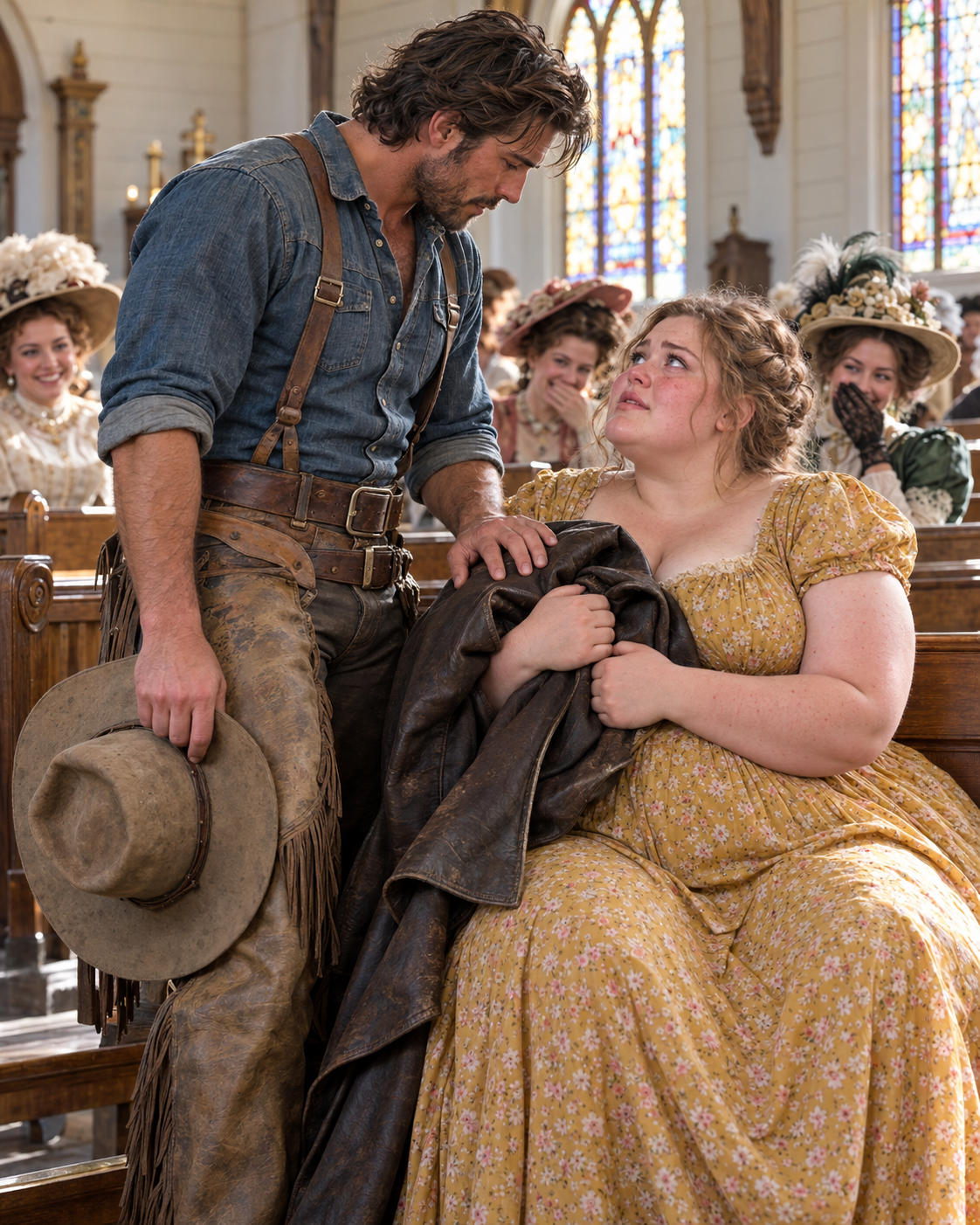
The whole town laughed when Reverend Abner called me a fat disgrace outside the Texas courthouse, never realizing the bundle beneath my coat was a child he wanted dead.
“Josiah, don’t open that door unless you want your sister’s child to die.”
The woman’s voice floated through the darkness, thin and trembling, but Josiah recognized it before she finished speaking.
“Eleanor?”
His voice broke around the name, and I felt his hand tighten painfully around mine.
Outside, lightning illuminated a woman standing beneath the old oak tree, her long gray-streaked hair blowing across a face marked by suffering.
She wore a torn riding cloak, and one hand pressed against a dark stain spreading across her shoulder.
Josiah took one step toward the door, but the woman raised her trembling hand.
“Don’t come outside, brother. Abner has men waiting beyond the fence.”
My heart hammered as Morning Dove stretched her tiny arms toward the stranger.
The baby’s sudden cry seemed to shatter whatever strength the woman had left.
“Oh, my precious girl,” she whispered.
Then her knees buckled.
Josiah moved before I could stop him.
He threw open the door and rushed into the rain, ignoring the danger hidden beyond the darkness.
I stood frozen with Morning Dove against my chest, watching him catch Eleanor before she struck the ground.
A rifle cracked somewhere near the northern fence.
The bullet shattered the porch lantern above my head.
Glass rained across the wooden boards, and I screamed as Josiah dragged his sister toward the doorway.
“Get down, Clementine!”
I dropped behind the heavy oak table, curling my body around Morning Dove as another bullet struck the porch railing.
Josiah carried Eleanor inside and slammed the door with his boot.
For several terrible seconds, the only sounds were the baby’s cries and the pounding rain.
Then Mrs. Bell appeared from the kitchen, carrying a shotgun with astonishing steadiness.
“I’ve buried enough people because of that preacher,” she said quietly.
Her words frightened me more than the gunfire.
Josiah laid Eleanor on the sofa, and I rushed to help stop the bleeding.
The wound was deep but had missed the bone.
As I pressed clean linen against her shoulder, Eleanor studied my face through half-closed eyes.
“You’re Clementine,” she whispered.
I stared at her.
“How do you know my name?”
Her lips trembled.
“Because I saw you take my daughter from beneath that wagon.”
My hands stopped moving.
“You were there?”
Eleanor nodded weakly.
“I couldn’t reach her without leading them straight to her hiding place.”
Tears filled her eyes as she glanced toward Morning Dove.
“I watched you hold her against your heart while the whole town laughed at you.”
I could barely breathe.
“Why didn’t you come to us sooner?”
“Because Reverend Abner told his men to kill anyone who protected her.”
Josiah knelt beside his sister.
“Ellie, what happened eleven years ago?”
She reached for him, and something passed between them that words could never fully explain.
“I tried to come home,” she whispered.
“Then why didn’t you?”
“Because Father made certain I couldn’t.”
Josiah recoiled as though she had struck him.
“Our father?”
Eleanor closed her eyes, and a tear slipped down her cheek.
“He paid Abner to make me disappear.”
The room fell silent.
I felt Josiah’s entire body stiffen beside me.
Their father, Colonel Montgomery, had died four years earlier, leaving Josiah the ranch, a fortune, and a reputation built upon honor.
Now that honor lay trembling on the edge of a terrible revelation.
Eleanor drew a painful breath.
“I found records proving Father and Abner had stolen land from Indigenous families using forged deeds and threats.”
She swallowed.
“When I confronted them, Father told me those people had no power to challenge him.”
Josiah stared at the floor.
“He told me you ran away with a married man.”
A bitter smile crossed Eleanor’s face.
“He always knew what kind of lie would make people stop asking questions.”
She explained how Abner had imprisoned her in an isolated mission building until a Comanche widow named Nita helped her escape.
For years, Eleanor had survived by moving between remote settlements, sewing clothes and teaching children to read.
Nita became her closest friend, and when sickness claimed Nita’s husband, the two women raised Morning Dove together.
“She was Nita’s daughter,” Eleanor whispered, watching the baby sleeping against my chest.
“She entrusted her to me when she was dying, and I promised she would never be abandoned.”
My eyes filled with tears as I looked at the little girl.
So many people had loved her.
And so many had died trying to keep her safe.
“Why is Abner hunting her now?” Josiah demanded.
Eleanor gripped his wrist.
“Because Nita gave me something before she died.”
She pointed toward Morning Dove’s blanket.
“Look inside the hem.”
I carefully lifted the faded fabric and examined the uneven stitching.
There, beneath a row of tiny blue crosses, I felt something stiff.
My fingers worked carefully through the thread until a narrow strip of oilcloth slipped into my palm.
Inside were folded pages bearing signatures, dates, and a familiar name.
Abner Whitcomb.
Josiah studied the documents beneath the dim candlelight.
His expression changed with every line.
“These are land transfers,” he murmured.
Eleanor nodded.
“Original records showing that the families never sold their property.”
I turned another page and found a list of payments made to armed men.
Beside several names were dates.
One date matched the attack near Willow Creek.
Josiah stared at the paper.
“Dear God.”
Eleanor caught his sleeve.
“Abner ordered the attack because Nita’s relatives demanded their land back.”
I felt sick as I remembered the reverend standing outside the courthouse, calling the murdered family wicked.
He had preached judgment while hiding evidence of his own crimes.
And now he wanted the last witness to disappear.
Outside, horses moved through the mud.
A man’s voice called from the darkness.
“Montgomery! You’ve got until sunrise to surrender the woman and the child!”
Josiah walked toward the window.
Reverend Abner sat beneath the trees with six armed riders surrounding him.
The preacher held a lantern high enough for us to see his face.
He was smiling.
“I know Eleanor’s inside!” he shouted.
“Don’t make me burn your pretty house down!”
Josiah reached for his rifle.
But Eleanor suddenly seized his arm.
“Don’t fight him the way he wants you to.”
“What choice do I have?”
“Make the truth louder than his lies.”
I looked at the documents in my hands.
Then I looked at the sewing basket beside the fireplace.
For the first time that night, an idea began forming.
“Josiah, how many ranch hands do we have?”
“Twenty-three, but only eight are here.”
“And how many families in Mercy Creek depend on your cattle contracts?”
“Most of them.”
I rose slowly.
“Then we don’t need more guns.”
Josiah studied me.
“What are you thinking?”
“We need witnesses.”
Mrs. Bell stepped forward.
“The sheriff won’t help us. Abner has him eating out of his hand.”
“Then we’ll find someone who doesn’t answer to Abner,” I said.
Josiah looked toward the old telegraph office beside the bunkhouse.
A narrow path ran behind the barn and through a dry creek bed.
From there, a rider could reach the railroad station without passing the front gate.
He turned to his foreman, Thomas Reed, who had just entered through the kitchen.
“Can you reach the station?”
Thomas nodded.
“If I leave through the creek before dawn.”
I handed him the documents, but Josiah stopped me.
“Not the originals.”
He brought me paper and ink.
While he dictated the names and dates, I copied the most damning details in my careful seamstress’s handwriting.
My fingers ached.
The candle burned low.
Outside, the men waited for daylight.
Finally, Thomas slipped through the cellar passage with copies concealed inside his boots.
He carried instructions to send a telegram to the county prosecutor in San Antonio and contact the territorial newspaper editor traveling through the region.
But when I returned to the sitting room, I found Josiah alone beside the fireplace.
He held his father’s portrait in both hands.
“I worshiped him,” he said without looking up.
I stood beside him.
“He was my whole world after Mother died.”
His voice trembled.
“He taught me to be honorable, Clementine.”
I gently touched his shoulder.
“Then perhaps the best thing you can do is become the man he pretended to be.”
He turned toward me.
For a moment, I saw the frightened boy beneath the wealthy rancher.
“What if this destroys everything my family built?”
I thought about Morning Dove, sleeping upstairs.
I thought about Eleanor’s wounded shoulder.
And I thought about all the years I had believed my value depended on what other people thought of me.
“Then we’ll build something better,” I whispered.
Josiah pulled me into his arms.
He held me so tightly that I could feel his heart pounding against mine.
“I was afraid to love you,” he confessed.
I lifted my face.
“Why?”
“Because everyone I’ve loved has been taken from me.”
A tear slipped down my cheek.
“Then don’t waste the time we have being afraid.”
He kissed me beneath the fading candlelight.
It wasn’t the desperate kiss of a man trying to forget danger.
It was the promise of someone choosing love despite knowing exactly what it might cost.
Just before sunrise, a terrible smell crept beneath the kitchen door.
Smoke.
I ran into the hallway and saw orange flames climbing the outer wall near the pantry.
“Fire!”
Josiah grabbed buckets while Mrs. Bell carried Eleanor toward the cellar.
I rushed upstairs for Morning Dove.
She was awake, crying inside her wooden cradle.
By the time I lifted her, smoke was already spreading across the ceiling.
I wrapped her in a wet blanket and hurried toward the staircase.
But halfway down, a burning beam crashed across the steps.
Sparks exploded around me.
I stumbled backward, clutching the baby as flames swallowed our only way out.
“Clementine!”
Josiah’s voice thundered from below.
“I’m here!”
“Go to the east window!”
I ran into the sewing room and pushed open the window overlooking the stable yard.
The ground seemed impossibly far below.
Smoke burned my throat.
Morning Dove coughed against my shoulder.
For one terrifying second, I remembered every voice that had mocked my size.
Too heavy.
Too clumsy.
Too much.
Those words rushed back as I stared at the narrow window frame.
Then I looked at the child in my arms.
No.
I would not let their cruelty become the last thing I believed about myself.
I climbed onto the windowsill.
Below, Josiah and two ranch hands had stretched a horse blanket between them.
“Give me the baby!” Josiah shouted.
I leaned forward and lowered Morning Dove as far as I could.
One of the men climbed onto a wagon and reached for her.
The moment his hands closed around her little body, relief nearly brought me to my knees.
“Now you!” Josiah called.
I stared at the blanket.
“It’s too far!”
“Look at me, Clementine!”
Through the smoke, I found his face.
“I’ve got you!”
I closed my eyes and jumped.
The impact knocked the breath from my lungs, but strong arms caught me before I struck the ground.
Josiah dropped to his knees beside me.
He held my face between his hands, searching desperately for injuries.
“Are you hurt?”
I tried to answer, but all I could do was cough.
He pulled me against his chest.
Behind us, flames consumed the windows where I had once watched wildflowers sway in the morning breeze.
Broken Spur was burning.
And the man responsible stood beyond the front gate, watching.
Reverend Abner raised his hat.
“Should’ve given me the child, Montgomery!”
Something savage flashed across Josiah’s face.
He reached for the pistol at his belt.
I caught his hand.
“Don’t.”
“He tried to murder you.”
“I know.”
My voice shook, but I held his gaze.
“Don’t let him turn you into another man who thinks a gun makes him righteous.”
For several seconds, Josiah stood trembling with rage.
Then he slowly lowered the weapon.
By sunrise, the main house was a blackened shell.
We had saved everyone, but nearly everything inside had been destroyed.
My wedding dress fabric was gone.
The cradle was gone.
And the beautiful rooms where I had finally learned what safety felt like lay buried beneath ashes.
I stood in the yard holding Morning Dove, trying not to cry.
Josiah placed his arm around me.
“It’s just a house,” he whispered.
But I knew he was grieving more than timber and stone.
He had lost the last place where his childhood still seemed innocent.
That afternoon, the first riders arrived from Mercy Creek.
I recognized Mr. Harper, the blacksmith, and his wife, who had once laughed when I struggled to climb into a carriage.
They brought bread, clean blankets, and a wagon filled with lumber.
Mrs. Harper approached me awkwardly.
“Clementine, I heard what happened.”
I nodded without speaking.
She looked down at Morning Dove.
“Is she all right?”
“She’s frightened, but she’s safe.”
The woman twisted her hands.
Then she whispered something I never expected to hear.
“I’m sorry for how I treated you.”
I stared at her.
She swallowed.
“I used to make jokes because everyone else did.”
Her eyes filled with shame.
“That doesn’t make it right.”
For years, I had imagined how wonderful an apology might feel.
But standing there with ash in my hair and a sleeping baby in my arms, I understood something strange.
Her apology didn’t erase the pain.
It simply reminded me that people could choose to become better.
“Thank you,” I said quietly.
By evening, more wagons arrived.
Some people came because Josiah was wealthy.
Some came because they feared what would happen if Abner destroyed the ranch.
But others came because they had finally seen the difference between a man who preached righteousness and a woman who practiced kindness.
Still, Reverend Abner remained dangerous.
And Thomas had not returned.
Two days passed.
Then three.
Every hoofbeat made me turn toward the road.
Eleanor’s fever worsened, and Morning Dove refused to sleep unless I held her close.
On the fourth morning, a rider appeared beyond the pasture.
It was Thomas.
But he wasn’t alone.
Behind him rode a stern-looking man wearing a county marshal’s badge, accompanied by four deputies.
Josiah hurried toward them.
The marshal dismounted and introduced himself as Samuel Whitaker.
“I received your telegram,” he said.
Then he removed his hat.
“I also received a message from Reverend Abner accusing you of kidnapping an Indigenous child and harboring a dangerous fugitive.”
My stomach dropped.
The marshal glanced toward Morning Dove.
“We’ll need to establish where this child belongs.”
Eleanor stepped forward despite her bandaged shoulder.
“She belongs with people who love her.”
The marshal’s expression softened slightly.
“Ma’am, love matters, but so do the rights of her surviving relatives.”
I tightened my embrace around Morning Dove.
For the first time, I understood that protecting her could not mean pretending her people had disappeared.
Her name, her family, her history, and her future deserved more than secrecy.
Eleanor told the marshal everything about Nita.
She described the girl’s relatives, the attack at Willow Creek, and the land records hidden inside the blanket.
Then she gave him the originals.
Whitaker examined the papers for a long time.
Finally, he looked up.
“If these signatures are authentic, we’re dealing with murder, fraud, and a conspiracy involving several prominent men.”
Josiah stepped forward.
“Then arrest Abner.”
The marshal shook his head.
“Not without stronger evidence connecting him to the killings.”
My heart sank.
But Eleanor suddenly spoke.
“There is a witness.”
We all turned toward her.
She looked at Mrs. Bell.
“You know who I mean.”
The housekeeper went pale.
“No.”
“Evelyn,” Eleanor whispered, “he can’t hurt us forever.”
Mrs. Bell gripped the back of a chair.
For a moment, she looked twenty years older.
Then she slowly unfastened the small brass locket she always wore.
Inside was a faded photograph of a young boy.
“My son was eighteen when Colonel Montgomery hired him,” she said.
Josiah stared at her.
“You told me Daniel died of fever.”
Mrs. Bell shook her head.
“He worked as Abner’s driver.”
Her voice cracked.
“One night, he saw them force families from their homes.”
She pressed the locket to her chest.
“He refused to help anymore.”
I felt a terrible certainty settle over me.
“What happened to him?”
Mrs. Bell closed her eyes.
“They hanged him beside the river and told everyone he’d stolen cattle.”
Nobody moved.
I thought about all the years she had served meals in that beautiful house, carrying her grief silently while the men responsible enjoyed respect and comfort.
“Why didn’t you tell anyone?” Josiah whispered.
“Because Abner threatened to kill you and Eleanor if I spoke.”
Tears spilled down her cheeks.
“I was a coward.”
I crossed the room and took her trembling hands.
“No,” I said gently.
“You were a mother who had already lost too much.”
Mrs. Bell began sobbing.
Then she reached into her apron and pulled out a small iron key.
“Daniel kept a journal in the old church bell tower,” she whispered.
“He told me where it was before they took him.”
The marshal straightened.
“Does it contain names?”
“Names, payments, and dates.”
“Why didn’t you retrieve it?”
“Because Abner kept the tower locked, and I knew he’d be watching me.”
Josiah reached for the key.
“Then we go tonight.”
I shook my head.
“No.”
He frowned.
“Clementine—”
“If Abner sees you coming, he’ll know exactly why you’re there.”
I glanced down at my plain gray dress.
“But he spent years looking at me without ever truly seeing me.”
That evening, I returned to Mercy Creek carrying a sewing basket.
Mrs. Harper accompanied me, claiming she needed help repairing the church’s altar cloth.
The town looked exactly as it always had.
Dust gathered outside the stores.
Men argued beneath the barber shop awning.
Children ran between wagons.
And near the church steps stood Reverend Abner.
When he saw me, his mouth curled into a cruel smile.
“Well, if it isn’t the rancher’s enormous little bride.”
My stomach tightened.
But I continued walking.
“Good evening, Reverend.”
He looked at my basket.
“Come to stitch yourself another wedding dress?”
“No,” I answered.
“Just helping Mrs. Harper with some church linens.”
He laughed.
“Charity suits you better than marriage.”
I smiled politely, even as my heart battered against my ribs.
Then Mrs. Harper distracted him by asking about Sunday’s service.
While they spoke, I slipped through the side entrance and hurried toward the bell tower.
The narrow staircase creaked beneath my feet.
Dust floated through thin shafts of evening light.
I reached the locked storage room and slid Mrs. Bell’s key into the door.
It turned.
Inside, the air smelled of old wood and damp paper.
I searched behind broken hymnals, cracked lanterns, and a forgotten collection box.
Nothing.
Footsteps sounded below.
I froze.
A man’s voice echoed through the stairwell.
“Who’s up there?”
Reverend Abner.
I stared desperately around the room.
Then I noticed a loose floorboard beneath the window.
I knelt and pried it upward with my sewing scissors.
A leather notebook lay inside.
Before I could open it, the stairwell door slammed.
“Mrs. Higgins!”
I shoved the notebook into my basket and rose.
Abner appeared in the doorway.
His eyes moved from my face to the lifted floorboard.
For one terrible second, neither of us spoke.
Then his expression changed.
“You foolish woman.”
I backed toward the window.
“Stay away from me.”
He stepped closer.
“You’ve caused enough trouble.”
I gripped my scissors.
“So have you.”
He laughed and reached for my basket.
I struck his hand with the metal handle.
He cursed.
I rushed past him toward the staircase, but he caught my sleeve.
The fabric tore.
I stumbled against the railing.
Below us, Mrs. Harper screamed.
And then a deep voice roared from the bottom of the stairs.
“Let her go!”
Josiah.
He had followed me despite my objections.
For once, I was grateful for his stubbornness.
Abner released my sleeve and reached inside his coat.
A pistol flashed in the dim light.
Josiah stopped.
“Don’t,” I whispered.
Abner smiled.
“Now we finally understand each other.”
He aimed the weapon toward Josiah.
And something inside me went terrifyingly calm.
For years, I had believed courage meant never feeling fear.
But I was frightened enough to shake.
I simply loved the people waiting for me more than I feared the man standing before me.
I swung my sewing basket with every ounce of strength I possessed.
It struck Abner’s arm just as he fired.
The bullet tore through the ceiling.
Josiah rushed forward, knocking the reverend to the floor.
The pistol skidded down the stairs.
Seconds later, Marshal Whitaker and his deputies stormed into the tower.
Abner screamed that he was being persecuted.
He shouted about righteousness, betrayal, and the corruption of the wicked.
But the marshal barely looked at him.
His attention rested on the leather notebook clutched against my chest.
“Mrs. Higgins,” he said, “is that what I think it is?”
I handed it over.
“Daniel Bell’s journal.”
Whitaker opened the first page.
Then the second.
His expression hardened.
By the time he reached the final entries, he had stopped speaking entirely.
Abner struggled beneath the deputies’ hands.
“Those are lies!”
The marshal looked down at him.
“Then you can explain them under oath.”
He ordered the reverend arrested.
For the first time since I had known him, Abner Whitcomb had nothing left to say.
The following weeks changed Mercy Creek in ways I had never imagined.
The journal revealed names, payments, forged property transfers, and descriptions of attacks against families who refused to surrender their land.
Several men who had followed Abner were arrested.
Others fled before warrants could be served.
The county began reviewing the stolen deeds, and the surviving families were finally given an opportunity to reclaim what had been taken.
The investigation also uncovered Colonel Montgomery’s role in the conspiracy.
Josiah surrendered his father’s business records without hesitation.
Some townspeople called him a traitor to his family.
Others warned that the scandal would ruin the Montgomery name.
But one evening, standing beside the blackened foundation of his childhood home, Josiah told me something I would never forget.
“A family name means nothing if protecting it requires burying the truth.”
I slipped my hand into his.
“Then our family will build its name differently.”
He smiled and kissed my fingers.
“Our family.”
Those two words still made my heart tremble.
But Morning Dove’s future remained uncertain.
A month after Abner’s arrest, Marshal Whitaker returned with an older Comanche woman named Sarah Redbird, who was Morning Dove’s grandmother.
She had survived the violence by seeking refuge with relatives farther west.
When she saw the child, she began crying before anyone spoke.
I placed Morning Dove in her arms.
The little girl studied the stranger’s face.
Then she reached toward the silver pendant hanging around Sarah’s neck.
I watched them together, feeling both happiness and a sorrow I was ashamed to admit.
I loved Morning Dove as fiercely as if she had been born from my own body.
But loving her did not give me the right to take her away from the people and heritage that were hers.
That evening, Sarah and I sat together beneath the porch of the small ranch house the men had begun building.
She told me about Nita.
She told me about the songs Morning Dove’s mother had sung.
And she told me how the baby’s father had once carved tiny wooden birds to make his daughter laugh.
I listened carefully.
Then I asked the question that had been breaking my heart.
“Will you take her away?”
Sarah looked toward Morning Dove sleeping beside us.
“I came to find my granddaughter,” she said.
“Not to punish the woman who saved her.”
Tears blurred my vision.
“I don’t want her to forget her family.”
Sarah took my hand.
“Then help me teach her.”
We agreed that Morning Dove would remain at Broken Spur for the time being, surrounded by those who loved her, while Sarah lived nearby and helped raise her within her people’s traditions.
The arrangement would be reviewed as the child grew, with her grandmother’s voice guiding the decisions about her future.
It wasn’t the simple ending I had once imagined.
It was something better.
It was a promise that love would never require a child to forget where she came from.
Spring arrived gently that year.
Wildflowers returned to the pastures, and the burned house was replaced by a smaller home with wide windows and a long wooden porch.
Josiah insisted that I have a sewing room facing the sunrise.
Mrs. Bell planted roses beneath the windows.
Eleanor recovered enough to teach reading lessons to children from neighboring ranches.
And Sarah filled our evenings with stories that gave Morning Dove roots deeper than any fence surrounding Broken Spur.
One morning, Josiah found me working on a simple ivory wedding dress.
He stood in the doorway, watching quietly.
“What are you smiling about?” I asked.
He walked toward me.
“Just thinking about the woman who changed my life.”
I laughed softly.
“She sounds troublesome.”
“Terribly.”
He knelt beside my chair.
“She saved a baby, exposed a murderer, fought a preacher with a sewing basket, and somehow convinced me I’m worth loving.”
My eyes filled with tears.
“Josiah, you were always worth loving.”
He touched my cheek.
“So were you, Clementine.”
Our wedding took place beneath the enormous oak tree where Eleanor had nearly collapsed that terrible night.
There were no grand decorations.
Just wildflowers, white ribbons, and the people who had stood beside us when everything seemed lost.
Sarah carried Morning Dove down the aisle.
Eleanor stood beside Josiah.
Mrs. Bell wept openly.
And I walked toward the man I loved wearing the dress I had sewn with my own hands.
For the first time in my life, I did not wonder whether people thought I looked too large.
I did not worry about the shape of my waist or the judgment in someone else’s eyes.
I thought about the frightened woman who had hidden a crying baby beneath her coat.
I wished I could reach through time and hold her hand.
I wished I could tell her that her body was never something she needed to apologize for.
That the space she occupied in the world was not a mistake.
And that one day, she would stand beneath an oak tree and be loved without condition.
When Josiah saw me approaching, tears rolled down his cheeks.
“You look beautiful,” he whispered.
I smiled.
“I know.”
He laughed through his tears.
And when he kissed me, the whole world seemed to grow quiet.
Years later, people would still talk about the scandal that brought down Reverend Abner.
They would remember the fire, the stolen land records, and the wealthy rancher who turned against his father’s legacy.
Some would even remember the seamstress who stood before an armed mob with a baby in her arms.
But none of those memories mattered as much to me as one ordinary evening many years later.
I sat on the porch watching Morning Dove, now a bright-eyed young girl, race across the pasture with a wooden bird in her hand.
Sarah was teaching her the songs of her family.
Eleanor was laughing beside the garden.
Mrs. Bell was calling everyone inside for supper.
And Josiah sat beside me, his silver hair catching the last golden light.
He took my hand.
“Any regrets, Mrs. Montgomery?”
I thought about the cruel laughter outside the courthouse.
I thought about the nights I had cried alone, believing I would never be chosen.
Then I looked at the home we had built, not from wealth or reputation, but from courage, truth, and the stubborn decision to love.
“Only one,” I answered.
Josiah looked concerned.
“What is it?”
I rested my head against his shoulder.
“That I spent so many years believing people who couldn’t see my worth.”
He kissed my forehead.
Across the yard, Morning Dove turned and waved to us.
I waved back, my heart so full it almost hurt.
Once, I had hidden a child beneath my coat because the world was too cruel to let her live openly.
Now she ran freely beneath the Texas sky, surrounded by people who knew her name, honored her family, and loved her exactly as she was.
And I finally understood the greatest lesson my life had taught me.
Cruel people may convince the world that kindness is weakness, that difference is shameful, and that power gives them the right to decide who deserves love.
But their judgment is not the truth.
Sometimes, the person everyone laughs at is the one brave enough to do what everyone else is afraid to do.
Sometimes, the home you dreamed of must burn before you can build one on honesty.
And sometimes, saving a stranger’s life is the very thing that teaches you how to save your own.
As the evening stars appeared above Broken Spur, Josiah squeezed my hand and whispered, “I love you, Clementine.”
I watched our daughter disappear into the wildflowers, laughing as Sarah called her home.
“I love you too,” I whispered.
And for the rest of my days, whenever someone asked how a lonely seamstress became the happiest woman in Texas, I gave them the same answer.
“I stopped asking the world for permission to be worthy of love.”
Because I had finally learned that the greatest beauty a person can possess is not the kind others can measure with their eyes.
It is the courage to protect someone smaller, the strength to forgive without surrendering the truth, and the quiet belief that every human life deserves dignity.
And beneath that wide Texas sky, surrounded by the family we had chosen and the future we had fought to protect, I knew one thing with absolute certainty.
I had never been too much of a woman to love; I had only been waiting for a life big enough to hold all the love I had to give.
THE END.