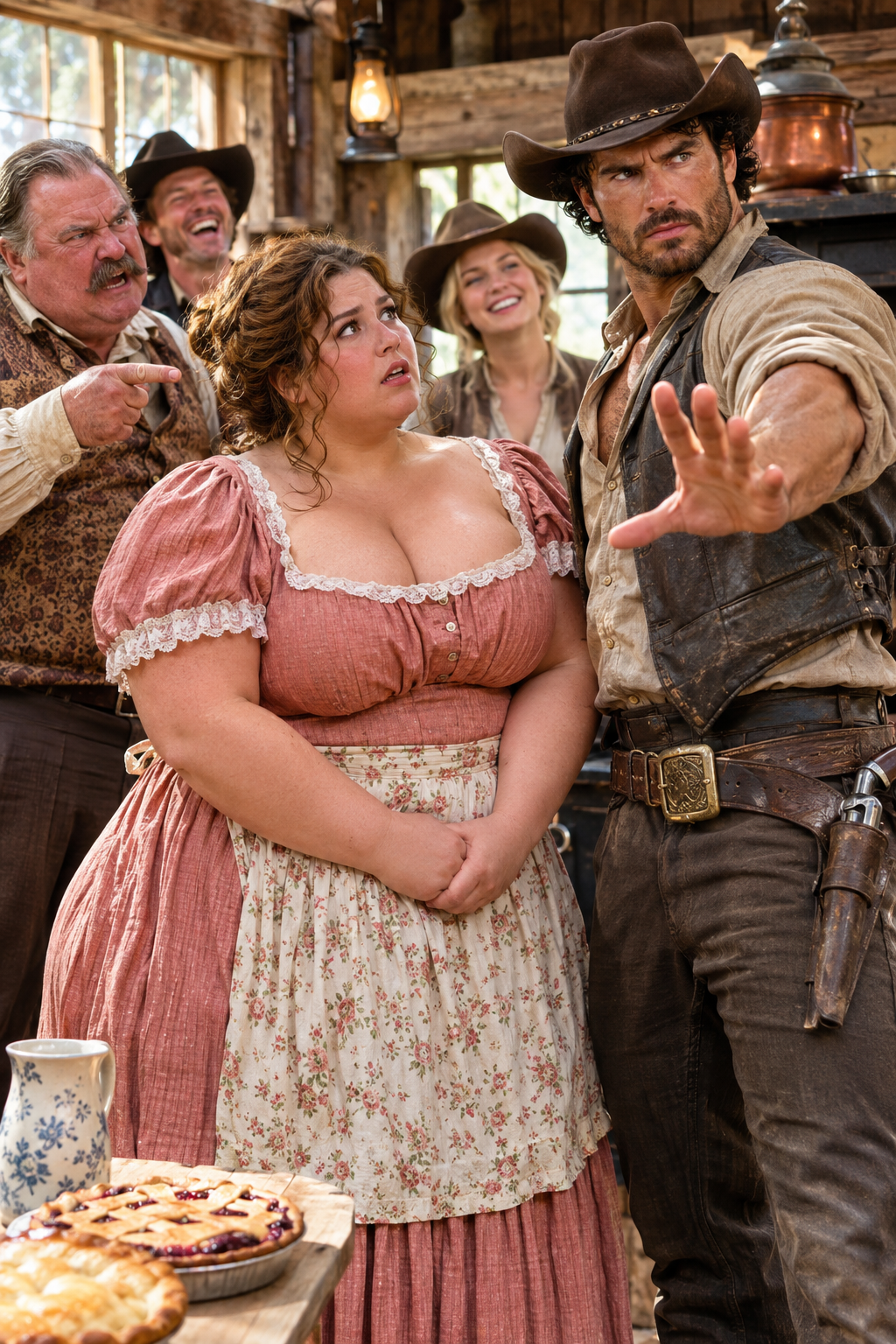
The third restaurant owner in Pine Creek Crossing took one look at Megan Foster and slammed his door in her face. But the towering rancher watching from across the street had a very different offer.
Megan Foster stared at the old business paper, her fingers tightening around its edges. The name printed near the bottom was one she had not seen in years: Foster’s Boarding House, St. Joseph, Missouri.
Her father’s boarding house.
And directly beside it was another name: Sullivan Freight and Livestock.
For several seconds, the kitchen seemed strangely quiet. Outside, ranch hands were clearing snow from the stable doors. Inside, the coffee pot hissed on the stove, and the smell of fresh biscuits filled the room.
But Megan barely noticed.
She turned the paper over, searching for a date. It was nearly eight years old, from the winter before her father died.
“Where did you get this?” she asked.
Dusty Sullivan stepped into the kitchen and looked at the document.
“That came with some old freight records. Why?”
Megan pointed at the name.
“Because that was my father’s business.”
Dusty’s expression changed.
He reached for the paper, then stopped when he saw how tightly she was holding it.
“Your father owned Foster’s Boarding House?”
“Yes. His name was Henry Foster.”
Dusty slowly pulled out a chair.
“Megan, I think we’d better sit down.”
Those words frightened her more than anything else he could have said.
She remained standing.
“Did you know who I was when you hired me?”
“No.”
“Then why do you look like you’ve seen a ghost?”
Dusty glanced toward the window.
“Because my father used to do business with a man named Henry Foster. And whatever happened between them nearly destroyed this ranch.”
Megan felt the floor shift beneath her.
Before she could demand an explanation, a horse galloped into the yard.
A ranch hand shouted from outside.
“Boss! We’ve got company!”
Dusty looked through the window.
His face hardened.
Keith Mercer had arrived.
And he had brought two men with him.
Mercer was a broad-shouldered man in an expensive black coat, with polished boots that looked ridiculous against the muddy snow. He climbed down from his horse as though he owned the property.
Dusty went outside to meet him.
Megan followed, still holding the paper.
“Morning, Sullivan,” Mercer called. “Beautiful day to settle accounts.”
“You were here three days ago,” Dusty replied.
“And your debt was already overdue three days ago.”
Mercer pulled a folded document from his coat.
“Your freight contract gives me the right to demand payment when your balance exceeds the agreed limit. You’ve crossed that limit.”
Dusty’s jaw tightened.
“I’ll have your money after the spring cattle drive.”
“Spring is months away.”
“Then you’ll have to wait.”
Mercer smiled.
“That’s not how contracts work.”
He handed Dusty the document.
Megan watched Dusty’s face as he read.
Something in his expression made her stomach twist.
“What is it?” she asked quietly.
Dusty did not answer.
Mercer noticed her standing beside him.
“Well, now. You must be the new cook everyone’s talking about.”
Megan said nothing.
Mercer’s eyes dropped to the paper in her hand.
For one brief moment, his smile disappeared.
“Where did you get that?”
Megan looked down.
“Why?”
Mercer recovered quickly.
“Just curious.”
He stepped closer.
“Old business papers can cause a lot of confusion when people don’t understand them.”
“Then perhaps you can explain this one,” Megan replied.
Mercer studied her face.
“What’s your name?”
“Megan Foster.”
The color drained from his cheeks.
It lasted only a second, but she saw it.
“Foster?” he repeated.
“That’s right.”
Mercer looked toward Dusty.
“Interesting choice of employee.”
Dusty stepped between them.
“You came here about money, Keith. Leave her out of it.”
Mercer put on his gloves.
“Ten days, Sullivan. Pay what you owe, or I’ll enforce the contract.”
He climbed onto his horse.
Then he looked directly at Megan.
“Some families would be wiser to leave the past buried.”
He rode away before she could respond.
For the first time since arriving at Double Pine Ranch, Megan wondered whether accepting Dusty’s job had been a terrible mistake.
That evening, she found Dusty in the barn repairing a broken harness.
“You owe me an explanation,” she said.
He put down his tools.
“You’re right.”
He led her into the small office beside the tack room, where old ledgers filled two wooden shelves.
“My father, Thomas Sullivan, started Double Pine with almost nothing,” Dusty began. “He hauled livestock, supplies, and freight between Missouri and the western territories. Your father’s boarding house was one of his regular stops.”
Megan listened carefully.
“Your father provided rooms and meals for drivers. Mine paid him for keeping shipments safe overnight.”
“That doesn’t explain why Mercer reacted to my name.”
Dusty opened a drawer and removed a worn leather notebook.
“Eight years ago, a shipment disappeared. Money, documents, and supplies meant for several ranchers. My father was blamed.”
“How much money?”
“Enough to ruin three businesses.”
Megan sat down.
“My father never told me about a missing shipment.”
“Mine insisted he was innocent. But the records showed that the shipment had last been checked at your father’s boarding house.”
Megan shook her head.
“My father wouldn’t steal.”
“I never said he did.”
“Then why did your family blame him?”
Dusty looked exhausted.
“Because someone produced a receipt with his signature. It said he had accepted responsibility for the cargo.”
Megan’s thoughts raced back to the final months of her father’s life.
The strange visitors.
The arguments behind closed doors.
The night she found him sitting at the kitchen table with his head in his hands.
He had told her they were only business troubles.
She had believed him.
“Did your father ever speak to mine afterward?” she asked.
“Once. They met shortly before Henry died.”
“What happened?”
“I don’t know. My father refused to discuss it.”
“Where is your father now?”
Dusty’s eyes lowered.
“He died four years ago.”
Megan stared at the notebook.
Two fathers were gone.
One shipment had disappeared.
And somehow Keith Mercer stood between their families.
“Why didn’t you tell me any of this when I arrived?”
“Because I didn’t know you were Henry Foster’s daughter. And when I found out today, I needed to understand what it meant before I said something I couldn’t take back.”
Megan wanted to believe him.
But Travis’s warning still burned in her memory.
That night, she read her stepbrother’s letter again.
There was something she had overlooked.
At the bottom, beneath his signature, Travis had written:
“If you still have Mother’s old recipe book, don’t let anyone take it.”
Megan frowned.
Her mother had died when she was fourteen. The recipe book had belonged to her long before she married Henry Foster.
Megan had carried it from Missouri, wrapped in a blue cloth at the bottom of her suitcase.
Why would Travis mention it now?
She opened her trunk and pulled out the book.
Its cover was cracked. Several pages were stained with flour and butter.
She turned through familiar recipes for cornbread, chicken pie, peach preserves, and Sunday biscuits.
Nothing seemed unusual.
Then she noticed something near the back.
Two pages had been stitched together with thin brown thread.
Her mother had been an excellent seamstress, but Megan had never noticed the stitching before.
She carefully cut it with her sewing scissors.
A folded paper slipped out.
It was a letter.
The handwriting belonged to her father.
“My dearest Megan,” it began.
Her breath caught.
She sat on the edge of the bed and continued reading.
“If you are holding this, it means I never found the courage to tell you what happened. I made a mistake by trusting a man who promised to help our family. That mistake cost more than money.”
Megan’s eyes filled with tears.
The next sentence made her heart pound.
“Thomas Sullivan was not the man who betrayed me.”
She read it twice.
Then she continued.
“I kept proof of what really happened, but it was not safe to leave it in Missouri. If the truth is ever needed, look where your mother believed every honest promise should begin.”
The letter ended there.
No name.
No location.
No explanation.
Only her father’s signature.
Megan spent the next hour trying to understand the final sentence.
Her mother had believed many things.
That hard work mattered.
That people deserved second chances.
That a person’s word should mean something.
And that no family should ever be turned away hungry.
What did any of that have to do with hidden evidence?
A knock interrupted her thoughts.
“Megan?”
It was Dusty.
She slipped the letter beneath her pillow.
“Come in.”
He stood in the doorway, holding a small plate.
“You missed supper.”
“I’m not hungry.”
“You’ve been feeding everyone else for days. Somebody ought to return the favor.”
On the plate sat a warm biscuit with honey.
Despite everything, Megan smiled.
Dusty placed it on her dresser.
“I know today was difficult,” he said. “If you want to leave, I’ll pay your wages and take you into town myself.”
Megan looked at him.
“Would you want me to leave?”
“No.”
The answer came so quickly that both of them fell silent.
Dusty rubbed the back of his neck.
“You’re the best cook we’ve ever had. The men respect you. And this house feels different with you in it.”
“Different how?”
He looked at her for a long moment.
“Like somebody finally opened the windows after a very long winter.”
Megan felt warmth rise in her cheeks.
Then she remembered Mercer’s threat.
“Your ranch is in trouble.”
“Yes.”
“And you’re still worried about whether I’ve eaten.”
Dusty gave a tired smile.
“Seems like a reasonable thing to worry about.”
After he left, Megan sat beside the window and watched snow drift across the yard.
For years, she had been judged by her appearance before anyone bothered to learn her name.
Dusty had given her work when everyone else turned her away.
Now she had a choice.
She could run from the danger surrounding Double Pine.
Or she could stay and help save the first place that had made her feel wanted.
By morning, she had made her decision.
“We’re going to sell those trail meals,” she announced at breakfast.
Dusty looked up from his coffee.
“With what money?”
“With the food we already have, the kitchen we already own, and a little common sense.”
One ranch hand laughed.
“Sounds cheaper than Keith Mercer’s freight charges.”
Megan smiled.
“Exactly.”
She began preparing sturdy meals travelers could carry without spoiling quickly: smoked beef, baked beans, hard biscuits, dried apples, and small jars of preserves.
She wrapped them in clean cloth and packed them into wooden boxes.
Dusty sent two men to nearby crossroads to speak with wagon drivers.
Within three days, their first customers arrived.
By the end of the week, travelers were asking for Double Pine meals by name.
Megan kept careful records of every sale.
The profits were modest, but steady.
For the first time in months, Dusty had money coming in that Mercer did not control.
Then something unexpected happened.
One of the stranded travelers Megan had sheltered during the snowstorm returned with six wagon drivers.
He told her that word of her kindness had spread along the road.
“Folks said you fed strangers when the weather was bad enough to kill a man,” he explained. “We figured someone like that deserved our business.”
Megan blinked back tears.
She had helped those travelers because they needed help.
She had never expected anything in return.
That evening, Dusty counted the day’s earnings and shook his head in amazement.
“You’ve done something I couldn’t manage in two years.”
“What’s that?”
“Made people come to this ranch because they want to.”
He looked at her.
“Not because a contract forces them to.”
Their eyes met.
For a moment, neither spoke.
Then a voice came from the doorway.
“Well, isn’t this touching?”
Megan turned.
Travis stood in the kitchen.
Her stepbrother looked thinner than she remembered. His coat was dirty, and one side of his face carried a fresh bruise.
“Travis!”
She hurried toward him.
He caught her arms.
“Did you get my letter?”
“Yes. What’s happened to you?”
He glanced at Dusty.
“We need to talk. Alone.”
Dusty stepped back.
“I’ll be outside.”
But before he could leave, Travis said, “Actually, Sullivan, maybe you should hear this too.”
He pulled out a chair and sat heavily.
“I worked for Keith Mercer.”
Megan stared at him.
“You what?”
“For almost six months. I thought he was just another freight businessman.”
Travis swallowed.
“Then I found out why he hired me.”
Dusty moved closer.
“Why?”
“Because of our father.”
Megan’s heart began to race.
Travis explained that Mercer had approached him in Missouri, offering good wages for clerical work.
At first, the job seemed ordinary.
But Mercer repeatedly questioned him about Henry Foster’s belongings.
Especially old papers.
And one particular recipe book.
“When I told him Megan had taken Mother’s book, he changed completely,” Travis said. “He wanted to know where you were.”
“Why?” Megan whispered.
“I didn’t know. Not until I found something in his office.”
Travis reached inside his coat.
He removed a small ledger.
“Mercer keeps two sets of books.”
Dusty took it carefully.
One recorded official freight charges.
The other listed private payments, hidden transfers, and names of men who had supposedly lost money in the shipment eight years earlier.
Megan watched Dusty turn the pages.
His expression grew darker.
“These payments were made after the shipment disappeared,” he said.
“That’s right,” Travis replied.
“And several went to people who claimed they’d never received their cargo.”
Travis nodded.
“Mercer paid them to keep quiet.”
Megan felt sick.
“So he stole the shipment?”
“That’s what I believe,” Travis answered. “But this ledger alone won’t prove it. He can claim the payments were for other business.”
Dusty closed the book.
“We need the original shipping records.”
Travis looked toward Megan.
“Your father had them.”
Silence filled the kitchen.
Megan slowly reached into her apron pocket and removed Henry’s letter.
“I think he left us a clue.”
She read it aloud.
When she reached the final sentence, Travis suddenly straightened.
“Where your mother believed every honest promise should begin,” he repeated.
He looked at Megan.
“Don’t you remember?”
“Remember what?”
“Mother used to say something whenever Father made a business agreement.”
Megan searched her memory.
Then the words returned.
“An honest promise begins at the table.”
Travis nodded.
“And where did Father make every important agreement?”
Megan’s eyes widened.
“The dining room.”
“Exactly.”
But the boarding house was hundreds of miles away.
And it had been sold after Henry’s death.
Dusty unfolded a map.
“Who owns it now?”
Travis hesitated.
“That’s the problem.”
Megan looked at him.
“Who?”
“Keith Mercer.”
The room went cold.
Mercer had purchased the boarding house through another businessman two years after Henry died.
Travis believed he had been searching it ever since.
“If your father hid something there,” he said, “Mercer may already have found it.”
Megan shook her head.
“Then why is he still searching for Mother’s recipe book?”
Nobody answered.
Suddenly, Dusty looked at the book lying on the table.
“Megan, did your mother ever bring anything from Missouri when your family moved into the boarding house?”
“Of course. Furniture, dishes, linens.”
“Anything special?”
Megan thought for a moment.
“Her old dining table. It belonged to her parents.”
Dusty leaned forward.
“Where is it?”
Megan’s face changed.
“It wasn’t sold with the boarding house.”
Travis frowned.
“Are you sure?”
“Yes. Father sent it away before he died. He said the wood was damaged and needed repairing.”
“To whom?”
Megan closed her eyes, trying to remember.
Then she opened them.
“To a furniture maker in Pine Creek Crossing.”
Dusty stared at her.
“Here?”
“Father said the man was an old friend. I never understood why he’d send a table so far away.”
Dusty stood so quickly his chair scraped across the floor.
“There’s only one furniture maker in town who’s been working that long.”
The following morning, they rode into Pine Creek Crossing.
The furniture shop belonged to an elderly carpenter named Samuel Briggs.
When Megan mentioned Henry Foster, the old man’s eyes filled with recognition.
“Henry’s girl?” he asked.
“Yes.”
Samuel removed his spectacles.
“I wondered if you’d ever come.”
He led them into a dusty storage room behind his workshop.
There, beneath a faded canvas sheet, stood a heavy oak dining table.
Megan recognized the carved flowers along its legs.
Her mother had polished those same flowers every Sunday.
She touched the wood with trembling fingers.
“Why did you keep it?”
Samuel looked toward Dusty.
“Because Henry paid me to keep it until someone from his family came asking.”
Travis stepped forward.
“Did he tell you why?”
Samuel shook his head.
“Only that there was something inside he couldn’t safely carry.”
Megan felt her heart hammer.
“Inside the table?”
The carpenter nodded.
“There’s a hidden compartment beneath the center panel.”
He reached underneath and pressed a narrow wooden latch.
A small section slid open.
Inside lay a sealed oilcloth package.
Megan lifted it carefully.
Before she could unwrap it, a gunshot cracked outside.
The workshop window shattered.
Dusty grabbed Megan and pulled her behind a workbench.
“Stay down!”
A second shot struck the doorframe.
Travis rushed toward the back entrance.
Dusty caught his arm.
“Don’t be a fool. We don’t know how many men are out there.”
A voice shouted from the street.
“Bring out the package!”
Megan recognized it immediately.
Keith Mercer.
Samuel’s hands shook.
“He’s been asking about that table for years.”
Dusty looked toward the rear window.
“There’s an alley behind the shop. Travis, take Megan through it.”
“I’m not leaving you,” Megan said.
“You’re carrying the only thing Mercer is willing to shoot someone for.”
Another bullet struck the wall.
Dusty met her eyes.
“Trust me.”
She wanted to argue.
Instead, she grabbed the package and followed Travis through the back door.
They hurried between two buildings toward the sheriff’s office.
Behind them came shouting.
Then another gunshot.
Megan stopped.
“Dusty!”
Travis pulled her forward.
“We can’t help him if Mercer gets those papers!”
They reached the sheriff’s office breathless.
Sheriff Daniel Hayes listened as Travis explained what had happened.
When Megan placed the package on his desk, he immediately sent two deputies toward the furniture shop.
Then he carefully cut the oilcloth.
Inside were shipping receipts, signed statements, and a letter from Thomas Sullivan.
The sheriff read the first page.
His face grew serious.
“Well,” he murmured. “This changes everything.”
Megan leaned forward.
“What does it say?”
The sheriff handed her the letter.
Thomas Sullivan had written that Keith Mercer arranged the missing shipment and used false receipts to blame Henry Foster.
But the letter revealed something worse.
Mercer had not acted alone.
He had bribed a freight clerk, threatened two witnesses, and forced Thomas Sullivan into signing a debt agreement to prevent the ranch from being seized immediately.
Henry Foster had discovered the scheme.
He had collected proof and planned to take it to the authorities.
Before he could do so, Mercer threatened his family.
Henry hid the records inside the table and sent it west, trusting Samuel Briggs to keep it safe.
Megan’s hands trembled as she read the final paragraph.
“Henry refused to profit from the theft. He chose to protect the truth, even when it cost him his business and his peace. I owe him more than I can repay.”
It was signed by Thomas Sullivan.
Megan began to cry.
For years, she had believed her father died defeated by ordinary financial troubles.
Now she understood that he had carried a terrible secret to protect the people he loved.
The sheriff examined the remaining documents.
They included the original freight inventory, proof of altered signatures, and records of payments made by Mercer.
Together with Travis’s ledger, they formed a powerful case.
Then the office door burst open.
Dusty stumbled inside, blood staining his sleeve.
Megan rushed toward him.
“Dusty!”
“It’s just my arm,” he said.
But his face was pale.
She guided him into a chair and began examining the wound.
A bullet had grazed his upper arm.
As she cleaned it, Dusty watched her.
“Did you find what we needed?”
Megan nodded through her tears.
“Our fathers were telling the truth.”
Dusty closed his eyes.
For a long moment, he said nothing.
Then he whispered, “Thank God.”
Outside, the deputies returned with Mercer in custody.
His two hired men had surrendered after discovering the sheriff was on his way.
Mercer shouted that the documents were stolen.
He claimed the old records meant nothing.
But when the sheriff showed him the original inventory, his confidence vanished.
“Where did you get that?” Mercer demanded.
Megan stepped forward.
“From a man you couldn’t frighten into forgetting the truth.”
Mercer stared at her.
“Your father should have minded his own business.”
The sheriff immediately wrote down the statement.
“Careful, Mercer. You’re making my job easier.”
Mercer was taken into custody while the sheriff arranged for the evidence to be reviewed by the proper authorities.
The investigation took several weeks.
During that time, Double Pine continued operating.
Megan refused to let the ranch fall apart while Dusty recovered.
She organized the kitchen, expanded the trail-meal business, and persuaded nearby farmers to supply ingredients at fair prices.
Travis stayed to help with the accounts.
He apologized repeatedly for working for Mercer.
Megan finally stopped him one evening.
“You didn’t know what kind of man he was.”
“I should have asked more questions.”
“Maybe. But when you learned the truth, you did something about it.”
Travis looked down.
“Father would have been proud of you.”
Megan smiled sadly.
“I hope he’d be proud of both of us.”
As winter softened into spring, news arrived from the authorities.
The evidence supported criminal charges against Mercer and his associates for fraud, theft, and related offenses.
The disputed freight agreement was challenged, and the ranch’s accounts were reviewed.
Mercer’s claim against Double Pine could no longer be enforced as he had demanded.
Several ranchers who had lost money in the original scheme came forward with their own records.
The truth spread through Pine Creek Crossing.
People who had once treated Megan as though she were invisible now greeted her warmly.
Some even asked whether she would consider opening a restaurant in town.
One afternoon, the owner who had slammed his door in her face appeared at the ranch.
He stood awkwardly in the kitchen doorway.
“Miss Foster,” he began, “I heard about your trail meals.”
Megan continued kneading bread.
“Have you?”
“Yes. They’re becoming quite popular.”
“That’s nice.”
He cleared his throat.
“I was wondering if you might supply some to my restaurant.”
Megan looked up.
For a moment, she remembered standing outside his door with her suitcase, desperate for work.
She remembered the humiliation.
The way he had judged her without hearing a word about her abilities.
Then she wiped her hands on her apron.
“I might,” she said.
His face brightened.
“But I’ll expect a fair price, payment on time, and the same respect you give every other supplier.”
The man swallowed.
“Of course.”
“And one more thing.”
“Yes?”
“If someone comes looking for honest work, you should hear what they can do before deciding what they’re worth.”
He lowered his eyes.
“You’re right, Miss Foster.”
Megan returned to her bread.
She did not need to humiliate him.
She had already proved her worth.
A few days later, Dusty found her standing beside the old oak table.
Samuel Briggs had delivered it to Double Pine after the investigation.
Megan had placed it in the dining room, where sunlight touched the carved flowers.
“Your mother would have liked it here,” Dusty said.
Megan smiled.
“She always said a table should be big enough to welcome one more person.”
Dusty stood beside her.
“I’ve been thinking about something.”
“That sounds dangerous.”
He laughed softly.
“Probably is.”
Then his expression grew serious.
“I spent years believing this ranch was something I had to save by myself. My father built it. I thought failing would mean letting him down.”
Megan listened.
“But you showed me something different,” he continued. “A place isn’t made strong by one person carrying every burden.”
He took her hand.
“It’s made strong by people who choose to stand together.”
Megan looked into his eyes.
“Dusty…”
“I don’t know what the future holds,” he said. “But I know I want you in it.”
Her heart beat faster.
“Are you asking me to stay as your cook?”
He smiled.
“No.”
“Then what are you asking?”
Dusty reached into his pocket and removed a small silver ring.
It was simple, with a tiny blue stone.
“My mother wore this. She told me to give it to someone who made this house feel like home.”
He lowered himself onto one knee.
“Megan Foster, would you marry me?”
For a moment, she could not speak.
She thought of the doors slammed in her face.
The years spent believing she was never quite enough.
The loneliness she had carried across miles of unfamiliar country.
Then she looked at the man kneeling before her.
The man who had seen her abilities before judging her appearance.
The man who had trusted her when trusting anyone seemed dangerous.
And she realized something important.
She had not found happiness because someone finally decided she was worthy.
She had always been worthy.
She had simply found someone who recognized it.
“Yes,” she whispered.
Dusty stood and wrapped his arms around her.
Outside, the ranch hands erupted into cheers.
Megan laughed through her tears.
“How long have they been listening?”
Dusty looked toward the window, where several familiar faces disappeared.
“Long enough, apparently.”
They married that summer beneath two towering pine trees near the ranch house.
Travis walked Megan down the aisle.
Samuel Briggs sat in the front row.
The ranch hands wore their cleanest shirts, and travelers who had become friends came from miles away.
After the ceremony, everyone gathered around the old dining table.
Megan had prepared a feast with help from the women of Pine Creek Crossing.
There was roast beef, fresh bread, apple pie, and enough food to feed twice the number of guests.
When the meal began, Dusty stood and raised his glass.
“My father used to tell me that land makes a man wealthy,” he said. “For years, I believed him.”
He looked at Megan.
“But I was wrong about what he meant.”
The guests grew quiet.
“Land can give you a living. Money can give you comfort. But neither one can give you a home.”
He squeezed Megan’s hand.
“Only people can do that.”
Years later, Double Pine Ranch became known for more than cattle and freight.
Its trail meals grew into a successful business that supported local farmers, wagon drivers, and families who needed steady work.
Megan made one rule that everyone had to follow.
No hungry traveler would be turned away simply because they had no money.
Those who could pay did.
Those who couldn’t were offered a meal and a place to rest.
Sometimes they returned months later with payment.
Sometimes they returned with nothing but gratitude.
Megan welcomed them anyway.
Above the dining room door, Dusty hung a wooden sign carved by Samuel Briggs.
It carried the words Megan’s mother had spoken so many years before:
“An honest promise begins at the table.”
Whenever visitors asked about the sign, Megan told them that her father had once risked everything to protect the truth.
She told them that kindness had saved strangers during a snowstorm, and that those same strangers had helped save a struggling ranch.
But she always finished with one more lesson.
“People will judge you by what they see,” she would say. “Some will close their doors before they know your name. Don’t let that convince you that you have nothing to offer.”
Then she would smile and add, “Keep your heart open, keep doing good work, and never mistake someone else’s opinion for your worth.”
And on quiet evenings, when the sun settled behind the hills, Megan would sit beside Dusty beneath the two tall pine trees.
Sometimes she thought about the young woman who had arrived in Pine Creek Crossing with a worn suitcase and almost no hope.
That woman had believed she needed someone to give her a chance before her life could begin.
Now Megan understood that the chance had only opened a door.
Everything that came afterward had been built through courage, kindness, honesty, and the willingness to trust again.
The ranch had given her shelter.
She had given it new life.
And together, she and Dusty had created something neither money nor fear could ever buy.
A home where a person’s worth was measured not by appearance, wealth, or reputation, but by the kindness they showed and the promises they kept.
Because sometimes the door that closes in your face is not the end of your story.
Sometimes it is simply the reason you keep walking until you find the place where you truly belong.
And as the years passed, the story of Megan Foster and Dusty Sullivan became one of the most beloved stories in Pine Creek Crossing.
Their ranch grew larger, but their hearts never grew smaller. Every winter, when snow covered the roads and travelers struggled to find shelter, Megan made sure the kitchen fire stayed burning and a pot of soup waited on the stove.
Eventually, their home filled with the laughter of children. Their eldest daughter, Grace, inherited Megan’s determination, while their younger son, Henry, named after Megan’s father, developed Dusty’s quiet kindness.
One cold evening, many years later, Grace came home upset after hearing another child being mocked for wearing old clothes.
“Why are people so cruel to someone who looks different?” she asked her mother.
Megan stopped folding a kitchen towel.
She recognized the hurt in her daughter’s voice.
“Because sometimes people are too quick to judge what they don’t understand,” she answered.
“Did anyone ever treat you that way?”
Megan smiled gently.
“More times than I can count.”
Grace looked surprised.
“But everyone loves you.”
“They didn’t always know me, sweetheart.”
Megan took her daughter’s hand and led her toward the old oak dining table.
“This table belonged to your grandmother. It carried a secret that helped save our family. But the greatest thing it taught me wasn’t about secrets or money.”
“What was it?”
“That everyone deserves a place where they are treated with dignity.”
Grace thought about that for a moment.
“Even people who are mean?”
Megan considered her answer.
“Everyone deserves basic kindness. But that doesn’t mean you must allow someone to hurt you. You can forgive people and still protect yourself.”
That evening, when Dusty returned from checking the cattle, he found Megan sitting beside the window, watching their children play in the yard.
“What’s on your mind?” he asked.
She leaned against his shoulder.
“Just thinking about how different life could have been.”
Dusty followed her gaze.
“If that restaurant owner had hired you, we might never have met.”
Megan laughed softly.
“Then I suppose I should thank him for closing his door.”
Dusty kissed her forehead.
“I’ve been grateful for it every day.”
Years later, when their children were grown, Megan and Dusty established a small fund to help struggling families and travelers passing through Pine Creek Crossing. They also offered work and training to people who had been rejected elsewhere.
Some stayed only a season.
Others built new lives in the town.
And every person who entered the ranch kitchen saw the same wooden sign hanging above the doorway.
“An honest promise begins at the table.”
One spring morning, an elderly Megan stood on the porch watching the sunrise over Double Pine Ranch.
Dusty came outside carrying two cups of coffee.
He handed one to her and settled into the chair beside her.
“Do you ever wish we’d done anything differently?” he asked.
Megan looked across the fields, toward the barns, the busy kitchen, and the home they had built together.
“I wish I’d spent less time believing the people who told me I wasn’t good enough.”
Dusty reached for her hand.
“And the rest?”
She smiled.
“I wouldn’t change a thing.”
They sat together as the first sunlight touched the pine trees.
Megan knew life had never promised her an easy road. She had faced rejection, fear, betrayal, and uncertainty. But none of those things had been powerful enough to decide who she would become.
She had made that decision herself.
And in the end, the greatest treasure hidden inside her mother’s old table had not been the papers that exposed a dishonest man.
It had been the reminder that truth, courage, and love could survive even the darkest years.
Megan had arrived at Double Pine Ranch searching for a job.
She had found a family, a purpose, and a love that lasted a lifetime.
Most importantly, she had discovered that being rejected by the wrong people could never take away her value.
The lesson of Megan’s story is simple: Never let someone else’s judgment become the measure of your worth. A closed door may delay your journey, but it cannot erase your abilities, your kindness, or the future you still have the power to build.
And sometimes, the people who once overlooked you will one day hear your story and realize they never understood the person standing before them.
But by then, you may have found something far more important than their approval.
You may have found the life you were always meant to live.
THE END.