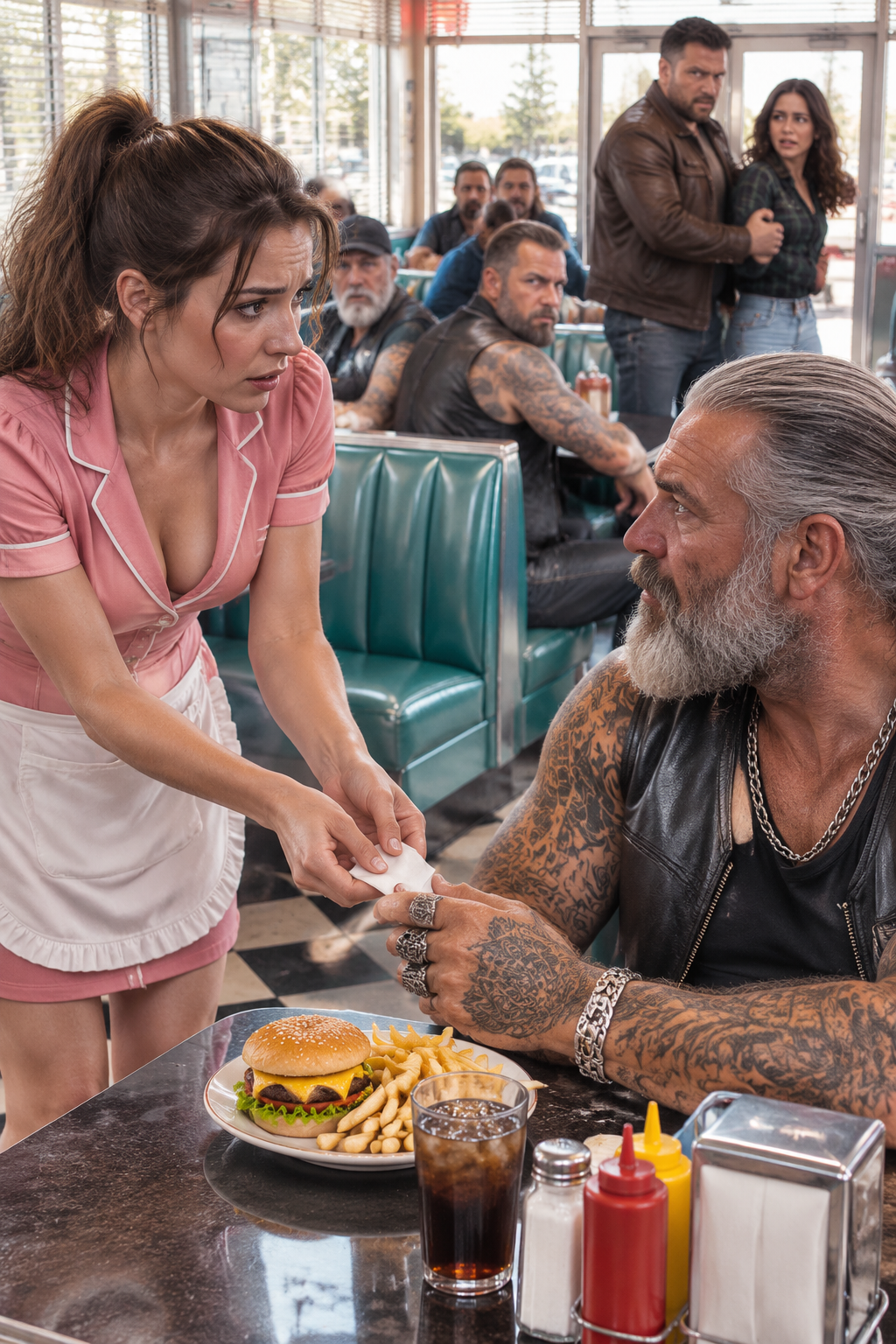
The teenage girl at table six looked me straight in the eyes and silently mouthed two words: “Help me.”
Her fingers slipped beneath the man’s jacket, and for one horrifying second, I thought she was reaching for his gun.
But instead, she pulled out a small silver necklace.
A heart-shaped pendant dangled from its broken chain.
“Look inside,” she whispered.
The man’s face drained of color.
“Put that down!”
He lunged for the necklace, but Boone stepped forward, his massive frame blocking the man’s view.
“Easy,” Boone said. “Nobody needs to get hurt.”
The girl clutched the pendant against her chest.
“He killed my mother.”
Those five words changed everything.
The man tightened his grip around her shoulders, pressing her against him like a human shield.
“She’s confused,” he snapped. “She’s been through a lot. Her mother’s dead, and she’s making up stories.”
But the girl shook her head.
“No. I saw what you did.”
I felt the blood turn cold in my veins.
Behind the kitchen counter, Eddie was still holding his phone, whispering desperately to the dispatcher.
Boone didn’t move.
Neither did the other bikers.
The only sound was the buzzing fluorescent light above table six.
“What’s your name, sweetheart?” Boone asked.
The girl swallowed.
“Lily.”
“Okay, Lily. I’m Boone. You don’t have to be afraid of us.”
The man laughed bitterly.
“Really? Five Hells Angels walk into a diner, and you’re telling her not to be afraid?”
Boone’s expression didn’t change.
“Right now, I’m not the one holding a frightened kid against her will.”
The man’s jaw tightened.
“Move away from the door.”
Boone glanced toward the two bikers standing near the entrance.
They stepped aside.
I couldn’t believe it.
After everything, they were letting him leave.
But Boone had noticed something I hadn’t.
The man’s eyes kept darting toward the parking lot, specifically toward a dark blue pickup truck parked beside the diner.
And through the rain-streaked windshield, I could see a second figure sitting inside.
Someone was waiting for them.
“Haley,” Boone said casually, “why don’t you get our friends some coffee?”
His voice was calm, but his eyes met mine with a warning.
He wanted me away from the doorway.
I turned toward the counter, pretending to reach for the coffeepot.
That’s when Lily screamed.
“Don’t let him take me back!”
The man clamped a hand over her mouth.
Boone moved.
Not fast enough to seem aggressive, but fast enough to put himself directly between Lily and the exit.
“Take your hand off her,” he said.
The man pulled his gun.
Everything happened at once.
Eddie shouted from the kitchen.
One of the bikers pushed me behind the counter.
A coffee mug shattered against the floor.
And the man aimed his pistol directly at Boone’s chest.
“Back up!”
Boone raised both hands.
“Okay. Everybody stays calm.”
“I said BACK UP!”
The man’s finger trembled against the trigger.
Lily was crying so hard she could barely stand.
I crouched behind the counter, my heart hammering painfully.
I’d worked at the Highway Star Diner for eleven years.
I’d seen drunken truck drivers, fistfights, desperate travelers, and people who’d lost everything except the money for a cup of coffee.
But I’d never seen a child look so certain she was about to die.
Then Boone said something strange.
“Your truck’s running.”
The man blinked.
“What?”
“Blue pickup outside. Engine’s running. Someone waiting in the passenger seat.”
For a fraction of a second, the man looked toward the window.
And Lily bit his hand.
He screamed and loosened his grip.
She dropped to the floor.
The gun went off.
The explosion was deafening.
Glass shattered behind Boone.
I screamed his name.
But he was already moving, throwing himself sideways as one of the other bikers slammed into the armed man.
They crashed against table six.
The gun skidded across the checkered tiles.
Lily scrambled beneath a booth.
Another biker kicked the weapon away.
And within seconds, three enormous men had the stranger pinned facedown on the floor.
“Don’t move!” Boone roared.
The man struggled violently.
“You don’t understand! They’re going to kill her!”
That made Boone hesitate.
“They?” he asked.
But before the man could answer, headlights flashed through the diner’s front windows.
The blue pickup suddenly accelerated.
Straight toward the building.
“GET DOWN!”
The truck smashed through the glass entrance.
Metal screamed.
Wood splintered.
The front booths exploded into flying debris.
I felt someone grab the back of my shirt and drag me beneath the counter just as the entire front wall collapsed.
For several seconds, there was nothing but dust, breaking glass, and the shrill sound of the diner’s fire alarm.
Then silence.
A horrible, ringing silence.
I could smell gasoline.
And underneath it, something burning.
“Lily!” I screamed.
No answer.
“LILY!”
A weak voice came from beneath the ruined booth.
“I’m here.”
I crawled across the floor, ignoring the broken glass cutting into my palms.
Lily was trapped beneath a fallen table.
Her face was bleeding, but she was conscious.
“Don’t move, sweetheart,” I whispered. “I’m getting you out.”
Before I could lift the table, Boone appeared beside me.
Blood ran down the side of his face.
“Move your hands back,” he said gently.
He lifted the heavy tabletop as though it weighed nothing.
I pulled Lily free.
She wrapped her arms around my neck and began sobbing.
“I don’t want to die.”
“You’re not going to die,” I told her.
I said it with a confidence I didn’t feel.
Behind us, the pickup’s engine was still running.
Its driver had vanished.
And the armed man who’d been pinned to the floor was gone.
One of Boone’s bikers, a muscular man called Tank, staggered toward us.
“He got out through the broken wall. Driver helped him.”
Boone looked toward the highway.
Two figures were running toward a black SUV parked beyond the gas pumps.
“Let them go,” Boone ordered.
Tank stared at him.
“They’re getting away!”
“We’ve got a kid to protect.”
That was the first moment I realized Boone wasn’t interested in being a hero.
He was interested in keeping Lily alive.
And those were two very different things.
We carried her into the kitchen, away from the broken windows and the leaking truck.
Eddie had already shut off the gas to the stoves.
His hands shook as he wrapped clean towels around Lily’s bleeding forearm.
“Police are eight minutes out,” he told us.
Eight minutes sounded like forever.
Boone knelt beside Lily.
“Sweetheart, I need you to tell me something. Why did that man say other people were going to kill you?”
Lily looked toward the ruined dining room.
Then she opened her fist.
The necklace was still there.
Its chain had cut into her palm, but she’d held on to it through everything.
“My mom told me never to lose this.”
She pressed the tiny clasp.
The heart opened.
Inside was a miniature photograph of a smiling woman holding a baby.
And behind the photograph was something else.
A tiny black memory card.
Boone went completely still.
“What is that?”
“Everything,” Lily whispered.
She started crying again.
“My mom worked for a shipping company. She found out they were moving girls across state lines. Girls from foster homes. Runaways. Kids nobody would notice were missing.”
A terrible heaviness settled in my chest.
“She reported it,” Lily continued. “But the police officer she talked to was working with them.”
Boone’s eyes narrowed.
“Which officer?”
“Detective Warren. He came to our house two nights ago. Mom knew something was wrong when she saw his car.”
Lily’s breathing became uneven.
“She made me hide in the laundry room. She gave me the necklace and told me to run if I heard screaming.”
I wanted to stop her.
I wanted to tell her she didn’t have to relive whatever happened next.
But Lily was staring at the floor, trapped somewhere inside the memory.
“I heard them arguing. Mom said she had copies of everything. She said if they touched me, she’d release it.”
Her voice broke.
“Then I heard a gunshot.”
Nobody spoke.
“Warren found me before I reached the backyard. He said if I didn’t come with him, he’d hurt my little brother.”
“Your brother?” Boone asked.
Lily nodded frantically.
“His name’s Noah. He’s nine. He’s staying with our aunt in Millbrook. Warren knows where he is.”
Boone stood up.
Something changed in his face.
Not anger.
Something colder.
Determination.
He took out his phone and dialed a number.
“Marcus,” he said when someone answered. “I need a favor. Remember that detective I told you about? The one who helped your daughter?”
He listened briefly.
“I’m sitting with a sixteen-year-old girl who says he’s involved in trafficking children. She has evidence. Her brother may be in danger.”
Another pause.
Then Boone said, “I need people I can trust.”
He ended the call.
“Who’s Marcus?” I asked.
“A state investigator. Retired army. Doesn’t owe Warren anything.”
Before I could ask another question, headlights swept across the wrecked diner.
We all froze.
A police cruiser pulled into the parking lot.
Then another.
Relief flooded through me.
“Thank God,” Eddie whispered.
But Lily grabbed Boone’s vest.
“No!”
Her voice rose into a terrified shriek.
“That’s his friend!”
Through the shattered front window, I saw a uniformed officer climb out of the first cruiser.
He was tall, clean-shaven, and moving quickly toward the building.
Lily pointed with a shaking finger.
“Officer Daniels. He came to our house with Warren.”
Boone moved to the kitchen doorway.
“Everybody stay back.”
The officer entered through the collapsed entrance, flashlight sweeping across the rubble.
“Police! Anybody injured?”
Boone stepped into view.
“Several people. Ambulance coming?”
“On the way,” Daniels answered.
His eyes scanned the kitchen.
“Where’s the girl?”
My stomach dropped.
He hadn’t asked who was hurt.
He’d asked specifically about Lily.
Boone folded his arms.
“What girl?”
Daniels’ expression hardened.
“We received a report about a kidnapped juvenile. Male suspect, armed. Girl approximately sixteen.”
“Suspect ran,” Boone replied. “Kid’s safe.”
“Then I need to speak with her.”
“Not until medical personnel arrive.”
Daniels stepped closer.
“Sir, this is a police investigation.”
Boone didn’t budge.
“And she’s a bleeding child.”
A second officer approached from outside.
She was a young woman with dark hair pulled into a tight ponytail.
“Daniels,” she called, “dispatch says state investigators are taking jurisdiction. We’re supposed to secure the scene.”
Daniels turned sharply.
“Who authorized that?”
“Captain Mercer.”
I saw something flash across his face.
Fear.
He reached for his radio.
“I’m going to check with dispatch.”
Instead, he walked toward his cruiser.
Boone watched him carefully.
Then his phone vibrated.
He looked at the screen.
“Marcus says nobody leaves with Lily until he gets here.”
The younger officer stepped inside.
“My name’s Officer Ramirez,” she said. “Is there a child who needs medical attention?”
I hesitated.
Boone studied her for a moment.
Then Lily’s frightened voice came from behind us.
“She wasn’t at our house.”
Ramirez heard her.
Her expression softened immediately.
“Okay,” she said. “Then let’s make sure you’re safe.”
She removed her jacket and draped it around Lily’s shoulders.
“What’s your name?”
“Lily.”
“Lily, I’m going to stay right here. Nobody’s taking you anywhere without explaining what’s happening.”
For the first time all night, Lily seemed to believe someone.
But outside, Daniels had started his cruiser.
He drove away without speaking to anyone.
Ramirez watched the taillights disappear.
“What the hell?”
Boone’s phone rang again.
He answered.
I watched the color drain from his face.
“Say that again.”
Then he looked directly at Lily.
“Where exactly is your brother?”
“Aunt Carol’s house. Cedar Lane. Number forty-eight.”
Boone repeated the address into his phone.
Then he swore quietly.
“What happened?” I asked.
He looked at Lily.
“Someone called in a fake domestic disturbance at your aunt’s house ten minutes ago. Two officers were dispatched.”
Lily made a sound I’ll never forget.
It wasn’t quite a scream.
It was the sound of a child’s last piece of hope breaking.
“Noah.”
She tried to stand, but her knees gave way.
I caught her.
Boone spoke into his phone.
“Marcus, get someone there now. And check which officers answered that call.”
Ramirez pulled out her radio.
“Dispatch, this is Unit Twelve. I need immediate confirmation of officers responding to forty-eight Cedar Lane, Millbrook.”
Static crackled.
Then a voice answered.
“Unit Twelve, responding officers are Daniels and Price.”
Ramirez stared at Boone.
Daniels.
The same officer who’d just left our diner.
He was heading straight toward Lily’s little brother.
Boone didn’t hesitate.
“Tank, get the bikes.”
Ramirez stepped in front of him.
“You can’t interfere with an active police response.”
Boone looked at her.
“Then come with us.”
She hesitated.
A uniform meant something to her. I could see that.
Rules.
Duty.
The belief that the badge represented protection.
But she’d also heard the fear in Lily’s voice.
And she’d watched Daniels abandon an active emergency scene.
Finally, Ramirez made a decision.
She keyed her radio.
“Dispatch, I’m responding to a possible child endangerment at forty-eight Cedar Lane. Request immediate state backup.”
Then she turned toward Boone.
“I’m driving. You’re following. And nobody does anything stupid.”
Boone almost smiled.
“Wouldn’t dream of it.”
Three of the bikers left with Ramirez.
Tank stayed with us, along with another rider named Grizzly.
An ambulance arrived moments later.
The paramedics checked Lily’s injuries and wanted to transport her immediately.
But Lily refused to move until someone promised Noah would be safe.
I held her hand while they cleaned the cuts on her face.
“You’ve got to let them help you,” I whispered.
She looked at me with eyes far older than sixteen.
“People keep saying they’re going to help. Then they disappear.”
That hurt more than anything she could’ve said.
Because she was right.
Her mother had trusted a detective.
She’d trusted people who wore badges.
And somehow, every promise of protection had turned into another nightmare.
I squeezed her hand.
“Then I’m staying with you.”
Lily studied my face.
“Even if it’s dangerous?”
I thought about my rent.
My overdue electricity bill.
The diner I’d probably just lost.
All the ordinary problems that had filled my world before 2:17 a.m.
They suddenly seemed very small.
“Especially then.”
The paramedic looked at me.
“You family?”
I glanced at Lily.
“No.”
Then Lily whispered, “She is tonight.”
Something inside me cracked open.
I rode in the ambulance beside her.
Tank and Grizzly followed on their motorcycles.
During the drive, Lily finally told me how she’d escaped Warren’s house.
He’d kept her locked in a basement for nearly thirty hours.
When he realized the memory card wasn’t where he’d expected, he became frantic.
He searched her clothes, her shoes, even the lining of her backpack.
But he’d never thought to examine the necklace.
“He said my mother hid something,” Lily whispered. “He kept asking where it was.”
“Why didn’t you tell him?”
“Because Mom died protecting it.”
She looked out at the dark highway.
“And because I heard him tell someone they were going to sell me if I didn’t cooperate.”
My throat tightened.
“How did you end up at the diner?”
“He was taking me to an airfield. The driver in the pickup was supposed to meet us there. But Warren stopped because I started throwing up.”
She swallowed.
“I pretended I was sick enough to need water.”
“That’s when you asked me for help.”
Lily nodded.
“I thought if I could just get somebody to look at me, maybe they’d understand.”
I remembered the way she’d mouthed those two words.
Help me.
So small.
So easy to ignore.
And yet they had changed everything.
At the hospital, two state investigators were waiting.
One was a silver-haired man in a charcoal coat.
He introduced himself as Marcus Vale.
Boone had trusted him.
For the moment, that was enough for me.
Marcus didn’t immediately ask Lily about the memory card.
Instead, he crouched beside her wheelchair.
“Your brother is our first priority,” he said.
Lily grabbed my hand.
“Where is he?”
“We’ve got officers going to the house.”
“Is he alive?”
Marcus hesitated.
Only a second.
But Lily noticed.
He took a breath.
“We don’t know yet.”
I wanted to hate him for that answer.
But after everything Lily had been through, I understood why he wouldn’t offer another promise he couldn’t guarantee.
Marcus held out his hand.
“Can I see what your mother left you?”
Lily looked at me.
I nodded.
She opened her necklace and passed him the tiny card.
Marcus placed it inside an evidence envelope.
“I’m going to have this copied and examined by people I trust.”
Then his phone rang.
He stepped aside.
For perhaps thirty seconds, he listened without speaking.
When he returned, his face was grave.
“There was a shooting at your aunt’s house.”
Lily stopped breathing.
I could feel her fingers turning cold in mine.
“Your aunt was wounded,” Marcus continued. “She’s being taken to a hospital.”
“And Noah?”
Marcus looked at the floor.
“They can’t find him.”
Lily began screaming.
She screamed until nurses came running.
Until a doctor asked us to give her space.
Until her voice gave out and she collapsed against me, shaking.
I held her through it.
And I made a decision.
I wasn’t leaving that hospital until we found her brother.
Not because I believed I could do what the police couldn’t.
But because Lily had already lost too many people who were supposed to stay.
An hour later, Boone returned.
His knuckles were scraped, and there was blood on his sleeve.
I stood so quickly my chair nearly toppled.
“Where’s Noah?”
Boone looked toward Lily’s hospital room.
“Is she awake?”
“Boone.”
He lowered his voice.
“We found Daniels’ cruiser abandoned outside Millbrook. There was blood on the driver’s seat.”
“Whose blood?”
“Don’t know.”
“Where’s the boy?”
Boone didn’t answer.
Then he reached into his vest and pulled out a little red sneaker.
My knees almost buckled.
“We found this behind the house.”
I covered my mouth.
Boone’s expression was grim.
“But listen to me, Haley. There wasn’t enough blood at the scene to suggest anyone was seriously hurt. And someone saw a little boy running toward the railroad tracks.”
“Alone?”
“That’s what we’re trying to find out.”
From inside the room, Lily’s voice suddenly called out.
“Boone?”
We turned.
She was standing in the doorway, barefoot and pale.
She saw the sneaker.
And instead of crying, she smiled.
It was the strangest thing I’d seen all night.
“That’s Noah’s.”
Boone nodded.
“I know, sweetheart.”
“No. You don’t understand.”
She rushed forward, nearly stumbling.
“Look inside.”
Boone turned the sneaker over.
Lily pointed at the tongue.
There, stitched into the fabric, were three tiny blue stars.
“Mom sewed those in,” she said. “She told Noah if he was ever scared and couldn’t find his way home, he should look for the North Star.”
I didn’t understand.
Neither did Boone.
But Lily’s eyes were suddenly bright.
“Noah knows where to hide.”
“Where?” Boone asked.
“The old railroad station. Mom used to take us there to watch the trains. There’s a storage room under the platform. We made it our secret clubhouse.”
Boone was already reaching for his phone.
“Marcus, we might have a location.”
But Lily grabbed his arm.
“Wait.”
She looked at me.
“If Noah went there, he won’t come out for strangers.”
“Then tell us what he needs to hear,” I said.
Lily swallowed.
“Tell him the moon still knows our names.”
I stared at her.
She managed a trembling smile.
“It’s something Mom used to say when we were little. She said even when we’re lost, the sky remembers where we belong.”
Boone repeated the phrase into his phone.
Then we waited.
The next forty minutes were the longest of my life.
Every sound made Lily jump.
Every passing pair of footsteps made me look toward the door.
Marcus remained nearby, coordinating with the officers searching the railway property.
At 5:41 a.m., his phone rang.
He answered.
Then he closed his eyes.
For one terrible moment, I thought we’d lost Noah.
But Marcus smiled.
A genuine, exhausted smile.
“They found him.”
Lily made a small choking sound.
“He’s alive?”
“He’s alive.”
She burst into tears.
I did too.
Marcus held up a hand.
“There’s something else. Noah wasn’t alone.”
My stomach tightened.
“He was hiding with another child. A twelve-year-old girl named Sophie.”
Boone looked sharply at Marcus.
“How did she get there?”
“Apparently Noah saw two men forcing her into a vehicle near the railroad yard. He distracted them by throwing rocks and helped her escape.”
Lily covered her mouth.
Her little brother hadn’t just run for his life.
He’d stopped to save someone else.
And in doing so, he had nearly gotten himself killed.
Marcus continued, “One suspect was arrested near the station. The other fled. We’re still searching.”
“Daniels?” Boone asked.
Marcus shook his head.
“Not yet.”
Later that morning, the truth began to unfold.
The memory card contained shipping schedules, financial records, photographs, and names.
Dozens of names.
People with money.
People with influence.
People who had spent years making children disappear.
Lily’s mother, Rebecca Morgan, had been a bookkeeper for a freight company operating near the state border.
When she discovered unexplained payments and suspicious transportation records, she began investigating.
What she found was worse than she could’ve imagined.
The company wasn’t simply laundering money.
It was helping a trafficking network move vulnerable children between states.
Rebecca had spent months secretly gathering evidence.
She’d contacted a federal investigator shortly before her death, but someone inside the local department had intercepted part of her complaint.
Detective Warren had been paid to silence her.
And when he couldn’t find the evidence, he’d kidnapped Lily.
The black memory card wasn’t the only proof Rebecca had left behind.
Marcus discovered she’d arranged for an encrypted backup to be delivered to federal authorities if she failed to check in.
That backup reached them the same morning Noah was found.
Within forty-eight hours, federal agents arrested Warren.
Daniels was captured trying to cross the state line with forged identification.
Several other officers were suspended, and more arrests followed as investigators worked through Rebecca’s records.
The company’s owner, a wealthy businessman who had donated generously to local charities and political campaigns, was taken into custody.
For the first time, the network was being dismantled.
But the part that mattered most to Lily wasn’t the arrests.
It was what happened three days later.
Noah walked into her hospital room carrying a stuffed dinosaur with one missing eye.
Lily jumped out of bed so quickly her nurse shouted.
They collided in the middle of the room.
She wrapped both arms around him and buried her face in his hair.
Noah started crying.
Then Lily started crying.
And soon everyone in the room was crying.
Even Boone.
Although he insisted afterward that it was because he’d gotten dust in his eye.
Noah held on to his sister.
“I remembered what Mom said,” he whispered.
“I know.”
“I thought if I hid where we watched the trains, you’d find me.”
Lily kissed the top of his head.
“You did everything right.”
Noah looked toward Boone.
“Are you the motorcycle guy?”
Boone chuckled.
“One of them.”
“Did you save my sister?”
Boone glanced at me.
“She saved herself, kid. We just helped her get somewhere safe.”
Noah considered that.
Then he walked over and hugged Boone around the waist.
The enormous biker went completely still.
His rough hands hovered awkwardly in the air.
Finally, he placed one hand gently on the boy’s back.
And for a moment, the toughest-looking man I’d ever met looked like he might fall apart.
A week later, I returned to the diner.
Or what was left of it.
The front wall was boarded up.
Broken booths were stacked beside a dumpster.
The neon sign had been destroyed.
My boss, Mr. Parker, stood in the parking lot staring at the damage.
“Insurance won’t cover all of this,” he said quietly.
I looked at the building that had been my second home for eleven years.
“What happens now?”
He sighed.
“I don’t know, Haley. I might have to close.”
I nodded, trying to swallow the disappointment.
Then a familiar rumble rolled across the parking lot.
Motorcycles.
Five of them.
Boone pulled up first.
Tank, Grizzly, and the others followed.
They climbed off their bikes and approached us.
Mr. Parker looked nervous.
“Can I help you gentlemen?”
Boone surveyed the damage.
“Looks like you could use some help.”
Parker gave a humorless laugh.
“Unless you can rebuild a diner for free, I’m afraid there’s not much you can do.”
Boone looked back at his friends.
Tank grinned.
“Funny you should mention that.”
Within two days, fifteen bikers had arrived with trucks full of tools.
One was an electrician.
Another was a carpenter.
Two worked in construction.
Grizzly’s brother owned a glass company.
And word spread.
Truck drivers who’d stopped at the diner for years donated money.
A local hardware store contributed building materials.
A retired contractor offered his services.
People I’d never met brought coffee, sandwiches, and homemade pies.
For nearly three weeks, the parking lot was filled with motorcycles, pickup trucks, and volunteers.
People who would never normally have spoken to one another worked side by side.
The diner rose from the wreckage, one board and one window at a time.
When it reopened, Mr. Parker installed a new sign above table six.
It read:
“COURAGE ISN’T ALWAYS LOUD. SOMETIMES IT’S TWO WORDS WHISPERED BY SOMEONE WHO REFUSES TO GIVE UP.”
Underneath was a photograph of Rebecca Morgan.
Lily had chosen it herself.
In the picture, Rebecca was smiling beside her two children.
A woman whose bravery had exposed something terrible.
A mother who had given everything to protect the people she loved.
Six weeks after that horrifying night, Lily and Noah came to the diner with their aunt Carol.
Carol was still recovering from her injuries, but she was walking again.
The siblings would be living with her while they worked through everything they’d survived.
Lily had started counseling.
Noah was back in school.
Neither of them was completely okay.
But they were safe.
And they were healing.
They sat at table six.
Lily ordered a chocolate milkshake.
Noah wanted pancakes with extra whipped cream.
Boone arrived a few minutes later, carrying a small wrapped box.
He placed it in front of Lily.
“What’s this?” she asked.
“Open it.”
Inside was a silver necklace.
A delicate heart-shaped pendant, almost identical to the one her mother had given her.
But there was an engraving on the back.
Lily read it aloud.
“Never mistake kindness for weakness.”
Her eyes filled with tears.
Boone sat beside her.
“My mother used to tell me that,” he said.
Lily looked surprised.
“Your mother?”
Boone smiled faintly.
“Yeah. I had one of those, too.”
Then his smile faded.
“She died when I was seventeen. Cancer. I spent a long time being angry at the world afterward.”
He looked down at his rough, scarred hands.
“Got into trouble. Made mistakes. Hurt people I shouldn’t have hurt.”
Nobody interrupted him.
“But years later, I realized something. Losing someone you love doesn’t give you permission to stop being the person they hoped you’d become.”
Lily touched the necklace.
“My mom wanted me to be brave.”
Boone shook his head.
“Your mom wanted you to live. Bravery was just how you got there.”
I turned away to wipe my eyes.
Outside, the afternoon sun poured through the new windows.
The diner smelled of fresh coffee and pancakes.
People laughed.
Silverware clinked against plates.
For the first time since that terrible night, the world felt ordinary again.
But before Lily left, she walked over to me.
“Haley?”
“Yeah, sweetheart?”
She hesitated.
“Can I ask you something?”
“Anything.”
“Why did you help me?”
The question caught me off guard.
I thought about the gun.
The broken glass.
The truck crashing through the diner.
The nights I’d spent lying awake, wondering how differently everything could’ve ended.
“I was scared,” I admitted.
Lily looked surprised.
“Really?”
“Terrified.”
“But you still helped.”
I smiled.
“So did you.”
She looked down at her hands.
“I almost didn’t ask. I thought you wouldn’t believe me.”
I felt something tighten in my chest.
“Lily, listen carefully. There may be people in this world who ignore you. People who turn away because helping is inconvenient or frightening. But that doesn’t mean you should ever stop asking.”
She nodded slowly.
“And it doesn’t mean you owe anyone silence when something is wrong.”
Lily stepped forward and hugged me.
I held her for a long time.
When she finally pulled away, she looked toward the photograph of her mother.
“Do you think she’d be proud of me?”
I looked at Rebecca’s smiling face.
Then at Lily.
A girl who’d survived something no child should ever experience.
A girl who’d protected her brother, preserved the truth, and refused to surrender even when every reason to hope seemed gone.
“Yes,” I whispered. “I think she’d be unbelievably proud.”
Lily smiled through her tears.
Then she took Noah’s hand and walked toward the door.
Boone held it open for them.
I watched them step into the sunshine.
And I realized something that would stay with me for the rest of my life.
That night, five bikers walked into a diner wearing leather vests and patches that made people nervous.
An armed man wore ordinary clothes and carried a badge in his pocket.
One looked dangerous.
The other looked respectable.
But appearances had told us nothing about the truth.
The people who looked frightening had chosen to protect a child.
And the people entrusted with protecting her had betrayed her.
I also learned that courage rarely feels like courage when you’re living through it.
Sometimes it feels like shaking hands.
A voice that barely works.
A whispered plea.
A waitress passing a note.
A little boy hiding beside railroad tracks.
Or a grieving mother refusing to let evil remain hidden.
We don’t always get to choose the moment when someone needs us.
We don’t always have the strength, resources, or certainty to know what to do.
But we can choose whether we look away.
Months later, on an ordinary Tuesday afternoon, a little girl came into the diner with her grandmother.
She noticed the photograph above table six.
“Who’s that lady?” she asked.
Her grandmother read the inscription.
Then she smiled sadly.
“Someone very brave.”
The little girl pointed toward the rebuilt front windows.
“And what happened here?”
I approached their table with two glasses of water.
“A lot of people helped save a little girl,” I told her.
She tilted her head.
“Were they superheroes?”
I thought of Boone with blood running down his face.
Of Eddie hiding behind the counter, still calling for help.
Of Officer Ramirez choosing conscience over convenience.
Of Marcus telling Lily the truth instead of offering comforting lies.
Of a twelve-year-old boy rescuing another child while fleeing danger himself.
And of Lily, who had looked straight into my eyes when she’d barely been able to speak.
“No, honey,” I said.
“They were just people who decided somebody else’s life mattered.”
The little girl considered that for a moment.
Then she smiled.
“I think that’s what superheroes are.”
I couldn’t argue with her.
That evening, after the last customer left, I turned off the lights and stood alone beside table six.
The diner was quiet.
The highway stretched endlessly into the darkness.
Somewhere out there, people were still hurting.
People were still afraid.
And some were waiting for someone to notice.
I touched the edge of the photograph and thought about how one small moment had changed so many lives.
I hadn’t stopped a trafficking network.
I hadn’t caught a corrupt detective.
I hadn’t rebuilt the diner with my own hands.
All I’d done was listen when someone silently asked for help.
But sometimes, listening is where everything begins.
And if there’s one thing I hope people remember from what happened at the Highway Star Diner, it’s this:
You don’t have to be fearless to be brave.
You don’t have to be powerful to make a difference.
And you don’t have to know how the story will end before deciding to do the right thing.
Because sometimes the smallest act of courage doesn’t just save one life.
It gives someone else the strength to save another.
And that kindness can travel farther than any of us will ever know.
I thought that was where our story ended.
The diner was rebuilt. Lily and Noah were safe. Warren and the people who had helped him were facing justice.
And for the first time in months, I could sleep without hearing that gunshot in my dreams.
But one evening, almost a year after Lily first walked into the Highway Star Diner, I received a letter that reminded me how far a single act of kindness could reach.
The envelope had no return address.
Inside was a photograph.
Lily stood in front of a school auditorium, wearing a blue dress and holding a small silver trophy. Noah stood beside her, grinning proudly.
On the back, she’d written:
Haley, I finally told our story. I was scared, but I remembered what you said. Sometimes helping someone begins with refusing to look away.
Beneath the photograph was a handwritten letter.
I sat down at table six and began reading.
Dear Haley,
Yesterday, I spoke in front of three hundred students about what happened to my family. I told them about my mom, about Noah, and about the night at the diner.
I didn’t tell them every terrible detail. Some things still hurt too much.
But I told them something important.
I told them that asking for help isn’t weakness.
After my speech, a girl from my school waited until everyone else had left. She came up to me crying and said she needed to tell someone about what was happening at home.
I didn’t know what to say at first.
Then I remembered you.
I took her to our school counselor, and we stayed with her until someone she trusted could help.
She’s safe now.
I wanted you to know because I think about that night all the time. For a long time, I only remembered being afraid. But now I remember something else.
I remember that somebody listened.
I hope someday I can make another person feel as safe as you made me feel.
Love, Lily.
I read the letter three times.
By the third, I couldn’t see the words through my tears.
The bell above the entrance jingled.
Boone walked in, carrying his usual motorcycle helmet beneath one arm.
He looked at me sitting alone with the letter.
“Everything all right, Haley?”
I laughed through my tears.
“Better than all right.”
I handed him the photograph.
He studied it carefully.
Then he smiled.
“Look at that kid.”
“She’s not much of a kid anymore.”
“No,” he said softly. “I guess she isn’t.”
He turned the photograph over and read the message.
For a long moment, neither of us spoke.
Then Boone reached into his vest.
“I got something for you, too.”
He placed a small wooden plaque on the table.
It was polished smooth, with a tiny silver heart set into the center.
Beneath it were four engraved words.
YOU CHOSE NOT TO LOOK AWAY.
I shook my head.
“Boone, I don’t deserve this.”
He pulled out the chair across from me.
“Can I tell you something?”
I nodded.
“The night we came in here, I wasn’t planning on stopping.”
I stared at him.
“What?”
“We’d been riding for hours. Tank wanted coffee. I wanted to get home. I almost told the boys to keep going.”
He looked around the diner.
“Then I saw your sign through the rain. Something told me to pull over.”
He smiled faintly.
“Never figured a cup of coffee would change my life.”
“Mine either.”
Boone leaned forward.
“You know what I think? Most people are waiting for some big moment to prove they’re good people. Some dramatic chance to save somebody.”
He tapped Lily’s letter.
“But most of the time, it starts smaller than that. Paying attention. Believing someone. Making a phone call. Staying when it’d be easier to leave.”
I looked toward table six.
The same booth.
The same window.
The same highway stretching into the darkness.
Yet everything felt different.
“Do you ever wonder what would’ve happened if you hadn’t stopped?” I asked.
Boone was quiet.
“Sometimes.”
“And?”
He studied the coffee cup in front of him.
“Then I remember we did stop. And that’s the part I can do something with.”
I smiled.
Outside, the evening rain had begun.
A young couple hurried into the diner, shaking water from their jackets.
Behind them came an elderly truck driver I’d seen a hundred times before.
The ordinary rhythm of life continued.
Boone stood and reached for his helmet.
“Take care of yourself, Haley.”
“You too.”
He started toward the door, then turned.
“Oh, and one more thing.”
“What?”
“Lily’s applying to college next year. Wants to study social work.”
I felt my heart swell.
“She told you?”
“Called me yesterday. Asked if I’d write her a recommendation.”
“Did you?”
Boone grinned.
“Told her I’d write the best one she’s ever seen.”
I laughed.
“I’d like to read that.”
“You wouldn’t. My spelling’s terrible.”
He opened the door.
Then, almost as an afterthought, he said, “Rebecca would’ve been proud of her.”
I looked down at the photograph.
“Yes,” I whispered. “She would.”
After Boone left, I placed the wooden plaque beneath Rebecca’s picture.
Then I went behind the counter and poured fresh coffee for the truck driver.
He thanked me and asked how my evening was going.
I glanced at Lily’s smiling face in the photograph.
“Pretty wonderful,” I said.
Later, as I locked the diner, I looked one last time at the empty booth.
For months, I’d thought of table six as the place where something terrible had almost happened.
But now I understood it differently.
It was where a frightened girl had found the courage to ask for help.
Where strangers had chosen compassion over fear.
Where ordinary people had discovered they were capable of extraordinary things.
And where the worst night of someone’s life had become the beginning of something good.
Lily would carry her mother’s courage into the world.
Noah would grow up knowing that even a frightened little boy could protect someone else.
Boone and his friends would keep riding, stopping wherever someone needed a hand.
And I would keep serving coffee, listening to stories, and remembering that every stranger who walked through those doors might be carrying a burden I couldn’t see.
I switched off the last light.
The neon sign outside glowed against the rain.
HIGHWAY STAR DINER — OPEN 24 HOURS.
I smiled.
Because the most important thing that happened that night wasn’t that five bikers had walked into a diner at exactly the right moment.
It was that one terrified girl had believed someone might care enough to help her.
And someone had.
That was the legacy Rebecca left behind.
Not just evidence that exposed terrible crimes.
Not just the children whose lives were saved.
But a reminder that goodness survives through the choices we make for one another.
Evil depends on silence, fear, and the belief that nobody will intervene.
Kindness breaks that silence.
Courage challenges that fear.
And sometimes, a single person choosing to care is enough to set an entire chain of hope in motion.
I walked into the rain and pulled my coat around my shoulders.
For the first time in a long while, the darkness didn’t frighten me.
Because I knew something now that I hadn’t known before.
No matter how dark the road becomes, there will always be people willing to carry a little light.
And sometimes, when someone whispers for help, you get to be one of them.
THE END.