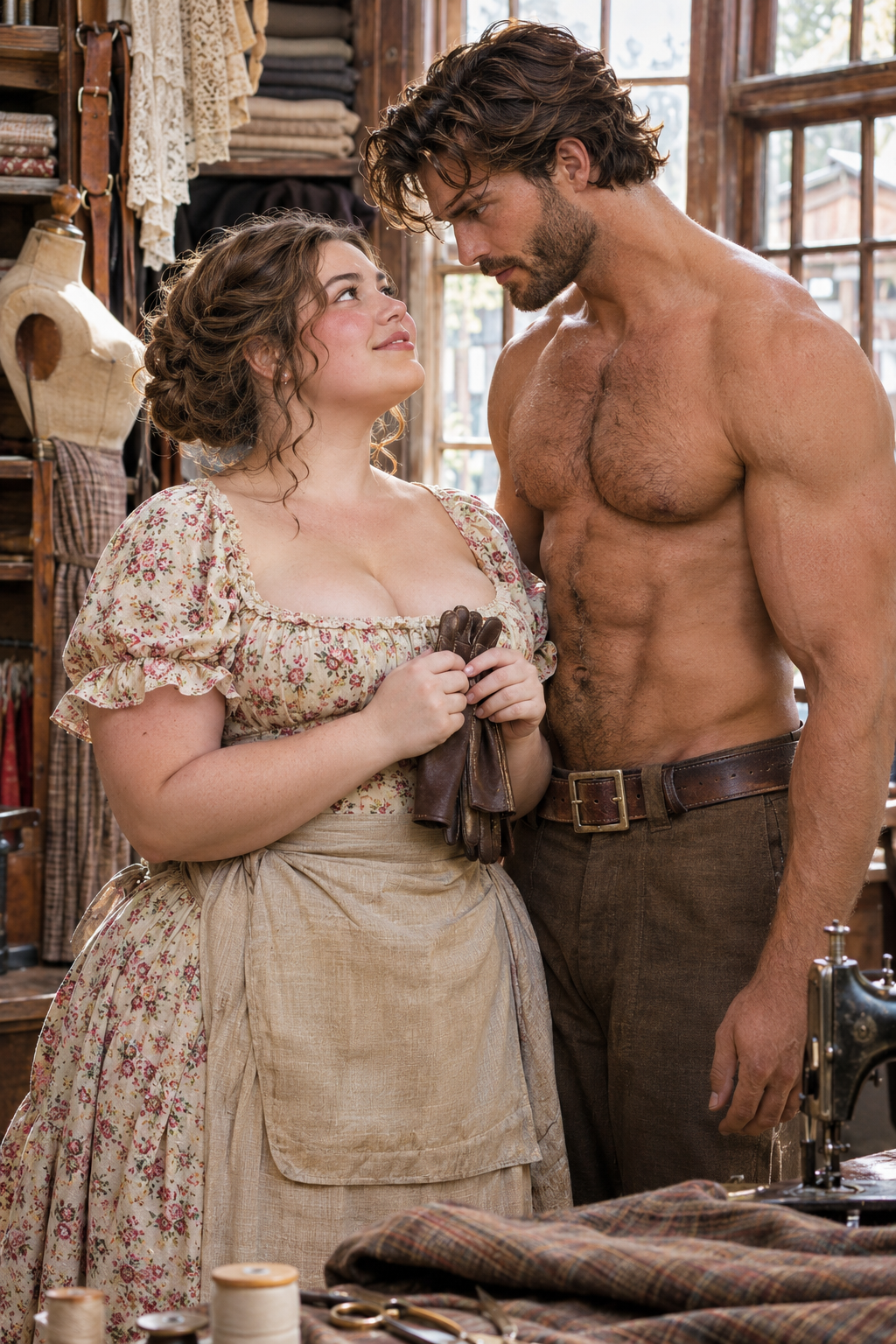
The tallest cattle rancher in Bannock walked into Rebecca Hayes’s dress shop carrying a glove that didn’t need fixing. It was the fourth time that week he’d found an excuse to see her.
Rebecca watched as Michael broke the seal and withdrew a letter. The paper was yellow around the edges, and the handwriting was noticeably different from the writing on the receipts.
“My father received this three weeks before he died,” Michael explained.
Rebecca carefully unfolded the letter. It contained a warning about a series of dishonest transactions involving several prominent businessmen in Bannock. At the bottom was a name she knew almost as well as her own.
Edward Whitmore.
Whitmore owned the town’s bank, financed most of its businesses, and served as chairman of the town council. He was the sort of man who could ruin a person’s livelihood with a single conversation.
“Your father knew?” Rebecca asked.
“He suspected something. He intended to investigate, but he died before he could.”
“How did he die?”
“His horse threw him near Miller’s Crossing. At least, that’s what everyone told me.”
Rebecca raised her eyes from the letter.
“You don’t believe them?”
Michael walked toward the window.
“My father had been riding horses since he was five years old. He knew that trail better than anyone. When they found him, his saddle was missing.”
A chill passed through Rebecca.
“Why haven’t you told anyone?”
“I tried. The sheriff at the time dismissed my concerns. Whitmore suggested grief was making me imagine things.”
Michael turned back toward her.
“I spent years convincing myself he was right.”
Rebecca examined the letter again. Suddenly, the missing grain and questionable payments seemed insignificant compared to what they might have uncovered.
“We need more than receipts,” she said.
Michael nodded.
“And until we find it, nobody can know what we’re doing.”
The following morning, Rebecca returned to her dress shop and found Edward Whitmore waiting outside.
He stood beneath the striped awning, dressed in an expensive gray suit, holding a silver-headed walking stick.
“Miss Hayes,” he greeted pleasantly. “I understand you’ve taken employment with Mr. Turner.”
Rebecca unlocked the door.
“Only a few afternoons each week.”
“An unusual arrangement for a dressmaker.”
“I’ve always been good with numbers.”
Whitmore followed her inside without being invited.
“How fortunate. Although numbers can sometimes lead people toward conclusions they don’t fully understand.”
Rebecca placed her handbag beneath the counter.
“I suppose that depends on the numbers.”
Whitmore smiled, but there was no warmth in his expression.
“Your brother’s medical expenses must be considerable.”
She stopped moving.
“Dr. Bennett has been very understanding.”
“Of course. Nevertheless, should you require financial assistance, my bank would be happy to help.”
“Thank you, but we’re managing.”
Whitmore tapped his walking stick against the floor.
“I would hate to see an unfortunate misunderstanding interfere with your family’s recovery.”
After he left, Rebecca remained behind the counter for several minutes. Her hands were trembling.
By noon, she had told Michael everything.
He listened without interrupting, but the muscles along his jaw tightened.
“You’re not coming back here alone,” he said.
“Michael—”
“He threatened your brother.”
“He wanted to frighten me.”
“And did he?”
Rebecca looked at him.
“Yes.”
Michael’s anger softened immediately.
“Then perhaps we should stop.”
She shook her head.
“If we stop because we’re frightened, he’ll know exactly how to control us.”
Michael studied her for a long moment.
“You’re a remarkably stubborn woman.”
“So I’ve been told.”
Despite his worry, he smiled.
That afternoon, they visited Samuel Price, an elderly rancher whose name appeared several times in the suspicious records.
Samuel lived alone in a weathered farmhouse beyond the northern ridge. His cattle were thin, his fences were collapsing, and his barn looked as though a strong wind might carry it away.
When Rebecca showed him the receipts, his face lost its color.
“Where did you get these?”
“From Michael’s accounts.”
Samuel slowly lowered himself into a chair.
“I never sold him any grain.”
Michael leaned forward.
“These papers say you did.”
Samuel looked toward the door before speaking.
“Whitmore made me sign blank receipts two years ago. Said it was necessary for renewing my loan.”
Rebecca exchanged a glance with Michael.
“Did you know what he intended to do with them?”
“Not until he threatened to take my land if I spoke.”
Samuel rubbed his tired eyes.
“My wife was dying. I needed money for medicine. I would’ve signed anything.”
Michael placed a hand on the old man’s shoulder.
“Would you be willing to tell the sheriff?”
Samuel immediately shook his head.
“Whitmore owns half this town, Michael. A man like me doesn’t stand a chance.”
Rebecca understood his fear. Still, as they left the farmhouse, she couldn’t stop thinking about how many other people might have been forced into similar arrangements.
On their journey home, Michael suddenly pulled his horse to a stop.
A rider was watching them from a distant hill.
The moment Michael turned toward him, the stranger disappeared.
“Someone’s following us,” Rebecca whispered.
“I know.”
Michael guided their horses onto a different trail.
Neither spoke again until they reached the ranch.
That evening, Rebecca stayed for supper. Michael’s housekeeper, Mrs. Collins, served roast chicken and fresh bread before disappearing into the kitchen.
Michael barely touched his food.
“You’re worried about something else,” Rebecca observed.
He sighed.
“I received an offer for my ranch last month.”
“From whom?”
“Whitmore.”
Rebecca set down her fork.
“He wants your land?”
“Apparently. I refused.”
Michael explained that a proposed railway route would pass through the eastern portion of his property. If construction proceeded, the land would become extremely valuable.
Rebecca suddenly understood.
“He’s not simply stealing money from you. He’s trying to weaken your business.”
Michael nodded.
“If enough money disappears, eventually I’ll need a loan. And Whitmore will be waiting.”
Rebecca thought about Samuel’s ruined farm.
“How many ranches has he already taken?”
“Seven that I know of.”
She stared at the candle between them.
“We have to stop him.”
Michael reached across the table and covered her hand with his.
“I wish I’d never involved you.”
Rebecca looked at their joined hands.
“I don’t.”
For several seconds, neither moved.
Then a loud crash came from outside.
Michael jumped to his feet.
Through the window, they saw flames rising from the barn.
“Stay here!”
He grabbed his coat and rushed outside.
Rebecca followed despite his instructions.
The ranch hands were already running toward the fire, carrying buckets and shouting to one another. Terrified horses kicked against their stalls as smoke poured through the open doors.
Michael disappeared into the burning building.
“Michael!” Rebecca screamed.
Moments later, he emerged leading two frightened horses. Before anyone could stop him, he returned for another.
Part of the roof collapsed.
Rebecca felt her heart nearly stop.
She ran toward the entrance, but a ranch hand caught her arm.
“You can’t go in there!”
“Let me go!”
Another terrible crash shook the barn.
Then Michael appeared through the smoke, carrying a young ranch hand across his shoulders.
His shirt was burned along one sleeve, and blood ran from a cut above his eyebrow.
Rebecca rushed to him.
“Are you hurt?”
“I’m fine.”
“You’re bleeding!”
“It’s nothing.”
She looked at him furiously.
“Don’t you ever tell me something like that is nothing.”
Michael stared at her, surprised by the tears gathering in her eyes.
Before he could respond, one of the ranch hands approached.
“Boss, we found this near the back wall.”
He held up an empty kerosene can.
Michael’s expression hardened.
The fire hadn’t been an accident.
By morning, most of the barn had been destroyed. Fortunately, every horse had survived, although two ranch hands suffered minor injuries.
Rebecca cleaned Michael’s wound while he sat at the kitchen table.
“You should’ve listened when I told you to stay inside,” he muttered.
“And you should’ve listened when your roof started falling.”
He almost smiled.
Then his expression became serious.
“Rebecca, whoever did this won’t stop at a barn.”
She finished tying the bandage.
“Neither will we.”
Michael gently caught her wrist.
“Why are you doing this?”
She hesitated.
“Because it’s wrong.”
“That’s not the only reason.”
Rebecca looked into his eyes.
“No,” she admitted quietly. “It isn’t.”
For the first time since they had met, Michael seemed completely speechless.
He leaned toward her, but before their lips could meet, someone knocked urgently at the kitchen door.
It was Rebecca’s brother, Daniel.
He stood on crutches, breathing heavily.
“Rebecca, something’s happened.”
She hurried toward him.
“What is it?”
“Someone broke into your shop last night.”
They returned to Bannock immediately.
The front window had been shattered, drawers overturned, and several dresses torn from their hangers.
Rebecca stared at the destruction.
Everything she had spent years building had been damaged in a single night.
Then she noticed something peculiar.
Her money box remained untouched.
“They weren’t looking for money,” she whispered.
Michael examined the scattered papers.
“They were looking for our evidence.”
Rebecca walked toward an unfinished wedding dress hanging near the back wall. She reached beneath its lining and carefully removed several folded documents.
Michael blinked.
“You hid them in a dress?”
“People rarely examine the inside of a wedding gown.”
For the first time that morning, he laughed.
Unfortunately, their relief didn’t last long.
Sheriff Thomas Reed entered the shop accompanied by Edward Whitmore.
“Miss Hayes,” the sheriff began, “I’m afraid we have a problem.”
Whitmore stood behind him, looking deeply concerned.
The sheriff produced a leather pouch.
“This was discovered beneath the counter.”
Rebecca frowned.
“I’ve never seen it before.”
The sheriff opened the pouch, revealing several gold coins and a collection of banknotes.
“Mr. Whitmore reported money missing from his bank yesterday.”
Michael stepped forward.
“You can’t seriously believe she stole it.”
“There’s more,” the sheriff replied.
He unfolded a document bearing Rebecca’s signature.
According to the paper, she had authorized several fraudulent withdrawals from Michael’s ranch account.
Rebecca stared at it.
“That’s not my signature.”
Whitmore sighed.
“I had hoped we could resolve this quietly.”
Michael’s hands curled into fists.
“You planted those things.”
“Careful, Mr. Turner.”
The sheriff removed his handcuffs.
“Miss Hayes, I’m going to have to ask you to accompany me.”
Michael moved between them.
Rebecca caught his arm.
“Don’t.”
“I’m not letting them take you.”
“If you fight him, they’ll arrest you too.”
Michael looked helplessly at her.
Rebecca forced herself to remain calm.
“Find the truth,” she whispered.
As the sheriff escorted her outside, townspeople gathered along the street.
Some whispered. Others stared.
Whitmore watched from the doorway with a satisfied smile.
By sunset, everyone in Bannock had heard that Rebecca Hayes was a thief.
Michael spent the evening trying to secure her release, but the sheriff insisted she remain in custody until the preliminary hearing.
When Michael finally visited her, Rebecca was sitting on a narrow wooden bench behind iron bars.
He removed his hat.
“I’m sorry.”
“You didn’t do this.”
“I brought you into it.”
Rebecca approached the bars.
“Listen to me. Whoever forged that signature copied it from somewhere.”
Michael frowned.
“My account records?”
“No. I always sign those with my middle initial. The forged document doesn’t have it.”
“Then where?”
Rebecca thought for a moment.
“The bank. I signed a deposit slip there last month.”
Michael’s eyes narrowed.
“That means someone inside Whitmore’s bank prepared the document.”
“Exactly.”
She reached through the bars and took his hand.
“Find someone who knows what happens behind that counter.”
Michael squeezed her fingers.
“I’ll get you out of here.”
“I know.”
He started to leave.
“Michael?”
He turned.
“Please be careful.”
He nodded, then walked into the darkness.
The following morning, Michael visited every businessman whose name appeared in the suspicious receipts. Most refused to speak. A few pretended not to recognize him.
By afternoon, he was beginning to lose hope.
Then a young man approached him outside the general store.
“Mr. Turner?”
Michael recognized him as Henry Dawson, one of Whitmore’s bank clerks.
“I heard about Miss Hayes,” Henry whispered. “She didn’t steal anything.”
Michael immediately stepped closer.
“How do you know?”
Henry glanced nervously around the street.
“Because I prepared the withdrawal papers.”
Michael stared at him.
“Whitmore ordered me to copy her signature. He said she was stealing from you and that we needed proof to recover the money.”
“Will you tell the sheriff?”
Henry swallowed.
“There’s something else you should see first.”
He arranged to meet Michael after dark at an abandoned mill outside town.
When Michael arrived, Henry was waiting with a heavy account book wrapped in cloth.
“Whitmore keeps two sets of records,” Henry explained. “The official ones and these.”
Michael opened the book.
Inside were years of fraudulent transactions, illegal property seizures, and payments to men whose names Michael recognized.
Then he reached a page dated seven years earlier.
A payment had been made to a man named Frank Mercer.
Beside the amount were three words.
Turner. Miller’s Crossing.
Michael felt the blood drain from his face.
His father had died at Miller’s Crossing.
“Who is Mercer?”
“Whitmore’s hired man. He left town shortly after your father’s death.”
Michael closed the book.
“Henry, this could put him in prison.”
A voice suddenly came from behind them.
“That’s precisely why you won’t be taking it anywhere.”
Edward Whitmore stepped from the shadows.
Two armed men stood beside him.
Henry stumbled backward.
Whitmore looked at Michael.
“Your father was equally troublesome.”
Michael’s face darkened.
“You killed him.”
“I gave him several opportunities to reconsider his intentions.”
Michael lunged forward, but one of the men struck him across the head with a pistol.
He fell heavily to the ground.
Henry tried to run.
A gunshot echoed through the mill.
The young clerk collapsed near the doorway.
Whitmore retrieved the account book.
“It’s unfortunate,” he remarked, “how often curiosity leads to tragedy.”
He instructed his men to tie Michael’s hands and set fire to the building.
As flames began climbing the wooden walls, Michael struggled against the ropes. Henry lay several feet away, bleeding from his shoulder.
Outside, horses galloped into the night.
Whitmore believed he had eliminated his final obstacles.
He was wrong.
Daniel Hayes had noticed Henry speaking with Michael earlier that day. Worried by his sister’s arrest and the attack on her shop, he had followed Michael to the mill in a borrowed wagon.
When he saw Whitmore leave, he hurried inside.
“Michael!”
“Daniel? Get out!”
Instead, Daniel pulled a knife from his pocket and cut the ropes.
Together, they dragged Henry outside moments before the burning ceiling collapsed.
Michael coughed violently as Daniel helped him into the wagon.
“The book,” Michael gasped. “Whitmore took it.”
Henry weakly lifted his head.
“There’s another copy.”
Michael stared at him.
“I’ve been copying the records for months,” Henry whispered. “They’re hidden beneath the floorboards in my mother’s house.”
Daniel immediately turned the wagon toward Bannock.
They reached Dr. Bennett’s office shortly before midnight.
While the doctor treated Henry, Michael found the sheriff and demanded that he accompany him to the Dawson residence.
This time, Michael wasn’t alone.
Daniel described everything he had witnessed. Henry, despite his injury, confirmed Whitmore’s involvement.
Within an hour, the sheriff stood over dozens of handwritten pages documenting years of corruption.
His expression grew increasingly grim.
“I owe Miss Hayes an apology.”
Michael looked toward the jail.
“You can start by opening her cell.”
Rebecca had nearly fallen asleep when she heard familiar footsteps.
She opened her eyes.
Michael stood outside the bars, bruised, exhausted, and covered in soot.
“What happened to you?”
He smiled faintly.
“It’s a long story.”
The sheriff unlocked the door.
Rebecca rushed into Michael’s arms.
He held her tightly, burying his face against her hair.
For a moment, neither cared who was watching.
But Whitmore wasn’t finished.
By dawn, he had emptied his personal safe and attempted to escape Bannock with two hired gunmen.
Sheriff Reed and several deputies intercepted him near Miller’s Crossing.
Whitmore refused to surrender.
He fired at the deputies before attempting to cross the river on horseback. His horse lost its footing on the slippery rocks, throwing him into the freezing water.
Ironically, it was Michael who rode into the river and pulled him to safety.
Whitmore lay coughing on the riverbank as the sheriff approached with handcuffs.
“Why?” Whitmore asked bitterly.
Michael looked down at him.
“Because I’m not you.”
Months later, Edward Whitmore was convicted of fraud, conspiracy, attempted murder, and his involvement in the death of Michael’s father.
Several families recovered their stolen properties. Samuel Price received enough compensation to repair his farm, and Henry Dawson eventually became the manager of Bannock’s reorganized bank.
Rebecca reopened her dress shop with help from neighbors who had once doubted her innocence.
One afternoon, Michael entered carrying a familiar leather glove.
Rebecca folded her arms.
“Don’t tell me the stitching is loose again.”
He examined the glove thoughtfully.
“Actually, I think it’s perfectly fine.”
“Then what brings you here?”
Michael removed his hat.
“I’ve been trying to ask you something for nearly a year.”
Rebecca smiled.
“You could’ve saved yourself a considerable amount of money on glove repairs.”
He laughed nervously before reaching into his pocket.
When he opened his hand, a small diamond ring rested against his palm.
“Rebecca Hayes, would you consider marrying a man who’s hopeless with numbers, occasionally foolish around burning buildings, and entirely incapable of finding a reasonable excuse to visit a dress shop?”
Rebecca’s eyes filled with tears.
“Only if he promises to stop pretending his gloves need fixing.”
“I promise.”
“Then yes, Michael Turner. I’ll marry you.”
He lifted her into his arms and kissed her while Mrs. Collins, who had been secretly watching through the window, hurried away to spread the news.
They married beneath the cottonwood trees on Michael’s ranch the following spring.
Rebecca continued running her dress shop and managing the ranch accounts. Together, they established a fund to help struggling families pay medical expenses without risking their homes.
Years later, their children would often ask how their parents had fallen in love.
Michael always claimed it began with a damaged glove.
Rebecca would laugh and remind him that the glove had never been damaged at all.
But privately, she knew their love had truly begun when they chose to trust each other enough to face something frightening together.
They had learned that kindness was not weakness, that courage did not mean living without fear, and that doing what was right mattered most when remaining silent would have been easier.
And whenever Michael walked past Rebecca’s dress shop, even after decades of marriage, he still found some ridiculous excuse to step inside.
Not because anything needed repairing.
But because, of all the places in the world, wherever Rebecca was had always felt most like home.
For nearly twenty years, Bannock remained a peaceful town.
Michael’s ranch prospered, Rebecca’s dress shop expanded, and their two children, Emma and William, grew up hearing stories about the extraordinary events that had brought their parents together.
But one autumn afternoon, a stranger arrived carrying a letter that threatened to reopen a chapter Michael believed had been closed forever.
Rebecca was arranging fabric when the man entered her shop.
“Mrs. Turner?”
“Yes?”
“My name is Joseph Mercer.”
Rebecca immediately recognized the surname.
“Are you related to Frank Mercer?”
The stranger lowered his eyes.
“He was my father.”
Rebecca felt a familiar uneasiness settle over her.
Joseph placed an envelope on the counter.
“My father died last month. Before he passed, he asked me to deliver this to Michael Turner.”
When Michael returned home that evening, Rebecca handed him the letter.
He recognized Frank Mercer’s signature immediately.
For several minutes, he read in silence.
Then he sat down.
“What does it say?” Rebecca asked.
Michael handed her the letter.
Frank Mercer had confessed to sabotaging Michael’s father’s saddle under Whitmore’s orders. He had spent the remainder of his life running from the consequences of that terrible decision.
But the confession contained something unexpected.
Michael’s father had survived the initial fall.
Mercer had found him injured beside the river. Rather than helping him, he had ridden away, fearing what Whitmore might do if the truth emerged.
At the bottom of the letter, Mercer had written a final request.
He hoped Michael would not punish Joseph for his father’s sins.
Rebecca watched her husband carefully.
“Michael?”
He stood and walked toward the window.
For years, he had imagined confronting the man responsible for his father’s death. Now that man was gone, leaving behind nothing but a confession and a son who had inherited his shame.
“What does Joseph want?” Michael finally asked.
“Nothing. He delivered the letter and offered to leave town.”
Michael remained silent.
The following morning, he found Joseph preparing to depart outside the boardinghouse.
“You’re leaving?” Michael asked.
Joseph nodded.
“I figured my presence wouldn’t be welcome.”
“Do you have somewhere to go?”
“Not particularly.”
“Can you work with cattle?”
Joseph looked surprised.
“I’ve worked on ranches most of my life.”
Michael considered him for a moment.
“I need another ranch hand.”
Joseph stared at him.
“After what my father did?”
Michael removed his hat.
“Your father made his choices. You haven’t made yours yet.”
The young man’s eyes filled with tears.
Within a week, Joseph began working at the Turner ranch.
Some townspeople questioned Michael’s decision. Others believed he had become too forgiving in his old age.
Rebecca understood better than anyone.
Michael wasn’t forgetting what had happened to his father. He was refusing to allow that tragedy to destroy another innocent life.
Joseph proved himself hardworking and trustworthy. Over the following years, he became one of Michael’s most dependable employees.
Eventually, Michael entrusted him with managing the northern portion of the ranch.
Life continued.
Emma married a schoolteacher, William took over much of the cattle business, and grandchildren filled the Turner household with laughter.
Michael’s hair turned silver. Rebecca began wearing spectacles whenever she worked with particularly delicate fabric.
Still, every Friday afternoon, Michael visited her dress shop.
Sometimes he brought a torn shirt.
Sometimes a perfectly good handkerchief.
And sometimes he arrived with nothing at all.
One winter morning, Rebecca found him sitting beside the fireplace, holding the old leather glove that had started everything.
“I can’t believe you kept that,” she said.
Michael smiled.
“Best investment I ever made.”
She sat beside him.
“You know, you could’ve simply asked me to supper.”
“I was afraid you’d say no.”
Rebecca laughed.
“The tallest rancher in Bannock, frightened of a dressmaker.”
“Terrified.”
She rested her head against his shoulder.
Outside, snow covered the fields where they had built their life together.
“Would you change anything?” Michael asked suddenly.
Rebecca thought about the burned barn, her arrest, the frightening nights, and all the years that had followed.
“I would change the suffering,” she answered. “But never what we became because we faced it together.”
Michael kissed her forehead.
That spring, on their fortieth wedding anniversary, their family organized a celebration beneath the same cottonwood trees where they had exchanged their vows.
Nearly everyone in Bannock attended.
Samuel Price’s grandchildren came. Henry Dawson, now retired, arrived carrying flowers. Joseph stood among the ranch hands with his own family.
During supper, William raised his glass.
“My father taught me how to manage cattle, negotiate a fair price, and recognize an approaching storm. But the greatest lesson he ever taught me had nothing to do with ranching.”
Michael looked toward his son.
“He taught me that a man’s strength isn’t measured by how many people fear him. It’s measured by how many people feel safe because he’s there.”
Rebecca quietly wiped her eyes.
Emma stood next.
“And our mother taught us that being kind doesn’t mean allowing others to take advantage of you. Sometimes the kindest thing you can do is refuse to remain silent.”
Applause spread beneath the trees.
Michael reached for Rebecca’s hand.
Neither needed to say anything.
Their children had understood.
Several years later, Michael passed away peacefully in his sleep, with Rebecca holding his hand.
The entire town mourned.
Businesses closed for the afternoon, and ranchers traveled miles to attend his funeral.
Joseph Mercer stood beside William as they lowered Michael’s coffin into the earth.
“He gave me a life I never thought I deserved,” Joseph whispered.
William placed a hand on his shoulder.
“He knew you deserved it.”
Rebecca continued visiting her dress shop for another three years.
One afternoon, her youngest granddaughter found her sitting beside the window, holding a familiar leather glove.
“Grandmother, why do you always keep that old thing?”
Rebecca smiled.
“Because someone once brought it here when there was absolutely nothing wrong with it.”
“Then why did he bring it?”
“He wanted to see me.”
The little girl giggled.
“Grandfather was silly.”
“Yes,” Rebecca whispered affectionately. “He certainly was.”
That evening, Rebecca returned home, placed the glove beside Michael’s photograph, and sat in her favorite chair overlooking the ranch.
She watched the sun disappear behind the distant hills.
For the first time in years, she felt unusually tired.
She closed her eyes, remembering a tall, nervous rancher standing inside a little dress shop, searching desperately for something to say.
By morning, Rebecca had peacefully joined the man she had loved for nearly half a century.
Their children buried them side by side beneath the cottonwood trees.
On their shared headstone, William had engraved a simple message.
“Together, they made the world a little kinder.”
Long after Michael and Rebecca were gone, the medical assistance fund they had established continued helping families throughout Bannock.
Their ranch remained in the family, and Rebecca’s dress shop eventually became a small sewing school where young women could learn a trade and earn an independent living.
Their legacy was not measured in cattle, money, or acres of land.
It lived in the people they had helped, the families they had protected, and the courage they had inspired.
And inside the sewing school, displayed in a small wooden frame, rested an ordinary leather glove.
Beneath it was a handwritten note Rebecca had left behind.
“Never underestimate the extraordinary things that can begin with an ordinary act of kindness.”
For generations, visitors stopped to read those words.
Few knew the entire story.
But everyone understood its meaning.
True love was never simply about finding someone who made life easier. It was about finding someone who made life worth facing, even when the road became difficult.
And sometimes, the greatest love story began with something as simple as a glove that didn’t need fixing.