The sheriff dragged me into the muddy square beside my bread cart and called me a liar, but he didn’t know the dragon had already shown me who stole the wages.
The horse stopped outside the tower.
I could hear its breathing through the broken doorway.
Slow.
Heavy.
Close.
I slipped Tobin’s letter into my coat and reached for the iron poker beside the dead fire.
The dragon made a low clicking sound.
Not a growl.
A warning.
I raised my eyes.
It was still perched on the wall, its torn wing folded tightly against its soot-dark body.
Its head had turned toward the doorway.
Then the horse stepped into the moonlight.
There was no rider.
My fingers tightened around the poker.
The animal wore Tobin’s saddle.
But Tobin’s saddle had been torn away when he was attacked.
I remembered the leather straps hanging loose beside his wounded body.
Someone had repaired them.
Recently.
The horse took another step.
Something dark was tied beneath its saddle.
A bundle.
I moved closer.
The dragon suddenly launched itself from the wall.
It struck the ground beside me, claws scraping stone, then darted toward the horse.
The horse startled.
The bundle fell.
I kicked it away from the animal and crouched beside it.
A man’s coat lay inside.
Brown wool.
Mud-stained.
At first, I saw nothing strange.
Then I found the badge.
A silver inspector’s badge.
Harlon Pike’s badge.
My heart hammered.
I lifted the coat.
A dark patch stained the inside lining near the ribs.
Blood.
Fresh blood.
The dragon sniffed it and hissed.
I heard footsteps behind me.
I spun around with the poker raised.
Tobin stood in the doorway.
For a moment, neither of us spoke.
He looked terrible.
His injured leg was wrapped tightly, and he leaned heavily on a rough wooden crutch.
His face was pale.
His beard had grown thick during the days he had been hidden.
But he was alive.
“How did you get out?” I whispered.
“Through the old mine shaft.”
I stared at him.
“You nearly gave me a heart attack.”
“You were supposed to think I was dead.”
“That wasn’t exactly comforting.”
He gave a tired smile.
Then his expression changed.
“You found the coat.”
I nodded.
“Is Pike dead?”
Tobin shook his head.
“No.”
“Then whose blood is this?”
Tobin looked toward the northern road.
“That’s what I came back to find out.”
The dragon made another clicking sound.
Tobin crouched beside it and scratched beneath its jaw.
“You’ve been good, Bramble.”
I blinked.
“You named it?”
“It had to be called something.”
“Bramble?”
“It likes stealing bread and hiding in thorn bushes.”
“That isn’t a name.”
“It is now.”
Despite everything, I almost laughed.
Then I remembered the badge.
“What happened?”
Tobin leaned against the wall.
“I escaped through the mine tunnel. It comes out near the north road. I followed Pike.”
“Why?”
“Because he had my horse.”
I frowned.
“He took your horse?”
“He needed it to leave town without being recognized.”
“Then why bring it back?”
Tobin looked at me.
“Because he wasn’t leaving town.”
A cold feeling settled over my shoulders.
“What do you mean?”
“He was going to the old county storehouse.”
I knew the place.
Everyone did.
It stood beyond the mill, half buried in the hillside.
For years, it had been used to store grain, tax records, tools, and emergency supplies.
No one went there anymore.
Or at least, no one admitted to it.
Tobin reached into his shirt and pulled out a folded scrap of paper.
“I found this in Pike’s coat.”
I opened it.
There were names.
Dozens of them.
Kiln workers.
Farmers.
Shopkeepers.
The names of men and women who owed taxes, collected wages, transported goods, or handled county accounts.
Beside each name was a number.
Some were crossed out.
Others were circled.
At the bottom were three words.
“Third bell. Tonight.”
I stared at the page.
“What’s happening at the third bell?”
“I don’t know.”
“Then we go to the sheriff.”
Tobin’s expression hardened.
“You still trust Dawson?”
I didn’t answer.
The sheriff had dragged me into the muddy square that morning.
He had called me a liar.
He had searched my house.
He had accused me of helping Tobin steal the wages.
But I had never seen fear in his eyes until he saw the dragon.
Not anger.
Fear.
“Maybe he doesn’t know,” I said.
Tobin looked at me quietly.
“Then we’d better find out.”
We left the tower through the back entrance.
Bramble followed.
The three of us crossed the fields under a moon hidden behind clouds.
Red Creek was strangely quiet.
Too quiet.
Usually, even after midnight, someone was moving between houses.
A drunk returning from the tavern.
A late worker carrying tools.
A mother calling a child inside.
That night there was nothing.
Not even dogs barking.
When we reached my house, Tobin stopped.
“What?”
He pointed at the door.
It was open.
I knew I had locked it.
I stepped inside first.
The kitchen had been searched.
Drawers were pulled out.
Flour covered the floor.
My father’s old wooden chest had been forced open.
But nothing valuable had been taken.
Someone had been looking for something.
“What would Pike want from you?” Tobin asked.
“I don’t know.”
Bramble suddenly darted into the room.
It stopped beside the cold stove and scratched at the floorboards.
I knelt.
There was a loose plank.
I lifted it.
Underneath was a small tin box.
My father had given it to me before he died.
I had forgotten it was there.
Inside was an old county ledger.
Tobin took it carefully.
“What is this?”
“My father used to keep accounts for the kiln.”
He opened the ledger.
His eyes widened.
“Look.”
I leaned over.
Several years of records filled the pages.
Wages paid.
Taxes collected.
Deliveries made.
But some numbers didn’t match.
Large amounts had been removed from the county accounts and replaced with smaller figures.
Tobin turned pages quickly.
“These aren’t mistakes.”
“No.”
“They’ve been doing this for years.”
I remembered my father sitting at the kitchen table late at night, rubbing his tired eyes.
He had once told me, “A town doesn’t collapse when people steal from it. It collapses when honest people become afraid to say they saw it.”
I had never understood what he meant.
Now I did.
Tobin closed the ledger.
“This is what Pike was looking for.”
“Then why didn’t he take it?”
A voice came from the doorway.
“Because he didn’t know it existed.”
Sheriff Dawson stood there.
His pistol was drawn.
Bramble hissed.
I stepped in front of Tobin.
Dawson looked at the dragon.
Then at Tobin.
Then at me.
“Put the ledger down.”
Tobin did not move.
“Sheriff,” I said, “what is happening?”
Dawson’s face looked older than it had that morning.
“Too much.”
“Did you know Tobin was alive?”
“Yes.”
The answer stunned me.
“How long?”
“Since yesterday.”
“Then why did you let everyone think he stole the wages?”
Dawson lowered the pistol.
“Because if Pike knew I knew, he’d kill him.”
Tobin stepped forward.
“You knew Pike was involved.”
“I suspected.”
“That’s not good enough.”
“No,” Dawson said quietly. “It isn’t.”
He closed the door behind him.
“Pike isn’t an inspector.”
The words landed like stones.
“I figured that out after he arrived,” Dawson continued. “His badge is genuine, but it belongs to a man who died two years ago.”
I stared at him.
“Then who is he?”
“We don’t know.”
“Why hasn’t anyone arrested him?”
Dawson’s jaw tightened.
“Because three men tried.”
“And?”
“They disappeared.”
Silence filled the kitchen.
“Who else knows?” I asked.
Dawson looked at Tobin.
“Now?”
“Everyone who needs to.”
A bell rang in the distance.
Once.
Twice.
Dawson’s face changed.
“The third bell.”
A third bell rang.
Far beyond the mill, something exploded.
The ground trembled beneath our feet.
Bramble screamed.
Not like an animal.
Like a child.
Dawson opened the door.
Smoke was rising over the northern hill.
“The storehouse.”
We ran.
Tobin struggled to keep pace, but refused to stop.
Dawson led us through the alley behind the mill.
Halfway there, we saw men running in the opposite direction.
Some carried lanterns.
Others carried sacks.
One man dropped a wooden box.
Coins spilled into the mud.
County coins.
Wage coins.
Dawson grabbed him.
“Who sent you?”
The man stared at the sheriff.
Then at Bramble.
Then he began to cry.
“Pike.”
Dawson shoved him against the wall.
“How many?”
“Eight.”
“Where?”
“The storehouse.”
“What are they doing?”
The man swallowed.
“Burning the records.”
We ran faster.
The storehouse was already burning when we reached it.
Flames poured through the windows.
Smoke rolled across the road.
Inside, people were shouting.
Dawson charged through the door.
Tobin followed.
I stayed behind for half a second.
Then Bramble flew over my head.
The little dragon disappeared into the smoke.
“Bramble!”
I ran after it.
The heat struck me immediately.
I covered my mouth with my sleeve.
The wooden shelves were burning.
Boxes of documents were stacked against the walls.
Someone had soaked them in oil.
A man rushed past me carrying a metal case.
I grabbed his coat.
He swung at me.
I fell.
Before he could strike again, Bramble landed on his shoulders.
The man screamed.
The dragon bit his ear.
He dropped the case.
I picked it up.
Inside were county seals, forged documents, and stacks of letters.
Then I saw something that made my blood run cold.
A list.
Every name from Pike’s paper.
Beside each name was a payment.
Bribes.
Not to the people listed.
To the men controlling the accounts.
I heard Tobin shouting.
“Merritt!”
I looked up.
He stood near the back wall.
Behind him was Harlon Pike.
Pike held a pistol against his chest.
“Drop the case,” Pike said.
I did not move.
“You’ve caused enough trouble.”
“You stole the county wages.”
Pike smiled.
“No.”
He glanced at Tobin.
“I stole something more valuable.”
“What?”
“Trust.”
He stepped backward.
“For years, people have blamed each other. Farmers blamed merchants. Workers blamed officials. The poor blamed the rich. The rich blamed thieves. All I had to do was give them a reason.”
Tobin stared at him.
“You forged the records.”
“I corrected them.”
“You murdered people.”
Pike’s smile faded.
“Some people refuse to understand correction.”
Dawson appeared behind him.
“Put the gun down, Pike.”
Pike turned.
For the first time, he looked frightened.
Then he fired.
The shot struck the ceiling.
Dawson tackled him.
The pistol skidded across the floor.
Tobin stumbled forward.
I grabbed the weapon.
Pike fought like a cornered animal.
He struck Dawson in the face and crawled toward the back door.
Bramble flew at him.
Pike swung wildly.
The dragon dodged.
Then Pike saw the flames behind him.
He froze.
The fire had reached the ceiling.
A burning beam cracked above him.
“Tobin!” I shouted.
He understood immediately.
He threw his crutch aside and lunged.
He pulled Dawson away just as the beam crashed down.
Pike disappeared beneath it.
For several seconds, nobody moved.
Then we heard him screaming.
Tobin looked at me.
“We have to get him out.”
Dawson stared at the burning beam.
“He’ll kill us.”
“He might.”
Tobin grabbed a broken pole.
“But we’re not him.”
Together, we lifted the beam.
It was heavier than anything I had ever carried.
My arms screamed.
Dawson pushed from the other side.
Tobin pulled Pike free.
We dragged him through the doorway just before the roof collapsed.
The storehouse burned until dawn.
By sunrise, half the town stood in the muddy square.
The ledger was placed on a table.
So were the letters from Pike’s case.
One by one, the evidence was read aloud.
Names.
Dates.
Amounts.
Years of stolen wages.
Forged reports.
Bribes.
Threats.
The truth was ugly.
It was also simple.
No dragon had stolen the wages.
No mail rider had run away.
No baker had sheltered a criminal.
People had simply been lied to for long enough that the lie had become easier to believe than the truth.
Pike survived.
He was taken to the county jail under guard.
Three other men confessed before noon.
Some were officials.
Some were merchants.
One was a respected man who had spent years preaching about honesty at the chapel.
That part hurt the town more than anything else.
Tobin recovered slowly.
His leg healed, though he walked with a limp afterward.
His wife came to Red Creek three weeks later.
I remember standing outside the bakery when she ran across the road and threw her arms around him.
He cried.
So did I.
Dawson resigned as sheriff before the month ended.
Not because he had been part of Pike’s scheme.
Because he believed that knowing the truth and remaining silent had still been a failure.
Before he left, he came to my bread cart.
“You were right,” he said.
“About what?”
“Birds.”
I frowned.
He smiled.
“You said you feed birds.”
Then he walked away.
Bramble stayed.
At first, people were afraid of him.
Children hid when he flew over the rooftops.
Mothers pulled them away from the market.
Shopkeepers covered their food.
But Bramble had no interest in people.
He wanted bread.
Apples.
Meat.
And occasionally someone’s shiny spoon.
He became a regular at my cart.
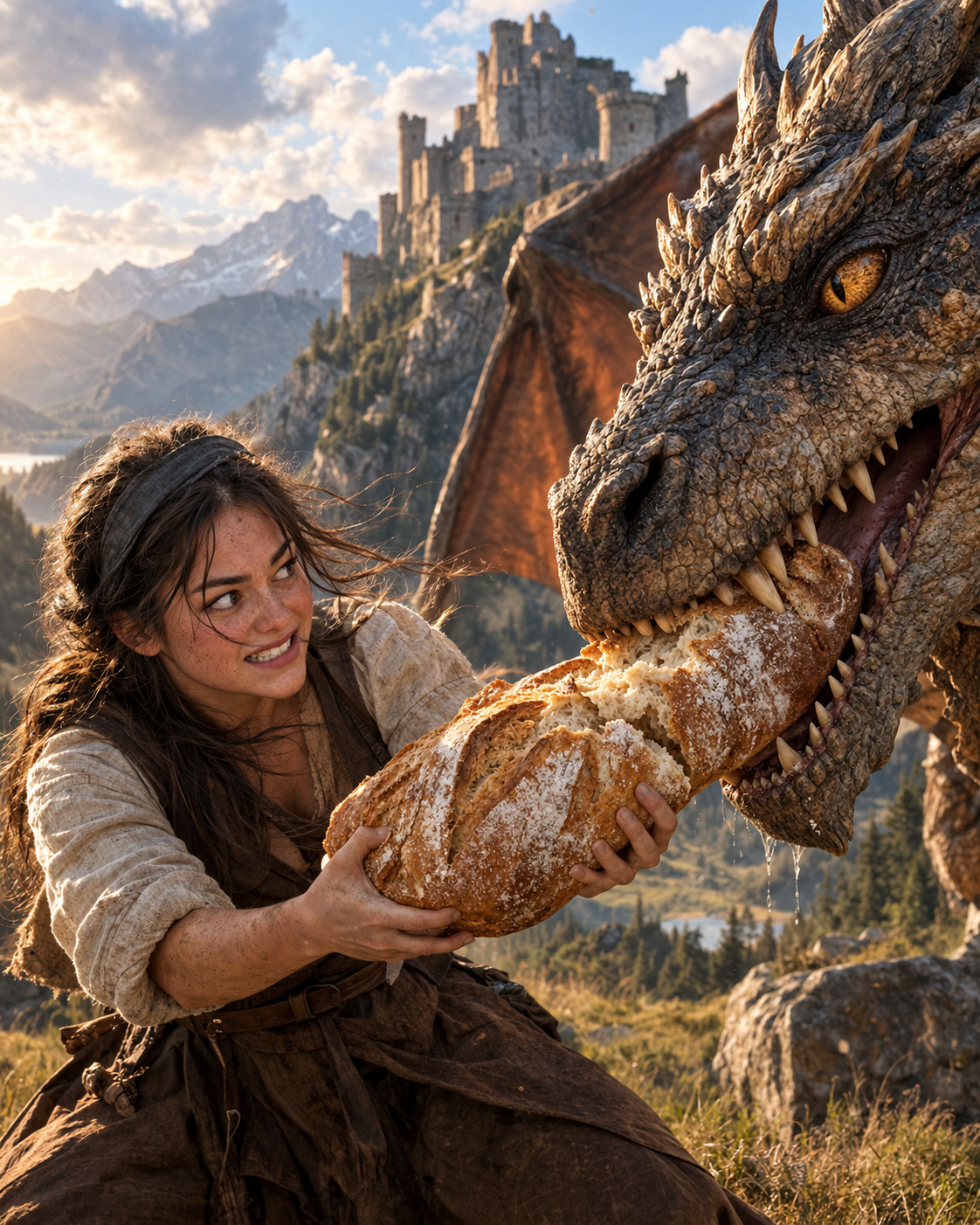
Every morning, he would appear on the roof of the bakery and stare at me until I gave him a piece of rye.
I pretended to hate it.
He pretended to believe me.
Months passed.
Red Creek changed.
The county accounts were rewritten.
The stolen wages were returned.
Some families received money they had not seen in years.
The old proverb changed too.
People no longer whispered, “When a dragon feeds at your table, someone is sleeping in its nest.”
Instead, children began saying something new.
“When a dragon eats your bread, check who is hiding behind you.”
I liked that better.
But one autumn evening, Tobin and I returned to the ruined tower.
The roof was gone.
Grass had grown between the stones.
The place where he had once lain injured was covered with yellow flowers.
Bramble flew above us.
Tobin leaned on his walking stick.
“You ever regret following me?”
I looked at him.
“I followed a dragon.”
“Fair enough.”
We laughed.
Then Bramble landed on the wall.
He was larger now.
Not much.
But enough.
His torn wing had healed into a crooked scar.
He looked at us for a long moment.
Then he turned toward the northern mountains.
“You think he’s leaving?” I asked.
Tobin nodded.
“Dragons don’t stay where they aren’t needed.”
Bramble opened his wings.
Before he took off, he dropped something at my feet.
A small silver object.
I picked it up.
It was Pike’s false inspector badge.
I looked at Tobin.
He shook his head.
“Keep it.”
“Why?”
“As a reminder.”
“Of Pike?”
“No.”
He looked toward the town below us.
“Of how easy it is to believe a badge, a title, or a loud voice without asking what is underneath.”
I closed my fingers around the badge.
Bramble rose into the evening sky.
He circled the tower once.
Then twice.
On the third circle, the setting sun caught the edges of his dark scales and made them shine like burned copper.
Then he disappeared beyond the mountains.
For a long time, neither of us spoke.
Finally, Tobin said, “Your father would have liked this.”
I smiled.
“I think he would have complained about the dragon eating his bread.”
“He sounds wise.”
“He was.”
We started walking home.
Below us, Red Creek glowed with lanterns.
People were opening their shops.
Children were running through the streets.
The kiln workers were laughing outside the tavern.
For the first time in years, nobody seemed afraid of what the next morning might bring.
And I understood something my father had tried to teach me long before I was old enough to understand it.
A lie does not become powerful because it is clever.
It becomes powerful because people stop questioning it.
Fear can make decent people look away.
Authority can make a falsehood sound official.
And sometimes the truth arrives in the strangest form imaginable.
A wounded mail rider.
A forgotten ledger.
A baker’s stolen loaf.
Or a one-winged dragon that refuses to abandon a man everyone else has already condemned.
I never became a hero.
I remained a baker.
I still woke before sunrise.
I still burned the first loaf whenever I was distracted.
I still argued with customers over whether rye bread was worth one extra copper.
But whenever someone in Red Creek accused another person of wrongdoing, the old crowd would grow quiet.
Someone would ask,
“Where’s the proof?”
And that question changed everything.
Years later, people still told stories about the dragon of Red Creek.
Some said Bramble had been a guardian spirit.
Others claimed he had belonged to an ancient dragon family living beneath the mountains.
Children insisted he could understand every human word.
I never corrected them.
The truth was enough for me.
I had seen a frightened creature protect an injured man when the whole town believed him guilty.
I had seen a sheriff admit that silence could be a kind of failure.
I had seen a criminal nearly destroy an entire town without ever drawing a sword until people were willing to believe his story.
And I had learned that courage was not always standing in front of danger.
Sometimes courage was simply refusing to repeat a lie.
Sometimes it was opening an old book everyone else had forgotten.
Sometimes it was asking one more question when everyone else had already decided they knew the answer.
And sometimes, when the world insists that something is a monster, you have to look closely enough to see who is actually holding the knife.
That night, I placed the silver badge in the wooden chest beside my father’s ledger.
Then I locked it.
Not because I wanted to forget what happened.
Because I wanted to remember.
Outside, somewhere far beyond the town, a dragon cried into the darkness.
The sound carried over the rooftops, across the fields, and into the quiet streets of Red Creek.
Nobody panicked.
Nobody reached for a weapon.
People simply stopped what they were doing and listened.
Then the town returned to its ordinary life.
And somehow, that was the greatest proof that we had finally learned the lesson.
The dragon had never come to save Red Creek.
It had only shown us how to save ourselves.
But the story did not end with Bramble disappearing beyond the mountains.
Not quite.
Three days after his departure, something happened that brought the whole town back to the ruined tower.
It began with a knock at my door before sunrise.
I opened it to find Sheriff Dawson standing outside.
He looked exhausted.
“You need to come with me.”
I reached for my coat.
“What happened?”
He hesitated.
“They found Pike’s horse.”
My stomach tightened.
“Where?”
“Near the old quarry.”
I followed him through the waking town.
The streets were empty except for a few workers heading toward the kiln.
A pale mist covered the fields.
When we reached the quarry road, Tobin was already there.
He stood beside a group of men staring at the ground.
I saw the horse first.
It was lying beneath a tree.
Dead.
Beside it was a strip of black cloth caught on a thorn.
Tobin picked it up.
“This is from Pike’s coat.”
Dawson shook his head.
“Pike is still locked in the county jail.”
“Then who was here?”
Nobody answered.
Tobin looked toward the mountains.
“Someone who knows about the money.”
My heart sank.
“Pike told us everything.”
“No,” Tobin said.
“He told us enough to save himself.”
Dawson frowned.
“What are you saying?”
Tobin unfolded a map.
It was the same map we had found in the metal case.
Several places were marked in red.
The storehouse.
The old quarry.
The kiln.
And one final location deep in the mountains.
“The money Pike stole over the years wasn’t all in Red Creek.”
Dawson stared at the map.
“Where is it?”
Tobin pointed toward the mountains.
“Under the old dragon caves.”
The men around us exchanged nervous glances.
I felt a strange chill.
“Why would Pike hide it there?”
“Because nobody goes there.”
Dawson looked at the dead horse.
“Then we go.”
I stared at him.
“You mean now?”
“Yes.”
Tobin smiled faintly.
“You wanted the truth.”
“I wanted breakfast.”
“You can have both.”
So we climbed.
The path became narrower as we moved higher.
Pine trees covered the slopes.
Mist gathered between the rocks.
By midday, we found the entrance to the caves.
It was hidden behind a wall of thorn bushes.
Dawson held up a lantern.
“There.”
A narrow passage disappeared into darkness.
We entered.
The cave smelled of wet stone.
Our footsteps echoed through the tunnels.
After nearly an hour, we reached a chamber.
And there it was.
Gold.
Silver.
Coins.
Sealed county boxes.
Enough money to rebuild half of Red Creek.
But there was something else.
A small wooden table stood in the center of the chamber.
On it was a single lantern.
Still burning.
Someone had been there recently.
Dawson drew his pistol.
“Stay behind me.”
A voice came from the darkness.
“You should have stayed in town.”
A man stepped into the lantern light.
I recognized him.
Merrick Vale.
The county treasurer.
The man who had stood beside Sheriff Dawson when the wages were declared missing.
The man who had spoken at my father’s funeral.
The man who had spent years telling everyone that Red Creek needed honest leadership.
Tobin stared at him.
“You.”
Merrick smiled.
“People always trust the man who carries the books.”
Dawson raised his pistol.
“Drop the knife.”
Merrick laughed.
“You still don’t understand.”
He pointed behind us.
A rock shifted.
Then another.
The entrance began collapsing.
“You’re going to bury us here,” I said.
“No.”
Merrick looked at the treasure.
“I’m going to bury the evidence.”
He struck the lantern.
Darkness swallowed the cave.
Then the explosion came.
The ground shook.
Rocks crashed from the ceiling.
I fell hard against the wall.
Someone grabbed my arm.
Tobin.
“Move!”
We crawled through the darkness.
Dust filled my mouth.
I couldn’t see Dawson.
I couldn’t see Merrick.
Then I heard something else.
A sound I knew.
A sharp clicking noise.
Bramble.
I looked up.
A faint orange glow appeared at the end of the tunnel.
Two golden eyes emerged from the darkness.
Bramble.
He was larger than before.
Much larger.
He spread his wings.
A gust of air swept through the tunnel.
Then he screamed.
The sound shook the cave.
He flew toward the collapsed passage.
His claws struck the rocks.
Again.
Again.
Stone cracked.
A gap opened.
Light poured through.
“Go!” Tobin shouted.
We crawled through the opening.
Dawson emerged next.
Then, behind us, Merrick appeared.
He was bleeding from his forehead.
He carried a small leather bag.
“Leave it!” Dawson shouted.
Merrick ran.
He reached the edge of the cliff.
The path ended there.
There was nowhere to go.
He turned.
Behind him stood Dawson.
In front of him stood the abyss.
Bramble landed on a rock above.
Merrick looked at the dragon.
For the first time, I saw genuine fear in his face.
“You wouldn’t let me die,” he whispered.
I remembered Pike.
I remembered the burning storehouse.
I remembered the people who had been willing to let Tobin die because it was easier than questioning the story.
I stepped forward.
“No.”
Merrick stared at me.
“We won’t.”
Dawson lowered his weapon.
“You’re coming back with us.”
Merrick laughed bitterly.
“You think the town will forgive you?”
“No,” Dawson said.
“They don’t have to.”
Merrick’s expression changed.
Dawson continued.
“Justice isn’t about making people forgive you.”
The sheriff stepped closer.
“It’s about making sure you don’t get to hurt them again.”
Merrick surrendered.
The leather bag fell into the dirt.
Inside were letters, names, and enough evidence to expose everyone who had helped him.
But when we returned to Red Creek, we did not hide what had happened.
The entire town gathered in the square.
The truth was read aloud.
Every name.
Every payment.
Every lie.
Some people wept.
Some became furious.
Some tried to deny everything.
But this time, nobody was willing to accept a story simply because a powerful man told it.
The county sent investigators.
Trials followed.
Property was recovered.
Families received what had been stolen from them.
The kiln workers finally received the wages they had been waiting for.
And Red Creek changed.
Not overnight.
Not perfectly.
But permanently.
People began keeping records where everyone could see them.
County meetings were opened to the public.
No official could approve money without another person checking the accounts.
And whenever someone said, “Trust me,” someone else would answer,
“Show us.”
That became the new saying in Red Creek.
Not “When a dragon feeds at your table, someone is sleeping in its nest.”
Not even “Where’s the proof?”
Just two words.
“Show us.”
Bramble stayed for the winter.
He made his home in the ruined tower.
Children brought him apples.
The kiln workers gave him scraps of meat.
And every morning, without fail, he appeared beside my bread cart.
I eventually gave up pretending he was stealing.
I started putting one loaf aside for him.
He always took the largest one.
Of course.
One snowy morning, Tobin came to the cart.
He looked toward the mountains.
“It’s time.”
I knew what he meant.
Bramble was ready to leave.
The little dragon sat on the roof of the bakery, watching the sunrise.
His wings were stronger now.
The torn one had healed into a long silver scar.
I took a loaf from the cart.
I held it toward him.
Bramble flew down.
He took it gently.
For a moment, his eyes met mine.
“You saved a man who everyone thought was a thief,” I whispered.
He tilted his head.
“You taught us something.”
He blinked.
Tobin laughed.
“I don’t think he understands you.”
“Maybe he does.”
Bramble lifted his wings.
Before flying away, he dropped something at my feet.
A small object.
I picked it up.
It was a copper button from Pike’s coat.
I looked at Tobin.
He smiled.
“Another reminder?”
I shook my head.
“No.”
I walked to the edge of the road and buried the button beneath the snow.
“I don’t need another reminder of the men who lied.”
Tobin looked at me.
“Then what will you remember?”
I watched Bramble rise into the sky.
“That the truth survived them.”
The dragon circled Red Creek once.
Then twice.
On the third circle, he turned toward the mountains.
Everyone in the square stopped to watch.
No one knew whether he would return.
Maybe he would.
Maybe he wouldn’t.
But this time, nobody needed him to.
That was the difference.
We had spent years waiting for someone powerful to protect us.
A sheriff.
A judge.
A county official.
A man with a badge.
A man with a title.
But Bramble had shown us something simpler.
Protection was not the same as obedience.
Trust was not the same as belief.
And justice was not the same as revenge.
Sometimes the strongest thing a person could do was ask a question when everyone else was afraid to speak.
Sometimes it was opening a ledger.
Sometimes it was helping a wounded stranger.
Sometimes it was refusing to turn away.
And sometimes the smallest creature in the room could see the truth more clearly than everyone else.
Years later, when people asked me about the dragon, I told them the same story.
I told them about the missing loaf.
The broken tower.
The wounded mail rider.
The false inspector.
The burning storehouse.
The hidden treasure.
And the town that almost destroyed itself by believing a lie.
But I always ended with the same part.
I told them that Bramble had never been our hero.
He had never spoken a word.
He had never asked for a reward.
He had simply protected someone who needed protecting.
The rest was up to us.
And that, more than anything, was what saved Red Creek.
Because a dragon can reveal the truth.
A sheriff can defend it.
A ledger can prove it.
A witness can speak it.
But only people can choose what they will do once they know it.
The last time I saw Bramble, the sun was setting behind the mountains.
He became a dark shape against the orange sky.
Then he disappeared.
I stood there until the light faded.
Tobin stood beside me.
“You think he’ll come back?”
I smiled.
“Maybe.”
“And if he doesn’t?”
I looked at the town.
At the bakery.
At the kiln.
At the families walking home beneath the evening lanterns.
“Then we won’t need him.”
Tobin nodded.
Neither of us said anything else.
The wind moved through the fields.
Somewhere beyond the mountains, a dragon cried once into the fading light.
And this time, Red Creek did not hear it as a warning.
We heard it as a promise.
A promise that truth could survive fear.
A promise that trust had to be earned.
A promise that no badge, title, rumor, or frightened crowd could make a lie become the truth forever.
And whenever darkness came again, whenever someone tried to convince us that silence was safer than courage, we remembered the little dragon who had stolen a loaf of bread.
The thief who had led us to a wounded man.
The monster who had taught us mercy.
And the creature who, without saying a single human word, taught an entire town the most important lesson it had ever learned:
Never let someone else decide what is true for you.
Look closer.
Ask questions.
And when you finally find the truth, have the courage to stand beside it.
Because sometimes, the truth is not the loudest voice in the room.
Sometimes, it is the smallest one.
And sometimes, if you are lucky enough to notice it,
it has wings.
THE END.