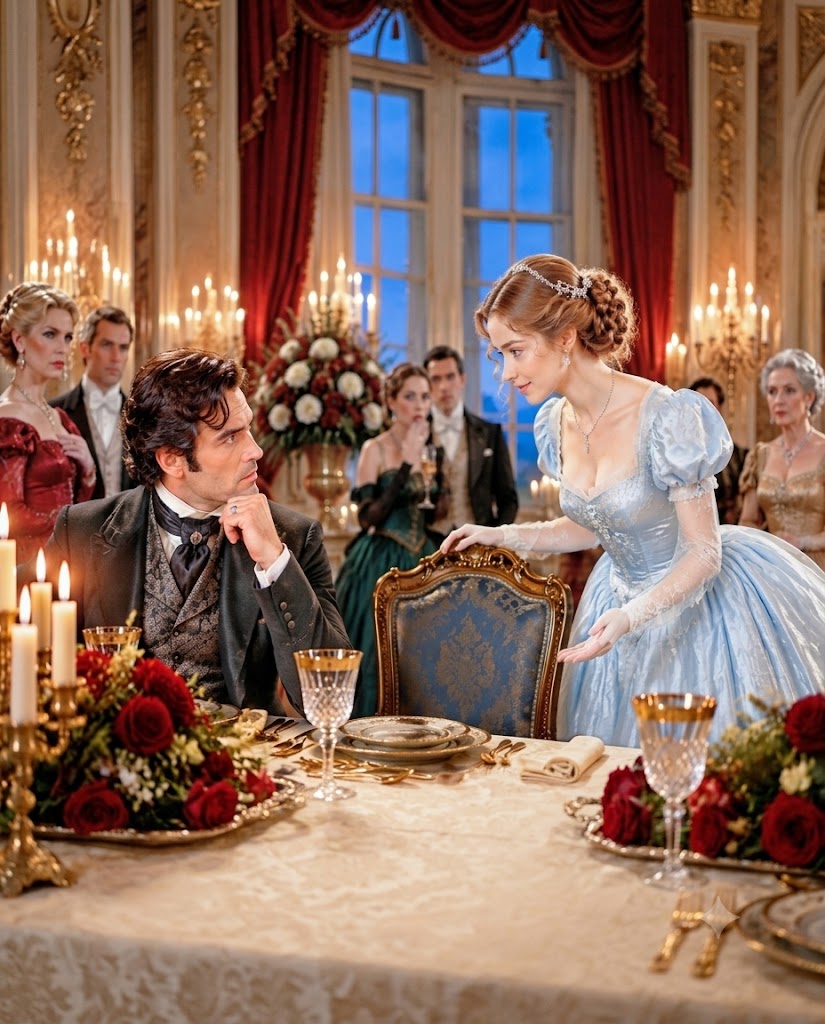
The seat beside the Duke had been empty for so long that no one in the room remembered who was supposed to sit there.
Edmund’s words seemed to alter the temperature of the garden.
Margaret stared at him.
“Your wife?”
He did not answer immediately.
The wind moved through the bare branches overhead, carrying the scent of wet earth and something faintly sweet from the greenhouse.
Finally, Edmund stepped closer.
“She was called Eleanor.”
Margaret’s fingers tightened around the folder beneath her arm.
“But everyone said—”
“Everyone says many things.”
His voice was quiet, but there was something beneath it. Not anger.
Pain.
“She died twelve years ago.”
Margaret looked down at the white rose.
Fresh petals.
A green stem.
A drop of water trembling on one leaf.
“If she died twelve years ago,” Margaret whispered, “who cut this?”
Edmund’s eyes remained fixed on the flower.
“That is what I have been trying to discover.”
A sudden knock sounded from inside the greenhouse.
Both of them turned.
The door stood half open.
No one was visible beyond it.
Margaret took one step forward.
Edmund caught her wrist.
“Don’t.”
His fingers were warm around her skin.
“Why?”
“Because three people have entered that greenhouse in the last twelve years.”
Margaret looked at him.
“Three?”
“One was my brother.”
“What happened to him?”
“He left Thornfield the same night.”
“And the other two?”
Edmund released her wrist.
“One died.”
“And the other?”
“He was never found.”
Margaret’s heart began to beat faster.
She looked again at the rose.
“Who was the woman who died?”
Edmund’s expression hardened.
“Eleanor’s maid.”
Silence settled between them.
Then something moved behind the glass.
A pale shape.
Margaret instinctively stepped backward.
Edmund moved in front of her.
The shape disappeared.
“Go back to the house,” he said.
“No.”
His eyes narrowed.
“You should listen to me.”
“I have spent the last twenty years listening to people tell me what I should not investigate.”
Margaret lifted the rose.
“My mother sent me here to complete a survey. She didn’t send me here to pretend that the west garden doesn’t exist.”
Edmund looked at her for a long moment.
Then, unexpectedly, he laughed.
It was barely more than a breath.
“You sound like her.”
“Like whom?”
“Eleanor.”
The name hung between them.
Margaret’s expression softened despite herself.
“What happened to her?”
Edmund looked toward the dark greenhouse.
“She disappeared.”
Margaret frowned.
“You said she died.”
“I said everyone believes she died.”
The wind stopped.
For one impossible moment, the garden became completely silent.
Then Edmund reached inside his coat and withdrew a small brass key.
He placed it in Margaret’s palm.
“The truth is beneath the greenhouse.”
She stared at the key.
“You’ve never opened it?”
“I tried.”
“And?”
“The lock was changed.”
“By whom?”
Edmund’s gaze met hers.
“I don’t know.”
That answer frightened her more than anything else.
That night, Margaret could not sleep.
Rain hammered against the windows of her room while the old house groaned around her.
She kept thinking about the rose.
About Edmund’s face.
About a woman everyone believed was dead.
Near midnight, she heard footsteps in the corridor.
Slow.
Careful.
They stopped outside her door.
Margaret sat upright.
The handle turned.
She reached for the candle beside her bed.
The door opened an inch.
Then a folded piece of paper slid across the floor.
The door closed.
Margaret waited.
Nothing happened.
She crossed the room and picked up the paper.
There were only six words written on it.
HE IS NOT THE MAN YOU THINK.
Margaret read them twice.
Then she turned the paper over.
Nothing.
She opened the door.
The corridor was empty.
At the far end, however, a curtain moved slightly.
Someone had been watching her.
By morning, Margaret had made a decision.
She would enter the greenhouse.
With or without Edmund.
She found him in the library just after sunrise.
He stood beside the fireplace reading a letter.
“You came,” he said without looking up.
“You expected me.”
“I heard your footsteps.”
Margaret placed the brass key on the desk.
“I’m going into the greenhouse.”
Edmund folded the letter.
“No.”
“I wasn’t asking permission.”
“I know.”
He looked at her.
“That’s precisely the problem.”
Margaret pulled the mysterious note from her pocket and placed it beside the key.
His expression changed.
For the first time since she had met him, the Duke looked genuinely unsettled.
“Where did you get this?”
“Someone left it outside my room.”
Edmund picked it up.
His eyes moved across the six words.
Then he turned the paper over.
Margaret watched him carefully.
“You recognize the handwriting.”
He did not answer.
“Edmund.”
“It belongs to Eleanor.”
The room seemed to shrink around them.
“But that’s impossible.”
“Yes.”
He folded the note.
“She has been dead for twelve years.”
Margaret’s voice dropped.
“You don’t believe that.”
“No.”
“Then why haven’t you told anyone?”
“Because the last time I told someone Eleanor might still be alive, my brother disappeared.”
Margaret felt a chill.
“Tell me everything.”
Edmund stared into the fire.
“Twelve years ago, Eleanor discovered something about Thornfield. Something involving the land, the estate accounts, and a group of men who had been using the abandoned grounds.”
“For what?”
“I never learned the whole truth.”
“You’re the Duke.”
“Titles don’t make locked doors open.”
His voice carried a bitterness that made Margaret pause.
“Eleanor was clever. Too clever for the people she was investigating. One evening, she told me she had found proof that someone inside Thornfield had been stealing from the estate for years.”
“Who?”
“She wouldn’t say.”
“Why?”
“She said she didn’t know whom she could trust.”
Margaret looked toward the library doors.
“Not even you?”
“Especially not me.”
“Why?”
Edmund’s jaw tightened.
“Because I had been away.”
He walked to a cabinet and removed a leather-bound ledger.
“When I returned, Eleanor was gone.”
He opened the ledger.
Several pages had been torn out.
“She left this behind.”
Margaret examined the damaged spine.
“What happened to the pages?”
“I don’t know.”
“Who had access to this?”
“Everyone.”
She looked up.
“That’s impossible.”
“Not at Thornfield.”
He closed the ledger.
“Servants, family, tenants, lawyers. The house was full of people who knew more about my affairs than I did.”
“And your brother?”
“He accused me of killing her.”
Margaret went still.
“Why?”
“Because he found blood in the greenhouse.”
A heavy silence followed.
“Was it hers?”
“We never proved it.”
“Then what happened to your brother?”
“He went looking for Eleanor.”
“And disappeared.”
“Yes.”
Margaret took a slow breath.
“Then we’re going into the greenhouse.”
Edmund looked at her.
“You’re determined.”
“I’ve noticed that you keep saying that as though it’s a flaw.”
“It may become one.”
“Only if you keep trying to stop me.”
For several seconds, neither moved.
Then Edmund took his coat from the back of the chair.
“Very well.”
They left through the west corridor.
The greenhouse stood at the far end of the estate, surrounded by dead vines and iron fencing.
Its glass panes were clouded with age.
The door was locked.
Edmund inserted the brass key.
It didn’t fit.
Margaret frowned.
“You said it was the key.”
“It was.”
He turned it again.
Nothing.
Then Margaret noticed something.
“The key isn’t for the door.”
She crouched beside the stone threshold.
A narrow brass plate was almost hidden beneath moss.
She brushed it clean.
There was a keyhole.
Edmund knelt beside her.
Together, they inserted the key.
Something clicked beneath the floor.
The greenhouse door opened by itself.
Cold air rushed out.
Inside, everything was dead.
Except for one rose bush growing beneath the central window.
It was covered in white flowers.
Margaret stepped forward.
Edmund grabbed her arm.
“Wait.”
A floorboard creaked.
Then another.
They both froze.
Someone was walking above them.
Margaret looked up.
There was no second floor.
Only the glass roof.
The footsteps continued.
Slowly.
Across the ceiling.
Then stopped directly above the rose bush.
A faint scraping sound followed.
Margaret whispered, “What is that?”
Edmund pulled her behind a stone pillar.
The greenhouse door slammed shut.
A metal bolt dropped into place.
They were trapped.
Margaret rushed toward it.
“Edmund!”
He tried the handle.
Nothing.
Then a voice spoke from somewhere beneath the floor.
“Duke Carver.”
Edmund went completely still.
The voice was old.
Male.
And calm.
“You should have stayed away.”
Margaret looked at Edmund.
“Who is that?”
“I don’t know.”
The voice laughed softly.
“You know exactly who I am.”
A panel beneath the rose bush suddenly opened.
Blackness appeared below.
Then a hand reached through.
Margaret recoiled.
Edmund drew the small pistol he carried beneath his coat.
“Come out.”
The hand disappeared.
A second later, a figure emerged from beneath the floor.
An elderly man in a dark coat.
His face was thin.
His hair almost completely white.
Margaret recognized him immediately.
She had seen his portrait in the entrance hall.
“Lord Julian,” she whispered.
Edmund lowered the pistol slightly.
His uncle.
The man who had supposedly died in France eleven years ago.
Julian smiled.
“Your mother taught you well, Margaret Selby.”
Her blood ran cold.
“How do you know my mother?”
“Because she knows where Eleanor is.”
Edmund stepped forward.
“You’re lying.”
Julian’s smile vanished.
“Am I?”
He reached into his coat and pulled out a small photograph.
He handed it to Margaret.
She stared at it.
The photograph showed Eleanor standing beside a young woman.
Margaret recognized the woman immediately.
Her mother.
But the photograph had been taken only three years ago.
Her mother’s face was unmistakable.
So was Eleanor’s.
Margaret’s fingers began to tremble.
“My mother told me Eleanor was dead.”
“She wanted you to believe that.”
“Why?”
“Because your mother helped her escape.”
Edmund looked at Margaret.
“Your mother was involved?”
“I didn’t know.”
Julian laughed.
“No one tells the children what their parents have done.”
Margaret ignored him.
“Where is Eleanor?”
Julian pointed beneath the floor.
“Below us.”
Edmund’s face hardened.
“What did you do to her?”
“Nothing.”
“Where is she?”
“She left yesterday.”
Margaret stared.
“Yesterday?”
Julian nodded.
“She knew you were coming.”
“Why?”
“Because she sent for you.”
A distant sound came from outside.
Horses.
Several riders.
Julian’s expression changed.
“They’ve found us.”
“Who?”
“The men who have owned Thornfield all these years.”
Edmund stepped toward him.
“My estate belongs to me.”
Julian looked almost pityingly at him.
“You still don’t understand.”
He moved toward the hidden passage.
“The estate was never the prize.”
Margaret’s voice was barely audible.
“Then what was?”
Julian looked at her.
“The records.”
Before she could ask another question, the greenhouse windows shattered.
Men in dark coats rushed through the broken glass.
Edmund pulled Margaret down.
A shot rang out.
The rose bush exploded in white petals.
Julian disappeared through the floor.
Edmund grabbed Margaret’s hand.
“Run.”
They raced through the hidden passage.
The tunnel was narrow and damp, lit only by old lamps fixed into the stone.
Behind them came shouting.
Margaret could hear boots pounding through the greenhouse.
“Where does this lead?” she asked.
“Old servants’ quarters.”
“How do you know?”
“Eleanor showed me once.”
“You said you had never found the passage.”
“I lied.”
Margaret stopped.
Edmund turned.
“What?”
“You lied to me.”
“I lied to everyone.”
“Why?”
“Because if I told the truth, they would know I was looking.”
“Who?”
He stared at her.
“The same people who have been watching you since you arrived.”
A gunshot echoed through the tunnel.
Margaret flinched.
Edmund pulled her close against the wall.
For a moment they stood almost breathless.
His hand was against her waist.
Her face was inches from his.
Neither spoke.
Then Margaret whispered, “If we survive this, you’re going to tell me everything.”
His eyes softened.
“If we survive this, I’ll tell you more than everything.”
They continued.
The tunnel ended behind a wooden panel in an abandoned room.
Edmund pushed it open.
They emerged into darkness.
Margaret recognized the room.
It was directly beneath the library.
On the desk lay a single envelope.
Her name was written across it.
MARGARET SELBY.
She opened it.
Inside was a letter.
My dear Margaret,
If you are reading this, then you have discovered what I could not hide forever.
Your mother and I did not betray the Duke.
We saved him.
Twelve years ago, Edmund’s uncle created a network that stole land, forged documents, and controlled tenants through debts they could never repay. Eleanor discovered the records. I helped her remove them from Thornfield.
But someone betrayed us.
The only person we could not prove was involved was Edmund himself.
So Eleanor disappeared.
Your mother raised you away from Thornfield because the people searching for the records believed you might know where they were hidden.
You do not.
But your mother does.
And now she is in danger.
There was one final line.
Trust Edmund.
Margaret lowered the letter.
Edmund watched her silently.
“She says I should trust you.”
His expression changed.
“She shouldn’t.”
Margaret stared at him.
“Why?”
“Because I don’t know if I deserve it.”
Footsteps sounded above them.
They both looked toward the ceiling.
Someone was entering the library.
Edmund extinguished the lamp.
A voice came through the floorboards.
“Search every room.”
Margaret whispered, “We need to leave.”
“No.”
He looked at her.
“We need the records.”
“Where are they?”
Edmund pointed to the library.
“Under the fireplace.”
They waited until the voices moved toward the corridor.
Then they slipped into the library.
Edmund knelt before the fireplace and removed three stones.
Behind them was a narrow iron box.
He pulled it free.
Inside were dozens of documents.
Property deeds.
Bank records.
Letters.
Names.
Margaret picked up the first ledger.
She understood immediately.
The entire foundation of Thornfield’s wealth had been built on stolen land.
Edmund looked at the papers.
His face was pale.
“I knew there were irregularities.”
“You didn’t know this.”
“No.”
He closed his eyes.
Then a voice spoke from the doorway.
“You should have left the box where it was.”
Margaret turned.
Lady Cesily stood there.
Her elegant dress was spotless.
Her expression was calm.
Behind her stood four armed men.
Edmund stepped in front of Margaret.
“Cesily.”
She smiled.
“You always were sentimental.”
“You knew.”
“I knew everything.”
Margaret’s stomach tightened.
“You sent the note.”
Cesily looked at her.
“No.”
She smiled.
“Julian did.”
Edmund raised his pistol.
Cesily laughed.
“You won’t shoot me.”
“Try me.”
“You wouldn’t.”
She glanced at Margaret.
“Not with her watching.”
Margaret stepped forward.
“Why did you bring me here?”
Cesily’s expression became colder.
“Because your mother knows where Eleanor hid the original records.”
“My mother doesn’t have them.”
“She does.”
“No.”
Cesily shook her head.
“You’ve misunderstood.”
She reached into her handbag.
“She has something much more valuable.”
A small photograph slid across the floor.
Margaret picked it up.
It showed her mother standing outside a cottage.
Beside her stood Eleanor.
And between them was a child.
A little girl of perhaps five years old.
Margaret stared.
The child’s face was familiar.
Too familiar.
“Who is she?”
Cesily’s eyes rested on Margaret.
“Your sister.”
Margaret stopped breathing.
“My mother had no other child.”
“That’s what she told you.”
Edmund looked at Cesily.
“Where is the girl?”
Cesily smiled.
“She is the reason your mother came to Thornfield.”
A terrible realization struck Margaret.
Her mother had not sent her to finish a survey.
She had sent her because she needed Margaret inside Thornfield.
She had been bait.
Edmund seemed to reach the same conclusion.
He moved toward Margaret.
“Don’t listen to her.”
Cesily raised her hand.
The men behind her lifted their weapons.
Then the library doors burst open.
A woman’s voice rang through the room.
“Drop them.”
Everyone turned.
Margaret’s mother stood in the doorway.
Pale.
Bruised.
But alive.
Beside her stood Eleanor.
Older than the photograph.
Her hair streaked with silver.
But unmistakably alive.
And behind them were three constables.
Cesily’s face changed.
For the first time, fear appeared in her eyes.
The next few seconds became chaos.
One man reached for his weapon.
A constable tackled him.
Another fled through the window.
Edmund seized the third.
Margaret’s mother crossed the room and pulled her daughter into her arms.
Margaret could barely speak.
“You lied to me.”
“I know.”
“You said Eleanor was dead.”
“I had to.”
“You have a daughter?”
Her mother closed her eyes.
“Yes.”
“Where is she?”
“She is safe.”
“Where?”
“Far from Thornfield.”
Margaret pulled away.
“You used me.”
Her mother’s face broke.
“I protected you the only way I knew how.”
“No.”
Margaret shook her head.
“You protected me by keeping me ignorant.”
Eleanor stepped forward.
“She is right.”
Margaret looked at her.
Eleanor’s eyes were tired but kind.
“We thought secrets would keep you safe.”
“And did they?”
Eleanor glanced around the ruined library.
“No.”
Edmund stood several feet away, staring at the documents.
The truth had changed the room.
Changed the house.
Changed him.
He walked toward Margaret.
“I owe you an apology.”
She looked at him.
“For what?”
“For every time I told you to leave.”
Margaret gave a small, exhausted smile.
“You were trying to protect me.”
“I was also afraid.”
“Of what?”
He looked at the papers.
“That if the truth came out, I would discover that everything I had inherited was built on someone else’s suffering.”
Margaret said nothing.
Edmund picked up the ledger.
“I cannot undo twelve years.”
“No.”
“But I can decide what happens next.”
Outside, bells began to ring.
Word had spread through the estate.
Servants gathered in the corridors.
Tenants were arriving at the gates.
The hidden records would soon be impossible to bury.
Lady Cesily was arrested before sunset.
Julian was found in the old tunnel, wounded but alive.
The men who had worked for them scattered.
Within weeks, the courts began investigating Thornfield’s accounts.
Edmund opened every ledger.
Every deed.
Every account.
He did not defend the wealth that could not be defended.
Land was returned.
Debts were canceled.
Compensation was paid where records allowed.
Some people forgave him.
Others did not.
Edmund accepted both.
As for the greenhouse, Margaret refused to let it remain abandoned.
She repaired the broken glass.
She planted roses.
Not only white ones.
Red.
Yellow.
Pink.
Hundreds of them.
The west garden became a place where tenants could walk freely.
Children played beneath the trees.
For the first time in years, Thornfield did not feel like a fortress.
It felt like a home.
Months later, Margaret stood beside the restored rose bush.
Edmund approached carrying two cups of tea.
“You’ve changed the garden.”
Margaret smiled.
“You changed the estate.”
“I had help.”
“So did I.”
He handed her a cup.
For a moment, neither spoke.
Then Edmund looked at the rose bush.
“Do you ever wonder what would have happened if you had never sat beside me at dinner?”
Margaret considered the question.
“I probably would have been given a smaller room.”
He laughed.
“And I would have remained comfortably miserable.”
“You were miserable?”
“Very.”
She raised an eyebrow.
“You hid it well.”
“I had practice.”
Margaret looked toward the greenhouse.
“Do you regret any of it?”
Edmund was silent.
“No.”
Then he added, “I regret the lies. I regret the years lost to fear. But I don’t regret the truth.”
Margaret smiled.
“Good.”
He looked at her.
“Margaret.”
“Yes?”
“There is something I should have said long ago.”
She waited.
“The seat beside me was never meant to remain empty.”
Her smile faded into something softer.
“Then who was supposed to sit there?”
Edmund’s gaze held hers.
“I didn’t know.”
He paused.
“Until you did.”
For once, Margaret had no clever answer.
She simply looked at him.
Beyond them, the wind moved gently through the roses.
A single white petal fell to the ground.
Margaret bent to pick it up.
Then she stopped.
She remembered the first rose.
The locked gate.
The warning.
The fear.
And she realized what the garden had taught her.
A place could be beautiful and still hide terrible things beneath its soil.
A family could love you and still hurt you with their silence.
A person could inherit a name, a house, and a fortune without understanding the cost of any of them.
But truth, once uncovered, did not have to become another weapon.
It could become a beginning.
Margaret placed the white petal back beneath the rose bush.
She did not keep it.
She did not need to.
Some things were not meant to be possessed.
They were meant to be understood.
Behind her, Edmund opened the greenhouse door.
Sunlight poured through the repaired glass.
For twelve years, Thornfield had been haunted by the things its people refused to say.
Now the doors stood open.
The records were no longer hidden.
The dead had been given their names.
The living had been given their choices.
And the empty seat beside the Duke was empty no longer.
Not because someone had been forced to fill it.
But because, at last, someone had chosen to stay.
For the first time in twelve years, Thornfield slept without a secret beneath its foundations.
Or so Margaret believed.
The following spring arrived quietly.
Snow disappeared from the stone walls. The gardens awakened beneath a veil of green, and the restored greenhouse filled with sunlight once more.
Margaret had stayed.
Not because Edmund had asked her to.
Not because Thornfield needed another person to repair what had been broken.
She stayed because, for the first time in her life, she had chosen a place without being told what that choice should mean.
Her mother had returned to the small cottage where she had lived for years, though she visited Thornfield often.
Eleanor had remained too.
She had become something unexpected in the household: not a ghost, not a scandal, but a living reminder that survival was sometimes its own form of courage.
And Edmund had changed.
The Duke who once ate alone now found himself surrounded by people.
The servants no longer lowered their voices when he entered a room.
Children from the village ran across the lawns.
Farmers came to the estate office without fear.
The old gates remained open during daylight.
Yet Margaret noticed something troubling.
Edmund still avoided one place.
The old eastern wing.
It had been closed since Eleanor disappeared.
Margaret discovered this by accident.
One afternoon, while reviewing the estate plans, she found a section that did not match the newer surveys.
A narrow corridor was marked behind the eastern library.
There was no door shown on the current plans.
Only a blank wall.
Margaret stared at it for a long time.
Then she carried the plans to Edmund.
He looked at them.
His expression changed.
“You found it.”
“Found what?”
He folded the map.
“The last room.”
Margaret waited.
“You knew?”
“Yes.”
“Then why didn’t you tell me?”
“Because Eleanor asked me not to.”
Margaret’s eyes narrowed.
“She knew about it?”
“She built the room.”
That answer unsettled her.
“Why?”
Edmund looked toward the window.
“Because she knew that one day the truth might not be enough.”
They walked together toward the eastern wing.
The corridor smelled of dust and old wood.
At the end stood a portrait of Edmund’s father.
Margaret had passed it dozens of times.
Now she noticed something strange.
The frame was newer than the painting.
She touched the edge.
“Help me.”
Edmund removed the portrait.
Behind it was a narrow iron door.
Margaret stared.
“Why hide a door behind your father’s portrait?”
“Because nobody would ever think to move it.”
The key was already in Edmund’s hand.
The lock opened.
Beyond the door was a small room.
There were no windows.
No furniture except a desk, a chair, and a wooden chest.
On the wall hung dozens of photographs.
Margaret stepped closer.
Her breath caught.
They were photographs of Thornfield’s tenants.
Families.
Children.
Workers.
Some photographs were decades old.
Others were recent.
Edmund’s voice was quiet.
“Eleanor collected them.”
“Why?”
“To remember the people behind the numbers.”
Margaret walked to the desk.
There was a notebook.
She opened it.
The first page contained a single sentence.
A house is only as honorable as the people it protects.
Margaret turned the page.
Names filled the notebook.
Not noble families.
Not politicians.
Not wealthy men.
Ordinary people.
Farmhands.
Widows.
Gardeners.
Servants.
Children who had grown into adults.
People whose land had been taken.
People who had disappeared.
People who had been paid to remain silent.
At the very back was a list of names Margaret recognized.
One belonged to her father.
She froze.
“Edmund.”
He came beside her.
Her father’s name had been underlined.
“What does this mean?”
Edmund read the page.
His face became pale.
“I don’t know.”
“You promised me no more secrets.”
“I know.”
“Then don’t lie.”
“I am not.”
Margaret turned the page.
There was another sentence.
He knew where the first ledger was hidden.
Margaret’s heart sank.
“My father?”
Edmund nodded slowly.
“Your father may have known about the records.”
“He died when I was a child.”
“I know.”
“Did my mother know?”
“I don’t know.”
Margaret closed the notebook.
For a moment she felt anger rising inside her.
After everything.
After all the lies.
Another secret.
Another door.
Another piece of the past waiting to drag the living backward.
She walked toward the door.
Edmund stopped her.
“Margaret.”
She turned.
“What?”
“You don’t have to investigate this.”
She almost laughed.
“That’s exactly what everyone said the first time.”
“I know.”
“Then you should know better.”
A faint smile appeared on his face.
“Yes.”
They spent the next three months searching.
This time, however, they did not hide their investigation.
Margaret’s mother joined them.
So did Eleanor.
Old documents were requested.
Letters were opened.
Witnesses were found.
Piece by piece, they reconstructed the final missing part of the story.
Margaret’s father had not been one of the conspirators.
He had discovered the stolen records years before Eleanor.
He had hidden them.
But before he could expose the network, he died suddenly.
His death had been called an accident.
Margaret’s mother had always suspected otherwise.
Now they found proof.
A letter.
Written two days before his death.
It was addressed to Eleanor.
I have hidden the original ledger where no one will search.
Not at Thornfield.
Not in the village.
Somewhere Margaret will one day understand.
Beneath the letter was a drawing.
A garden.
A rose bush.
Margaret stared at it.
Then she understood.
“The first rose.”
Edmund looked at her.
“What?”
“The white rose.”
She ran from the room.
They followed her into the greenhouse.
The original rose bush stood in the center.
Margaret knelt.
She examined the soil.
Nothing.
Then she noticed the stone border.
One stone was slightly different.
Edmund helped her move it.
Beneath it was an iron box.
Inside was the original ledger.
Not copies.
Not altered pages.
The complete record.
Every transaction.
Every forged signature.
Every name.
Every payment.
At the bottom was one final document.
A transfer of ownership.
The land had never legally belonged to Edmund’s family.
It had been purchased through fraud.
For a long time, nobody spoke.
Edmund looked at the document.
Then he looked at Margaret.
“What do you think I should do?”
Margaret shook her head.
“This isn’t my decision.”
“It affects you.”
“It affects everyone.”
He took a breath.
“Then I’ll return it.”
“You could lose Thornfield.”
“I know.”
“You could lose the title.”
“I know.”
“You could lose everything.”
Edmund smiled sadly.
“Perhaps I should have understood sooner that everything isn’t the same as something worth keeping.”
The legal battle lasted almost a year.
Newspapers arrived.
Lawyers came and went.
People argued in the courts.
Some demanded that Thornfield be surrendered entirely.
Others argued that the current generation could not be punished for crimes committed before they were born.
Margaret refused to become the voice of either side.
She simply told the truth.
Edmund did the same.
In the end, the estate was divided.
Large portions of the land were returned to the families who could prove their claims.
Other areas became a public trust.
The manor itself remained under Edmund’s care, but no longer as a private symbol of inherited power.
It became something different.
A school.
A library.
A community center.
The greenhouse became a public conservatory.
The gardens became open grounds.
The old dining room where Margaret had first sat beside Edmund was converted into a reading hall.
The empty chair remained.
Margaret insisted on it.
“Why keep it?” Edmund asked.
“Because people should remember what it meant.”
“What does it mean now?”
“That no seat belongs to someone simply because of their name.”
He looked at her.
“And who does this one belong to?”
Margaret smiled.
“Whoever needs it.”
Years passed.
The story of Thornfield became less frightening with time.
People stopped whispering about the vanished wife.
They stopped calling Edmund the cold Duke.
They began calling him Edmund.
Just Edmund.
Margaret continued her work with gardens and historical estates.
She published a book about Thornfield’s restoration.
The final chapter was titled The Things We Leave Open.
She did not write about her relationship with Edmund in detail.
Some things belonged only to the people who lived them.
But everyone knew they had married.
Their wedding was small.
No grand ceremony.
No royal guests.
No elaborate decorations.
Margaret walked through the greenhouse instead of down a cathedral aisle.
White roses lined the path.
When she reached Edmund, he whispered, “You realize this means you are officially trapped at Thornfield.”
She smiled.
“I was never trapped.”
That answer stayed with him.
Years later, when Margaret was old enough to have silver in her hair, she returned to the greenhouse one autumn evening.
The place was still beautiful.
Children were laughing outside.
Someone was playing the piano in the old library.
The scent of roses filled the air.
Edmund sat beside the window.
He had aged too.
His hair was gray.
His face carried lines that Margaret had come to love.
He looked up.
“You’re late.”
“I was busy.”
“You’re always busy.”
“And you’re always complaining.”
“I have a reputation to maintain.”
She sat beside him.
For a while they watched the sunset.
Then Margaret noticed a young girl standing near the greenhouse door.
She was perhaps eight years old.
She held a small white rose.
“Who is she?”
Edmund smiled.
“The gardener’s daughter.”
The girl approached them shyly.
“Mr. Carver?”
“Yes?”
“Can I ask you something?”
“Of course.”
“Is it true that this house used to be haunted?”
Margaret laughed softly.
Edmund glanced at her.
“What have you heard?”
“That a dead woman used to cut roses at night.”
Margaret looked at the white flower in the girl’s hand.
“People like stories.”
“Was it true?”
Edmund considered the question.
Then he answered honestly.
“There were ghosts here.”
The girl’s eyes widened.
“Really?”
“Yes.”
“What kind?”
Edmund looked at Margaret.
“The kind made by secrets.”
The girl frowned.
Margaret smiled.
“Sometimes people hide things because they think silence will protect someone.”
“Does it?”
“No,” Margaret said gently.
“Not forever.”
The girl looked toward the old greenhouse.
“What happened to the ghosts?”
“They stopped being ghosts when people finally told the truth.”
The girl thought about that.
Then she smiled and ran outside.
Margaret leaned against Edmund’s shoulder.
“You frightened her.”
“I told her the truth.”
“You always use that excuse.”
He laughed.
Outside, the first stars appeared.
The garden was quiet.
Not the frightening silence of years ago.
A peaceful silence.
The kind that comes after a storm.
Margaret looked around the greenhouse.
She remembered the locked gate.
The white rose.
The hidden passage.
The gunshots.
The letters.
The lies.
The woman everyone believed was dead.
She remembered sitting beside Edmund for the first time, unaware that one empty chair could change the course of two lives.
“What are you thinking?” he asked.
“That I almost left.”
“You should have.”
“I know.”
“Why didn’t you?”
Margaret looked at him.
“Because sometimes the door you are most afraid to open is the one that leads you home.”
Edmund took her hand.
They sat quietly.
The old house stood behind them.
It was no longer perfect.
Some walls still carried cracks.
Some rooms remained empty.
Some memories would never become beautiful.
But perhaps that was the point.
A home did not become worthy because nothing terrible had happened inside it.
It became worthy when the people inside chose not to repeat what had happened before.
Margaret looked at the white roses one last time.
They had once been symbols of fear.
Now they were simply flowers.
And that, she thought, was perhaps the greatest victory of all.
Not erasing the past.
Not pretending it had never happened.
But refusing to let it decide what the future would become.
The greenhouse doors remained open until midnight.
Anyone could enter.
Anyone could sit beside the window.
Anyone could pick up a book, walk among the roses, or simply rest in the quiet.
And on the wall beside the entrance, Margaret had placed a single inscription:
WHAT IS HIDDEN MAY CONTROL US.
WHAT IS TOLD MAY HEAL US.
Below it was one empty chair.
It remained there for anyone who needed a place.
Because Margaret had learned something that no inheritance, title, or family secret could teach her.
A person’s worth was never determined by the seat they inherited.
It was determined by what they chose to do once they were finally given the chance to stand up.
And Thornfield, after all its secrets, finally became a place where people could choose.
Choose to speak.
Choose to forgive.
Choose to leave.
Choose to stay.
And sometimes, if they were very lucky, choose someone with whom they could face the truth and still remain.
The last white rose of the season opened beneath the autumn moon.
No one cut it.
No one hid it.
It simply bloomed.
And for the first time, that was enough.
THE END.