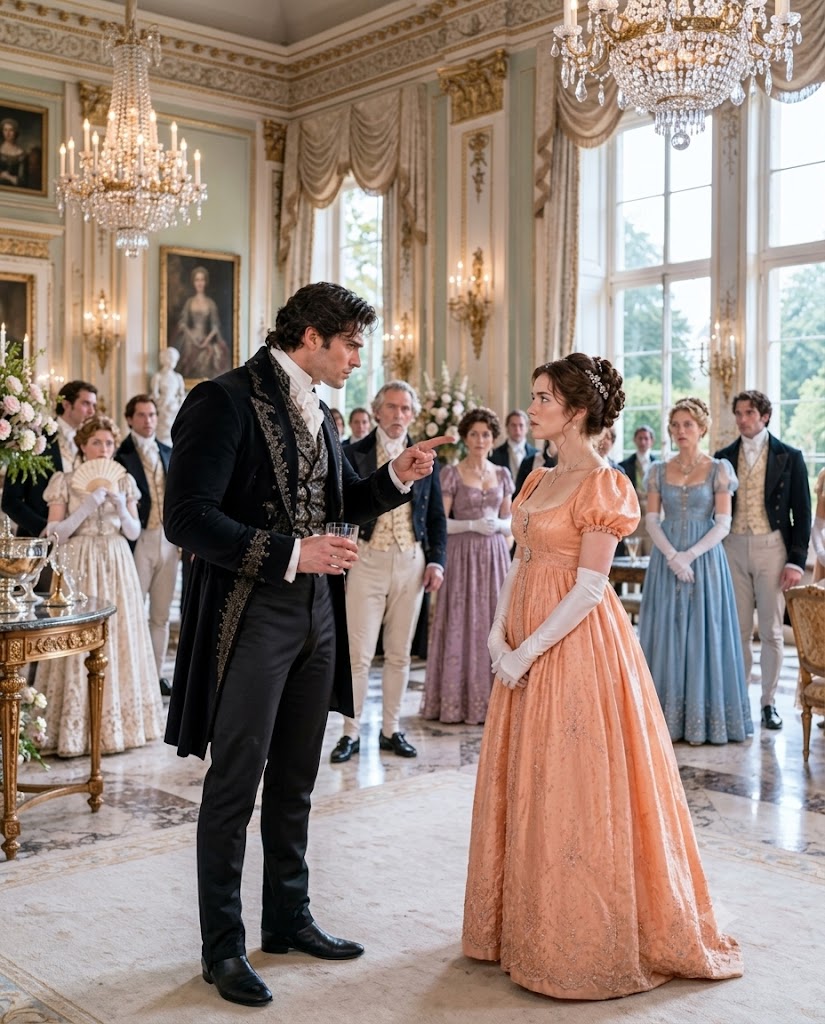
The room went quiet when Diana Hayes walked through the ballroom doors.
The man lifted the envelope between two fingers.
“Your Grace,” he said, “there is something you ought to know about Miss Hayes.”
Gideon did not look at the envelope.
“Then speak.”
The man’s smile returned, thinner this time.
“The name written on this letter is Lord Adrian Vale.”
Diana went cold.
For three years, she had trained herself not to react whenever that name was spoken.
She had failed.
Gideon saw it.
Of course he saw it.
His eyes moved from her face to the envelope.
“Give it to me.”
Lord Vale laughed softly.
“I thought you might say that.”
He extended the letter, but before Gideon could take it, Diana stepped between them.
“No.”
Both men looked at her.
Diana’s fingers tightened around the receipt Gideon had given her.
“Whatever is in that letter,” she said, “it concerns me.”
Lord Vale inclined his head.
“Precisely.”
He handed it to her.
She broke the seal.
Inside was a single sheet of paper.
Three lines.
Three names.
And beneath them, one sentence that made the ballroom seem to tilt beneath her feet.
“Your father did not die in debt. He was murdered to conceal what he discovered.”
Diana stopped breathing.
Gideon reached for the paper.
She pulled it against her chest.
“Diana.”
“No.”
Her voice was barely audible.
“You knew.”
Gideon’s expression hardened.
“Not everything.”
“You knew enough.”
“Yes.”
The answer struck harder than any denial could have.
A murmur spread through the ballroom.
People were watching again.
Diana folded the letter with shaking hands.
“Three years,” she whispered. “You knew something about my father for three years.”
“I knew there were questions surrounding his death.”
“And you said nothing.”
“I tried to find proof.”
“You could have told me.”
“I could not prove it.”
Her eyes flashed.
“So you decided I was better off living a lie?”
“No.”
Gideon’s voice dropped.
“I decided you were safer alive than informed.”
The orchestra stopped.
Not gradually.
All at once.
A silence fell over the ballroom.
Then Lord Vale smiled.
“That is the trouble with powerful men, Miss Hayes. They mistake secrecy for protection.”
Gideon turned toward him.
“You have five seconds to tell me why you brought this here.”
Vale’s smile vanished.
“Because tonight is the last night Miss Hayes is safe.”
A glass shattered somewhere behind them.
Diana looked toward the doors.
Two unfamiliar men stood there.
Not guests.
Their coats were too plain.
Their posture too rigid.
And both had their hands inside their jackets.
Gideon saw them at the same moment.
“Diana, behind me.”
She did not argue.
A gunshot cracked through the ballroom.
Guests screamed.
Gideon caught Diana around the waist and pulled her down as the bullet struck the marble pillar behind them.
Chaos exploded.
Chairs overturned.
Women cried out.
Men shoved toward the exits.
Someone knocked over a table of champagne glasses.
Diana’s cheek pressed against the cold floor.
Gideon’s body covered hers.
“Stay down.”
“I can move.”
“I know.”
Another shot.
This one struck the chandelier.
Glass rained from above.
Gideon dragged her toward the shadow beneath the musicians’ platform.
Lord Vale disappeared into the crowd.
“Where is he going?” Diana demanded.
“Not our concern.”
“It is if he has the evidence.”
Gideon looked at her.
For the first time that evening, something like admiration crossed his face.
“You really have not changed.”
“Neither have you.”
A faint smile touched his mouth.
Then he stood.
“Stay here.”
She caught his sleeve.
“Don’t you dare.”
He looked down at her hand.
“You just told me I don’t own your life.”
“I did.”
“Then trust me with it.”
Before she could answer, he was gone.
Diana remained beneath the platform for exactly three seconds.
Then she crawled toward the side door.
She had spent three years being protected by silence.
She had no intention of dying because of it.
The corridor beyond the ballroom was empty.
She ran.
Behind her, men shouted.
A door slammed.
Then came another gunshot.
Diana reached the staircase.
Someone seized her wrist.
She spun.
Lord Vale stood there.
“Come with me.”
She tried to pull free.
“Let go.”
“If you stay here, Westmore will bury the truth.”
“I don’t trust you.”
“You shouldn’t.”
The honesty stopped her.
Vale released her.
“My carriage is waiting.”
“Why help me?”
His expression changed.
“Because your father once saved my life.”
Diana stared at him.
“He never told me.”
“He would not.”
“Why?”
“Because your father was a better man than either of us.”
A shout echoed from the corridor.
Vale looked over his shoulder.
“They are coming.”
Diana hesitated.
Then she heard Gideon’s voice.
“Diana!”
She turned.
Gideon appeared at the end of the corridor.
His coat was torn.
Blood darkened his sleeve.
His eyes locked onto Vale.
“Step away from her.”
Vale laughed bitterly.
“You still think every road leads back to you, Westmore.”
“It does tonight.”
Diana stepped between them.
“Enough.”
Both men stopped.
She held up the letter.
“I am done being moved around like a piece on a chessboard.”
Gideon looked at her.
“What do you want?”
“The truth.”
“Then we leave now.”
“Together?”
“Yes.”
Vale shook his head.
“No. Not together.”
Gideon turned.
“Explain.”
Vale looked at Diana.
“The men who attacked the ballroom were not after you.”
Diana frowned.
“They were after this.”
He pointed at the letter.
“What?”
“Your father left something else.”
Diana’s heart began to pound.
“Where?”
Vale looked at Gideon.
“Ask him.”
Gideon said nothing.
Diana stared at him.
“Gideon.”
His silence answered before his words did.
“Your father left a ledger.”
Her stomach tightened.
“You have it.”
“Yes.”
“Where?”
“In my estate.”
“Then take me there.”
“It’s not safe.”
“Neither is staying here.”
Gideon looked toward the ballroom.
He knew she was right.
Five minutes later, they were in his carriage.
Lord Vale rode ahead.
The city blurred beyond the rain-streaked windows.
Diana sat opposite Gideon.
Neither spoke.
Finally, she said, “Tell me everything.”
Gideon looked out into the darkness.
“Your father discovered that several noble families were secretly diverting funds from a charitable trust.”
Diana frowned.
“How?”
“Through false invoices.”
“And who was involved?”
“I never found a complete list.”
“You found enough.”
“Yes.”
“Which is why he died.”
Gideon nodded.
“He sent the first portion of the ledger to me.”
Diana stared at him.
“When?”
“The night before he died.”
“And you never told me?”
“I was twenty-eight. Arrogant. Certain I could handle it alone.”
“You failed.”
“Yes.”
The simple admission disarmed her.
Gideon continued.
“Your father knew someone close to him had betrayed him. He asked me to protect you if anything happened.”
Diana’s voice cracked.
“He asked you.”
“Yes.”
“And you did?”
“I tried.”
She looked away.
“You failed there too.”
“I know.”
Rain struck the carriage roof.
For a long time, only that sound remained.
Then Diana whispered, “Why did you leave me?”
Gideon’s face tightened.
“Because I believed the people responsible for your father’s death were watching you.”
“That doesn’t answer me.”
“No.”
He turned toward her.
“I left because I loved you.”
Her breath stopped.
Three years.
Three years of anger.
Three years of believing he had abandoned her because she was not worth staying for.
Gideon looked down at his hands.
“And because I loved you, I became afraid of what would happen if they discovered how much you meant to me.”
Diana’s eyes filled with tears.
“You should have told me.”
“I was a coward.”
The carriage stopped.
Gideon opened the door.
They had arrived at Westmore House.
But before Diana could step down, a figure emerged from the shadows.
Lord Vale.
He held a lantern.
“Change of plans.”
Gideon reached for his pistol.
Vale raised one hand.
“Your men have been followed.”
Gideon’s expression darkened.
“How long?”
“Since the ballroom.”
Diana looked behind them.
A carriage stood at the end of the lane.
Then another.
“Where is the ledger?” Vale asked.
Gideon stared at him.
“Safe.”
Vale shook his head.
“No. It isn’t.”
“What do you mean?”
“The men following us know where it is.”
Gideon swore.
Diana stepped down.
“Then we move it.”
“To where?” Gideon asked.
She looked toward the house.
“My father’s study.”
Gideon shook his head.
“They’ll search there first.”
“No.”
Diana pulled the letter from her reticule.
She unfolded it again.
Three names.
One sentence.
Then she noticed something she had missed.
The ink beneath her father’s signature was slightly darker.
A second message had been written beneath the first and concealed beneath a thin layer of wax.
She held it toward the lantern.
Gideon leaned closer.
“There.”
A line appeared.
“Where the first promise was made.”
Diana whispered the words.
Then she remembered.
Her father had once taken her to an abandoned chapel outside the estate.
He had called it the place where he had met her mother.
“The chapel.”
Gideon looked at her.
“Are you certain?”
“Yes.”
They left immediately.
The old chapel stood beyond the western fields.
By the time they arrived, the rain had stopped.
Moonlight broke through the clouds.
The chapel door was unlocked.
Diana entered first.
Dust covered the pews.
Broken stained glass lay scattered across the floor.
At the altar, she saw a small iron box.
Her heart raced.
She knelt.
Inside was the ledger.
But there was something else.
A miniature portrait of her mother.
On the back, written in her father’s handwriting, were six words.
“Forgive me for choosing silence.”
Diana pressed the portrait to her chest.
Then she heard footsteps.
Gideon drew his pistol.
Vale closed the chapel door.
Three men entered through the opposite entrance.
At their center stood a familiar face.
Diana knew him immediately.
Lord Harrington.
A man who had attended her father’s funeral.
A man who had sent flowers every year.
A man who had once told Diana that her father had been “a foolish dreamer.”
Harrington smiled.
“I had hoped the ledger would lead you here.”
Diana stood.
“You killed my father.”
Harrington’s expression did not change.
“He discovered what should never have been discovered.”
Gideon stepped forward.
“You murdered him for money.”
“No.”
Harrington looked at Diana.
“We did it for power.”
The words seemed to echo.
“How many?” Diana asked.
Harrington frowned.
“How many people knew?”
“Enough.”
“How many did you kill?”
He smiled.
“Only those who refused to understand.”
Gideon raised his pistol.
Harrington’s men raised theirs.
“Put it down, Your Grace.”
Gideon did not move.
Diana looked at the ledger.
Then at Harrington.
“You said you hoped the ledger would lead us here.”
“Yes.”
“You made one mistake.”
“What?”
“You assumed I was alone.”
The chapel doors burst open.
Constables rushed inside.
Harrington turned in shock.
Lord Vale stepped forward.
“I told you,” he said quietly, “you should never have underestimated her.”
Harrington’s face went white.
Gideon lowered his pistol.
The fight ended before it began.
Within minutes, Harrington and the others were in custody.
But Diana did not feel victorious.
She stood beside the altar, staring at her father’s handwriting.
Gideon approached slowly.
“It is over.”
She shook her head.
“No.”
He stopped.
“It is only beginning.”
He looked at her.
She held out the ledger.
“This belongs in the hands of people who can expose all of it.”
Gideon nodded.
“And what will you do?”
Diana looked toward the broken window.
For three years, she had lived as though survival were the only thing she could ask from life.
Now she understood something else.
She could choose what came next.
“I will tell the truth.”
The following weeks changed everything.
The ledger was examined by Parliament.
Names were exposed.
Accounts were seized.
Families who had seemed untouchable were suddenly forced to answer questions.
Lord Harrington was tried.
The investigation uncovered more corruption than even Diana had imagined.
Her father’s name was cleared.
But the greatest change happened quietly.
Diana stopped apologizing for surviving.
She sold the gowns Gideon had commissioned.
Every one.
Then she used the money to establish a small workshop for women who, like her, had been left without protection after the deaths or failures of men upon whom society expected them to depend.
She called it Hayes House.
Gideon visited once.
He stood in the doorway while Diana directed six seamstresses around a long table.
“You seem busy.”
She looked up.
“I am.”
“Good.”
He smiled.
She smiled back.
Neither mentioned the past.
Not then.
Later, they walked through the garden.
“You never answered my question,” Gideon said.
“Which one?”
“Whether you trust me.”
Diana stopped.
“I do.”
His face softened.
“But trust isn’t the same as forgiveness.”
“I know.”
“And forgiveness isn’t the same as forgetting.”
“I know that too.”
She looked at him.
“For three years, I thought love meant someone had to save me.”
Gideon said nothing.
“Now I think love means someone can stand beside you while you save yourself.”
He reached for her hand.
Slowly.
Giving her every opportunity to refuse.
She did not.
“I can live with that,” he said.
Diana laughed softly.
“Can you?”
“No.”
She raised an eyebrow.
“I suppose I shall have to learn.”
They continued walking.
Behind them, Hayes House was filled with voices.
Women laughing.
Scissors cutting cloth.
Needles passing through silk.
Lives being rebuilt one careful stitch at a time.
Diana glanced back.
The old gown from the ballroom had been preserved.
She had cut away the damaged seams.
She had kept the fabric.
Not because it reminded her of poverty.
Because it reminded her of the night she stopped believing that being rescued was the same as being loved.
The dress had entered the ballroom torn.
It had left carrying a truth powerful enough to destroy men who believed themselves untouchable.
Diana understood now that broken things were not always ruined things.
Sometimes they were simply waiting for someone brave enough to repair them differently.
And sometimes the person who needed to be saved was not the one standing in the shadows.
Sometimes it was the person who finally stepped into the light.
Years later, when young women came to Hayes House frightened of debt, betrayal, or a future they could not yet imagine, Diana never promised that life would be kind.
She promised something better.
“You are not powerless simply because someone else has power over you.”
She would say it while placing a needle into their hands.
“You may lose money. You may lose a home. You may even lose people you believed would stay forever.”
Then she would look them directly in the eyes.
“But do not surrender the one thing they cannot take unless you give it away.”
“Your choice.”
That became the quiet principle upon which Hayes House was built.
Not rescue.
Not dependence.
Choice.
And whenever Diana remembered the ballroom, the creditor’s letter, the torn seam beneath her fingers, and Gideon standing before her with a receipt that could have made her dependent on him forever, she remembered something else too.
He had paid her debt.
But he had never asked her to become indebted to him.
That distinction mattered.
It was the difference between possession and love.
Between control and protection.
Between being saved and being seen.
Three years after the night in the ballroom, Diana returned to the same hall.
The chandeliers had been replaced.
The walls had been repainted.
The people were different.
She wore no salvaged gown this time.
She wore a dress made at Hayes House.
It was simple.
Elegant.
Perfectly fitted.
As she entered, the room grew quiet for a moment.
Diana smiled.
Not because everyone was watching.
But because she no longer cared whether they were.
Across the ballroom stood Gideon.
He did not cross the room immediately.
He waited.
Diana walked toward him.
“You waited.”
“You once told me you didn’t belong to anyone.”
“I did.”
“I thought I should remember that.”
She smiled.
“I appreciate your progress.”
He offered his hand.
“Dance with me?”
Diana looked at his hand.
Then at his eyes.
“Yes.”
The orchestra began.
They moved onto the floor.
And this time, when the room watched them, Diana did not feel like a woman standing on the edge of ruin.
She felt like a woman who had survived it.
The loose seams had been repaired.
The debts had been paid.
The secrets had been uncovered.
But the greatest thing she had recovered was not her family’s name.
It was herself.
And that, she finally understood, was the one fortune no one could ever take from her.
The music carried them slowly across the ballroom.
For a while, Diana allowed herself to forget everything that had brought her there.
The ledger.
Her father’s death.
The years of silence.
The fear.
The debts.
The night she had entered this room wearing a dress held together by hidden stitches and sheer determination.
That woman seemed very far away now.
Yet, in some strange way, Diana knew she was still a part of her.
She would always be.
The woman who had walked through those doors three years ago had been frightened, angry, and desperate.
But she had walked in anyway.
That mattered.
Gideon’s hand rested lightly against hers.
“You are thinking too much,” he murmured.
Diana glanced up.
“And you are avoiding saying something.”
He smiled.
“I was waiting for the right moment.”
“That has never stopped you before.”
His expression softened.
“No. It hasn’t.”
The music ended.
Applause filled the ballroom.
Gideon did not release her hand immediately.
“Come with me.”
Diana raised an eyebrow.
“Where?”
“Somewhere quieter.”
“I have learned that following you into quiet places usually ends badly.”
A quiet laugh escaped him.
“I deserve that.”
He led her through a side door and into the moonlit garden.
The noise of the ballroom faded behind them.
For several moments, they walked without speaking.
Then Gideon stopped beneath an old oak tree.
“I have something for you.”
Diana looked suspiciously at him.
“If it is another receipt, I may throw it into the fountain.”
“It isn’t.”
He reached inside his coat.
This time, there was no envelope.
No creditor’s seal.
No document bearing the name of some powerful man.
Instead, he produced a small wooden box.
Diana stared at it.
“What is it?”
“Something your father gave me.”
Her breath caught.
Gideon opened the box.
Inside was a silver key.
Diana recognized it immediately.
Her father had worn it on a chain around his neck when she was a child.
“I thought it was lost.”
“So did I.”
She touched it with trembling fingers.
“Where did you find it?”
“In the false bottom of the ledger case.”
Diana looked at him.
“Why didn’t you give it to me before?”
“Because I did not know what it opened.”
“And now?”
“Now I do.”
He placed the key in her palm.
“There is one room in your father’s old office that no one could open after his death.”
Diana’s heart began to beat faster.
“You found another secret?”
“I found a door.”
They returned to Hayes House before dawn.
The old estate was silent.
Diana carried the key herself.
Her father’s study had changed very little since the investigation.
The desk remained.
The books remained.
Even the faint scratch on the floor where her father had once dragged a chair across the room remained.
Gideon walked to the far wall.
He pressed his hand against the wooden panels.
“Here.”
Diana inserted the key.
There was a soft click.
A narrow section of the wall opened.
Behind it was a small room.
No treasure waited inside.
No hidden fortune.
No jewels.
There were only shelves.
Hundreds of letters.
Ledgers.
Names.
Records.
And photographs.
Diana stepped forward slowly.
“What is this?”
Gideon picked up the first ledger.
“Your father’s real work.”
She looked at him.
“What do you mean?”
“He wasn’t merely investigating the people who stole money.”
Gideon opened the book.
“He had been helping the people they stole from.”
Diana turned the pages.
There were names of widows.
Orphans.
Workers.
Families who had lost homes.
Beside each name were amounts of money.
Small amounts.
Sometimes only a few pounds.
But there were hundreds of them.
Her father had been secretly paying debts.
Buying medicine.
Keeping children in school.
Protecting people who could never repay him.
Diana covered her mouth.
“He never told me.”
“He didn’t want praise.”
She turned another page.
Then another.
At the very back was a letter.
Her father’s handwriting.
Diana knew it before she read the first word.
“My dearest Diana,”
Her hands began to shake.
She sat at the desk.
Gideon remained behind her.
The letter was dated three days before her father’s death.
“My dearest Diana,
If you are reading this, then I have failed to return home.
I wish I could tell you that I am sorry for leaving you.
But that would not be enough.
A father should leave his daughter memories of laughter, not questions.
I have spent too much of my life believing that silence could protect the people I love.
I was wrong.
If there is one thing I want you to understand, it is this:
Never measure your worth by what the world is willing to give you.
Money can disappear.
A title can be taken.
A house can burn.
A name can be dragged through the mud.
But character is yours until the day you surrender it.
If I have taught you anything, let it be this.
Do not become hard because the world has been cruel.
Become wiser.
Do not allow fear to make your choices.
And never confuse dependence with love.
If someone stands beside you, let it be because they respect the person you are—not because they wish to own the life you might become.
I have loved you every day of your life.
Even on the days when I was too frightened to say it.
Your father.”
Diana could no longer see the page.
Tears blurred the ink.
She lowered the letter.
For years she had wanted one final conversation with her father.
One explanation.
One apology.
One chance to ask why he had left her alone.
Instead, she had received something better.
His truth.
She pressed the letter against her heart.
Gideon stepped closer.
“Diana.”
She shook her head.
“Don’t.”
He stopped.
She wiped her eyes.
“Just stay.”
So he did.
He stayed.
No promises.
No speeches.
No attempts to make the pain disappear.
He simply stood beside her while she cried.
And perhaps that was the greatest gift he could have given her.
Not an answer.
Not a solution.
Presence.
When the sun rose, Diana walked outside.
The estate gardens were wet with morning dew.
Workers had begun arriving at Hayes House.
One by one, women entered through the doors.
Some carried children.
Some carried sewing baskets.
Some carried nothing at all.
But they came.
Diana watched them.
Gideon stood beside her.
“What will you do with the room?”
She looked back at the house.
“Keep it.”
“For what?”
“For the letters.”
He nodded.
“And the money?”
“What money?”
“The money your father left.”
Diana smiled faintly.
“There isn’t much.”
“There is enough.”
She looked at him.
“You knew?”
“I found the accounts.”
“How much?”
“Enough to change your life.”
Diana considered it.
Then she shook her head.
“No.”
Gideon frowned.
“No?”
“I don’t want my life changed by money.”
“What will you do with it?”
Diana looked toward the women entering Hayes House.
“I’ll change theirs.”
And she did.
The old estate became more than a workshop.
It became a school.
Women learned accounting.
Reading.
Business.
Dressmaking.
Bookkeeping.
Some learned how to negotiate contracts.
Some learned how to manage money.
Some simply learned how to sign their own names.
Diana insisted upon that.
Every woman who entered Hayes House had to learn to write her name.
“It is a small thing,” one woman said.
“No,” Diana replied.
“It is the beginning of everything.”
Years passed.
Hayes House grew.
The women who had once arrived frightened eventually left carrying businesses of their own.
A seamstress opened a shop.
A widow became an accountant.
A young girl who had once been unable to read eventually became a teacher.
And every year, on the anniversary of her father’s death, Diana returned to the hidden room.
She read his letter.
Then she opened the door.
She never allowed the room to become a shrine.
It became an archive.
A reminder.
The truth was preserved not so that the dead could be worshipped, but so that the living could learn.
Lord Harrington’s conviction became one of the most discussed scandals of the decade.
His associates lost their titles and fortunes.
Several charitable institutions were reformed.
New safeguards were established.
People began asking questions they had once been too afraid to ask.
But Diana knew better than to believe that one victory could end injustice forever.
There would always be another Harrington.
Another secret.
Another powerful person convinced that ordinary people could be silenced.
That was why she kept the doors of Hayes House open.
One evening, many years later, Diana found a young girl sitting alone on the front steps.
She could not have been more than sixteen.
Her dress was worn.
Her shoes were soaked through.
Diana sat beside her.
“What is your name?”
The girl hesitated.
“Eleanor.”
“Why are you here, Eleanor?”
“My father says I should marry a man I don’t love.”
Diana was quiet.
“And what do you want?”
The girl looked confused.
“No one has asked me that before.”
Diana smiled.
“Then perhaps it is time someone did.”
The girl began to cry.
Diana did not tell her that everything would be easy.
She did not promise that courage would cost nothing.
Instead, she told her the truth.
“It may be difficult.”
Eleanor wiped her eyes.
“Then what should I do?”
Diana took her hand.
“Learn everything you can.”
“Why?”
“Because knowledge gives you choices.”
She pointed toward the house.
“Money gives you options. Education gives you choices. Courage gives you the strength to use them.”
Eleanor looked at the doors.
“And if I fail?”
Diana smiled.
“Then you learn something and begin again.”
The girl looked at her for a long moment.
“Were you ever afraid?”
Diana laughed softly.
“Every day.”
“You don’t look afraid.”
“That is because fear and courage are not opposites.”
Eleanor frowned.
“What are they, then?”
“Courage is what you do while you are afraid.”
Years later, Eleanor would repeat those words to another frightened girl.
And that girl would repeat them to another.
That was how Diana’s legacy spread.
Not through wealth.
Not through titles.
Not through statues.
Through words passed quietly from one person to another.
Through hands teaching hands.
Through women who had once been told they were powerless learning how to stand.
And Gideon remained beside her through all of it.
Their marriage was not perfect.
There were arguments.
There were misunderstandings.
There were days when Diana wanted independence and Gideon wanted to protect her.
There were days when Gideon made mistakes.
But he learned.
More importantly, he listened.
Whenever they disagreed, Diana remembered the ballroom.
She remembered the receipt.
The torn seam.
The words he had spoken.
You cannot buy my life.
And Gideon remembered too.
So he never tried.
One winter evening, decades after that first night, they sat together by the fire.
Gideon’s hair had turned silver.
Diana’s hands had grown softer from years of work, yet faint scars remained across her fingers from needles and fabric.
She held a cup of tea.
He held a book.
Neither spoke for several minutes.
Then Gideon said, “Do you ever think about that night?”
Diana smiled.
“More often than I admit.”
“What do you remember most?”
She thought about it.
“The dress.”
He laughed.
“Not me?”
“You were difficult to forget.”
“Good.”
She looked into the fire.
“I remember being ashamed of that dress.”
“Why?”
“Because it was torn.”
She paused.
“Now I think that was foolish.”
Gideon closed his book.
“Why?”
“Because the dress wasn’t the thing that was broken.”
He waited.
“I was.”
Then she smiled.
“And I wasn’t broken forever.”
Gideon reached for her hand.
“No.”
His thumb brushed over her knuckles.
“You were becoming someone else.”
Diana looked at him.
“Someone stronger?”
“Someone who no longer needed anyone to tell her who she was.”
She smiled.
“Except you.”
“I was hoping you’d say that.”
She laughed.
Outside, snow covered the gardens.
Inside, the fire burned quietly.
The world had changed around them.
Titles had fallen.
New families had risen.
Old scandals had become history.
People had forgotten the details of the ballroom.
But Diana had never forgotten the lesson.
A person could lose everything and still possess the power to begin again.
She had once believed survival meant holding tightly to whatever remained.
Now she knew survival was sometimes about letting go.
Letting go of resentment.
Letting go of fear.
Letting go of the belief that someone else had to rescue you before you could begin living.
She had not been saved that night.
She had been seen.
There was a difference.
And because someone had finally seen her—not as a poor woman, not as a ruined daughter, not as a debt to be paid, but as a person capable of choosing her own future—she had learned to see others the same way.
That was the true legacy of Hayes House.
Not that Diana Hayes had escaped poverty.
Not that she had married a duke.
Not that her family’s name had been restored.
It was that she had taken the very things that had once been used to control her and turned them into tools for freedom.
The debt became a lesson.
The ledger became a warning.
The torn gown became a symbol.
And the secret room became a place where truth could breathe.
On the final evening of her life, Diana asked to be taken outside.
The garden was quiet.
The stars were bright.
Gideon sat beside her beneath the old oak tree where he had once given her the silver key.
She looked toward the house.
“Do you hear them?”
“Hear what?”
“The laughter.”
He listened.
From inside Hayes House came the distant sound of young women talking.
Someone was playing the piano.
Someone else was laughing too loudly.
Diana smiled.
“It is beautiful.”
“Yes.”
She leaned her head against his shoulder.
“Promise me something.”
“Anything.”
“Don’t let them turn Hayes House into a monument.”
He looked at her.
“What do you mean?”
“Keep it alive.”
He squeezed her hand.
“I will.”
“Good.”
She closed her eyes.
“I don’t want people to remember me as someone who was rescued.”
Gideon’s voice trembled.
“How should they remember you?”
Diana thought for a moment.
Then she whispered,
“As someone who learned how to stand.”
Gideon kissed her forehead.
“You did more than stand.”
She smiled.
“So did you.”
The wind moved gently through the branches.
The lights inside the house glowed warmly against the darkness.
Diana opened her eyes one last time.
She looked toward the windows.
Young women were gathered around a long table.
One was teaching another how to sew.
Another was reading a letter aloud.
Another was writing her name.
Diana watched them.
Then she smiled.
Because she finally understood that a life did not end when the person who lived it disappeared.
A life ended only when everything it had taught was forgotten.
And hers would not be forgotten.
Not because she had been a duchess.
Not because she had survived a scandal.
Not because a powerful man had loved her.
But because she had taken the worst thing that had ever happened to her and refused to let it be the final thing that defined her.
The following morning, the women of Hayes House found the doors already open.
On Diana’s desk was a single sheet of paper.
There were no grand instructions.
No list of rules.
Only one sentence.
“Never let anyone convince you that your circumstances are the same thing as your worth.”
Below it was her name.
Diana Hayes.
And beneath that, in smaller letters:
“Begin again.”
The women read it in silence.
Then one of them opened the windows.
Morning sunlight flooded the room.
The old house filled with light.
And somewhere in the distance, the city began another ordinary day.
But inside Hayes House, nothing was ordinary anymore.
Because every woman who walked through those doors carried a piece of Diana’s courage with her.
Every repaired dress.
Every signed contract.
Every young girl who learned to read.
Every woman who discovered that she could earn her own living.
Every person who finally understood that fear did not have to become destiny.
That was the story Diana left behind.
Not a story about a duke rescuing a woman from ruin.
Not a story about a poor girl becoming a lady.
It was the story of a woman who discovered that the greatest rescue sometimes comes from within.
And that love, when it is real, does not take away your freedom.
It gives you the courage to use it.
The ballroom eventually changed.
The chandeliers gathered dust.
The old families disappeared.
The gowns faded.
The names written in ledgers became history.
But the lesson remained.
A torn seam can be repaired.
A ruined reputation can be rebuilt.
A broken heart can learn to trust again.
A life can begin after the moment you thought it had ended.
And sometimes, the person standing in front of you with nothing left to lose is not at the end of their story.
They are standing at the beginning of it.
Diana had entered that ballroom believing she had nothing left.
She left knowing she still had herself.
And in the end, that was everything.
THE END.