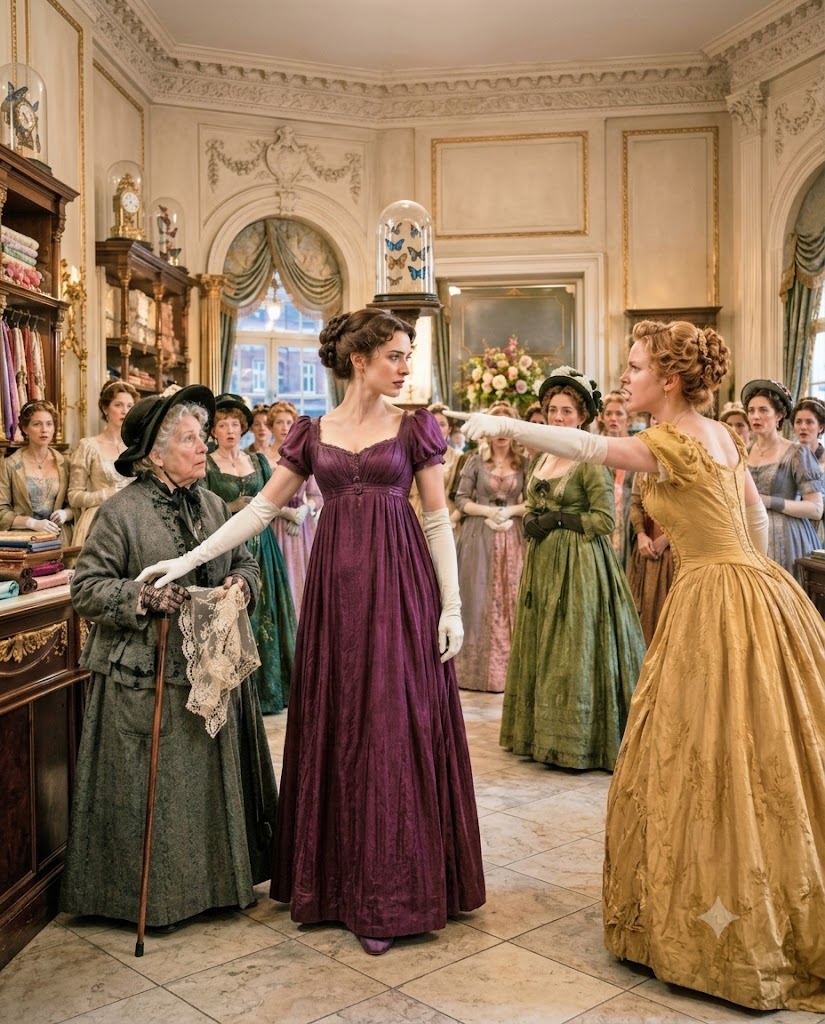
The room went quiet when Beatrice Hastings told the wrong woman to step back.
Leopold offered his hand.
Beatrice looked at it for one long second.
Then she placed her gloved fingers in his.
The orchestra began again.
Around them, silk rustled and diamonds flashed as London pretended not to stare.
Leopold led her onto the dance floor.
“You have my attention,” Beatrice murmured.
“That was not my intention.”
“Then you have failed.”
For the first time that evening, the Duke almost smiled.
They moved beneath the chandeliers, turning slowly among couples who watched them with poorly concealed curiosity.
Beatrice could feel the questions forming behind every fan and every jeweled hand.
Who was she?
Why had the Duke chosen her?
What did the Duchess know?
And, most dangerously, what did any of it have to do with the Hastings family?
“My mother discovered something six months ago,” Leopold said.
“About my family?”
“About your father.”
Beatrice’s steps faltered.
Leopold steadied her without breaking rhythm.
“My father died when I was seventeen.”
“I know.”
“You know very little about him.”
“I know he was accused of taking money from several estates before his death.”
Leopold’s expression hardened.
“That is what London was told.”
“And it wasn’t true?”
“No.”
The music carried them past a group of gentlemen.
Beatrice caught Harriet Finch watching from beside the marble fireplace.
Her face was pale.
She was no longer smiling.
“Then what happened?” Beatrice asked.
“My mother believes your father was framed.”
Beatrice stared at him.
“For what?”
“Fraud.”
The word seemed absurd.
Her father had died disgraced, leaving behind debts so enormous that creditors had taken almost everything the family owned.
Beatrice had spent ten years hearing the same story.
Her father had betrayed his friends.
He had stolen money.
He had ruined himself.
He had ruined them.
And yet now the Duke was telling her that the entire story might have been a lie.
“Why would your mother believe that?”
“Because she found the ledger.”
Beatrice’s breath caught.
“What ledger?”
“The original.”
The music ended.
Applause rose around them.
Leopold did not release her hand.
“Come with me.”
He led her away from the ballroom and through a narrow corridor guarded by two silent footmen.
They entered a small library.
Agatha, Dowager Duchess of Ashborne, was waiting beside the fire.
She had changed from the plain clothing Beatrice had seen three days earlier.
Tonight she wore black velvet and a single strand of pearls.
Yet somehow she seemed more formidable without jewels.
“Sit, Miss Hastings.”
Beatrice remained standing.
“I would rather know why I am here.”
Agatha nodded.
“Good.”
She crossed the room and locked the door.
“My husband died believing your father had betrayed him.”
Beatrice said nothing.
“Your father, Edmund Hastings, was my husband’s closest friend. They built several shipping ventures together. When the company began losing money, my husband blamed Edmund.”
“Because he had evidence.”
“Because someone gave him evidence.”
Agatha opened a drawer.
She removed a leather-bound ledger.
The cover was cracked with age.
Beatrice recognized the initials stamped into the corner.
E.H.
Her father’s initials.
She reached for it.
Agatha did not let go immediately.
“There is something you must understand.”
“What?”
“Your father did not steal the money.”
Beatrice’s eyes burned.
“Then who did?”
Agatha looked toward Leopold.
Then back at her.
“Someone who had access to both families.”
A sound came from the corridor.
Three sharp knocks.
Leopold crossed the room.
He opened the door.
No one was there.
Only a white envelope lay on the carpet.
He picked it up.
His face changed when he saw the seal.
“What is it?” Beatrice asked.
Leopold handed it to his mother.
Agatha opened it.
Inside was a single sheet.
Her fingers trembled.
Beatrice watched her read.
Then the Duchess whispered,
“They know.”
“Who?” Beatrice asked.
Agatha looked at her.
“The people who killed your father.”
The room seemed to lose all warmth.
Beatrice stared at the letter.
“What does it say?”
Agatha passed it to her.
There were only seven words.
STOP DIGGING, OR HISTORY WILL REPEAT ITSELF.
For several seconds, nobody moved.
Then Beatrice folded the paper.
“If they wanted me frightened, they should have chosen someone else.”
Leopold looked at her sharply.
“You don’t understand.”
“No,” she said. “I understand perfectly.”
She placed the letter on the desk.
“Someone has spent ten years making my family believe my father was a criminal. Someone is afraid that the truth will come out.”
Agatha smiled faintly.
“That is precisely why I chose you.”
“Chose me?”
“The lace.”
Beatrice frowned.
“What does a piece of lace have to do with any of this?”
“Everything.”
Agatha opened the ledger.
Between two pages was a tiny strip of ivory lace.
Beatrice recognized it instantly.
It was the same pattern she had purchased at the dressmaker’s shop.
She stepped closer.
“That can’t be.”
“It was sewn into the lining of a document case belonging to your father.”
Leopold leaned against the desk.
“My mother has spent months trying to find the rest of the pattern.”
“Why?”
“Because it was used as a marker.”
Agatha pointed to the ledger.
“Your father and my husband had a code. They marked important documents with pieces of fabric. Each pattern represented a different person.”
Beatrice stared at the lace.
“The ivory pattern?”
“Someone inside the Ashborne household.”
The realization came slowly.
Someone had been helping the thief.
Someone close enough to know about the ledger.
Someone who had survived the scandal.
“Who?” Beatrice asked.
Agatha’s silence answered before her words did.
“Lord William Finch.”
Beatrice’s heart stopped.
“Harriet’s father?”
Agatha nodded.
“William Finch was my husband’s solicitor.”
Beatrice remembered Harriet’s face at the dressmaker’s shop.
The contempt.
The certainty.
The way she had immediately recognized the lace.
“She knew.”
“She may know something,” Leopold said. “That is not the same thing.”
“Then why was she afraid tonight?”
Before anyone could answer, the library door burst open.
A footman stumbled inside.
“Your Grace!”
“What happened?”
“There has been an accident.”
“Where?”
“The east gallery.”
Leopold was already moving.
Beatrice followed.
They reached the gallery to find a crowd gathered around a fallen man.
Harriet Finch stood nearby, one hand pressed to her mouth.
The man on the floor was Lord William Finch.
He was alive.
Barely.
A broken glass lay beside him.
Someone had poisoned his drink.
Leopold knelt beside him.
“Call the physician.”
William’s eyes opened.
He looked at Beatrice.
Not Leopold.
Not Harriet.
Beatrice.
His lips moved.
She bent down.
“What did you say?”
His fingers closed weakly around her wrist.
“The lace…”
Then his eyes rolled back.
Harriet screamed.
The physician arrived within minutes.
Guests were ordered to remain inside.
Doors were locked.
No one was permitted to leave Ashborne House.
The ballroom became a prison.
Whispers turned into accusations.
Beatrice stood at the edge of the gallery while Leopold spoke with the physician.
Harriet approached her.
For once, there was no arrogance in her expression.
Only fear.
“You need to leave,” Harriet whispered.
“I can’t.”
“You don’t understand.”
“I understand that your father tried to tell me something.”
Harriet looked toward the corridor.
“Come with me.”
Beatrice followed her into a servants’ passage.
They stopped beside a narrow window.
“My father has been afraid for years,” Harriet said.
“Of whom?”
“I don’t know.”
“That isn’t true.”
Harriet’s eyes filled with tears.
“He knew your father was innocent.”
“Then why did he say nothing?”
“Because he was guilty too.”
The words struck like a slap.
“He helped them.”
“Who?”
“I never learned their names. My father would disappear for days. He kept letters locked in his office. Once, when I was sixteen, I saw your father’s name on one.”
“What did it say?”
Harriet swallowed.
“Your father had discovered that money was being transferred from Ashborne accounts to a company in France. He wanted to expose it.”
“And your father stopped him.”
Harriet nodded.
“He forged the documents that made it look as though your father had stolen everything.”
Beatrice felt sick.
“Why?”
“Because they threatened me.”
Silence filled the passage.
Harriet wiped her eyes.
“I was seventeen. My father told me that if he refused, I would disappear.”
Beatrice looked at her.
“You could have told someone.”
“Who would have believed me?”
The answer hurt because it was true.
For ten years, nobody had believed Edmund Hastings.
And perhaps that was the real crime.
Not merely the theft.
Not merely the forgery.
But the willingness of respectable people to believe the worst about a man once society had decided he was guilty.
A bell rang from the gallery.
Harriet flinched.
“They’ve found something.”
They hurried back.
The physician had discovered a small metal key inside Lord Finch’s coat.
Leopold took it.
“Where did you find this?”
“In his inner pocket.”
Agatha examined it.
“I know this key.”
“To what?”
“The old Ashborne counting room.”
Leopold’s expression changed.
“That room was sealed after Father’s death.”
“Then someone has opened it recently.”
They moved through the house together.
The counting room was hidden behind a paneled wall on the second floor.
Leopold unlocked it.
The door opened with a groan.
Dust covered the shelves.
Old account books filled the cabinets.
A large desk stood beneath a portrait of Leopold’s father.
Beatrice noticed something on the floor.
Fresh mud.
Someone had been there that night.
She followed the footprints.
They ended at the desk.
One drawer was open.
Inside was an empty velvet-lined box.
Agatha whispered,
“The ledger.”
Beatrice looked around.
“Then someone took it.”
“No,” Leopold said.
He pointed toward the fireplace.
A corner of burnt paper protruded from the ashes.
Beatrice pulled it out carefully.
Only half remained.
But one word was still visible.
HASTINGS.
Another sound came from behind them.
The door slammed shut.
Leopold rushed toward it.
Locked.
Smoke began pouring from beneath the door.
“They’ve set the room on fire.”
Agatha coughed.
Leopold threw his shoulder against the door.
It did not move.
Beatrice looked around desperately.
Then she remembered the old woman’s steady hands in the dressmaker’s shop.
Agatha had not been helpless.
She had been watching.
“Duchess!”
Agatha looked at her.
“Your hairpin.”
Without asking why, Agatha removed it.
Beatrice knelt beside the lock.
Her father had taught her one thing during childhood that society considered unsuitable for a young lady.
How to open a locked drawer without a key.
Three years before his death, he had told her,
“Never assume a locked door means you are not meant to enter.”
She inserted the pin.
The mechanism clicked.
The door opened.
They stumbled into the corridor as smoke poured behind them.
Footmen rushed forward.
Within minutes the fire was extinguished.
Leopold turned to Beatrice.
“You saved us.”
“No.”
She looked at Agatha.
“She did.”
The Duchess gave her a knowing smile.
“Now you understand.”
“Understand what?”
“That appearances are useful weapons.”
Later that night, Beatrice sat alone in the library.
The house had fallen silent.
William Finch was alive but unconscious.
Harriet had refused to leave his side.
The fire had destroyed several old records, but not the entire room.
Leopold entered carrying a small wooden box.
“I found this beneath the desk.”
He placed it before her.
Inside was a letter.
The handwriting was unmistakable.
Her father’s.
Beatrice’s hands shook as she unfolded it.
My dear Beatrice,
If you are reading this, then I failed to tell you the truth while I still could.
Not because I was guilty.
Because I was afraid.
Your mother was already ill. You were young. I believed silence would protect you.
I was wrong.
There are people who have built their fortunes by making honest men look dishonest.
They do not fear the law.
They fear exposure.
The person who betrayed me is someone you have known all your life.
Do not trust a name merely because it is respectable.
Do not trust a title merely because it is inherited.
And above all, do not mistake kindness for weakness.
The letter ended there.
No signature was necessary.
Beatrice pressed it against her chest.
“Someone you have known all your life,” she whispered.
Leopold sat across from her.
“Who?”
“I don’t know.”
A soft knock sounded.
Harriet entered.
She held a small envelope.
“My father woke.”
Beatrice stood.
“What did he say?”
“He asked for you.”
They went upstairs.
William Finch lay pale against the pillows.
When Beatrice entered, his eyes opened.
“I am sorry,” he whispered.
“For what?”
“For what I did to your father.”
“You already told me.”
“No.”
His breathing became shallow.
“You don’t know everything.”
He reached beneath the pillow.
A second key appeared in his hand.
“The person who ordered it…”
He coughed.
“…was not my employer.”
Beatrice leaned closer.
“Who was it?”
William looked at Harriet.
His daughter understood.
She turned away.
“Tell her,” Harriet whispered.
William closed his eyes.
“The Marquess of Bellgrave.”
Beatrice froze.
Bellgrave.
A man she knew.
A man who had attended her father’s funeral.
A man who had sent flowers when her mother died.
A man who had, for ten years, been regarded as one of London’s most honorable patrons.
And a man who was currently standing downstairs.
At Ashborne House.
Beatrice rushed to the gallery.
The Marquess was gone.
So was Leopold.
A servant approached her.
“Your Grace asked me to give you this if he did not return.”
It was the ivory lace.
Beatrice unfolded it.
A tiny note was stitched into the center.
MIDNIGHT. OLD DOCKS. COME ALONE.
She looked toward the clock.
Eleven forty-five.
Harriet caught her arm.
“Don’t go.”
“If Bellgrave has Leopold—”
“You don’t know that.”
“No.”
Beatrice picked up her coat.
“But I know what my father would have done.”
The rain had returned by the time she reached the docks.
Fog rolled across the Thames.
Ships groaned in the darkness.
She walked between warehouses until she saw a lantern.
A man stepped from the shadows.
The Marquess of Bellgrave.
“Miss Hastings.”
“Where is the Duke?”
“Safe.”
“Then let me see him.”
Bellgrave smiled.
“You have your father’s courage.”
“I also have his memory.”
“You have his stubbornness.”
“Tell me why.”
Bellgrave looked toward the river.
“Your father discovered something that would have destroyed half the men who now sit in Parliament.”
“Money?”
“Power.”
He turned.
“Your father believed truth was enough to defeat corruption.”
“And you proved him wrong.”
“I proved him dead.”
Beatrice’s blood ran cold.
“You killed him.”
“I gave the order.”
“Why?”
“Because he would not stop.”
A carriage appeared through the fog.
Leopold stepped out.
His hands were bound.
Beatrice took a step forward.
“Leopold.”
“Don’t.”
Bellgrave raised a pistol.
“He is alive because you came alone.”
Beatrice stared at him.
“You expect me to believe you?”
“No.”
Bellgrave nodded toward Leopold.
“I expect you to believe him.”
Leopold looked at her.
“Beatrice, listen to me.”
“I’m listening.”
“The ledger isn’t in Ashborne House.”
“I know.”
Bellgrave frowned.
Leopold continued.
“Your father hid it before he died.”
Beatrice remembered the letter.
Do not trust a name merely because it is respectable.
Do not trust a title merely because it is inherited.
And then she remembered something else.
The lace.
Her father’s obsession with patterns.
The ivory fabric.
She looked at Bellgrave’s coat.
A small piece of lace was sewn beneath his cuff.
Not ivory.
Black.
A marker.
“Bellgrave,” she whispered.
He smiled.
“You see it now.”
“No.”
Beatrice smiled back.
“I see that you wanted me to see it.”
His expression changed.
She stepped backward.
“You’ve been trying to frighten me all night. The letter. The fire. The meeting here.”
Bellgrave’s eyes narrowed.
“You need to know where the ledger is.”
“Why?”
“Because it proves everything.”
“No.”
She shook her head.
“It proves what you want it to prove.”
Bellgrave raised the pistol.
“You are very clever for a woman who should have stayed in a dressmaker’s shop.”
“And you’re very careless for a man who believes everyone else is stupid.”
A bell rang in the distance.
Bellgrave glanced toward the river.
Beatrice moved.
She kicked the lantern.
Darkness swallowed the dock.
A shot cracked through the fog.
Leopold lunged forward.
Beatrice heard men shouting.
Footsteps thundered across the boards.
Then someone seized her arm.
She almost screamed.
“It’s me.”
Leopold.
He had freed himself.
“How?”
“Your lace.”
“What?”
“The pin hidden inside it.”
He held up a tiny metal pin.
“The same kind you used on the counting-room door.”
Beatrice almost laughed.
“Your mother planned this.”
“Yes.”
“Where is Bellgrave?”
“Gone.”
A second voice came from behind them.
“No.”
Agatha stepped from the fog.
“He isn’t.”
Bellgrave emerged between two warehouses.
But this time he was surrounded.
Police officers closed in from every side.
Behind them stood Harriet.
And beside her was William Finch, supported by two men.
Bellgrave stared at them.
“You cannot prove anything.”
William raised his voice.
“I can.”
He held up the missing ledger.
Bellgrave’s face collapsed.
“How?”
William looked at Beatrice.
“Your father trusted me once.”
“I thought you betrayed him.”
“I did.”
His voice broke.
“But I kept one thing.”
He opened the ledger.
Inside were names.
Dates.
Payments.
Signatures.
And Bellgrave’s seal.
The evidence was enough.
For the first time, the Marquess looked afraid.
Not because of the police.
Because his name could no longer protect him.
Months later, London changed its story.
Edmund Hastings was officially cleared.
The money was traced.
The companies were exposed.
Several men resigned from positions they had once believed untouchable.
Lord Finch confessed publicly to his part in the forgery.
He was not forgiven immediately.
Neither did he ask to be.
Harriet left London for a time.
She said she needed to learn who she was without her father’s reputation defining her.
Agatha returned to Ashborne House.
But she no longer wore plain dresses when she walked through the city.
Beatrice sometimes laughed about that.
“You were never poor,” she told her.
“No,” Agatha replied. “But sometimes people only listen when they think you have nothing.”
As for Leopold, he became less reclusive.
Not because he suddenly enjoyed society.
But because he had learned that silence could protect a secret as easily as it could protect a person.
One spring afternoon, months after the night at the docks, Beatrice returned to the dressmaker’s shop.
The same rain tapped against the windows.
The same ivory lace hung beneath the lamps.
The shopkeeper smiled when she entered.
“You came back.”
“I did.”
Beatrice touched the lace.
“Still expensive?”
The shopkeeper laughed.
“More than ever.”
Beatrice bought it anyway.
Outside, a carriage waited.
Leopold stepped down.
“You took your time.”
“I was negotiating.”
“For lace?”
“For something more important.”
He offered his hand.
She took it.
“What?”
“Whether I should forgive the world for being exactly what it is.”
Leopold looked at her.
“And?”
“I decided I don’t have to forgive it.”
She glanced at the busy street.
“I only have to decide what kind of person I will be in it.”
He smiled.
“That sounds like my mother.”
“I’ll take that as a compliment.”
“It was meant to be.”
They walked together through the rain.
Beatrice no longer cared who watched.
She had learned that courage was not the absence of fear.
It was refusing to let fear make your choices.
She had learned that respectability could hide cruelty, while worn gloves could conceal extraordinary strength.
Most of all, she had learned that a person’s worth was never determined by the room they entered, the clothes they wore, or the name written above their door.
Sometimes the person everyone ignored was the one who knew where the truth was buried.
And sometimes the woman everyone expected to step back was the very woman who would stand still long enough to change everything.
Years later, when people told the story of the Hastings scandal, they remembered the Duke, the Marquess, the missing ledger, and the mysterious ivory lace.
But Beatrice remembered something simpler.
An old woman standing quietly in a dressmaker’s shop.
A cruel voice telling her to step back.
And one small choice to say,
“That’s enough.”
Because history was rarely changed by the people who believed they had the most power.
Sometimes it changed because someone ordinary decided that another human being deserved dignity.
Sometimes truth survived because one person refused to look away.
And sometimes, all it took to begin changing an entire world was the courage to defend someone who seemed to have nothing to give you in return.
The lace became a family heirloom.
Beatrice kept it in a small wooden box beside her father’s letters.
She never wore it.
She didn’t need to.
Whenever she opened the box, she remembered the lesson it had taught her:
Never measure a person by what the world can see.
Never confuse silence with weakness.
And never assume that because a door is guarded, you are not meant to find out what lies behind it.
Outside, London continued to rain.
Carriages rolled over wet stones.
Chimneys breathed smoke into the gray sky.
People hurried past one another, each carrying secrets the city knew nothing about.
And somewhere among them, Beatrice walked with her head held high.
Not because she had become powerful.
But because she had finally understood something far more valuable.
She no longer needed the world to tell her who she was.
She knew.
THE END.