The room was full of eligible gentlemen.
The clause he left unexplained was written in a hand Beatrice did not recognize.
She read it twice.
Then a third time.
“If either party is threatened by the consequences of this marriage, the other shall retain the right to act independently, without interference from family, title, fortune, or public expectation.”
Beatrice lifted her eyes.
“What does that mean?”
Arthur did not answer immediately.
Instead, he closed the door behind him.
“It means,” he said quietly, “that if you marry me, no one—not my mother, not Parliament, not society, not even I—will own your decisions.”
“That is a remarkable promise from a duke.”
“It is not a promise.”
His expression hardened.
“It is a condition.”
Beatrice looked back at the paper.
“And the threat?”
Arthur crossed the room.
“There is a man who believes my title belongs to him.”
Her fingers tightened around the document.
“Your cousin?”
“Edward Vale.”
She knew the name.
Everyone did.
Lord Edward Vale was the son of Arthur’s late uncle, and for years he had behaved as though the dukedom had merely been waiting for him to inherit it.
“But you are the Duke of Rothsay.”
“I am.”
“And he cannot simply take your title.”
“No.”
Arthur paused.
“Not legally.”
The words chilled her.
Beatrice lowered the paper.
“What has he done?”
Arthur looked toward the window.
“Three months ago, my father died suddenly. Before his funeral, Edward approached me with a letter. He claimed my father had left instructions that would alter the succession.”
“Was there such a document?”
“I thought there was.”
“And now?”
“Now I believe Edward forged it.”
Beatrice stared at him.
“Then why not expose him?”
“Because the original document disappeared.”
Silence filled the library.
“And you think I can help you find it?”
“I think you can help me survive long enough to find it.”
She almost laughed, but his face stopped her.
“You came here to ask me to become your wife so that your enemies would believe you have secured an alliance?”
“No.”
“Then why me?”
Arthur finally looked directly at her.
“Because you are the only woman in London who has looked at my title and asked what it costs.”
Something inside her shifted.
She remembered the ballroom.
The silence after their dance.
Her aunt’s frozen face.
The way Arthur had held her hand as though the entire room could disappear and it would make no difference.
“You could marry a wealthy woman,” Beatrice said.
“I could.”
“A woman with powerful relatives.”
“Yes.”
“Someone who would make Edward afraid.”
Arthur’s jaw tightened.
“I do not want someone Edward can control.”
“And you believe he cannot control me?”
“I know he has already tried.”
Beatrice went still.
“What?”
Arthur reached into his coat and placed a second envelope on the desk.
She recognized the handwriting immediately.
It was addressed to her.
Her hands trembled as she opened it.
Inside was a single sheet.
Miss Hayes,
You have been noticed.
You are advised to reconsider your association with the Duke of Rothsay.
Some doors close permanently once opened.
Beatrice read it twice.
Then she looked up.
“When did you receive this?”
“I didn’t.”
“You did not?”
“It was delivered to my solicitor yesterday.”
Arthur’s eyes were cold.
“He wanted me to know that you had become a target.”
A long silence followed.
Beatrice folded the letter.
“You should have told me.”
“I know.”
“Before asking me to marry you.”
“Yes.”
“Why didn’t you?”
“Because I wanted one conversation in which you were not frightened into saying yes.”
That answer struck her harder than any grand declaration could have.
She placed the letter beside the contract.
“Suppose I refuse.”
Arthur’s face did not change.
“Then I leave.”
“And Edward?”
“I deal with him.”
“Alone?”
“Yes.”
She studied him.
“And if I accept?”
“Then I tell you everything.”
“Everything?”
“Everything.”
Beatrice looked at the clause again.
For the first time, she understood why he had written it.
He was not asking her to surrender herself to a duke.
He was offering her a place beside a man who expected war.
She should have refused.
Instead, she dipped the pen into the ink.
“I will marry you.”
Arthur exhaled slowly.
“But I have conditions.”
His eyebrows lifted.
“Of course you do.”
“I keep my own money.”
“Agreed.”
“I keep my own correspondence.”
“Agreed.”
“I will not be displayed at your side like a jeweled possession.”
“Agreed.”
“And if I discover you have lied to me about anything concerning this matter, I walk away.”
Arthur stepped closer.
“Agreed.”
She signed.
He signed beneath her.
Neither of them noticed the shadow outside the window.
But someone had been watching.
And by midnight, Edward Vale knew the duke had found his greatest weakness.
Not the woman.
The trust between them.
The wedding took place twelve days later.
There were no trumpets.
No lavish procession.
No crowded church filled with London society.
Arthur insisted upon a small ceremony in a quiet chapel outside the city.
Beatrice wore ivory.
Arthur wore black.
When the priest asked whether she accepted him, she looked at Arthur.
He did not smile.
He did not need to.
“Yes,” she said.
His fingers closed around hers.
“I do.”
For one brief moment, the danger disappeared.
Then the church doors opened.
A messenger stood outside.
Arthur read the telegram.
His expression changed.
“What is it?” Beatrice asked.
“My solicitor has found the first piece of the missing document.”
“Where?”
Arthur folded the message.
“At Rothsay House.”
They returned to London that evening.
Rothsay House was enormous, imposing, and strangely silent.
Beatrice understood immediately why Arthur had never described it as home.
It felt more like a fortress built by generations of men who had trusted stone more than people.
His mother, the Dowager Duchess, met them in the entrance hall.
She looked at Beatrice with undisguised disappointment.
“So,” she said, “this is the solution.”
Beatrice held her ground.
“I am not a solution, Your Grace.”
Arthur glanced at her.
His mother noticed.
Something flickered in her eyes.
“You have married a woman who speaks before she is spoken to.”
“I have married the woman I chose,” Arthur replied.
The dowager’s face hardened.
“Then pray your choice survives the consequences.”
She turned and walked away.
Beatrice watched her disappear.
“She dislikes me.”
“She dislikes uncertainty.”
“And I am uncertain?”
“You are uncontrollable.”
Beatrice looked at him.
“Is that a compliment?”
“It is the highest one I possess.”
That night, they searched Arthur’s father’s study.
The room had been untouched since the old duke’s death.
Books covered the walls.
A great oak desk stood beneath the portrait of Arthur’s grandfather.
Beatrice examined the shelves while Arthur searched the drawers.
Hours passed.
Nothing.
Then she noticed something strange.
One portrait hung slightly lower than the others.
“Arthur.”
He crossed the room.
Together they moved the frame.
Behind it was a narrow compartment.
Inside lay a leather-bound ledger.
Arthur opened it.
Most of the pages contained household accounts.
Near the back, however, was a handwritten note.
If the succession is challenged, trust the woman who asks why.
Beatrice felt the blood leave her face.
Arthur read it again.
“My father knew.”
“He knew Edward would challenge you?”
“Perhaps.”
“There must be more.”
They searched the compartment.
At the bottom was a brass key.
Engraved on it were three letters.
M.C.R.
“What does that mean?” Beatrice asked.
Arthur stared at it.
“Mother’s Country Residence.”
“Your mother has a country estate?”
“Yes.”
“Then why hide a key there?”
Arthur’s expression darkened.
“Because my mother has never admitted knowing about it.”
Before they could leave, footsteps sounded in the corridor.
Arthur extinguished the lamp.
The door opened.
A figure stepped inside.
Edward Vale.
Beatrice’s heart slammed against her ribs.
Edward looked around the dark room.
Then he smiled.
“I wondered when you would find that.”
Arthur stepped from the shadows.
“How did you get in?”
“I have always had a key.”
“To my father’s study?”
“To this house.”
Edward’s smile disappeared.
“You have no idea how many people inside this family have been waiting for you to fail.”
Arthur moved closer.
“Then perhaps you should tell them they have failed first.”
Edward looked at Beatrice.
“Your wife is brave.”
“She is.”
“Bravery is often mistaken for intelligence.”
Beatrice stepped forward.
“And arrogance is often mistaken for power.”
Edward’s eyes narrowed.
Arthur almost smiled.
Edward left without another word.
The moment the door closed, Arthur turned to her.
“You should not provoke him.”
“He came into our house.”
“Our house?”
The words slipped out.
Arthur stared at her.
Beatrice realized what she had said.
Something softened in his expression.
“Yes,” he said.
“Our house.”
The next morning, they left for the country estate.
The journey was long.
Neither spoke much.
But somewhere between London and the gray hills of Rothsay land, Beatrice realized something had changed.
She no longer felt like a woman who had entered a stranger’s life.
She felt like someone defending her own.
The estate stood beside a lake surrounded by ancient trees.
Arthur’s mother was already there.
She was waiting.
“You should not have come,” she said.
Arthur held up the brass key.
“You know what this opens.”
The dowager stared at it.
Then she closed her eyes.
“Yes.”
Beatrice felt Arthur stiffen.
“What is it?” he asked.
“A room your father built beneath the old chapel.”
“Why?”
“To protect the family papers.”
“From whom?”
She looked at him.
“From your uncle.”
Arthur went silent.
“My father knew Edward was dangerous,” she continued. “But he did not trust the law to protect you.”
“Then why did you keep this from me?”
“Because I was afraid.”
Arthur’s expression changed.
“Of Edward?”
“Of what would happen if you challenged him.”
The dowager looked at Beatrice.
“And now I fear you have both walked into something that cannot be undone.”
That night, they opened the hidden room.
Inside were boxes of letters, legal records, and sealed envelopes.
Arthur searched desperately.
Beatrice read each document.
Then she found a letter signed by Arthur’s father.
My son,
If you are reading this, Edward has already begun his attempt to take the dukedom.
Do not fight him with anger.
Fight him with truth.
The evidence is divided between three places.
One beneath the chapel.
One in my study.
And one entrusted to the person I trusted most.
Arthur frowned.
“The third.”
Beatrice looked at the dowager.
She was crying.
“I was the person,” she whispered.
“Where is it?”
“I gave it away.”
“To whom?”
The dowager’s face broke.
“To Edward.”
Arthur stepped backward.
For several seconds, no one moved.
Then he laughed once.
Not with humor.
With disbelief.
“You gave him the evidence?”
“I believed he would leave you alone.”
“He threatened you.”
“Yes.”
“And you gave him what he wanted.”
“I gave him copies.”
Beatrice looked up.
“Copies?”
The dowager nodded.
“The originals were never with me.”
“Where are they?”
She looked at Beatrice.
“Your father.”
Beatrice froze.
“My father?”
“He was your husband’s father’s solicitor.”
Arthur turned toward her.
“You never told me.”
“I didn’t know,” Beatrice whispered.
Her father had died six years earlier.
She remembered his study.
His locked desk.
The strange insistence that no one touch the bottom drawer.
Arthur understood at the same time.
“Your father’s papers.”
They returned to London before dawn.
Beatrice’s old home had been sold after her father’s death.
The new owner allowed them to search the study.
They found the desk in an attic.
The bottom drawer had no keyhole.
Arthur examined it.
“Secret mechanism.”
Beatrice remembered something.
“My father used to say that every honest man should keep one secret drawer.”
She pressed the carved rose on the side.
A click sounded.
The drawer opened.
Inside was a sealed packet.
Arthur broke the seal.
Documents spilled across the desk.
The first was a copy of the succession agreement.
The second was a letter from Arthur’s uncle admitting that he had planned to forge the disputed document.
The third was a statement signed by three witnesses.
Edward had known.
He had known everything.
But there was one problem.
The witnesses were dead.
The letters could be challenged.
And Edward had already prepared his final move.
That evening, Parliament was to hear the succession dispute.
If Edward presented his forged document first, Arthur’s claim could be suspended until an investigation was completed.
And during that investigation, Edward would become acting administrator of the Rothsay estate.
He would control everything.
Arthur looked at Beatrice.
“We have one night.”
“No,” she said.
“We have one truth.”
He stared at her.
“We need proof Edward cannot destroy.”
Beatrice looked at the letters.
Then she remembered his words.
Your wife is brave.
She understood.
Edward believed her greatest weakness was that she loved Arthur.
He did not know she had learned how to think like his enemy.
“Arthur,” she said, “we don’t need to prove the document is false.”
“What?”
“We need to make Edward prove it himself.”
They prepared a trap.
A rumor was leaked that another copy of the succession document had been found.
Edward took the bait.
He came to Rothsay House that night.
He entered through the west corridor.
He found Beatrice alone in the library.
“You should have left London,” he said.
She closed the book in her hands.
“You first.”
His smile was thin.
“You think marriage has made you powerful.”
“No.”
“It has made you visible.”
“So has your desperation.”
His eyes hardened.
“Where is the document?”
Beatrice deliberately hesitated.
“Which one?”
“The original.”
“You mean the one you forged?”
For the first time, Edward’s composure cracked.
“You have no proof.”
“I don’t need proof.”
She stepped closer.
“I only need you to keep talking.”
Edward suddenly realized the room was not empty.
Behind the curtain stood Arthur.
And beside him were two solicitors and a magistrate.
Edward’s face drained of color.
“You planned this.”
“No,” Arthur said.
“She did.”
Beatrice felt his eyes on her.
Edward laughed bitterly.
“You think this changes anything?”
He reached inside his coat.
Arthur stepped forward.
Edward pulled out a folded paper.
“This is the original.”
He threw it onto the table.
“And it proves I am the rightful heir.”
Beatrice looked at the document.
Then she smiled.
“Thank you.”
Edward froze.
Arthur picked it up.
The magistrate examined it.
One of the solicitors compared the seal to the preserved seal from Arthur’s father’s office.
It matched.
Too perfectly.
Beatrice pointed to the signature.
“Ask him why the ink is wrong.”
Edward stared at her.
The solicitor bent over the page.
“The duke used iron-gall ink,” he said slowly. “This is modern compound ink.”
Edward’s face changed.
The magistrate looked at him.
“Lord Vale, where did you obtain this?”
Edward said nothing.
Arthur’s voice was quiet.
“Tell them.”
Still nothing.
Then Edward lunged for the papers.
Arthur caught his wrist.
For one violent second, the two men struggled.
Edward drew a small knife.
Beatrice screamed.
Arthur turned.
The blade flashed.
Edward stumbled backward.
He struck the edge of the desk and fell.
The knife clattered across the floor.
Silence followed.
Edward was breathing.
Arthur was bleeding from his arm.
Beatrice ran to him.
“It is nothing,” he said.
“You’re bleeding.”
“I’ve survived worse.”
“That doesn’t make it nothing.”
His eyes found hers.
And suddenly the entire room disappeared.
Not the title.
Not the inheritance.
Not Parliament.
Just the woman standing in front of him with tears in her eyes.
Edward was arrested before midnight.
The succession dispute ended three weeks later.
The evidence was overwhelming.
Edward’s forged document was exposed.
The letters were authenticated.
The witnesses’ statements were accepted alongside the supporting records.
Arthur remained Duke of Rothsay.
But he did something no one expected.
He gave up control of several estates to charitable trusts.
He sold the townhouse his family had used for generations and established a school for girls who had no fortune and no family connections.
When Beatrice asked why, he told her the truth.
“I spent my whole life believing power meant never needing anyone.”
“And now?”
“Now I think power is being able to stand beside someone without needing to stand above them.”
Months passed.
London eventually found another scandal to discuss.
The ballroom whispers faded.
The invitations returned.
The marriage hunters came again.
But Beatrice no longer hid behind the gallery railing.
One spring evening, she stood beside Arthur at a crowded reception.
Music filled the room.
The same polished floors.
The same glittering glasses.
The same people who had once believed a woman like her had no place beside a duke.
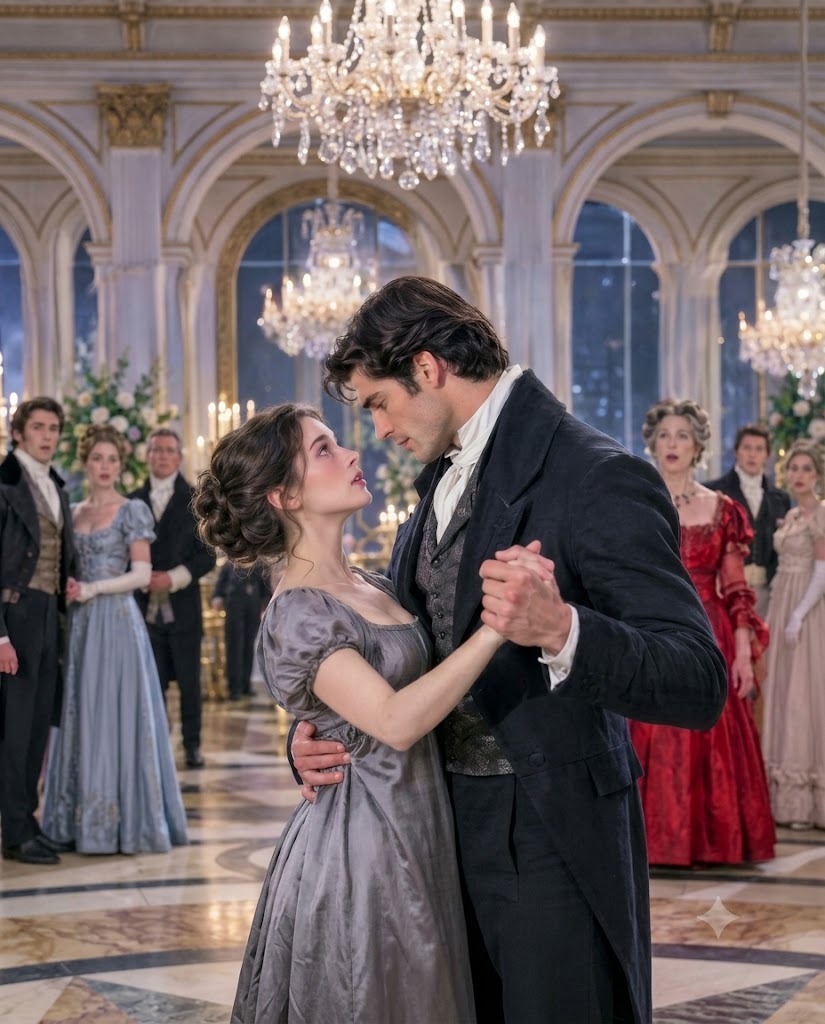
Arthur extended his hand.
“Dance with me.”
She smiled.
“You know what happened the last time.”
“I remember.”
“And you still want to?”
“More than ever.”
She placed her hand in his.
They stepped onto the floor.
This time, no one went silent.
No one dared.
But Beatrice noticed something else.
Arthur was no longer looking at the room.
He was looking only at her.
“You know,” she whispered, “I once thought the worst thing that could happen to me was being noticed.”
“And now?”
She looked around at the world she had entered and changed.
“Now I think the worst thing would have been never speaking when I had something worth saying.”
Arthur’s fingers tightened gently around hers.
“That is why I chose you.”
“No,” Beatrice said.
“You chose me because I asked questions.”
He smiled.
“And you stayed because I answered them.”
She laughed.
“Eventually.”
“Eventually.”
They continued to dance.
Outside, London moved beneath the spring moon.
The titles remained.
The wealth remained.
The expectations remained.
But the thing that had begun with a glance from a ballroom gallery had become something neither of them had expected.
Not a rescue.
Not a bargain.
Not a marriage built on fear.
A partnership.
Beatrice had entered Arthur’s world believing she needed protection from it.
Arthur had entered hers believing he needed someone he could trust.
Both had been wrong.
What they needed was not protection from the world, but the courage to face it together.
Years later, when people asked Beatrice how she had become a duchess, she never told them about the ballroom first.
She told them about the contract.
About the clause.
About the condition that had seemed strange at the time.
She would live beside him as his equal.
And whenever someone asked why that mattered, she gave the same answer.
“Because love that demands surrender is only another kind of captivity.”
Then she would smile.
“And the greatest promise two people can make is not that they will never face danger. It is that neither will ask the other to disappear in order to survive it.”
That was the lesson Beatrice carried for the rest of her life.
A title could open doors.
Money could build walls.
Power could silence a room.
But none of those things could create trust.
Trust had to be chosen.
Again and again.
Especially when choosing it was dangerous.
And sometimes, the person standing quietly above the crowd was not waiting to be rescued at all.
She was waiting for someone brave enough to see her clearly.
The years that followed were gentler than the years that had come before.
But they were not without storms.
Beatrice learned that happiness did not mean the absence of trouble.
It meant knowing where to stand when trouble arrived.
And Arthur learned that a man could spend his entire life protecting a title and still fail to protect the person who mattered most.
Their marriage became the subject of countless stories.
Some called it unusual.
Some called it reckless.
Others insisted that Beatrice had married Arthur for his fortune, while others whispered that Arthur had married her because he needed a clever woman to manage the affairs of his estate.
Neither explanation was true.
The truth was far less convenient.
They had chosen each other.
And neither of them had ever been very good at making convenient choices.
Three years after their wedding, Beatrice received a letter that changed everything.
It arrived on a rainy November morning.
She was sitting in the library, sorting through letters from the school she and Arthur had established, when a servant entered carrying a sealed envelope.
“There is no sender, Your Grace.”
Beatrice looked at the seal.
Her heart stopped.
It was the same black wax Edward Vale had used years ago.
For several seconds, she simply stared at it.
Arthur noticed immediately.
“What is it?”
“I don’t know.”
She opened the envelope.
Inside was a single sheet.
Your Grace,
You believed the danger ended when Edward was imprisoned.
It did not.
Your husband’s father left something else behind.
Something that should never have been found.
If you want the truth, return to the place where your marriage began.
There was no signature.
Arthur read the message.
“The ballroom.”
Beatrice nodded.
“The gallery.”
He looked at her.
“You don’t have to go.”
“I know.”
“And you still want to?”
“Yes.”
Arthur reached for his coat.
“Then I’m coming.”
They returned to the old ballroom that evening.
It had been years since Beatrice had stood behind the carved railing.
The house belonged to another family now, but the new owners allowed them inside after Arthur explained the circumstances.
The ballroom looked smaller than she remembered.
Perhaps because she was no longer the frightened young woman hiding above a room full of strangers.
They climbed the stairs to the gallery.
Beatrice ran her fingers along the carved railing.
“This is where I first saw you.”
“I remember.”
“You were staring.”
“You were hiding.”
“I had good reason.”
Arthur smiled.
“Perhaps.”
She examined the wood.
Then she noticed something.
A small carving of a rose.
The same symbol her father had used on his secret drawer.
“Arthur.”
He came closer.
She pressed the carving.
Nothing happened.
She pressed it again.
A narrow section of the railing shifted.
Behind it was a small metal compartment.
Inside lay a leather pouch.
Arthur opened it.
There was an old key.
And beneath it, another letter.
Arthur unfolded the paper.
The handwriting belonged to his father.
My son,
If you have found this, then the first danger has passed.
But I left one final truth hidden because I feared what would happen if it were known while I lived.
The fortune of Rothsay was never built solely upon the estates.
One generation before me, our family acquired land through an agreement that was later proven fraudulent.
The rightful heirs were dispossessed.
I spent years trying to correct the injustice without destroying the people who depended upon those estates.
I failed.
Arthur read the final paragraph in silence.
Beatrice took the letter from him.
There was one sentence underlined twice.
If my son inherits the title, he must decide whether preserving the family name is worth preserving the family’s lie.
Neither spoke.
Outside, rain struck the windows.
Arthur folded the letter.
“I knew there was something wrong.”
“You suspected?”
“My father told me once that a title could be inherited in a day but a debt could last a century.”
Beatrice looked at him.
“Then this is the debt.”
“Yes.”
“And what will you do?”
Arthur stared down at the ballroom floor.
For the first time since she had known him, he looked uncertain.
“If I expose this, some families who have lived on that land for generations may lose everything.”
“And if you hide it?”
“Then I become part of the lie.”
Beatrice took his hand.
“You already know the answer.”
He looked at her.
“I do.”
The following weeks were difficult.
Arthur ordered a full investigation.
Records were uncovered.
Old maps were found.
Letters emerged from private collections.
The truth became undeniable.
The Rothsay family had benefited from land taken unlawfully generations earlier.
Arthur could have fought the evidence.
He could have used lawyers, influence, and political connections.
He could have buried the matter beneath another generation of silence.
Instead, he opened the estate records.
He invited the descendants of the dispossessed families to speak.
Some demanded compensation.
Some demanded land.
Some wanted only an apology.
Arthur gave them all three where the law and circumstances allowed.
The decision cost him money.
It cost him political influence.
It cost him friends.
And for a time, it nearly destroyed the family’s reputation.
Newspapers called him foolish.
Old acquaintances stopped inviting him to dinners.
Members of the aristocracy whispered that he was humiliating his own name.
Arthur endured it.
One evening, exhausted, he returned home and found Beatrice waiting beside the fire.
“They hate you,” she said.
“So I have been informed.”
“You look tired.”
“I am.”
“Do you regret it?”
Arthur removed his coat.
“No.”
“Not even once?”
He looked at her.
“I regret that it took me so long to understand.”
She crossed the room.
“Understand what?”
“That inheritance is not ownership.”
Beatrice said nothing.
Arthur continued.
“A man inherits a house, but he does not inherit the right to decide who deserves dignity.”
She smiled faintly.
“You have finally become dangerous.”
“I learned from you.”
She laughed.
“Then I apologize to the kingdom.”
He pulled her closer.
For a moment, there was peace.
But the story was not finished.
Because while Arthur was repairing the past, Beatrice was confronting a different kind of danger.
She discovered that her younger sister Clara had been secretly corresponding with a man named Julian Mercer.
Julian was intelligent, charming, and ambitious.
He was also the son of a politician who had publicly opposed Arthur’s reforms.
When Beatrice confronted Clara, her sister refused to explain.
“You don’t understand.”
“I understand more than you think.”
“He loves me.”
“Perhaps.”
“You don’t trust him.”
“I don’t trust the circumstances.”
Clara’s eyes filled with tears.
“Why does everyone think a woman must choose between love and judgment?”
The question struck Beatrice deeply.
She remembered herself at Clara’s age.
Remembered how many people had told her that a woman’s greatest virtue was obedience.
She sat beside her sister.
“I don’t want to choose for you.”
“Then what do you want?”
“I want you to know what you are choosing.”
Clara looked at her.
“What if I make a mistake?”
“You might.”
“Then?”
“Then you survive it.”
Beatrice took her hand.
“No one can promise you a life without mistakes, Clara. But you must never give someone the right to make all your decisions for you.”
Clara eventually married Julian.
Not because Beatrice approved.
Not because Arthur approved.
Because Clara made the choice herself.
Years later, when Clara confessed that her marriage had been difficult but honest, Beatrice understood something important.
People often believed love meant protecting someone from every painful decision.
It did not.
Sometimes love meant allowing someone to make a decision you feared they might regret.
The greatest test was not whether you could save another person.
It was whether you respected their right to become themselves.
Time moved forward.
The school grew.
The estate changed.
The old ballroom was eventually restored and opened to the public.
Beatrice refused to have her portrait placed beside Arthur’s in the great hall.
Instead, she donated money for a library.
Above its entrance, she had a single sentence engraved:
Knowledge is the freedom to choose.
Arthur approved.
Of course he did.
By their tenth anniversary, their household was full of children.
Not all were theirs.
Some were nieces and nephews.
Some belonged to servants.
Some were students from the school who stayed during holidays.
The enormous house that had once felt like a fortress had become noisy.
Alive.
Human.
One summer evening, Beatrice stood on the terrace watching the children run across the lawn.
Arthur joined her.
“You’re smiling.”
“So are you.”
“I have been told it happens occasionally.”
She leaned against him.
“Do you remember the first night you saw me?”
“Every detail.”
“You don’t.”
“I do.”
“You don’t even remember what I was wearing.”
“Dark blue.”
She turned.
“It was green.”
Arthur paused.
“Then I remember the important details.”
She laughed.
“That is a very convenient answer.”
“I am a duke. We specialize in convenient answers.”
She shook her head.
Then she noticed something on the lawn.
A young girl had separated from the others.
She stood alone beneath an oak tree, holding a book.
Beatrice watched her.
The girl looked toward the house.
Then toward the children.
She seemed uncertain whether she belonged.
Beatrice knew that look.
She had worn it herself.
She walked across the lawn.
“Why are you hiding here?”
The girl looked embarrassed.
“I don’t know anyone.”
“You know me.”
The girl smiled.
“You’re the duchess.”
Beatrice shook her head.
“Tonight, I’m only Beatrice.”
The girl looked at the book in her hands.
“What are you reading?”
“A story about a girl who doesn’t belong anywhere.”
Beatrice sat beside her.
“Does she eventually find somewhere?”
The girl thought.
“I don’t know. I’m not finished.”
Beatrice smiled.
“Then keep reading.”
The girl opened the book.
Arthur watched them from the terrace.
And for a moment, he saw the same girl Beatrice had once been.
The woman behind the railing.
The woman who had believed she needed to remain invisible to survive.
But she had not remained invisible.
She had become a wife.
A duchess.
A reformer.
A sister.
A teacher.
A woman who had learned that courage was not the absence of fear.
It was refusing to let fear make every decision.
That night, after everyone had gone to bed, Beatrice and Arthur returned to the ballroom.
They stood beneath the chandeliers.
The room was empty.
Arthur held out his hand.
“One dance.”
“Again?”
“Again.”
She placed her hand in his.
The music began softly.
They moved across the floor.
No guests watched them.
No family judged them.
No scandal waited outside the doors.
For once, there was nothing to prove.
Beatrice rested her head against his shoulder.
“Do you ever wonder what would have happened if you had never come to my house that morning?”
“Frequently.”
“And?”
“I would probably have married someone else.”
She lifted her head.
Arthur’s eyes sparkled.
“Perhaps someone very sensible.”
“Absolutely.”
“Someone obedient.”
“Certainly.”
“Someone who would never argue with you.”
“Impossible.”
She laughed.
“And would you have been happy?”
Arthur became quiet.
“No.”
She knew the answer before he said it.
“Neither would I.”
They continued dancing.
The song ended.
Neither moved.
Arthur looked at her.
“You changed my life.”
Beatrice shook her head.
“No.”
He raised an eyebrow.
“You did.”
“No,” she repeated.
“We changed it.”
He smiled.
“That sounds like something you would say.”
“It happens to be true.”
Outside, dawn was beginning to lighten the sky.
The first pale line of morning appeared beyond the windows.
Beatrice looked toward it.
“Arthur.”
“Yes?”
“If you could go back, would you do it differently?”
He knew what she meant.
The danger.
The lies.
The forged documents.
The knife.
The fear.
The years spent repairing an inheritance built on injustice.
He thought for a long moment.
“I would tell you the truth sooner.”
She smiled.
“Good answer.”
“And you?”
“I would still ask questions.”
“I know.”
“I would still refuse your first offer.”
Arthur laughed.
“You did not.”
“I considered it.”
“You signed.”
“Eventually.”
He kissed her forehead.
Then they walked out of the ballroom together.
The gallery remained above them.
The carved railing still bore the faint marks of time.
But Beatrice no longer stood behind it.
She walked openly through the doors.
And that, more than the title, the wealth, or the years of scandal, was the real ending of her story.
She had once believed that being seen was dangerous.
Then she learned that being unseen could be far more dangerous.
Because when people cannot see you, they decide who you are.
They decide what you deserve.
They decide what you should sacrifice.
They decide how small you must become to fit inside the life they have prepared for you.
Beatrice refused.
She chose to speak.
She chose to question.
She chose to love without surrendering herself.
And Arthur learned to do the same.
Their story was never truly about a duke rescuing a woman from obscurity.
It was about two people discovering that love could not be built on possession.
It had to be built on choice.
Again and again.
Every morning.
Every difficult conversation.
Every moment when fear whispered that silence would be easier.
Years later, when Beatrice was an old woman, she returned once more to the ballroom.
Her hair had turned silver.
Her hands were thinner.
But her eyes were unchanged.
She stood behind the gallery railing.
Below her, a new generation danced.
Young men.
Young women.
Dreamers who had not yet learned how cruel society could be.
She watched them quietly.
Then she heard footsteps behind her.
Arthur.
Older now.
His hair silver too.
He came to stand beside her.
“You’re hiding again.”
Beatrice smiled.
“No.”
She looked down at the ballroom.
“I’m remembering.”
Arthur took her hand.
“Then come downstairs.”
She looked at him.
“Why?”
“Because you’ve spent enough of your life above everyone else.”
She laughed softly.
Together, they descended the staircase.
When they reached the ballroom floor, the music had changed.
Arthur offered his hand.
Beatrice accepted it.
And they danced.
Not because anyone was watching.
Not because a title required it.
Not because society expected it.
But because after all those years, they still chose each other.
That was the final truth.
Not that love would protect you from pain.
Not that courage would guarantee victory.
Not that doing the right thing would always be rewarded.
Sometimes it would cost you.
Sometimes it would leave you standing alone.
Sometimes it would force you to rebuild everything you thought you knew.
But if you could still choose truth when lies were easier, dignity when surrender was safer, and love without possession, then even the hardest life could become your own.
And so the woman who had once hidden above the ballroom never disappeared.
She simply stopped hiding.
And the man who had first noticed her from across the room never stopped seeing her.
For the rest of their lives, whenever the world became loud, complicated, or cruel, they returned to the same simple truth:
A person is not valuable because of the title they carry.
Not because of the fortune they inherit.
Not because of the approval they receive.
A person is valuable because they are free to choose who they become.
And sometimes, the most powerful thing two people can give each other is not protection.
It is the freedom to remain completely, courageously, and unmistakably themselves.
THE END.